TSA

Airport amenity of the week: VeriFLY at Denver Int’l Airport

Have you been through an airport security checkpoint recently?

We have. And it has us worrying that as passenger numbers increase TSOs and travelers will too easily revert to the pre-COVID checkpoint mentality and not pay attention to social distancing and safety.

That’s why we’re not even waiting until Friday to declare the ‘Airport Amenity of the Week.’

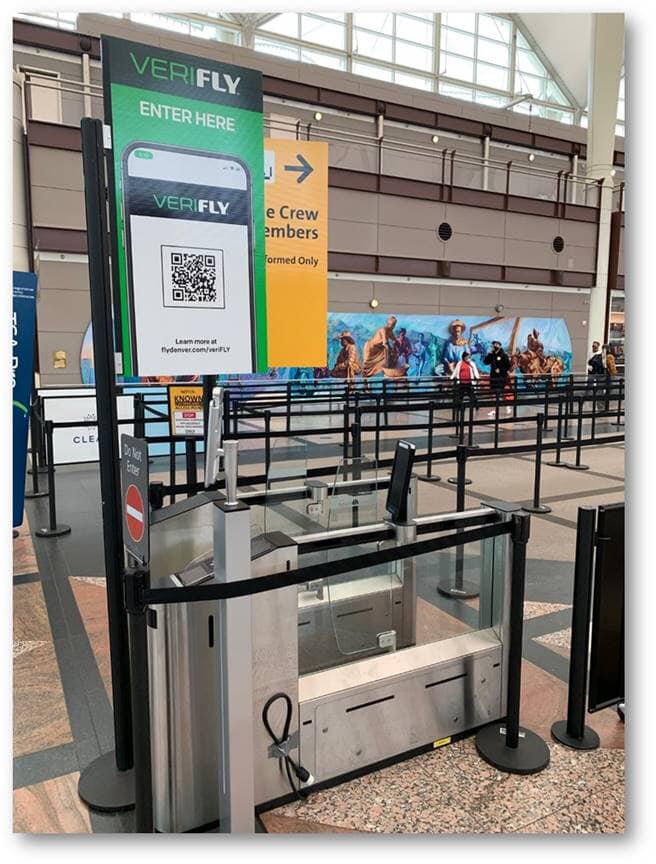
We’re giving the nod to Denver International Airport (DEN), which is the first airport in the U.S. to begin using the VeriFLY app to let passengers reserve a checkpoint time and then travel to the gates in a reserved train car.

Here’s how it works:

Travelers download the VeriFLY app (only available for iPhone for now), create an account, and then reserve a time to through the checkpoint on their travel date. There’s a 15-minute show-up window and there are a limited number of reservations per hour.

Passengers must fill out a health survey within 24 hours of their flight. Then, on the day of their flight, they go to the designated VeriFLY lane at the south screening checkpoint at their reserved time.

A touch-less, electronic gate will scan the access code on the app. And temperatures will be taken before passengers move to either a standard or Precheck TSA screening lane.

Once through security, passengers using the VeriFLY system will travel to their respective concourses in a reserved train car. For social distancing, only 12 VeriFLY travelers will be allowed in the train car at a time.

Face masks/covering are, of course, required for all travelers.

We hope – and expect – more airports will begin using this system.

Travelers tip TSA a whopping $926,000

Rushed, distracted travelers unwittingly gave the Transportation Security Administration a cash tip of more than $926,000 last year.

TSA gets to keep the cash and currency travelers forget to pick up when they empty their pockets into the bins at the airport security checkpoints.

And that cash adds up.

During Fiscal Year 2019, which ended in September 30, 2019, TSA collected $926,030.44 in unclaimed money. That included $18,899.09 in foreign currency.

The amount of unclaimed money TSA collects has been increasing each year. But for the first time, the total collected actually decreased year over year. In FY 2018, travelers left behind $960,105.49.

For 2019, here the Top 5 airports where travelers left behind the most cash:

  1. John F. Kennedy International Airport – $98,110
  2. San Francisco International Airport – $52,668.70
  3. Miami International Airport – $47,694.03
  4. McCarran International Airport – $44,401.76
  5. Dallas/Fort Worth International Airport – $40,218.19

And here are the totals from previous years:

FY 2013 – $638,142.64

FY 2014 – $674,841.06

FY 2015 – $765,759.15

FY 2016 – $867,812.39

FY 2017 – $866,839.56

FY 2018 – $960,105.49

Hold onto your cash

Don’t want to unwittingly leave a tip for TSA at the checkpoint?

Take a moment to organize your stuff before you get to the airport and again before you get on the TSA checkpoint line.

Instead of emptying your pockets into the bin, put loose change, bills and anything in your pocket into a small bag or pouch that you put inside your carry-on bag or purse.

Vote for TSA’s Cutest Canine

Here’s something cute and furry for a Friday.

National Dog Day is coming up on August 26. And in preparation for that holiday, the Transportation Security Administration (TSA) is having a contest to pick the cutest canine from its roster of more than 1000 dogs trained to sniff out explosives.

Four furry finalists were in the running, chosen from those nominated by their handlers.

To narrow it down to a winner, the first match-up took place on Wednesday, August 19 between two of the finalists.

And it looks like Kajila from Honolulu’s Daniel Inouye International Airport (HNL) won that round.

On Thursday, August 20, the public was asked to pick their favorite between pup Lexa-Alexey from Dallas Fort Worth International Airport (DFW) and Ron, who works at Oakland International Airport (OAK).

Voting in this second round ends early Friday morning.

On Friday, August 21, the winners of the first two rounds will go head to head, with the overall winner to be announced on August 26, National Dog Day.

You can vote on TSA’s InstagramTwitter and Facebook.

TSA’s explosives detection canines have serious job descriptions.

They’re tasked with screening passengers, cargo, mass-transit, and maritime systems, and they support other security missions. Each dog is specially trained and paired with a TSA handler.

If you see these dogs at the airport, you may want to pet them.

Don’t do that.

TSA says that “While TSA canines are sociable, they are working dogs and they should not be petted or fed by anyone except their handlers.”

Airport songs for safety

Like other airports around the country, Mineta San Jose International Airport (SJC) is keeping the facilities clean.

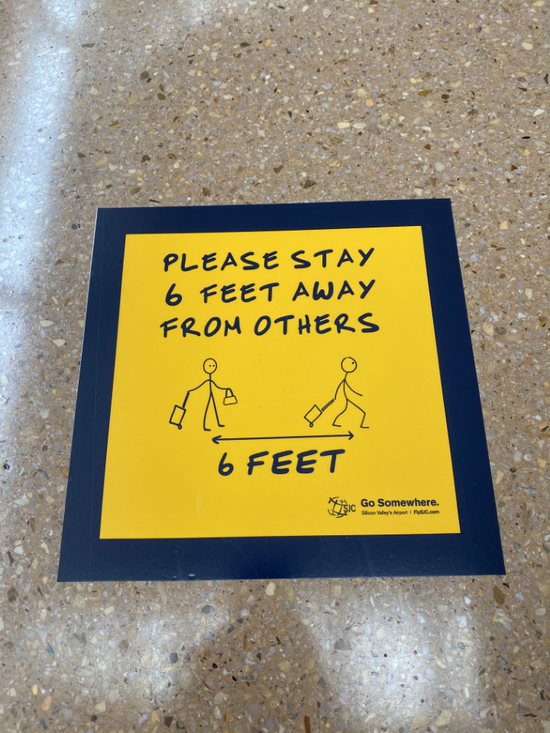
The airport is also using signs and floor stickers to encourage passengers to remember to keep their distance and wear face coverings.

Now, SJC is also getting even more creative with getting those messages out.

The airport has enlisted Santa Cruz-based singer/songwriter artist Nick Gallant to write and record three original songs to remind passengers and employees what they can and should do to keep things safe.

The ditties are catchy.

And you’ll have plenty of time to learn them by heart. Each song is being played throughout the Airport’s terminal buildings once an hour on a 20-minute cycle.

Give a listen:

FlySJC · SJC Go Somewhere Safely

Why play safety songs in an airport?

“By now our travelers and employees know what they need to do to keep each other safe while traveling,” said SJC Assistant Director of Aviation Judy Ross, “So the challenge for us was to find a unique, engaging way to remind everyone to stay vigilant.”

Mineta San Jose International Airport (SJC) isn’t the first to have safety songs to remind passengers to pay attention to the rules.

Way back in 2011, Montana’s Glacier Park International Airport (FCA) was running a video of a local band named The Singing Sons of Beaches to remind passengers of the rules and routines required at the TSA checkpoint.

The “bonus reminders” aren’t always songs.

Over the years McCarran International Airport Airport (LAS) in Las Vegas has enlisted celebrities to create instructional reminder videos as well.

https://youtu.be/syA2jqxxGRM
https://youtu.be/rMRm57QONFE
https://youtu.be/7p7LKLFMg14
https://youtu.be/hFhUHO41ya0

Airports upping their safety act with helmets and more

What are airports up to now?

If you’re heading to an airport now or sometime in the future, the new normal is going to be, well, different.

Masks for everyone, please.

As more and more airlines now require each employee and passenger to cover their mouth and nose with a mask or cloth, airports from Seattle to Singapore are adding that requirement to anyone entering the terminals.

https://twitter.com/ChangiAirport/status/1259382157039960064?s=20

Temperature checks may become the new normal.

Airports in Asia have been scanning travelers’ temperatures for quite some time.

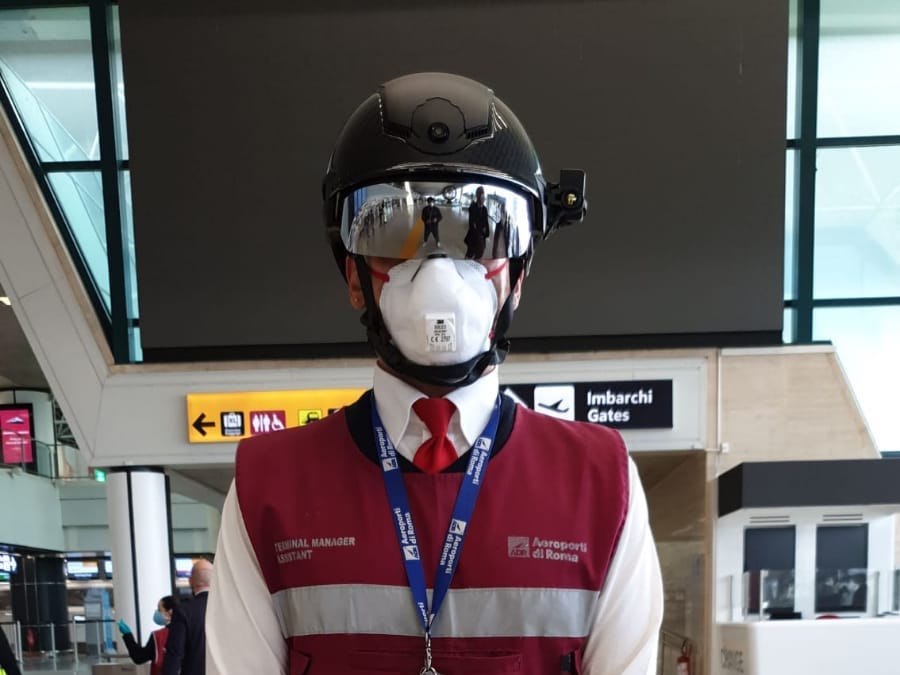
Now Fiumicino Airport in Rome is using ‘smart helmets’ to check the temperature of passengers.

The device is worn by airport workers and allows them to check and measure the body temperature of passengers at a distance.

Frontier Airlines, which stepped back from charging an extra fee to keep middle seats free, will begin pre-boarding temperature screenings for passengers on June 1.

Customers will be screened via touchless thermometers prior to boarding.

If the temperature reading is 100.4 degrees or higher, they will be given time to rest and, if the flight departure time allows, get another temperature check.

“If the second check is 100.4 degrees or higher, a Frontier gate agent will explain to the customer that they will not be flying that day for the health and safety of others,” the airline said in its statement. Any passenger with a 100.4 degrees or higher fever will be offered the option to rebook travel on a later date or make other arrangements.

And don’t be surprised if in the not-too-distant future TSA officers scan you for a fever at the same time they’re looking through your stuff.

What do you think of these moves? Will it make you feel safer when you fly?

TSA officers buy meals, stock pantries for airport co-workers affected by COVID-19

Courtesy TSA

(Our story about TSA workers helping airport workers during the pandemic first appeared on CNBC in a slightly different version.)

The steep decline in air travel due to the COVID-19 pandemic has triggered layoffs, furloughs and shortened work hours for many airport employees, including wheelchair attendants, baggage handlers, janitorial crews and concessions staff.

But in a growing number of cities their co-workers from the Transportation Security Administration, who continue to receive paychecks, are stepping up to help. They’re hosting temporary food pantries in airports around the nation and providing free lunches and dinners to their struggling colleagues. They’re also donating their time to make masks and other essential items for communities in need.

Unite Here, a union representing hospitality workers, estimates that 42,000 of its members in the airport industry are currently out of work. Most of those lost jobs are in airport concessions and airline catering, where wages range from $9 to $16 an hour.

That’s just Unite Here members. The Airport Restaurant and Retail Association (ARRA) estimates 120,000 to 125,000 airport employees are currently out of work. 

Some of those workers may eventually get called back. But for now, their incomes are disrupted, and many could use some help.

Food pantries to the rescue

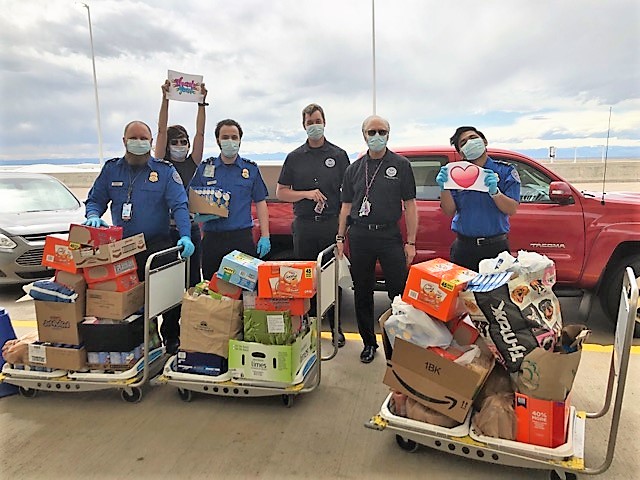
As a thank-you for the support they received while working without paychecks during the 2018/2019 partial government shutdown, TSA officers at Denver International Airport on April 30 hosted a food pantry in support of airport and air carrier colleagues working with reduced hours or partial paychecks.

“Our team rallied to collect thousands of non-perishable items for the pantry,” said Larry Nau, TSA Federal Security Director for Colorado, “133 airport employees shopped the pantry and took home items for a total of 538 family members fed.”

On April 24, Transportation Security Administration employees at Ronald Reagan Washington National Airport (DCA) opened a free food and toiletries pantry to assist airport employees laid off or working with reduced hours or paychecks.

TSA officers are donating cash, products and gift cards to keep the pantry stocked with items such as cereal, evaporated milk, soup, pasta, toothpaste, soap, laundry detergent, feminine products, diapers and deodorant.

And in early April, TSA employees at Dulles International Airport (IAD) opened a free pantry for affected airport community members that is stocked with everything from donated dried and canned goods and toiletries to toys for employees who have kids at home.

Elsewhere, TSA officers have also set up a food pantry at Cincinnati/Northern Kentucky International Airport (CVG).

Feeding colleagues in need

Twice in early April, TSA officers at Rhode Island’s T.F. Green Airport (PVD) chipped in to buy and deliver pizza dinners for fellow airport workers, including airline employees, wheelchair attendants and housekeeping staff.

“Providence is a small airport and the employees who work here are like family,” Christopher Primiano, TSA stakeholder liaison at PVD Airport, told CNBC, “We know this could go on for some time so we’re looking into what else we can do, from donations and food drives to bake sales. We want to help and give back as much as we can.”

On April 10, TSA employees at PDX bought pre-made lunches for around 300 airport employees. They did it again on April 21, partnering with local employees from Customs and Border Protection (CBP) and the Federal Aviation Administration (FAA) to donate lunch and supplies to an equal number of airport workers.  

As part of its “TSA Gives Back” program, early last month TSA officers at Green Bay-Austin Straubel International Airport (GRB) in Wisconsin chipped in to buy and deliver pizza, dessert and balloons to airline and car rental employees at the airport who are experiencing shrinking paychecks.

And, at McGhee Tyson Airport (TYS) in Knoxville, Tennessee, TSOs are collecting donations and arranged for Second Harvest, the community food bank, to supply food boxes to about 300 airport employees.  

TSA officers offer other assistance

TSA employees are screening record low numbers of passengers and crew members at airports around the country, so at Newark Liberty International Airport (EWR) TSA officers are finding a creative and helpful way to use their break time and downtime between screening duties.  

Following instructions from an online video, TSA officers at EWR made 200 face masks out of 100 pairs of brand-new socks purchased with funds donated by TSA employees. Each sock-mask was placed in a separate plastic zippered bag along with an instruction card and all 200 masks were delivered to two area homeless shelters.

TSOs at Newark Liberty Airport have also used their downtime at the checkpoints to make home-made get-well cards and write notes of support for health care workers and COVID-19 patients in isolation at a nearby medical center.

Payback: TSA workers set up food banks, by meals for airport employees

Updating this story as new examples arrive.

During the partial shutdown of the federal government in 2019, many TSA employees continued to show up for work despite missing paychecks.

To help them out, airport employees, airlines and airport concessionaires around the country joined with social service agencies and the local community to stock pantries with food and goods.

Now at some airports, TSA workers are returning the favor by setting up food pantries and special meals for airport employees who have had hours cut or who have been put out of work because there are so few passengers in airports.

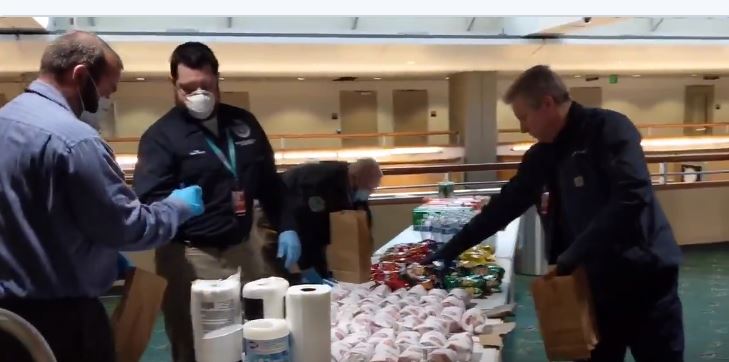
Here’s what’s happening at Portland International Airport (PDX).

TSA employees at Dulles International Airport (IAD) have set up a food pantry for airport workers.

And at T.F. Green International Airport (PVD) in Rhode Island, TSA officers chipped in and bought pizza dinners – twice so far – for their fellow airport workers, including wheelchair attendants and airline employees.

Courtesy TSA

We’ll update this list of good-deeds as we hear of my examples.

How sad it is out there in the world of travel?

You know that the current health crisis has caused people to cancel trips and airlines to temporarily slash flight schedules to the bone.

Here are few other measurements that underscore how bad it is right now.

TSA screening numbers hit record low

On Tuesday, April 7, the Transportation Security Administration screened just 97,310 passengers and flight crew members at all airports across the country.

That’s a record low for TSA and down 95% from the 2,091,056 passengers screened at airports a year ago on the same weekday.

TSA screening officers also continue to test positive for COVID-19.

On Wednesday, April 8, TSA reported that in the previous 14 days, 43 screening officers and 7 non-screening officers who’d had limited interaction with travelers tested positive for COVID-19.

TSA is updating that list daily. The agency is also posting the airport, last day worked, checkpoint location and shift times for each TSA officer who tests positive. So you can check to see if you may have been exposed.

Hotel occupancy rates way down

Hotels around the country are experiencing shocking year-over-year declines, according to data from STR.

Comparing the week of March 29 through April 4, 2020 with the same time period last year:

Occupancy across the country is down 68.5%, to 21.6% and average daily rates (ADR) are down 41.5% to $76.51.

When you look at the Top 25, the numbers are worse:

The Top 25 markets were down over 74 %, to 19.4%, with the Oahu, Minneapolis-St. Paul, New York and Seattle markets getting hammered the worst.

In some cities, hotels are renting rooms to local governments to house health care workers, first responders, military personnel, people who have been ordered to quarantine, infected patients and homeless people at risk from the virus.

Travel Tidbits from an airport near you

SFO Airport consolidates international flights to a single concourse

So many international flights have been temporarily canceled that some airports are closing down parts of concourses and terminals.

Courtesy SFO Airport

One example: San Francisco International Airport (SFO).

Because the schedule for international flights from SFO will be reduced by 52% by April 1, the airport will temporarily close one part of the International Terminal.

On April 1, and through at least through the end of May, SFO will close Boarding Area A (Gates A1 to A15) in the International Terminal and consolidate all international flight departures to Boarding Area G, which houses Gates G1-G14.

The SFO Medical Clinic (in the Int’l Terminal Main Hall, by the A Gates); the Grand Hyatt at SFO and the Int’l Parking Garage A will still be open, but this will allow SFO to close a security checkpoint and consolidate Custom & Border Protection staff.

Consolidation is going on at other airports as well. So if you are traveling, be sure to check the airport and airline websites.

TSA’s COVID-19 Count Keeps Increasing

Over the weekend, TSA updated its map and its list showing which states and which airports have TSA screening officers who have tested positive for COVID-19.

On Saturday, March 28, TSA reported that over the past two weeks 55 TSA screening officers have tested positive for COVID-19.

TSA says 19 others who had “relatively limited interaction with the traveling public” tested positive as well.

We hope those officers recover quickly, of course. But if you’ve traveled through an airport in one of the blue states on the map during the past few weeks, be sure to check this list to see which airports are affected.

The list includes the last date the officers worked, the checkpoints they were stationed at and their shift hours.

If you think you may have passed through the checkpoints where these officers were stationed, please be sure to check with your doctor about what steps to take next.

TSA maps its COVID-19 cases

Airports are getting quieter and quieter, but some people are still flying.

So Transportation Security Administration officers are among the workers who must still show up for work.

Unfortunately, it turns out TSA workers aren’t immune to COVID-19 and there are have been some TSA officers who have tested positive for the virus. So it’s possible some passengers may have been exposed to the virus by these officers at some airports.

But which airports?

TSA has put together a map and is keeping a list.

Here’s what it looked like on March 23, 2020.

As of March 23, TSA said 25 screening officers had tested positive for COVID-19. An additional five non-screening employees who TSA says “have relatively limited interaction with the traveling public,” have tested positive for the virus as well.

Here’s the list of where TSA officers tested positive for the virus:

  • Newark-Liberty International Airport (EWR)
  • John F. Kennedy International Airport (JFK)
  • Hartsfield-Jackson Atlanta International Airport (ATL)
  • Orlando International Airport (MCO)
  • LaGuardia Airport (LGA)
  • Cleveland Hopkins International Airport (CVG)
  • Cyril E. King International Airport (STT; St. Thomas, VI)
  • Washington Dulles International Airport (IAD)
  • Norman Mineta San Jose International Airport (SJC)
  • Fort Lauderdale – Hollywood Int’l Airport (FLL)
  • Louis Armstrong New Orleans International Airport (MSY)

TSA says it continues to work with the CDC and state and local health departments to monitor local situations.

In the meantime, passengers will find that at some airports TSA has closed some checkpoints and is staffing others with reduced hours.