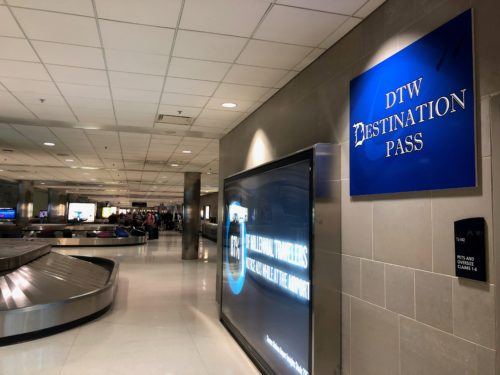
The pilot DTW Destination Pass program
at Detroit Metropolitan Wayne County Airport (DTW) which allows non-ticketed
passengers past the security checkpoint began in October and was supposed to
end this week.
But so many non-ticketed visitors are
interested in visiting DTW airport to shop, dine, check out airplanes and spend
more time with friends and family starting or ending their travels that airport
officials have decided to keep the program going indefinitely.
“We understand that our facility is more than
just an airport—it is a place where memories are made,” said WCAA CEO Chad
Newton, “One participant of the program shared with us that she was able to
bring her 3-year-old nephew to the airport to greet his parents and see
airplanes for the first time.”
The DTW Destination Pass program is limited to 75 visitor passes per day. Passes can be used from 8 a.m. to 8 p.m. Tuesday through Sunday. Check the DTW website for details about applying for a pass.
Where else can you get an airport gate pass?
DTW is just the latest airport to welcome non-ticketed passengers past the security checkpoint.
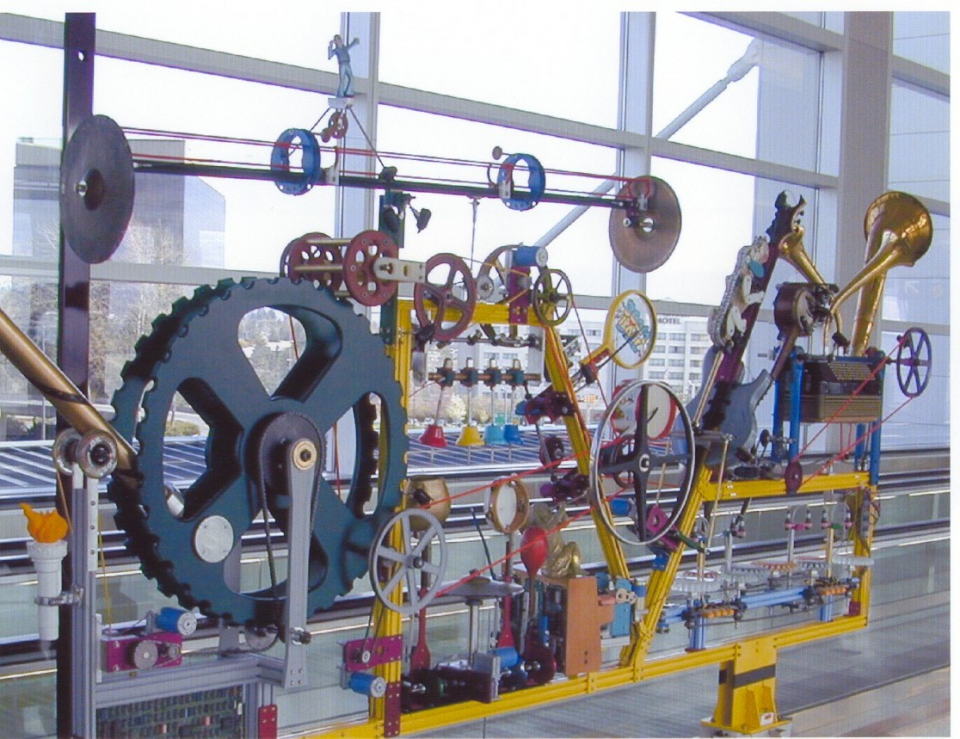
Art at SEA airport
In December, Seattle-Tacoma International
Airport (SEA) brought back and made permanent the SEA Visitor Pass program, which
gives non-ticketed guests access to the secure side of the airport.
Pittsburgh International Airport (PIT) started
the trend by introducing the myPITPass program in
August 2017. That program operates Monday to Friday from 9 a.m. to 5 p.m.
Tampa International Airport (TPA) began
offering its All Access pass in April, 2019, welcoming guests on
Saturdays.
Photo La Gourmetreise, Courtesy New Orleans & Company
And Louis Armstrong New Orleans International Airport (MSY) began welcoming non-ticketed guests into the new terminal on December 4.
The MSY Guest Pass is offered seven days a week, with a limit of 50 visitors Monday through Friday and 100 visitors on Saturdays and Sundays.
Gate pass program at Louis Armstrong New Orleans International
Airport
As promised,
the Louis Armstrong New Orleans
International Airport (MSY) is joining the list of airports that invite and
allow non-ticketed guests airside, past security to shop, dine, listen to live
music and spend more time with friends and family leaving for trips or coming
home.
The free MSY Guest Pass program kicks off December
4 and will be available seven days a week from 11 a.m. to 8 p.m. MSY officials say the airport will issue no more
than 50 passes on weekdays and no more than 100 passes each Saturday and Sunday.
Anyone seeking
an MSY Guest Pass will need to sign up 24 hours in advance and provide their
full name, date of birth and contact information. Visitors under 18 will need
to be accompanied by an adult.
Pass holders must
still pass through the security checkpoint and all pass holders will be limited
to one visit per month.
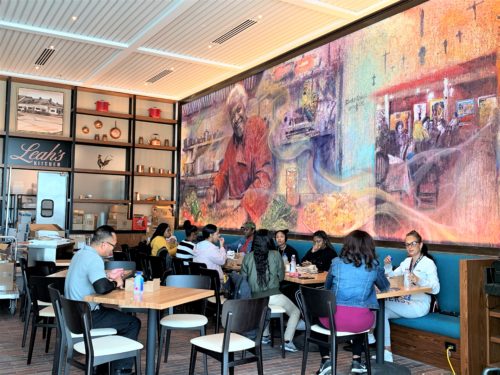
Leah’s Kitchen at MSY
MSY is justifiably proud of its shiny new terminal, which has branches of local shops such as Dirty Coast and Fleurty Girl and restaurants from award-winning chefs, including Emeril Lagasse, John Folse, Michael Gullotta, Susan Spicer, and the late Leah Chase and her family.
We expect more airports to join this trend, but for now just a few other airports offer gate passes to non-ticketed guests: Pittsburgh International Airport (PIT) has the MyPITpass program and Tampa International Airport (TPA) offers an All Access gate pass program.
Good news for passengers during this busy travel season.
As the busy holiday travel season kicks into gear, we’ve gathered up some airport news that may make your journey as wee bit smoother.
Concert at Sea-Tac Airport
At noon on Friday, November 22, Washington State native soul and R&B singer Allen Stone, will perform a live show in Central Terminal featuring songs from his new album, Building Balance.
The performance will be live-streamed Sea-Tac Airport’s Facebook and will celebrate the expansion of the already robust live music program at Seattle-Tacoma International Airport.
Located on the outdoor DEN plaza, between the main terminal and the Westin Hotel, the rink will be open from 9 a.m. to 9 p.m. daily through January 20.
There’s no fee to skate. And there are free skate rentals as
the on-side “Skate Shop” Airstream trailer near the ice rink.
The ice rink will feature music daily and host special
activities and performances on the ice throughout the skating season including
Colorado Avalanche Ice Patrol, Denver Figure Skating Club, E-Gals Ice Crew,
curling lessons, little tykes’ hockey and more.
Holiday Open House at Pittsburgh Airport
Pittsburgh International Airport will its annual open house this year on Saturday, December 7 from 10 a.m. to 5 p.m.
Open to all who register, the in-terminal event features shopping and dining specials, live music, kids’ entertainment and visits with Santa. Registration closes December 4.
Here’s a rundown of the entertainment:
Juggler: 10 a.m. – 2 p.m.
Balloon Artist: 10 a.m. – 4 p.m.
Touch-A-Truck: 10 a.m. – 4 p.m.
Face Painting: 10 a.m. – 5 p.m.
Children’s Museum Activity: 11 a.m. – 2 p.m.
Lovebettie: 11 a.m. – 4 p.m.
Photos with Santa: 12 p.m. – 4 p.m.
Caricature Artist: 2 p.m. – 5 p.m.
Airbrush Tattoo Artist: 3 p.m. – 5 p.m.
The Pittsburgh Pirates Pierogies: 3:30 p.m. – 4:30 p.m.
SFO Airport pilots premium Uber pick-up
To reduce congestion at curbsides, in June
2019 San Francisco International Airport
(SFO) moved domestic terminal pickups for ride-hailing services Uber, Lyft and
Wingz away from the terminal curbside to the 5th floor of the Domestic Hourly
Parking Garage, with pickups in the International Terminal at the center island
of the Departures level roadway.
Now, just in time for the holiday travel season, SFO has kicked off a two-month pilot program with Uber to offer a premium curbside pickup option for travelers.
Passengers who choose a premium Uber product, including Uber
Comfort, Uber Select, and Uber XL, Uber Black and Uber Black SUV will be picked
up curbside at designated locations in each Domestic Terminal: Terminal 1 at
Door 9; Terminal 2 at Doors 5 and 6; Terminal 3 at Doors 12 and 13.
Pickups
at the International Terminal will continue in the current location, which is at
the center island of the Departure level roadway.
Passengers
choosing (basic) UberX and Uber Pool in the Domestic Terminals must still go to
the domestic hourly parking garage for pickup.
Should airports go off the grid? Pittsburgh Int’l Airport – and others – think so.
Aerial view of Pittsburgh International Airport. Courtesy PIT Airport
Remember that 11-hour power outage at Hartsfield-Jackson Atlanta International Airport in December 2017?
The blackout canceled hundreds of flights, stranded thousands of passengers and cost Delta Airlines alone an estimated $50 million in lost business?
Since then power outages linked to everything from equipment failures, faulty wires and an explosion at an electric power station have disrupted operations at numerous airports.
The list includes Washington’s Reagan National Airport, Los Angeles International Airport, New York’s LaGuardia Airport, John Wayne Airport in Orange County, CA, Philadelphia International Airport and McCarran International Airport in Las Vegas.
And just last Saturday, power at the New Orleans International Airport went out – twice – due to high winds associated with Tropical Storm Olga.
In addition to flight cancelations and delays, a celebratory open house for the new $1 billion terminal opening November 6 had to be postponed by a few hours.
Microgrids to the rescue?
During power outages at airports, generators and other forms of back-up power usually kick-in to power essential emergency lighting. But boarding, deplaning, airfield activity and the business of the airport often come to a standstill.
That’s just one reason Pittsburgh International Airport (PIT) recently declared its intention to become the first major U.S. airport to create a self-sufficient energy system – or microgrid – using only energy sources (solar and natural gas) from its own property.
“After watching what happened in Atlanta and Los Angeles, I think every airport CEO across the country, and probably around the world, wondered if they were ready and prepared,” said PIT Airport CEO Christina Cassotis.
“Here the answer is yes, but we’d like to make sure we can continue to operate in any circumstance,” she said,
To that end, Pittsburgh International Airport plans to have its microgrid in place by 2021 to power the entire airport, including the airfield, the on-site Hyatt hotel, and a Sunoco station.
Power for PIT’s microgrid will be generated through the airport’s onsite natural gas wells and almost 8000 solar panels covering eight acres of the airport land. A connection to the traditional electrical grid will remain, but only as an option for emergency or backup power when needed.
“It has everything to do with resiliency and redundancy,” said Cassotis, “We wanted to make sure we could do everything with the assets we have to enhance the safety of the traveling public and ensure continued operations. As a bonus, we get to lower the cost of energy.”
Many military facilities, college campuses, hospital complexes, industrial parks, and other large institutions already have some sort of microgrid in place to ensure uninterrupted power.
In general, these systems are connected to existing grids but can disconnect and operate on their own with power from batteries, diesel-powered generators or, ideally, solar or another source of renewable power, said Craig Schiller, a Manager specializing in aviation at the global energy non-profit Rocky Mountain Institute (RMI).
Detroit Metro Airport (DTW) already has a microgrid in place. Airports in Los Angeles, Denver, San Diego, Boston, Orange County, CA and elsewhere are now exploring and creating microgrids as well.
To help move the process along, early next year RMI will publish an airport microgrid toolkit funded by a $450,000 grant from the National Academies of Sciences, Engineering and Medicine’s Transportation Research Board.
Microgrids can give airports greater control over the energy they need and use and, in many cases, save airports money on energy costs, said RMI’s Schiller, “But the bottom line is maximizing an airport’s ability to meet its function.”
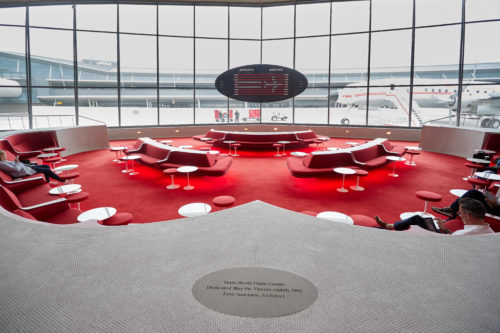
TWA Hotel is a microgrid island
Most microgrids are designed to connect to existing power grids.
But the 512-room TWA Hotel and conference center opened in May 2019 in the landmark Eero Saarinen-designed TWA Flight Center at JFK Airport’s Terminal 5 is an “islanded microgrid” operating independently of New York City’s electric grid.
The hotel has its own 9,000-square-foot microgrid/cogeneration power plant on the roof, fueled by natural gas.
The plant generates all the electricity for the hotel campus and harvests waste heat from engines for hot water and other uses. A battery storage system helps with peak loads and backup.
“Think of it as a Tesla on the hotel’s roof,” said Tyler Morse, chief executive of MCR/Morse Development.
“The entire city and the airport could be down, but the hotel would still be operating, with people having cocktails at the bar,” said Mike Byrnes, Senior Vice President for Veolia North America, which has operators on duty 24/7 to operate and maintain the hotel’s microgrid.
Beyond ensuring that cocktails can continue to be served during a blackout, the TWA Hotel’s power plant will also contribute to the business’s bottom line.
Hotel developer Morse said the Con Edison electric bills would have cost $5 million per year. “The $15 million we spent to build the plant will be paid back in three years,” said Morse, “And we’ll be saving $4 million annually.”
Which should be enough to buy everyone a round of drinks, or three, in the lobby bars in the next New York City blackout.
(My story about Airport Microgrids first appeared on CNBC in a slightly different version.)
Detroit Metro Airport now allows non-ticketed passengers to spend time on the post-security side of both the McNamara and North terminals.
The “DTW Destination Pass” program allows non-flying ing guests to come to the airport to shop, eat, check out the art, planes pot, people watch, escort a friend or family to their gate or be there when a loved deplanes.
“The new regulations allow us to expand our
gate pass program that already exists for our Westin hotel guests,” said Wayne
County Airport Authority CEO Chad Newton in a statement, “Now we can welcome
more community members into our home to create memorable moments—from watching
planes to greeting family and friends.”
DTW’s Destination Pass program isn’t permanent
(yet) but is being piloted through the holidays with an end date of January 5,
2020.
Here’s how it works:
From Tuesday through Sunday, up to 75 non-ticketed passengers will be able to enter the secure side of both DTW terminals from 8 a.m. to 8 p.m.
Visitors will need to apply for a pass through the DTW
website the day before their planned visit. Applicants will get an email
notification letting them know if the application has been approved. If
approved, detailed instructions will be sent electronically.
Pass holders will need to go through the same security screening as all other passengers going through the security checkpoints. During peak checkpoint times, passengers heading to flights will get priority over pass holders at the checkpoints.
After their visit, pass holders will be asked
to fill out a survey.
When the pilot program is done, “Wayne County Airport
Authority will be evaluating the use of the program, along with the airport’s
cost to provide this service. We will also be reviewing the completed
participant surveys,” said airport spokeswoman Lisa Gass.
Other airports invite non-ticketed visitors as well
While DTW’s Destination Pass is being piloted,
the gate-pass programs at Pittsburgh International Airport and Tampa
International Airport are permanent.
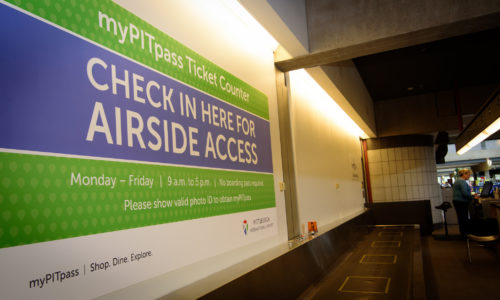
Pittsburgh International Airport kicked off the trend with the “myPIT Pass” program in August 2017. The program operates Monday to Friday from 9 a.m. to 5 p.m. Non-ticketed passengers may apply for a pass by showing a U.S. government-issued photo ID at a special counter in the terminal.
Tampa International Airport (TPA) introduced its TPA All Access Pass in April 2019. TPA’s pass allows non-ticketed guests who apply at least 24 hours in advance to visit one of four airside areas of the airport each Saturday from 8 a.m. to 8 p.m. There is a limit of 25 people per airside.
Seattle-Tacoma International Airport (SEA) tested a gate-pass program for a few weeks during the 2018 holiday season and had 1,1650 people take advantage of the program. The decision to bring back the program on a temporary or permanent basis is still under review.
According to Transportation Security Administration spokesperson Lorie Dankers, before any airport can offer a gate-pass program to non-ticketed fliers, the airport must submit a formal proposal to the TSA to amend the local airport security plan. If TSA approves the plan, an airport is permitted to invite non-ticketed passengers past security.
So perhaps we’re seeing the beginning of a trend.
(My story about airport gate passes first appeared on USA TODAY in a slightly differing form.)
Oktoberfest kicks off at Pittsburgh International Airport this Friday with live oompah tunes, classic German brews and dishes, complimentary pretzel bites and more.
Starting at 4 p.m. on Friday Grammy-nominated accordionist Kevin Solecki will be playing oompah tunes in the Center Core.
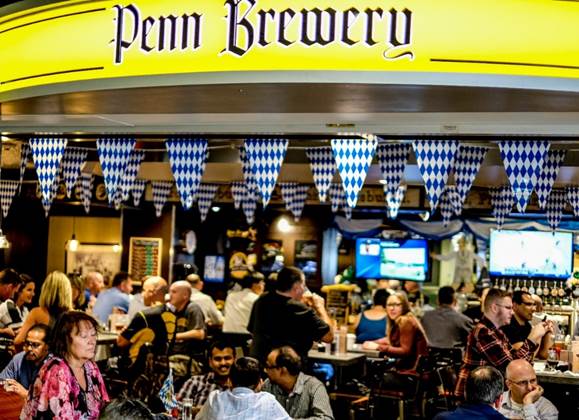
And throughout the month, the classic German brews at the airport’s Penn Brewery will include Great American Beer Festival medalists, Penn Oktoberfest and Penn Gold. On the menu will be classic dishes like Bavarian Pretzels with German Obatzda dip, Wurst Baguette on a Pretzel Roll and the German Reuben Sandwich.
More Oktoberfest parties are planned at PIT during the weekends of Sept. 20-22 and 27-29.
Amtrak’s BOGO sale
Amtrak has extended its Buy One Get One (BOGO) Saturday companion fare sale for destinations in the Northeast.
The sale applies to tickets booked on Saturday trips on either the Acela service in business class or Northeast Regional service in coach. (Three day advance purchase required).
These trains have stops in cities such as New York, Philadelphia, Providence, Rhode Island and Richmond, Virginia. Use the discount code “C222.”
Rather drive?
The premium rental car brand Silvercar by Audi has partnered up with activewear brand Outdoor Voicesin Austin to offer renters a cool deal.
Now through October, all Silvercar by Audi rentals at the Austin location come with Outdoor Voices apparel, a “Doing Things” local guide and a discount good for $100 off a purchase of $250 or more at Outdoor Voices.
City or celebrity? Branding goals fuel airport name changes
Louisville, Kentucky is well known for bourbon,
the Kentucky Derby and Louisville Slugger baseball bats.
It’s also the city the late, legendary boxer
Muhammad Ali called home.
In his honor, Louisville International
Airport (SDF) was recently renamed Louisville Muhammad Ali International
Airport and a new logo honoring The Champ and his famous praise, “Float like a butterfly, sting like a
bee,” was
adopted.
In addition to honoring a native son, the
airport name change is expected bring economic benefits to Louisville and both
built on and boost Ali-related tourism to the city.
“Even three years after our city’s most famous son’s
passing, Louisville continues to see people coming from across the globe to
discover and trace Ali’s legacy,” Karen Williams, President and CEO of
Louisville Tourism said in
a statement, “The airport rebranding supports current marketing efforts to
engage in Ali’s ‘Footsteps of
Greatness’ as a reason to inspire visitation to Louisville.”
Location, Location, Location
While Louisville added the name of a local
icon to its airport’s name, other airports are moving away from celebrity names
in favor of stronger geographic branding.
In 2016, the Allegheny County Airport
Authority declined to change the name of Pittsburgh International
Airport to the Fred Rogers International Airport.
An online
petition seeking to honor the late star of the locally produced “Mister Rogers’
Neighborhood” PBS TV program was signed by more than 15,000 supporters. But
airport representatives said vacation planners were more likely to search
online for “Pittsburgh Airport” than for “Fred Rogers.”
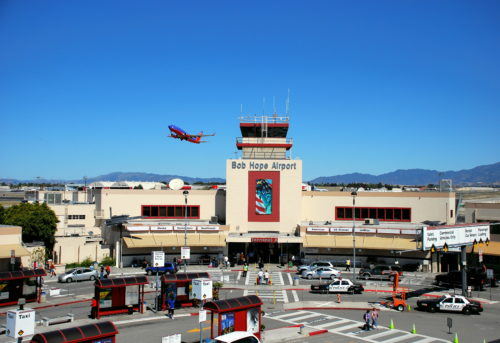
In southern California, regional Bob Hope Airport (BUR) is now Hollywood Burbank Airport.
The switch came in 2017 after airport
officials realized that while the general public knew that the late Bob Hope was
a comedian, few outside the region knew the airport was so located so close to
Hollywood and many top Los Angeles-area attractions.
“Some thought the airport was in Palm Springs,” said
airport spokeswoman Lucy Burghdorf, “Others thought it was in Vietnam,” because
Hope had hosted annual USO Christmas tours to entertain troops during much of the
Vietnam War.
To help solve BUR’s identity problem, “We studied
what other airports had done and why,” said Michael Fiore, cofounder and
chief brand officer of the Anyone
Collective, “And
for the most part we found the same answers: those with a geographic
identifiers attached to them were performing better than others.”
The name-change, coupled with branding and
marketing efforts that include everything from new signage at the airport and
on highways to online advertising, has garnered the airport national awards
and, more importantly, more passengers, said Fiore.
Some other airports have gently tweaked their
names in the interest of better branding.
Lambert-St. Louis International Airport (STL) was renamed St. Louis Lambert International Airport in February 2017. The move was made “to
improve marketing positions locally and globally while also expanding
connections with the St. Louis region,” according to the airport’s strategic
plan.
“This decision was made to better identify our
geographical location to travelers who are not from this region,” said MKE spokesman
Harold Mester, “Our new brand adds the name of our anchor city while still
honoring our namesake, Brig. Gen. Billy Mitchell, who is considered to be the
father of the U.S. Air Force.”
“As we continue to market the airport in
international and west coast markets, we have found that these populations are
challenged to locate us,” said Kevin A. Dillon, Executive Director of the
Connecticut Airport Authority, “Accordingly, we are undergoing a review to be
completed by the end of the year to determine if it is feasible to change the
airport name, and, if so, how we can continue to preserve the memory of Eugene
Bradley at the airport.”
Bucking the Trend
While the benefits of geographic branding are
convincing some airports to change or tweak names, at least one airport is bucking
the trend.
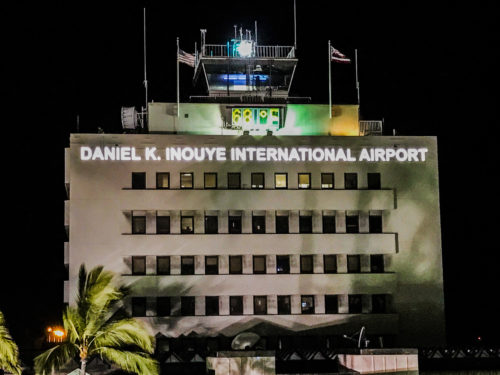
In 2017, the Hawaii Department of
Transportation (HDOT) changed the name of Honolulu International
Airport (HNL) to the Daniel K. Inouye International Airport.
The much-beloved Inouye served as Hawaii’s
first representative in Congress in 1959 and went on to represent the Aloha
State in both the House and Senate for a combined 53 years.
This is the
fourth name change in the airport’s history, notes HDOT.
When it
opened in 1927, HNL was named the John Rodgers Airport. After surviving the
attack on Pearl Harbor, in 1947 the airport was renamed Honolulu Airport. “International”
was added to the name in 1951.
It is too soon to tell if the name change will boost the local economy or increase tourism to Honolulu. But HDOT pegs the cost of new signage, parts, materials, labor and other tasks associated with this latest name change at one million dollars.
What do you think? Should an airport be named for a city or a celebrity?
The wheelchairs are designed to navigate the airport independently.
As they move, they detect and avoid people and obstacles. And that could make them a useful mobility solution for passengers heading to connecting flights a ong distances away; a common issue in many sprawling international airports.
For the test, the wheelchairs will follow a leader to a common destination, with a staff person on hand to serve as a guide.
Smart luggage
What about their luggage?
Perhaps the self-navigating wheelchairs might be paired with self-driving suitcases or the smart suitcase being developed by researchers at Carnegie Mellon University.
Their smart suitcase is designed with blind users in mind and both helps to clear the way and warn of impending collisions. The researchers are also working on a wayfinding smartphone app to help people with visual disabilities navigate airport terminals.
The rolling suitcase sounds alarms (beeps) when users are headed for a collision with a pedestrian. The navigation app provides users with turn-by-turn audio instructions on how to reach a departure gate, a restroom or a restaurant.
Both proved effective in a pair of user studies conducted recently at PIT airport.
The smart suitcase, called BBeep, has a camera for tracking pedestrians in the user’s path.
“A [standard] rolling suitcase can help clear the way and can serve as an extended sensing mechanism for identifying changes in floor texture,” say project researchers. With its camera and system of beeps, “BBeep can also sound an alarm when collisions are imminent — both warning the user and alerting people in the area, enabling them to make room. “
First up: a charming video to announce that the PIT Paws therapy dog team has joined others across the country hand out trading cards to fans.
Airport therapy dog trading cards? PIT recently hopped on the bandwagon, joining several other airports in releasing its own set of trading cards to feature the PIT PAWS therapy dog team. Read more about the latest aviation trend here: https://t.co/aF2HaOERK2#PITPAWSpic.twitter.com/UN11YdFq8k
— Pittsburgh International Airport (@PITairport) March 24, 2019
PIT Airport also shared a video about the more than 700,000 bees that reside on property:
PIT airport said goodbye – temporarily – to the statues of George Washington and former Pittsburgh Steeler Franco Harris.
— Pittsburgh International Airport (@PITairport) March 22, 2019
And the airport made room for a new – and somewhat large – piece of art.
It took a bit of extra effort to install the latest addition in the display case on Ticketing Level. See how the 24-foot-long oil painting made it from artist Mia Tarducci’s studio to PIT, and check out other new installations here: https://t.co/NxBiNIhn2Q#DestinationPITartpic.twitter.com/PR9VuRaFZw
— Pittsburgh International Airport (@PITairport) March 25, 2019
Pittsburgh International Airport is getting a $1.1 billion
makeover that includes a new terminal with 51-gates, a modern check-in
concourse and a new bag-claim system.
The pictures look so appealing that when the new terminal opens in 2023, they may have to seriously consider trading in the PIT airport code for something, well, prettier.
The new airport terminal will be built next to PIT’s current airside facility, between Concourses C and D, and is designed by award-winning architect Luis Vidal, who designed Heathrow Airport’s T2, and by San Francisco-based Gensler.
While some things may change as the project gets underway,
airport officials say the new terminal building will have an emphasis on sustainability,
with both indoor and outdoor green plazas and gathering spaces.
The new terminal brings together check-in, ticketing, security and baggage operations into one facility, with a separate level for departing and arriving passengers. There will also be an expanded TSA checkpoint, shorter walking distances and additional space for artwork, concessions and other amenities.
“This new terminal, inspired by the beauty, tech renaissance
and people of our region will integrate seamlessly into the great design of the
existing Airside Terminal,” said Airport Authority CEO Christina Cassotis. “In
considering this design, we looked at function first, then form, to construct a
building that will be both iconic, practical and affordable and that can be
easily adapted as the technology and transportation needs of our community
change.”
Let’s just hope PIT keeps the dinosaur, the Calder mobile, the shrine to Mister Rogers and the other amenities that make PIT a bit quirky and endearing.
(All photos courtesy of Pittsburgh International Airport)