Pittsburgh International Airport

Travel tidbits from airlines, airports & the U.S. governnment shutdown

U.S. government shutdown is affecting air travel. Already.

The U.S. government shutdown is beginning to take a toll on air travel.

TSA workers, air traffic controllers and others – already working longer hours due to staffing shortages – are now working without paychecks and the fallout is clear.

Earlier this week, Transportation Secretary Sean Duffy said there’s been a slight increase in the number of sick calls from TSA workers and air traffic controllers since the shutdown began.

And that may be the reason Hollywood Burbank Airport had no air traffic controllers scheduled to work Monday evening. And why several East Coast airports had issues with air traffic control staffing.

Take a look at the FAA’s National Airspace System Status chart. You’ll notice under that the cause for many of the delays is currently listed as “staffing.”

If the shutdown continues, this list will grow.

Help for airport workers on the job without pay

The 2019 government shutdown lasted 35 days, during which time employees of TSA, the FAA and Customs and Border Protection (among others) had to work without pay.

During that time, airports and airlines and community groups set up food pantries and free meals for those unpaid workers.

It’s happening again.

During the shutdown, the Allegheny County Authority (ACAA), the operator of Pittsburgh International Airport (PIT) is providing free meals to working U.S. Customs and Border Protection (CBP), Transportation Security Administration (TSA) and Federal Aviation Administration (FAA) employees.

The first meals were provided at both Pittsburgh International Airport (PIT) and Allegheny County Airport (AGC) on Friday, Oct. 3. The plan is to provide meals twice a week for the duration of the shutdown.

According to PIT officials, airport concessions partners are contributing by helping to prepare the meals at a discounted rate. Participants include Air Ventures, Beer Code, Bruegger’s Bagels, Chick-fil-A, Jimmy John’s, Local Craft, Shake Shack, and Wellington, with more to come.

Currently, the meals will be distributed across all shifts on Tuesdays and Thursdays at PIT and AGC.

And at Hartsfield-Jackson Atlanta International Airport (ATL), TSA workers are getting support.

If the shutdown continues, starting October 11, 2025, TSA workers will be offered several benefits, including complimentary parking during their shifts; two meal vouchers per shift (one voucher per shift for part-time workers); and discounts or special meals from ATL concessionaries.

Any other airports doing this? Let us know.

JetBlue’s new special celebrating Puerto Rico

One of JetBlue‘s Airbus A320s now bears a special livery, Isla del Bluencanto, designed by Puerto Rican artist Juan Gutiérrez Rovira, also known as The Stencil Network. 

The design was chosen by a public vote and celebrates Puerto Rico’s rich culture and spirit and showcases iconic symbols of Puerto Rican heritage.

Look for the jibaro figure on the tail; fruits and flora of the island, on the body of the aircraft; and the phrase “Somos Boruca” – We are Puerto Rico – on the plane’s underbelly,

Air New Zealand’s Prime Day deals

Amazon’s October Prime Days include some travel deals, including some great fares to New Zealand with Air New Zealand’s Prime Day fares.

From October 7 to 9, the airline is offering round-trip flights to Auckland for as low as $825 in the economy cabin. There are tempting fares in Premium Economy and Business Premier as well, and with departures from major U.S. cities, including Los Angeles, San Francisco, Houston, New York and more.

How to best test an airport terminal

You’d think that after hiring the best architects and builders and spending billions of dollars, a new airport terminal would be ready to spring into action when the work is done.

But before flights begin to come and go from a new terminal, airports usually run a dress rehearsal day with volunteers pretending to be passengers.

Here’s a slightly different version of a story we wrote for The Points Guy about why and how airports do these tests.

Why ask fake passengers to test airport terminals?

Pittsburgh International Airport (PIT) is putting the finishing touches on a new $1.7 billion terminal set to open in October. Architectural and engineering firms Gensler, HDR and Luis Vidal + Architects designed the terminal and all systems and areas have been completed and rigorously tested.

“But construction and operational readiness aren’t equal,” Daniel Bryan, the consultant leading PIT’s operational readiness and transition team, said. Before the official opening date can be set and announced, PIT is conducting two public trial days, or dress rehearsals, where volunteers act as passengers to help make sure everything — and everyone — is truly ready for the big day.

The first terminal-wide test took place Saturday, Sept. 20, and included about 1,000 of the 18,000 people who responded to the airport’s initial call-out for volunteers.

Pretend passengers traveling on a pretend peak travel day were asked to do all the things real passengers do when they travel from the curb to the gate — checking bags, skis and golf clubs, going through the security checkpoint and finding their gate.

“This will be the first time we’ll see the building come alive,” Bryan said, so the team planned to check the acoustics, the public address system levels, signage and more. The test day was also a day for airport staff to do a run-through for the first day.

San Diego International Airport’s new terminal

It was the same story at San Diego International Airport (SAN) on Sept. 14. Opening day for is Sept. 23 for the $3.8 billion Terminal 1 designed by Gensler in partnership with Turner-Flatiron.

All went well, with adjustments planned in response to feedback that the paging system was too loud in some areas and not loud enough in others, and that better signage was needed for the outdoor dining deck and the oversized baggage belt.

What did Kansas City International Airport learn from its test?

Kansas City International Airport (MCI) held a test day back in 2023 ahead of the opening of its new $1.5 billion terminal.

All systems worked well, said airport spokesman Justin Meyer, and in response to volunteer feedback, the airport ordered more hefty paper towels for the restrooms.

Then there was the problem of test day volunteers missing their fake flights because they were spending too much time checking out the terminal.

Welcoming back, Calder, to PIT Airport

[This is a slightly different version of a story we wrote for the Pittsburgh International Airport’s Blue Sky News]

Check out the Calder sculpture at PIT Airport

It is black and white, weighs 600 pounds and is 28 feet long and equally wide.

And it will be impossible to miss it at Pittsburgh International Airport’s new landside terminal.

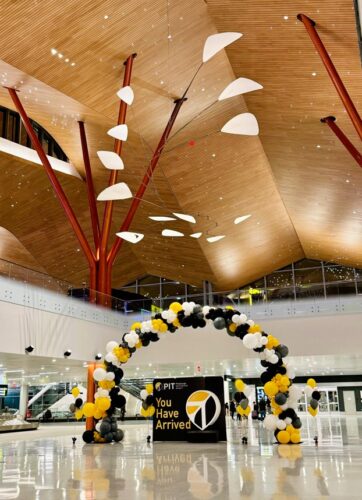
“Pittsburgh,” the kinetic mobile by famed artist Alexander Calder that has dangled from ceilings in the city’s airport terminals, on and off, for almost 70 years, has been reinstalled in the brand-new terminal’s atrium space to serve as both a gently waving welcome and farewell for all passengers and pre-security guests.

First installed in 1959 over the rotunda of the Greaterer Pittsburgh Airport terminal that opened in 1952, the mobile spent some time at the Carnegie Museum of Art before moving to the current PIT terminal in 1992.

As such, the sculpture has been part of the airport’s art program since before the airport even had much of an art program, said Keny Marshall, PIT’s Manager of Arts and Culture.

“People just expect to see the Calder at the airport,” said Marshall. And while the new landside terminal was not designed around the sculpture, its “place of prominence” was determined in collaboration with the architects – Gensler + HDR, in association with luis vidal + architects – to highlight the piece and to give the public a better view of it, he said.

PIT Calder Mobile

“Pittsburgh” is made of black steel rods and white aluminum paddles and is balanced so that elements move with just the slightest breeze to allow the activation of the mobile. The piece has been in storage for the past two years in preparation for its move to the new terminal.

In its previous location above PIT’s post-security Airside Center Core, the Calder mobile was in “an architecturally cluttered space” where few passengers stopped to take time to look at it, said Alex Taylor, an associate professor in the Department of History of Art and Architecture at the University of Pittsburgh who has studied Calder’s work extensively.

“When I’d go to the airport, I would stop with my carry-on to watch the work for as many minutes as I could spare before I had to get to the gate,” said Taylor, “But it always felt like I was the only one.”

Carol Brown would also make sure to visit the Calder during her trips through the modern-day terminal. The former county parks director was instrumental in getting the sculpture restored when it was hung incorrectly at the old terminal with its metal sections painted first yellow and green (Allegheny County’s colors) and then pink. Once it was restored, Brown advocated to have it put in the then-new 1992 terminal.

“I would always stop to say ‘Hi, Calder,’ when I went through the terminal. And I am looking forward to being able to say that again in the new terminal,” said Brown.

That will be easy to do. In the new landside terminal, the mobile will hang in the large open atrium space with an overlook offering multiple viewing angles, said Marshall.

Experts from Ohio-based McKay Lodge Art Conservation Laboratory, the company that took the Calder down from its previous spot and packed it for storage, will be on hand to unpack the sculpture and put it back up.

It will be an unusual challenge. A special lift is needed to attach the sculpture to the new terminal’s ceiling, which is almost 80 feet high.

And luckily, PIT airport owns a special piece of machinery – the Teupen Leo 26 aerial lift –  that can easily handle the task, said Renee Piechocki, a longtime public art consultant for PIT.

And because each piece of the sculpture is carefully cantilevered off the next, “as soon as you add a piece, everything changes. Only once the sculpture is fully assembled does it gracefully balance in the space,” said Marshall.

When the new terminal opens sometime this October, passengers and the public will be able to see the sculpture from eye level or above on the pre-security departure level of the new terminal.

On the arrivals level, one floor below, people will be able to look up at the sculpture and walk beneath it, explained Marshall.

What other airports have Calder sculptures?

(Courtesy Calder Foundation, New York / Artists Rights Society )

Other airports have, or once had, Calder mobiles.

Among them is the artist’s 45-foot-long mobile titled “.125” (above) that currently hangs in the Departure Hall of Terminal 4 at John F. Kennedy International Airport.

A Calder mobile named “Brass in the Sky,” once hung in Marshall Field & Co.’s Cloud Room Restaurant at Chicago’s Midway Airport.

And a 40-foot-wide Calder work titled ‘Red, Black and Blue” made its way from Dallas Love Field (DAL) to Dallas Fort Worth International Airport (DFW) and to Milwaukee Mitchell International Airport (MKE) before finally landing at the Milwaukee Art Museum.

Valued now at about $12 million, PIT’s Calder mobile may be the airport’s most valuable and well-known work in a growing art collection.

“But you don’t need an art degree to understand why it is the centerpiece of the new terminal,” said Piechocki.

Like the multi-tiered sculpture, Piechocki imagines there will be multiple layers of responses to the mobile in its new space.

For those already familiar with the sculpture from the existing terminal, she hopes the reaction is “Wow, they finally gave the Calder the place it deserved. It looks amazing.”

For someone who has never been to Pittsburgh and who knows art, the reaction might be, “Oh my god! Is that a Calder?”

And for someone who is just a little grumpy and stressed out at the airport who might not know anything about art? Piechocki hopes they might pass by the sculpture and “be subconsciously a little less stressed out because they’re looking at a beautiful thing moving through the air.”

Here’s a snap of PIT’s Calder sculpture from the recent install. We can’t wait to see it in person!

(All photos courtesy Pittsburgh International Airport, except where noted)

Tiny tour of Pittsburgh International Airport’s new terminal

Pretty much everyone who flies to or from Pittsburgh, PA is looking forward to the opening of the new landside terminal at Pittsburgh International Airport (PIT).

This $1.5 billion project is about 80% complete and will wrap up later this year with an opening date set for fall.

The Stuck at the Airport team stopped by for a hard hat tour to see how things were going.

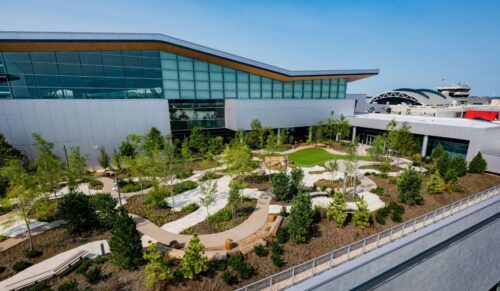
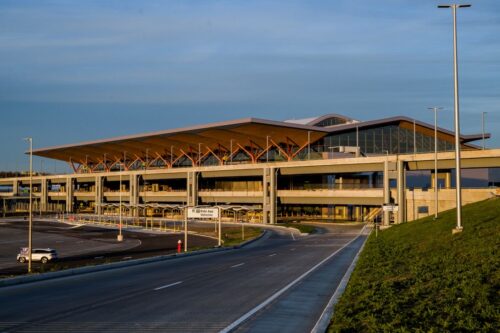
Here’s a tiny tour of Pittsburgh International Airport’s new landside terminal, in progress.

Travel tidbits from airports near you

Pittsburgh Int’l Airport’s new terminal is almost done

(Image courtesy Gensler)

Later this week, we’ll be doing a hard hat tour of Pittsburgh International Airport’s new terminal, visiting the airport’s in-terminal day care center (yes, they have one!) and checking in on some of our favorite art pieces at PIT.

Stay tuned for pics.

Fresh art at Seattle-Tacoma International Airport

SEA is the home base airport for the Stuck at the Airport team, and one thing we love about the airport is all the art. It’s wonderful and, often, reassuring to see favorite pieces before or after a flight.

And it’s always a treat to spot new art being added to the collection.

It’s not crazy to celebrate an anniversary at an airport

Our tradition of celebrating milestone anniversaries at new or cool airport hotels, such as the Hilton with a rooftop lounge that opened at Nashville International Airport not too long ago, made it into this Washington Post article about airport hotels.

This article is a perfect match for a story we wrote back in 2018 about the first airport hotels.

Airport hotels are no longer dominated by the staid, cheap, bed-for-a-night abodes that were standard for so many decades. New accommodations hark back to the luxury of early aviation, featuring top-notch amenities enjoyable by all. My latest in the @washingtonpost.com.

Edward Russell (@byerussell.com) 2025-04-22T13:06:28.199Z