Rules

Pigs & peacocks are pets, not service or emotional support animals, says DOT. Only trained dogs fly free.

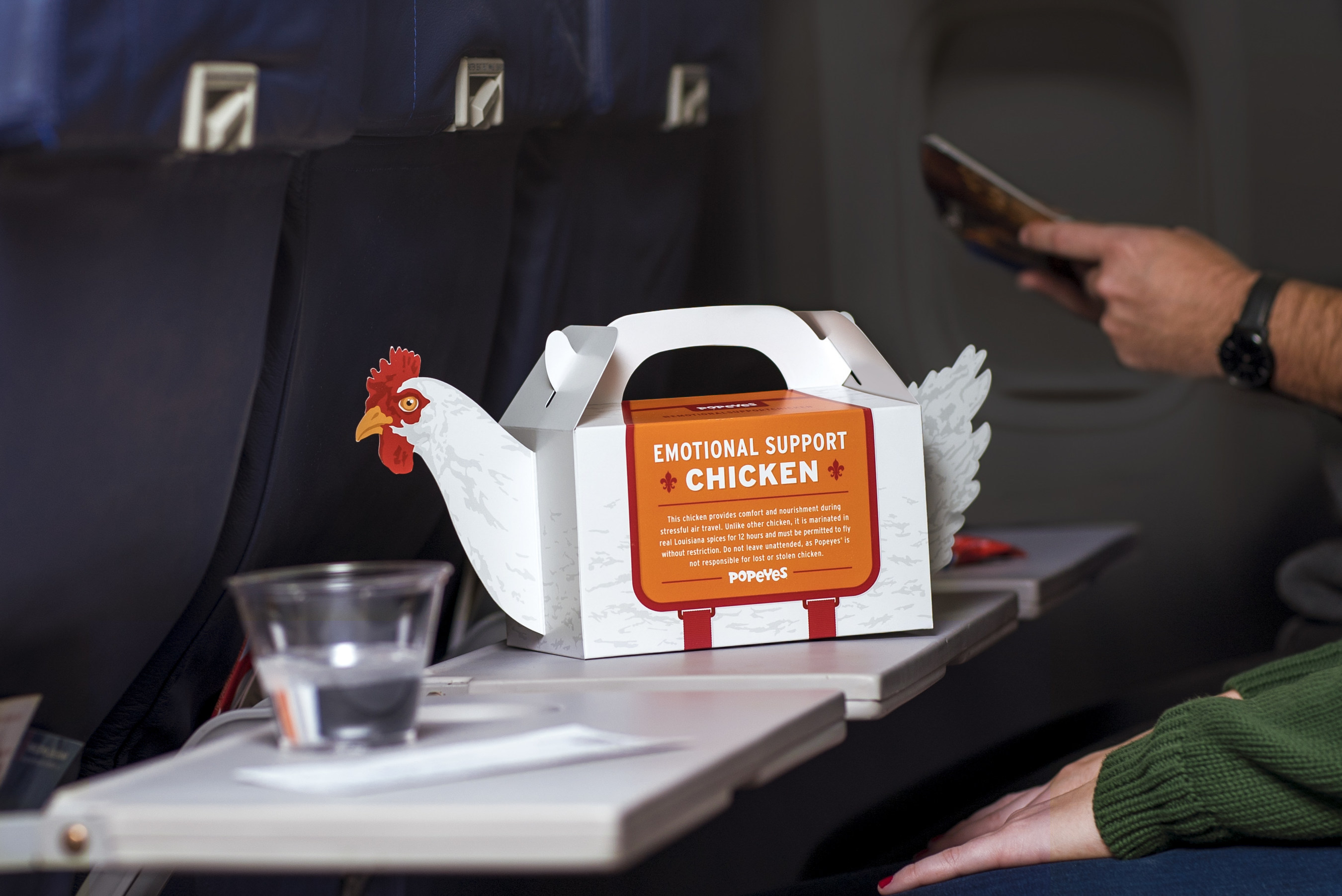
Popeyes at PHL Airport launched this ‘Emotional Support Chicken” in 2018.

It’s been a while since we had a story about someone trying to pass off what is clearly a pet as an emotional support animal so that the pet will fly for free.

Airlines tightened their policies on this after things got out of hand with passengers passing off badly behaved, dangerous, and obviously untrained animals as emotional support animals.

Now, after a long wait and much debate, the Department of Transportation (DOT) has issued its final ruling on the matter.

Basically, the DOT definition of a service animal is now aligned with the Americans With Disabilities Act’s definition.

Here are some of the key takeaways to know:

*The rules now define a service animal as a dog, regardless of breed or type “that is individually trained to do work or perform tasks for the benefit of a qualified individual with a disability, including a physical, sensory, psychiatric, intellectual, or other mental disability.”

*Airlines may now categorize emotional support animals as pets rather than service animals and limit a passenger to only two service animals.

*Airlines may require passengers traveling with a service dog to fill out a DOT-approved form attesting to the animal’s training and to vouch for the dog’s good health. On flights eight hours or longer owners must promise that their service dog won’t have to relieve itself or can do so in a sanitary manner.

You can read the other details of this final ruling here.

Who likes the rule? Who hates it?

Companies that issue emotional support animal certificates over the internet for a fee are, understandably, not happy with the ruling. Nor are travelers who have been flying their pets uncrated in the airline cabins for free with these fake papers.

But organizations that train services dogs and groups that represent and serve travelers with disabilities welcome today’s announcement.

“People with disabilities depend on their service dogs to live independently,” says Sheri Soltes, vice-chair of Assistance Dogs International NA. “With the new DOT rules, airline passengers with disabilities who use trained service dogs can travel safely without the risk of themselves or their dogs being attacked by out of control animals.” 

Christine Benninger, President and CEO of Guide Dogs for the Blind, says “This much-needed ruling acknowledges the negative effects fraudulent service animals have had on legitimate service animals and their handlers, which include safety, health, risks of attacks from untrained animals, and the erosion of the positive public image of a formally trained service dog.”

She notes, though, that there are challenges ahead. “The ruling requires handlers to provide more pre-boarding paperwork and validation, and the addition of extra steps for those traveling with a disability is not equal access.”

And Open Doors Organization (ODO) says:

By aligning the definition of a service animal with that of the Department of Justice under the Americans with Disabilities Act (ADA), the DOT has ensured that untrained animals, classified as emotional support animals, are no longer traveling uncrated in aircraft cabins, making air travel safer for everyone and eliminating the stigma for legitimate service animals.

By defining a service animal as a dog that is trained to perform a task or function to assist a person with a disability, and including psychiatric service animals, the air travel experience is safer for everyone and legitimate service animals and their handlers will be treated with the respect they deserve.

What do you think?

Travel Tidbits: Free Wi-Fi & More Fees

There’s good news and bad news for travelers this week.
Alaska Electronics

In Japan, rules have been eased so that airlines may allow passengers to use their personal electronic gadgets from gate to gate.

Free, unlimited Wi-Fi was introduced last week at Amsterdam’s Schiphol.

But as of today Allegiant Air follows the lead of Spirit Airlines in adding a fee to have an agent print out a boarding pass for you.

Here’s a link to my story about that Allegiant fee on USA TODAY, where I’m filling in on the Today in the Sky blog.

r

Fines set for having pot at Colorado airports

den sign

While it is now legal to possess and purchase marijuana in Colorado, anyone who brings pot to either of the state’s two busiest airports – Denver International and Colorado Springs – now risks the chance of being fined.

On Wednesday, Denver International Airport held a public hearing to formalize a policy it rolled out earlier in the month prohibiting the possession, use and consumption of marijuana for everyone – travelers, meters and greeters and workers – on airport property.

At the same time, DIA officials announced a set of “administrative citations,” or fines that would be issued as part of that policy: $150 for a first offense, $500 for a second offense and up to $999 for a third offense and beyond.

“This is really a last resort for us though,” said DIA spokeswoman Stacey Stegman. “Our primary goal is for people to comply with federal law,” which states that it is illegal to bring marijuana past security or transport it across state lines. See DIA’s new signage below, and then read on.

Stegman said that, as at other airports, if a TSA officer discovers marijuana, local law enforcement is called. “Law enforcement would look at the circumstances and determine what to do—depending upon intent, age, quantity, etc.”

If someone over age 21 is found at DIA airport with a small amount of pot, they’d likely be asked to put it in their vehicle, have someone take it away from the airport or asked to throw it away in a checkpoint trash receptacle. (DIA’s receptacles have lids with small holes, so Stegman isn’t worried about discarded marijuana being retrieved by others.) Those who decline these options would be asked to leave the airport and, before a citation would be given “other options would be explored,” said Stegman.

Signs outlining the rules will be posted at Denver International Airport within seven days, at which time airport and local authorities will begin enforcing the policy.

Starting Friday, January 10, pot is also prohibited throughout Colorado Springs Airport. According to a report in The Gazette, officials have warned the public that possession of pot at the airport could be punishable by a fine of up to $2,500 – and jail time.

Those found with marijuana at the Colorado Springs Airport will have the option to give it up voluntarily, without penalty, by putting it in their cars, giving it to someone to take away from the airport or depositing it in an “amnesty box” to be destroyed.

(My story about pot fine at Colorado Airports first appeared on the Runway Girl Network)

Don’t leave a dead relative at the airport

Each Friday on msnbc.com’s Overhead Bin, I tackle a reader’s travel-related question. This week’s topic was flying with cremated remains.

Dottie Flanagan, an accounting manager from Falmouth, Mass., will be flying to Knoxville, Tenn., in a few months to bury her mother’s cremated remains.

Flanagan isn’t sure yet which airline she’ll fly on or whether she’ll fly out of the airport in Boston or Providence, R.I., but she wrote to Overhead Bin to ask if there might be a problem taking the urn along as a carry-on item.

“The funeral parlor gave me the urn wrapped in bubble wrap and placed in a bag with handles,” said Flanagan. “It is ceramic with pink roses on it, shaped like a ginger gar and about 11 inches high. The lid is glued to the bottom and it cannot be opened. I’m sure I could obtain a letter from the funeral home certifying what was in the container if that would help.”

To help Flanagan with this task, I first reviewed the “Transporting the deceased” section of Transportation Security Administration website. There we learned that while passengers are allowed to carry a crematory container as carry-on luggage, the container must still pass through the X-ray machine. According to the TSA, “If the container is made of a material that generates an opaque image and prevents the Transportation Security Officer from clearly being able to see what is inside, then the container cannot be allowed through the security checkpoint.”

Paperwork from a funeral home about the contents of a container will not exclude it from screening and the TSA states that “out of respect … under no circumstances will an officer open the container even if the passenger requests this be done.”

As a precaution, TSA urges travelers to get a crematory container made of wood or plastic that can be successfully X-rayed. That still left me wondering about Flanagan’s ceramic container and we asked TSA spokesperson Nico Melendez to take a look at a jar similar to the one Flanagan will be carrying.

“Most urns will go through the X-ray machine with no problem,” said Melendez, “and this looks like porcelain, and should be fine. The problems we have are with containers made of lead that are difficult to see through, which is why we ask people to travel with the simplest container possible.”

If an urn is turned away from the security checkpoint, Melendez points out that the TSA does permit urns to be screened and placed in checked luggage. But some airlines specifically prohibit crematory containers from checked baggage.

The bottom line? For the final word on transporting cremated remains to their final resting spot, check with your carrier.

(Photo courtesy Flickr Commons.)

Peanuts on planes: got a problem with that?

Peanuts on a plane.

For a lot of people, that’s a more frightening scenario than snakes on a plane.

And a lot more likely.

And as I wrote in my msnbc.com column this week – Passengers peeved about peanuts on airplanes – a lot of travelers think the best way to enhance airline passenger protections is to ban peanuts on planes.

peanuts

Through September 23rd, the Department of Transportation (DOT) is taking public comment on a wide range of issues affecting airline passengers. Everything from peanuts on planes to involuntary bumping policies to surprise baggage fees.

Of the nearly 1,300 public comments submitted so far, the majority are focused on peanut allergies.

One problem though.

Technically, DOT doesn’t have the authority to change in-flight peanut policies. That’s because an appropriations law from 2000 prohibits the agency from passing peanut rules until a scientific study proves a rule change will actually benefit airline passengers with allergies. And no such study has been completed or commissioned.

Still, the agency is trying to gauge public opinion on ways to handle in-flight peanuts.

“We haven’t said we won’t do anything,” said DOT spokesperson Bill Mosely. “We haven’t ruled anything in or out. So we still do want to hear public comments about peanuts. We plan to read and review them all.”

The problem with flying peanuts

Peanut allergies among children have tripled between 1997 and 2008, and peanut allergies, tree-nut allergies, or both, are reported by 1 percent of the U.S. population, or about 3 million people, according to the Food Allergy and Anaphylaxis Network (FAAN), a group that supports discontinuing serving peanuts on planes.

The fear of having a severe reaction from exposure to peanuts while locked inside an airplane keeps some allergy sufferers grounded. Under DOT’s rules, passengers with severe peanut allergies have a qualifying disability covered by the Air Carrier Access Act, which prohibits discrimination by U.S. and foreign carriers against individuals with disabilities.

As far back as 1988, DOT advised airlines to make reasonable accommodations for passengers disabled by their peanut allergies. Most airlines voluntarily comply, but no formal rules have been put in place.

Now, DOT is asking the public to comment on three alternatives to accommodate peanut-allergy sufferers on airplanes:

  • Ban the serving of peanuts and all peanut products on all flights;
  • Ban the serving of peanuts and all peanut products on all flights where a passenger with a peanut allergy requests it in advance, or;
  • Require airlines to establish a peanut-free buffer zone for passengers with severe peanut allergies.

DOT is also asking the public to comment on how peanuts and peanut products carried on board by passengers should be handled.

Peanut protections for airline passengers

If you’ve got a problem with peanuts, here’s what you need to know:

AirTran, Alaska/Horizon, American, Continental, JetBlue and United are among the major domestic airlines that do not serve peanuts. However, most airlines also post notices saying they can’t promise that some items served on board won’t contain nut products or that other passengers won’t bring their own nut products on board.

Two domestic airlines continue to ladle out legumes.

In 2009, both Southwest Airlines and Delta Air Lines served about 92 million bags of peanuts. “That does sound like a lot of nuts,” said Patrick Archer, president of the American Peanut Council, “But the airline portion of the overall U.S. peanut business is really very small.”

If alerted, Delta Airlines will accommodate a passenger with a peanut allergy by creating a peanut-free buffer zone for three rows in front of and three rows behind their seat. The airline’s website also notes that when advised that a passenger with peanut allergies is flying, “Gate agents will be notified in case you’d like to pre-board and cleanse the immediate seating area.”

And while Southwest Airlines can’t guarantee a nut-free airplane, it will suspend peanut service on an entire flight if a passenger with an allergy requests it. See Southwest’s peanut dust allergy page for more information.

Want to share your thoughts about peanuts-on-planes? You can leave a comment below.

You can also file comments for the DOT to read (through September 23, 2010) here.

Paperless boarding passes: benefit or bother?

We’ve all become accustomed to checking in for our flights on-line and printing out our boarding passes at home or at an airport kiosk on our way to the security checkpoint.

Now the TSA is working with five airlines and 70 airports to test paperless boarding passes.

Here’s how it works: When a traveler checks in on-line the airline emails a boarding pass in the form of a 2-D barcode that can be downloaded to a smartphone. The barcode on the phone can be scanned at the security checkpoint and by the airline gate agent; just like a paper pass.

It’s sound great, doesn’t it?

. But as I wrote in my most recent msnbc.com column – Going paperless: Tech-savvy air travelers on board – it’s probably not a good idea to disconnect your printer just yet. Electronic passes aren’t accepted everywhere. And they’re not fool-proof. “One of the first times I used one, my phone browser refreshed and I lost the boarding pass 30 seconds before boarding,” recalls Walter Hopgood, a frequent business traveler from Damascus, Oregon.

Path to paperless

Some airlines in Europe, Canada and Asia have been using paperless boarding passes since early 2007, but the United States has been behind the curve on adopting the new technology.

Why?

“We were slower to get Internet access on cell phones, slower to get affordable data plans on cell phones and slower than Europeans to start using cell phones for accessing data,” said Henry Harteveldt, a travel industry analyst for Forrester Research.  But it’s also because the TSA has been very cautious, says Catherine Mayer, vice president of airport services at SITA, an information technology company serving the aviation industry. “The agency had additional security requirements it wanted airlines to meet before it would allow paperless boarding to be introduced here.”

Continental, the first airline to work up software to meet TSA’s authentication standards, kicked off the TSA’s pilot program for paperless boarding in December, 2007. Now the test program includes five U.S. airlines (Alaska, American, Continental, Delta and United), 71 domestic airports and Frankfurt Airport in Germany.

“Airlines are able to streamline the airport experience for passengers,” said Justin Taubman, the program manager for TSA’s mobile boarding pass program. “And the TSA is able to enhance the security of the boarding passes.”

Good to go?

While electronic boarding passes do save paper and time while heightening the TSA’s ability to detect fraudulent boarding passes, the pilot program is not glitch-free.

Some passengers encounter scanners with spent batteries or security-checkpoint staffers untrained or uninterested in the mobile pass pilot program.  When Justin Meyer of Kansas City showed up at 5 a.m. at a Fort Lauderdale, Fla., security checkpoint armed with his electronic boarding pass, a TSA employee pressed him for paper. “I didn’t have it,” Meyer recalled, “so I had to wait about 10 minutes while they found the scanner and plugged it in.”

Other travelers have stored a paperless pass on a smartphone that has lost its charge. Or they’ve sailed through the TSA checkpoint paper-free, only to discover that an airline is using a gate without a scanner. Or they’ve discovered some airlines only deliver one paperless pass per smartphone — and that won’t work if you’re traveling with a family of four.

“Like any new technology or service, there needs to be a transition period when everyone is learning the way to proceed,” said Steve Lott of International Air Transport Association, an industry trade group.  And so for now, notes Shashank Nigam of the airline consulting firm, Simpliflying, “Paperless boarding may very well remain an early adopter thing until all airlines and airports fall in line.”

That may not be too far off. TSA’s Justin Taubman says the agency is currently working with vendors to develop equipment for a new boarding pass scanning system. “Once the new Credential Authenticating Boarding Pass Scanning System, or CAT/BPSS, is in place,” he said, “the pilot project will become an official TSA program.”

And we’ll have to learn a new acronym.

You can read my original column – Going paperless: Tech-savvy air travelers on board – and see some reader comments – on msnbc.com.

Leave the airport, visit a park

Does a bear sh#t in the woods? Depends on which woods.

Glacier National Park visitors 1960

My Well Mannered Traveler column on msnbc.com this is week is all about What’s OK, what’s not in national and state parks. Even some well-seasoned travelers don’t know the ins and outs. But if you don’t check out the rules before you head off into the woods you can end up in a heap of trouble.

Wendy Peck of Winnipeg, Manitoba found that out at the beginning of her two-month park-centric visit to the United States. She had her heart set on poking around the national parks in Arizona and Utah, hiking and camping with Amie, her black lab.

“That plan quickly fell apart,” says Peck, who discovered that most every national park in the United States prohibits dogs on back-country trails. “We were usually restricted to asphalt views. It was very disappointing.”

But Peck figured out that many national parks have state parks just down the road that usually offer much of the same landscapes and more pet-friendly policies.  “I found that by switching my focus to state parks, that I actually had a better time. Far fewer people, much more freedom, and some pretty cool sights that most others just don’t see. “

Peck’s vacation was saved, but rules about what is — or is not — allowed in state and national parks have ended up ruining or mangling trips for many other travelers.

Want to avoid those surprises?  Here’s some advice from park officials and outdoor enthusiasts.

Bugs and bunnies, shorelines and cemeteries

Figuring out what is – or is not – a National Park Service property can be confusing. National Park Service properties around the country encompass 392 areas, or “units” with 80 million acres of land and more than a dozen different, and often confusing, designations.

Those “units” include 58 traditional national parks, such as Yosemite, Yellowstone and Bryce Canyon, but also about 150 historic sites and battlefields, as well as national monuments and memorials, national historical parks, national seashores, national parkways and national recreation areas, including man-made lakes such as Lake Mead, behind Hoover Dam.

“Yes, we know we have some identity issues out there,” says David Barna, chief of public affairs for the National Park Service, “But you can divide the areas we manage into two piles: half of them preserve natural resources — bugs and bunnies — the other half preserves cultural resources, which represent the history of America.”

They may all be managed by the same agency, but the same rules don’t apply in each location. “There are places where a dog needs to be on a leash,” Barna says, “and places where that rule doesn’t apply.” Likewise, while personal watercraft (i.e. Jet Skis) are not allowed in the 58 national parks, those vehicles are allowed on recreational lakes and at some offshore national seashore areas managed by the park service. “It depends on what classification the areas fall under,” add Barna.

And then there are the seemingly site-specific rules. “For example, all boats entering Lake Powell [which stretches from Arizona to Utah] must be certified to be free of zebra mussels prior to launching. And in Maine’s Acadia National Park, visitors can’t bring firewood from home due to the threat of invasive insects,” says Dan Wulfman of Tracks & Trails, a company that organizes national park driving vacations.

How to navigate park rules

Kurt Repanshek of National Parks Traveler urges park visitors to study the National Park Service website long before leaving home. “Each park unit has its own website, but the content varies greatly. So don’t rely on that alone. If you don’t see information about the specific activity you’re interested in, make a phone call.”

And if you find the national park rules too restricting, don’t despair. It may just mean that a state park is a better match for you and your vacation style. “State parks,” says Shannon Andrea of the National Parks Conservation Association, “have less national significance and almost always allow for some form of active recreation such as bike riding, swimming, hiking, fishing, camping or horseback riding as part of their mission.”

Or maybe a visit to a National Forest is what you need. Myrna Johnson, a Boston-based outdoor enthusiast and urban open space professional, says National Forests “tend to be a little less traveled than National Parks and offer great backcountry opportunities for those who are looking for a slightly more rugged experience.”

Pay to play

National Park Service visitor pass

Whether you set out for a national or a state park, don’t forget to bring along your wallet. Of the 392 National Park Service properties, 130 currently charge some sort of entrance and/or amenities use fee. So consider investing in an $80 annual America the Beautiful Pass. There are some restrictions, but the pass covers a full year of entrance fees for a carload of up to four adults at National Park Service sites and at sites managed by agencies such as the USDA Forest Service, Fish and Wildlife Service and the Bureau of Land Management. (U.S. citizens and permanent residents ages 62 or over can get a lifetime pass good for that same carload for just $10.) The America the Beautiful Pass won’t cover entry fees at state parks, but y states offer their own annual passes, which can be an equally good deal.

And it’s always a good idea to call ahead. National Parks have not experienced budget cuts this year, but many state parks have. So make sure the park you want to visit will be open when you show up at the gate.

(Photos courtesy National Park Service Historic Photograph Collection.)

The DOT’s new 3-hour rule: what you need to know

(Denver Airport – courtesy Gregory Thow)

A new set of DOT rules go into effect today promising a wide variety of protections for airline travelers.  As I outlined in an msnbc.com column, Something for everyone in the DOT rules, these regulations offer quite a bit more than just the assurance that passengers will be let off a plane if a delay stretches into the three-hour range.

Here’s just a bit of what you need to know:

Stuck on an airplane?

With a few security-related exemptions, an airline must now let you off  a plane by the three-hour point of a tarmac delay.  After two hours, though, the DOT now requires airlines to offer you some water and a little something – maybe pretzels or a granola bar – to eat.  Even if you’re on one of those small, regional carriers.

Each airline must also now have contingency plans in place and those plans need to be posted on an airline’s website. Airlines have more leeway with these plans for international flights – so comparing plans before you buy tickets could be useful.

Got a beef?

To make sure you can file a complaint, airlines must now post e-mail, Web and snail-mail addresses on their Web sites, e-ticket confirmations, and at ticket counters and boarding gates. And no more sending those complaints to the ‘circular file.’ The DOT now requires airlines to answer your complaint within 60 days.

There’s more.  So I urge you read the full column – Something for everyone in the DOT rules – so you know what to expect.

Don’t worry, be happy

And, for those of you worried that the three-hour rule means you’ll be marooned at an airport once you’re let off a delayed plane, airport officials say: “Don’t worry.”

Airport directors I spoke with for a USATODAY.com column – Are airports ready for the three hour rule? – say most every airport, even small ones currently excluded from the new DOT rules, has plans and equipment in place to help airlines comply with the new rules and to accommodate passengers let back into the terminal after a 3-hour delay.

We’ll just have to wait and see what happens next.

Get ready to start getting to the airport even earlier

Late Thursday afternoon  (January 14, 2010) Homeland Security Secretary Janet Napolitano released a(nother) new statement about additional aviation security precautions being rolled out at the nation’s airports.

What will those new precautions entail?

According to Napolitano’s statement, “…Some of these measures include enhanced random screening, additional federal air marshals on certain routes and adding individuals of concern to our terrorist watch list system.”

None of that sounds all that new. But on the ground, says a TSA spokesperson, that means that, depending on what airport you’re in, you might notice “an increase in measures such as…behavioral detection officers and a wider use of tools like explosive trace detection.  Not just at the checkpoint but throughout the airport environment.”

The bottom line, says Napolitano: “…travelers should allot extra time when flying…”

Allotting extra time, of course, means getting to the airport even earlier than you do now.

But even with all these new procedures, it’s a fair bet that your trip through the security checkpoint will go smoothly and you’ll end up just hanging around the airport waiting for your flight.

If you’re at Miami International Airport (MIA) this Saturday, January 16th, you can spend that extra time watching a fashion show in the Central Terminal (On Departure Level, Terminal G by the $10 Boutique).

The show will last for an hour, from 1:30 to 2:30, and feature women’s, men’s and children’s clothing and accessories from a variety of airport vendors. There will also be sampling of Toblerone chocolate, and a performance by Venezuelan composer, producer and singer Claudio Corsi, who now lives in the Miami area.

Not planning on being at Miami International Airport this Saturday?  If you’re across country at San Francisco International Airport (SFO), you can fritter away a few extra hours playing pinball – for free.

The free pinball machines are part of SFO’s exhibit about the history of pinball that will be on view through April 2010.

Tune up: airline instrument policies

Thanks to a YouTube video that’s gone viral, millions of people around the world now know that in March 2008, United Airlines baggage handlers broke Dave Carroll’s guitar. Instead of just admitting it and paying for the repairs, the airline kept telling the musician to go away.

He didn’t.  He made a video and the rest, as they say, is music and social media history.  United Airlines changed its tune, promised to do better in the future and, when Carroll refused compensation, donated $3,000 to non-profit music foundation in his name.

Does that mean United and other airlines now won’t break anyone’s guitar? Don’t count on it.  But now everyone is paying more attention to how instruments on airplanes are handled.

Want to make sure your instrument arrives safely? Here’s a video and some tips from the folks at Taylor Guitars and the American Federation of Musicians:

  • Know your airline’s policy on transporting instruments. Look it up on the airline’s Web site, print it out and take it with you. “Many flight attendants do not know their own airline’s policy regarding carry-on guitars. If you can calmly explain that your instrument is within their mandated guidelines, and actually show them those guidelines, you will be way ahead of the game.”
  • Each airline has a maximize size for carry-on items, measured by linear inches. On many airlines, including Continental, American, and United, the limit is 45 linear inches.  So know your instrument’s size in linear inches.  That’s the sum of the length, width and height of your travel case.  “In many cases, even though your instrument case does not fit in the ‘size wise’ metal contraption at the gate, it might still be within the linear-inch maximum.”
  • Carry a fabric tape measure with you.  It can come in handy if you’re challenged about your dimensions of your instrument case.

For more on this topic, see my Well Mannered Traveler column on MSNBC.com: Get in tune with your airline’s instrument policy.