A couple jokes to spread some cheer: *Why is Peter Pan always flying? Because he can never, never land *Why did the students study in the airplane? They wanted higher grades For a chance to win a prize, comment your favorite aviation-themed joke on this post! #CampDEN#wegotjokespic.twitter.com/XuCFSh30ni
Here's the deal: Today we reveal our new Vegas-inspired public awareness campaign, LAS All In. You can bet that we are doing our best to protect the health of our customers. Look for these safety messages throughout the airport. 🎲🎲#AllinLASpic.twitter.com/Qstp15jNpm
— Harry Reid International Airport (@LASairport) May 20, 2020
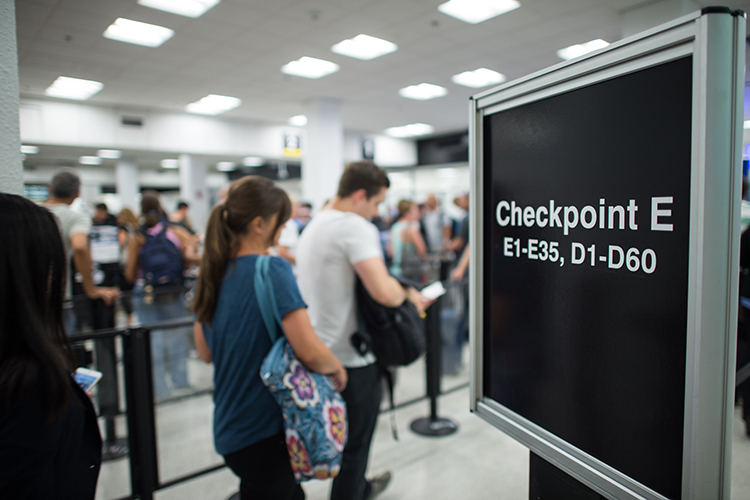
As we head into the Memorial Day holiday and a slight uptick in air travel, the Transportation Security Administration rolling out some new rules for the security checkpoint screen area in response to COVID-19.
Some of these strategies are already in place. Others will show up at checkpoints by mid-June.
Scan you own boarding pass
Still no word about TSA taking passenger temperatures, but TSA officers will now ask passengers to place their paper or electronic boarding pass on the ticket readers themselves. TSOs will still examine your document, but they won’t touch it.
Clear bags for food
TSA also now asks passengers to put any carry-on food items in a clear plastic bag and place that bag in a bin at the checkpoints.
“Food items often trigger an alarm during the screening process; separating the food from the carry-on bag lessens the likelihood that a TSA officer will need to open the carry-on bag and remove the food items for a closer inspection,” TSA says in a statement.
“This allows social distancing, reduces the TSA officer’s need to touch a person’s container of food, and reduces the potential for cross-contamination. TSA Precheck members do not need to remove items from their bags,” TSA adds.
If you haven’t flown since the pandemic arrived, you’ll see TSA checkpoint officers wearing facial protection and gloves. Passengers are also asked to wear masks at checkpoints as well and be prepared to lower their masks if requested. At many airports, masks are now required throughout the terminals and on the planes.
The aviation industry, government agencies, and technology companies are scrambling to find a way to respond to the COVID-19 pandemic so that travelers will be safe in airports and in the sky.
Already, masks, hand sanitizing stations, and hyper-vigilant cleaning protocols have become standard.
And now temperature checks are being added to the list.
Airports, airlines and industry organizations are discussing how to make this happen on a national level.
But the Port of Seattle Commission doesn’t want to wait.
On Wednesday the commission told its staff to work up a plan, by June 9, for rolling out temperature screenings at Seattle-Tacoma International Airport (SEA).
The priority will be on screening arriving international passengers. And with this directive, SEA believes it is the first large U.S. airport to begin working on a formal plan for temperature checks and health screening.
Commission has directed staff to develop a plan to facilitate temperature checks at @flySEA. This direction makes our airport the 1st large U.S. airport to begin work on a formal plan for temperature checks and health screening. https://t.co/wz3EJbGbtopic.twitter.com/f8Qwip66TF
— Port of Seattle – ⚓️ (@PortofSeattle) May 13, 2020
Port of Seattle commissioners acknowledge that with temperature screening will come questions. Mostly about passenger privacy and the fact that temperature checks won’t catch even a majority of virus carriers.
“No single measure is sufficient to slow the spread of coronavirus, and each comes with additional costs and inconvenience. However, given the gravity of the virus, and the impact it has had on our region’s well-being, the benefits of these measures outweigh the costs,” Port of Seattle commissioners said in a statement.
(Our story about TSA workers helping airport workers during the pandemic first appeared on CNBC in a slightly different version.)
The steep decline in air travel due to the COVID-19 pandemic has triggered layoffs, furloughs and shortened work hours for many airport employees, including wheelchair attendants, baggage handlers, janitorial crews and concessions staff.
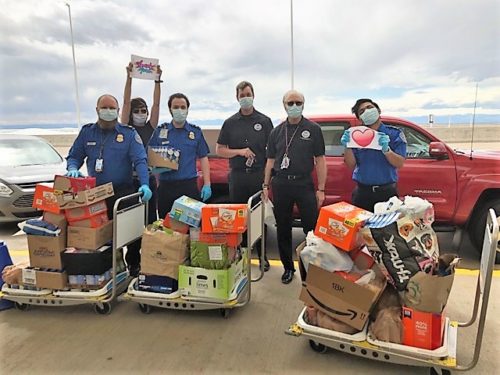
But in a growing number of cities their co-workers from the Transportation Security Administration, who continue to receive paychecks, are stepping up to help. They’re hosting temporary food pantries in airports around the nation and providing free lunches and dinners to their struggling colleagues. They’re also donating their time to make masks and other essential items for communities in need.
Unite Here, a union representing hospitality workers, estimates that 42,000 of its members in the airport industry are currently out of work. Most of those lost jobs are in airport concessions and airline catering, where wages range from $9 to $16 an hour.
That’s just Unite Here members. The Airport Restaurant and Retail Association (ARRA) estimates 120,000 to 125,000 airport employees are currently out of work.
Some of those workers may eventually get called back. But for now, their incomes are disrupted, and many could use some help.
Food pantries to the rescue
As a thank-you for the support they received while working without paychecks during the 2018/2019 partial government shutdown, TSA officers at Denver International Airport on April 30 hosted a food pantry in support of airport and air carrier colleagues working with reduced hours or partial paychecks.
“Our team rallied to collect thousands of non-perishable items for the pantry,” said Larry Nau, TSA Federal Security Director for Colorado, “133 airport employees shopped the pantry and took home items for a total of 538 family members fed.”
On April 24, Transportation Security Administration employees at Ronald Reagan Washington National Airport (DCA) opened a free food and toiletries pantry to assist airport employees laid off or working with reduced hours or paychecks.
TSA officers are donating cash, products and gift cards to keep the pantry stocked with items such as cereal, evaporated milk, soup, pasta, toothpaste, soap, laundry detergent, feminine products, diapers and deodorant.
And in early April, TSA employees at Dulles International Airport (IAD) opened a free pantry for affected airport community members that is stocked with everything from donated dried and canned goods and toiletries to toys for employees who have kids at home.
IAD has the greatest @TSA employees, #ManagerMike thanks you for all you do to keep the airport secure and for this great example of giving back! Folks as you can see, the shelves are getting empty so please make donations if you can! https://t.co/EozTgt579ppic.twitter.com/5nH3YJ9W8e
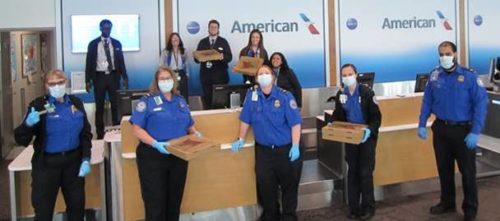
Twice in early April, TSA officers at Rhode Island’s T.F. Green Airport (PVD) chipped in to buy and deliver pizza dinners for fellow airport workers, including airline employees, wheelchair attendants and housekeeping staff.
“Providence is a small airport and the employees who work here are like family,” Christopher Primiano, TSA stakeholder liaison at PVD Airport, told CNBC, “We know this could go on for some time so we’re looking into what else we can do, from donations and food drives to bake sales. We want to help and give back as much as we can.”
On April 10, TSA employees at PDX bought pre-made lunches for around 300 airport employees. They did it again on April 21, partnering with local employees from Customs and Border Protection (CBP) and the Federal Aviation Administration (FAA) to donate lunch and supplies to an equal number of airport workers.
As part of its “TSA Gives Back” program, early last month TSA officers at Green Bay-Austin Straubel International Airport (GRB) in Wisconsin chipped in to buy and deliver pizza, dessert and balloons to airline and car rental employees at the airport who are experiencing shrinking paychecks.
— Lisa Farbstein, TSA Spokesperson (@TSA_Northeast) April 3, 2020
And, at McGhee Tyson Airport (TYS) in Knoxville, Tennessee, TSOs are collecting donations and arranged for Second Harvest, the community food bank, to supply food boxes to about 300 airport employees.
Following instructions from an online video, TSA officers at EWR made 200 face masks out of 100 pairs of brand-new socks purchased with funds donated by TSA employees. Each sock-mask was placed in a separate plastic zippered bag along with an instruction card and all 200 masks were delivered to two area homeless shelters.
TSOs at Newark Liberty Airport have also used their downtime at the checkpoints to make home-made get-well cards and write notes of support for health care workers and COVID-19 patients in isolation at a nearby medical center.
What will air travel be like once the ‘stay home’ advisories are lifted?
Here’s a preview:
The passenger terminal at Paine Field (PAE) in Everett, WA, north of Seattle, just installed a fever detection system. The system is non-invasive, non-contact and scans passengers in the security checkpoint area to see if they’re running a fever.
Systems like this are in use in many Asian airports and in other parts of the world. But this seems to be the first time a fever detection system has been installed at a U.S. airport.
How does the Elevated Body Temperature Detection system work?
How does the Elevated Body Temperature Detection system work? Here’s how Athena Security describes it:
“The system identifies the face of the subject, ignores hot spots like hot lights above and other hot objects on the person like a cell phone or hot coffee. The person looks at the camera and the system finds the hottest point on the face near the eyes, called the inner canthus. Near the eyes is the area that most closely correlates with basal body temperature, so the subject needs to remove glasses and look at the camera.”
Athena Security also notes that the fever detection system only identifies elevated temperature. It does not diagnose any disease or virus, such as COVID-19.
The Paine Field passenger terminal is operated by Propeller Airports, which says the system is installed and operating in the area before the TSA checkpoint, which the airport, not TSA, controls.
Any passenger flagged as having a temperature will be offered secondary screening. If a fever is confirmed, “the passenger and the airline will determine their ability to travel,” Propeller Airports said in a statement.
#PAE is rolling out a new fever detection system. This technology, developed by @AthenaSecure, is non-invasive, non-contact and alerts personnel when a passenger of staff member has a fever. We care about your health! For more info visit: https://t.co/RfZE52SaWcpic.twitter.com/D1bqL6Ic6L
While the fever detection system it is not a TSA-sponsored initiative, “the agency supports efforts by airports and airlines that help reduce the spread of the virus and allow a prudent return to normal operations,” TSA spokesman Lorie Dankers told Stuck at The Airport via email.
The fever detection is not the only innovative safety technology at Paine Field Airport. Last month the airport began using an innovative and proprietary UV technology to disinfect the terminal.
We are employing enhanced cleaning protocols to maximize the safety and well-being of everyone. The machine in the video link is the #UVHammer. It uses UVC lighting to kill 99% of viruses and bacteria. https://t.co/tXvrCb4VAL
The small Paine Field passenger terminal in Everett, WA opened in March 2019. Before schedule reductions due to COVID-19, Alaska Airlines and United Airlines were operating about 24 flights a day from PAE
What do you think? Are you willing to have your temperature taken at the airport?
During the partial shutdown of the federal government in 2019, many TSA employees continued to show up for work despite missing paychecks.
To help them out, airport employees, airlines and airport concessionaires around the country joined with social service agencies and the local community to stock pantries with food and goods.
'Unprecedented': Food bank provides emergency meals for unpaid TSA workers amid shutdown https://t.co/p48VrzEaNE
Now at some airports, TSA workers are returning the favor by setting up food pantries and special meals for airport employees who have had hours cut or who have been put out of work because there are so few passengers in airports.
IAD has the greatest @TSA employees, #ManagerMike thanks you for all you do to keep the airport secure and for this great example of giving back! Folks as you can see, the shelves are getting empty so please make donations if you can! https://t.co/EozTgt579ppic.twitter.com/5nH3YJ9W8e
And at T.F. Green International Airport (PVD) in Rhode Island, TSA officers chipped in and bought pizza dinners – twice so far – for their fellow airport workers, including wheelchair attendants and airline employees.
Courtesy TSA
We’ll update this list of good-deeds as we hear of my examples.
So many people are out of work right now and not sure how they’ll pay bills.
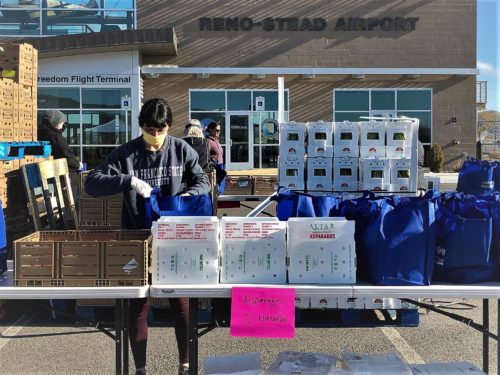
So it’s encouraging to see Reno-Stead Airport stepping up to help out the Food Bank in its community.
Like many other communities, in just the past two weeks, the food bank in Reno has seen a 30-50% increase in need.
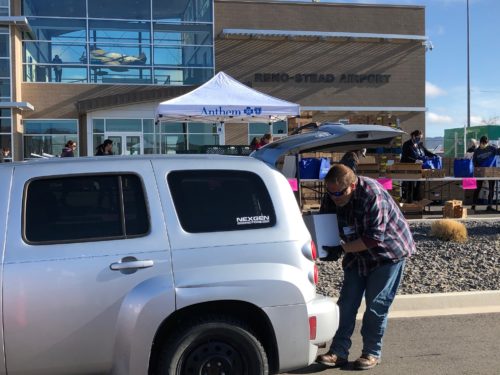
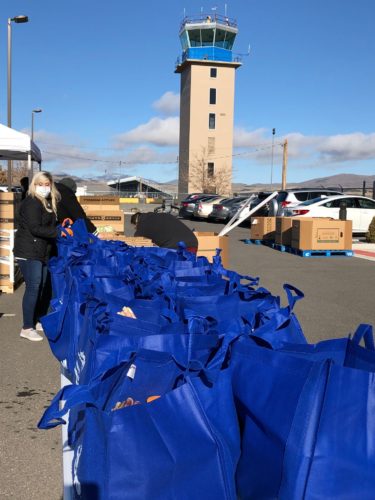
So on Friday, Reno-Stead Airport, the 5,000-acre general aviation facility of the Reno-Tahoe Airport Authority, served as drive-through Mobile Harvest food distribution site to support those affected by COVID-19.
In just a few hours, the drive-through airport food bank served 417 clients, giving each a bag filled with milk, lettuce, tomatoes, apples and asparagus and a dry-goods box of rice, beans, canned goods and peanut butter.
If you hear of other airports helping out their communities in creative ways right now, please let us know so we can share those stories.
But airports are essential community services and must stay open.
“Especially in the time of crisis when critically needed supplies are being shipped and medical workers are being asked to travel to the hardest hit cities,” said Kevin Burke, President and CEO of airport member organization Airports Council International – North America (ACI-NA).
In the U.S., Burke says ACI-NA expects total airport operating revenue will decrease by roughly $12.3 billion for 2020, a nearly 49 percent reduction.
Some of these losses may be offset once the U.S. Transportation Department and the Federal Aviation Administration begins distributing the $10 billion airports are slated to receive from the recently signed CARES Act.
“However, we expect our losses will increase as this crisis continues,” said Burke.
How are airports coping?
Airports around the country are taking a wide variety of measures to cope and cut costs.
Efforts include closing and consolidating security checkpoints, locking yoga rooms and kids play areas, and shuttering restaurants and concessions. Many airports are even turning off escalators and moving walkways to save on electricity bills.
At Pittsburgh International Airport, which has seen a 90% reduction in the number of passengers, so many commercial flights have been canceled that the airport is using one of its four runways as a parking lot for almost 100 grounded planes.
The parking fees for those planes won’t come close to replacing revenue losses from the airport’s key income sources which, like other airports, include fees related to airline and passenger activity, said airport CEO Christina Cassotis.
“But the airport must stay open and operationalas an essential part of the country’s transportation system,” she said.
“And whether we have one passenger or one plane, we must do the same work to make sure everything is in good working order, from wildlife management to cutting the grass and making sure the airfields are free of debris,” said Cassotis.
AtLos Angeles International Airport, the airport’s Landside Access Modernization Program (LAMP) and terminal modernization projects are continuing as planned. But other airports are freezing work on major construction projects.
Salt Lake City International Airport (SLC) has 25 planes parked in ramp areas and de-icing pads, said airport spokeswoman Nancy Volmer. Inside the terminals, close to 50% of concessions are now closed.
Denver International Airport has closed one of its six runways and is now operating with one 24-hour checkpoint. Among a wide variety of other measures, the airport disabled the air hand dryers in restrooms to reduce the spread of germs, closed the Interfaith Chapel and is stopping valet parking in its east and west garages on April 10.
And at Florida’s Jacksonville International Airport (JAX), both concourses remain open with only three of the airport’s 13 stores and three of its 15 restaurants operating. Because the airports’ volunteer ambassador program has been suspended, the airport’s traditional and very popular Mother’s Day flower giveaway has been canceled for this year.
“There are no volunteers to hand the flowers out and really very few passengers traveling through the terminal,” said JAX spokesman Greg Willis.
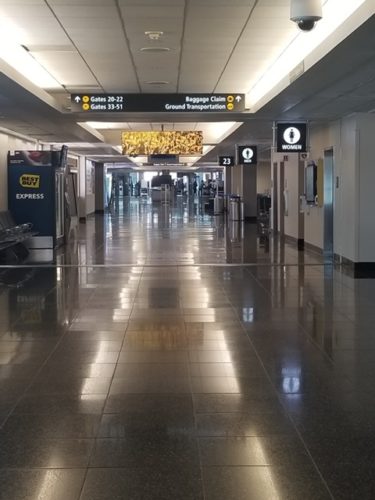
Seattle-Tacoma International Airport (SEA) reports that passenger counts are down as much as 90 percent. The airport’s children’s play area is closed, both the live music and the Visitor Pass programs are suspended and a long list of bars, restaurants and shops are shuttered.
To help concession operators, some of which opened new shops, bars and restaurants in just the last month as part of the airport’s expansion and modernization programs, the Port of Seattle established a short-term emergency relief package that includes a two-month deferral of rent and fees.
Airports elsewhere are figuring out how to help tenants as well.
Rent and fee deferrals will help in the short run, But the Airport Restaurant and Retail Association, which represents more than 20 large and small airport concessionaires, is asking U.S. airports to consider offering 12 months of rent abatement.
“Our businesses are part of the nature and character of airports and were projected to do $10 billion worth of sales in 2020,” said Pat Murray, ARRA Board Chairman and Executive Vice President at SSP Group, “$2.5 billion of that would have been paid in rent and fees to airports. Now we’re looking at a sales drop of over $9.5 billion.”
If some sort of relief isn’t offered, he said, “our sector may cease to exist.”
You know that the current health crisis has caused people to cancel trips and airlines to temporarily slash flight schedules to the bone.
Here are few other measurements that underscore how bad it is right now.
TSA screening numbers hit record low
On Tuesday, April 7, the Transportation Security Administration screened just 97,310 passengers and flight crew members at all airports across the country.
That’s a record low for TSA and down 95% from the 2,091,056 passengers screened at airports a year ago on the same weekday.
BREAKING NEWS: On Tuesday, 97,130 individuals were screened at @TSA checkpoints nationwide. First time it's dipped lower than 100,000 during the pandemic. Yes, it's a record low. Exactly one year ago Tuesday, 2,091,056 people went through security checkpoints.
— Lisa Farbstein, TSA Spokesperson (@TSA_Northeast) April 8, 2020
TSA screening officers also continue to test positive for COVID-19.
On Wednesday, April 8, TSA reported that in the previous 14 days, 43 screening officers and 7 non-screening officers who’d had limited interaction with travelers tested positive for COVID-19.
TSA is updating that list daily. The agency is also posting the airport, last day worked, checkpoint location and shift times for each TSA officer who tests positive. So you can check to see if you may have been exposed.
Hotel occupancy rates way down
Hotels around the country are experiencing shocking year-over-year declines, according to data from STR.
Comparing the week of March 29 through April 4, 2020 with the same time period last year:
Occupancy across the country is down 68.5%, to 21.6% and average daily rates (ADR) are down 41.5% to $76.51.
When you look at the Top 25, the numbers are worse:
The Top 25 markets were down over 74 %, to 19.4%, with the Oahu, Minneapolis-St. Paul, New York and Seattle markets getting hammered the worst.
In some cities, hotels are renting rooms to local governments to house health care workers, first responders, military personnel, people who have been ordered to quarantine, infected patients and homeless people at risk from the virus.
Because the schedule for international flights from SFO will be reduced by 52% by April 1, the airport will temporarily close one part of the International Terminal.
On April 1, and through at least through the end of May, SFO will close Boarding Area A (Gates A1 to A15) in the International Terminal and consolidate all international flight departures to Boarding Area G, which houses Gates G1-G14.
The SFO Medical Clinic (in the Int’l Terminal Main Hall, by the A Gates); the Grand Hyatt at SFO and the Int’l Parking Garage A will still be open, but this will allow SFO to close a security checkpoint and consolidate Custom & Border Protection staff.
Consolidation is going on at other airports as well. So if you are traveling, be sure to check the airport and airline websites.
TSA’s COVID-19 Count Keeps Increasing
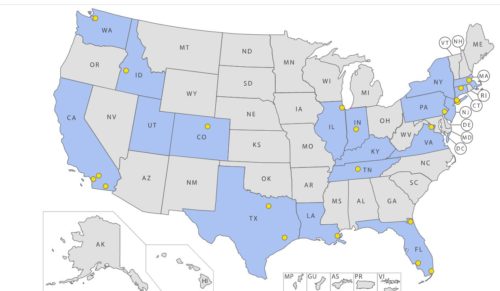
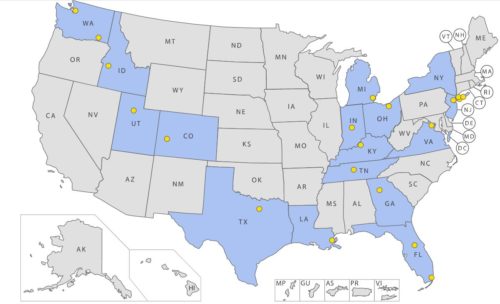
Over the weekend, TSA updated its map and its list showing
which states and which airports have TSA screening officers who have tested positive
for COVID-19.
On Saturday, March 28, TSA reported that over the past two weeks 55 TSA screening officers have tested positive for COVID-19.
TSA says 19 others who had “relatively limited interaction with the traveling public” tested positive as well.
We hope those officers recover quickly, of course. But if you’ve traveled through an airport in one of the blue states on the map during the past few weeks, be sure to check this list to see which airports are affected.
The list includes the last date the officers worked, the checkpoints they were stationed at and their shift hours.
If you think you may have passed through the checkpoints where these officers were stationed, please be sure to check with your doctor about what steps to take next.