TSA

TSA donation policy + Airports & Halloween

Many airports, airlines and community groups have been helping out federal workers working without pay at airports by setting up food pantries and making gift cards, diapers and other basic necessitites available.

Members of the public are helping out too. And, if you’re so inclined, TSA has shared this information about the proper way to do that.

Airports getting into the Halloween spirit

Many airports around the country – and the world – have a great time celebrating Halloween.

More airports add food pantries for federal employees and refuse to air DHS video

The Salt Lake City International Airport (SLC) is joining the list of airports organizing and paying for food and supply pantries to assist federal employees who are not being paid during the federal government shutdown.

These workers include Transportation Security Administration (TSA) and Customs and Border Protection (CBP) workers who are considered essentional workers and are required to work without pay.

The pantry is located in the SLC Dept of Airports office and includes everything from bread and pasta to diapers and toilet paper, toothpaste and laundry detergent.

SLC airport officials say they plan to restock and keep the pantry open as long as the federal shutdown is in place.

Some of the other airports that have already put together pantries and support programs for these workers include Hartsfield Jackson Atlanta International Airport (ATL), Reno-Tahoe International Airport (RNO) and El Paso International Airport (ELP).

Several airports will be rolling out similiar programs next week.

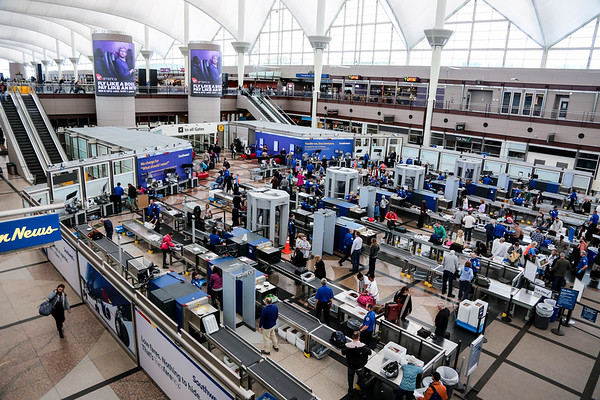
Meanwhile, there’s a long – and growing – list of airports that are refusing to run a video at security checkpoints in which Homeland Security Secretary Kristi Noem blames Democrats for the continuation of the federal government shutdown.

In Detroit, the Wayne County Airport Authority has posted statements and photos explainging that it has requested that TSA stop playing the video at Detroit Metropolitan Airport (DTW).

“WCAA does not operate the checkpoint monitors, which are located in TSA-leased space. The TSA did not seek approval to play the message.”

The airport has placed these signs near the checkpoint entrances explaining why the videos are running.

Government shutdown travel ticker + Airports balk at running DHS ‘blame’ video.

Las VegasAirport

Government shutdown taking a toll on travel

Last week, the U.S. Travel Assocation ran the numbers and said that the government shutdown will cost the travel economy $1 billion a week.

As we head into the second week of shutdown, the organization has a ticker tape running to tally the ongoing losses. It’s not pretty.

Airports opt out of Department of Homeland Security ‘blame’ video

Air traffic controllers, TSA officers and Custom and Border Protection employees are required to show up for work at the nation’s airports, even though they’re not being paid during the government shutdown.

The current administration, via the Department of Homeland Security, has produced a propaganda video to be shown at airport security checkpoints featuring Homeland Security Secretary Kristi Noem claiming that “Democrats in Congress refuse to fund the federal government, and because of this, many of our operations are impacted and most of our TSA employees are working without pay.”

But airports are pushing back.

So far, we’ve learned that Portland International Airport (PDX), Seattle-Tacoma International Airport (SEA), Spokane International Airport (GEG), Buffalo Niagara International Airport (BUF), Niagara Falls International Airport (IAG), Cleveland Hopkins International Airport (CLE) and Westchester County Airport (HPN), north of New York City, won’t be airing the video.

“We believe the Hatch Act clearly prohibits use of public assets for political purposes and messaging,” a PDX spokesperson told local news outlets, adding that, Oregon law states no public employee can promote or oppose any political committee, party, or affiliation. We believe consenting to playing this video on Port assets would violate Oregon law.”

Officials at the Port of Seattle, which operates SEA, said they won’t air the video due to its “political nature.”

We suspect there will be more airports that opt out of airing the video and and will add to the list.

TSA shelves “shoes off” policy

The Department of Homeland Security formally announced on Tuesday that all commercial airline passengers passing through Transportation Security Administration checkpoints at airports are now allowed to keep their shoes on.

TSA first instituted a “shoes off” policy in 2006, almost five years after “Shoe Bomber” Richard Reid tried to set off explosives hidden in his shoes during an American Airlines flight from Paris to Miami.

Travelers with TSA PreCheck status have been able to keep their shoes on at TSA checkpoints since 2013, courtesy of the expedited screening privileges the paid program offers.

But as of today, all passengers, including those with and those without TSA PreCheck status, may keep their shoes when going through screening at airport checkpoints.

Why the change?

DHS believes that its “cutting-edge technological advancements and multi-layered security approach” means the agency can now “implement this change while maintaining the highest security standards.”

Keep in mind, though, that the ‘shoe pass’ isn’t universal.

If you have shoes with metal in them, they’re likely to set off the alarm and you’ll be asked to take them off and send them through the X-ray machine.

If you’re selected for random extra screening (the dreaded “SSSS” on your boarding pass), you’ll also likely be asked to take your shoes off and send them through the machine.

And, as we were today, you also may be chosen at random to step aside at the checkpoint and have your shoes wiped with those little pads to check for explosives.

How many firearms did travelers bring to airport checkpoints in 2024?

The Transportation Security Administration (TSA) released its 2024 tally for the number of firearms found at airport checkpoints.

And while this time around the number of “finds” isn’t a record breaker, it’s still quite shocking.

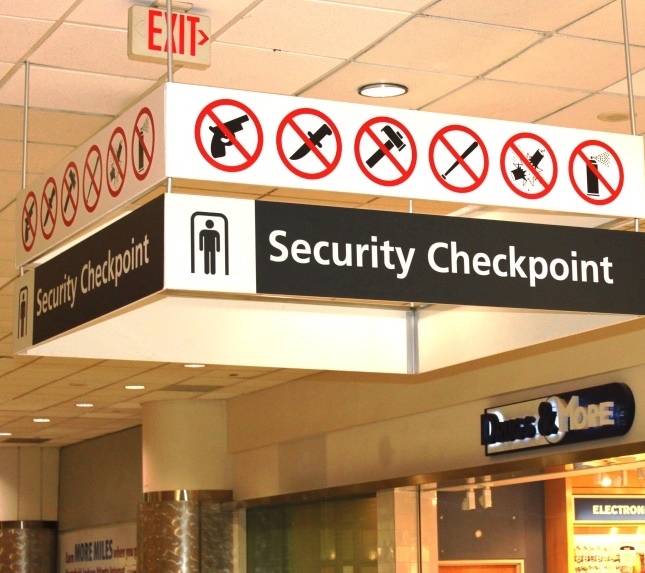
In 2024, (TSA) found a total of 6,678 firearms at airport security checkpoints, a slight decrease from the 6,737 firearms found in 2023.

More alarming: In 2024, approximately 94% of the firearms passengers brought to the checkpoints were loaded.

TSA screened more than 904 million passengers in 2024 and the total number of firearms found equates to 18.2 firearms found each day and 7.4 firearms per million people.

That’s a decrease from the 7.8 firearms per million people in 2023.

In 2024, firearms were discovered at 277 airports with the most firearms, 440, found at Hartsfield-Jackson Atlanta International Airport (ATL).

Other airports on the Top 10 list for firearm discoveries include:

Dallas Fort Worth (DFW): 390

George Bush Intercontinental (IAH): 272

Phoenix Sky Harbor (PHX): 247

Nashville (BNA): 188

Denver (DEN): 166

Orlando (MCO): 150

Dallas Love Field (DAL): 143

Tampa (TPA): 135

Austin (AUS): 126

What happens when TSA discovers a firearm at an airport checkpoint?

TSA will immediately contact local law enforcement and, depending on local laws, the person who brought the firearms to the airport will either be arrested or cited.

TSA does not confiscate firearms, but in addition to any action taken by local law enforcement, the agency has the authority to levy a maximum civil penalty of $14,950 and revoke TSA PreCheck eligibility revoked for at least five years.

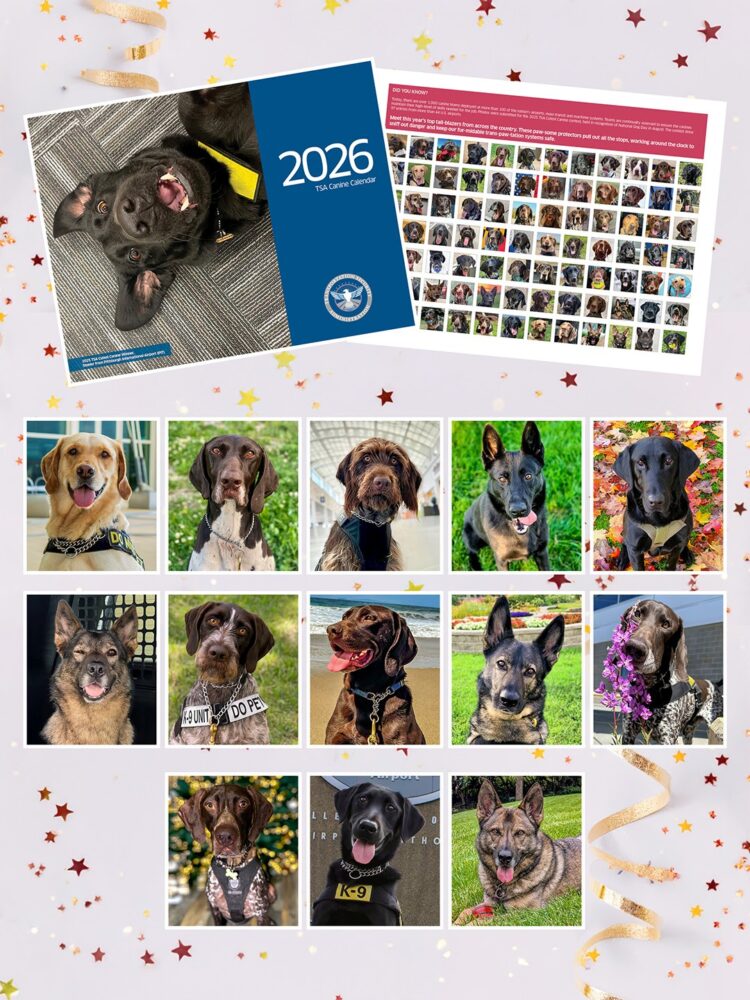
Download TSA’s 2025 Canine Calendar

Love dogs and looking for a fun, free 2025 calendar?

Then check out the 2025 Canine Calendar put out – for free – by the Transportation Security Administration.

The calendar features 13 hard-working TSA canines selected from more than 80 entries submitted by TSA teams nationwide. Each month features photos, fun facts about each winning pup as well as notations for special holidays, such as Squirrel Appreciation Day (January 21) and World Chocolate Day (July 7).

The 2025 TSA Canine Calendar also includes factoids about the history of TSA’s canine program.

For example, if you turn to the March 2025 page you’ll learn that the Federal Aviation Administration’s (FAA) canine program was created after a bomb threat at John F. Kennedy International Airport (JFK) on March 15, 1972.

On that day, moments into a flight, the airline received an anonymous call warning about a bomb onboard. The aircraft returned to JFK where passengers were evacuated and a bomb-sniffing dog named Brandy was brought on board to search. Brandy found the explosive device 12 minutes before it was set to detonate.

Yay, Brandy!

Today, there are more than 1,000 canine teams (dogs and handlers) deployed at more than 100 of the nation’s airports, mass transit and maritime systems.

Not just any dog is suited to work with the TSA.

According to the TSA, each year about 300 new canine recruits complete an intensive 16-week training program at the TSA Canine Training Center, located at Joint Base San Antonio-Lackland in San Antonio, Texas.

While in training, the dogs are paired with their handlers and then master the art of detecting a variety of explosives odors. The dogs are also trained on how to do their sensitive work while on duty in busy transportation environments.

Here’s the line-up for this year’s TSA Canine Calendar. Download your copy here.

  • Argo: Baltimore/Washington International Thurgood Marshall Airport (BWI)
  • Arina: Phoenix Sky Harbor International Airport (PHX)
  • Badger: Chicago O’Hare International Airport (ORD)
  • Barni: San Francisco International Airport (SFO)
  • Bely: Charleston International Airport (CHS)
  • Beny: Boston Logan International Airport (BOS)
  • Birdie: Milwaukee Mitchell International Airport (MKE)
  • Bruno: Jackson-Medgar Wiley Evers International Airport (JAN)
  • Carlo: Kansas City International Airport (MCI)
  • Dodo: Portland International Airport (PDX)
  • Hary: Richmond International Airport (RIC)
  • Kipper: San Diego International Airport (SAN)
  • Smokie: Dallas Love Field (DAL)

Airports celebrate National Dog Day

Monday, August 26, was National Dog Day and airports around the country took the opportunity to celebrate the therapy dogs and their people who volunteer to hang out in the terminals helping passengers de-stress.

Here’s a sampling of some of the celebrations. Let us know if we missed yours.

And, look! After all the votes were counted, Barni from San Francisco International Airport (SFO) has been crowned the Cutest Canine for 2024.

TSA’s 6 month gun tally + Happy Birthday SEA

The Transportation Security Administration (TSA) has been screening a record number of travelers and finding lots of firearms as it does.

How many firearms?

For the first half of the year, which ended on June 30, TSA reports that it found 3,269 firearms at airport security checkpoints, an average of 19 firearms a day.

94% of all the firearms found so far were loaded.

During this period last year, TSA found about the same number of firearms: 3,251.

How’s it going now that we’re into the 2nd half of 2024?

In the first 8 days of July, TSA found an additional 166 additional firearms. So we’re off to an alarming start.

Happy 75th birthday to Seattle-Tacoma Int’l Airport

SEA easing into its 75th year

Seattle-Tacoma International Airport (SEA) celebrated a milestone birthday on Tuesday with a day of festivities in the terminal and a look back at opening day.

SEA scavenger hunt

SEA created a terminal-wide scavenger hunt in honor of its 75th birthday.

Here’s the map of where to look for the scavenger hunt items and the list of what to look for next time you’re in the SEA terminal.

Travel Tidbits from Airports Near You

Here’s a quick roundup of fun posts and new amenities recently spotted at airports.

New York’s Albany International Airport (ALB) is getting ready for all the travelers who will be arriving for the Belmont Stakes horse race in Saratoga on June 8.

They’ve set up a selfie station with a horse statue just past the security checkpoint.

Party on!

Airports often put together a gate-side celebration when an airline kicks off a new route. But Louis Armstrong New Orleans International Airport (MSY) does it especially well.

We’ve been watching these Jabbrrbox workspace pods sprout at Seattle-Tacoma International Airport (SEA) over the past few months and have yet to try them out. Given how busy the airport is this season, though, we’re sure travelers with work to do or important calls to take will find them useful.

We’re keeping an eye out for the colorful posts from airports in support of Pride Month.

Vancouver International Airport (YVR) is lighting up its tower with a two-fer in support of Indigenous History Month AND Pride Month.

And we got a kick out of this TSA post recognizing National Hug Your Cat Day. Is that even a real thing?

Self-service security screening? It’s being tested

Self-service checkout works at the grocery store.

So why not self-service screening at the airport?

That’s what the Transportation Security Administration has in mind.

For the next six months, TSA and the Department of Homeland Security will be testing a self-service checkpoint at Harry Reid International Airport (LAS) in Las Vegas.

Starting in mid-March, travelers enrolled in TSA PreCheck will have the option to use TSA’s Innovation Checkpoint at LAS and test out a prototype technology that includes new body scanning technology that lets passengers complete the screening process on their own.

As they do now, travelers will empty their pockets and put all carry-on items into bins that go through the X-ray machines. Then each passenger steps into an enclosed scanning booth.

If, for example, the passenger has left a cell phone in their pocket, the booth directs them to step out, empty their pockets and try again.

The goal, TSA says, is to use this technology to cut down on instances where a TSA agent is required to conduct a pat-down or secondary screening.

Curious about how it works and ready – or not – to give it a try?

Here’s a TV clip from TODAY.