Whether you’re a kid or an adult, your first flight on an airplane is a big deal.
Virginia’s Norfolk International Airport (ORF) gets that. And, clearly, the folks who work at the airport remember that scared, giddy feeling of taking that first flight.
Like many other airports, ORF is on target to break passenger records this year. And like many other airports, ORF has a bundle of capital projects underway to modernize and expand its facilities.
The airport is also working on upping the customer experience. They’ve built a new children’s play area and have complimentary coloring books and crayons available at the airport Information Booth for anyone who asks.
Also free for the asking, My First Flight buttons.
“The idea is akin to what some theme parks make available for first-time visitors,” said ORF airport spokesperson Chris Jones. “We found a button-making kit online and then designed and created the buttons in-house. Hopefully, kids will hold onto them as keepsakes to remember their first flight into or out of ORF.”
The My First Flight buttons are rolling out this week and are available at the airport information booth. Volunteer Ambassadors are also carrying them to hand out.
Keep in mind: First Flights can take place at any age.
So don’t be shy about asking for a My First Flight button at ORF if you fit the bill. You don’t have to wear it, but it’s a great souvenir.
And it’s our Airport Amenity of the Week.
Every child's first flight is a magical moment 🌟 We now have "My First Flight" buttons to help commemorate the experience. Remember this milestone with a keepsake that celebrates the joy of new adventures. You can pick one up at our Information Desk! ✈️ pic.twitter.com/aWBSsQREmg
— Norfolk International Airport (@NorfolkAirport) August 27, 2024
(This is a slightly different version of a story we wrote for NBC News)
What makes a happy camper this summer? S’mores, sing-alongs and — lately — streaming.
The pandemic nudged millions of people toward outdoorsy trips and experiences, and many are now hooked. But they’re increasingly demanding a decent Wi-Fi connection wherever they pitch their tents or park their RVs, and campsites are providing it.
Wi-Fi at campgrounds has become “the fourth utility behind water, sewer and electric,” said Tim Rout, founder and chief solutions officer at AccessParks, a San Diego-based broadband provider for RV parks and campgrounds.
“Six or seven years ago it was a ‘nice to have’ service so people could load their email or check their bank account,” said Rout. “Now people expect the same quality of service in RV parks that they get at home.”
Who wants to be connected when camping?
About 40% of campers say Wi-Fi availability influences where they decide to camp, said David Basler, chief strategy officer for the Outdoor Hospitality Industry trade group. “Generationally, this increases to 65% in Gen Z and millennials and 45% in Gen X campers,” he said.
Searches for Wi-Fi-equipped U.S. properties on the campsite booking platform Hipcamp are up 110% year over year, according to founder and CEO Alyssa Ravasio, who said the number of such sites grew by 30% over the past year. Most Hipcamp hosts that provide Wi-Fi don’t charge guests extra for it, Ravasio added.
Wi-Fi is now offered at 82% of U.S. campsites, OHI estimates, slightly ahead of laundry and even shower facilities. It was the most commonly provided amenity last year among privately operated camping properties surveyed recently by The Dyrt. The camping information app found Wi-Fi being added at a faster rate (nearly 16% of campsites added it from 2022 to 2023) than pickleball courts (12%), dog parks or kayaks and canoes (each at 10%).
Working while camping
The Dyrt found 29% of campers worked while camping last year, up from less than 24% in 2022 and 2021, even as more employers mandated a return to in-person work. Some campers may have been “quiet vacationing” — working from a remote destination rather than taking off to fully unplug.
Rout said AccessParks’ business was already growing before the pandemic. “But since more people flocked to the outdoors and RV sales accelerated, there is a younger, more professional demographic in campgrounds — more families, more Zoom calls with work, distance learning, etc.,” he said. “Since then, our growth has dramatically increased due to the demand for fast broadband Wi-Fi.”
At least one Montana campground relies on Wi-Fi for a camera system that monitors the area for grizzly bears, Rout added.
Wiring up
Marley Behnke said Wi-Fi was already installed at the campground in Grayling, Michigan, that she bought in late 2022. In addition to letting guests stay connected and share details from their adventures with loved ones, “there are apps that provide real-time updates for activities, facilitate food delivery, organize scavenger hunts and enable interactive games,” she said.
Wiring a campsite for high-speed broadband comes with challenges like ensuring the signal can make its way through uneven terrain, trees and metal RV bodies and withstand extreme weather. Depending on property size and the type of service offered, installation might run anywhere from $50,000 to $500,000, Rout said, though campgrounds can typically recoup the expense by raising prices by little more than $1 a night.
While middle- and lower-income travelers are especially keen to camp this summer, Deloitte researchers say, camping demand is up 7% in a year when high-income travelers comprise a greater share of this season’s leisure travelers overall. The “glamping” (glamorous camping) sector is forecast to grow by more than 15% each year through 2029, according to Arizton market research.
“I’ve got kids who have not grown up camping consistently, so I definitely need a posher camping experience,” said Sommer Nyte, 46, a Bellingham, Washington, realtor who recently bought a new pop-up tent trailer. Wi-Fi is on her wish list alongside pools, boat rentals and programming for families with children.
Internet connectivity isn’t sweeping every campsite, though.
While the RV Industry Association found about 60% of private sites offered Wi-Fi as of 2022, only 3% of public ones did.
In New Zealand, the appearance of a group of stars named Ngā mata o te ariki Tāwhirimātea (Matariki) in the winter night sky marks the traditional beginning of the Māori new year.
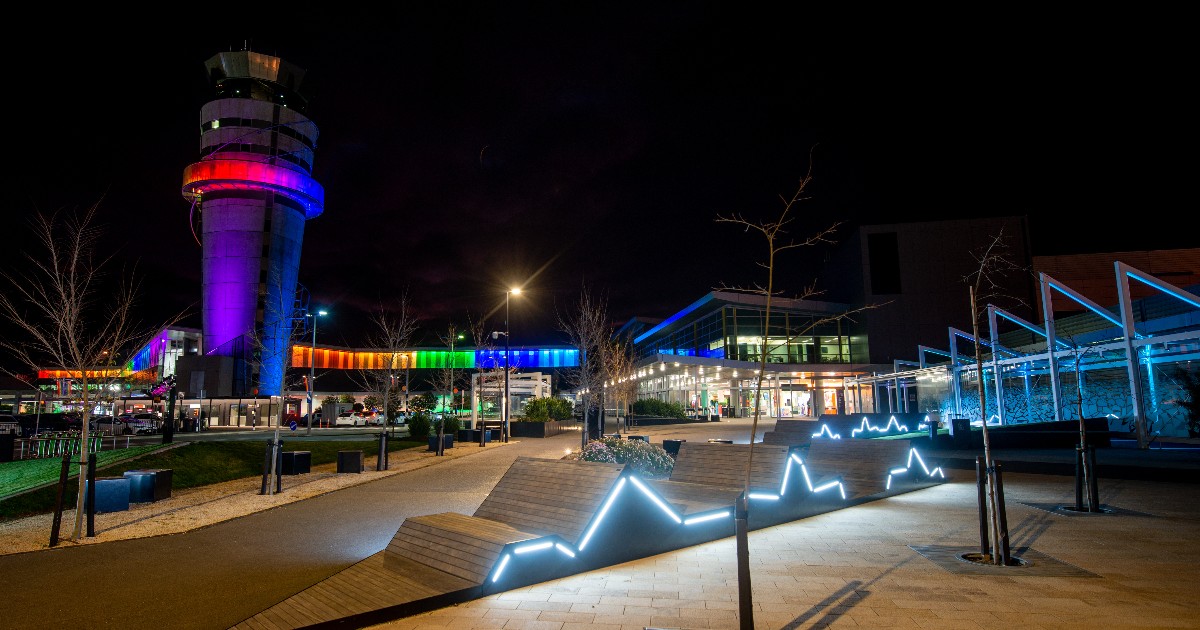
In addition to some great art inside and around the terminal, which travelers can discover on this handy art trail map, Christchurch Airport has outdoor ping pong tables on its plaza and themed jet bridges.
The Stuck at the Airport team hasn’t seen these themed jet bridges in person – yet – but we love the idea.
According to the airport, each themed jet bridge features floor to ceiling imagery of a special southern landscape, accompanied by the scene’s distinctive sounds and scents. Scents!!!
The themes are updated every so often with new sights, sounds and smells. But current themes include the Mackenzie Night Sky, West Coast, Kaikoura, Abel Tasman, Fiordland, a Canterbury sheep farm, Mackenzie country, Christchurch Adventure Park and a Marlborough vineyard.
Some of the other amenities we’re looking forward to exploring at Christchurch Airport include the coloring wall and the complimentary Mini Explorer Activity Books.
We’re also intrigued by ‘Spitfire Square,‘ which is a short walk from the airport terminal and home to a fitness center, a hair salon and a pharmacy.
Like all airports, London’s Heathrow Airport is very busy for the holidays, with more than three million travelers expected to pass through the terminals in just the last two weeks of December.
But unlike all airports, Heathrow is passing out thousands of gifts to passengers to help them on their merry way.
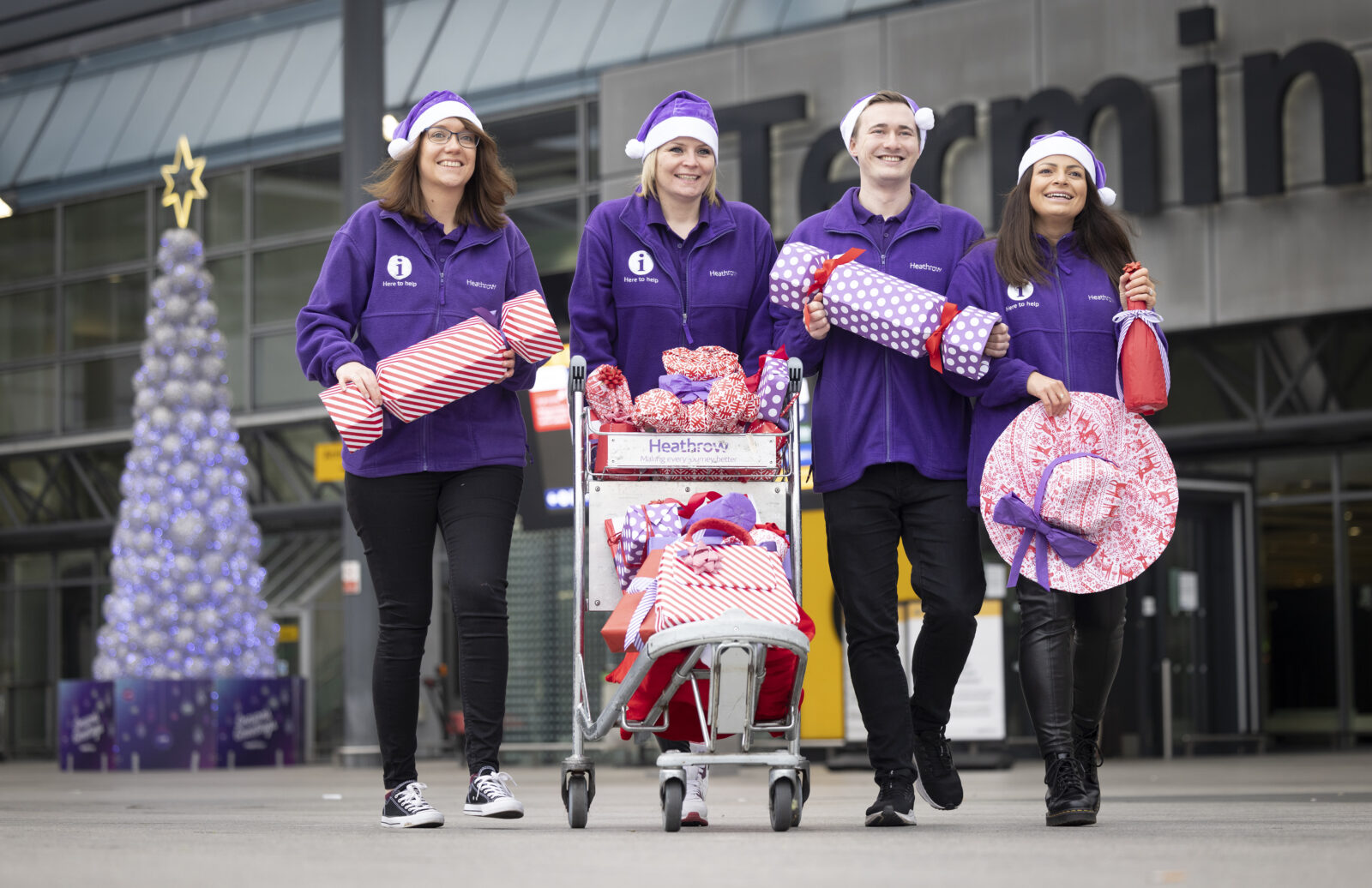
Throughout December, Heathrow’s team of ‘Little Here to Helpers’ are handing out 10,000 gifts across all four terminals. The gifts are provided by airport tenants, including airlines, shops, bars, and restaurants, and include everything from free flights and lounge access to Chanel perfumes, Pret breakfasts, and designer makeup from World Duty Free.
Want a gift? If you’re traveling through Heathrow look for the smiling folks in Santa hats hanging out near one of the 25 Christmas trees spread across the terminals. Not everyone will get a free gift, of course, but if you head that way, you’ll increase your chances.
Let us know if you score.
But wait, there’s more!
Heathrow also has an advent calendar on its website and on its app. Behind the windows, you’ll find discounts from Heathrow shops, bonus points from Heathrow Rewards, World Duty Free promotions, and deals on festive-inspired food and beverage menus.
Kids Eat Free
Airport meals can get expensive. And if you’re traveling with kids you’ll have to feed them too.
So it’s nice to know that Heathrow’s Kids Eat Free program is still in force.
Through January 3, 2023 participating restaurants at Heathrow Airport will offer once free child’s meal with each adult meal purchased, with a limit of four free kids meals.
This is a great airport amenity and is available during school holidays.
You may notice the heartwarming news and social media posts about airports working hard to reunite left behind stuffed animals with their rightful owners.
Teddy and 5-year-old Ezekiel have been REUNITED! Thank you @SouthwestAir and the 4 million people across the globe who followed along on Teddy's journey. We're so glad he's home! pic.twitter.com/UWv9cI7m8G
Or, the story that likely started the heartwarming “airports goes-all-out-to-reunite stuffed animal with child” trend. Back in 2015, Tampa International Airport took a stuffed tiger named Hobbes on an airport adventure before sending Hobbes home.
— Tampa International Airport ✈️ (@FlyTPA) June 15, 2015
We love these stories.
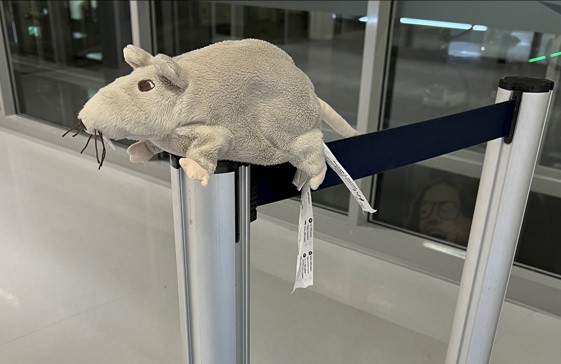
So, when making our way through Norway’s Bergen Airport (BGO) last week at about 5 am we did a double-take when were spotted a stuffed rat taped to a lane post.
It was very early in the morning. But we did notice that Bergen Airport is spotless. So it didn’t seem likely that the stuffed rat was there as a social comment. Nor did it seem like an official guidepost to point travelers to their gates.
So all we could conclude was that this stuffed rat had been left behind by a small child. And that it may soon show up on Bergen Airport’s social media feed in search of its owner.
We’ll check back to see.
Other amenities spotted at Bergen Airport
Besides the stuffed rat, there are some other sights at Bergen Airport that made us smile.
The sign for the bathroom employs the hard-to-miss universal symbols for “gotta go, now.”
And the kids’ play area in the main terminal area has this fun hopscotch board with an airplane, of course, in the top box.
Have you spotted a cool amenity (or a stuffed rat) and an airport? Send us a photo and we’ll try to include it in a future post on Stuck at the Airport.
We know that right now some of the features we mention might be temporarily unavailable due to health concerns. But we are confident they will be back.
Did we miss your favorite amenity at Dulles International Airport (IAD)? Let us know in the comments section below.
Have an airport you’d like to see featured in the “5 Things We Love About…” series? Make your nomination in the comments section as well.
5 Thing We Love About Dulles International Airport
1. The IAD Main Terminal Building
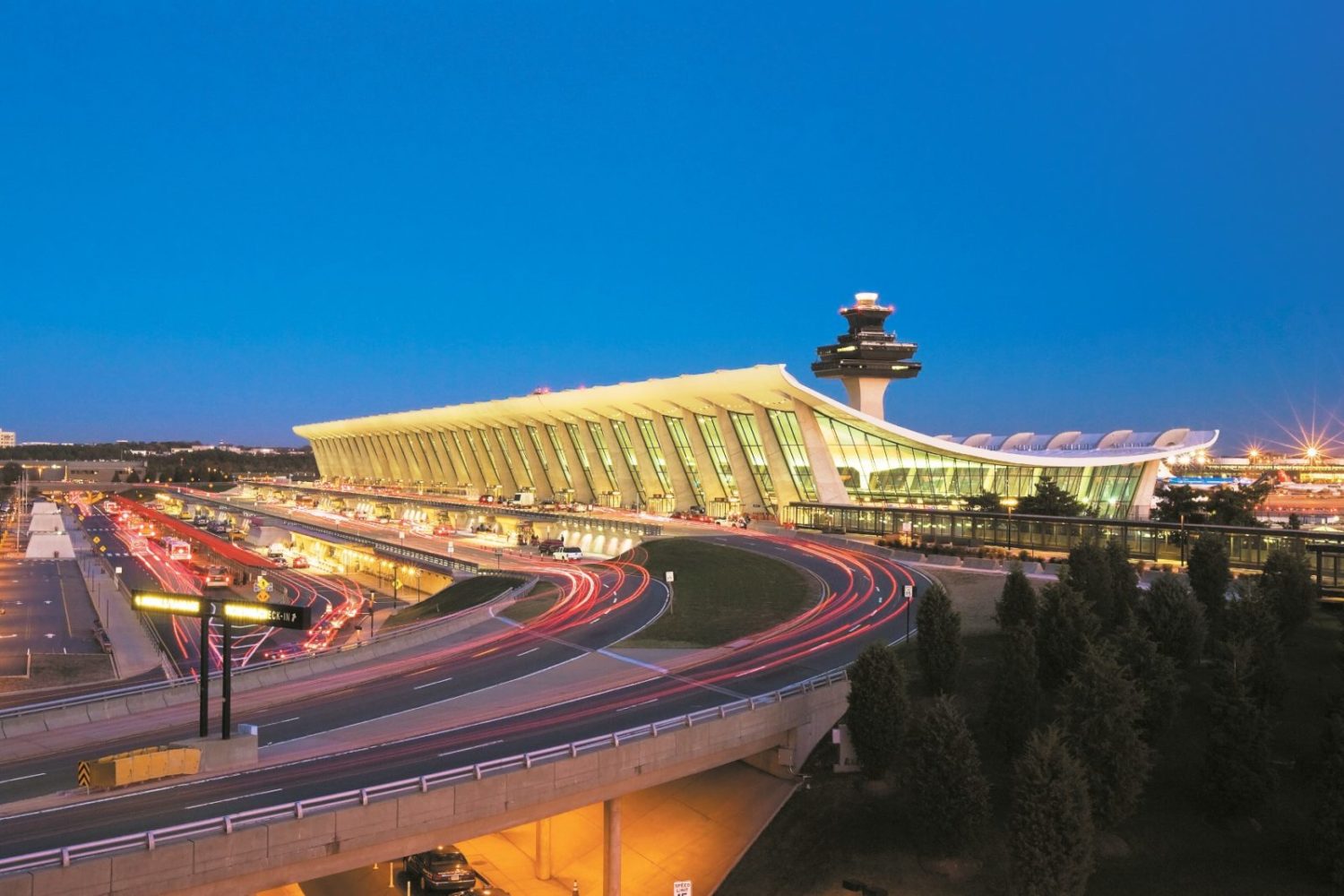
Opened in 1962 as the country’s first ‘jet-age’ airport, Dulles International Airport is perhaps best-known for architect Eero Saarinen’s iconic curved-roof design for the main terminal.
2. The mobile lounges at IAD
These days, many passengers at IAD move between concourses on the underground AeroTrain, a 3.78-mile underground people mover system.
But IAD’s historic mobile lounges are in still in use.
IAD’s mobile lounges transport international arriving passengers from their arrival gate to the International Arrivals Building. The mobile lounges shuttle passengers between the main terminal and the concourses, and between concourse. And when airplanes are parked on a remote hardstand, the mobile lounges ferry passengers to the main terminal.
3. The historic FAA air traffic control tower at IAD
The original Airport Traffic Control Tower (ATCT) at Dulles International Airport dates to the airport’s opening in 1962 and remains on-site because of its historical significance to the airport’s design.
A new tower was dedicated in 2007 and is about one mile from the original tower.
4. Kids play area at IAD
What can we say? Sometimes kids have all the fun at the airport.
5. Only airport with Chipotle breakfast
Want a breakfast burrito made by Chipotle? The only place you will find that on the Chipotle menu is at Dulles International Airport.
Bonus: Pat Nixon christens 1st 747
Back on January 15, 1970 then-First Lady Pat Nixon christened the first commercial Boeing 747 during a ceremony at Dulles International Airport.
Our “5 Things We Love About…” series celebrating features and amenities at airports around the country and the world continues today with 5 Things We Love About Houston’s William P. Hobby Airport (HOU).
Keep in mind that some amenities may be temporarily unavailable due to health concerns. We are confident they’ll be back.
If we missed one of your favorite things about Houston’s William P. Hobby Airport, please leave a note in the comments section below.
HOU: 5 Things We Love About Houston’s William P. Hobby Airport
1. The Art At HOU
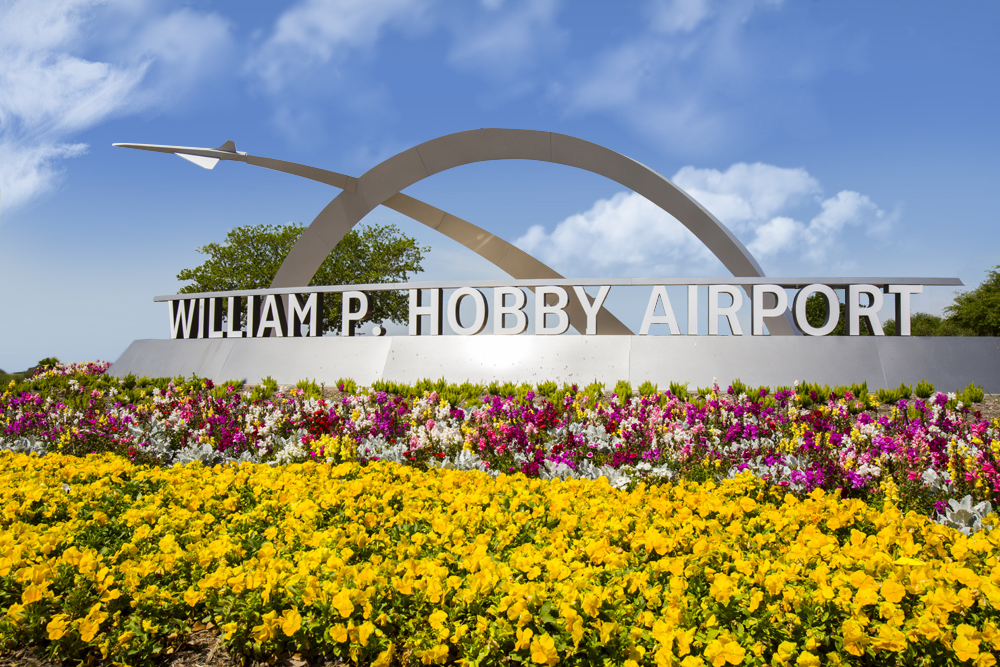
Houston’s Airport System has one of the largest collections of public art in the state of Texas and William P. Hobby Airport (HOU) gets to show off quite a bit of that art.
2. The music at HOU
HOU’s Harmony in the Air program presents live music performances in the Central Concourse Rotunda.
Concerts are scheduled Monday through Saturday and include everything from classical, jazz and pop to international music.
3. Amenities for families at HOU
HOU has a 450-square-foot space-themed play area near Gate A4 with a rocket slide, comet climbing structure, and an interactive light board.
The airport also has two nursing rooms. Each room has AC and USB power outlets, a changing table and nursing glider chairs. Locations: near Gates 4 and 46.
4. NASA exhibit at HOU
Houston is “Space City,” so travelers passing through HOU airport are treated to space-themed exhibits.
5. Souvenirs at HOU
The souvenir shopping at HOU ranges from space-themed items to more traditional Texas-wear.
Did we miss one of your favorite amenities at Houston’s William P. Hobby Airport (HOU)? Add your note in the comments section below.
(This is an ever so slightly different version of my story that posted on NBC News).
Would a “clean city” pledge get you to plan a trip?
We’re into what by all rights should be a busy summer travel season. But many states are hitting the breaks on reopening plans due to record spikes in COVID-19 cases.
Yet in many parts of the country, beaches and bars are filling up, hotel occupancy rates are rising and attractions such as zoos, aquariums and museums are welcoming back visitors.
Disney World Resort’s phased opening plans in Florida are on track, even though Disneyland’s plans in California are delayed.
The push to reopen is being fueled in part by businesses starving for customers and cash flow. But also by a cooped up public cautiously optimistic about making travel plans and hoping for a slowdown in the spread of COVID-19.
Communities that for months have been asking guests to stay away are now scrambling for ways to get business and leisure travelers to come back.
Campaigns to get tourists back
Now, branded campaigns declaring a destination clean, safe, and sanitized are trending.
“Tourism has taken a serious blow and destinations are doing whatever they can to restore consumer confidence,” says Misty Belles, a managing director with the Virtuoso travel agency network. “We know that concerns over contracting the virus are one of the key barriers to getting people comfortable with traveling again, so cities across the country are touting their enhanced cleaning protocols to quell those fears,” she adds.
In Ohio, window decals and website badges in Columbus are a sign that businesses have signed the “Live Forward” pledge to make the health and safety of patrons a priority.
“To meet this obligation, we’ve established additional protection measures and trained our team in enhanced best practices for safety and sanitation,” says David Miller, President and CEO of Cameron Mitchell Restaurants.
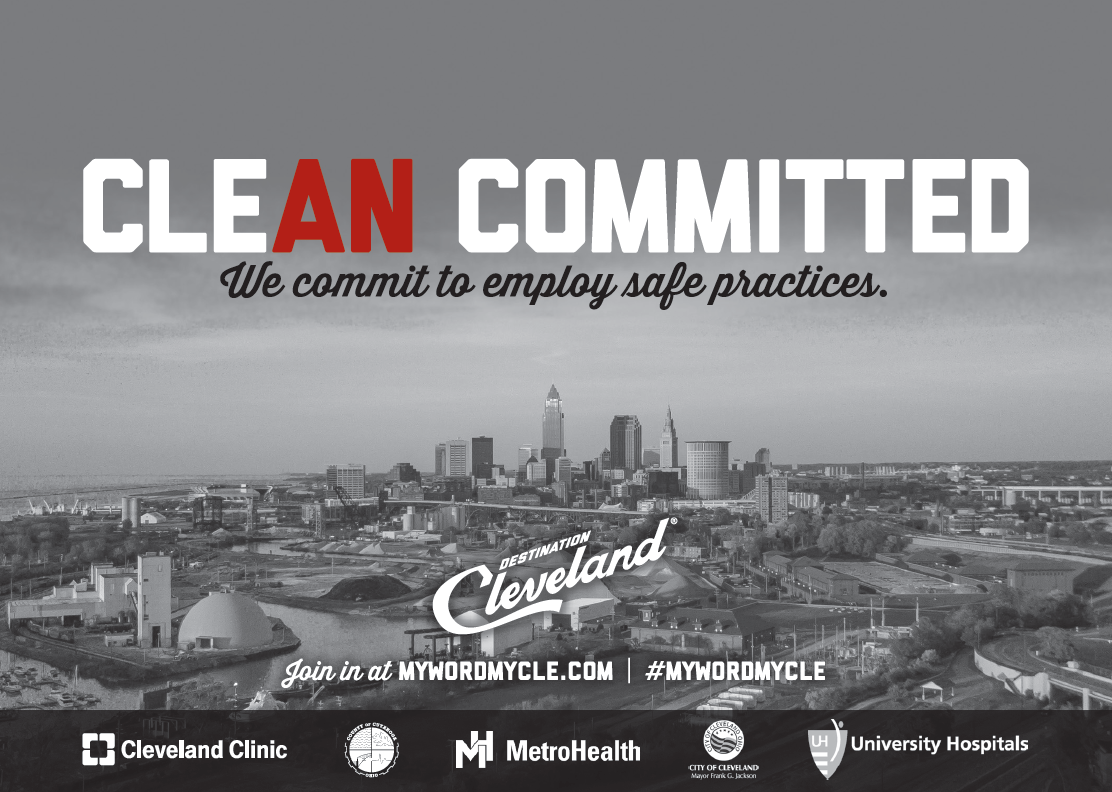
Cleveland’s Clean Committed campaign provides participating businesses with safety kits, guidelines, and materials to help make sure the city is ready for the return of visitors.
In Rochester, Minnesota (home of the Mayo Clinic), businesses in the Rochester Ready program are also implementing protocols in physical distancing, masking, cleaning, sanitizing and building ventilation.
Nashville’s Good to Go program is one of many with searchable databases of businesses that have vowed to adhere to coronavirus guidelines.
States are getting into the act as well. For example, Indiana has a Hoosier Hospitality Promise and the Count on Me NC public health initiative program stretches across North Carolina.
The list of vacation spots with clean campaigns is long and getting longer.
It is not only because cities are taking the health concerns of citizens and visitors seriously. Lodging industry consultant Bjorn Hanson says it also because “no destination manager or government entity wants to be viewed as doing less than others to attract and protect travelers.”
Will travelers trust a city’s seal of cleanliness?
Megan Tenney, whose family of six has been traveling full time since September 2018, now monitors COVID requirements and the health news in places the family is considering visiting.
“We’re focusing on places that seem to be doing better or were less affected to begin with,” said Tenney, “And I think a ‘clean campaign’ would give us the confidence to travel to a location.”
But while Brian DeRoy of Charleston, South Carolina feels that “whoever can market best in the game of being clean is going to have an advantage,” Seattle-based frequent traveler Rob Grabarek would not feel reassured by a city’s program alone.
“I’d have to examine the extent of a local government’s policies to see if I felt there were sufficient,” said Grabarek, “And while I applaud the idea of identifying businesses that are in compliance, I wouldn’t feel safe unless the entire community were adhering to the same stringent practices.”
Given that there is no single organization or government entity to oversee and assure that all these cleaning campaigns are effective, the emphasis on cleanliness as a destination marketing tool may not last long.
“Our travel advisors tell us there are really two traveler mindsets right now,” said Virtuoso’s Belles, “Those who want to pull back the curtain and know how everything they potentially come in contact with is being sterilized and those who just want to trust that it’s happening. Too much focus on cleanliness may actually backfire on those looking for the escapism in their vacation.”
What do you think? Would a city’s pledge of cleanliness be reassuring enough to get you to plan a trip?
5 Things We Love About San Francisco International Airport (SFO)
Today Stuck at the Airport kicks off a new feature of short airport profiles celebrating some of the services, amenities and features we love about airports around the world.
We could go on and on (as we often do) about some our favorites, of course.
But to keep things moving along, we are keeping the list for this series to just five things we love about each airport.
Our goal is to add at least one “Five things we love about…” feature each week. But, honestly, we’re just hanging around waiting for the time we can once again step foot into some of these airports, so during the next few weeks we’ll likely be posting a few of these features each week.
If you want to add a note about a feature or amenity you love about an airport that we don’t mention, we encourage you to add it in the comments section below.
Keep in mind: some amenities may be temporarily unavailable due to COVID-19 concerns.
And if you want to sponsor one of the “5 Things We Love About…” entries, get in touch.
5 Things We Love About: San Francisco International Airport (SFO)
Courtesy SFO Airport
1. Museums at SFO Airport
Back in 1999, the SFO Museum was the first airport museum to be accredited by the Americal Alliance of Museums (AAM).
Today, the SFO Museum presents charming and educational exhibitions in more than twenty galleries through the airport terminals.
Courtesy SFO Museum
But that’s not all. SFO is also home to the San Francisco Airport Commission Aviation Museum and Louis A. Turpen Aviation Museum, which is home to a permanent collection dedicated to the history of commercial aviation.
2. SFO’s “Kids Spot” play areas
Kids will definitely enjoy many of the museum exhibitions at SFO Airport, but they’ll also enjoy the interactive Kids Spot areas around the airport, located in Terminals 1, 2 and 3.
3. The SkyTerrace outdoor observation deck
Outdoor observation decks at airports are rare amenities these days. SFO has two.
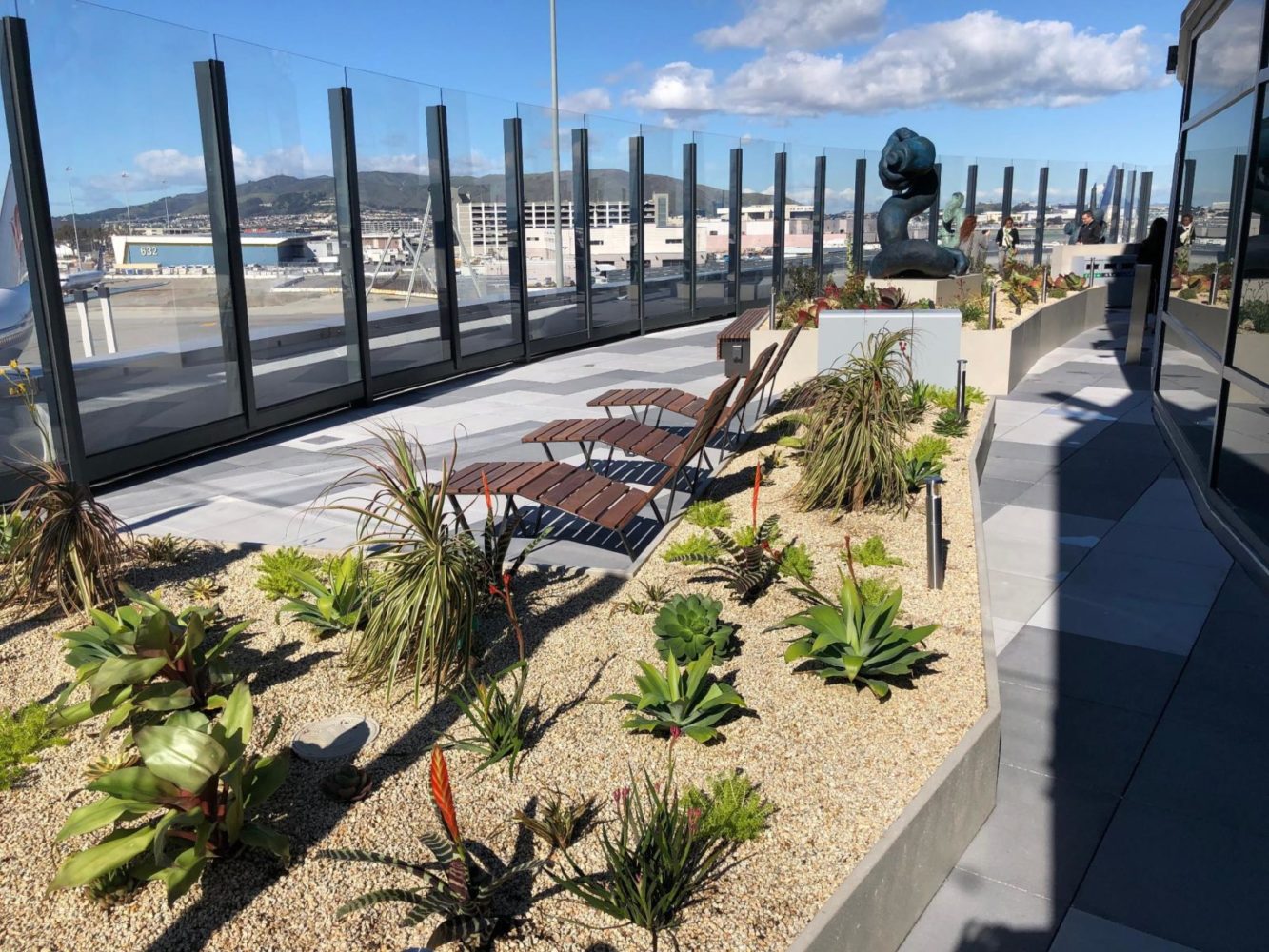
The Outdoor Terrace in International Terminal 5 is located post-security (near Gate G14) and wooden chairs, tables, chaise lounges, drought-tolerant landscaping, bronze sculptures and 180-degree views of the airfield.
The SkyTerrace is an outdoor observation deck located pre-security in Terminal 2 that also offers great views of the airfield.
4. The Wag Brigade therapy animals
Like many airports, San Francisco International has a team of certified therapy animals that mingles with travelers to provide diversion and reduce stress.
SFO’s team is called the Wag Brigade and includes a charming assortment of dogs and a pig named Lilou.
5. Yoga Rooms
SFO created the first airport yoga room back in 2012. Now there are yoga rooms in Terminal 2 and Terminal 3. And a handful of other airports, include Chicago’s O’Hare and Midway Airports and Dallas Fort Worth International Airport, have yoga rooms as well.
This “Things We Love About Airports” segment is made possible by Reel Women Productions, creator of books, radio documentaries, news and feature articles, and the StuckatTheAirport.com blog.
If you’d like to sponsor an upcoming “Things we love about airports” installment, get in touch.
Earlier this month, more than 200 ‘fake’ passengers showed
up at Seattle-Tacoma International Airport.
They weren’t working a scam. And they weren’t there to
protest anything.
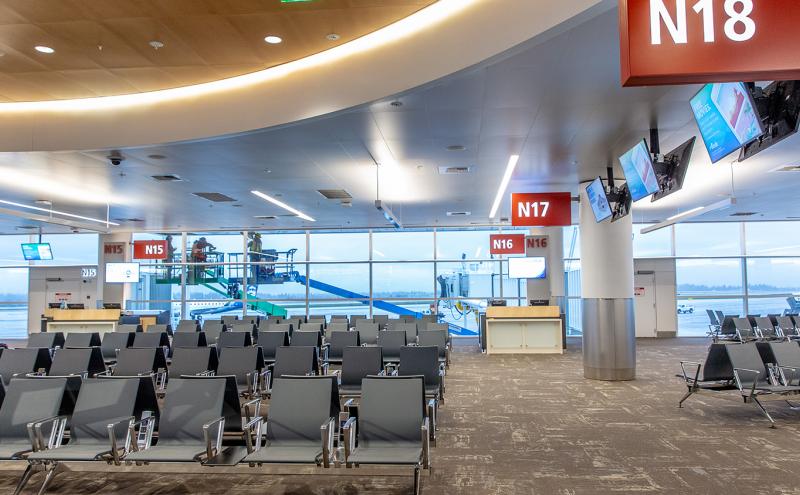
Instead, they were there volunteering to help Sea-Tac airport
test the operational readiness of a satellite terminal undergoing its first
major expansion and modernization in 45 years.
Happy to be spending their Saturday morning at the airport, 3-year-old
Ari Weinstein and his 6-year-old brother, Micah, were toting tiny rolling
suitcases for the day’s pretend flight.
“We thought it would be fun to check-out the new airport
addition and see how easy it was for kids,” said the boys’ dad, Ben Weinstein,
a Boeing engineer, “I’m also curious to see how the latest airport design works
with new airplanes.”
72-year-old Vicki Lockwood and her 93-year-old mom, Ruby
Griffin, had signed up to be testers too.
“I wanted to see what was happening so I can tell my friends
at the senior center what it’s all about,” said Griffin.
Travel agent Rufo Calvo volunteered as a tester so he could
get an early look at the new terminal area and tell his clients what to expect.
And Toffee Coleman, who travels four or times a month for her job in marketing
and sales, was curious to find out what the expanded terminal would offer for business
travelers. “I hope it measures up to the central terminal in terms of ease of
use, amenities and accessibility,” she said.
Opening day for the first phase of Sea-Tac airport’s
expanded North Satellite was less than two weeks away. The bathrooms, drinking
fountains, food concessions and visual paging systems weren’t quite ready, but this
“passenger-flow simulation” was testing the journey between the main terminal
and the expanded satellite as well as the process of boarding and deplaning a
flight at one of the new gates.
“We’ll also be asking the volunteers if the temperature in
the terminal is comfortable and if they can hear the overhead announcements
clearly,” said Charles Goedken, Sea-Tac’s senior manager for Operational
Readiness, Activation and Transition, or ORAT, which is the system of best
practices many airports use from the design stage forward to make sure a new
airport or new terminal is ready for opening day.
“What you try to do is to start working early with the planning and construction team so that when the airport or the facility is open everyone knows what to do,” said Lance Lyttle, the managing director of Sea-Tac Airport, “You don’t want to find issues on opening day; you want to find them before opening day.”
Lyttle was with Hartsfield-Jackson Atlanta International Airport and Houston’s William P. Hobby Airport when each opened new terminals and says no airport wants to relive the opening glitches experienced by Heathrow and Denver airports.
In the early 1990s, the high-profile failure of an
expensive, computerized baggage-handling system delayed the opening of Denver
International Airport by 16 months and increased the construction budget by
millions of dollars.
After that, “DEN returned to manual baggage systems,” said
Denver International Airport spokeswoman Alex Renteria.
In 2008, the grand opening of Terminal 5 at Heathrow Airport’s
turned to mush thanks to a cascading series of staffing and baggage-handling
problems that forced British Airways to suspend luggage check-in and cancel more
than 200 flights over four days. Thousands of passengers missed their flights and
more than 15,000 pieces of luggage were delayed.
“If you have a failed opening of a facility it lives as part of your reputation forever,” said Sea-Tac Airport’s Lance Lyttle, “People use it as an example. And not in a good way. Heathrow underestimated the value of ORAT. But the next time [the opening of Terminal 2, in 2014] they went overboard and got it right.”
New terminals and terminal upgrade projects are underway at
all three New York-area airports and at airports in Istanbul, Singapore, Salt
Lake City, San Francisco, New Orleans, Pittsburgh and many other cities and
testing is key to those projects.
At Turkey’s new international in Istanbul, which is expected
to be fully open by March, 2019, the ORAT (Operational Readiness, Activation
and Transition) team reported for duty more than 20 months ago.
“More
than 60,000 airport community staff have gone thru a familiarization and
training program,” said Stephan Schwolgin, Istanbul Airport’s ORAT project
manager, “More than 175 trials have been conducted with nearly 10.000 fake
passengers and 7 real aircraft.”
The
experience of unbiased, fake passengers is valuable for gathering feedback on
everything from wayfinding and flight information display systems to walking
distances and the availability of power sockets, said Schwolgin.
On February 6 Finland’s Helsinki Airport will hold a test
day with more than 200 fake passengers at the airport’s new central plaza,
called Aukio, which will serve both departing and arriving passengers.
“We will test the functionality of
services and passenger paths, especially the state-of-the-art security check
with a full body scanner,” said Joni Sundelin, Helsinki Airport’s executive
director, “The trial day includes testing not only of the passenger flow,
signage, restaurants and bathroom facilities, but also services and processes
for passengers with reduced mobility.”
During a previous test of a
different part of the airport, “There was a funny
issue with the toilets,” said Sundelin. “Test passengers were wearing brightly
colored vest and when the testers entered the bathroom all the automatic water
taps with motion sensors activated. Apparently the sensors were so sensitive
they recognized the bright yellow and orange vests moving even from the
distance,” said Sundelin.
When testing with fake passengers for San Francisco International Airport’s Boarding Area E, “We learned there was some signage too small or not universal enough,” said Kristi Hogan, Associate Vice President, Transportation for engineering firm AECOM, “No one could find the yoga room.”
For a passenger-flow simulation scheduled for
June 6 in advance of the July opening of 9 new gates at SFO’s Terminal 1,
volunteers of all ages and abilities will be asked to test the terminal signage;
flush toilets and use faucets and automatic hand dryers in the bathrooms; locate
flight display boards; test the Wi-Fi and make phone calls on their cell
phones.
“We’ll have some fake passengers arrive on the
BART train and have others get dropped off at the curb,” said Hogan, “And we’ll
also ask them to become arriving passengers and make their way to baggage
claim, to taxis or to BART.
Trials and simulations will also soon be
underway in advance of the scheduled May 15 opening of the new terminal at Louis
Armstrong New Orleans International Airport (MSY)
“These simulations will test everything from
parking, ticket counters, security checkpoints, flight monitors, restrooms,
gates, concessions, emergency exits, lost and found, and ground transportation,”
said MSY spokeswoman Erin Burns.
Emergency response systems, baggage systems,
PA systems and everything on the facility maintenance side will also get
tested, said Burns, including simultaneous toilet flushes & sink use, seating,
power access and severe weather operations.
Employees and fake passengers will performed many
of these tests but, with perhaps the Denver and Heathrow terminal debacles in
mind, Burns said data on how MSY passengers might experience the facility will
also be gathered during sneak peaks events held in the terminal right up to the
official opening.