If the U.S. government shutdown continues, there could be trouble for travelers and the U.S. travel and tourism economy on multiple fronts.
Trouble at airports and in the skies
For now, airports and airlines are continuing to operate as normal and are issuing reassurances that they are.
But if the shutdown continues, air travelers should be prepared for long security and customs lines and canceled or delayed flights.
Air traffic controllers, TSA officers and Customs and Border Protection (CBP) staff are considered ‘essential workers’ and are required to work during the shutdown.
But they won’t be getting paid. And, as the last government shutdown dragged on, the strain of working under those conditions caused many of those workers to call in sick, take on other jobs or just not show up for their shifts.
TSA says it has stopped actively managing its website and social media accounts during the lapse in federal funding.
However, before stepping away, the agency stated on X (formerly Twitter) that approximately 61,000 of its 64,000 employees are considered excepted or exempt, and that TSA will continue operations.
“The remaining employees will be temporarily furloughed,” it added.
In a pre-shutdown release, the Airline trade group, Airlines for America, warned that while “aviation is the safest mode of transportation, to maintain that during the shutdown, “the system may need to slow down, reducing efficiency.”
The National Air Traffic Controllers Association notes that in addition to air traffic controllers working without pay, the shutdown means that approximately 2,350 aviation safety professionals that NATCA represents, including aircraft certification engineers and aerospace engineers, are furloughed.
“Critical safety support, operational support, and modernization work will stop,” says NATCA.
Closures of museums and National Parks
Elsewhere, Smithsonian Museums and the National Zoo in Washington, D.C. are closed.
A message from the National Park Service says that “National parks remain as accessible as possible during the federal government shutdown. However, some services may be limited or unavailable.”
The agency has posted some closure alerts on its website and has more details in its contingency plan document. But be prepared to find visitor centers, historic buildings and other staffed facilities in any National Parks that remain open to be inaccessible.
There are state and local efforts around the country to keep individual parks and monuments open.
For example, Colorado is offering to help keep its eight National Park properties open. The South Dakota tourism office says many of its National Park sites remain open, including Badlands National Park and Mount Rushmore. However, visitor centers and guided tours are unavailable.
And the Interior Department announced plans to keep the Statue of Liberty and Ellis Island open in New York.
In general, the rule of thumb for travelers during this shutdown is to be flexible, check – and check again – on the status of any place you hope to visit and hope that this mess gets resolved quickly.
Because in addition to the disruptions individual travelers may be dealing with, Tourism Economics estimates that the travel economy is at risk of losing $1 billion a week due to disruptions in air and rail travel and the closure of national parks and museums.
Americans embarking on spring break trips and summer vacations this year face a bevy of new fees, rules, and restrictions in some popular destinations that are rethinking how many visitors to welcome and what types of behavior to accept.
As the post-pandemic travel rebound continues, the return of tourists — and their wallets — is good news for most destinations. At the start of this year, more than half of Americans had plans to travel in the next six months, according to the U.S. Travel Association, and a third of leisure travelers are planning to travel more this year than last.
But taking a page from Venice, Italy, which banned cruise ships in 2021, and Amsterdam, which is launching a campaign to discourage its rowdiest revelers, many U.S. cities are welcoming back visitors on new terms — in some cases with higher price tags.
Lake Tahoe, California
This year, the Lake Tahoe, California, region had the misfortune to land on Fodor’s Travel’s list of places to reconsider visiting in 2023, after suffering traffic congestion, crowded hiking paths, and trashed beaches. It was the downside of a pandemic-era boom in visitors that many outdoor destinations saw while other activities were suspended or came with greater health risks.
“Locals felt the city was too small for the influx of people coming into town,” said Sonia Wheeler, community service officer for the South Lake Tahoe Police Department. “People couldn’t get home from the grocery store sometimes because there was too much traffic from tourists heading to or from the ski resorts.”
Officials hope to strike a new balance. Policies rolled out during and since the pandemic have tightened restrictions on vacation rentals around Lake Tahoe, with a combination of caps and outright bans in towns along its shoreline.
Now, sixteen area groups are trying to hammer out a stewardship plan that recognizes that “our environment, our economy, and our communities are wholly interconnected,” said Tahoe Regional Planning Agency Executive Director Julie Regan. Ideas on the table include parking reservations and encouraging off-peak visits, an agency spokesperson said.
In the meantime, strict enforcement of new laws targeting vacationers — including $500 fines for noise complaints and for using outdoor hot tubs from 10 p.m. to 8 a.m. — have helped.
“Locals still have concerns about the influx of tourists,” Wheeler said, “but since most vacation rentals have been outlawed, except for certain areas of town, our officers aren’t responding to as many complaints.”
The pandemic was a mixed blessing for many destinations
Early on, it gave some communities “a chance to breathe and enjoy their towns, and parks, and beach without the crowds, traffic, noise, etc.,” said Alix Collins of the nonprofit Center for Responsible Travel. But it “also gave them a time to think about how to better manage tourism moving forward.”
As with Lake Tahoe, many areas’ recalibration efforts are “more of a result of the pot boiling over” from tourism pressures, particularly “on traffic, housing, and daily life,” said Seleni Matus, the executive director of the International Institute of Tourism Studies at George Washington University in Washington, D.C.
Elsewhere, the challenge is getting visitors to better coexist with locals.
“A good example is Port Aransas, Texas,” said Cathy Ritter, whose consulting firm, Better Destinations, helped the Gulf Coast town on a barrier island outside Corpus Christi develop a marketing campaign and a mascot aimed at guests.
One goal, she said, was “to educate visitors on the etiquette of using the golf carts locals use to get around.”
Fees At Popular Hawaii Parks
In Hawaii, where state officials expect tourist numbers to recover fully by 2025, a program of timed reservation tickets for out-of-state visitors that rolled out at popular state attractions just before the pandemic is being expanded.
As of last May, nonresident visitors at Oahu’s Diamond Head State Monument, one of Hawaii’s most heavily trafficked parks, must pay $5 per person for timed entry reservations and $10 for parking. Previously, all comers were welcome, anytime, for $1 per person and $5 for parking.
“Before we put the timed reservation system in place, Diamond Head could have more than 6,000 visitors on a busy day,” said Curt Cottrell, administrator of Hawaii’s Division of State Parks. “Everyone wanted to hike at sunrise or in the morning, and the parking lot could be a crushing mass of walk-ins, Ubers, rental cars, and trolleys.”
The timed system caps visitors at 3,000 daily and spreads them out throughout the day. “Now the summit isn’t crowded, there aren’t long lines at the bathrooms and we’re generating four times the revenue with half the people,” Cottrell said.
Separately, a proposed $50 “green fee” — modeled on arrival charges levied in Ecuador’s Galápagos National Park ($100 per person), Bhutan ($200 per day), Costa Rica ($15 per person), Palau ($100 per person) and elsewhere — is working its way through the Hawaii Legislature.
On the U.S. mainland, a timed vehicle reservation program — piloted over the last two summers to reduce crowding during popular times at Rocky Mountain, Glacier, and Arches national parks — will be back in force this summer.
The reservation fee is in addition to vehicle entry fees collected at most national parks.
“Visitation numbers continue to climb toward pre-pandemic levels,” said Jenny Anzelmo-Sarles, chief spokesperson for the National Park Service. “Parks piloting these systems are seeing less congestion at the entrance stations, on the roads and trails, and in parking areas, resulting in improved visitor experiences and visitor safety.”
The changes have drawn some concerns about potential inequities in accessing public parks.
“I love and support” efforts to protect destinations and improve the visitor experience, said Todd Montgomery, director of the Sustainable Tourism Lab at Oregon State University, “but how you do that can be a slippery slope.”
Extra fees and reservation systems can create barriers for visitors with limited travel budgets, those who can’t easily access the internet, and people whose jobs make it difficult to plan vacations months ahead, Montgomery said, “so it needs to be done in a thoughtful, equitable and fair way.”
Other outdoor destinations are focused on coaxing better conduct out of guests.
Starting in 2017, trail ambassadors stationed at many popular Oregon trailheads have been offering advice to visitors on safety, ethical use of public lands, and Leave No Trace practices.
“At the time, we were hearing from local sheriff’s offices needing support for search and rescue, from land managers about increasing issues around trash and dog poop on trails, and visitors creating social trails in unauthorized areas,” said Elizabeth Keenan of the Mt. Hood and Columbia River Gorge Regional Tourism Alliance.
“All those issues increased during the pandemic, with new recreators and ‘pandemic dogs’ out on the trails,” Keenan said. Ambassadors now spend more time guiding visitors to restrooms and water access, describing the terrain and elevation for better decision-making, and passing out poop bags, she said.
Some communities are simply steering visitors away.
Citing concerns that a potential oil or sewage spill from a visiting cruise ship could harm California’s Monterey Bay National Marine Sanctuary, the Monterey City Council voted in February to stop providing dockside support to cruise liners, effectively telling them to go somewhere else.
And they are. Before the pandemic, 15 to 20 cruise ships stopped at Monterey Bay each year, said City Manager Hans Uslar. “Now I see in their advertising that the port of Monterey is out, and instead they’re spending another day at sea,” he said.
Before the pandemic, tourism income in Monterey County averaged about $3.2 billion annually, of which about $1.5 million came from cruise passengers, Uslar said.
“I’m OK with the loss of the cruise income,” he said, “because in return, the product we are selling — which is the natural beauty of Monterey Bay — is now a tiny bit safer. And that is not something you can quantify in millions of dollars.
My story this week for CNBC is about airports, airlines, hotels and other places – including Disney and National Parks – that have unique and, at times, bespoke, fragrances that you may want to take home.
If only we could do a scratch and sniff blog post today!
Singapore’s Changi Airport dazzles passengers with spiral tube slides, a butterfly garden, free movie
theaters and the new $1.25 billion Jewel
shopping and entertainment attraction built around the world’s
tallest indoor waterfall.
The award-winning airport also has a
special amenity that can’t be seen: a bespoke fragrance that’s diffused into
many areas of the sprawling terminals.
The airport’s signature scent has fresh floral notes of orchid, Damask rose, Asian spices and essential oils said to calm nerves and lower blood pressure. And travelers who want that soothing aroma for their homes can have it: a gift shop in Jewel’s mall sells the Changi Scent line of candles, reed diffusers and perfume oils for $14-$18.
Other
airports in Asia, as well as in Europe and the United States, scent their
public spaces as well.
“Honestly,
we borrowed the idea from the hotel industry, where many properties have
branded scents that welcome guests to the lobbies,” said Kevin Bumen, director of
California’s San Luis Obispo County
Regional Airport (SBP).
When the
airport opened its new 6-gate terminal, improving the passenger experience was
a high priority.
“We decided
one thing we could do was to add scent in the ticketing areas and in bag claim,”
said Bumen, “Those are the first and last areas passengers experience, and they
can be points of stress and confusion. So tested several fragrances and chose a
spa-like scent that conveys the idea that the airport is fresh and clean and
relaxing.”
“We’ve redesigned
much of the airport and improved our aesthetics. Now we’re looking into how to
enhance that with scents,” said TPA spokeswoman Emily Nipps, “We’ve
narrowed it down to three scents and I can tell you we’re sticking with scents
that reflect the Tampa Bay Region – ocean, wood, tropics, greenery, that sort
of thing.”
Airlines
adopt aromas
Singapore Airlines, Cathay Pacific, Virgin Atlantic, Delta and
United are among the carriers that use bespoke and specially chosen fragrances
in some gate areas, lounges, lavatories, jetways and airplane cabins.
Japan’s ANA (All Nippon Airways) has a unique
fragrance that it is a blend of 12 natural aromas, including traditional Japanese umbrella-pine, Yoshino
Japanese cedar, mint and rosemary. Customers can purchase the scents on-line and
on flights with in-flight shopping.
British
scent designer Rachel Vosper created a bespoke scent called “Air” for Virgin Atlantic that has notes of lemon, rose, vanilla and essential oils such as
lavender and eucalyptus. The airline sells candles featuring the fragrance for 30 British pounds (about $37).
Cathay Pacific’s
unique scent, designed by Air Aroma,
is a mixture of subtle
woods, white florals, and fresh green tea notes, while Delta Air Lines’ “Calm” scent was created with lavender
and chamomile.
Alaska Airlines’ “Ocean Citron” scent, used in lounge soaps and hand lotions, was custom made by Seattle-based Antica Farmacista, and is designed to evoke “the allure of the cool blue ocean,” with notes of California Lemon, Soft Jasmine, Lavender, Green Tea, among others.
To create its signature scent, called “Landing,” United
Airlines tried
to avoid notes that were
too polarizing as well as notes that might be considered too feminine or too
masculine, said airline spokeswoman Maddie King. The final product, used in the
airline’s lounges and warm towels on board, includes a blend of orange peel,
bergamot, cypress, fir balsam, black pepper, black tea, violet wood,
sandalwood, cedar, amber, leather and patchouli.
The time and money airlines spend on choosing or developing a
signature scent “Is truly all about customer experience,” said Logan Andres, Director
of Products and Marketing for ScentAir, a company that provides and creates scents
for airlines, airports resorts and hotels as well as casinos, stores, spas,
auto dealerships and even doctors’ offices and funeral homes.
“Our research on this found that for airline passengers a good
smelling and welcoming gate area while you’re waiting for you plane is only
second behind having someplace to plug in your smartphone. And it was more
important than cushy seats. We were kind of surprised.”
Aroma to go
It’s not surprising that many travelers want to take home a
nice-smelling souvenir of a place they’ve enjoyed.
Disney has a new line of plush toys infused with the scent of iconic park foods, including
Mickey Mouse ice-cream bars and pizza slices and Minnie Mouse cupcakes and
donuts.
Paddywax sells a collection
of candles with scents inspired by the country’s national parks.
In addition to raising funds for the National
Park Foundation, “These scented candles transport you to the wilderness of
our national parks, filling the mind with treasured memories from trails and
vistas experienced with loved ones,” said Stefanie Mathew, the National Park Foundation’s
senior vice president of corporate partnerships.
Sometimes, the souvenir scents are free.
Through its Scent Concierge program, guests at Hotel Spero in San Francisco can choose a wooden wand infused with one of four distinct scents and either take their wand home or use it to create a special fragrance in their rooms.
And at Casa Velas
in Puerto Vallarta, Mexico, guests are given a small complimentary bottle of
the hotel’s signature citrus-lavender scent as a checkout amenity.
“Research has
shown that smell triggers emotions and memories,” said Luis Angarita, the
resort’s Managing Director, “So we thought an amenity of our signature scent
would be the perfect takeaway for our guests. Whenever they open the bottle,
they’ll think of their special times at Casa Velas.”
And maybe book another trip.
Do you notice the scent of airports, airplane, hotels or other venues you visit? Would you want to take any of those scents home?
It’s a fair bet that you won’t have time to visit all four of Colorado’s national parks on your next trip to the Centennial State.
And it’s a fair bet that, like me, you can’t even name Colorado’s four national parks.
For the record they are: Mesa Verde National Park (Cortez and Mancos); Rocky Mountain National Park (East Park and Grand Lake); Grand Sand Dunes National Park and Preserve, in Mosca; Black Canyon of the Gunnison National Park, in Montrose – not to mention the historic sites and spaces dubbed ‘monuments.’
So it’s good to know that Denver International Airport (DEN) has an exhibition celebrating the state’s four very diverse National Parks – which have dunes, deserts, canyons and mountains – at the Ansbacher Hall in the Jeppesen Terminal, Level 6 north before A Bridge Security.
The exhibit has images, objects and artifacts offering historical, education and recreational facts unique to each park and provides scenic murals where travelers can take photos “inside” all four of Colorado’s national parks. (Is that cheating?)
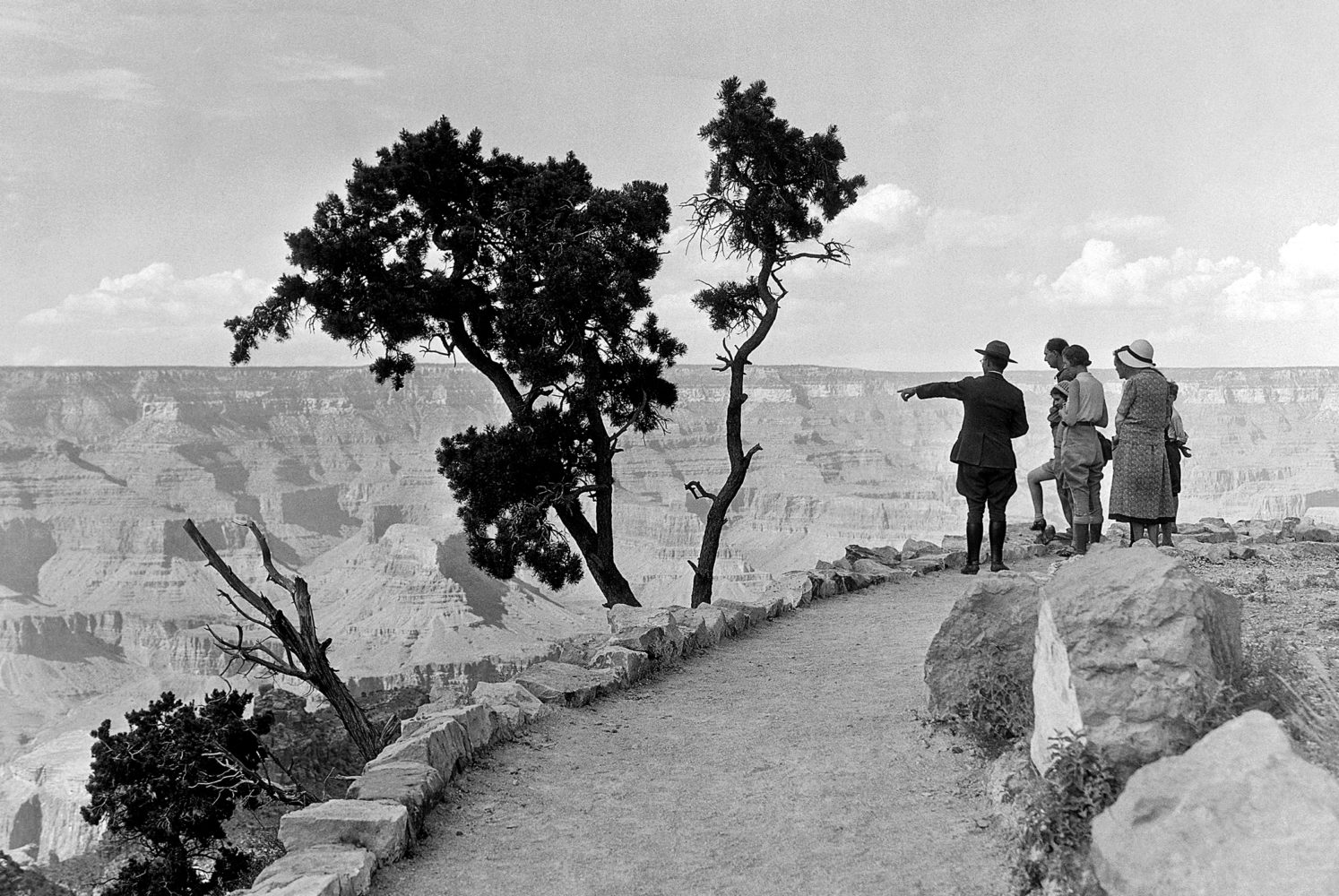
Grand Canyon, 1932, courtesy of Grand Canyon National Park
The National Park Service turns 100 this year and to celebrate the Phoenix Airport Museum at Phoenix Sky Harbor International Airport has put together an exhibition showcasing the diverse range of Arizona’s National Park offerings.
Each of Arizona’s parks is represented with historic images and objects.
Flagstaff Black on White Bowl, 1100s, clay, courtesy of Wupatki National Monument
The selection includes ancient pottery from early cultures, a button from a Buffalo Soldier’s uniform, a fossil cast of an early reptile from pre-historic times and a boat that was used by Otis ‘Dock’ Marston in 1963 for a complete traverse of the Grand Canyon. There is even a slab of petrified wood that lived 225 million years ago.
On August 25 – from 10 a.m. to 3 p.m. – two National Park Rangers from Arizona parks will be in the PHX Gallery in Terminal 4 answering questions and offering more information about the Find Your Park in Arizona exhibit, which is on display through Jan. 29, 2017.