Airbus

Korean Air: behind the scenes, tech-wise

Last month I joined Korean Air as a judge for a kids art show in LA, a paint-the-plane event in Seoul, and a tour of the airline’s farm, water bottling plant and various tech centers.

Here are some snaps and part of the story about the tech center and engine test cell I put together for USA Today’s Today in the Sky.

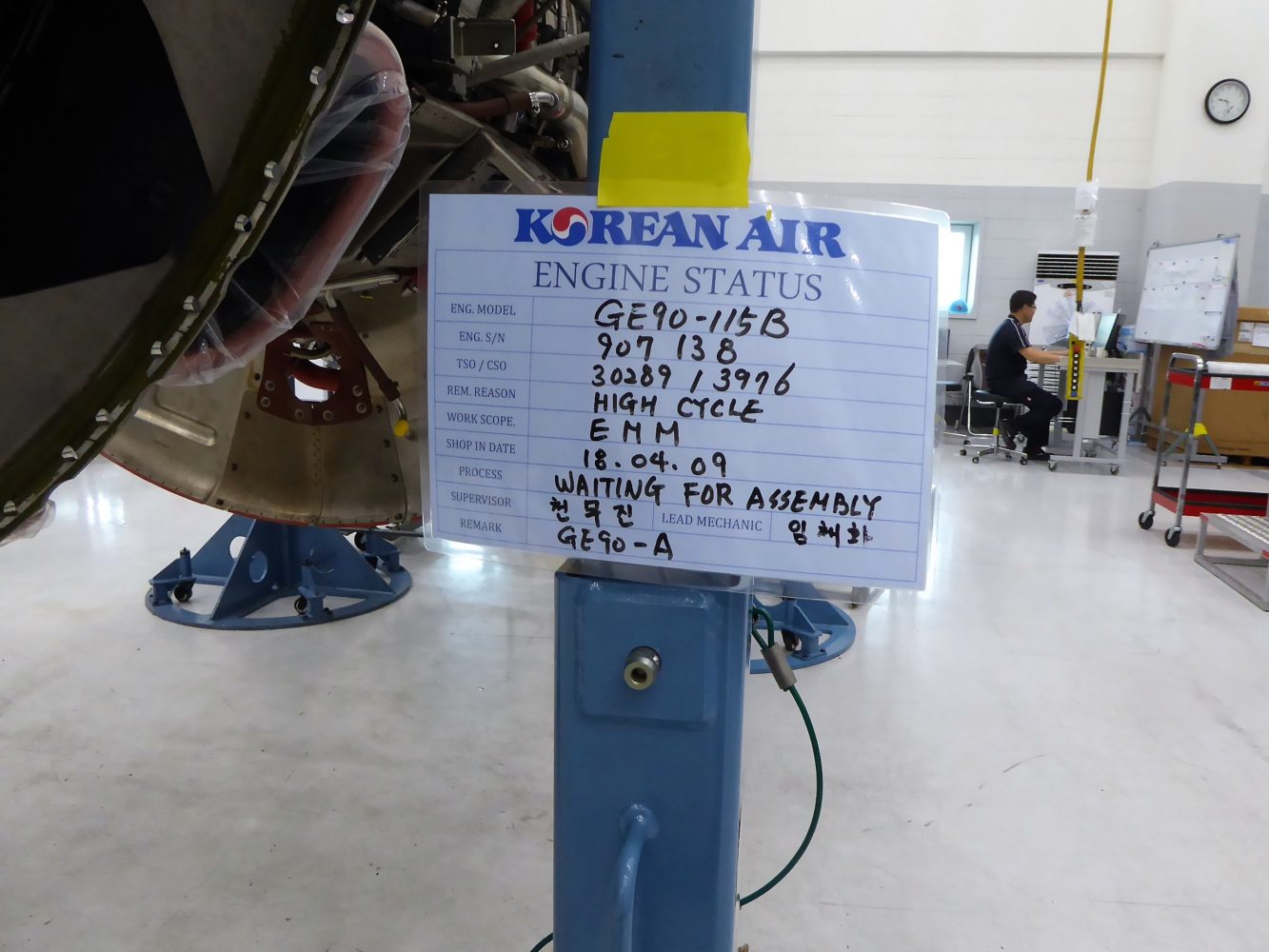
At its sprawling Tech Center in the port city of Busan, South Korea, Korean Air performs a wide variety of services for its own fleet and for many other airlines. In Incheon, Korean Air and aerospace manufacturer Pratt Whitney operate the world’s largest engine test facility as a joint venture.

The Paint Hangar

In Busan, South Korean, the Tech Center’s environmentally-friendly paint hangar has repainted hundreds of aircraft for Korea Air and other airlines since it was established in 1998.

During the visit, a Korean Air 777-200 was well into its 9-day repainting process. On the to-do list:  repainting four Qantas A380s between May 2019 and November 2020.

Tech Center

This Korean Air 747 cargo plane was parked inside a 2-bay maintenance hangar undergoing an extremely thorough, required, multi-week inspection known as a D-check, during which all parts of the aircraft are evaluated.  According to Korean Air, this type of heavy maintenance is performed on more than 100 aircraft a year.

Inside other buildings at the Tech Center, parts are being manufactured for both Boeing and Airbus (including Sharklets for the Airbus A320).

Elsewhere, hundreds of technicians perform maintenance and repair for aircraft operated by commercial airlines and for Korean and US aircraft, including F-15 and F-16 fighters, CH-53 helicopters and a wide variety of other aircraft we were not permitted to photograph.

Engine Test Cell center in Incheon

Korean Air’s $80 million Engine Test Cell (ETC) opened in 2016, and is a joint project with Pratt Whitney.

The ETC is designed to test the world’s largest jet engines, with a maximum thrust of up to 150,000 pounds.

Currently the largest and most powerful commercial jet engine is on the Boeing 777 and has a thrust of 115,000 pounds, but Korean Air’s ETC is ready for the next generation of supersized engines, which are already in production.

Before this center was created, Korean Air had to send its engines elsewhere to be tested, said Bill Kim, manager of Korean Air’s Engine Test Cell facility. The airline had to pay upwards of $8,000 to transport each engine overseas and then wait up to a month for an engine to get tested and returned.

“Here the turn-around time is far less: just two days,” said Kim, which means far less downtime and less need for Korean Air and other airline customers to purchase as many spare engines, which can cost up to $30 million dollars each.

To see the full story – and all 33 photos – see the original story Behind the scenes at Korean Air’s tech and engine-test facility on USA TODAY’s Today in the Sky.

(All photos by Harriet Baskas).

Would you sleep in an airplane cargo section?

Here’s an unusual look at the flying future introduced by Airbus and Zodiac Aerospace at the Aircraft Interior Expo taking place in Hamburg this week.

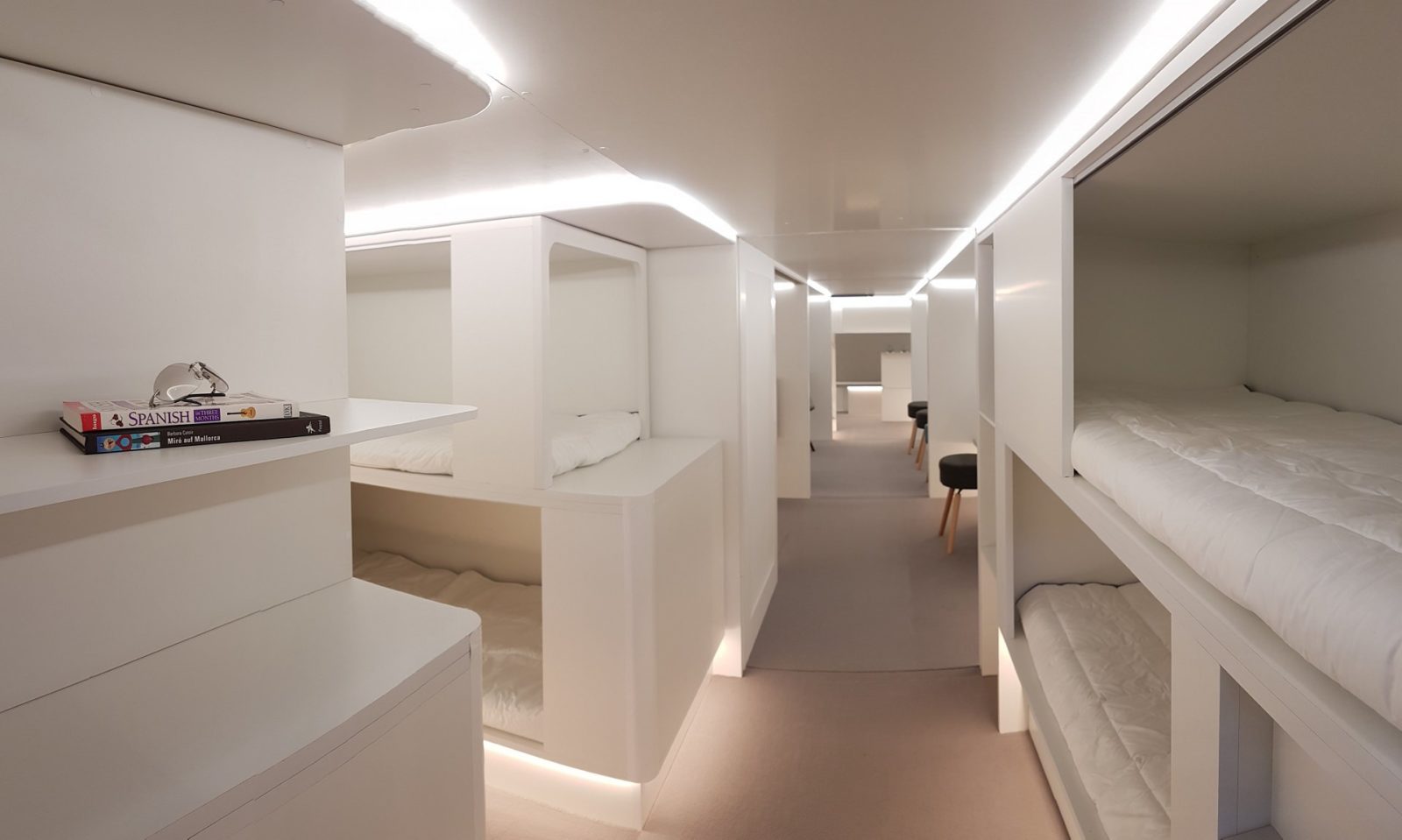
The two companies say they are developing lower-deck modules with sleeping berths as an option for the cargo compartment of an aircraft.

These passenger modules are envisioned as being easily interchangeable with regular cargo containers and easily put in or taken out during a typical turnaround as they don’t require any modification of the cargo area flooring.

The modules, which could be configured for other uses besides sleeping, offer airlines “new opportunities for additional services to passengers, improving their experience while enabling airlines to differentiate and add value for their commercial operations,” the companies said in a statement.

“This approach to commercial air travel is a step change towards passenger comfort. We have already received very positive feedback from several airlines on our first mock-ups,” said Geoff Pinner, Head of Airbus Cabin & Cargo Programme.

The plan is to get approval for the modules by 2020 and to roll them out first on A330 aircraft.

Ready for this?

How about a workout – in the gym – on your next flight?

Courtesy Transpose

Sitting for hours on long-haul flights is bad for both butts and brains, but the standard layout of narrow, forward-facing seats in ever more tightly packed airplane cabins doesn’t offer much option for passenger movement.

But what if you could get out of your seat mid-flight and head to the in-flight gym for a workout – maybe a spinning or yoga class– in a section of the cabin the airline could easily swap out, in plug-and-play fashion, for a kids’ play area or a meeting-friendly café on the next flight?

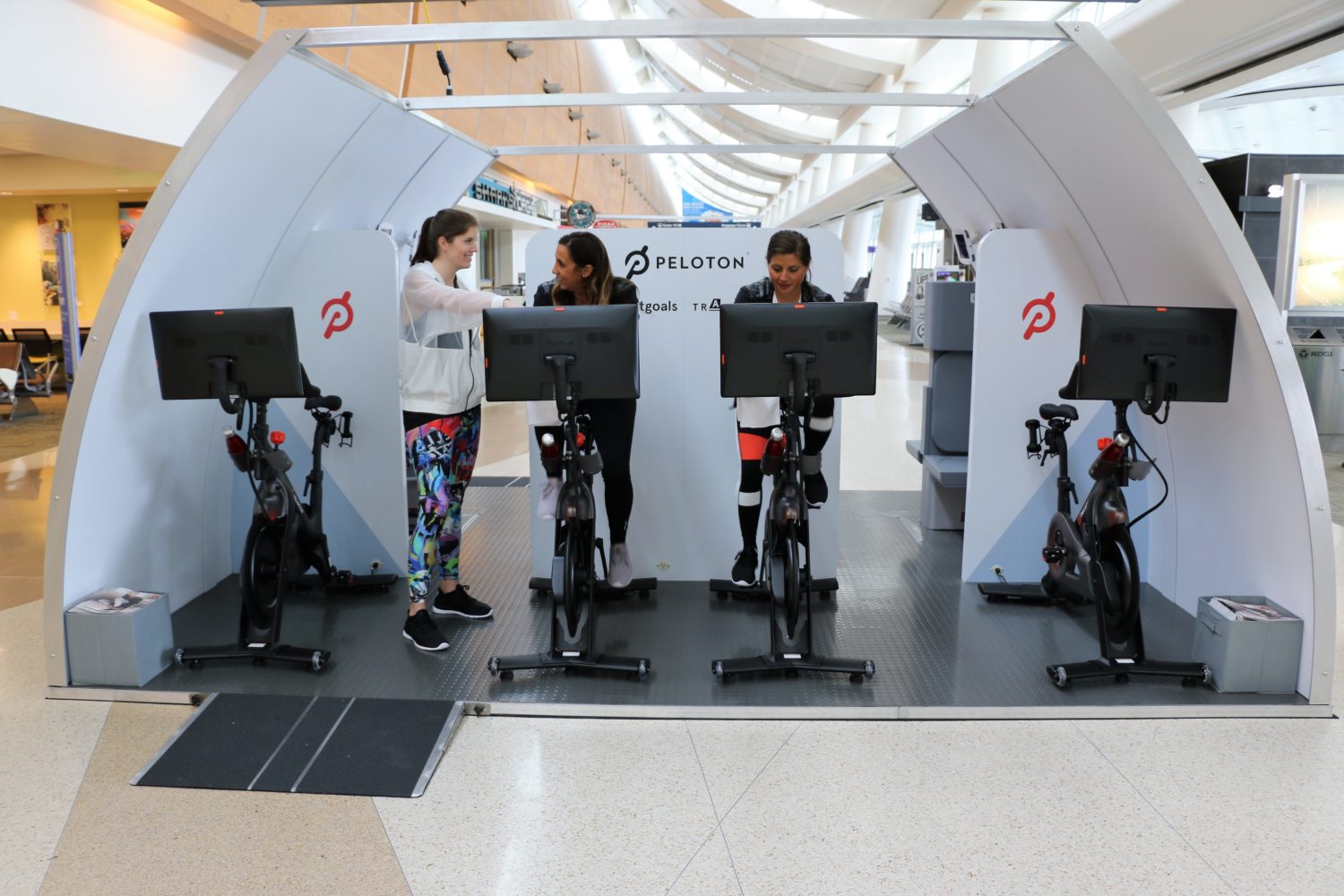
That’s the idea behind Transpose, a project of Airbus’s Silicon Valley outpost known as which has partnered with Reebok and Peloton to display (through May 19) a prototype ‘flying gym’ module complete with stationary bikes, yoga mats, resistance stations and other workout equipment at Mineta San Jose International Airport.


Courtesy Transpose

“For most people, the future of flight will still be on large commercial aircraft,” said Transpose project executive Jason Chua, “We’re trying to allow for new types of in-flight experiences with a modular cabin architecture that allows for customized spaces that can be loaded and unloaded onto aircraft very rapidly.”

Beyond gyms, Transpose cabin modules could be plug-in spas, napping pods, gaming centers, dining areas, yoga studios or, as one traveler suggested, a karaoke lounge. And, Chua suggests, each creative design would offer new ways for both airlines to generate revenue and for brands to engage with flyers beyond putting advertisements on napkins, on tray table stickers, before in-flight movies and in the pages of in-flight magazines.

More ways to carve out the cabin

While quick-change cabin modules may be a new idea, Transpose isn’t the first to suggest using cabin space for activities that promote wellness.

Back in 2002, Scandinavian Airlines (SAS) actively promoted the basic stretching and exercise opportunities offered by a metal bar attached high on a wall in unused space near the galley on some of its long-haul aircraft.

More recently, designers at Seattle-based Teague joined with Nike to envision a Boeing 787 Dreamliner with an interior luxuriously fitted out with amenities for professional and elite college athletes, such as extra-long lie-flat seats, a nutrition zone, biometric monitoring and analyzing systems, a recovery room with massage table, and more.

Courtesy Teague

And last summer, Russian plane maker Sukhoi showed off a concept mock up for a its SportJet, a private jet outfitted for sports teams outfitted with special equipment and lighting, including a variety of in-seat diagnostic devices that will test athletes before, during and after the flight, “to diagnose the physiological and psychological parameters of the athlete’s functionality.”

But while in-flight gyms, yoga studios and other high-flying cabin concepts for commercial airplanes seem intriguing, “A lot of these concepts don’t really account for the business model of air travel,” said Devin Lidell, Principal Brand Strategist at Teague, “They don’t answer the question of how can the airline make money with that, and will someone actually pay for it?”

An entire cabin on a commercial plane outfitted with elliptical machines probably isn’t reasonable – or realistic, said Lidell, “But maybe you could have some seats that are mainly for take-off and landing and then allow passengers to move about the airplane in a different way. Or explore having whole cabins built around passengers with like-minded interests. People may pay more for that.”

When it comes to in-flight wellbeing, for now passengers are limited to walking up and down the aisle (when the drink or meal carts aren’t in the way) or doing stretching exercises – sometimes to the odd glances from other passengers, at their seats.

To help, many airlines offer instructions and encouragement for in-seat exercises on the in-flight entertainment system, in the in-flight magazines or on seat-back cards. Some, like Lufthansa, have recruited sports stars to demonstrate the moves in short videos.

Another, extremely low-tech approach comes from Shanghai-based budget carrier, Spring Airlines, which has instructed its flight attendants to actively encourage passengers to perform in-flight exercises, said Raymond Kollau of AirlineTrends.com.

“Flight attendants announce over the PA that they will be demonstrating in-flight exercises – such as waving hands in the air, massaging temples, or stretching arms – and they recommend everyone do those actions as well,” said Kollau, “And many passengers actually join in.”

(A slightly different version of my story about gyms on airplanes appeared on CNBC)

Airbus souvenirs from the Toulouse Airport

AC-763

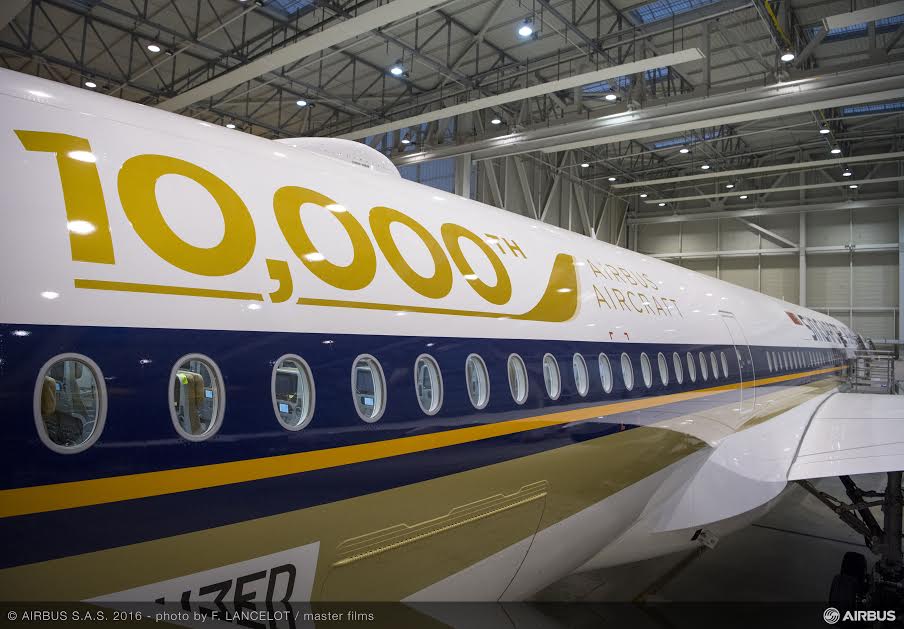
I traveled to Toulouse, France earlier this month to tour the Airbus factory and cover the delivery of the company’s 10,000th aircraft: an  A350-900 that went to Singapore Airlines adorned with a special decal.

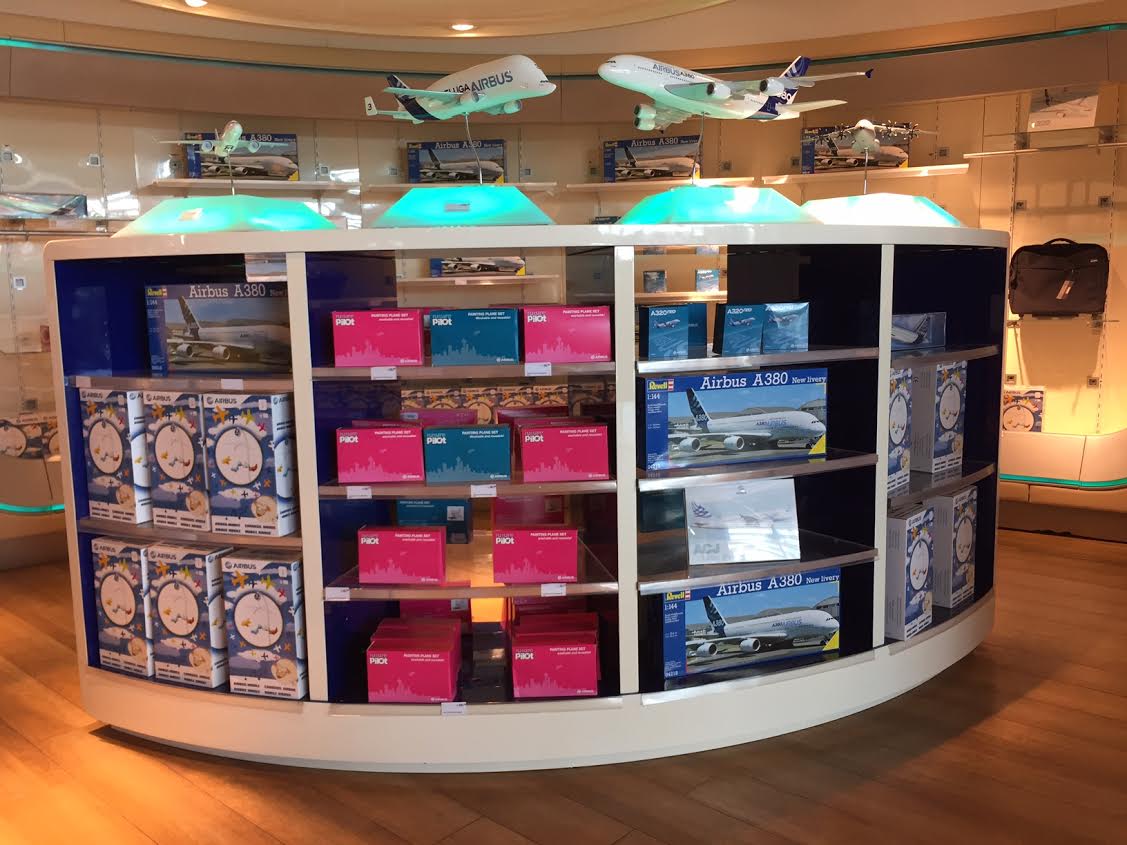
On the way home, I spent some time in the Toulouse-Blagnac Airport, where at least one shop had a corner devoted to Airbus-branded souvenirs and this adorable airplane mobile.

toulouse-mobile

airbus-souvenir


Airbus delivers 10,000th aircraft. Singapore Airlines got it.

10000th-airbus-plane

Courtesy Airbus

I was in Toulouse, France last week for my first visit the Airbus factory and the celebrations surrounding the delivery of the company’s 10,000 aircraft, which just happened to be Singapore Airline’s sixth Airbus A350-900 – and the plane the carrier will use to launch non-stop flights between Singapore and San Francisco next week.

Here are some snaps from the adventure. More details later as I put together a fact-filled slide-show on this event for CNBC.

sign-for-plane-delivery

EVE-1236-01

EVE-1236

Cake celebrating the delivery of the 10,000th plane by Airbus. Photo: Harriet Baskas

Cake celebrating the delivery of the 10,000th plane by Airbus. Photo: Harriet Baskas

Sadly, I couldn’t fly on the delivery flight to Singapore from Toulouse, but I did show up to wave goodbye…

plane-on-the-runway-to-take-off

Airbus getting ready to deliver its 10,000th aircraft

AC-763

On Friday, Oct 14, Airbus will deliver its 10,000th aircraft – the A350 XWB pictured above – to Singapore Airlines at the Airbus factory in Toulouse, France. On Saturday, this A350 delivery flight – SQ8895 – will take off for Singapore.

Airbus bills the A350 XWB mid-size, long range aircraft family as “the world’s most modern and efficient aircraft family” with an “all-new efficient design” that includes “the latest and unique technologies improving performance in operation,” and making it competitive with the 787 and the 777 (made by, you know, Boeing).

Stay tuned for more details as I’m in Toulouse for a tour of the factory and for the delivery ceremony of the plane. Lots to learn!

Pretty darn exciting..

Airline industry, non-profits save lives with flights

Airbus Foundation

Courtesy Airbus Foundation

Airlines are reporting profits and being urged to join humanitarian efforts to help plug a $15 billion funding hole in global disaster relief.

The call comes on the heels of a United Nations report that found while at least $40 billion in annual humanitarian aid is needed annually to help victims of natural disasters and armed conflicts worldwide, today the world spends only $25 billion a year on securing and getting food, water, shelter, medical supplies, support teams and other emergency resources to people in need.

That’s twelve times the amount spent 15 years ago, the report notes. But with so many in need now, new disasters cropping up all the time and the high costs associated with rushing humanitarian relief to where it will do the most good, creative solutions are needed.

And that’s where alliances between airlines, aircraft manufactures and a variety of non-governmental organizations come in.

Through its foundation, aircraft manufacturer Airbus has been filling some otherwise empty, new aircraft being delivered to customers from its factories in Hamburg, Germany and Toulouse, France with humanitarian relief supplies destined for disaster-hit regions and communities in need.

“The flights are happening anyway and the pilots and the fuel are already paid for,” said
Airbus Foundation spokeswoman Deborah Waddon, “The NGOs arrange for the cargo, we make donations for the cost of the cargo, the loading is often done for free and the airlines cover just an incremental fuel cost for the extra cargo.”

Since 2008, airlines such as Emirates, JetBlue, South African Airways, Thai Airways, Vietnam Airlines and a handful of others have worked with Airbus on at least 30 delivery flights that have brought more than 250 tons of humanitarian relief to areas of Nepal, Columbia, Thailand, Africa and Haiti. On more than 15 occasions, Airbus has also used its test planes to deliver additional supplies quickly in the aftermath of disasters.

For example, a test aircraft loaded with 50 humanitarian staff and about 22 tons of food and medical aid flew to Nepal in 2015 after the devastating earthquake. And a Nepal Airlines aircraft delivery flight was used to transport more than five ton of relief goods and medical equipment to Kathmandu.

“Transporting supplies is one of our main expenses, so this way we can support more people,” said Olaug Bergseth, a senior officer for corporate partnerships with the International Federation of Red Cross and Red Crescent Societies, one of the NGOs that works closely with Airbus. “It’s faster, it’s more efficient and it’s cheaper.”

Courtesy Boeing


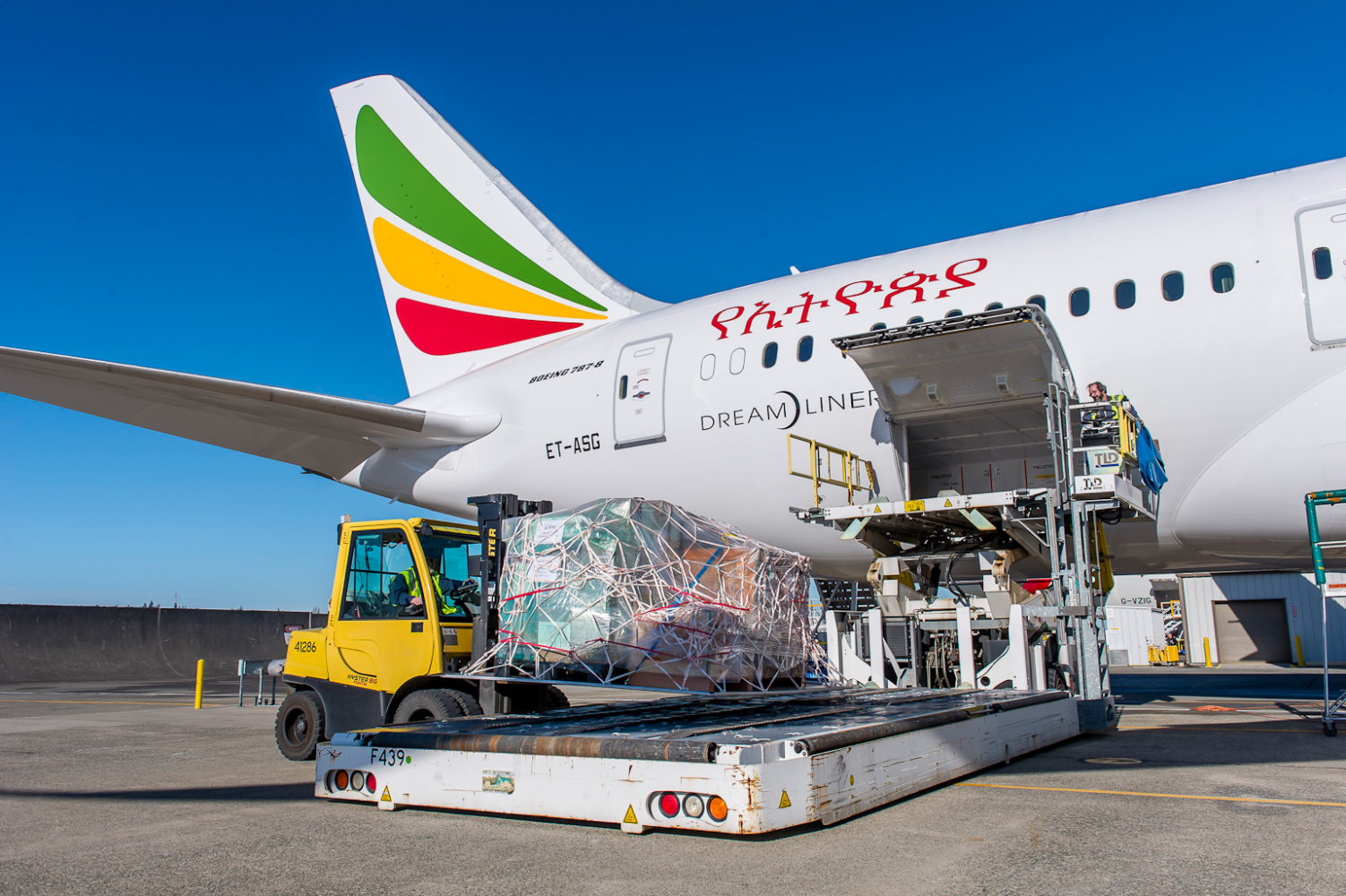
Through its Humanitarian Delivery Flight program, the Boeing Company also works with nonprofit and NGOs to load everything from medical supplies and clothing to educational materials into the empty cargo space of new airplanes for transport and delivery to areas of need.

Since 1992, Boeing’s program has made 180 humanitarian delivery flights, working with more than 50 airline customers to deliver more than 1.4 million pounds of supplies.

At least 26 of those humanitarian delivery flights have been on Ethiopian Airlines, which has also helped its neighbor, Somalia, by bringing back needed supplies.

“These flights have helped transform lives with their precious cargo,” said Bill McSherry, vice president of Government Operations at Boeing Commercial Airplanes.

Airlink worked with Avianca Airlines to get earthquake relief supplies to Ecuador

Courtesy Airlink

Delivery flights don’t always get relief supplies exactly where they need to go, so Boeing often teams up with Airlink, a Washington, D.C. nonprofit disaster relief organization that works with more than 35 airlines and more than 60 NGOs, to transport supplies and relief workers.

“We focus a lot on disaster response, but also on what you might call slow-burn events, such as an education program in Africa that is teaching children not to play with land mines and other remnants of war,” said Airlink Executive Director Steven Smith.

Smith notes that since more than 60 percent of humanitarian funding goes to supply chain costs, the transportation and coordination services airlines and Airlink provide can help NGOs stretch budgets and be more effective.

During the recent Ebola crisis in West Africa, for example, Airlink sent healthcare workers and 100 shipments of aid for 37 different NGOs using 11 airlines.

And more recently, Airlink used donated miles and funds from Air Canada, Alaska Airlines and United Airlines to send 19 military veterans from Team Rubicon USA and Team Rubicon Canada to Fort McMurray in Alberta, Canada to help out residents returning home after devastating wildfires destroyed more than 2,400 homes.

(My story about airline industry efforts to help save lives first appeared on CNBC in a slightly different form.)