Assistance

Now the airport info booths are going virtual

We’re declaring the virtual information booth an official trend at airports.

Louisville Muhammad Ali International Airport (SDF) rolled out its Virtual Information Booth back in May 2020. The super social distanced system lets travelers connect with a volunteer Airport Ambassador in a remote location via a live video feed.

In July 2020 Los Angeles International Airport (LAX) introduced a pilot virtual assistant program in Terminal 2. That system lets passengers have real-time conversations with customer service agents over a touch-free tablet at the real-world information booth. 

Two more U.S. airports now have virtual information booths as well.

The Virtual Information Desk at Baltimore/Washington International Airport (BWI) is near the Southwest Airlines baggage claim belts 1-5. Passengers can get help from a Pathfinder staff member stationed in a safe, remote location.

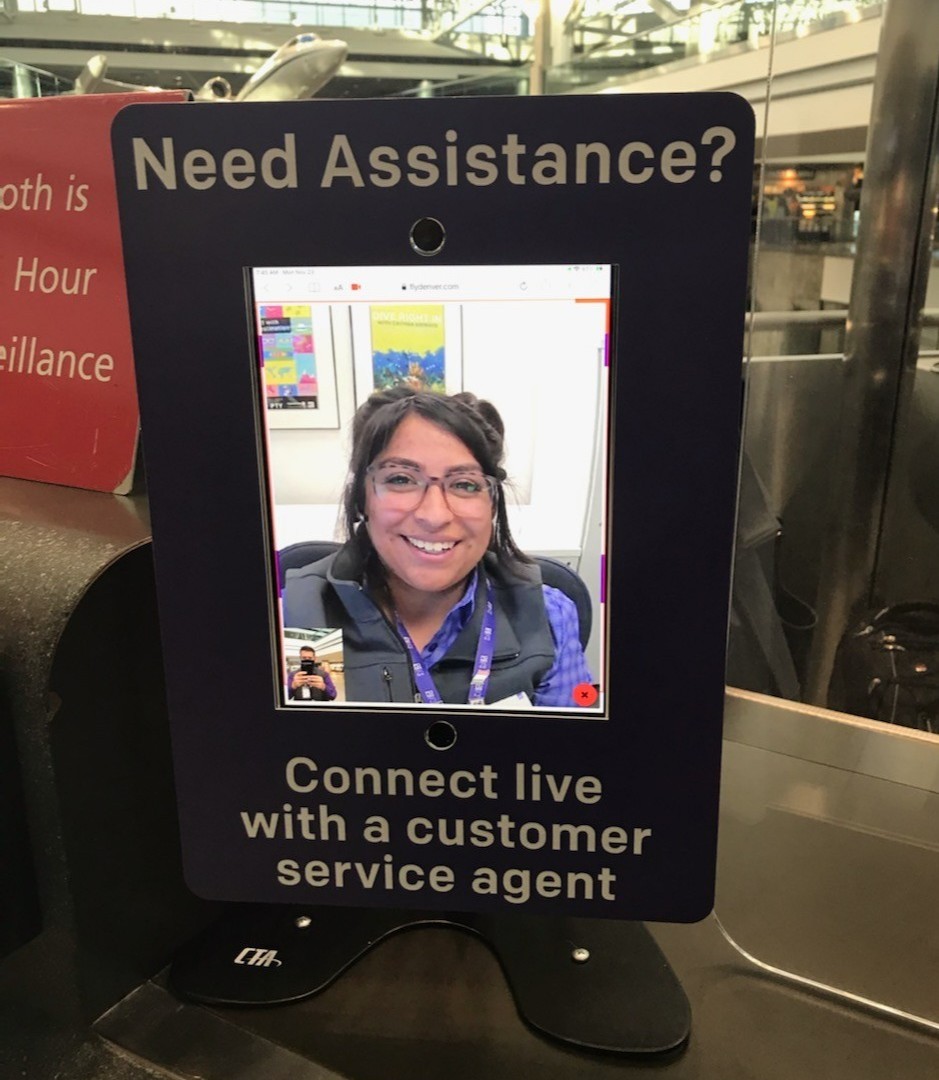
During this holiday season, Denver International Airport (DEN) is testing a new Live Agent program. DEN’s program will let passengers interact with a live customer service agent via video, text messaging, and live chat. 

At two information (one in the center of the terminal, near arrivals; one in the center of Concourse C) passengers can use iPads to contact a customer service agent for a virtual face-to-face interaction.

The customer service agents can also be reached through DEN’s website and via text chat.

The pilot program, in partnership with Recursive Labs, also allows a traveler to use the camera on their smartphone to show the Live Agent where they are in the airport so the agent can help with directions.

https://twitter.com/DENAirport/status/1331330518181351424?s=20

More airports adding free service to aid blind, low vision travelers.

Courtesy AIRA

There’s a growing list of airports offering passengers free access to an augmented reality service that provides greater mobility and independence to blind passengers and those with low vision.

Some theme parks and all the museums in Washington, D.C. that are part of the Smithsonian Institution are doing it too.

How it works: off-site eyes

San Diego-based Aira offers a paid “OnStar” style subscription service that works with smart glasses and/or smartphone software. The service lets users connect (via a tap or a voice command) to remote live agents who use the cameras on the glasses or a smartphone to see what’s around the user and offer guidance.

Many airports, along with theme parks and museums and other sites, are offering the service as a free amenity to all travelers who might want to use it.

The first airport to offer free Aira to passengers was Memphis International Airport, back in 2017.

Since then, more than two dozen of airports in the United States – and beyond – including London Heathrow, Seattle-Tacoma International, Minneapolis-St. Paul and Houston’s Hobby and Georgy Bush International Airport have decided to offer the service free for travelers as well.

Among those joining the list most recently: Los Angeles International Airport, JFK Terminal 4 and, in Australia – Sydney Airport.

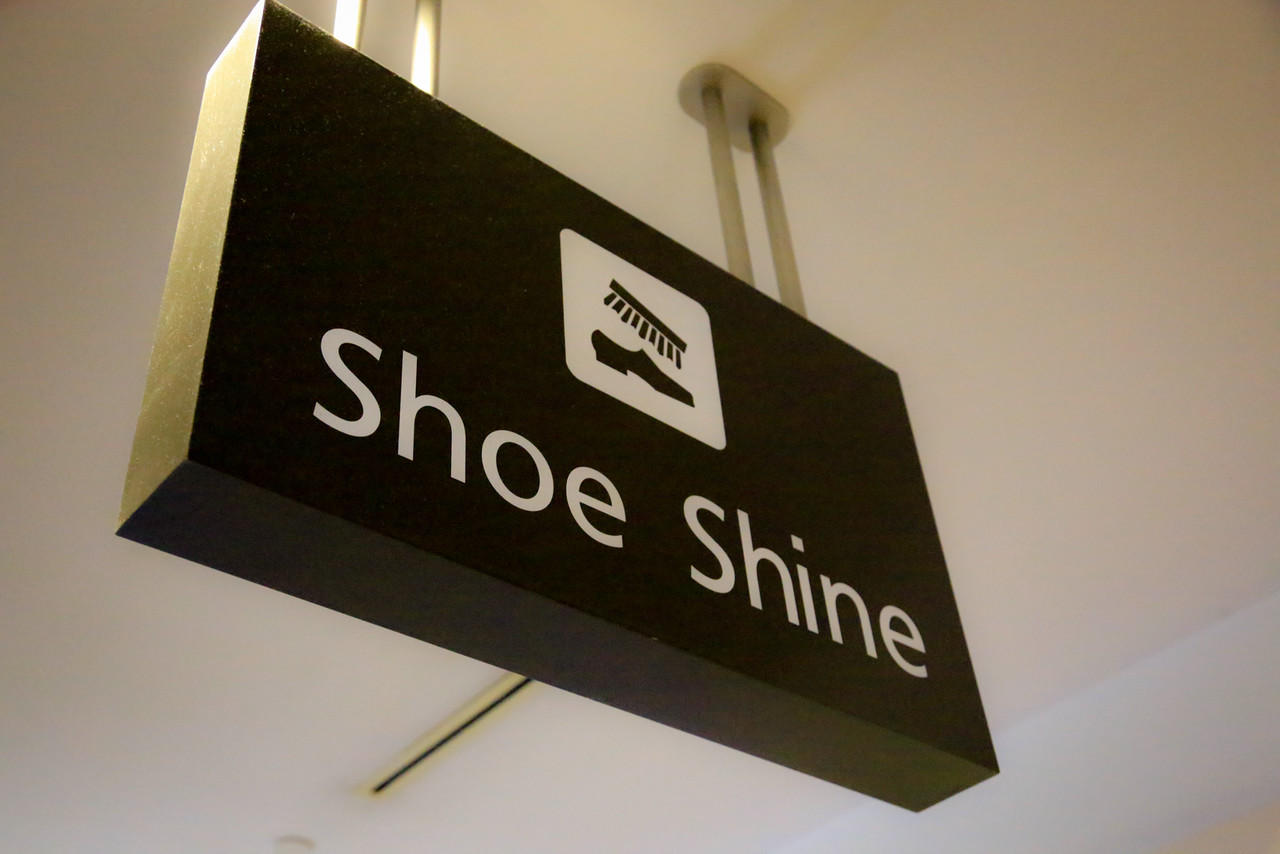
You still can get your shoes shined at the airport

 My “At the Airport” column for USATODAY this month is all about the incredibly hard-working people who work at shoeshine stands at airports around the country.

I’d spotted shoeshine stands occasionally at airports, but didn’t realize what an ‘out of time’ and endangered service this can be.

Bottom line: wear some nice shoes to the airport, get them shined and be a generous tipper.

Courtesy El Paso International Airport


“People used to spend time getting ready to travel,” said Hector Diaz, who has managed the five-locations of the Shoe Hospital at Chicago’s O’Hare International Airport for 10 years, “Now they just get up and put on gym shoes, sandals or whatever. Some mornings customers are still wearing pajama bottoms when they come in to have their shoes shined. It gets confusing.”

With travel attire so informal, shoeshine services at airports may seem, like payphones, to be on the way out. But in the most recent passenger amenities survey conducted by Airports Council International –North America, the number of airports with shoeshine stands (about 50) exceeds those with business centers and TSA PreCheck enrollment stations.

Time-crunched business travelers are helping to keep most airport shoe shine stands in business, but in many airports it’s a long-held tradition of fast, friendly, inexpensive and, in some cases, complimentary services, that keeps customers coming back.

Wayne Kendrick at work at Louis Armstron New Orleans Int’l Airport – courtesy of the airport

At Louis Armstrong New Orleans International Airport, the two Like New Shoe Shine stands have been run by Wayne Kendrick’s family for about 40 years. Kendrick, who began helping his dad at the airport 33 years ago, now operates the stands at MSY with his brother, charging $7 for a shine, up just $2 from the $5 his dad charged years ago.

“He’s been called ‘the Mayor of the Airport’ on more than one occasion,” said MSY spokeswoman Michelle Wilcut, “Some people drop off their shoes before traveling and pick them up on their return. Wayne has also been known to walk out to the curb to pick up a bag of shoes from customers that are not traveling but need a shine.”

Javier Anchondo has been operating the Los Amigos Shoe Shine at El Paso International Airport for a dozen years, and has been charging $4 for a full shine for shoes or boots since 2005. Anchondo used to have special prices for armed forces members, employees, first responders and others, but that got too complicated so he decided to simplify things by offering the $4 deal to all.

Courtesy Chicago Dept of Aviation

At Chicago O’Hare International Airport the Shoe Hospital not only shines shoes ($6) and boots ($8), it also offers repair services for shoes, luggage, purses, bags, jackets and other leather items and sells accessories such as shoe laces, arch supports and shoe cushions, often to pilots and flights attendants. Passengers can drop off items in need of repair and pick up them up on their return trip or have repaired items mailed home.

“Shining shoes is a dying art,” says Denise Pullen, owner of the Classic Shine Company, “But I’m trying to keep that art in the forefront and bring it to venues – like airports – where it’s a convenience.”

Classic Shine operates at 5 airports, including Dallas/Fort International, Kentucky’s Louisville International; McGhee Tyson, near Knoxville; Northwest Arkansas Region Airport; Greenville- Spartanburg International Airport in South Carolina; and, soon, San Diego International Airport.

The company charges $8 across the board for its service.

“We perform the same steps whether we do shoes or boots, so we’re not going to charge more for one than the other,” said Pullen, “Plus, boot customers are some of our best customers – and our best tippers.”

Photo by Sandy Stevens at Austin-Bergstrom Int’l Airport

In keeping with the “Keep Austin Weird” mantra, passengers at Austin Bergstrom International Airport have asked the staff at the Love Shines shoe shine stand to shine everything from fancy boots to casual Keens.

“I’ve heard a band give them a shout out from the airport music stage,” said AUS airport spokesman Jim Halbrook, “The singer had gotten his shoes shined there and was very happy with the quality.”

Another singer happy with the way his shoes and boots look after visiting an airport shoe shine stand is Lyle Lovett, who penned an essay for the Houston Chronicle about his deep appreciation for the shoe shine stand in Terminal C at Houston’s George Bush Intercontinental Airport.

Although he says he’s capable of caring for his own footwear, “Even on days I wish I didn’t have to fly, I look forward to getting to the airport early enough to get a shine. There’s just something extra-good about a professional shine, something important,” Lovett writes.

And it’s not just the excellent shoe shine that Lovett likes. As the shine men and women are improving his boots, Lovett says he enjoys their stories and always benefits “from the pride they take in their work.”

Free shines; tips accepted

Over the past twenty years Marvin Earle and his team have shined shoes for hundreds of celebrities at shoe shine stands located in many of the terminals at Los Angeles International Airport. But whether or not the person in his chair is a celebrity, “I try to build a relationship with my customers. I talk, I listen, and I stay away from politics,” said Earle, “It’s about showing class and providing 100 percent customer service.”

As his company name “Marvin’s Complimentary Shoe Shine,” implies, Earle’s team does not charge a set price for shoe shine services, for shoe laces, for glued-back-on heels, or for the reconditioning magic they perform on purses, belts and bags. Instead, they make their money from tips. And while Earle said sometimes people distracted by their cell phones don’t leave a tip, most customers tip an average of $7.

Rick Evans has owned the Shine on the Go shoe shine stand at Missouri’s Kansas City International Airport for eight years and is especially proud of his shoe shine chair, which was made for him by the wood shop teacher from a local high school.

Evans adopted a “no set price,” policy about two years ago and declares it a positive move for his customers and for the bottom line of his business. “The policy creates repeat customers,” said Evans, “They like the idea that they get to set their price and most people are very fair.”

Courtesy Denver Int’l Airport

The shoe shiners at Executive Shine staff stands in all three concourses at Denver International Airport work on an average of 400 to 600 pairs of shoes, boots, and occasional sneakers – as well as belts and bags – every day. Here too, customers get to decide what they’ll pay for the work performed and “It’s not uncommon to see a small line of passengers waiting for a shoe shine,” according to Denver airport spokeswoman Daria Serna.

“Passengers today are just as likely as they were 40 years ago to want to look their best when they arrive at their destination,” said Serna “As long as this service continues to be in demand, we expect the airport shoe shine to continue to thrive.”


KLM offering Amsterdam travelers a ‘care tag’

Thinking of heading to Amsterdam?

September, when all the college kids and summer tourists clear out, might be a good time to go.

And if you do, KLM Royal Dutch Airlines has what may be a fun – free – travel gadget for you.

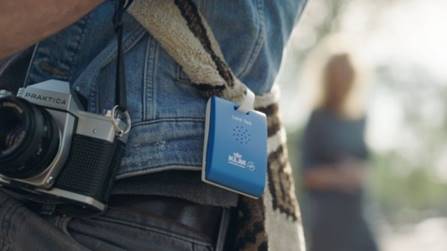
For travelers going to Amsterdam in September, KLM has created a “Care Tag,” which it describes as a smart audio luggage tag with a built-in offline GPS module and a speaker that automatically provides verbal tips (recorded by KLM crew members) on how to travel in the city.

KLM says the tips include alerts on busy intersections with a lot of cyclists, where and how to lock your bike, and when you should watch out for pickpockets, where to taste local food for free, where to see great street art, or where to rent a bike or boat.

How do you get a tag?  KLM says passengers traveling to Amsterdam in September will be able to order their  tag on line for free. The first batch of Care Tags will speak English, but Care Tags that speak Chinese, Portuguese, German and Russian will be available later this year.

I’m checking to see if just a speaker on the tags or if you can plug in a set of headphones.

And, while the Lost and Found pup was cute – but not real – KLM reps say the Care Tag is real thing.


Airlines, airports still a challenge for travelers with disabilities

ADA IMAGE

To mark the 25th anniversary of the signing of the Americans with Disabilities Act, last month the Open Doors Organization (ODO) released the findings of a new study looking at the impact the disability travel market has on the industry and the broader economy.

A follow up to similar studies the group conducted in 2002 and 2005, this year’s study found that in the past two years alone, more than 26 million adults with disabilities traveled for pleasure and/or business, taking 73 million trips and spending $17.3 billion annually (up from $13.6 billion in 2002) on those trips.

ODO points out that “[s]ince these individuals typically travel with one or more other adults, the economic impact is actually double, or $34.6 billion.”

The number of travelers in this group and the money they spend on travel is large – and, as the population ages – surely getting larger. Yet the study, conducted for ODO by Mandala Research, found that while there have been some improvements, unnecessary barriers still exist.

For example, among adults with disabilities who have traveled by air, 72 percent said they encountered major obstacles with airlines and 65 percent with airports, down from 84 percent and 82 percent in 2005, respectively.

“When we carried out our first nationwide study in 2002, the goal was to wake up the travel industry to the importance of this mostly under-served market segment and give them hard numbers on which to base investment decisions,” said ODO director Eric Lipp.

“Now 13 years later, our economic impact is no longer a secret, especially in air travel. At large airports like Miami and Minneapolis/St. Paul, airlines now must provide more than 1 million wheelchair assists per year. And as the Baby Boomers continue to age, you can be sure our market will keep growing for years to come,” he said.

The ODO report goes beyond airports and airlines to explore travel patterns, spending levels and the physical, customer-service and communication obstacles encountered by people with disabilities in hotels and restaurants and on cruises and ground transportation, including ride-share services.

Interested in finding out more? The non-profit ODO has copies of the full study available for sale.

Airlines encouraging disaster relief donations

Heartbroken over the images and stories coming out of Oklahoma?

Oklahoma Tornados 2013

Courtesy American Red Cross


Airlines are joining in to encourage you to help out by donating some money or miles.

Here are a few that have posted notices on their websites:

Through June 30, 2012, American Airlines AAdvantage members can earn a one-time bonus of 250 AAdvantage miles for a minimum donation of $50, or 500 AAdvantage miles for a minimum donation of $100 or more to American Red Cross Disaster Relief. More details here.

You can also to donate to disaster relief through the Alaska Airlines Charity Mile Pool  and through Southwest Airlines, which is working with American Red Cross Disaster Relief to raise funds to help those affected by the tornadoes, as well as for military members and their families and other relief services.  

Horizon Air president apologizes to mistreated passenger

Over the weekend, a Bend, Ore., man took to Facebook to describe the incivility he alleged was inflicted on a fellow passenger on an Horizon Air flight out of Oregon’s Redmond Municipal Airport.

Cameron Clark witnessed what he described on Facebook as “the worst of humanity” when airline staff on duty appeared to ignore and refuse special assistance to a couple he thought was “disabled/mentally and physically challenged.”

Clark estimated the couple to be in their 70s and said that the man later told him he had late-stage Parkinson’s disease, that his companion had MS and that he was trying to get to Bellingham, Wash., to see his daughter.

“He had a hard time walking,” Clark wrote on Facebook, “No one offered him a wheelchair or asked how they could be helpful. He stumbled off toward the safety inspection line. Predictably, he didn’t understand/comprehend their restriction of his luggage, and got stuck in security.”

Throughout the weekend, Clark’s Facebook post created a flurry of negative and outraged comments, which Alaska Airlines responded to with a series of Facebook posts of its own.

I spoke with Alaska Airlines spokesperson Paul McElroy on Monday morning and he told me that while the passenger did not get on his Friday flight, he did fly Saturday and is visiting with his daughter at an alternate location. McElroy said the airline refunded the passenger’s initial ticket price and provided complimentary round-trip transportation for his trip.

“There are things we should have done better,” said McElroy, who added that the president of Horizon Airlines was preparing a post to that effect. (Regional airline Horizon Air and Alaska Airlines are both owned by the Alaska Air Group, which is based in Seattle.)

Coincidentally, on Monday the airline was meeting with Eric Lipp, the executive director of Open Doors Organization, an independent disability advocacy group. “We’re going to leverage their visit and ask them to help us review what we did with this customer to see if we could have done better,” McElroy said.

Lipp said there are laws to help passengers with disabilities and extra services that airlines can and are willing to provide. “But the law says the passenger has to self-identify,” said Lipp. “Otherwise, it’s a puzzle. The breakdown here is that the passenger didn’t self-identify and the airline didn’t have the right codes in the system to get him services he was entitled to.”

Lipp had other advice for passengers with disabilities and much of it was rolled into the apology Horizon Air president Glenn Johnson posted on Facebook on Monday afternoon. Here’s part of that statement, which includes some helpful tips.

“…First and foremost, we’ve determined that we could and should have handled this better and I apologize to our passenger on behalf of all of us at Horizon Air and Alaska Airlines. This experience has reminded us of the importance of assisting passengers with disabilities and making sure every one of them receives the special care they may need.

The information we’ve gathered during our review will certainly improve our efforts going forward.”

…Alaska and Horizon have partnered with Open Doors Organization, an independent disability advocacy group, to review employees’ handling of the situation and suggest improvements in the airlines’ disability, awareness and sensitivity training. Eric Lipp, Open Doors Organization’s executive director, advises passengers with a disability who are traveling to:

  • Self-disclose to the airline any assistance you may need before you arrive at the airport. This could include an escort or wheelchair assistance through security, to the gate, and while boarding and exiting the plane.
  • Ask the airline if you prefer to have a personal assistant escort you to the gate. Most airlines will issue passes to personal assistants to help passengers with disabilities get to or from the gate area.
  • Plan ahead and arrive at the airport at least 90 minutes before your flight departs, which allows time to check luggage, obtain wheelchair services, get through security and board the flight.

(Part of this post first appeared in my NBC News story Witness blasts Alaska Airlines for treatment of fellow passenger.

Tidbits for travelers: new airport, new avatar on duty

Mari, a Stuck at The Airport reader who works in air navigation in Georgia – the country, not the state – wrote to draw our attention to the King David the Builder International Airport being built in Kutaisi, Georgia by the Dutch architectural firm, UNStudio.

The airport is scheduled to be completed by September, 2012. Here’s what the tower is going to look like:

(Photo courtesy UNStudio)

Very futuristic-looking, right?

At Washington Dulles International Airport, the future is already here.

A 3D-looking Tensator Virtual Assistant – Dulles has named her “Paige” – is on duty welcoming passengers, offering Customs and Border Protection information and sharing connecting flight information in the International Arrivals Building.

Here’s a video (taken by an airport representative) of Paige in action:

Infographic Friday: what do travelers do?

Travelers are a studied bunch. No doubt that’s why all these infographics are popping up. Or maybe it’s just fun to rustle these up. Here are two that showed up in my inbox this week:

The first one is from Rasmussen College and highlights how travelers use social media when on vacation.

The other was put together by Travelex and, way down at the bottom, shows that only 5% of traverers get their travel cash at the airport before they leave on a trip, 26% get cash at the airport in their destination city (-presumably at a money exchange booth?) and 24% seek out an ATM in town.

How the world travels
Travelex Currency Exchange

At Singapore Airport, iPad-toting team helps flustered fliers

One more story about Singapore’s Changi Airport…

For my ‘At the Airport’ column on USATODAY.com this month, I reported on an afternoon spent observing the crack team of Experience Agents at Changi Airport.

Apropos of an airport with a butterfly garden, a rooftop pool, a three-story indoor slide and 500 complimentary Internet kiosks among its award-winning amenities, Singapore’s Changi Airport is determined to best other airports in the customer-service department. Last March, the airport introduced a 90-member team of salaried, iPad-toting Changi Experience Agents (CEAs) tasked with roaming the four terminals assisting travelers with way-finding, check-in, transfers, lost luggage and other travel-related issues. In some cases the CEAs seem to all but read travelers’ minds in anticipating their needs.

The program is part of an ongoing effort the airport descibes as providing a “positively surprising experience for all visitors and passengers.”

For example, a CEA found Kenneth Ocastro staring in bewilderment at the digital flight directory in the departure hall of the Changi’s busiest terminal.

The young man had purchased a non-refundable ticket to Manila on a budget carrier, but arrived at Changi too late to make his flight. “It was raining very hard and I had to wait a long time for the taxi to come,” said Ocastro, “And when I got here the gate was closed.”

Ocastro was beginning to panic when Changi Experience Agent Johnwin Custodio stepped in. “The passenger was looking around and seemed very nervous,” said Custodio, “So I approached him and offered my help.”

Rather than simply pointing Ocastro to the long line at his airline’s counter – an exercise apt to be futile – Custodio used his iPad to check rates and schedules for alternate Manila-bound flights. It took about 20 minutes, but he found a good option, walked Ocastro over to that carrier’s ticket counter and hovered nearby, solving other travelers’ problems, while Ocastro waited his turn.

“At most airports, you need to go find a customer-service agent at a booth, but here we are creating an impact the moment you step into the airport,” said CEA Maxime d’Alexandry. The 22-year-old was hired for this, his first job, after serving a mandatory stint in Singapore’s army and received Changi’s 2011 “Personality of the Year” award for helping a stranded wheelchair user who’d soiled himself wash up and then shop, buy and change into a new set of clothes.

“It’s just an example of the things we do on our job is to reduce passenger stress,” said d’Alexandry.

To that end, the 90 CEAs together speak a total of more than 20 languages and dialects, including Hindi, Japanese, French, Tagalog and Thai; a reflection of the wide range of cultures represented among the airport’s more than 45 million annual passengers. And when confronted with a passenger whose language they do not understand, CEAs use the Google translation app on their iPads. “That helps us cut down on the number of passengers who miss their flights because they can’t find the right check-in counter or gate,” said Ira Fanador, a CEA supervisor,

The iPads also allow the CEAs to help passengers buy last-minute tickets or apply for visas; tasks which are often cheaper when completed online even if a traveler is already at the airport.

Fanador says since the Changi Experience Agents were introduced, they’ve been able to resolve most, but not all, problems they’ve encountered. She’s still sad that they couldn’t help a frightened and wounded woman trying to return to China without the passport her employer had taken from her, but is proud her team was able to assist the three African men found crying on the sidewalk outside the airport.

“They’d come in from the Philippines and discovered that tickets on to their home in Senegal turned out to be bogus,” explained Fanador. “They had no money and didn’t know what to do.” A team of CEAs helped provide meals for the men, tried to work something out with the airlines, and contacted a local charity, which took the men in and eventually sponsored their tickets home. “By the end of the ordeal we were all friends,” said d’Alexandry.

Changi’s experience agents don’t just deal with the sticky problems. During an afternoon following d’Alexandry and several other CEAs around the airport, I saw them give directions to transfer gates and to the various airport gardens, help search for a lost passport and tell a tired-looking traveler that he needn’t stand waiting for an open slot at the cellphone charging kiosk because there was another free one just down the hall.

“Flying is just so stressful,” said d’Alexandry. “It’s just a good idea for an airport to do what it can to reach out.”