TSA

Why did the TSA give up on knives on planes?

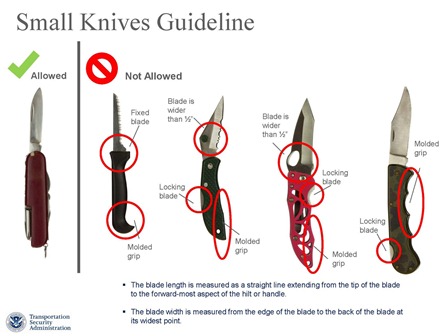
TSA_KNIVES Guide

Politics and arrogance likely scuttled the plan by the Transportation Security Administration (TSA) to allow small knives back on planes, but it’s not clear that fliers are any safer for it.

Last week, the TSA announced that while the agency’s “top priority continues to be expansion of efforts to implement a layered, risk-based security approach to passenger screening while maximizing resources,” it was putting aside a proposed plan to allow passengers to take small knives, toy bats, billiard cues, ski poles, hockey sticks and other currently prohibited sports equipment on board as carry-on items.

The revised list of allowable carry-on items was supposed to go into effect at the end of April, but the plan received strong opposition from flight attendants, pilots, law enforcement, airlines and bi-partisan group of legislators concerned that knives, especially, could be used in attacks on flight crews and other passengers.

“On its merits, the original decision to remove the items from the list was probably based on sound examination of threats risks and vulnerabilities, but given the public reaction, and that of stakeholders and congress, politically, it became too big of fight and not one TSA felt was worth having,” Christian Beckner, deputy director of the Homeland Security Policy Institute at George Washington University told NBC News.

While TSA administrator John Pistole may have lost this battle, “He has the right instincts,” Richard Bloom, director of Terrorism, Intelligence, and Security Studies at Embry-Riddle Aeronautical University’s Prescott Arizona Campus told NBC News.

“Unfortunately because of the political climate at the federal level in Washington and the political aspects of TSA, his hands are tied more than he’d like to them to be.”

That doesn’t mean the discussion is over.

“The TSA can probably revisit the discussion about hockey sticks, golf clubs and other items in the coming months,” said Beckner, “But because of the history of how the attacks of September 11 were carried out, there will be always be a visceral reaction to removing even the small knives from the list.”

Going forward, the discussion will likely take a different form.

“You can’t make an acceptable risk decision unless you talk to those affected by it,” said Henry Willis, director the Rand Corporation’s Homeland Security and Defense Center. “I expect TSA to continue making decisions informed by risk, but to more actively engage those affected by those decisions when making them.”

Even so, there are likely to be roadblocks.

An amendment attached to the homeland security bill coming out of the House of Representatives contains language that restrict the TSA from using funds to implement a program that allows knives back on planes, said Eben Burnham-Snyder, spokesman for congressman Ed Markey (D-Mass), who introduced the bi-partisan amendment with Michael Grimm (R-N.Y.). “It’s basically an insurance policy on the reversal of the decision.”

And then there’s gridlock.

“I wish I was wrong about this, but I expect more of the same,” said Bloom. “Even if folks come up with good ideas in term of counter-terrorism and research on this topic, I think politics will continue to get in the way.”

(My story: Why did the TSA give up on knives on pkanes? first appeared on NBC News)

TSA nixes plan to allow small knives & more in carry-on bags

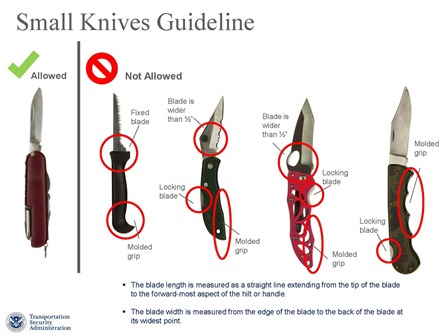
TSA_KNIVES Guide

If TSA head John Pistole could have had his way, the chart above would be in use by now.

But after months of criticism from pilots, flights attendants, airlines, legislators,members of the public and a slew of others, Pistole decided that passengers will not be allowed to carry small knives, souvenir novelty bats, hockey sticks and other previously banned sports items back onto planes as carry-on items.

Here’s how the TSA described the decision:

“After extensive engagement with the Aviation Security Advisory Committee, law enforcement officials, passenger advocates, and other important stakeholders, TSA will continue to enforce the current prohibited items list. TSA’s top priority continues to be expansion of efforts to implement a layered, Risk-Based Security approach to passenger screening while maximizing resources. ”

As you may imagine, all manner of groups that were opposing the plan – already delayed from its scheduled late April roll-out – expressed their pleasure with John Pistole’s decision:

“We commend the TSA for revising its policy,” said Veda Shook, president of the Association of Flight Attendants International. “Terrorists armed only with knives killed thousands of Americans on 9/11/2001. As the women and men on the front lines in the air, we vowed to do everything in our power to protect passengers and flight crews from harm and prevent that type of atrocity from happening ever again.”

“This decision is the right one for the safety and security of every Transportation Security Officer, airline passenger and aviation employee,” American Federation of Government Employees National President J. David Cox Sr. said in a statement.

“We applaud this as a victory for common sense,” said Gregg Overman, spokesman for the Allied Pilots Association.

And here’s some of what Paul Hudson, President of FlyersRights.org, had to say:

“Hopefully, the TSA has learned the lesson that transportation security policies affecting many millions of air travelers need to be fully vetted with all stakeholders, not made just on internal deliberations and secret lobbying by those with special financial interests or insider connections.”

TSA & airlines pre-notify travelers about PreCheck eligibility

TSAS PRECHECK

What good is privilege if you don’t know you have it or don’t know how to use it?

Passengers eligible for TSA’s PreCheck program offering expedited security screening at 40 airports are sometimes unaware of their status and unsure of which checkpoint line to join.

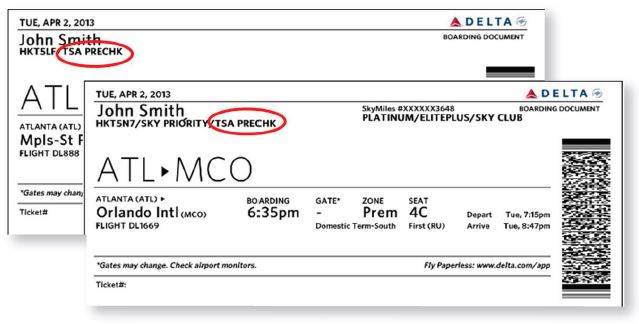
So Delta, United and US Airways are now alerting qualified passengers to their PreCheck status with a “TSA PreCheck” alert on mobile and paper boarding passes.

“All TSA PreCheck participants are vetted for eligibility each time they fly,” said TSA spokesman David Castelveter. And knowing their status prior to arriving at airport “helps passengers effectively route themselves to available TSA PreCheck lanes,” he said.

While much appreciated by eligible travelers who can leave shoes and light jackets on and 3-1-1 compliant liquids in their bags, the system still has a few wrinkles.

Only some airlines in the PreCheck program currently add the alerts to boarding passes and not all boarding pass systems support the PreCheck notification feature.

Delta and US Airways passengers will see “TSA PreCheck” on printed boarding passes and, by the end of this week, the TSA PreCheck logo will be on those airlines’ mobile boarding passes. On United, the TSA PreCheck logo is currently only on printed boarding passes.

Another issue: because neither TSA nor the airlines filter by airport, “the TSA PreCheck pre-notification indicator will continue to appear on those selected customers’ boarding passes whether the airport has a TSA PreCheck screening lane or not,” Delta Air Lines spokesperson Michael Thomas told NBC News.

To solve that problem, TSA encourages passengers to bookmark and check the list of participating airports and checkpoint locations on the PreCheck chart and the TSA mobile application.

More details on the PreCheck program and eligibility are on the TSA website.

(My story about the TSA PreCheck program first appeared in NBC News.com)


TSA will delay allowing knives & more back on planes

Thursday, April 25, was the TSA’s target date for allowing knives and some sports equipment, such as hockey sticks, back on airplanes as carry-on items.

But today the TSA announced that it will hold off on that decision for an undetermined amount of time.

Here’s their statement:

“In order to accommodate further input from the Aviation Security Advisory Committee (ASAC), which includes representatives from the aviation community, passenger advocates, law enforcement experts, and other stakeholders, TSA will temporarily delay implementation of changes to the Prohibited Items List, originally scheduled to go into effect April 25. This timing will enable TSA to incorporate the ASAC’s feedback about the changes to the Prohibited Items List and continue workforce training.”

Glass-bottomed plane, flying pets & TSA plan for talented travelers

glass bottom plane

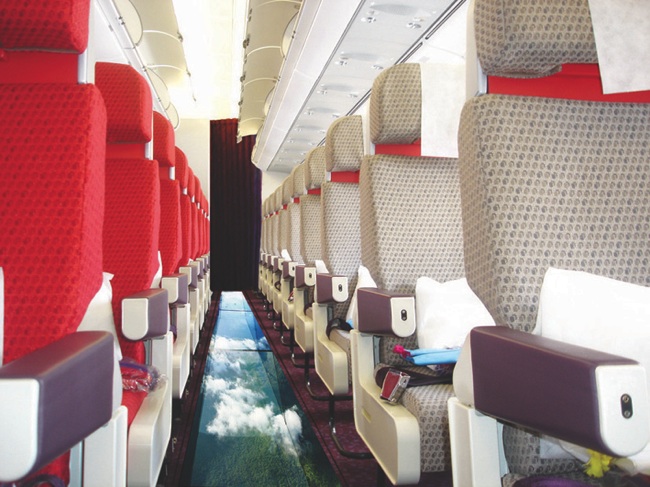
Virgin Atlantic announced today, April 1st, that it will soon introduce a glass-bottomed plane, WestJet has announced that bears, billy goats, monkeys and any other pet will now be allowed onto airplanes. For the “Furry Family” plans, no pet carriers are needed.

And, for my first post for the Gadling travel site, I report on a new program being tested by the Transportation Security Administration (TSA) to give expedited security checkpoint privileges to passengers willing to sing, dance, juggle or tell jokes to others waiting in line.

The pilot program rolls out today in airports in Los Angeles and New York. “Cities where a lot of folks ham it up on the security lines anyway,” said TSA arts and entertainment director Lance Strongarm.

Some passengers will be able to volunteer to perform; others will be chosen at random by TSA officers to step out of line and into the spotlight. “Yes, there will actually be spotlights,” said Strongarm. “We want to do this right.”

Passengers waiting to be screened will be invited to vote, by clapping, whistling or booing, on whether the person performing goes to the front – or the back – of the line.

“It will be a cross between ‘America’s Got Talent’ and ‘Survivor’ – but at the airport,” said Strongarm. And because the TSA already has cameras filming all activity that takes place at checkpoint areas, “it will be easy to provide footage for the reality show we’re shopping around that will help generate needed funds for TSA operations,” he said.

One TSA officer gave thumbs up to the plan. “We really don’t want to touch your junk,” he said, “but we would appreciate hearing some nice funk or folk music while going through your things.”

Travelers polled at LAX Terminal 4 over the weekend gave mixed reactions to the new plan. “I love it and will go practice juggling small knives and souvenir bats as soon as I get home,” said one passenger, noting that those items will soon be allowed back on airplanes as carry-on items. “I’d say it sounds like an April Fool Day joke,” said another, “but we all know the TSA has absolutely no sense of humor.”

(My story TSA To Allow Entertaining Passengers to Cut the Line – originally appeared on Gadling.com on April 1st, 2013)

TSA eases rules for wounded warriors at airport checkpoints

The Transportation Security Administration (TSA) has expanded the services it offers to wounded military service members at airport security checkpoints nationwide.

Starting Wednesday, March 27, 2013 injured troops and veterans will no longer be required to remove their shoes, jackets or hats at airport security checkpoints as long as they call ahead to arrange for the expedited service.

“We’ve had a wounded warrior program in place for some time to assist injured members of the military through the checkpoint process,” said TSA spokesperson Nico Melendez.

“Starting now, in airports with or without TSA PreCheck lanes, these heroes will be escorted to and through the checkpoints and will not have to remove hats, caps, light jackets or shoes.”

The expedited checkpoint rules for wounded warriors are now much the same as those the TSA offers for travelers over 75 and under 12 years of age, but in order to receive this new service, a wounded warrior or a travel companion must contact the Military Severely Injured Joint Services Operations Center via email or by phone (888.262.2396) at least 24 hours ahead of travel to be assured of the special service.

“Anything that can be done to make is easier for wounded warriors to go through airport checkpoints is a good thing,” said Garry Augustine, national service director for the non-profit Disabled American Veterans.

He said amputees wearing prosthetic legs have reported difficult and uncomfortable experiences at airport checkpoints when asked to remove their shoes, so being able to leave shoes on “is definitely going to be an advantage.”

The new expedited program for wounded warriors is being added to the existing program that offers expedited screening to U.S. service personnel in uniform who, with proper identification, and whether traveling on official orders or not, are currently not required to remove their shoes or boots unless their footwear sets off alarms in the checkpoint security equipment.

In addition to the new expedited procedures for wounded warriors, the TSA recently announced that, beginning April 25, small knives and a variety of previously prohibited items — such as ski poles, pool cues and golf clubs (two per passenger) — will be allowed as carry-on items.

(My story TSA extends expedited security to wounded warriors first appeared on NBCNews.com Travel)

Flight attendants ask passengers to fight new TSA rules

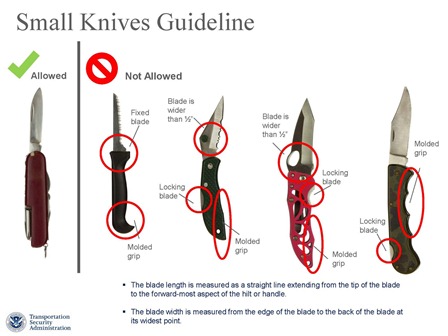
TSA_KNIVES Guide


If you’re traveling through Los Angeles International, Washington National, or Norfolk International airports on Thursday, March 21, you may see groups of flight attendants handing out leaflets.

Members of the Coalition of Flight Attendants Unions and others are asking passengers to join them in calling on members of Congress to support legislation to overturn the new TSA rules that will allow small knives back into airplane cabins. They’ll also be asking passengers to sign a White House petition seeking a roll-back of the new rules. More than 36,000 people have signed the petition so far. 100,000 signatures are needed by April 5th in order to get a response from the White House.

Here’s part of what the leaflet says:

The new rule does not make sense for combating potential terrorist attacks nor the daily disturbances we handle by de-escalating conflicts or asking passengers to help us contain problems. Aircraft cabins are fuller than ever and Flight Attendant staffing has been cut. Introducing knives and other weapons into these situations makes our job harder and everyone in the cabin less safe.

It makes no sense to choose between guarding against a hostile take-over attempt and an explosive device. We need to ensure air travel is secured against all threats to our safety and security.

We believe the millions who travel expect to arrive safely – and it’s our job to ensure it. Join us in opposition to this short-sighted, dangerous change to aviation security.

Whether you agree or disagree with the effort, here’s where the leafleting will be taking place and where you can go to chat about the issue.

On Thursday, March 21:

Washington National Airport (DCA),  Concourse Level Terminals A, B, C from 9 a.m to 11 am.

Los Angeles International Airport (LAX), Outside Departure Level – Terminals 1 and 2, 12:20 pm until 2 pm.

Norfolk International Airport (ORF), Airport Lobby, from 1 pm to 3 pm.

The TSA’s revisions to the prohibited items list are scheduled to go into effect on April 25th. You can read details about the changes in the rules about sharp objects and sporting goods and other items on the TSA website, which has a full list of the items allowed – or not – in carry-on and checked bags.


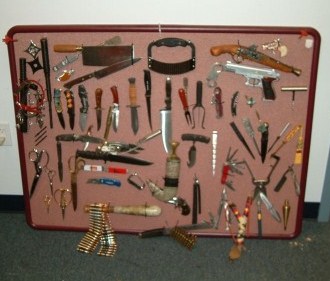
TSA sticking to its guns about knives

TSA DISPLAY


On Thursday, Transportation Security Administration Chief John Pistole went before lawmakers on Thursday and re-confirmed the agency’s decision to allow some knives and other items on airplanes for the first time since they were banned following the 9/11 terror attacks.

“I think the decision is solid and it stands and we plan to move forward,” Pistole testified before the House Homeland Security Committee, The Associated Press reported. It’s unlikely in these days of hardened cockpit doors and other preventative measures that the small folding knives could be used by terrorists to take over a plane, Pistole said.

On March 5, TSA announced that some knives under two and a half inches and some previously banned sports equipment, including hockey sticks, will be allowed back on airplanes.

TSA says the change to the prohibited items list is “part of an overall risk-based security approach” allowing employees to better focus on “finding higher threat items such as explosives.”

But groups representing airline industry workers, including many flight attendants, pilots, TSA officers and federal air marshals, have come out against what they characterizes as a dangerous and “ill-advised” move.

This will “put law enforcement officers and the flying public at greater risk,” said Jon Adler, president of the Federal Law Enforcement Officers Association.

Several members of the House committee share those concerns and urged Pistole to reconsider his position, AP reported.

The Teamsters, as well as the United Steelworkers and some passengers rights groups have also stated their opposition to the new TSA rules and executives at American Airlines, US Airways and Delta Air Lines have written letters directly to the TSA chief.

“We object to the agency decision to allow small knives back in the airplane cabin,” Richard Anderson, Delta’s chief executive officer, wrote in a letter dated March 8th. In a letter dated March 12, American Airlines senior vice president William Ris encouraged TSA “to reassess its proposed revisions to the prohibited items list.”

Southwest Airlines “is engaged with TSA in discussions,” said spokesman Chris Mainz. United has also expressed concerns to the TSA about the policy, but on Thursday a spokesperson declined to offer specifics.

The airline trade group Airlines for America was originally in support of TSA’s approach to “combining its vast experience with billions of passenger screenings with thorough risk-based assessments,” but it has softened its stance.

“We believe additional discussion is warranted before items that have been banned for more than 11 years are allowed back on aircraft,” said A4A spokeswoman Katie Connell.

A petition asking the White House to stop the TSA changes now has over 30,000 signatures. Earlier this week, Rep. Ed Markey (D-Mass.) introduced legislation with Rep. Michael Grimm (R-N.Y.) aimed at blocking the changes as well.

(My story about pushback to the TSA plan to allow knives back on airplanes first appeared on NBC NEWS.com)

Wrinkles in TSA’s rules on knives and sports equipment

What could go wrong with the Transportation Security Administration’s (TSA) plan to allow small knives and some sports equipment back on airplanes for the first time since 9/11?

A lot.

TSA_Sports items Permitted

Carry-on Confusion

TSA has decided small knives less than 2.36 inches long and no wider than half an inch as well as sports equipment such as hockey and lacrosse sticks, billiard cues, ski poles, souvenir-sized bats and up to two golf clubs per person “are unlikely to result in catastrophic destruction of an aircraft.”

But some larger items, such as hockey sticks, may still not make it onto airplanes because “airline policy dictates what can or cannot be stored in the overhead bins and under the seats,” said TSA spokesperson David Castelveter.

United Airlines and Southwest Airlines spokespeople told me that their current carry-on policies will apply after April 25, when the new rules are set to go into effect. But American Airlines Matt Miller said that airline is reviewing their policies and may update them, “as necessary.”

Bottom line: After April 25, be sure to check your airline’s carry-on rules before you fly.

State vs. Federal Rules

The new TSA rules will allow small knives to pass through the security checkpoint as a carry-on item, but Michigan put a law on its books after 9/11 prohibiting all knives (as well as firearms, explosives, razors and box cutters) in secure areas of airports.

The Michigan attorney general insists that this law will remain in place.

The TSA agrees. “It remains the responsibility of passengers to comply with state and local laws for each point of travel and be aware that origination and destination cities may have local laws prohibiting the possession of these items,” said TSA’s Castelveter.

Detroit Metropolitan Airport spokesperson Scott Wintner said Airport Authority Police officers will enforce the Michigan law “when violations come to their attention,” but aviation attorney Adam Wasch, with Wicker Smith in Fort Lauderdale, FL said “the courts may eventually decide that TSA rules pre-empt state rules on these matters.”

In the meantime, “allowing two sets of conflicting policies on whether pocket knives are prohibited muddies the water for passengers and creates a logistical nightmare for TSA workers.”

Piles of petitions

Unions and associations representing many flight attendants, federal air marshals and pilots are actively opposing the impending TSA rule changes.

The Flight Attendants Union Coalition has begun a campaign to reverse the TSA rules and on Saturday morning had about 15,000 signatures on a White House petition

The White House is required to respond if a petition gets at least 100,000 signatures.

The Federal Law Enforcement Officers Association (FLEOA), which represents air marshals has issued its own statement opposing what it calls “TSA’s reckless knife carry-on policy.”

At least one airline has officially come out against the TSA’s new rules.

On Friday, Delta Air Lines chief executive officer Richard Anderson sent a letter to TSA chief John Pistole voicing objection “to the agency decision to allow small knives back in the aircraft cabin.”

Anderson said the airline shared the flight attendant group’s “legitimate concerns” about the decision and said “If the purpose is to increase security checkpoint flow, there are much more effective steps we can take together to streamline the security checkpoints with risk-based screening mechanisms.”

29 year-old Ian Funderburg, who has been a flight attendant with a major domestic airline for the past two years, is also speaking out against TSA’s new rules.

“Baffled” to learn that knives would soon be allowed back on-board airplanes, Funderburg started his own campaign on the popular petition platform Change.org.

On Saturday morning Funderburg’s petition currently has more than 8,000 signatures.
“It’s not just a fear for flight attendants. The rules will probably renew fear in passengers,” said Funderburg. “We have to stop it.”

( This is a slightly updated version of my story about the TSA’s new rules that appeared on NBC NEWS.)

More on TSA’s move to allow small knives, sports sticks on airplanes

TSA_Permitted Items one

Not everyone is happy about the TSA’s decision to take small knives and sports equipment – including golf clubs (2 per person), pool cues, lacrosse sticks, hockey sticks, ski poles – and small novelty/souvenir bats off the list of items that passengers are prohibited to take on planes as part of their allowable carry-on items.

The new rules go into effect on April 25, but many flight attendants and their unions aren’t happy. The Flight Attendants Union Coalition released a statement blasting the TSA’s decision. and Ian Funderburg, who identifies himself as a flight attendant, has started an on-line petition asking the President of the United States to reverse the TSA’s Decision.

A TSA spokesperson told me on Wednesday that the agency worked closely with airlines on this latest revision of the prohibited items list and that airlines were comfortable with the action.

I was also reminded that while the TSA has said it’s OK for hockey sticks and other sports equipment to go through the security checkpoint and taken onto planes, that doesn’t mean that an airline must allow that stick or that equipment onto the plane. If an item is deemed too big for the overhead bin, or if the item exceeds the number of carry-on items a passengers is allowed, an airline still has the right to ask a passenger to check an item that will not fit an overhead bin.

And if passengers are asked to check – and pay baggage fees for – sports equipment that TSA says is allowable past the security checkpoint, you can bet there are going to be dust ups and debate.

I had the pleasure of talking about this topic on National Public Radio’s All Things Considered on Wednesday evening. You can hear that four minute story here.