Lyft

Dude, where’s my ride? Airports move Uber/Lyft away from curbside

At many airports, curbside pick-up is moving away from the curb.

On October 29, Los Angeles International joins the growing list of airports where curbside traffic has gotten so bad that taxis and ride-hailing services such as Uber to Lyft are no longer permitted to pick up at passengers at the curb.

“We have heard from our guests that the current system with ride pickups can be frustrating.” “said Keith Wilschetz, Deputy Executive Director for Operations and Emergency Management at Los Angeles World Airports, said in a statement

“Frustrating” is a polite way of describing how excruciating and time-consuming using a ride-app at LAX can be.

During peak times, app users now often spend upwards of 45 minutes to an hour between waiting for their ride to arrive curbside and sitting in traffic to get out of the Central Terminal Area.

“That’s if the drive doesn’t cancel on you,” said LAX spokesman Heath Montgomery.

At LAX, bad curbside traffic is about to get worse as the airport construction associated with terminal redevelopment and the new automated people mover begins.

“We will be losing more than 30% of our curb front, so doing nothing is not an option,” said Montgomery.

The solution at LAX is to move the pick-up area for both taxi and ride app users away from the terminal curbsides entirely to a new area, dubbed “LAX-it,” just east of Terminal 1.

Passengers will be able to walk to the new pick-up area from some of the terminals and a shuttle will pick-up passengers at all terminals in a dedicated lane on the lower/arrivals level lane.

LAX officials say getting from the airport to the pick-up lot should be no more than 15 minutes (from most terminals) and exiting the terminal should be faster because drivers no longer must battle backups in the Central Terminal Area.

Once it rolls out on October 29, the LAX-it system will no doubt need some tweaks.

For now, some passengers are worried the new system will be confusing and pick-up time will be no shorter than it is now. In a statement, Lyft said it looks forward to working with LAX on providing “the best possible pick-up and drop-off experience for all users,” but Uber outlined its long list of concerns with the plan in a letter to airport officials.

How do other airports tackle curbside congestion?  

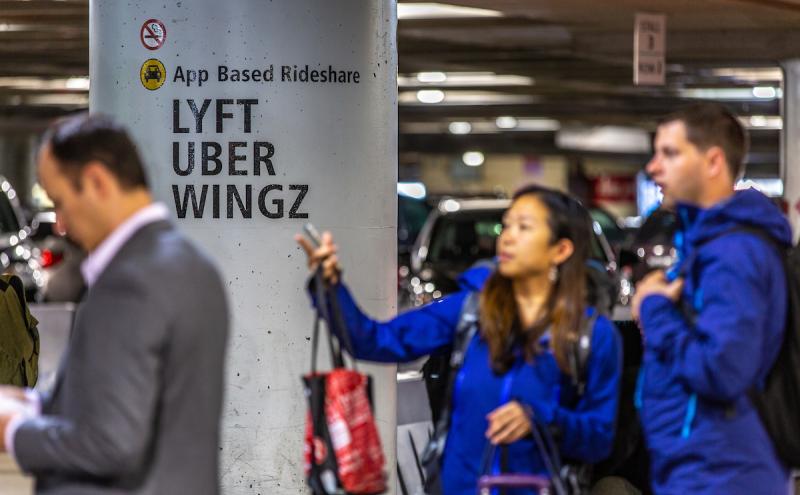
Back in 2016, Seattle Tacoma International Airport worked with ride-app providers to move pick-ups inside the airport parking garage, adjacent to space set already aside for other commercial ground transportation operators.

“We have since made traffic flow process improvements,” said SEA spokeswoman Kate Hudson, “We’re lucky in Washington state that cars must have front and near license plates as it allows passengers to locate their vehicle from both angles.”

The Port of Seattle staffs the ride-app pick-up area and contracts for additional ambassadors during peak times. 

With a goal of diverting at least 45% of ride-hailing pick-up activity away from the terminal roadways, in summer 2018 San Francisco International Airport relocated pickups for Uber Pool, Express Pool and Lyft’s shared categories to the Domestic Parking Garage. And in March 2019, Uber X and Lyft offered their customers the option to be picked up in the Airport’s Domestic Hourly Garage at $3 less than the curbside rate.

“To date, these measures have only shifted about 21% of [ride-hailed] pickup activity off the terminal roadways, falling short of the 45% diversion rate,” said SFO spokesman Doug Yakel, so as of June 5, 2019 SFO relocated all domestic terminal pickups for ride-apps, including Uber, Lyft, and Wingz, from the curbside to the 5th floor of the Domestic Hourly Parking Garage.

In mid-November 2018, Austin-Bergstrom International Airport (AUS) moved the pick-up area for all taxis and ride-app companies to the ground level of the airport’s Rental Car Facility.

“In the new space, dedicated taxi lanes are to the immediate left, while three ride share pick-up lanes are on the right,” said AUS spokesman Bryce Dubee, “The three ride share lanes are color-coded in blue, red and yellow with corresponding numbers 1-4 so that both passengers and drivers have a specific spot to meet up.”

The overall walking distance is about 750 feet, so before the switch was made the airport purchase four ADA-compliant 12-passenger electric shuttles to provide transport between lower-level locations and also leased an electric autonomous vehicle to transport passengers on the upper level of the garage.

Looking ahead, at the end of this month, Boston Logan International Airport (BOS) will move both pick-ups and drop-offs for app ride passengers to new dedicated curb areas.

The new areas – conveniently located in the Central Parking – will be protected from the weather, brightly lit, and connected to all terminals via moving walkways,” said BOS spokeswoman Samantha Decker. “The new areas will also provide all the services passengers expect, including luggage carts, wheelchair services, and bag check service.”

(My story about airports relocating pick-up spots for Uber, Lyft, Wingz and taxis first appeared on USA TODAY)

Travel Tidbits from Icelandair, PDXairport, Uber and Lyft

Icelandair has decided to extend the run of its Buddy Hotline Service through July 8.

The free program offers passengers a chance to get travel planning tips via phone or via online messenger from a member of the Icelandair team who’s an Iceland local.

According to Icelandair, each of the “Buddies” has a different expertise, such as local cuisine, outdoor adventures, wellness and Icelandic culture. And each buddy is eager to offer insider tips to help travelers make the most of their trip.  

The Hotline is open weekdays through July 8 from 9 a.m. – 3 p.m. ET and weekends from 12 p.m. – 3 p.m. ET.

PDX testing new ways to leave airports via Lyft and Uber

Like many airports, Portland International often has a very long line of people waiting for their assigned driver from a ride-hailing service such as Uber or Lyft.

Now, thanks to a pilot program being tested by both Uber and Lyft, the line should move much faster.

And, soon, so should the ride-hailing pick-up line at other airports.

First, the airport has separated the pick-up locations for the ride-hailing brands (Uber, Lyft and Winz) that serve the airport.

Uber and Lyft are also using a new system for pickups.

Uber is using PIN technology, a system it has used a high-volume events and festivals, to more quickly connect UberX riders and their drivers.  

Travelers request an UberX ride, receive a one-time code, and enter the line at the pick-up location. When they reach the front of the line, they show their code to the driver and upon validation, start the trip. (Separately, riders can also use Uber products for pick-ups at PDX, including UberPOOL, Uber XL etc. )

Lyft is also offering travelers a new code-based pick-up service.

With Lyft, travelers request their ride and are given a code. When the passenger arrives at the curb, they show the code to the next available driver and off they go. 

Both companies are testing their processes at PDX this week with full implementation expected by May 20. 

The pin-systems should get riders moving more quickly. S we expect the pilot program to become a permanent program at PDX and other airports shortly.


Travel Tidbits from an airport near you

Boston Logan Airport – and others – are reminding travelers that Uber & Lyft driver are planning a strike today, which might make getting to and from this and other airports a bit more complicated.

Delta Air Lines announces a “Reclaim My Status” loyalty benefit for its customers. Nice.

And the newest exhibit at St. Louis Lambert International Airport is curated by the Griot Museum of Black History.

Batik Story Quilts: Yoruba and Other Cultural Proverbs, displays Batik tapestry quilts made by artist Tunde Odulande.  

The exhibit includes seven quilts:

The Fairytale of the Blue Ghosts and Their Magical Spree,” Musicians Make Music While the Audience Makes Orchestration,” “Has Man Finally Arrived?,” “If you Don’t Know Where You Are Going, Any Road Will Do,” and “Our Heritage” are on display across from carousel 1 in the Terminal 1 Baggage Claim area.

Sweet Mother” and “Mask of Peace” are on display near the A Concourse entrance. Batik Story Quilts: Yoruba and Other Cultural Proverbs is on display at STL through October 23, 2019 

More ways to leave airports

DENVER AIRPORT WESTIN HOTEL with TRAINS

Photo courtesy Denver International Airport

Good news from Las Vegas, Chicago and Denver for travelers seeking more options for getting to and from the airports.

On Monday, San Francisco-based Lyft became the first ride-hailing service authorized to provide service to and from McCarran International Airport in Las Vegas.

https://twitter.com/LasVegasLyft/status/658717874006003712

To mark the milestone, Lyft’s website has a code (FLYLAS) good for $5 off two rides to or from the airport, valid for the next six months.

Ride-sharing heavyweight, Uber, has not yet cleared the airport’s permitting process, But the company says it is working on that.

Meanwhile, ride-hailing companies such as Uber and Lyft and Sidecar will be able to legally offer pick-ups at O’Hare and Midway airports beginning in 2016. (The deal with the city also allows the companies to provide service at the McCormick Place convention center and Navy Pier.)

And April 22, 2016 has been set at the opening day for the new commuter rail line that will run between Denver International Airport and Denver’s downtown Union Station.

The Regional Transportation District’s new A Line will make the 23-mile run in an estimated 37 minutes.

Tickets will cost $9 one-way, but for that same $9, travelers will be able to purchase an Airport Day Pass that will allow unlimited bus and rail rides, including to and from the airport, for one day.

Airports making deals with Uber, Lyft etc.

My “At the Airport” column on USA TODAY this month is an update on what’s happening with ride-hailing services at airports. Here’s the story:

Temporary sign at PIT Airport marks where Uber pick-ups are allowed.

After detours and disputes, many major airports are successfully hammering out deals with ride-hailing services such as Uber, Lyft and Sidecar.

That means more and, often, less expensive ground transportation options for many travelers.

Earlier this month, the Metropolitan Washington Airports Authority announced that, beginning Nov. 1, Uber and Lyft would be added to the list of authorized ground transportation options at Washington Dulles International and Ronald Reagan Washington Airports.

At the end of August, the Los Angeles City County approved a permit process that will allow Transportation Network Companies (TNCs), as the ride-hailing services are also called, to pick up passengers at Los Angeles International Airport.

Lyft, which already has operating agreements with 16 airports, is currently going through the permitting process at LAX, said airport spokeswoman Nancy Castles, but while representatives from Wingz, Opoli and Uber say they intend to apply, as of last week, no other TNC, had submitted an application for a permit.

“In the meantime, TNCs may continue to drop off passengers at LAX, but they cannot pick up customers,” Castles said.

In July, San Diego International Airport signed permits allowing Uber and Lyft to join ride-hailing service Opoli in offering pickup and drop-off service at the airport and, at the beginning of September, UberX began operating legally at Sacramento International Airport.

Airports in Seattle and other cities are working on and/and or close to announcing agreements with ride-hailing services as well, and if Chicago Mayor Rahm Emanuel’s new budget plan moves forward, ride-hailing services will soon be officially allowed to pick up and drop off passengers at O’Hare and Midway Airports.

“It wasn’t a question of when services such as Uber and Lyft were coming to airports or how to keep them out,” said Kevin Burke, President and CEO of ACI-NA, the organization which represents most commercial airports in North America, “The big challenge for airport directors was how to regulate the services,” given the various governing models in place at the nation’s airports, he said.

To help move things along, ACI-NA put together a task force that examines the services and offers suggestions to airports on how to negotiate a deal that works for everyone.

“Airports want to provide options for passengers that are coming in and leaving, and if Uber and Lyft are viable options, then we should be providing them,” Burke said. At the same time, though, airports need to make sure passengers are safe and airports need to protect themselves as legal entities, he said.

In 2013, airports in the U.S. and Canada earned $3.1 billion from parking and ground transportation fees, so airports need to make sure the agreements they work out with ride-hailing services protect that revenue as well.

“As we move along we’ll see more and more airports solving these challenges,” Burke said,” but each airport has a different story and there will likely be some snags.”

One of those snags is in Florida, where last week Broward County Commissioners spent more than six hours debating regulations that would have allowed Uber to operate at Fort Lauderdale-Hollywood International Airport.

“They provide a very good service, our customers want to see that service, and we want to work with them to get that service here,” said Kent George, director of the Broward County Aviation Department, but negotiations between Uber and the county have “been difficult.”

George said while the airport looks at ground transportation services more as a customer service than a revenue center, he’s confident Uber won’t walk away from the large South Florida market, which includes 26 million annual passengers at Fort Lauderdale, 40 million passengers Miami International Airport and more than 7 million annual passengers at Palm Beach International Airport.

“The airports are working together and I believe we will eventually get to ‘yes’,” George said.

Airports adding – and rejecting – ride-shares

Flying car

Airports across the country are grappling with how to deal with taxi-alternative services and Transportation Network Companies (TNCs) such as Uber and each week a few deals are being made.

This week San Francisco International Airport (SFO) announced an agreement with Wingz, a company that connects citizen drivers with people needing airport rides. The pilot permit allows drivers to pick up and drop off at the airport, starting within the next 30 days.

Last month, SFO announced agreements with Sidecar, Lyft and UberX, awarding each a permit for a 90-day pilot program to allow the airport to evaluate the businesses.

This week, the Houston City Council approved rules granting Uber and other app-based companies access to the Houston airports, but in Cincinnati, signs are now posted at CVG airport alerting travlers that only permitted ride-share companies have permission to operate at the airport.

SFO inks deal with Uber & Lyft

Uber app

Airports around the country are grappling with how – and if – they can regulate and collect revenue from  taxi-alternative companies such as Lyft, Sidecar and UberX, which maintain that they do not fall under the same rules that apply to traditional taxis that operate at airports.

Some airports have taken a hands-off approach to the problem, but San Francisco International Airport has been adamant that these ‘transportation network companies’ are operating illegally at the airport.

But things have changed.

Earlier this month SFO announced that it had come to an agreement withe Sidecar to allows that company to operate legally at the airport.

Now comes word that the airport has worked out a deal that allows Lyft and UberX to pick up and drop off at SFO as well.

All three companies should be operating – legally – at the airport within the next 30 days and the deals will no doubt serve as a guide to help these companies work out their differences with other airports as well.

SFO makes deal with Sidecar

Sidecar

In a first for California, San Francisco International Airport (SFO) and Sidecar have come to an agreement that allows the Transportation Network Company (TNC) to operate legally at the Airport.

The permit, which allows the company to drop off and pick up customers at SFO, represents the first airport TNC agreement in the state of California. Sidecar, which is headquartered in San Francisco, expects to begin operations at SFO within the next 30 days.

“SFO is one of our most in-demand places for ride requests,” Sidecar CEO Sunil Paul wrote in a blog post on the company’s website, “so we’re excited and proud to work with them to offer riders safe and affordable travel to and from the airport.”

SFO officials say permit discussions continue with other transportation network companies, including Lyft and UberX, but that so far neither have signed a permit with SFO and so are not legally allowed to operate at the Airport.

Last November, SFO came to an agreement with Relay Rides – a company that offers free airport parking, a car wash and a cut of the proceeds to travelers who let the company rent out their cars to others. A similar company, Flight Car, does not have legal permission to operate at the airport.

Cities, airports butt heads over rideshare services

App-powered ridesharing services such as Uber and Lyft keep butting heads with regulators in cities around the country, claiming that rules for traditional taxis are outdated and not applicable to new transportation models.

Here’s my story on the latest chapter in the battle that appeared on CNBC Road Warrior.

Glacier National Park visitors 1960

After a few weeks of negotiations with state and city authorities and the threat of a restraining order, Lyft worked out a deal to start service in New York City beginning Friday at 7 p.m.

Manhattan, Queens, the Bronx and Staten Island will, for now, get a limited version of the service that was originally planned, but the deal means Lyft is putting operations in Buffalo and Rochester on hold by Aug. 1 while it works out a variety of insurance and regulatory issues.

In Memphis, Tennessee, Uber and Lyft continue service despite recent cease-and-desist orders from the city.

Uber spokesman Lane Kasselman said via email that while the company was not aware of any actions taken by the city of Memphis, “any attempt to restrict consumer choice and limit economic opportunity does nothing but hurt the thousands of residents and visitors who already rely on Uber for safe, affordable and reliable transportation.”

But Lyft spokeswoman Erin Simpson said the company took the cease-and-desist letter “as an opportunity to start a conversation with local leaders about Lyft’s peer-to-peer model and how we can work together to craft new rules that prioritize safety.”

Consumer alerts and cease-and-desist orders against Uber, Lyft and other transportation network companies are in effect in more than a dozen other cities and states. But while the so-called transportation disruptors have gained regulatory approval in Seattle, Minneapolis and a handful of other jurisdictions around the country, pushback at the national level continues.

Through its “Who’s Driving You?” campaign, the Taxicab, Limousine & Paratransit Association is tracking insurance alerts regarding rideshare companies and soliciting and sharing passenger complaints and negative news stories about the services.

“We would like to see ridesharing companies following a single set of rules designed to protect the public in the taxicab space,” said Dave Sutton, spokesperson for TLPA’s ‘Who’s Driving You?’ campaign.

TLPA also recently drew attention to the fact that the Airport Ground Transportation Association, a trade organization for airport ground transportation operators, airports and others, issued a warning to North American airports.

“Transportation Network Companies have moved beyond city regulations to now challenge airport ground transportation regulations as not applying to them. They intend to operate at airports and challenge airport officials to stop them,” said Ray Mundy, AGTA executive director, in the warning.

That plan already seems to be underway.

In 2013, when California became the first state to regulate ridesharing services, the Public Utilities Commission included a provision prohibiting TNCs from operating “on the property of or into any airport unless such operations are authorized by the airport involved.”

But in June 2014, law enforcement officials at five major California airports (LAX, OAK, SAN, SFO and SJC) told the commission that many ridesharing services were flouting those rules by continuing to operate at the airports without permits.

“We’ve invested a lot of work since last fall, trying to find a way to create a lawful way for TNCs to operate at airports,” said Doug Yakel, spokesman for San Francisco International Airport. But he said while SFO is in discussions with several TNC companies regarding permits, “thus far we have not completed this process for any company.”

Airports in Chicago, Raleigh-Durham, North Carolina, and many other cities have also grappled with the TNC issue.

Now Airports Council International-North America, the trade organization for North American airports, is getting involved.

While “it is unacceptable for TNCs to simply ignore regulations and requirements with which they disagree, as has been the case at some airports … the demand for transportation network companies cannot be overlooked and must be addressed,” said Deborah McElroy, ACI-NA executive vice president.

ACI-NA has put together a task force to help airport officials establish regulations and work out reasonable solutions, although given the circumstances at individual airports, the appropriate solutions may differ greatly, said McElroy.

And while “there’s no handbook yet” for dealing with TNCs in cities and airports, “we’re just seeing the beginning of a new method of transportation that’s vastly superior to what came before,” said Joshua Schank, president and CEO of the Eno Center for Transportation. “They will eventually find a way to regulate them and make them safe.”

Detour for Sidecar & uberX at LAX & SFO

aerocarmodel_2_lrg

Ride-sharing services provided by companies such as Lyft, Sidecar and uberX have become popular, if somewhat controversial, lower-cost alternatives to traditional taxicabs in many cities and at many airports.

The services match people who need rides with mobile app-dispatched citizen drivers willing to provide rides and accept a fee.

But, citing an aggressive stance by authorities at Los Angeles International Airport for issuing citations to drivers picking up passengers there, Uber and Sidecar have recently pulled the plug on that part of their LAX service.

“Although we look forward to working with the authorities to resolve these issues quickly, this unwarranted action by authorities to punish drivers and riders cannot continue,” Uber spokesman Andrew Noyes wrote in a company blog post a week ago. “That’s why we’re temporarily halting uberX pick-ups at LAX effective immediately.”

Noyes told CNBC there were no projections on when the uberX pickup service might resume, but that for now uberX drivers are still dropping off passengers at LAX. The company’s other services, UberBLACK and UberSUV, which work with licensed commercial drivers, continue both pickups and dropoffs at LAX, he said.

Sidecar spokeswoman Margaret Ryan said via email that because the company has heard of the increased enforcement action at LAX, “we’ve advised Los Angeles drivers to avoid picking up passengers at LAX as well.”

In an email, Los Angeles Airport Police spokeswoman Sgt. Belinda Nettles said “no special enforcement is taking place” against uberX, Sidecar or other ride-share drivers. Only that “airport police officers are enforcing airport rules and regulations, as well as any violations pertaining to the penal code, vehicle code and the Los Angeles municipal codes as appropriate.”

At issue are the first round of rules issued by the California Public Utilities Commission for regulating companies such as Uber, Sidecar and Lyft, which the commission calls transportation network companies. “The question of picking up passengers by TNCs is still under review” by the commission, and TNCs wishing to serve the airport also need licenses or permits, and insurance, to do business at LAX, Nettles said.

Nettles said Thursday she was unable to provide information on what types of citations were issued to uberX drivers. “We cite for airport rules and regulation violations and California vehicle and penal code violations as appropriate daily,” she said.

LAX is not the only airport that has taken action against ride-sharing companies.

In April, San Francisco International Airport issued a cease and desist order to ride-sharing services operating there. “These were enforced primarily through admonishments, and some citations were also issued,” said SFO spokesman Doug Yakel.

Like many other airports, San Francisco has rules stating that each business that provides ground transportation, rental car or airport parking services must get an airport permit .

In response, Uber published a blog post in August with tips for riders at SFO noting that pickups by Uber services were unaffected, but that “SFO has taken an aggressive stance against uberX and has begun citing some drivers.” The company suggested fliers instead use another Uber ride service, such as UberBLACK or UberSUV.

Ryan said Sidecar is working with the state utilities commission to work out a solution but that in response to the cease and desist order, “we’ve advised San Francisco drivers to avoid trips to SFO until we’ve figured it out.”

Lyft has not yet responded to a request from CNBC for the status of its services at LAX or SFO.

For its part, SFO airport, which recently came to an agreement with car-sharing service Relay Rides, remains “open to new business models that provide our customers with a variety of transportation options,” said Yakel.

He said while the decision by the California Public Utilities Commission to regulate transportation network companies provides a framework to move forward with a permitting process at SFO, “we have yet to receive word of any TNC attempting to operate at SFO being permitted through the CPUC.”

(My story about ride-sharing services at SFO and LAX first appeared on CNBC Road Warrior)