Alexander Calder

Welcoming back, Calder, to PIT Airport

[This is a slightly different version of a story we wrote for the Pittsburgh International Airport’s Blue Sky News]

Check out the Calder sculpture at PIT Airport

It is black and white, weighs 600 pounds and is 28 feet long and equally wide.

And it will be impossible to miss it at Pittsburgh International Airport’s new landside terminal.

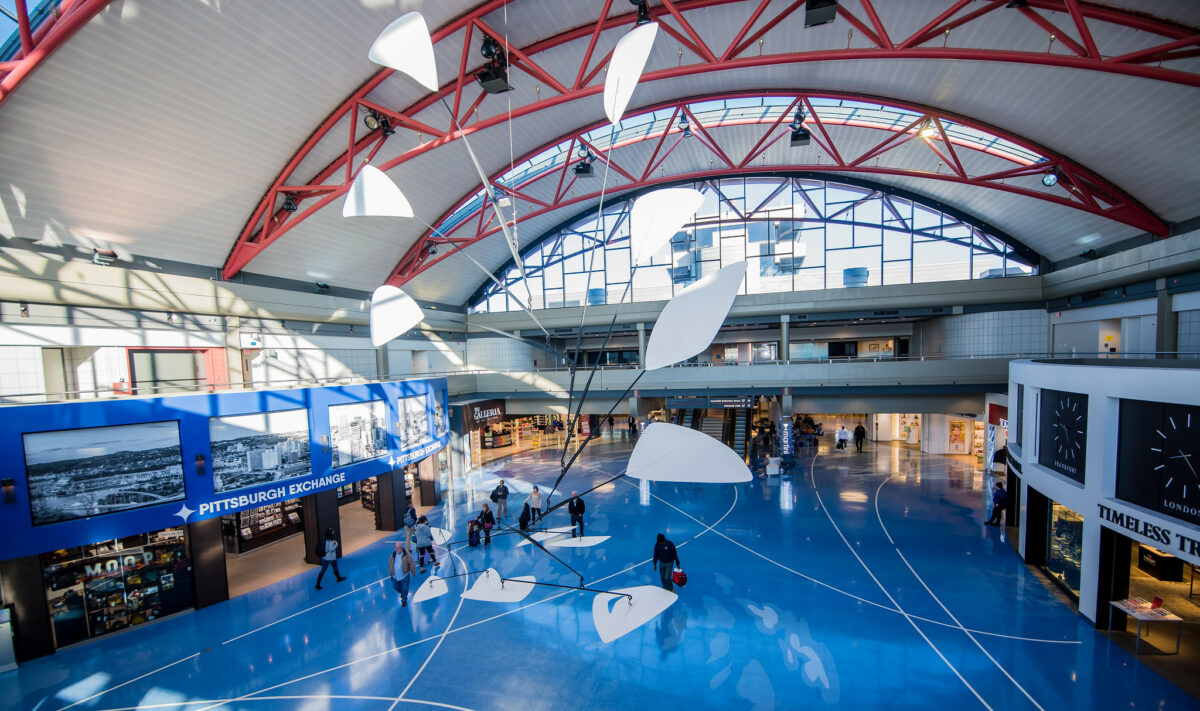
“Pittsburgh,” the kinetic mobile by famed artist Alexander Calder that has dangled from ceilings in the city’s airport terminals, on and off, for almost 70 years, has been reinstalled in the brand-new terminal’s atrium space to serve as both a gently waving welcome and farewell for all passengers and pre-security guests.

First installed in 1959 over the rotunda of the Greaterer Pittsburgh Airport terminal that opened in 1952, the mobile spent some time at the Carnegie Museum of Art before moving to the current PIT terminal in 1992.

As such, the sculpture has been part of the airport’s art program since before the airport even had much of an art program, said Keny Marshall, PIT’s Manager of Arts and Culture.

“People just expect to see the Calder at the airport,” said Marshall. And while the new landside terminal was not designed around the sculpture, its “place of prominence” was determined in collaboration with the architects – Gensler + HDR, in association with luis vidal + architects – to highlight the piece and to give the public a better view of it, he said.

PIT Calder Mobile

“Pittsburgh” is made of black steel rods and white aluminum paddles and is balanced so that elements move with just the slightest breeze to allow the activation of the mobile. The piece has been in storage for the past two years in preparation for its move to the new terminal.

In its previous location above PIT’s post-security Airside Center Core, the Calder mobile was in “an architecturally cluttered space” where few passengers stopped to take time to look at it, said Alex Taylor, an associate professor in the Department of History of Art and Architecture at the University of Pittsburgh who has studied Calder’s work extensively.

“When I’d go to the airport, I would stop with my carry-on to watch the work for as many minutes as I could spare before I had to get to the gate,” said Taylor, “But it always felt like I was the only one.”

Carol Brown would also make sure to visit the Calder during her trips through the modern-day terminal. The former county parks director was instrumental in getting the sculpture restored when it was hung incorrectly at the old terminal with its metal sections painted first yellow and green (Allegheny County’s colors) and then pink. Once it was restored, Brown advocated to have it put in the then-new 1992 terminal.

“I would always stop to say ‘Hi, Calder,’ when I went through the terminal. And I am looking forward to being able to say that again in the new terminal,” said Brown.

That will be easy to do. In the new landside terminal, the mobile will hang in the large open atrium space with an overlook offering multiple viewing angles, said Marshall.

Experts from Ohio-based McKay Lodge Art Conservation Laboratory, the company that took the Calder down from its previous spot and packed it for storage, will be on hand to unpack the sculpture and put it back up.

It will be an unusual challenge. A special lift is needed to attach the sculpture to the new terminal’s ceiling, which is almost 80 feet high.

And luckily, PIT airport owns a special piece of machinery – the Teupen Leo 26 aerial lift –  that can easily handle the task, said Renee Piechocki, a longtime public art consultant for PIT.

And because each piece of the sculpture is carefully cantilevered off the next, “as soon as you add a piece, everything changes. Only once the sculpture is fully assembled does it gracefully balance in the space,” said Marshall.

When the new terminal opens sometime this October, passengers and the public will be able to see the sculpture from eye level or above on the pre-security departure level of the new terminal.

On the arrivals level, one floor below, people will be able to look up at the sculpture and walk beneath it, explained Marshall.

What other airports have Calder sculptures?

(Courtesy Calder Foundation, New York / Artists Rights Society )

Other airports have, or once had, Calder mobiles.

Among them is the artist’s 45-foot-long mobile titled “.125” (above) that currently hangs in the Departure Hall of Terminal 4 at John F. Kennedy International Airport.

A Calder mobile named “Brass in the Sky,” once hung in Marshall Field & Co.’s Cloud Room Restaurant at Chicago’s Midway Airport.

And a 40-foot-wide Calder work titled ‘Red, Black and Blue” made its way from Dallas Love Field (DAL) to Dallas Fort Worth International Airport (DFW) and to Milwaukee Mitchell International Airport (MKE) before finally landing at the Milwaukee Art Museum.

Valued now at about $12 million, PIT’s Calder mobile may be the airport’s most valuable and well-known work in a growing art collection.

“But you don’t need an art degree to understand why it is the centerpiece of the new terminal,” said Piechocki.

Like the multi-tiered sculpture, Piechocki imagines there will be multiple layers of responses to the mobile in its new space.

For those already familiar with the sculpture from the existing terminal, she hopes the reaction is “Wow, they finally gave the Calder the place it deserved. It looks amazing.”

For someone who has never been to Pittsburgh and who knows art, the reaction might be, “Oh my god! Is that a Calder?”

And for someone who is just a little grumpy and stressed out at the airport who might not know anything about art? Piechocki hopes they might pass by the sculpture and “be subconsciously a little less stressed out because they’re looking at a beautiful thing moving through the air.”

Here’s a snap of PIT’s Calder sculpture from the recent install. We can’t wait to see it in person!

(All photos courtesy Pittsburgh International Airport, except where noted)

Airports, airplanes & Alexander Calder

Courtesy Calder Foundation

July 22 was artist Alexander Calder’s birthday, giving us an excuse to share some photos of his work in airports and on airplanes.

The photo above is of Calder in 1957 inspecting the installation of his work originally titled .125, after the gauge of the aluminum elements in Terminal 4 at John F. Kennedy International Airport (then Idlewild Airport). The piece was later redubbed Flight.

Courtesy Library of Congress

Pittsburgh International Airport (PIT) also has a work by Alexander Calder in its collection. This piece is titled, appropriately enough, Pittsburgh.

Courtesy Pittsburgh International Airport

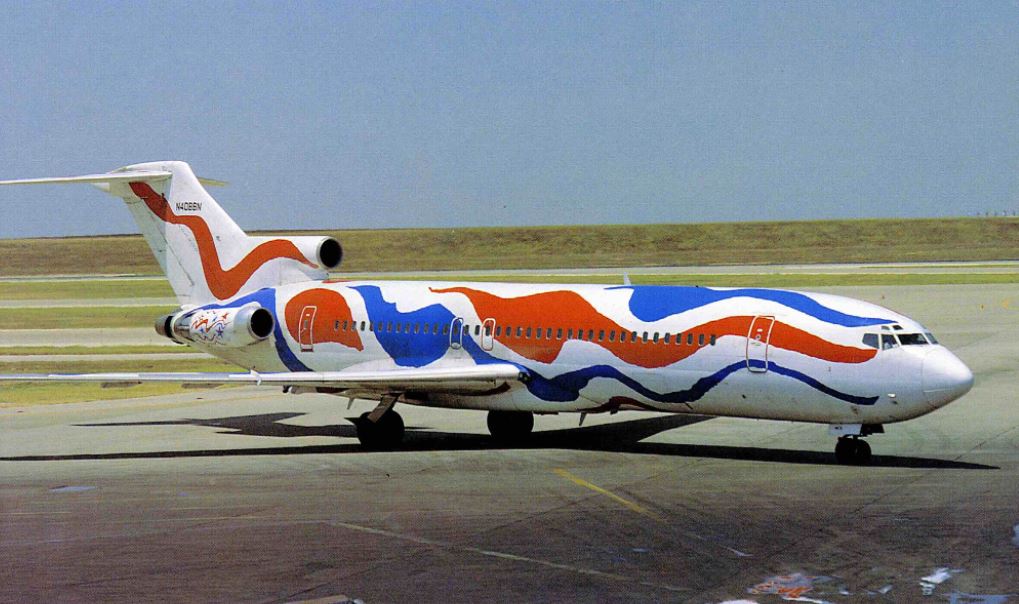
Calder’s work also appeared on Braniff International Airways airplanes in the mid-1970s.

The first was a Douglas DC-8 known as Flying Colors of South America. The second was a Boeing 727-200 named Flying Colors of the United States.

Courtesy of the Calder Foundation

https://twitter.com/SFOMuseum/status/1418356832234393600?s=20

To learn more about the airplanes Calder painted for Braniff, see this article from 2020 by Chris Sloan in Airways Magazine.

Bridge art coming to Pittsburgh Airport

A intriguing piece of public art, Glenn Kaino’s Arch, will soon be on display inside Pittsburgh International Airport, most likely in the Landside Terminal.

The work is a transformer/robot made up of pieces that look like Pittsburgh’s bridges and was originally located in Downtown Pittsburgh’s Cultural District, evidently as a temporary installation celebrating the city’s 250th anniversary. Now the work will be moved inside.

Arches should be happy at PIT airport, which already has a good deal of artwork, including an Andy Warhol Museum exhibit, and – last time I checked – an Alexander Calder mobile titled Pittsburgh, a model of a T Rex that is about 15 feet high and 30 feet long and a shrine to Mister Rogers.

Mr Rogers at PIT

Five reasons to appreciate Pittsburgh International Airport

Chocolate hockey puck from PIT

Despite the van driver’s assurance that we’d get stuck in rush hour traffic, I arrived at Pittsburgh International Airport yesterday with plenty of time to poke around before my flight.

Good thing. Because in addition to the free internet access, there really are plenty of reasons to appreciate spending time at this airport.

Here are just five of them:

The dinosaur

Dinosaur at PIT

The shopping.  Plenty of it – and a shoe store. Enough said

Nine West shore store at PIT

The mobile by Alexander Calder in the center core.  This is a great art treasure to have at the airport.

Alexander Calder mobile at PIT

The shrine to Mr. Rogers, who filmed his long-running running TV show in Pittsburgh.

Mr Rogers shrine at Pittsburgh Airport

And, just across the way, a wall covered in Andy Warhol self-portrait wallpaper, along with several pieces of his artwork.

Andy Warhol Wallpaper at PIT

Party at Pittsburgh International Airport

To celebrate five years of service to Pittsburgh International Airport (PIT), Southwest Airlines will be throwing a little party at its PIT gates starting at 10 a.m. on Tuesday. Gate games and decorations are promised, but with Southwest, well, you never know quite what will happen.

Even without a Southwest party, Pittsburgh Airport has a few special amenities worth applauding.  There’s this giant  aluminum and iron mobile by Alexander Calder suspended over the air-side central atrium:

PIT also has free Wi-Fi, exhibits from The Andy Warhol Museum, a T-Rex model on loan from the Carnegie Museum of Natural History, and an exhibit honoring Fred Rogers of Mister Rogers Neighborhood.