Airlines

U.S. government opens, but flights not yet 100%

Will air traffic be ‘normal’ now that the government shutdown is over? Not quite yet…

The longest government shutdown is officially over. But the hassle it created for air travelers is not.

The U.S. Department of Transportation and the Federal Aviation Administration (FAA) didn’t end the current flight reductions, which were set to go to 8% on Thursday and to 10% on Friday.

Instead, there’s a new emergency order freezing the mandated flight reductions at the current 6% level while the FAA figures out what’s next.

“If the FAA safety team determines the trend lines are moving in the right direction, we’ll put forward a path to resume normal operations,” said U.S. Transportation Secretary Sean P. Duffy.

The 40 affected airports where flight reductions have been mandated remains the same (see below). But cancellations and delays continue to ripple through the entire system.

Early Thursday morning (1 am EST) Flightaware.com was reporting close to 1000 canceled flights within, into or out of the U.S. and about 400 delays for the day.

And getting back to normal won’t be all that easy. Or smooth. Even when the flights reductions are completely lifted.

“Airlines cannot flip a switch and resume normal operations immediately after a vote,” aviation industry group, Airlines for America, noted in a statement shortly before the government shutdown votes were completed, “There will be residual effects for days.”

“High impact” airports with mandated flight reductions

ANC – Ted Stevens Anchorage International Airport  
ATL – Hartsfield-Jackson Atlanta International Airport 
BOS – Boston Logan International Airport  
BWI – Baltimore/Washington International Airport  
CLT – Charlotte Douglas International Airport  
CVG – Cincinnati/Northern Kentucky International Airport  
DAL – Dallas Love Field  
DCA – Ronald Reagan Washington National Airport  
DEN – Denver International Airport  
DFW – Dallas/Fort Worth International Airport  
DTW – Detroit Metropolitan Wayne County Airport  
EWR – Newark Liberty International Airport  
FLL – Fort Lauderdale/Hollywood International Airport  
HNL – Honolulu International Airport  
HOU – William P. Hobby Airport  
IAD – Washington Dulles International Airport  
IAH – George Bush Houston Intercontinental Airport  
IND – Indianapolis International Airport  
JFK – New York John F. Kennedy International Airport  
LAS – Las Vegas McCarran International Airport  
LAX – Los Angeles International Airport  
LGA – New York LaGuardia Airport  
MCO – Orlando International Airport  
MDW – Chicago Midway International Airport  
MEM – Memphis International Airport  
MIA – Miami International Airport  
MSP – Minneapolis–St. Paul International Airport  
OAK – Oakland International Airport  
ONT – Ontario International Airport  
ORD – Chicago O’Hare International Airport  
PDX – Portland International Airport  
PHL – Philadelphia International Airport  
PHX – Phoenix Sky Harbor International Airport  
SAN – San Diego International Airport  
SDF – Louisville International Airport  
SEA – Seattle–Tacoma International Airport  
SFO – San Francisco International Airport  
SLC – Salt Lake City International Airport  
TEB – Teterboro Airport  
TPA – Tampa International Airport  
 

Shutdown fallout: FAA will reduce air traffic by 10%. Starting Friday

As if air travel wasn’t stressful enough…

On Wednesday, the Federal Aviation Administration and the Department of Transportation announced a decision to reduce air traffic by 10% at 40 “high-volume” markets across the country starting Friday.

Unless, that is, the government shutdown concludes before then.

Which could be a stretch.

The FAA didn’t say which markets would be affected, but not long after the announcement, airlines began sharing how they planned to respond to the directive.

In a memo to employees and on social media, United Airlines said the reductions will start on Friday, November 7.

“United’s long-haul international flying and our hub-to-hub flying will not be impacted by this schedule reduction direction from the FAA,” United CEO Scott Kirby said in the memo, “Instead, we will focus our schedule reductions on regional flying and domestic mainline flights that do not travel between our hubs.”

He added that customers traveling during this period will be eligible for a refund if they do not wish to fly – even if their flight isn’t impacted. That includes non-refundable tickets and those customers with basic economy tickets.

American Airlines also shared a statement.

“While we are awaiting additional information from the FAA to determine which flights will be impacted, we expect the vast majority of our customers’ travel will be unaffected. As schedule changes are made, we will proactively reach out to customers who are impacted,” the airline said on Wednesday evening.

Southwest Airlines said it is evaluating how the planned FAA flight reductions will affect its schedule. “We know that these FAA-imposed cancellations can impact an important moment in your life. We appreciate your understanding,” the airline said in a statement.

Other airlines are making plans as well and we’ll no doubt learn a lot more on Thursday.

In the meantime if, like us, you have a flight scheduled in the next few days, keep an eye on your inbox, your airline app and on the news.

How will the U.S. government shutdown mess with travel?

If the U.S. government shutdown continues, there could be trouble for travelers and the U.S. travel and tourism economy on multiple fronts.

Trouble at airports and in the skies

For now, airports and airlines are continuing to operate as normal and are issuing reassurances that they are.

But if the shutdown continues, air travelers should be prepared for long security and customs lines and canceled or delayed flights.

Air traffic controllers, TSA officers and Customs and Border Protection (CBP) staff are considered ‘essential workers’ and are required to work during the shutdown.

But they won’t be getting paid. And, as the last government shutdown dragged on, the strain of working under those conditions caused many of those workers to call in sick, take on other jobs or just not show up for their shifts.

TSA says it has stopped actively managing its website and social media accounts during the lapse in federal funding.

However, before stepping away, the agency stated on X (formerly Twitter) that approximately 61,000 of its 64,000 employees are considered excepted or exempt, and that TSA will continue operations.

“The remaining employees will be temporarily furloughed,” it added.

In a pre-shutdown release, the Airline trade group, Airlines for America, warned that while “aviation is the safest mode of transportation, to maintain that during the shutdown, “the system may need to slow down, reducing efficiency.”

The U.S. Transportation Department is furloughing more than 11,000 employees at the Federal Aviation Administration (FAA).

The National Air Traffic Controllers Association notes that in addition to air traffic controllers working without pay, the shutdown means that approximately 2,350 aviation safety professionals that NATCA represents, including aircraft certification engineers and aerospace engineers, are furloughed.

“Critical safety support, operational support, and modernization work will stop,” says NATCA.

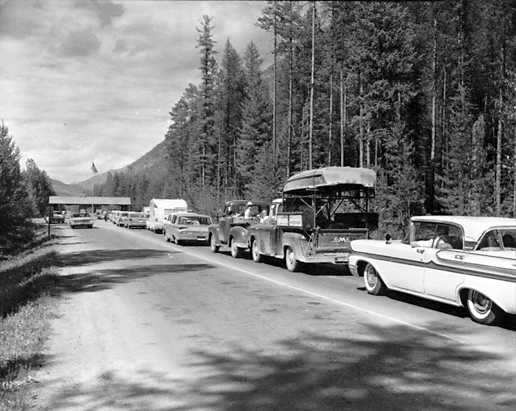
Glacier National Park visitors 1960

Closures of museums and National Parks

Elsewhere, Smithsonian Museums and the National Zoo in Washington, D.C. are closed.

A message from the National Park Service says that “National parks remain as accessible as possible during the federal government shutdown. However, some services may be limited or unavailable.”

The agency has posted some closure alerts on its website and has more details in its contingency plan document. But be prepared to find visitor centers, historic buildings and other staffed facilities in any National Parks that remain open to be inaccessible.

There are state and local efforts around the country to keep individual parks and monuments open.

For example, Colorado is offering to help keep its eight National Park properties open. The South Dakota tourism office says many of its National Park sites remain open, including Badlands National Park and Mount Rushmore. However, visitor centers and guided tours are unavailable.

And the Interior Department announced plans to keep the Statue of Liberty and Ellis Island open in New York.

In general, the rule of thumb for travelers during this shutdown is to be flexible, check – and check again – on the status of any place you hope to visit and hope that this mess gets resolved quickly.

Because in addition to the disruptions individual travelers may be dealing with, Tourism Economics estimates that the travel economy is at risk of losing $1 billion a week due to disruptions in air and rail travel and the closure of national parks and museums. 

Swank new ways to fly + cool new places to fly to

This week there was news about new planes with upgraded interiors and a bevy of “let’s go!” new routes.

Earlier this week we shared photos and notes about the new seasonal Edelweiss Air flight from Seattle-Tacoma International Airport (SEA) to Zurich.

Alaska Airlines also announced that flights between Seattle and Rome will begin in May 2026. The carrier points out that the ‘Emerald City; will be connected to the ‘Eternal City’ for the first time.

With Hawaiian Airlines, Alaska Airlines recently launched flights to Tokyo Narita and in September will begin flying to Seoul, South Korea.

Charlotte Douglas International Airport (CLT) celebrated new seasonal nonstop service to Athens Airport (ATH).

American Airlines woos with the ‘premium’ Boeing 787-9 aircraft

And this week, to much hoopla, American Airlines began flying one of its new 787-9P ‘premium’ aircraft, with an inaugural flight on June 5 from Chicago O’Hare (ORD) to Los Angeles International Airport (LAX).

Sadly, the Stuck at The Airport team, sadly, wasn’t on that first flight. But we look forward to hopping on board soon to experience all the new creature comforts.

Here’s a short video of the new interior that the airline shared a few weeks back.

And here’s an important public service announcement

(Image courtesy Clark County Dept of Aviation)

Harry Reid International Airport (LAS) in Las Vegas and the #WhatsMyName Foundation introduced a safety campaign that is important to remember every time and anywhere you hail a rideshare.

The foundation was created to honor Sami Josephson, a young woman kidnapped and murdered by a fake rideshare driver in 2019. The campaign uses the letters of Sami’s name to spell out the tips that could save your life.

Here are the tips to remember:

S: Stop before you get in a vehicle and go over the safety rules in the app

A: Ask your driver “What’s my name?” to confirm that they are the driver assigned to you. (Don’t say, “Are you ….”)

M: Match the make, model and license plate of the car with the one displayed in your rideshare app.

I – Inform a friend or family member of your ride details. Rideshare apps offer a real-time tracking app. Use it.

Do you love the scent of the airport?

Have you ever wished that you or your home would smell just like your favorite airport or airline?

It’s not such a far-fetched idea.

Back in 2012, we saw the debut of a line of 19 city-centric scents named for their airport city codes — CDG (Paris), LHR (London), DXB (Dubai) — and packaged in slender bottles with labels that looked like baggage tags, bar codes and all.

The Scent of Departure line no longer seems to exist, but it seemed like a charming travel souvenir.

Linking scents with airports – and airlines – is still a thing.

In mid-January Air France introduced a signature fragrance now being spritzed in its La Première (first class) lobby, a handful of lounge areas at Charles de Gaulle Airport (CDG) and onboard aircraft in the La Première suites.

Named AF001 as a nod to the Concorde flights that traveled between New York and Paris in the late 1970s, the bespoke scent will soon waft through other Air France lounges in Paris and around the world.

What does AF001 smell like?

According to Air France, it has a “comforting, musky scent, combined with mimosa from the south of France” that adds “a sunny, natural vibrancy.”

Air France may have the newest bespoke fragrance in the skies, but as we shared in a story we first wrote for The Points Guy site, there are other airlines and airports with their own special scents.

Dubai-based Emirates worked with Irish brand Voya on a bespoke Eau de Toilette fragrance used on flights in First and Business Class.

Singapore Airlines signature scent is called Batik Flora and was created by Singapore-based Scent by SIX. The fragrance draws its floral notes from the six flowers in the batik motif featured on the airline’s uniforms.

Singapore’s Changi Airport also has its own signature fragrance, called Changi Scent, which smells like orchid, geranium, mint, citrus and Asian spices.

And Hong Kong-based Cathay Pacific worked with Australian scent marketing agency Air Aroma on a signature scent that features lavender, jasmine, bamboo, juniper berry, tea leaves, white musk and cedarwood.

Tampa International Airport (TPA) wanted a fragrance that could reflect the Tampa Bay Region. They settled on Scent Air’s “Bamboo Tea,” which has notes of green Bergamot (an Italian citrus fruit), Jasmine, Neroli (the blossom of the bitter orange tree), Musk and Tree Moss.

Smelled any good airports? Let us know.