airline fees

United Airlines drops fee for surfboards. In California.

Surfer dudes and dudettes take note: United Airlines has dropped the fees it charges to check your surfboard – if you’re flying direct to or from California.

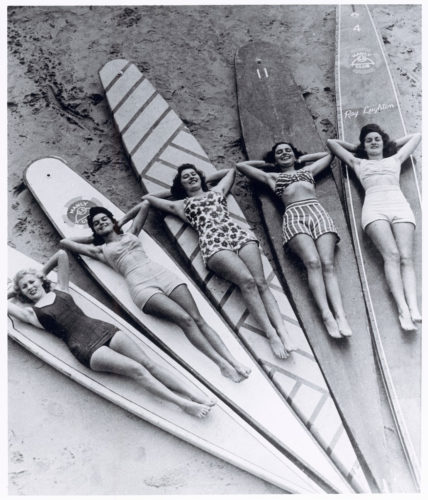
Surf Sirens, by Ray Leighton. Courtesy Flickr Commons, courtesy National Library of Australia

(Photo: Surf Sirens, by Ray Leighton. Via Flickr Commons, courtesy National Library of Australia)

Noting that surfing was recently named California’s official state sport, United Airlines is no longer charging surfers traveling to or from California (only) a $150 or $200 special fee to check surfboards, wakeboards or paddleboards.

Instead, only the regular checked bag fees will apply.

United’s new policy only applies to direct flights into or out of the Golden State.

Flying with your surfboard on another airline? Here’s what it will cost:

Alaska Airlines: surfboards/paddleboards (and may other pieces of sports equipment) flies as regular checked baggage.

American Airlines:  $150 surfboards, kiteboards, waveboards, and wave skis.

Delta Air Lines: $150 USD/CAD for travel to all regions (excluding Europe and North Africa)

Hawaiian Airlines: $35 to neighbor island; $100 to other North American destinations.

JetBlue: $100.

Southwest: $75.

Have you traveled with a surfboard? Please share your tips for getting sports equipment on and off planes safely.

Airlines earn loads from the extras

LAX Flight Path Museum airplane models

You’re not imagining it. All those little ‘extras’ the airlines charge really do add up.

The proof, of course is in the price of your airline ticket once you add the charge for choosing a seat and bringing along a checked bag. But also in a host of other ancillary items that Jay Sorensen of the IdeaWorks Company totes up for us annually after scouring the financial findings of airlines.

He’s tallied the 2015 revenue breakouts from 67 airlines reporting an overall $40.5 billion in ancillary income for the 2016 edition of the CarTrawler Ancillary Revenue Yearbook.

He looked at disclosed revenue from activities such as frequent flier miles sold to partners, fees for checked bags, commissions from car rentals and at la carte items sold through Amadeus, Sabre, and Travelport for each of the 67 airlines.

Here are the some of the highlights:

*The “winner” in ancillary revenue share is Spirit, at 43.4 percent.

*Allegiant Air sold 452,272 hotel room nights and 1,204,982 car rental days to
passengers which contributed to ancillary revenue from 3rd parties of $40.2 million for
the year.

*Delta earned $125 million from its Comfort+ seating product.

*Qatar Airways took in $528 million from the sale of duty free goods.

*United disclosed mileage sales of $2.999 billion for 2015 with the majority of miles sold
to Chase Bank for the MileagePlus co-branded credit card.

There’s lots more in the report, which I plan to review over lunch, but in the meantime, here’s a link in case you want to dive in now.

Airlines earning more – and more – from fees

Spirit Airlines A319Side

Passengers complain mightily about the extra fees airlines now charge for everything from checking bags to choosing seats, yet are paying up – and up.

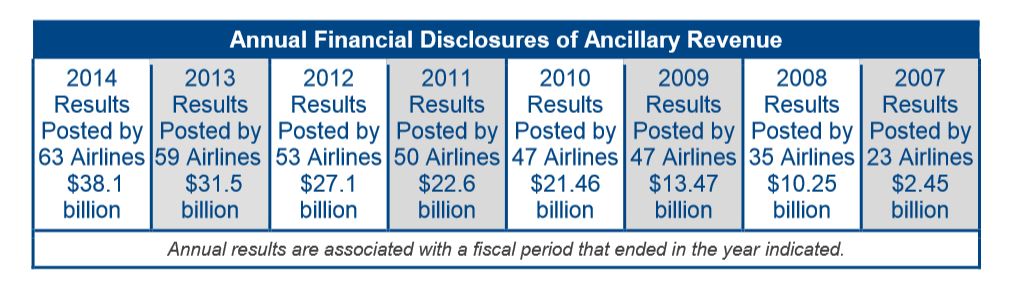
In 2014, airlines earned $38.1 billion from fees charged for retail activities, a la carte services, frequent flier miles sold to partners and other so-called ancillary fees, according to a report from IdeaWorksCompany and CarTrawler.

IdeaWorks ancillary revenue chart

Courtesy IdeaWorks

That’s $6.6 billion more than the $31.5 billion that IdeaWorks tallied in 2013 and $35.6 billion more than the $2.45 billion in fees earned by airlines in 2007, the first year the study was conducted.

The numbers are going up in part because more airlines are doing it,” said Jay Sorensen, president of IdeaWorks, “But also because more airlines are talking in their financial filings about what they’re doing to earn ancillary income. In fact, some are quite proud of their accomplishments.”

In its newly released 2015 Yearbook of Ancillary Revenue, IdeaWorksCompany scoured the financial filings of 130 airlines for 2014 and found 63 that disclosed revenue for extras such as a frequent flier miles sold to credit card companies, bag fees and onboard meals.

Among the findings:

*Spirit Airlines, which trumpets “Bare Fares” and charges for everything from water to printing boarding passes at the airport, earned almost 39 percent of its total revenue from ancillary fees in 2014 – more than any other airline in the study. The carrier took in $76.2 million from assigned seating fees alone and earned an average $56 in ancillary revenue from each passenger;

*Ancillary revenue brought in $5.86 billion for United, $4.65 billion for American/US Airways and $3.2 billion for Delta Air Lines;

*Alaska Airlines, which this year introduced a seating option called Preferred Plus (offering extra legroom, priority boarding and a free drink), is expected to begin earning at least $15 million a year from the program;

*And JetBlue, which this year added bag fees and a booking bundle that combines fares with a checked bag and reduces or waives change fees, could net more than $200 million from its new program.

The list of extra charges faced by airline passengers can seem endless, and new fees for everything from flying on child-free flights to being first to exit the plane on arrival have been bandied about.

But Sorensen doesn’t see much new coming in terms of new fees.

“Airlines all over the world are already selling whatever they can. They’ll just get better at pricing these products – and better at selling them,” he said.

(My story about airline fees escalating first appeared on NBC News)

Travel Tidbits: Free Wi-Fi & More Fees

There’s good news and bad news for travelers this week.
Alaska Electronics

In Japan, rules have been eased so that airlines may allow passengers to use their personal electronic gadgets from gate to gate.

Free, unlimited Wi-Fi was introduced last week at Amsterdam’s Schiphol.

But as of today Allegiant Air follows the lead of Spirit Airlines in adding a fee to have an agent print out a boarding pass for you.

Here’s a link to my story about that Allegiant fee on USA TODAY, where I’m filling in on the Today in the Sky blog.

r

App helps bumped, delayed fliers collect cash

Boston line at airport

Courtesy of the Boston Public Library, Leslie Jones Collection.

Getting compensation from an airline for a delayed, canceled or overbooked flight can range from difficult to impossible.

Several online companies, including AirHelp, EUclaim and refund.me charge a fee ranging from 15 to 27 percent (plus, in some cases, handling charges), for helping European travelers file claims under regulations that apply to flights to or from a European Union member state.

Now, one of those companies is offering its services to U.S. fliers online, and through a free app.
“Passengers are often left in limbo about what compensation they are entitled to,” AirHelp CEO and co-founder Henrik Zillmer told CNBC. And, especially when it comes to overbooked flights in the United States, they are eligible for a lot more compensation than they are receiving, he added.

AirHelp estimates that, under U.S. Department of Transportation’s rules, each year a total of $450 million in potential compensation is owed to passengers involuntarily bumped on overbooked U.S. flights and that, under European Union regulations, there are $2.1 billion in potential claims for U.S. air passengers flying to, from or within Europe on EU carriers.

Yet, because travelers don’t fully understand the rules— and because airlines don’t go out of their way to inform fliers of their rights—only a very small percentage of the compensation owed to passengers ends up being claimed or paid.

Under U.S. rules, bumped passengers are eligible for compensation equal to double the price of their tickets up to $650 if delayed one or two hours from their originally scheduled arrival time for domestic flights, or one to four hours for international flights. Those subject to longer delays—more than two hours after their originally scheduled arrival time for domestic flights and more than four hours for international flights—are eligible to receive payments of four times the value of their tickets, up to $1,300.

In overbooked situations, the rules require airlines to first ask people to give up their seats voluntarily in exchange for compensation and allow airlines to decide what to offer volunteers in terms of cash, travel vouchers, meals and lodging.

And currently, far more people volunteer to give up their seats than getting bumped.

According to DOT statistics for 2013, 56,968 passengers (0.92 percent of all fliers) were bumped from domestic flights while 466,677 passengers volunteered to take another flight in exchange for compensation.

Most of those volunteers accept travel vouchers valued far below the amounts DOT requires airlines to pay involuntarily bumped passengers, said Zillmer, “and only about 15 percent of those vouchers are redeemed. So it’s a super deal for airlines.”

But, he said, if passengers understood the rules better, they might not be as quick to give up their seats for airline vouchers.

Most airlines, including American and Delta, post information about the overbooking regulations and individual “oversales” policies online in their Conditions of Carriage.

“We’ve invested in some technology in recent months to install electronic pads that capture IDB [involuntarily denied boarding] acknowledgment from customers,” said Delta Air Lines’ spokesman Morgan Durrant. “Think credit card signature pad at your grocery store. Compensation is then issued.”

A United representative noted that only one passenger for every 10,000 was involuntarily denied boarding in 2013. The airline carried 76 million customers last year. “When necessary, we solicit volunteers with alternate transportation and compensation. In the rare instances that there aren’t enough volunteers, we give compensation that meets all regulatory requirements to any customer who is involuntarily denied boarding,” United spokesman Rahsaan Johnson said.

According to AirHelp, compensation for a delayed, canceled or overbooked flight could be up to about $825 per passenger—plus meals, phone calls and hotel stays—for passengers traveling to or from Europe on an EU carrier, or on a carrier from non-EU members Iceland, Norway or Switzerland. (Exemptions are made if an airline can prove the delay was caused by circumstances outside the airline’s control, such as bad weather.)

AirHelp’s new service for U.S. travelers helps them figure out if they are eligible for compensation and, for those who don’t want to pursue a claim on their own, offers to process the claim “including going to court if necessary” for a 25 percent contingency fee payable only if a claim is successful.

“In terms of empowering consumers, the online platform lowers the barrier for passengers, in terms of costs and procedures, to submit a claim” said Raymond Kollau of Airlinetrends.com.

“Call it the democratization of airline service failure compensation, if you will,” he said.

Helping passengers get the monetary compensation they are owed from airlines “will be a good thing,” said George Hobica of AirfareWatchdog. But he considers the 25 percent fee for successfully filing a claim to be a bit hefty.

“Consumers should be able to get compensation by themselves if they work at it,” said Hobica.

“It is a shame that we need lawyers to collect basic, regulated compensation,” in the first place, said Charlie Leocha of Travelers United. But “airlines prey on passengers’ ignorance,” he said.

(My story about apps that help fliers recover fees owed by airlines first appeared on CNBC Road Warrior)

New airline fees for the new year

suitcase

While a winter storm caused many airlines to issue travel change fee waivers this week, there are several new fees scheduled to take place in the new year. Here’s a sampling:

*United Airlines is raising the membership rates for the United Club. According to a notice on the United website:

“Effective January 1, 2013, United Club annual membership rates will increase by $25 and membership-with-spouse rates will increase by up to $100. Additionally, the three-year membership options will be discontinued. Current three-year memberships will be honored through their existing membership period.”

Beginning on January 15, 2013:

Alaska Airlines will no longer check bags through to a final destination when separate tickets are presented at check-in. This policy change affects passengers who start travel on Alaska Airlines, but continue on a separately purchased ticket on another airline. Alaska will continue to check bags for passengers traveling on a single ticket and connecting to one of our 59 interline airline partners.

Southwest Airlines has also rolled out some new fees for the new year:

The airline plans to begin charging a “no-show” fee to passengers who fail to cancel restricted ticket reservations and it has already raised baggage fees:

“Effective for tickets purchased on or after December 15, 2012, for travel on or after February 13, 2013, the 3rd checked bag and any bag thereafter is $75 per piece and the overweight and oversize baggage fee is $75 per piece. Large media camera equipment is $75 per item, and sporting equipment is $0-$75 per item.”

Before the change, the first and second checked bags were free and charge for the third (through the ninth) checked bag was $50. The overweight bag charge was also $50 and there was no charge for large media camera equipment. The fee for sporting equipment was $0-$50 per item.

Bag fees on Southwest subsidiary Air Tran have also gone up:

“1st and 2nd Checked Bag Fee
Effective for tickets purchased on or after December 15, 2012, for travel on or after February 13, 2013, first checked bag fee is $25 and second checked bag fee is $35 when bag fees apply.

Excess Baggage Fee
Effective for tickets purchased on or after December 15, 2012, for travel on or after February 13, 2013, the 3rd checked bag and any bag thereafter is $75 per piece.

Oversize and Overweight Baggage Fee
Effective for tickets purchased on or after December 15, 2012, for travel on or after February 13, 2013, overweight and oversize baggage fee is $75.”

No doubt there’s more to come….so start saving your pennies.

Spirit Airlines ups the ante: will charge $100 for carry-on bags

Spirit Airlines is being really mean-spirited now.

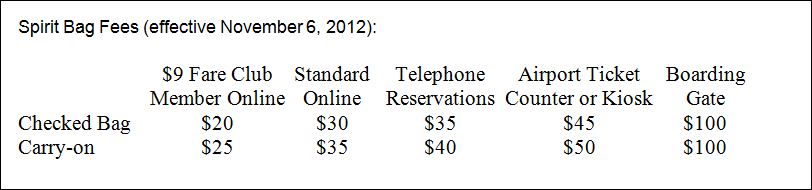
On Monday the airline announced that, beginning on November 6, passengers who wait until they get to the boarding gate to pay the airline’s fee for checking a piece of luggage or carrying it onto the airplane will pay $100 per bag.

Passengers can pay lower luggage fees by paying earlier in the process, such as online , on the phone or at an airline kiosk. but there’s no way around paying something to carry-on or check a piece of luggage.

Spirit is the airline that advertises really low fares but often surprises unsuspecting customers with hefty added fees for everything from seat assignments to onb0ard drinks.  Beginning October 31, 2012, the airline will also begin charging a $2 fee for printing a boarding pass at an airline kiosk. (Since January there’s been a $5 fee to have a boarding pass printed by an agent at the airport.)

Spirit claims that separating out these – and a plethora of other fees – “empowers customers to save money on air travel.” You decide.

Here’s the new chart of fees for baggage

For now passengers flying on a Spirit Airlines flight are not charged a fee for taking aboard one personal item that fits under the seat.

Tidbits for travelers: seat fees, bag check refunds & fast rail service to ORD.

Good news, bad news for air travelers today.

In the good file:

IND suitcase art

If you book a 2-night weekend stay (Fri/Sat/Sun) at a IHG hotel (InterContinental, Crowne Plaza, , Holiday Inn, Holiday Inn Express, Staybridge Suites, Candlewood Suites and others), and check a bag on your flight there, you can get a rebate for up to $50 of your bag check fees. There are restrictions of course – you need to pay with a Visa, stay between Sept 1 and Dec 30th,  and accept your refund in the form of an IHG Visa Prepaid Card – but it’s still a good offer.

Kimpton hotels have had a similar offer for a while. It’s We’ve got your bag program promises a $25 room credit if you show a receipt for a checked bag.

Also: Chicago’s mayor announced the formation of a Blue Ribbon Committee to study whether or not express train service between O’Hare International Airport and downtown Chicago is a good idea.

Do they really need to study this? We say: just do it!  A lot of travelers would happily pay a premium over the current fare on the Blue Line to make it downtown in a hurry.

orange airplane seat

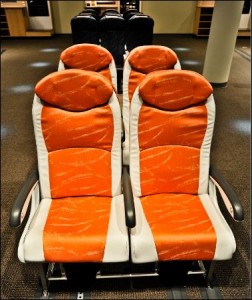
In the bad file: Joining the pack of other carriers, such as United, that will let you buy seats with extra legroom, American Airlines has announced a new fee today for what it calls “Express Seats:” the roomier seats in the first few rows of the coach cabin.

Pricing will be based on distance and range from $19 (i.e. St. Louis to Chicago) to $39 (Chicago to Honolulu) and the seats will be up for sale 50 minutes to 24 hours before a flight.  Buying one of those seats also allows you to board with Group 1.  Here’s their spin.

Changes galore in fees and service charges on Alaska Airlines/Horizon Air

Heads up, Alaska Airlines or Horizon Air customers.  A bunch of changes to the airlines’ fees and services were announced today.  The news is good and bad…

Here’s a rundown:

Effective for travel on or after June 16 for tickets purchased beginning May 1.

Checked bags and baggage service guarantee

It will cost you $20 for each of your first three checked bags. This is a $5 increase for the first checked bag, a $5 decrease for the second, and a $30 decrease for the third.

There’s also a change to the carriers baggage service guarantee.  Yes – there’s a service guarantee!

Instead of promising you they’ll get your bags to your within 25 minutes the airlines now promise to get bags to you within 20 minutes.  And if the bags don’t show up in 20 minutes they’ll either give you 2,000 Alaska Airlines Mileage Plan miles or $20 off a future flight.

Unaccompanied minors

Alaska and Horizon are also lowering the fees for unaccompanied minors ages 5 to 12.

The new fees are $25 per child for direct flights and $50 per child for connecting flights.

This is a reduction from the current $75 fee, which applied to several children traveling together.

[Note: As of tomorrow, April 23, 2010, Southwest Airlines is raising its fares on unaccompanied minors; see news about this and other airlines’ unaccompanied minor fees in my msnbc.com column “Are Airlines Cashing in on your kids?”]

Same-day confirmed travel

If you want to change your flight within six hours of departure, it will cost $25 to confirm a seat.

Outside of that six-hour window, you must pay the difference in fare plus any applicable change fee. Until now, for a flight on the same calendar day it seems you could pay this $25 same-day confirmed fee or stand by for free.

Instant ticketing and refund policy

Effective May 12, you will no longer be able to hold reservations for 24 hours without payment when booking directly with the airlines, but you’ll get one free change or a full refund within 24 hours of purchase on all tickets.

For more details see the Alaska Airlines website.