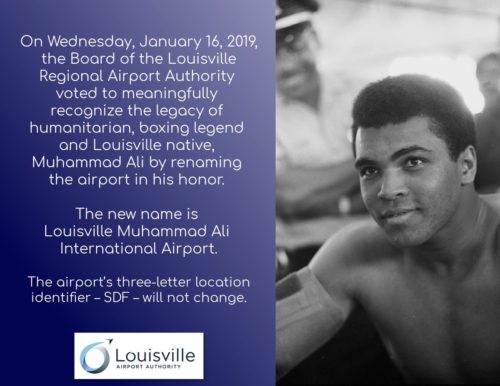
Thie past January the Louisville Airport Board voted to change the airport’s name from Louisville International Airport to Louisville Muhammad Ali International Airport.
“Muhammad Ali was a global citizen who impacted the world through his respect and love for all people, regardless of age, ethnicity, gender or geographic border,” said Donald Lassere, President and CEO of the Muhammad Ali Center. “The renaming of the airport communicates to the world that Muhammad Ali’s hometown is bold in its thinking, along with being a city of greatness and compassion.”
Last week, the airport officially unveiled a logo celebrating that decision.
Logo designers say the range of colors in the brand mark – from deep red to a golden orange – highlight the action of the Champ’s arms raising in victory while signifying strength and power. The shape of the butterfly pays homage to Ali’s famous phrase, “float like a butterfly, sting like a bee” and the context of flight for the airport.
“Muhammad Ali’s incredible story, his connection to our city and his legacy present us with both an opportunity and a responsibility,” said Louisville Mayor Greg Fischer at the logo unveiling, “That’s why we’re renaming this airport for him, why we’re unveiling a logo today that symbolizes his boldness and his ability to connect with people around the world – the mark of a compassionate warrior. We want the world to know that The Champ’s legacy is alive and well, and growing in Louisville.”
Your next
flight – and flights you take in the future – will benefit from discussions and
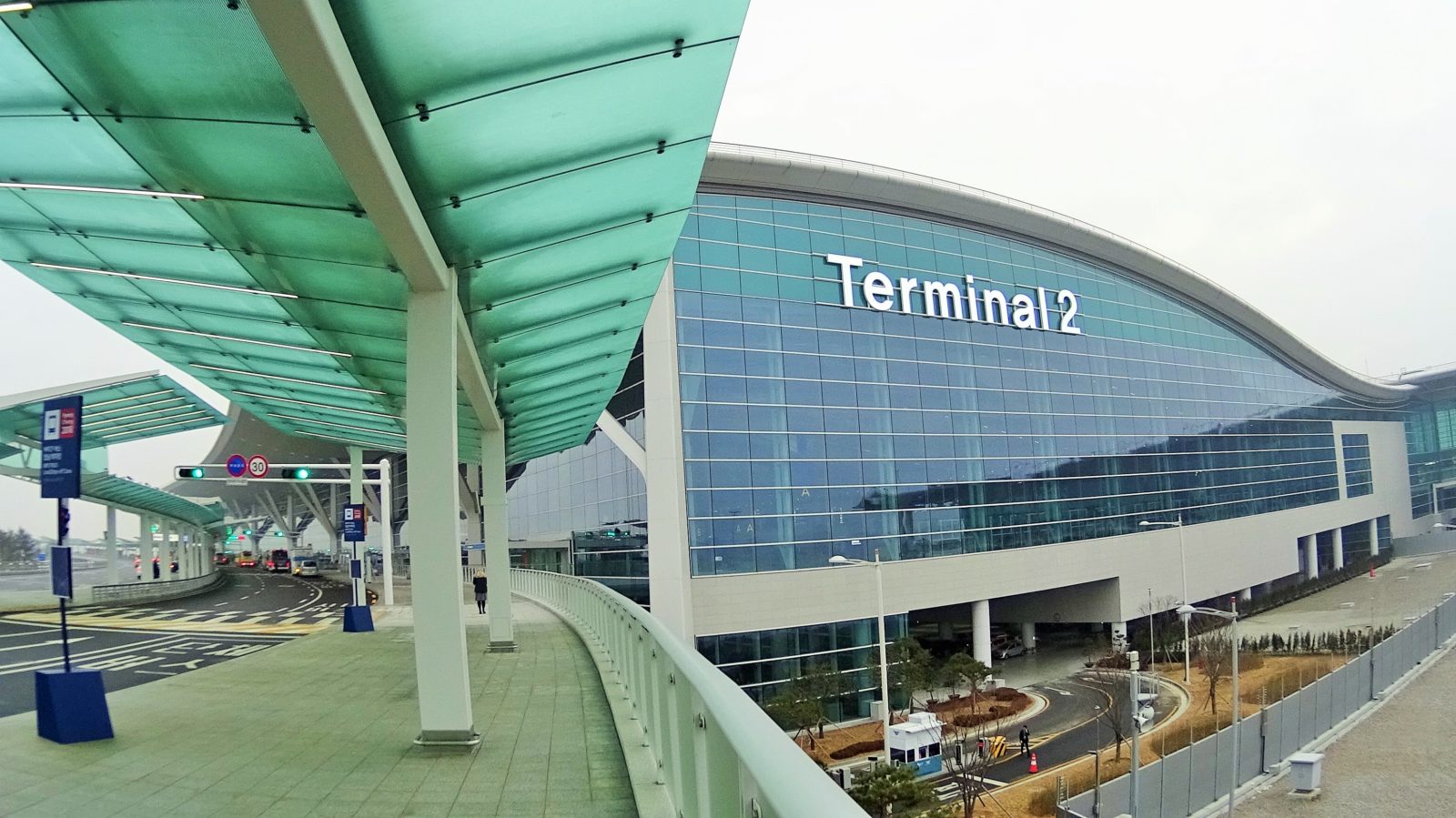
decisions made by top brass from the global air transport industry in Seoul, South
Korea last weekend.
More than a
thousand airline CEOs and industry leaders were on hand for the annual meeting
of the International Air Transport Association (IATA). On the agenda was everything
from climate change and “flight shaming” to the future of the beleaguered 737 MAX,
congested skies, baggage tracking and a myriad of ways to improve the flying experience.
Also on the
list: A downgrade for the industry trade group’s 2019 profit expectations.
“Although 2019 is expected to be the 10th consecutive year
of airline profits,” Alexandre de Juniac, IATA’s Director General and CEO told
the group, “Rising costs, trade wars and other uncertainties are likely to have
an impact on the bottom line. The prolonged grounding of the 737 MAX aircraft
is taking its toll. And aviation, like all industries, is under intensified
scrutiny for its impact on climate change.”
In December 2018, IATA forecast a profit of $35.5 billion for
the global air transport industry in 2019. The revised
outlook downgrades
that forecast to $28 billion.
“Airlines will still turn a
profit this year, but there is no easy money to be made,” said de Juniac.
Restoring public trust when Boeing’s 737 MAX back returns
to the skies
In his air transport industry report, IATA’s de Juniac said
the two recent Boeing 737 MAX crashes and the grounding of the aircraft have damaged
the aviation industry’s reputation,
“Trust in the
certification system has been damaged – among regulators, between regulators
and the industry and with the flying public,” said de Juniac, who called for
improved coordination in the industry.
“To be clear, I am
not advocating for knee-jerk reactions. But governments and industry must find
a way to maintain public confidence in safety with fast and coordinated
responses,” he added.
Estimates for when the U.S. Federal Aviation Administration (FAA)
will give the 737 MAX the green light to fly again range from this summer to
the end of the year. But even airline CEOs that don’t have 737 MAX planes
in their fleets worry about what may happen if one country’s regulatory agency
lifts the ban before others decide to do so.
“I do indeed believe this is what we are facing,” said
Carsten Spohr, chairman and chief executive of the Lufthansa Group, during a panel
discussion of airline executives, “Probably we will see the MAX flying
domestically in the U.S. first before we see if flying somewhere else. But this
is a global industry and we need global trust. [It will be] difficult to
explain to our global passengers that the aircraft is safe in some part of the
world and supposedly not safe somewhere else.”
To try to avoid this scenario, later this month IATA will meet with representatives from Boeing, 737 MAX customers and regulators from the FAA and other countries, said Gilberto Lopez Meyer, IATA’s senior vice-president for safety and flight operations.
In 2017, private and commercial aviation created about 859
million tons of CO2, or about 2% of all man-made carbon emissions, according
to IATA.
To reduce emissions as air traffic increases, the industry
has agreed to a wide variety of standards, mitigation measures and targets. And,
at its meeting in Seoul, IATA members passed a
resolution calling on governments to implement a
global plan calling for carbon-neutral growth as of 2020 and a 50%
reduction in the industry’s net CO2 emissions by 2050, compared to 2005 levels.
Fuel efficient airplanes, improvements in air traffic
management and increased use of biofuels are among the tools helping the
aviation industry reach reduced carbon emission goals and carbon offset
programs are in the toolbox. But, while passengers tell IATA they support voluntary
offset programs and more than 40 of the group’s member airlines offer them, IATA
has found that take-up rates are low.
In fact, few hands were raised when a room full of airline
executives were asked if they’d purchased carbon offsets for their own flights
to the meeting in Seoul.
Airline industry’s to-do list:
Looking ahead, IATA member airlines, which represent more
than 80 percent of all global air traffic, passed several
other resolutions that could have a real impact on your travel experience.
One commits airlines to move forward with plans for using bar-coded baggage tags with radio-frequency
identification (RFID) inlays, which can help keep checked luggage from going
astray.
Another focuses airline
attention on improving the air travel experience for people living with
disabilities.
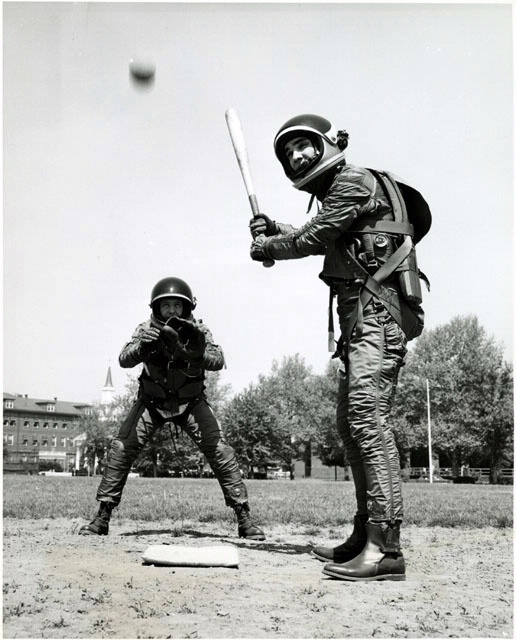
At the U.S. Naval Air Material Center in Philadelphia, a player swings a baseball bat in a B.F. Goodrich Mark IV spacesuit. Courtesy Smithsonian Institution
To celebrate the 50th anniversary of the first Moon landing, the Smithsonian Institution National Air and Space Museum has launched “Apollo at the Park,” a project that will place 15 replica statues of Neil Armstrong’s iconic Apollo 11 spacesuit in major league ballparks across country.
National Park in Washington, D.C. got its statue this week.
Neil Armstrong spacesuit statues are coming soon to a participating ballpark near you: https://t.co/PdRW85UOsX 👨🚀⚾️
— National Air and Space Museum (@airandspace) June 4, 2019
Here are the rest of the team parks where statues will appear this summer at part of Apollo at the Park.
Atlanta Braves
Boston Red Sox
Chicago Cubs
Cleveland Indians
Cincinnati Reds
Colorado Rockies
Detroit Tigers
Houston Astros
Minnesota Twins
New York Yankees
Pittsburgh Pirates
San Francisco Giants
Seattle Mariners
Tampa Bay Rays
What’s the connection between space and baseball and that photo above? According to the Smithsonian:
“In the late 1950s, workers at the U.S. Naval Air Material Center in Philadelphia took to a makeshift field in some interesting uniforms — B.F. Goodrich Mark IV spacesuits. The game was staged as a flexibility demonstration for the spacesuit. The final score of the baseball game is unknown, but the Mark IV would evolve to become the original Project Mercury spacesuit, a definite home run!“
And for stats fans, the National Air & Space Museum offer this:
*A ballpark stadium seat is roughly the same size at the Apollo 11 seat that Neil Armstrong, Buzz Aldrin and Michael Collins sat in for three days on their journey to the moon.
*The Apollo 11 landing site, Tranquility Base, and the lunar area that Neil Armstrong and Buzz Aldrin explored is roughly the size of a baseball diamond.
A
wing and an organized prayer: OK at some airports, but no longer in Orlando
Chapel at Hartsfield-Jackson Atlanta International Airport
My story this week for CNBC is about airport chapels. Here’s a very slightly different version of that piece.
They’re not as ubiquitous as cocktail bars and souvenir shops, but chapels and inter-faith prayer spaces, many with full or part-time chaplains and regularly-scheduled services, are among the amenities offered by more than three dozen airports around the country.
Some prayer rooms occupy what has, over time, become prime real estate in pre or post-security areas of airport terminals. Others are tucked away and may be hard to find on mezzanines, down back corridors or in bag claim areas.
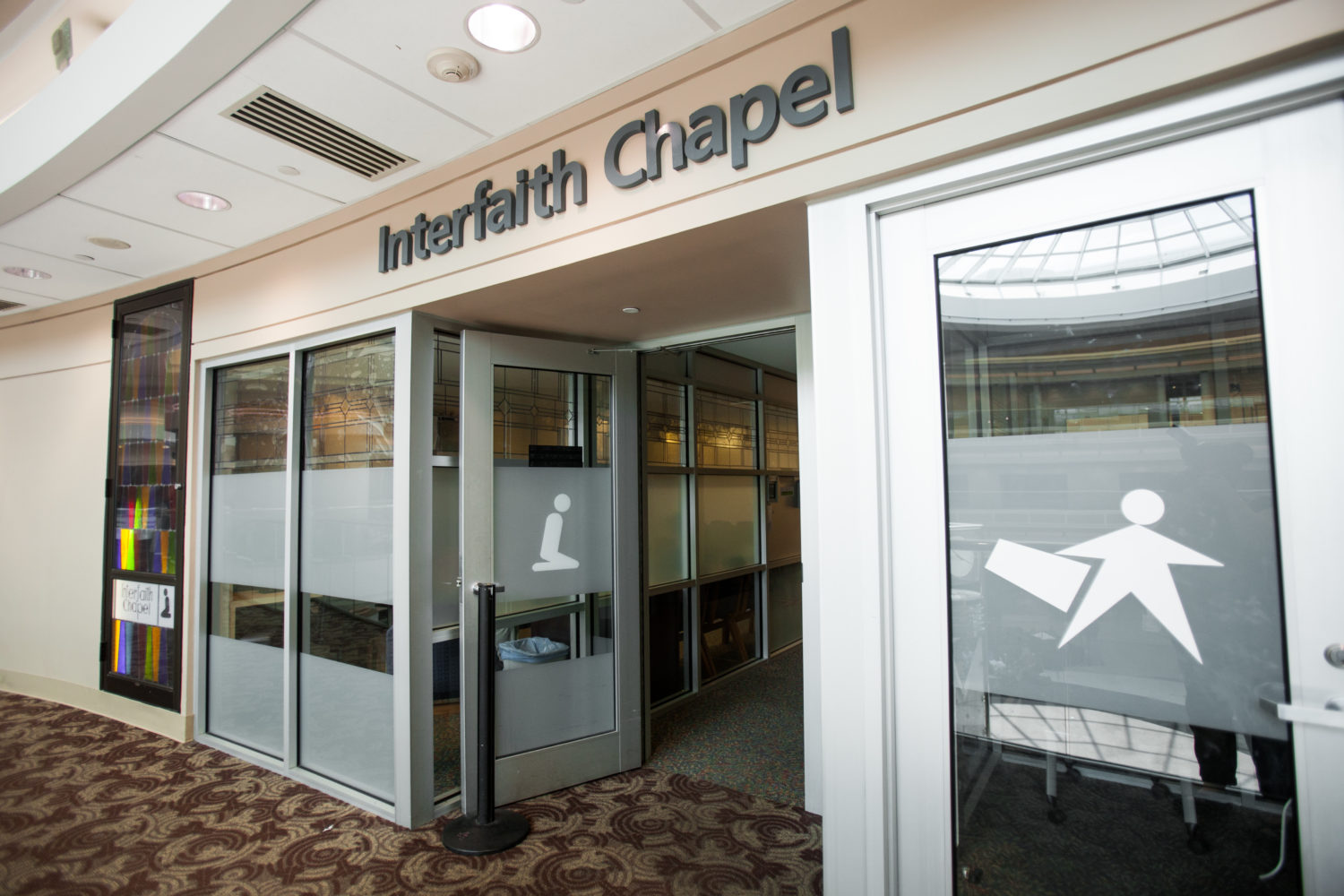
But a recent rise in violence at churches, mosques and synagogues prompted Orlando International Airport to rethink holding religious services at its interfaith chapel and reflection space, prompting some concern about whether other airports will make similar changes.
Interfaith chapel at Orlando International Airport
Earliest airport chapel
In 1951, Boston Logan International Airport (BOS) was the first U.S. airport to set aside dedicated space for prayer. “It was explicitly meant for people working at the airport. A neon light pointed to the chapel,” notes Wendy Cadge, an expert in contemporary American religion, in “A Brief History of Airport Chapels.”
Today
Logan’s appropriately named Our Lady of the
Airways
is located in the airport’s public area. It seats 250, is open around-the-clock
and offers mass daily for passengers, airport and airline employees and the
general public.
Orlando International Airport makes a change
At
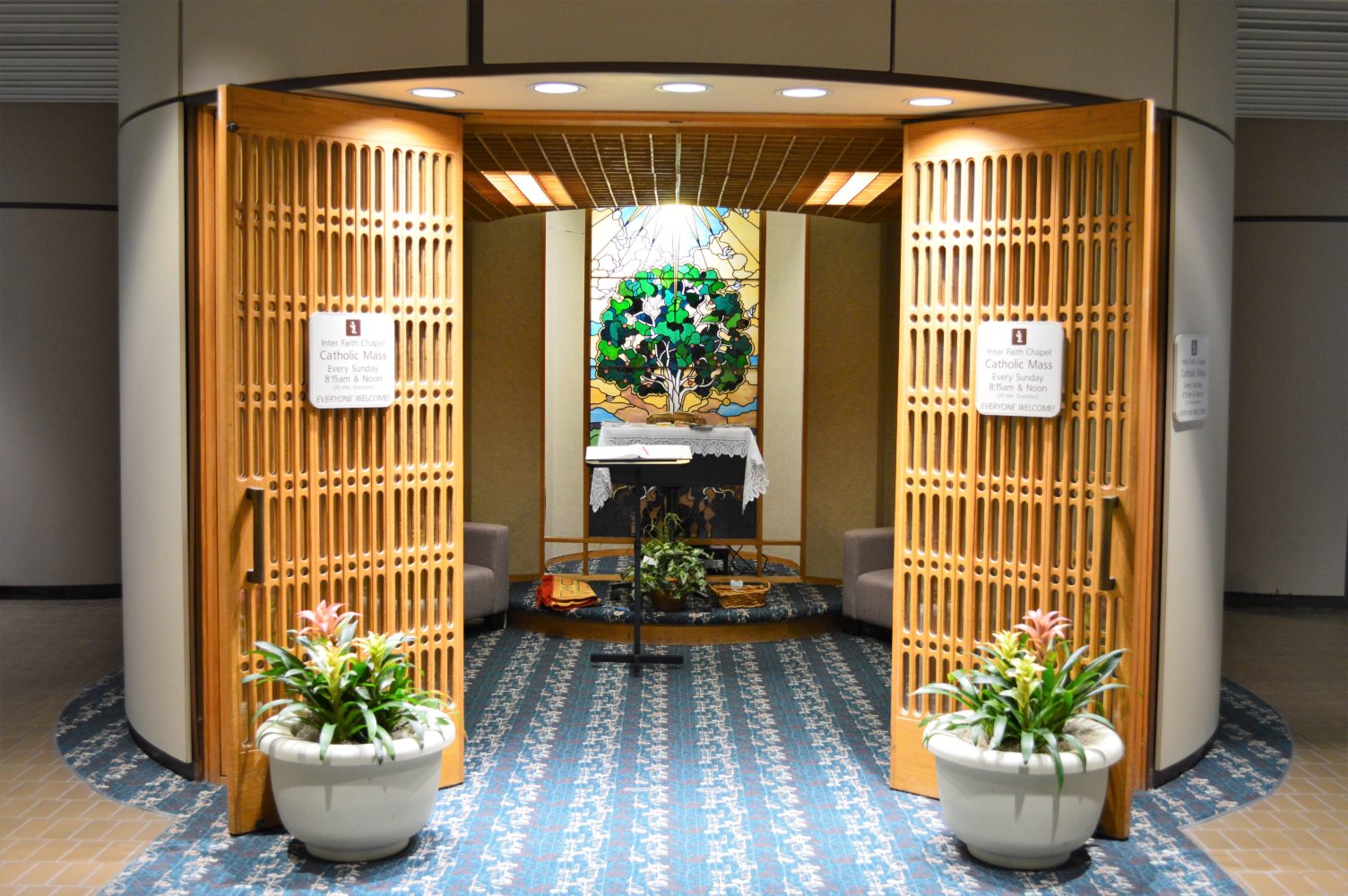
Orlando International Airport (MCO), an interfaith chapel with a Tree of Life
stained glass window dates to the airport’s 1981 opening. A second reflection
space for prayer, with
accommodations for Muslim travelers, was added in 2015, as part of a customer service
enhancement project.
Both
spaces are located post-security and for many years Catholic mass has been offered
in MCO’s chapel each Sunday morning and during holidays. But, citing increased
passenger volume, space allocation and safety, the airport board recently
revised it policies.
Now,
while ticketed passengers and employees are welcome to visit the prayer spaces
anytime, organized religious services of any kind are not permitted.
“Every
airport authority has to make the decisions that they think are the best for
their environment and location,” said Susan Schneider of the Interfaith Airport
Chapels of Chicago, which offers religious services and passenger support services
at both O’Hare and Midway Airports. “If Orlando feels this is something they must
do at this time, you have to trust the decision. You just hope it’s the right
decision.”
Reverend
Rodrick Burton, a pastor is St. Louis, is certain the authorities at Orlando
International Airport have made the wrong decision.
“I believe Orlando’s actions are stunning in
their shortsightedness and in an effort to be politically correct or to
misinterpret the constitutional right of freedom of religion,” said Burton, who
serves as president
of the St. Louis Airport Interfaith Chaplaincy, an organization that has offered
“prayer, religious services, spiritual guidance, empathetic listening” and
other assistance at St. Louis Lambert International Airport (STL) for more than
33 years.
“There’s nothing sacred about those spaces
if Chaplain’s don’t attend to them. Those chapels will become quiet rooms,” he
added.
Status of other airport chapels
I polled about two dozen other airports around the country on the status of their interfaith spaces and organized religious services.
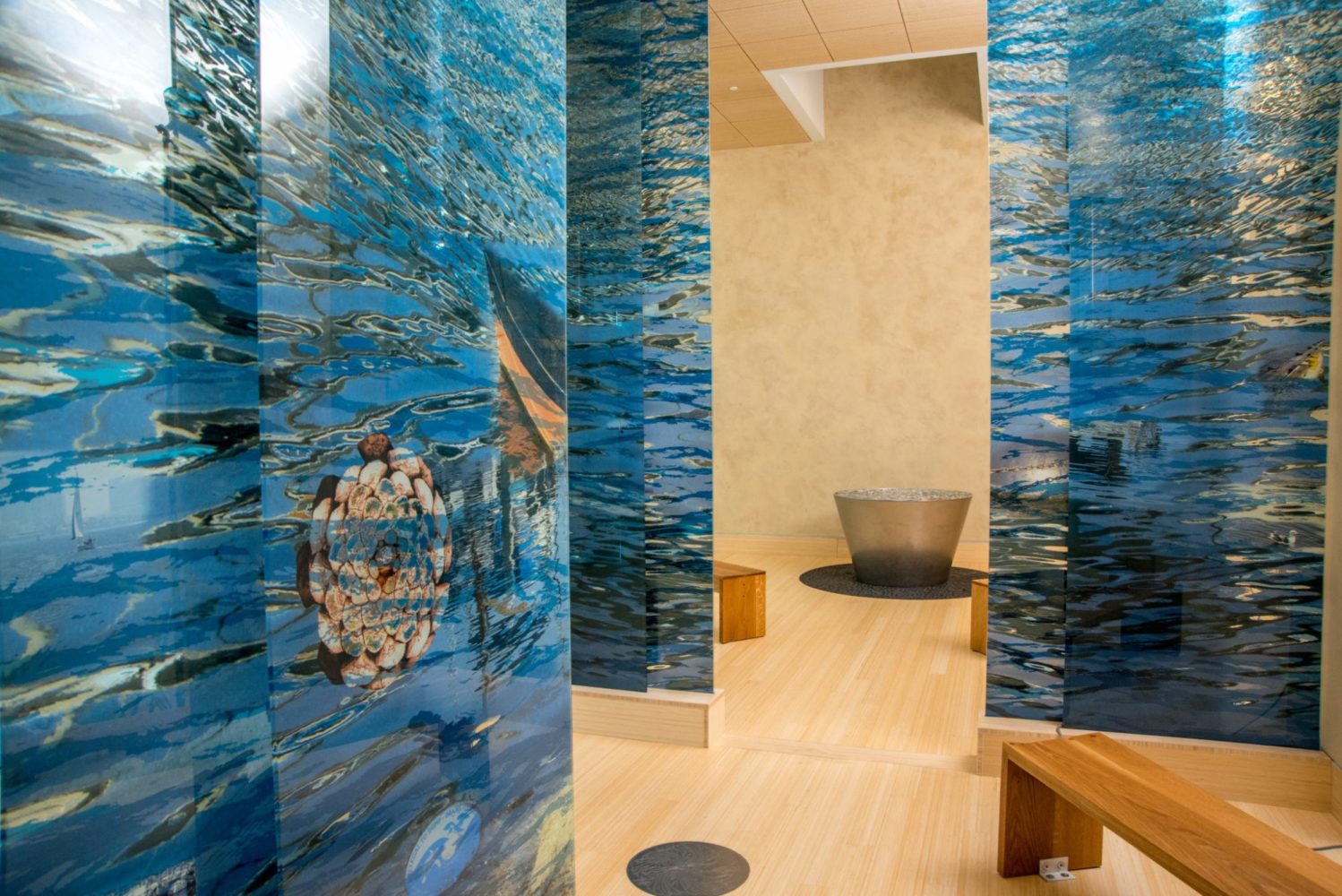
Reflection room at San Diego International Airport
Airports in Phoenix, Pittsburgh, San Diego, Philadelphia,
San Diego, Seattle and many other cities have chapels, quiet rooms, meditation
spaces and/or reflection rooms that welcome travelers at all hours, but do not
offer religious services. “No regular services are held here. It is strictly
self-service,” said Greg Willis, Marketing Program Manager at Florida’s Jacksonville
International Airport, “We provide a book where customers can write down their
thoughts and prayers.”
Interfaith chapel at Phoenix Sky Harbor International Airport
Some airport chapels have been ensconced in
airport terminals for a long time. At Hartsfield-Jackson Atlanta International
Airport, the ATL Interfaith Airport Chapel was established in 1979. Pittsburgh
International Airport opened its post-security interfaith chapel in 1992, along
with the current terminal. And the quiet room at Philadelphia International
Airport was created just last August.
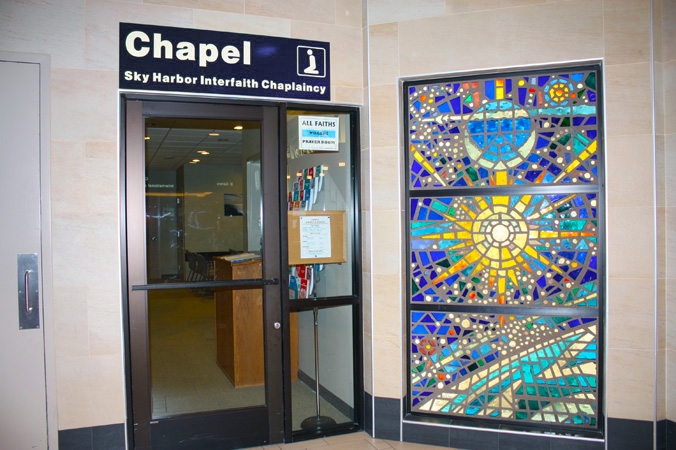
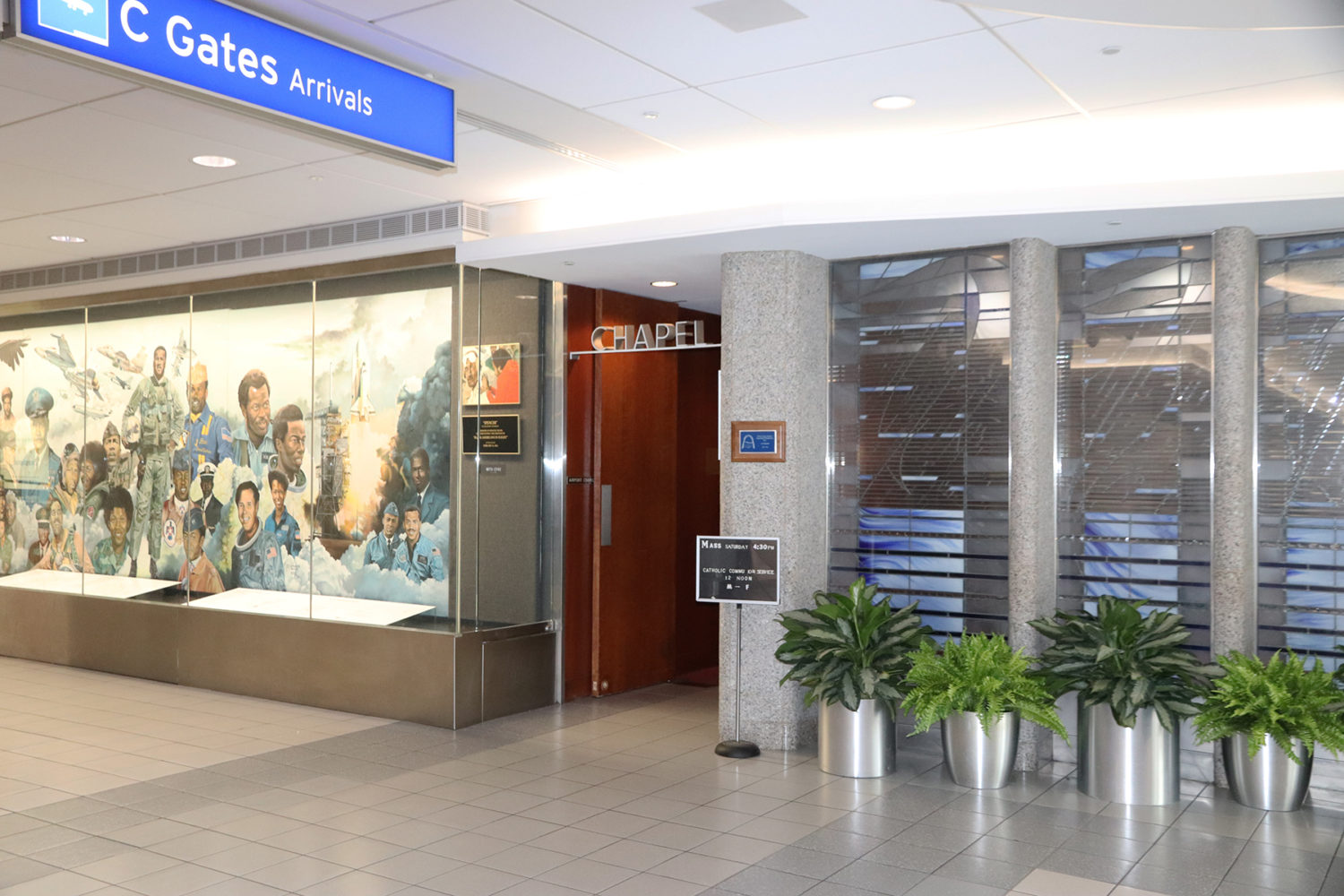
T1 chapel entry at St. Louis Lamber International Airport
In addition to the scheduled religious services offered at Boston Logan and St. Louis Lambert International Airport, airport chapels in Atlanta, Cleveland, San Francisco, Denver, Dallas, New York (JFK) and a handful of other airports offer organized religious services. All airports that responded to my query say they currently have no plans to follow Orlando’s lead in banning these services.
A solution that works
Meanwhile, back in Orlando, after some scrambling
and, no doubt some prayers, there’s now an alternative arrangement for those
seeking to attend Sunday mass at the airport.
Instead of being offered in the post-security airport
chapel, starting this Sunday, mass will be held in the Hyatt Regency Orlando
International Airport hotel, which is attached to the main terminal of the
airport.
The solution is being hailed as a godsend for the
both travelers and the airport.
“Security and Safety will always be a top
priority at Orlando International,” said Tom Draper, Senior Director of Airport
Operations for the Greater Orlando Aviation Authority, “By moving these
activities to a larger and more private location, we are minimizing activity in
secure areas while enhancing the guest experience for those traveling
through the airport.”
In
2018, travelers left TSA almost $1 million in inadvertent “tips”
Passengers in a rush to get through the airport security checkpoint often leave behind belts, mobile phones, laptops and other valuable items.
They also leave lots of coin and cash.
According to a report due out today from the Transportation Security Administration, during FY 2018 travelers left for than $960,000 – ($960, 105.49 to be exact) – in the plastic bins at airport checkpoints around the country.
That’s $90,265.93 more than the $869,839.56 travelers left behind as inadvertent ‘tips’ for TSA in FY 2017.
It is $92, 293.10 more than the $867, 812.39 passengers forgot to pick up in FY 2016.
And it’s a whopping, $194,346.34 more than passengers left behind in FY 2015.
By law, TSA is allowed to use these funds for projects it considers important for civil aviation security.
In past years some of the left-behind funds have been used to promote and improve the TSA Pre-Check program, for checkpoint maintenance, and for translation of checkpoint signage into different foreign languages.
Much of unclaimed money from the past few years remains in TSA’s coffers. In fact, as of March 15, 2019, when TSA actually completed its report, NO funds from 2017 had been expended.
And that funds are now included in the list of funds the Department of Homeland Security has its eyes on to help fund border operations, NBC recently reported. (Although the law specificially says the funds are to be used for civil aviation protection.)
Who are the
biggest tippers?
As you might suspect, some of the county’s
largest airports collect the most unclaimed coins and cash at the security
checkpoints.
TSA’s Unclaimed Money at Airports report for FY
2018 shows that passengers at New York’s John F. Kennedy Airport (JFK) left
behind the most money: $72, 392.74.
Next on the list: Los Angeles International
Airport (LAX), where $71,748.83 was unclaimed in the bins.
Miami, Chicago O’Hare and Newark Liberty
International are in the Top 5 of airports where passengers leave behind the
most coins and cash.
Here’s the Top Ten list:
1. JFK
72,392.74
2. LAX
71,748.83
3. MIA
50,504.49
4. ORD
49,597.23
5. EWR
41,026.07
6. DFW
36,707.99
7. SFO
33,264.80
8. LAS
33,038.23
9. MCO
32,687.10
10.
IAD 31,090.38
Why would travelers leave so much
money behind at checkpoints? And why does the tally just keep going up?
According to TSA spokesperson Jenny Burke, one reason may be that more people are traveling. Many airports are serving a record number of passengers and TSA is, therefore, screening a record number of passengers.
That makes the pool of possible
inadvertent “tippers” much bigger.
Another reason: In this age of credit and debit card transactions, travelers find it more valuable to spend their time getting to their gate than stopping to scoop up a few pennies or dimes.
(A slightly different version of my story about TSA’s report on unclaimed money from FY 2018 first appeared on USA TODAY. )
It’s Souvenir Sunday, the day StuckatTheAirport.com usually looks at fun, inexpensive, locally-themed items you can buy at airports.
But..because I’ve spent the week on a river – the Danube River – on board a Viking River Cruise, this week’s souvenirs come from one of our stops.
In Vienna, the chef for the cruise toured a group of about 15 passengers through a downtown market where stalls were filled with everything from fish and wine and olives to every spice you can imagine
We got to see everything, of course, but also had an opportunity to do some tastings.
Then it was time to shop. Pretty much every stall had small and large packets of nuts, spices and dried fruit for sale. But I only found one shop that this wide and very colorful assortment of sardines – all priced at below $8.
Do you look for fun, unusual and locally-themed souvenir in your travels? If you see something great – especially at an airport – please snap a photo and send it along.
If se feature your souvenir on StuckatTheAirport.com, we’ll send you a travel-themed souvenir.
You’ve seen lots of list for the year’s best airports. But here’s a list of the world’s best beaches – according to beach expert and coastal expert Dr. Stephen Leatherman, a professor at Florida International University.
#1: Kailua Beach Park, Oahu, Hawaii
Leatherman’s top pick this year is this “windward” shore beach.
“Because of the steady onshore winds and shallow waters, Kailua is a great place to learn to windsurf. The beach gradually slopes offshore, and there are generally no hazardous water conditions—and lifeguards are on duty.
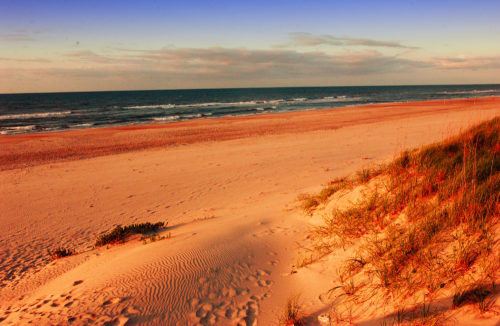
#2: Ocracoke Lifeguarded Beach, Outer Banks of North Carolina
Beach at Ocracoke, part of the Cape Hatteras National Seashore. Dr. Beach has awarded Ocracoke a No. 1 ranking.
Ocracoke, once the home of Blackbeard the pirate, is still a special place—and is #2 on Leatherman’s list this yerar.
“Here you will find some of the wildest beaches in the country. Big surf dominates in late summer so families with children may want to come earlier in the year.?
#3: Grayton Beach State Park, Florida panhandle
“This beach boasts of its sugar-white sand and emerald green water where development has been restrained so big sand dunes still dominate the landscape,” says Leatherman, “At the same time, all the amenities of great restaurants and accommodations are close by in the old town of Grayton Beach or Seaside.
Here are the rest of this year’s Best Beaches:
# 4: Coopers Beach, Southampton, New York
#5: Duke Kahanamoku Beach, Oahu, Hawaii
#6: Coast Guard Beach, Cape Cod, Massachusetts
#7: Caladesi Island State Park, Dunedin/Clearwater, Florida
#8: Hapuna Beach, Big Island, Hawaii
#9: Coronado Beach, San Diego, California
#10: Beachwalker Park, Kiawah Island, South Carolina
Have a favorite beach of your own to suggest? Please share it here.
Here’s a fun – and free way- to get an upgraded airplane seat:
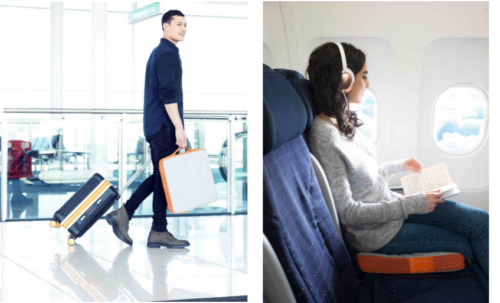
To draw attention to airline seat comfort (or the lack of it) Vanema, a company that makes lightweight aircraft seats, is giving passengers free seat cushions.
The company recently handed out 2,000 of its Octasupport seat cushions at Ljubljana Airport in Slovenia. In exchange, the company is asking passengers to provide feedback on their priority comfort issues.
“Our goal is to start a discussion about how next generation materials (like Octaspring) can improve passengers’ journeys, while helping airlines achieve their goals of cutting CO2 emissions,” says Venema company chairman Sandi Cesko.
In the next few months, the company plans to hand out these seat cushions at airport in the Netherlands, the United Kingdom and, possibly, Austria.
So keep an eye out for the booths and grab a cushion.
It may be the cheapest and fastest way to upgrade your airplane seat. And you can the cushion with you for your next flight.
(Thanks to Emil Atanasov, Guest Services agent on Viking Jarl for helping with Wi-Fi today. )
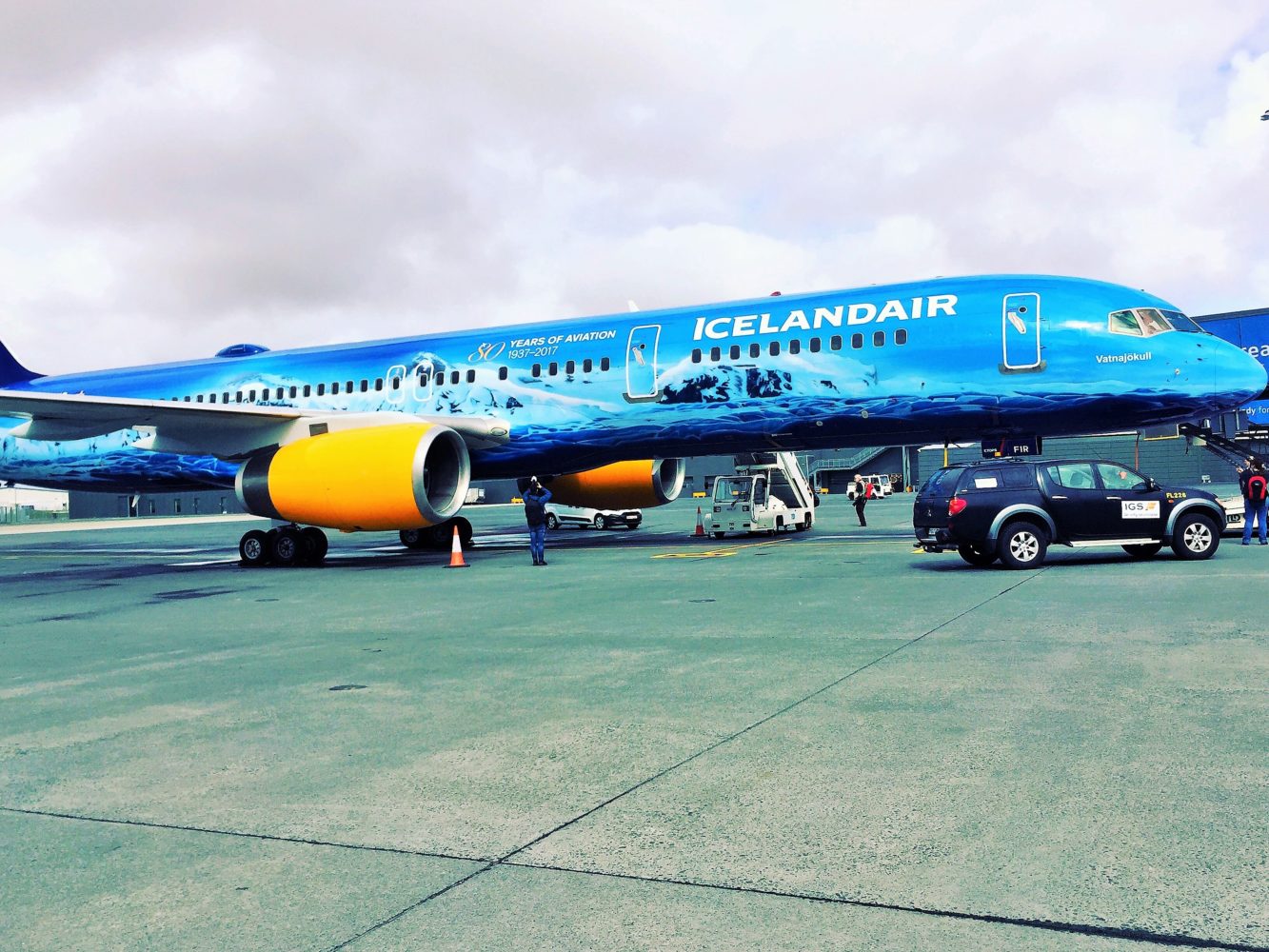
The free program offers passengers a chance to get travel planning tips via phone or via online messenger from a member of the Icelandair team who’s an Iceland local.
According to Icelandair, each of the “Buddies” has a different expertise, such as local cuisine, outdoor adventures, wellness and Icelandic culture. And each buddy is eager to offer insider tips to help travelers make the most of their trip.
The Hotline is open weekdays through July 8 from 9 a.m. – 3 p.m. ET and weekends from 12 p.m. – 3 p.m. ET.
PDX testing new ways to leave airports via Lyft and Uber
Like many airports, Portland International often has a very long line of people waiting for their assigned driver from a ride-hailing service such as Uber or Lyft.
Now, thanks to a pilot program being tested by both Uber and Lyft, the line should move much faster.
And, soon, so should the ride-hailing pick-up line at other airports.
First, the airport has separated the pick-up locations for the ride-hailing brands (Uber, Lyft and Winz) that serve the airport.
Uber and Lyft are also using a new system for pickups.
Uber is using PIN technology, a system it has used a high-volume events and festivals, to more quickly connect UberX riders and their drivers.
Travelers request an UberX ride, receive a one-time code, and enter the line at the pick-up location. When they reach the front of the line, they show their code to the driver and upon validation, start the trip. (Separately, riders can also use Uber products for pick-ups at PDX, including UberPOOL, Uber XL etc. )
With Lyft, travelers request their ride and are given a code. When the passenger arrives at the curb, they show the code to the next available driver and off they go.
Both companies are testing their processes at PDX this week with full implementation expected by May 20.
The pin-systems should get riders moving more quickly. S we expect the pilot program to become a permanent program at PDX and other airports shortly.
Spider-Man weaves through
United Airlines’ newest safety video
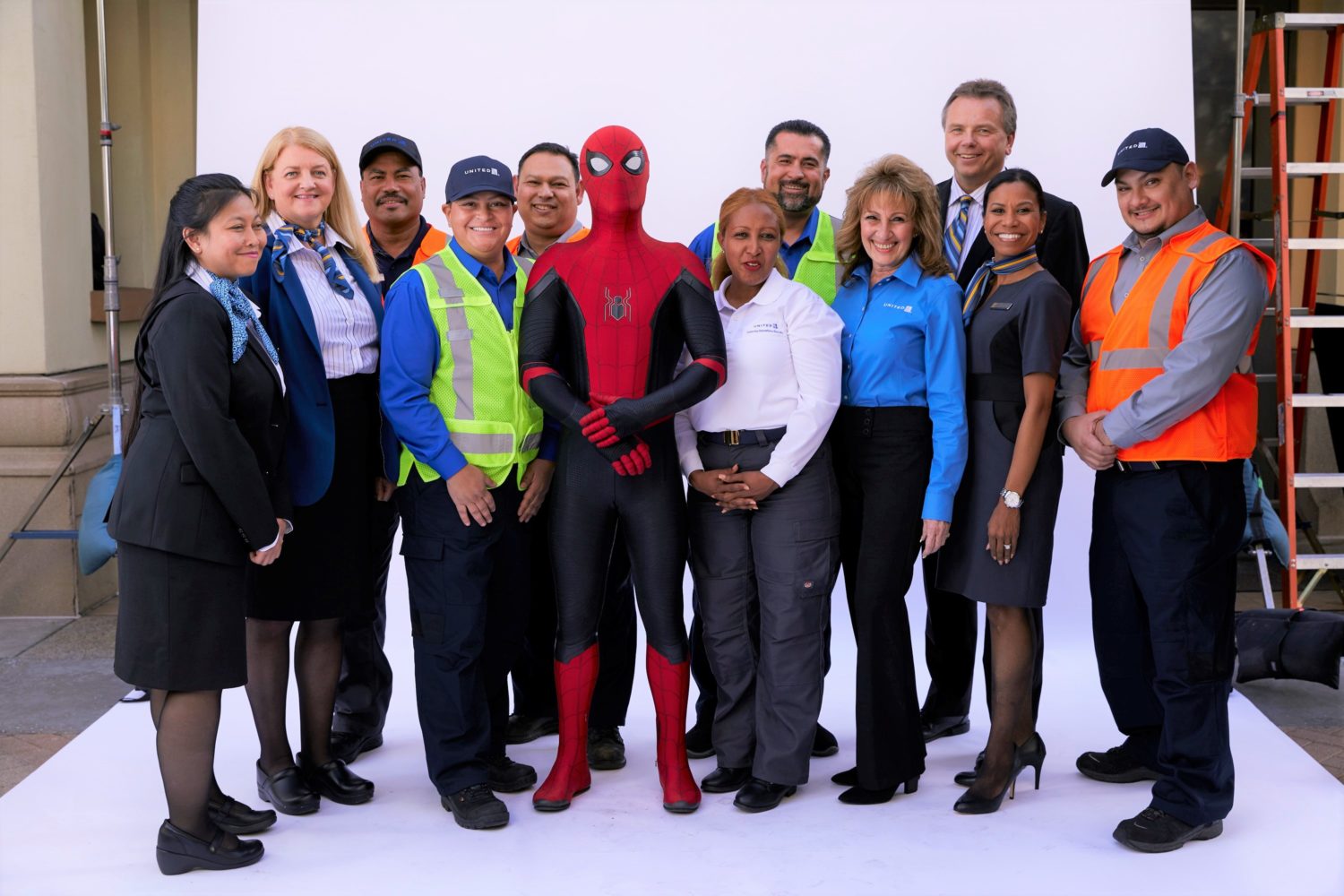
Spider-Man poses with United Airlines employees who appear in the new safety demonstration video – courtesy United Airlines
F
For a story on USA TODAY, I was invited to be on set during part of the filming for United Airlines’ new safety demonstration video featuring Spider-Man – and friends.
Here’s the story, And the video.
https://youtu.be/eM0H9rbqusw
“Spider-Man: Far From Home” won’t be in movie theaters until
July 2 but, starting today, fans of the webbed wonder (and of hidden film references
known as Easter eggs) will be able to see Spider-Man in action in United Airlines’ newest inflight safety demonstration video.
United
Airlines, Sony and Marvel worked together to weave the Federal Aviation Administration’s
required safety instructions into a fast-paced, short (4:44) film starring
Spider-Man, a trio of villains, and some of Spider-Man’s friends.
“We’ve kept the worlds of Spider-Man and United safety
separate, but together,” said Daniel Cuellar, Director of Global Advertising
for United, “Crew members, as always, are doing the demos and giving
instructions, but there’s an underlying fun Spider-Man aspect to it.”
And some cool
special effects.
“That’s the benefit of partnering with Sony,” said United’s Vice President of Marketing,
Mark Krolick. “We were able to make this safety video with movie
theater-style production and effects. It’s not something we usually have the
opportunity to do and I think our customers will appreciate the higher production
value.”
And, United hopes, pay attention in a world where airlines
try to out-do each other with engaging safety videos.
“There is
plenty of evidence that learning is more effective when there is play and fun
involved, and these videos follow a trend of gamification and entertainment of
information,” said Sabrina Habib, a professor of Visual Communications at the
University of South Carolina.
Spoiler alert: here’s the plot of
United’s new Spider-Man-themed safety video
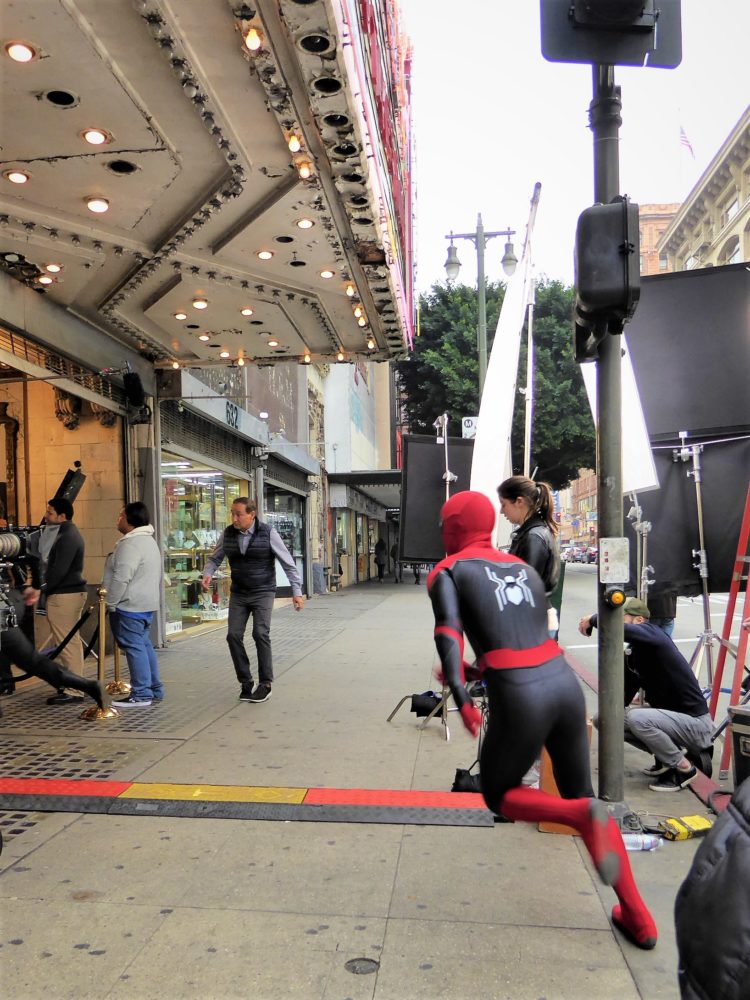
On the set during filming of the United Airlines new safety video. Photo Harriet Baskas
In United’s
new safety video, villains cause trouble at the corner store owned by Mr.
Delmar (played by Hemky Madera). Spider-Man happens to be nearby and springs
into action. He chases the goons into a movie theater, to a park fountain, and down
a dark alley; captures them all; and leaves them neatly wrapped up in a web
with a handwritten note for the authorities that says “All Yours! Gotta Fly.
Spider-Man.”
If you pay attention,
you’ll notice a framed photo of the late comic book writer and Marvel super
hero creator Stan Lee in the store. That’s Spider-Man movie character Eugene
“Flash” Thompson (played by Toni Revolori) helping to demonstrate safety
instructions about putting electronic devices into airplane mode.
And, while you
may not know who they are, some of the extras in the video are people who bid
their MileagePlus miles for a chance to be part of the project.
There’s more:
Spider-Man’s
alter ego, Peter Parker, has a best friend, Ned (played by Jacob Batalon) who is
in-line outside a movie theater when Spider-Man streaks by chasing a goon into
the theater. They race by a man walking down the sidewalk, played by none other
than United Airlines’ CEO Oscar Munoz.
“Wow, that must be
some good movie,” says man-on-the street Munoz
“Yeah, I hear the
best friend’s hilarious,” replies Ned.
During filming of the street scene outside the classic
Palace Theatre in downtown Los Angeles this past January, Munoz was having fun
bantering with the production crew and was patient and good-natured about the
multiple takes.
Off the set, there was an upcoming earnings report
and the impact the partial government shutdown was having on the airline
industry to think about, but Munoz felt taking time to do this safety video
cameo was important.
Besides being
fun for him to do, “It brings an awareness that while United is incredibly serious
about issues of safety and operational reliability,” said Munoz, “Were are
the also the ‘The Friendly Skies’ and we want to be friendly and fun. I think
this gives us that narrative.”
United CEO Oscar Munoz, Spider-Man and Jacob Batalon (‘Ned’). Photo_Harriet Baskas
How did United
Airlines rope Spider-Man into a safety video appearance?
United is not only an official airline sponsor for the new
Spider-Man movie; one of its airplanes has a cameo in the film.
In “Spider-Man: Far From Home.” Peter Parker and his high
school classmates go on a class trip to Europe, stopping in London, Venice, Prague
and a few other places. United flew a 777-200, retrofitted with the Polaris business
cabin, to London for a week of shooting.
“There are lots of different scenes of the kids going over
and coming back.” said United’s global advertising director Daniel Cuellar,
“Peter Parker has one very rich friend who’s flying in Polaris while everyone
else is flying in economy. So there’s lots of great footage of the aircraft.
And when the kids come home from Europe, they filmed in Newark Airport as
well.”
Other tie-ins
United’s “Spider-Man:
Far From Home” tie-in goes beyond the safety video and the aircraft cameo in
the film.
Starting in
June, travelers in United’s Polaris business class will get a Spider-Man-themed
amenity kit, in red or blue, which includes a Spidey-branded eye mask and
socks, alongside tissues and other branded personal care items.
The airline is
also inviting MileagePlus members to bid award miles
for a chance to attend the “Spider-Man: Far from Home” premiere in Los Angeles
on June 26 or to use award miles to attend pre-release screenings in seven of
the airline’s hub cities.