free Wi-Fi

Free Wi-Fi at Heathrow Airport

Someday there will be complimentary Wi-Fi at all airports.

We’re moving in that direction, but some pretty major airports still charge for that service.

Heathrow Airport has been one of them. But that will change – somewhat – when the airport’s contract with Boingo expires on May 31, 2013 and a new one, with Arqiva, goes live on Saturday, June 1.

Under the new service, everyone will get 45 minutes of free Wi-Fi at Heathrow once every calendar day. Members of the free Heathrow Rewards program will get 90 minutes of free Wi-Fi.  A Heathrow Airport spokesperson said passengers will not be permitted to log on to the free service from the same device more than once per calendar day.

After your time is up, the fees will be about $1.50 for one hour and about $7.50 for three hours.  A 24 hour pass will be about $13.60, by today’s exchange rates.

Look for more information about the new Wi-Fi service on the Heathrow Airport website beginning June 1.

Better Wi-Fi for DTW & a fitness center for YYZ

Two good bits of news on the airport amenities front:

EXERCISE

In September, a GoodLife Fitness Club will open in Terminal 1 at Toronto Pearson International Airport (YYZ) offering cardiovascular equipment, strength training equipment and free weights as well as luggage storage, a lounge area with massage chairs, towel service and changing rooms with showers and lockers. No word yet on what it will cost to use the club, but workout clothing will be available for purchase for those who get inspired by the layout.

And fans of fast, free Wi-Fi at airports will soon be much happier when spending time at Detroit Metro Airport (DTW).

Advanced Wireless Group is replacing Boingo at DTW and by September will install a much speedier Wi-Fi system that will be free to use if you’re willing to watch a 30-second advertisement once every 45 minutes.

The current system offers only 30 minutes of free Wi-Fi access to travelers willing to watch a 30-second video ad.

Travel Tidbits: blizzard, extra points and free Wi-Fi

Snowstorm

Thanks to Storm Nemo, on Thursday evening I was one of the hundreds of thousands of travelers who had to cancel important weekend plans that involved flying to the east coast.

Then I had to sit on the phone for hours trying to work out a new and, it turns out, quite expensive new plan.

For those of you still trying to figure out your options, here’s a link to a list of many of the change-fee waiver policies airlines have posted.

In other news…. Dallas Fort Worth (DFW) International Airport announced that it is the latest airport to join the Thanks Again program, which offers travelers frequent flyer miles or points for qualifying purchases made at the airport for things such as parking, food and retail items. Travelers at DFW will also be able to get points or miles for stays at the airport hotels, such as the Grand Hyatt, and at Paradise 4 Paws, the airport’s pet hotel.

170 other airports already participate in the Thanks Again program – which requires a simple sign-up and registration of a credit-card.

And during the month of February passengers at John F. Kennedy (JFK), LaGuardia (LGA) and Newark Liberty International (EWR) airports – as well as passengers at some New York City subway stations – will be able to get complimentary Boingo Wi-Fi sessions courtesy of Norwegian Cruise Line, which is celebrating a new ship, the Norwegian Breakaway.

That should come in handy if you end up stuck at one of those airports – or in the city – this weekend due to Storm Nemo.

Airports improve the pick-up experience. With cellphone lots.

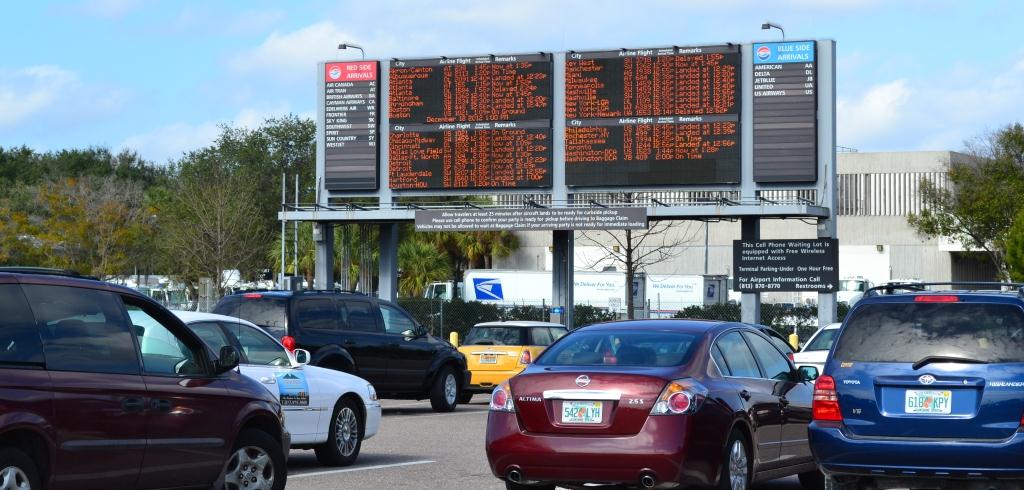
TAMPA CELL PHONE LOT

When grandma is flying in for a special occasion, you’ll find a spot in the airport’s short-term parking garage, go into the terminal and wait where you’ll be sure to see her when she exits the secure area.

But if it’s “just” a friend coming in for the weekend or a spouse coming home from a quick business trip, these days you’re likely to wait in your car in the cellphone lot, have your friend or family member call you when they’ve landed and then drive over and make a quick pick-up at the curb.

Cellphone lots offering free, short-term parking near airports are now available at most large, medium and many small airports. But just ten years ago, none of these lots even existed. Their presence at airports is the result of two post-9/11 trends we now take for granted: heightened concerns about security outside the terminals and the growing number of people using cellphones.

After 9/11, motorists waiting for passengers to arrive were no longer allowed to clog up roadways outside airport terminals by idling for a long time at the curb, or leaving a car parked outside baggage claim and running inside to greet a passenger. It’s hard to believe now, but in the “old days,” many airports would let you do that.

To cut down on congestion caused by drivers who instead began circling terminal lanes over and over, in 2004 airports such as Los Angeles International and Seattle-Tacoma International came up with the idea of directing drivers to free, off-site parking lots where they could wait for an arriving passenger with a cellphone to call for a pick-up. At least a dozen airports had cellphone waiting lots by the end of 2004 and today it’s rare – and irritating – to find an airport without one.

“Security concerns and technology have definitely driven the rise of this airport amenity” said Debbie McElroy, spokesperson for ACI-NA, the organization that represents most North American airports.

But so has economics. In the past, many airports gave drivers a grace period in the parking garage, anywhere from 15 to 60 minutes, to allow them to go into the terminal and meet a passenger. But most of these free parking sessions have been eliminated as airports try to maximize revenue generated from their parking garages. “Airports still want to provide good service to their communities,” said McElroy, “so when they cut free parking they’ll often add a cellphone waiting lot nearby.”

And while many cellphone lots are put on property an airport wasn’t using for anything else, the lots do have costs. “You have to establish them, maintain them and make sure you have periodic security checks,” McElroy said. “And in some airports, the lots are on land that could otherwise be put to use generating some sort of revenue.”

But cellphone lots are now so popular that many airports are now expanding theirs and adding amenities for waiting drivers such as free Wi-Fi, vending machines, restrooms (portable and permanent) and electronic reader boards displaying up-to-date flight arrival information.

At Fort Lauderdale Hollywood International Airport, community outreach coordinator Allan Siegel says the airport offers a flight-status screen as well as emergency services for vehicles with a flat tire or dead battery. And at the Austin-Bergstrom International Airport, there are flight information display monitors, restrooms and regular food truck service offering Mexican food, Panini sandwiches, salads, appetizers and drinks.

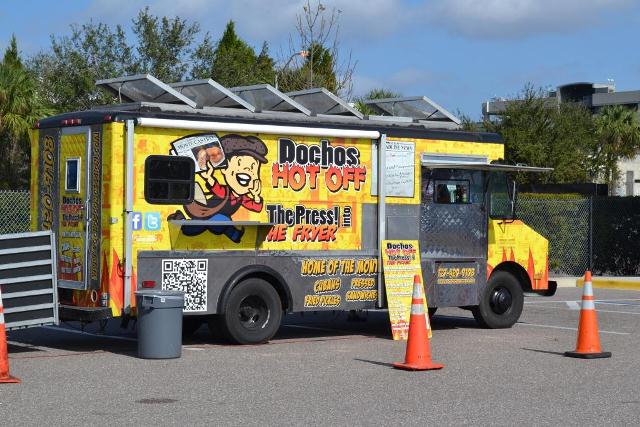
TAMPA CELL PHONE FOOD TRUCK

Tampa International Airport has vending machines, restrooms, real-time flight information, free Wi-Fi, and electric vehicle charging stations in its cellphone lot and, before the holidays it began a 30-day experiment with having food trucks on-site as well, a different one each day.

The experiment has been such a success that the trial period has been extended. The airport is even posting the food truck schedule on its Facebook page.

“Other airports are watching Tampa to see how successful they are in doing this,” said McElroy, “And I think there’s probably room for other airports to contract with vendors to offer more services and amenities at their cellphone lots as well.”

What others kinds of services and amenities might be added?

Tim O’Krongley, assistant aviation director for the San Antonio Airport System, said there’s been some discussion about adding food truck service at San Antonio International Airport. And when Seattle-Tacoma International Airport opens a new, larger permanent cellphone lot next spring, free Wi-Fi and some food options may be added as well.

But here are some other options that might make cellphone lots even more enticing: drive-through espresso stands, exercise stations, playgrounds, fresh flower stands and coin-operated car washes and vacuums to encourage drivers to clean up their cars before going in for the pick-up.

What amenities would you like to see at an airport cellphone waiting lot?

(Photos courtesy Tampa International Airport)

(My story: Airports improve the pick-up experience first appeared on USA TODAY)

Airport Wi-Fi: free, but why so stingy?


One of the most requested, used and appreciated amenities at airports these days is free wireless internet access.

And, in more and more airports, travelers are finding that Wi-Fi access is indeed free.

But the definition of “free” seems to be changing.

The trend for a while there was for airports to offer passengers unlimited use of Wi-Fi, making it possible to turn an irritating hour or two wait for a flight into productive work time.  But then some airports, such as Houston’s George Bush Intercontinental, began offering free Wi-Fi for limited time periods, forcing travelers who needed more time to purchase the service.

I wrote about what seemed to be that emerging trend in June, 2011, in my on-line “At the Airport” column on USA Today. (Should you pay for Wi-Fi? Airports explore tiered service.)

Three recent free Wi-Fi announcements underscore what now seems to be an official “sort-of-free” trend.

Earlier this week, it was announced that when Berlin’s new Brandenburg Airport (finally) opens, next March, passengers will be able to access basic complimentary Wi-Fi service for 30 minutes. (Somewhat troubling, users will only be able to access the service by entering a credit or debit card number.)

Travelers needing more than 30 minutes of Wi-Fi access (and, really, who doesn’t) will have to purchase a premium service – with higher bandwidth – from the contracted service provider, Boingo.

After some controversy over the fast-tracking of an interim Wi-Fi provider contract while what could be a two-year process to find a company to replace T Mobile gets underway, complimentary Wi-Fi should begin at Los Angeles International Airport in July.

Passengers will get access to 45 minutes of Internet service provided by Advanced Wireless after watching a 15- to 30-second advertisement.

And on Wednesday, Detroit Metropolitan Airport (DTW) announced that, in September, Boingo would begin offering a limited complimentary Wi-Fi access service as well.

At DTW, access to the airport’s wireless network for 30 minutes will be offered for no cost after viewing a 30-second video advertisement. “Users who require an extended or high-speed connection will continue to have the option to connect via one of Boingo’s existing service plans,” the airport said in a statement.

What’s up?

Some say that airports are taking a page from airlines, which now charge for services – such as checked baggage and seat assignments – that were once considered part of the ticket package. Boingo corporate communications director Christian Gunning says that the trend of airports offering tiered wireless access (free for s short time; then access to premium service for a fee) allows airports to generate revenue from both casual and more serious users.

Via e-mail he said, “Some of the airports really need every extra bit of revenue they can muster since they’re operating under big budgetary deficits and some manage to generate healthy revenues from alternate concessions (think slot machines in Las Vegas). … It’s pretty complicated overall, and the final outcome is slightly different for each airport we work with.”

Complicated? Sure.

Irritating? You bet.

What travelers might soon encounter at more airports?

Probably, but I hope not.


Tidbits for travelers: Free Wi-Fi & free photos with Santa

Free Wi-Fi on Delta Air Lines

From now till January 2, 2012 passengers on Wi-Fi equipped Delta airplanes will be able to use the in-flight Gogo Wi-Fi for free for 30 minutes each flight.

It is a partnership with eBay, so you can continue shopping on that one site for the entire flight.

More info on free Wi-Fi on Delta Air Lines here.

Holiday music at JFK and LGA airports

Jazz trios, quartets and quintets from the New York Pops orchestra and up to 25 members of the performance choir from the Choir Academy of Harlem will entertain American Airlines passengers with holiday music at LaGuardia and JFK International Airports during the next few weeks.

In LaGuardia Airport, performances will be in the Central Terminal Building, American Airlines Concourse D, Gate D5.

• Dec. 14, 3:30 p.m. to 6:00 p.m. The New York Pops Jazz Trio
• Dec. 20, 12:00 p.m. to 2:30 p.m. The New York Pops Jazz Trio
• Dec. 22, 1:00 p.m. to 3:30 p.m. The New York Pops Jazz Quartet

At JFK International Airport, the concerts will be held in American Airlines Terminal 8, Concourse B Lobby by Gates 14 and 16.

• Dec. 16, 2:30 p.m. to 5:00 p.m. The New York Pops Jazz Quintet
• Dec. 19, 4:00 p.m. to 6:00 p.m. Choir Academy of Harlem Performance Choir
• Dec. 20, 4:00 p.m. to 6:00 p.m. Choir Academy of Harlem Performance Choir
• Dec. 22, 2:30 p.m. to 5:00 p.m. The New York Pops Jazz Quintet
• Dec. 23, 2:30 p.m. to 5:00 p.m. The New York Pops Jazz Quintet

During their performances, The New York Pops will offer travelers an opportunity to win tickets to an upcoming concert at Carnegie Hall.

Photos with Santa


Southwest Airlines, Clear Channel Airports and Microsoft Windows are teaming up to offer free holiday photos with Santa at 19 airports around the country through December 24th.

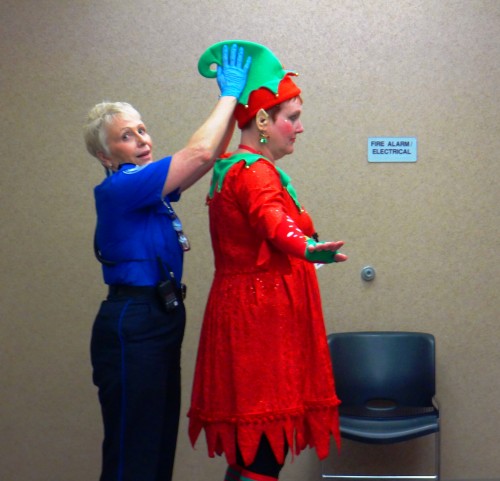
Look for the holiday-themed kiosks , Santa and a “Windows 7 Elf” at some of the Southwest Airlines gates at these airports:

Austin-Bergstrom International Airport (AUS)
Chicago Midway International Airport (MDW)
Denver International Airport (DEN)
Detroit Metro Airport (DTW)
Fort Lauderdale-Hollywood International Airport (FLL)
General Mitchell International Airport (MKE)
Lambert-St. Louis International Airport (STL)
Logan International Airport (BOS)
Louis Armstrong New Orleans International Airport (MSY)
Nashville International Airport (BNA)
Norman Y. Mineta San Jose International Airport (SJC)
Oakland International Airport (OAK)
Philadelphia International Airport (PHL)
Phoenix Sky Harbor International Airport (PHX)
Sacramento International Airport (SMF)
San Antonio International Airport (SAT)
San Francisco International Airport (SFO)
Seattle-Tacoma International Airport (SEA)
Tampa International Airport (TPA)

John Wayne Airport’s new Terminal C open, with baggage woes

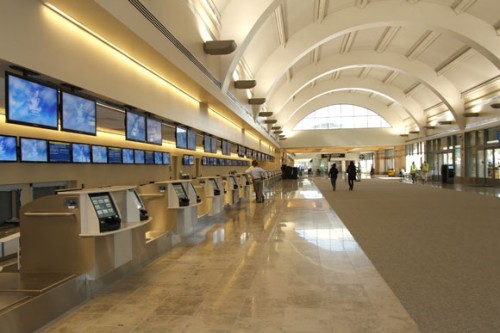
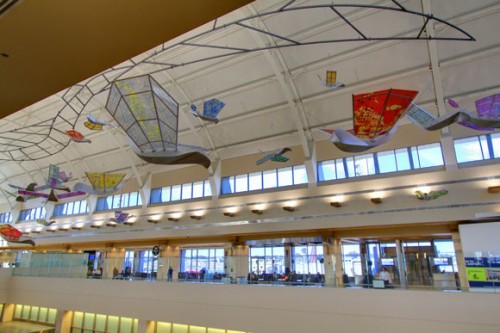
On Monday, November 14, 2011, John Wayne Airport in Orange County, California officially opened its new Terminal C, which offers travelers a new parking structure, new security screening lanes, new gates, new shops, new restaurants, free Wi-Fi, new artwork, workstations and plenty of places to plug in gadgets.

Flight of Ideas - by Beth Nybeck

You can see a map of the new terminal and a list of the new eateries and shops here but, unfortunately, if you’re heading to JWA’s new Terminal C you won’t be able to check your luggage.

Although the new terminal is open for business, the baggage handling system failed a certification test last week. So for now you’ll need to check your luggage in Terminal B.

All in all, the place does look pretty swanky and I’m hoping to visit in person soon. If you get there before I do, please share your thoughts on what you see and send along a few photos.

How 9/11 changed the airport experience


As the 10th anniversary of the 9/11 tragedy rolls around, many travelers are thinking back to where they were that day and what they were doing as the horrific details began to emerge. Some are recounting their blessings, remembering how close they came to being part of the carnage.

Count me among them.

In the summer of 2001, I was on the road promoting my guide book, Stuck at the Airport, which detailed services and amenities at the many of the nation’s airports. (Modern versions of those guides are now online at USATODAY.com) Airport shops offering massages or manicures were a rare find back then; an airport with a website was even rarer.

I got a call from a woman at the Port Authority of New York & New Jersey, the operator of LaGuardia, JFK and Newark airports. She invited me to visit her office at the World Trade Center and chat with her staff about how airports could be more welcoming. “We can’t pay you to come out here from Seattle,” she said, “But if you’re in town anyway and can come by, we’ll take you out for a nice meal.”

That seemed like a good excuse to visit family back east. So we picked a date: September 12. My thank-you meal would be at Windows on the World, the restaurant at the top of the North Tower.

Then and now

Since then, as you well know, pretty much everything about the airport experience has changed.

Before 9/11, my airport review ritual went like this: I’d fly into an airport, stash my belongings in a gate-side locker (remember those?), and spend several hours walking from concourse to concourse, terminal to terminal, asking questions, taking pictures and making detailed notes.

On a cheap weekend fare I’d often fly in and out of an airport (or two) on the same day, taking advantage of the long layovers other travelers despise.

I visited more than 100 airports this way, many of them multiple times, and only once – in July, 1999 in Memphis – was I ever stopped by someone from airport security and questioned about what I was doing.

More often than not, it was other travelers who noticed my note-taking and assumed I worked for the airport. They’d stop me to ask for directions and tips on where to shop or find something to eat.

I not only took notes about what was offered inside airports, I made note of what people did in the airports.

Read. Sleep. Chat. Try to get some work done. Eat. Drink. Talk on the telephone. The same as now, but without all the cell phones, laptops and searching around for an electrical outlet.

Back then there were a lot of small children squealing “There’s daddy!” as tired-looking businessmen streamed off planes. And plenty of grandmas and grandpas rushing to plant wet kisses on squirmy babies they may have been meeting for the first time. There were waves of teary goodbyes and joyous reunions at the gates. And thinking back now, I realize the last time I saw my father smile at me before his final illness was at an airport, while we chatted as I waited to board a delayed flight.

Now it’s all grumbling about the Wi-Fi signal and jostling for a good spot so you can board the plane first and find a place to stash your carry-on bag. No last minute kisses, hugs and good wishes as the door to the jet way is about to close. No waves and tears at the window as a plane backs away.

I miss that.

But, setting aside for a moment the long lines, x-ray machines, body scanners and icky, intrusive pat-downs we must now endure at the security checkpoints, the post 9/11 world of airports has some upsides.

Recognizing that passengers were spending lots more time inside airports – and needing to diversify income sources once cash-strapped airlines began balking at footing the bills – airports began bulking up on services and amenities in the terminals.

Now, kiosks offering manicures and massages are no longer rare sightings at airports. Many terminals have wine bars, sports bars and fine restaurants where you can settle in and really relax. The selection of shops at some airports now rivals those offered at neighborhood malls and, with medical clinics, hair salons, pharmacies, convenience stores, play areas, art galleries and – hooray – free Wi-Fi, popping up along many airport concourses, it’s getting easier and easier to get distracted and miss a flight.

I’ve done that; more than twice.

But, as pleasant as it may be to have fun while being stuck at the airport, the sobering reality is that some of these amenities were ushered along in response to tragedy. And while I’m all for safety and security in the skies, I’m still mourning the loss of that one airport amenity that allowed for a last hug from a loved one before stepping onto a plane.

What pre-9/11 airport experience are you missing?

(This article originally appeared on USATODAY.com as my September, 2011 At the Airport column.)


Free WiFi – and more – at Spokane Int’l Airport

Well, here’s an airport moving in the right direction.

Washington’s Spokane International Airport, which serves about 3 million passengers a year, is now offering travelers free Wi-Fi (well, for 20 minutes..) inside the Terminal Building and, starting in September, will be providing baggage carts at no charge.

“In today’s climate, people are unhappy with the pricing models of air travel companies and are suffering from declines in customer service,” said airport director Lawrence Krauter.
“This is just the beginning of our commitment to explore new ways to provide greater customer satisfaction at Spokane International Airport.”

Just the beginning? Wonder what will come next? Maybe a circus, like the one offered each year at Dusseldorf International Airport. Or a miniature golf course, like they have at Florida’s Palm Beach International Airport.

After all, this is the airport that serves as the gateway for the Spokane Fantasy Flight to the North Pole each December for 60 kids and their elf escorts – so you know they know how to have a good time.

Airport Wi-Fi: Should you pay?

In my At the Airport column on USATODAY.com this month, I take a look at tiered Wi-Fi service being offered at some airports.  The big question is: should  you pay?

For years, one of the top if not the top amenity on many road warriors’ wish lists has been free Wi-Fi at the airport.

Slowly but surely, it’s happening.

Take a look at the USATODAY.com Airport Guides, airport websites, and various commercial and user-generated Wi-Fi directories. You’ll see there are now hundreds of U.S. airports offering travelers complimentary wireless Internet access.

San Francisco? Free. Orlando? Free. Seattle, Sacramento and San Jose? Free, free, free.

Washington’s Dulles and National airports? As of April, 2011, free as well.

Free Wi-Fi sounds great. But during heavy usage times at some airports, service often slows down. And some free airport Wi-Fi has strings. Most often, it’s in the form of advertising a user must view before getting online.

At Denver International Airport, “Sometimes it’s a session sponsorship, such as a video and then users are directed to the internet,” said DIA spokesperson Laura Coale. “Sometimes it is banner ads.”

At Boston’s Logan International Airport, where 198,000 free Wi-Fi sessions were logged during May, travelers must click through to a second screen before they see the button offering free Wi-Fi. “The user agrees to watch a short commercial or take a survey to gain access to the free site,” said airport spokesperson Mathew Brelis, “That times out after an hour and they need to log back on again.”

There remain some holdouts. Notable among airports that only offer paid Wi-Fi (outside of airline club lounges) are Hartsfield-Jackson Atlanta International Airport, Minneapolis-St. Paul International Airport, Newark Liberty International Airport, LaGuardia Airport and JFK, except for JetBlue’s Terminal 5, where complimentary Wi-Fi is offered as an amenity by the airline. There’s a plan underway to provide free Wi-Fi at Los Angeles International Airport within a year.

Is a little Wi-Fi too little?

At some airports that cannot yet swing free Wi-Fi financially or contractually, there is a new model: hybrid, or tiered, service. Complimentary Wi-Fi with limited time and, often, limited bandwidth is available, but for a fee travelers can also choose more secure, robust and unlimited service.

Will Rogers World Airport in Oklahoma City offers travelers 20 minutes of complimentary Wi-Fi. In Houston, travelers get 45 minutes of complimentary Wi-Fi at both Hobby Airport and George Bush Intercontinental airports.

“Some revenue needs to be generated by Boingo, our wireless vendor, to cover the costs of the Wi-Fi system,” explains Houston Airports spokesperson Marlene McClinton, “And charges for upgraded, faster downloads and beyond 45 minutes help.”

“The airport is weighing the possibility of offering entirely free Wi-Fi,” said McClinton, “But a timeline and strategy are still being discussed.”

Austin-Bergstrom International Airport has had some form of paid Wi-Fi available since 2000, but in May it began offering travelers a complimentary 30-minute session. Once the free session expires, a customer must wait 24 hours for another, find one of the airport’s free internet kiosks, or purchase premium access from the airport’s Wi-Fi provider, Boingo Wireless, which has roaming agreements with a variety of partners.

“Austin’s airport has different customer groups,” said spokesman Jim Halbrook. “Our business travelers need and pay for a premium Wi-Fi product. The 30-minute complimentary Wi-Fi sessions are a convenient amenity for casual users,” he said. “It’s our way of fulfilling the needs of very different travelers.”

Nashville International Airport is currently evaluating its Wi-Fi options. During the winter, the airport complemented paid airport-wide Wi-Fi with 20 minutes of sponsored Wi-Fi in the Meeter/Greeter areas and in the food court.

“We are still determining the impact of the promotion to our business model,” said airport spokesperson Emily Richard. “Airport officials are studying how to continue to offer a complimentary service to customers that desire it and a level of service and security for those customers who require it.”

For now, sponsored, complimentary Wi-Fi continues to be offered in the food court.

Why just the food court?

“Anecdotal studies say free Wi-Fi may have an overall negative effect on airport revenue,” explains Boingo Wireless spokesman Christian Gunning. “If people are watching a movie on-line they’re not walking around the airport shopping or spending money in the food court.”

Do travelers care?

Karen Marmolejo, a career/life coach in Sacramento, won’t pay for Wi-Fi at an airport, but is grateful when free access is offered. “Generally I don’t need access to the internet for more than 20 minutes anyway as there are many things I can do on my laptop that doesn’t require me to be online,” she said.

But Forrester Research travel industry analyst Henry Harteveldt said hybrid Wi-Fi “is a way for airports to avoid building out the infrastructure to support travelers. It is cheap — and annoying… Shame on them.”

Annoying or not, hybrid Wi-Fi plans at airports may be sticking around.

“Consumers are familiar with these kinds of policies where the heaviest users pay higher fees,” said Amy Cravens, senior analyst for In-Stat. “The tiered pricing model has its place in the hotspot market, particularly in airports where the amount of time spent on the network varies so greatly.”

Outside airports, many travelers are already making those choices.

A survey by travel research organization YPartnership found that 67% of frequent travelers have had a bad experience with free Internet while on the road. “Nearly half of those respondents are willing to pay for Internet. They just want fast service to get their work done and to access the Internet for entertainment,” said David Garrison, CEO of iBAHN, the provider of internet service at 300,000 hotel rooms worldwide.

“[T]he explosion in the use of photos and videos — think Facebook, You Tube and devices like iPad — has caused the amount of data per session to go up 50% per year. So free is not free and it’s getting more expensive every year.”

Note: Every bit helps: after I wrote this article I noticed Boingo was celebrating its 10th anniversary by giving away free Wi-Fi minutes and assorted prizes. Get your free Wi-Fi code here.


Photo courtesy slambo_42 via Flickr Commons