Aviation history

What I’m watching, reading..instead of working

Don’t tell me this hasn’t happened to you.

You have stuff to do.  Deadlines.  Work someone will pay you for if you just, you know, do it.

So you pour a cup of coffee and sit down at the computer.

But then, dang, the Internet happens.

Here’s a bit of what got me distracted today.

Air New Zealand posted time-lapse video footage of its first new domestic A320 being built and painted with all black livery.

The paint job has something to do with the All Blacks rugby team, so of course I had to visit that site and then the Small Blacks site as well.

As long as I was visiting the Air New Zealand site, I had to check in on what that wild and crazy furry creature, Rico, was up to. I found this reel of bloopers.

A quick check of email and Twitter sent me off in new directions.

Florida’s Dali Museum was opening in its snazzy new building in St. Petersburg, FL. And as someone who first came upon that museum collection, by accident, when it shared space with a factory in Cleveland, Ohio, I of course had to visit.

While there, I came across this clip of Salvador Dali as a guest on the old TV show, What’s My Line?

Then, of course, it was time to check email and Twitter and catch up on my RSS feed.

A blog post by the folks at the  Smithsonian Air and Space Museum – 5 Cool Things at the Udvar-Hazy Center You May Have Missed – caught my eye because the Udvar-Hazy Center is just down the road Dulles International Airport.

And then I really got tangled up in the web. A comment on the museum blog post mentioned Anita, “the spider from Skylab.”  I didn’t know about Anita so had to follow that thread.

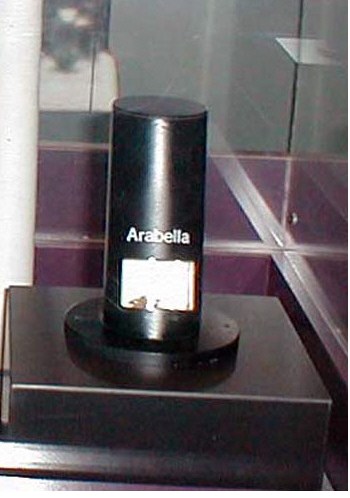
It turns out that Anita and a companion spider, Arabella, were part of an experiment flown on Skylab, a space station launched in May 1973.

According the Smithsonian website:

Scientists and students interested in the growth, development, behavior, and adaptation of organisms in weightlessness provided a variety of biology experiments for flight in the orbital research laboratory. A common Cross spider, “Anita” participated in a web formation experiment suggested by a high school student. The experiment was carried out on the Skylab 3 mission, which lasted 59 days from July 28-September 25, 1973. Astronauts Alan Bean, Jack Lousma, and Owen Garriott carried out the scientific research in space, reported the results, and returned this specimen at the end of their mission. NASA then sent Anita, a companion spider “Arabella,” and the experiment equipment to the Museum.

Anita is on display at the Udvar-Hazy Center.

Anita Skylab Space Station spider

Arabella is in storage.

Love is in the air at Stockholm’s Arlanda Airport

Throughout the year, Stockholm’s Arlanda Airport is a pretty lovey-dovey place.

marriage ceremony at Stockholm Arlanda

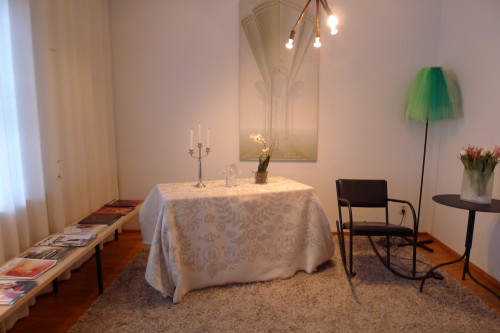
Last Thursday morning, I stopped by the airport chapel just as chaplain Anders Berglund was finishing up a short marriage ceremony for Melitza and Frank Kortman (below).  After chit-chat and champagne, the couple set off for their honeymoon in Bali and Berglund explained that this was the second of three weddings he’d be presiding over that day and just a few of the more than 200 weddings that take place at the airport chapel each year.

Wedding at Stockholm Airport

More than 200 Swedish marriages begin with ceremonies at the airport’s VIP lounge as well.

Wedding at Stockholm Airport VIP Lounge

The folks at Guinness World Records may not be keeping tabs, but I’m pretty sure more wedding ceremonies take place at Stockholm’s Arlanda than at any other airport.

That’s all very romantic. But on Monday, Arlanda is going to be the starting point for what is certainly a world first in weddings.

On Monday morning, December 6, 2010, one of the business class cabins on SAS fligh SK903 from Stockholm to New York will be transformed into a wedding chapel in preparation for the world’s first in-flight, same-sex weddings.

One gay couple and one lesbian couple – winners of a spirited, record-breaking, on-line contest that took place over the last few months – will be married when the plane takes off and while it is still in Swedish airspace. Once the legal business is completed, there will be an in-flight reception, complete with wedding dinner, wedding cake, first dances  and other traditional, and no doubt some non-traditional, wedding celebrations.

I’ll be attending the in-flight weddings as a media guest and will share more details once the flight arrives in New York.

In the meantime, you can read more about the contest and winning couples on the SAS website, where there’s also information about the flowers, the wedding bands and the wedding outfits.

Fresh art at Tampa International Airport

Tampa International Airport is one those airports with an extensive, eclectic and very valuable, collection of permanent public art.

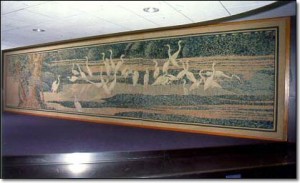
Some of my favorite pieces in the collection include the 22 tapestries in the baggage claim area made by 20 women from Phumalanga, Swaziland in Africa.

Tampa Airport Tapestries

(Photo courtesy Tampa Airport)

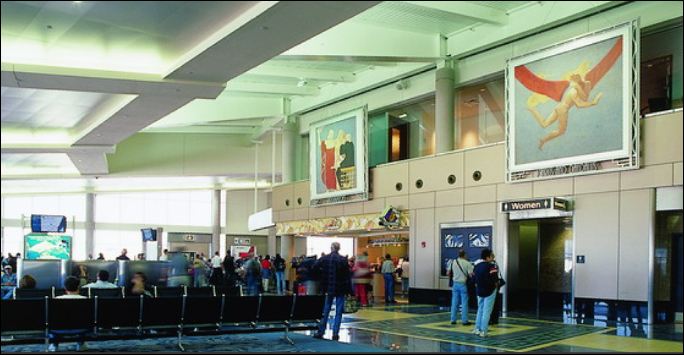
And the seven WPA-era murals by George Snow Hill depicting the history of flight.

Tampa airport murals

These murals are especially incredible to see because they were ignored for years and almost destroyed.

From the airport’s website:

In the late 1930’s, local artist George Snow Hill was commissioned to create these murals to adorn the walls of Tampa’s newly built Peter O. Knight Airport. Hill artistically interpreted the history of flight through the contributions made by Icarus and Daedalus, Archimedes, The Montgolfier Brothers, Otto Lilienthal, Tony Jannus, The Wright Brothers, and a triptych, capturing the first scheduled airline flight in history.

The murals were removed from the walls of the Peter O. Knight Airport upon demolition in 1965, and restored by George Snow Hill himself. In 1971, they were relocated to the new terminal building, where only the triptych and the Wright Brothers mural hung in the airport’s executive suite. The others were rolled and placed in storage, untouched for years.

You can read more about the Tampa airport’s art collection here, but be sure to scroll down to the notes about a brand new temporary exhibit featuring blown glass vessels and sculptures by Owen Pach, on display in the airport’s renovated art gallery.

Owen Pach glass art at Tampa

“Fiery Passion – The Beauty of Glass”will be on display through March 2011.

For more information about Owen Pach, see this website.

And for a general guide to Tampa International Airport, see my list of airport guides on USATODAY.com.

Daylight Saving Time: where to watch the clock

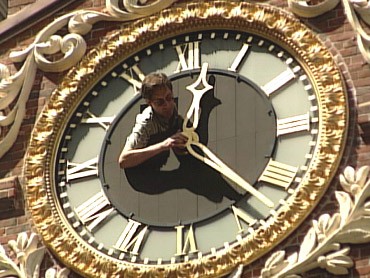
Clock turn back time

(Boston: courtesy Marriott’s Custom House)

Daylight Saving Time (DST) ends at 2 a.m. Sunday morning when we “fall back” to standard time by turning our clocks back one hour.

As you rush around resetting the clocks on the microwave, the TV and the bedside alarm, imagine yourself watching time fly in one of the clock-worthy cities I included in the slide-show-style story I put together for msnbc.com this week: How time flies! Where to see the world’s clocks.

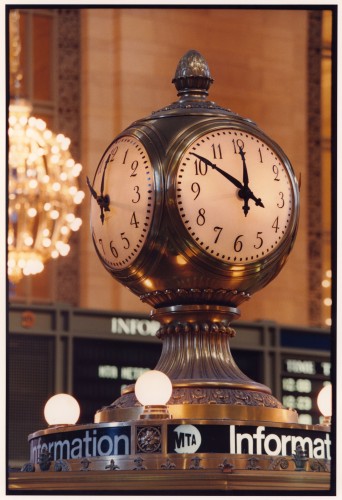
Grand Central Terminal clock

(Courtesy Metro-North Railroad)

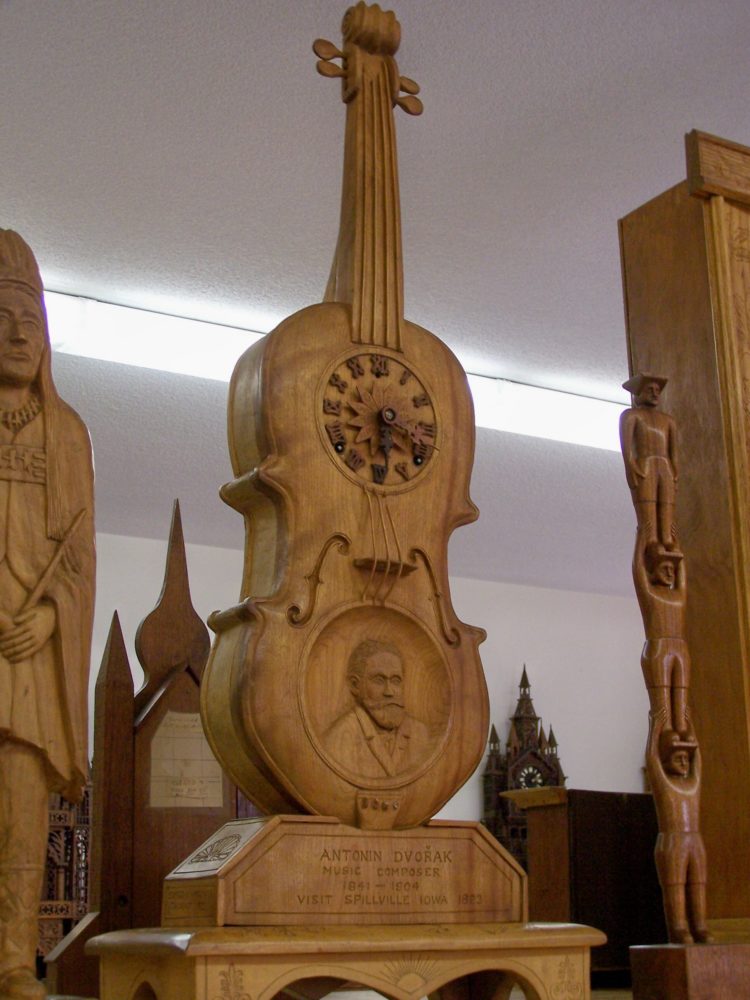
The story includes the information booth clock at New York City’s Grand Central Station, clock and watch museums in Pennsylvania and Connecticut, what may be the oldest continually running town clock (in Winnsboro, South Carolina), and the Bily Clocks Museum in Spillville, Iowa, which is home to 43 intricately carved clocks, some more than ten feet tall, made by Joseph and Frank Bily over the course of 45 years.

Dvorak clock Bily Brothers

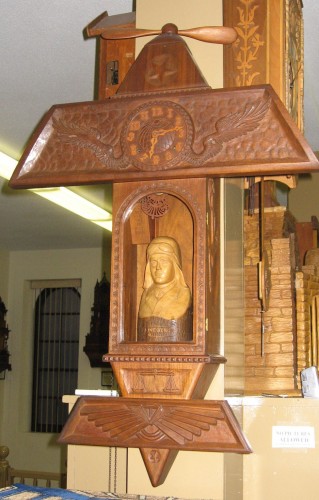
The Bily Brothers’ clocks have themes ranging from art and religion to history and culture. The collection includes an American Pioneer History Clock, an Apostle Clock, a violin-shaped clock honoring Czech composer Antonin Dvorkak (above) and an airplane-shaped clock (below) made to commemorate Charles Lindbergh’s trans-Atlantic flight. (That propeller moves!)

Lindbergh Bily Clocks Museum

(Courtesy: Bily Clocks Museum)

In researching the story, I also came upon this film documenting the incredible video mapping project done to mark the 600th anniversary of Prague’s astronomical clock in Old Town Square.

Museum Monday: 75 years at Phoenix Sky Harbor International Airport

There are more than 700 aviation and space-related museums in this country. Each Monday we try to profile one of them.  Eventually we’ll visit them all.

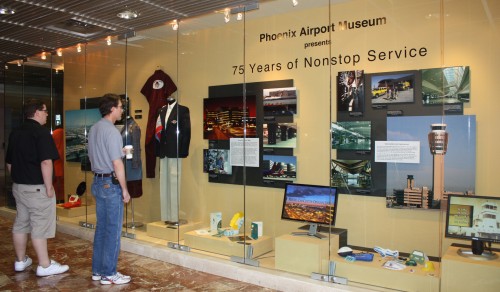
This week, we’re stopping at Phoenix Sky Harbor International Airport, which has an exhibit of photos, videos and historic memorabilia celebrating its 75th anniversary.

History exhibit at Phoenix Sky Harbor

According to airport history notes, the city of Phoenix purchased Sky Harbor Airport on July 16, 1935 for $100,000. That November, a dedication event took place that included speeches, an aerial circus performance and a dinner dance.

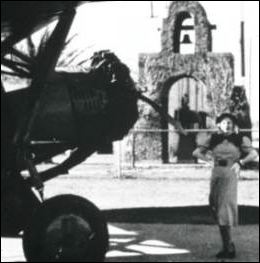
The original terminal building, hangar and tower were located on the north side of today’s airport property and at one time a chapel with a bell stood at the entrance of the airport.

Sky Harbor wedding chapel

Arizona didn’t require a three-day waiting period for couples wanting to get married, so the airport hoped to generate business by having an on-site wedding chapel for couples wanting to tie the knot as soon as possible.

Interested in learning more about the history of Phoenix Sky Harbor International Airport?

75 Years of Nonstop Service will be on exhibit until March 13, 2011 in the pre-security area of Terminal 3.  You can also go online, to Sky Harbor’s History section to watch video clips and read excerpts from research done for the airport’s 50th anniversary.

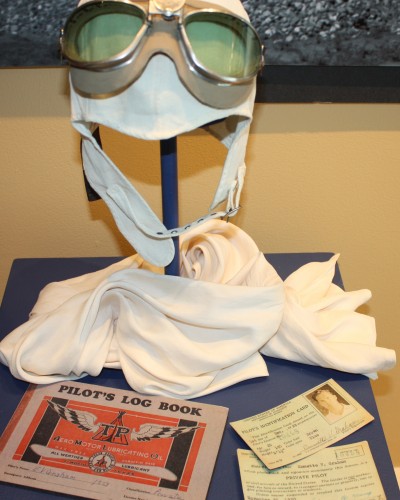
Phoenix Sky Harbor International Airport pilot log

Saturday is free Museum Day: take advantage of it

This Saturday, September 25, 2010 is free Museum Day around the country.

More than 1300 museums – including a lot of aviation and space museums – will open their doors for free to anyone who shows up with a downloaded coupon from Smithsonian magazine that’s good for admission for two people to any one museum on the list.

Ticket for free museum day

Last year, more than 300,000 people took advantage of the Smithsonian’s free museum day offer. This year, event organizers expect a lot more people – maybe 20% more – to show up.

It’s a great opportunity to go to a museum you’ve been meaning to go to but have put off because the price tag seemed too high.

A few suggestions:

The Intrepid Sea, Air and Space Museum in New York City (regular adults admission: $22);

The U.S. Space & Rocket Center in Huntsville, Alabama (regular adult admission; $24.95);

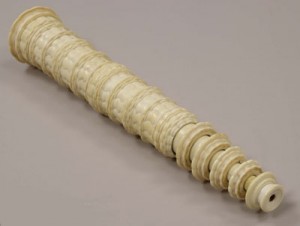
The Adler Planetarium (regular admission $27 for adults) in Chicago, where there’s a great exhibition of rare and antique telescopes including this rare circa 1660 ivory telescope from Germany

Or the Kansas Cosmosphere and Space Center in Hutchinson, Kansas.

Kansas Cosmophere

Museum Monday: Oregon’s Tillamook Air Museum

There are more than 700 air and space-related museums in this country.

Each Monday, we highlight one of them.  Eventually we’ll hit them all.

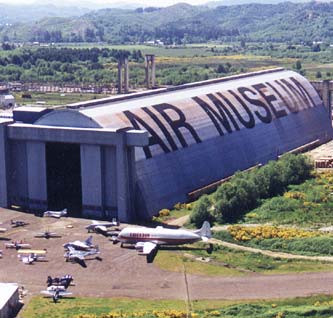
This week: The Tillamook Air Museum in Tillamook, Oregon.

Tillamook Air Museum

The museum has about three dozen aircraft in its collection, but I’ve chosen to highlight it this week because of history of the building that houses the museum.

During WWII, the U.S. Navy stationed a fleet of blimps along the east and west coasts.  Each airship was 252 feet long and filled with 425,000 cu. feet of helium.

These “K-class” blimps had a range of 2,000 miles and could stay in the air for three days at a time, so they were ideally suited for anti-submarine patrol and for escorting ship convoys out to sea.  The blimps also trailed targets for fighter-plane practice.

To store off-duty dirigibles, the Navy built 17 seven-acre blimp hangars.

They used the exact same blueprint for each building, and each clear-span wooden structure was 15-stories high, more than 1,000 feet long, and built with fire-retardant lumber.

Tillamook’s dairy land was chosen as the site for two of those hangers in part because the countryside offered mild weather and the largest flat area on the Oregon and Washington coast.

Tillamook Blimps in hangar

Unfortunately, Tillamook’s Hangar A burned down in 1992. (It turned out that the chemicals that make wood fire-retardant eventually leech out.) But Hangar B is still around and now shares the title of World’s Largest Clear-Span Wooden Building with the six other still-intact blimp hangars around the country.

Hangar B is now also home to the Tillamook Air Museum, which houses a flight simulator, a collection of more than 30 WW II “War Birds,” and historical films and displays about the construction of the building and the blimps that were once based here.

Blimp Hangar  Bio

Length: 1,072 feet
Height: 192 feet (over 15 stories)
Width: 296 feet
Area: Over 7 acres (enough to play six football games)
Doors: 120 ft. high, 6 sections each weighing 30 tons. 220 ft. wide opening. The sections roll on railroad tracks
Catwalks: 2 catwalks, each 137 ft. above the hangar deck

Do you have have a favorite aviation or space museum? If so, let us know where it is and why you like it. Your museum pick may be featured on a future edition of Museum Monday here at StuckatTheAirport.com.

Stuck at DFW? Visit the observation park; learn something

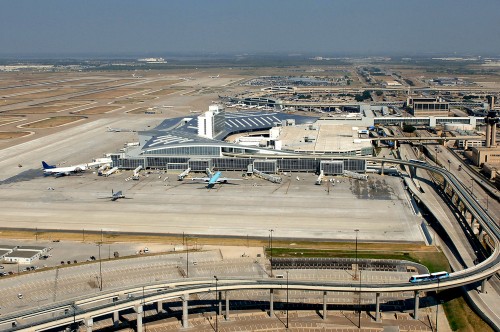
DFW International Airport

DFW International Airport is big.

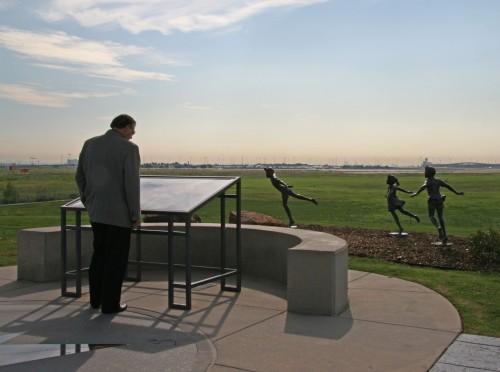
Within its 30 square miles are five terminals, two full-service hotels, a multi-million dollar collection of art and a golf course. There’s also Founders’ Plaza: DFW’s public observation park.

DFW Founders plaza

The park has the airport’s original beacon, along with shaded picnic tables, viewing stations and a live audio feed of the radio conversations from the air traffic control tower.

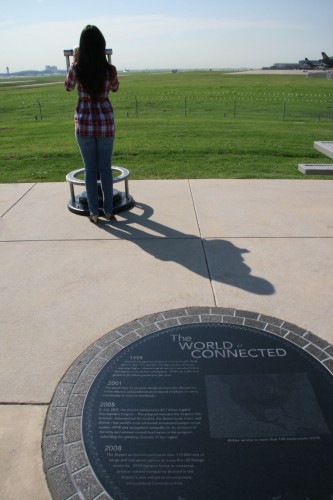
And now it has six, black-granite sidewalk medallions, each four-feet in diameter.

DFW Founder Plaza_ medallion

Laser-etched into the surface of each medallion is information about the history of the airport and of commercial aviation in north Texas. A different piece of the story is told on each medallion.

Want to see them for yourself? Founders’ Plaza is located at North Airfield Drive and Texan Trail, just south of State Highway 114 in Grapevine.

No time to leave the terminals? No problem. DFW has some nifty stuff inside as well. My favorites: the Cereality breakfast bar where you choose cereal and toppings and pajama-clad Cereologists fill up the bowl; the two La Bodega Winery locations and all the great artwork in Terminal D.

DFW ART in Terminal D

Photos courtesy DFW Airport.

Museum Monday: Discover the Airport! Exhibit at Syracuse Airport

There are more than 700 aviation and space-related museums in this country.

Each Monday we visit one of them.  Eventually we’ll hit them all.

This week’s pick: the Discover the Airport! Exhibit at New York’s Syracuse Hancock International Airport.

The exhibit is located right there in the main lobby of the airport terminal and includes the cockpit of a Boeing 727, landing gear, a baggage tug, a mock air control tower and a “marshaller” display that lets you learn about – and practice – signaling techniques needed to help aircraft take-off and land safely.

Sounds like fun!

Know of another great aviation or space museum? Let us know and it may be featured on a future edition of Museum Monday here at StuckatTheAirport.com.

Syracuse Hancock Airport luggage tug