Aviation history

Souvenir Sunday: Alaska Aviation Museum

The Alaska Aviation Museum in Anchorage, just down the road from the Ted Stevens Anchorage International Airport, may look small from the outside, but don’t let that fool you.

The museum is jam-packed with restored vintage aircraft, flight simulators, two theaters featuring Alaska aviation films and three hangers filled with bush pilot, military aviation and commercial aviation memorabilia, including items related to Alaska Airlines and other airlines integral to a state with limited ground transportation options.

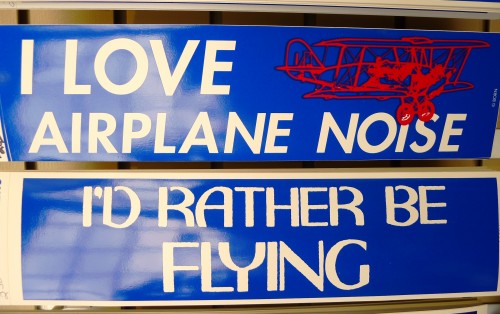
The museum also has an active restoration hanger and a well-stocked aviation-themed gift shop where I found a few Souvenir Sunday treasures, including these stickers –

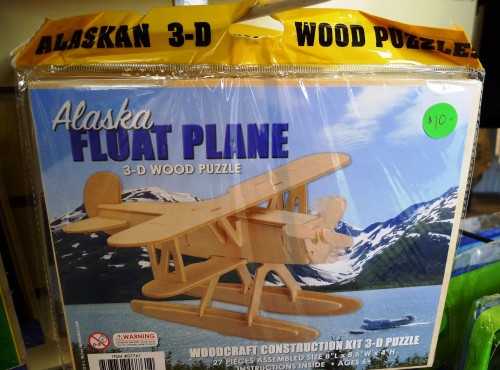
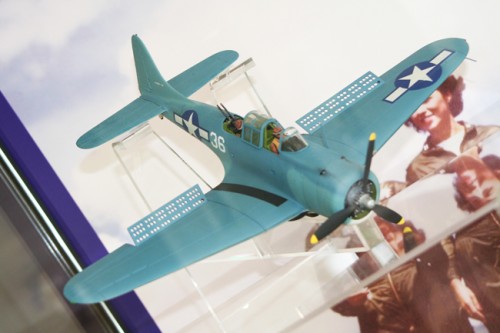
And this great 3-D float plane puzzle:

Online museum of flight attendant uniforms

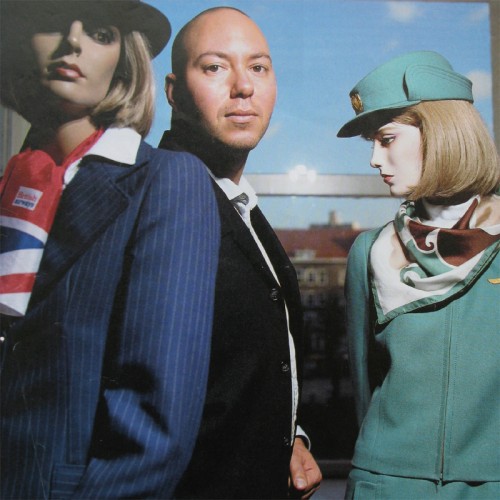
This was a treat: for msnbc.com’s Overhead Bin blog, I profiled Cliff Muskiet’s on-line museum of more than 1000 flight attendant uniforms.

The address for his website — uniformfreak.com — says it all.

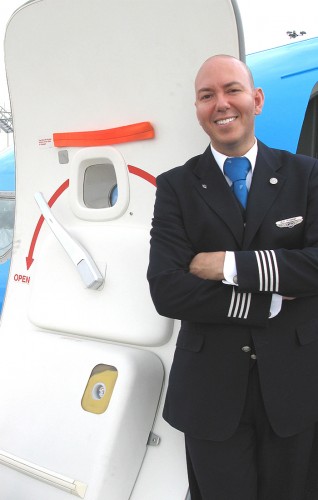
Cliff Muskiet, an aviation-crazed kid who grew up to be a flight attendant for KLM Royal Dutch Airlines, has amassed a collection of more than 1,000 flight attendant uniforms.

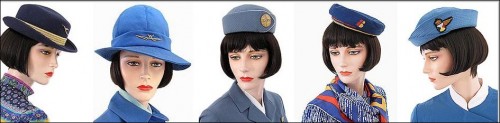
“Only stewardess uniforms,” said Muskiet. “The female uniforms come in various colors, materials and with different accessories like hats, scarves and gloves. Male uniforms all look the same: jacket, pants, plain shirt and a tie, most men’s uniforms are dark blue and quite boring.”

Muskiet got his first few uniforms in the 1970s and 80s. After a 1993 stop in Ghana, where he picked up some old Ghana Airways uniforms, he began collecting in earnest.

“I love the 1970s psychedelic patterns and color combinations: yellow, red, orange, purple, green, white and blue; every color was used and everything was possible,” Muskiet said. “Also flower prints, dots or checked fabrics were used a lot. I love the big pointy collars from the 70s and synthetic fabrics.”

Muskiet keeps his collection of uniforms and accessories in closets, containers, garment bags and suitcases in two rooms of his home in Amsterdam. For display in his online museum, he photographs each uniform on his one mannequin, which is a size 2.

“I have uniforms in a size 2, but also in a size 10 or 14,” he said. “When she has to wear a size 14, I use pins to make the uniform look nice at the front.”

Among his favorites are two KLM uniforms that have sentimental value: a circa 1971 uniform that was the first one given to him and an example of the KLM uniforms worn from 1975 through 1982. “The uniforms remind me of my childhood and the many trips I made to the USA on KLM with my mother,” said Muskiet. Some of his other favorites are the uniforms worn by female flight attendants on Asiana Airlines in the 1990s, on Kuwait Airways and United Airlines from 1968-1971 and the current outfits worn by TAP Portugal and British Caledonian.

“In the late 1960s and 1970s, a lot of different colors were used and that is something I really miss,” he said. “Especially in the USA, flight attendant uniforms have become a bit boring and look like business outfits.”

A tour through Muskiet’s online museum is anything but boring. “From looking at so many uniforms, you can see trends that correlate with the events of the time and learn about the role of the flight attendant throughout history,” said Kathrine Browne, collections assistant at Seattle’s Museum of Flight. Browne helped put together two popular exhibitions featuring flight attendant uniforms — called “Style in the Aisle” — taken from the museum’s 1,500-piece collection. She is unaware of an online collection that can compare with Muskiet’s. “The collection is exceptional.”

Muskiet is always on the lookout for more uniforms and says he enjoys everything about his job as a purser for KLM. “Except the time differences. One week you are in Hong Kong and the next week you are in New York: time difference 13 hours! The older you get, the more difficult it is to deal with this, but it is all worth it.”

Especially if you’re wearing the right, stylish uniform.

D.B. Cooper caper back in the news


It may be another 40 years before before the FBI solves the D.B. Cooper caper, but federal agents aren’t willing to give up.

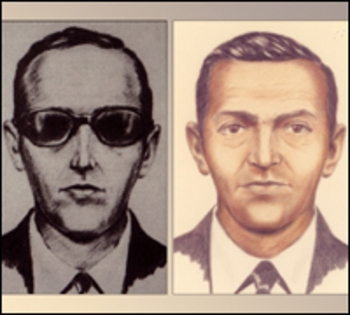
Back in 1971, a man who bought a ticket under the name Dan Cooper hijacked a plane flying from Portland to Seattle and demanded a flight to Mexico, four parachutes – and $200,000.

Cooper bailed out somewhere over southwest Washington – and disappeared. Along with most all of that money.

All these years, the FBI has following leads but has been unable to crack the case. Now they’re giving it another try.

According to a story on msnbc.com,

The latest lead in the case originated with a source in law enforcement, who directed agents to a person who was close to the suspect and obtained objects now being analyzed to see if they bear fingerprints matching those left by the hijacker on the plane…

The suspect has been dead quite a while, but it would nice to put this unsolved mystery to rest.

Or would it?

If the case was solved, then the folks who gather every year at a bar in Ariel, Washington for their annual party in honor of Cooper would have to find something else to drink to.

Take a listen to my story about the party, “Whatever happened to DB Cooper” that aired a few years back on National Public Radio. There are some intriguing theories floating around out there….

The history of flight – in pictures

If you’re in Los Angeles anytime soon, make your way over to the Autry National Center to see Skydreamers, a truly wonderful exhibition of photographs from the collection of Stephen White that documents the history of flight. I put together a History of Flight slide show with some of the images from the show for msnbc.com; here’s a short preview.

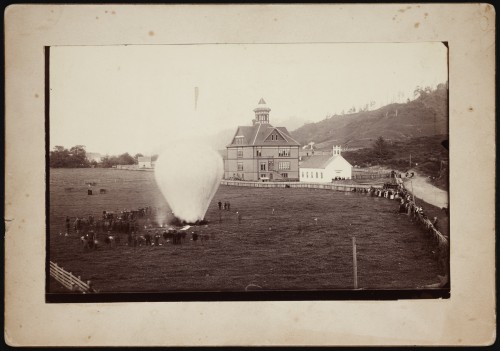
Skydreamers_Balloon Ascension

As in this 1871 photo of a balloon ascending over Ferndale, CA, some of the earliest attempts to conquer space were in free floating hot-air balloons. Next came heavier than air machines and, ultimately, rocket ships that can elude gravity and soar into space. Lucky for us photographers and artists were often on hand to document and imagine these journeys.


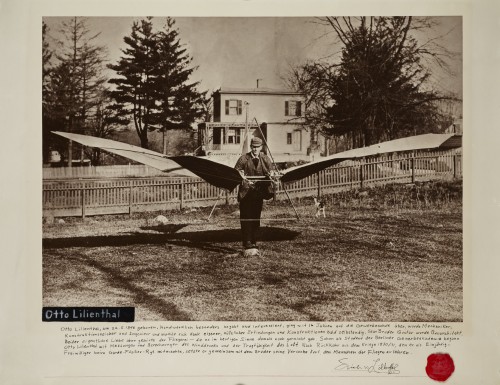
Otto Lilienthal

In his now classic aviation book, Birdflight as the basis for aviation, published in 1889, Otto Lilienthal outlined his theories on flying based on his study of bird wing structure and the aerodynamics of bird flight. He built and famously experimented with a series of 18 bird-inspired gliders and served as an inspiration for Wright Brothers, who studied his gliding techniques.

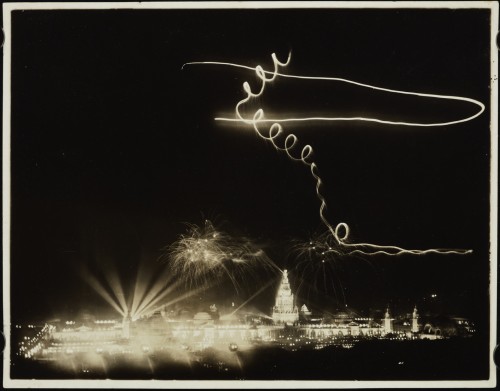
Stunt pilot Art Smith became well known for aerobatic flying and for using flares to do skywriting at night, a talent he exhibited on the closing night of San Francisco’s Pan Pacific International Exposition in 1915. Smith later went on to work for the US post office as one the first air mail pilots.

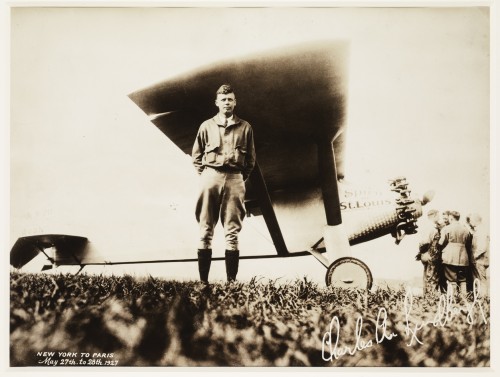
Famed aviator Charles Lindbergh stands in front of his airplane, the Spirit of St. Louis, shortly after completing the first solo, non-stop flight across the Atlantic Ocean in May, 1927. The plane is now in Washington, D.C. at the Smithsonian Institution’s National Air and Space Museum.

In 1934, the Griffith Park Observatory was getting ready to open in Los Angeles. This photograph shows the artist, Roger Haywood, sculpting a section of an exact replica of the moon, reduced to 38 feet.

I’ll post more photos from the Skydreamers exhibition tomorrow, but if you want to start planning a trip to Los Angeles to see the full show, you have until September 4, 2011 to see it at the Autry National Center.

Tornado closes Lambert-St. Louis Airport indefinitely

We’ll be getting more details today, but Friday night, April 22nd, an apparent tornado ripped through the St. Louis area and caused so much damage at Lambert-St. Louis International Airport that the airport is now closed indefinitely while they figure out what to do.

Here’s a story from the local TV news station KMOV:


Airport spokespeople say at least four people were transported to area hospitals with minor injuries and that:

“At this time, it appears that Terminal 1 and Concourse C suffered the most damage from the storm with high winds that blew out up to 50 percent of windows and caused roof damage as well.  There is also considerable storm damage at the entrances of the airport and along roadways.”

KMOV has also posted a gallery of photos showing what the area looked like after the tornado:

See the rest of the KMOV STL airport tornado damage photo gallery.

The damage is heartbreaking. Especially for those who have been looking forward to all the new features and amenities that were being put in place for a major restoration project.

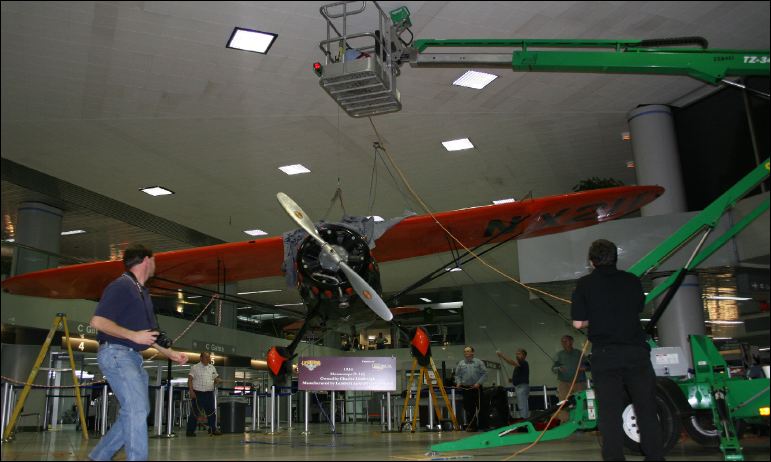
Let’s hope the Lindbergh 1934 Monocoupe D-145 is safe. Charles Lindbergh’s personal plane hovered over the STL Concourse C checkpoint for 30 years and just last month was lowered and moved to the Mt. Vernon Municipal Airport to make way for a concourse relocation project. The plane is owned by the Missouri History Museum and is scheduled to return to STL when renovations there are complete.

Do you remember your first airplane ride?

Julie McKinney -famiily and friends at Orlando Airport

I had way too much fun gathering stories, drawings and photos for this story about first flights that appeared on msnbc.com today.  I know there are lots more great stories – and first flight souvenirs – out there, so after you read these stories, please send along your own.


Do you remember your first airplane ride?

Julie McKinney does. No doubt other passengers on that flight do too.

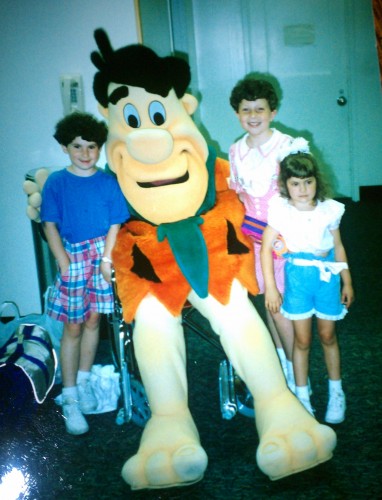
It was 1992 and she was “that” kid: the excited 5-year old on her first airplane ride and headed to Disney World. “I was the one singing ‘M-I-C-K-E-Y-M-O-U-S-E’ the entire flight from Pittsburgh to Orlando,” said McKinney.

Now 23, McKinney remembers other passengers singing along. “The singing continued until the end of the flight and I don’t remember anyone getting upset. I think of this now every time I fly and can’t imagine how I’d react to a singing child sitting in front of me.”

Roller coasters, dolphins and cotton balls

Whether it was 50 years ago or just last week, your first airplane ride, like your first kiss, can leave a lasting impression and have an impact on what sort of traveler you become.

Jeff Pecor was also Disney World-bound on his first airplane ride, at age 8, in the early 1980s. Now on staff at Yapta, an airfare and hotel price tracking site, Pecor remembers it being “so cool that they served food and they gave you plastic pilot wings. And everyone was so nice.”

Unforgettable as well: “That first roller-coaster feeling that hits your stomach when the plane sometimes drops suddenly during turbulence. That sensation still gets me today, but it’s altogether different when you’re not expecting the plane to do that.”

Raymond Kollau, who today tracks airline news for airlinetrends.com, first boarded a plane when he was 16, in the summer of 1986. “From the air, the waves in the Mediterranean looked like dolphins,” said Kollau, “And I remember telling my sister she couldn’t walk in the aisle because it would make the plane lean forwards or backwards.”

First Flight

Snow Wonderland

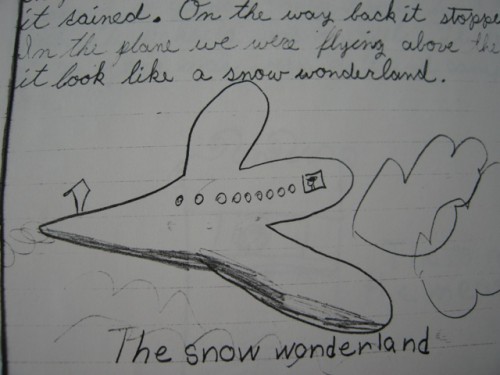
To Boston-based artist Annie Silverman, the world outside the airplane window on her first flight, in 1957, looked like a “snow wonderland.” She even documented the scene in an autobiography she wrote and illustrated in her 4th grade class that year. “It was Christmas vacation and we were all dressed up,” said Silverman, “I remember that the clouds looked like giant cotton balls, the sky was so blue and there was the constant hum of the motor.”
Gum balls, not cotton balls welcomed Thomas Sawyer on his first flight. Sawyer, the bladder cancer survivor recently in the news for his experience with a botched airport pat-down, took his first flight as a young newlywed with his wife, Sherry. At the end of that flight, he realized he’d been sitting on a wad of gum. “The very good looking stewardess attempted to remove it and my wife finally said to her, ‘I think I will take care of that, thank-you.’ She obviously didn’t want this young lady touching my butt. We have laughed about it for 41 years,” said Sawyer.


There was probably no laughing when Orville and Wilbur Wright made those historic first, heavier-than-air powered flights on December 17, 1903. The weather and the wind were bad that day and, according to Peter Jakab, Associate Director of Curatorial Affairs at the National and Space Museum, “Years later Orville said that had they known then what they learned later, they would never have made that test flight under those conditions.”


Still, in preparing for that first flight Orville wrote in his diary, “…Isn’t it astonishing that all these secrets have been preserved for so many years just so we can discover them!!”

Baby’s first flight


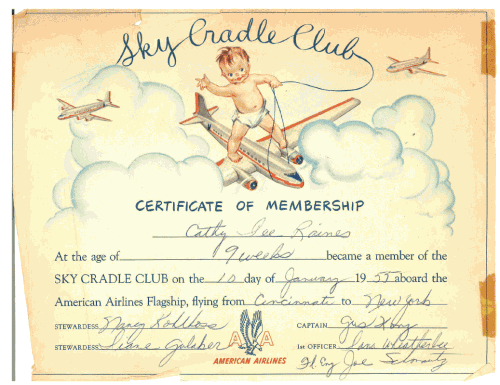
Cathy Raines first discovered flying on January 10th, 1955, when she was just nine weeks old. She’s flown to 45 countries since then. And while she doesn’t remember that first flight, she’s proud to have the Sky Cradle Club certificate issued that day by the American Airlines crew. “There’s a drawing of a baby in a diaper astride a jet plane and it’s signed by two stewardesses, the captain and others,” said Raines.


Although Delta Air Lines recently brought back the tradition of handing out plastic wings to kids and polite adults, most airlines did away with tangible souvenirs such as First Flight certificates and wings as a cost-saving step after 9/11.

Mary Winking at John Wayne Airport - 1985

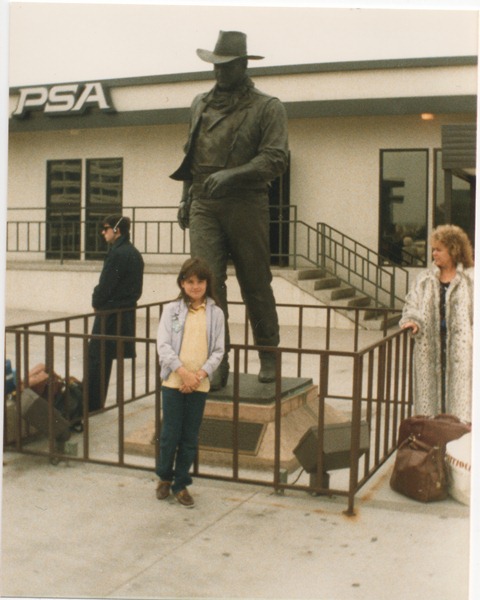
That disappoints American Airlines flight attendant Mary Winking, who has fond memories of her first flight when she was nine years old. “The flight attendants were very attentive and let me help hand out the honey roasted peanuts. I got my first pair of wings that day and still have them with other keepsakes from that first trip to California.”


“I still wish we had the stick-on wings to give out to children and/or a certificate to present to them like we used to,” says Kelly Vrajitoru, also an American Airlines flight attendant. She remembers that on her first flight, at five years old, she held tight to her mother’s hand “feeling my stomach lift as we took off.”


Today, Vrajitoru tries to pay extra attention to first-time flyers, especially kids. “I always offer to have a parent take a picture of their kid with the Captain before take-off or on landing, or to have them sit in the cockpit to take a closer look at all the gears and instruments. I know it makes a special and lasting impression.”


The passenger of the future

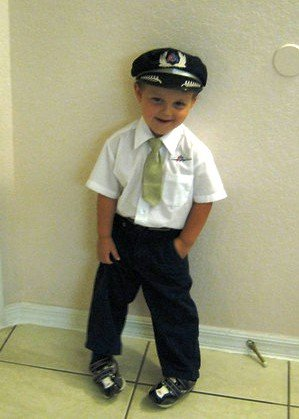
Jacob Whitecotton, now four years old, got some of that special attention when he took his first flight from Oklahoma to Orlando at age three. For the flight, Jake dressed up in a white shirt, a tie and the kid-sized American Airlines pilot cap his mom bought for him at an airport gift shop.  “It was a blast. He was going through the airport pulling a little rolling suitcase and he looked just like a tiny pilot,” said Jake’s mom, Andrea Whitecotton.


Once on the plane, Jacob got the royal treatment. A flight attendant produced a set of wings from a secret stash he’d squirreled away. Flight attendants and other travelers took pictures. One passenger gave Jake a disposable camera so he could document his flight.


What does Jake remember?  “I got to go in the cockpit and they let me drive the plane.”


What do you remember about your first flight? Please share your memories below.

[This story first appeared on msnbc.com]


Stuck at… San Diego International Airport?

Heading to or through San Diego International Airport (SAN) anytime soon? Be sure to go early so you can enjoy the art.

In the Terminal 2 East/West corridor (post-security) from now through September 15th, you’ll find Within the Heart of Time and Space, a temporary installation with 15 sculptures by San Diego–based artist Jeffrey Steorts,

SAN DIEGO AIRPORT ART


Also, through July 2011 in the SAN Commuter Terminal (Pre-security) there’s an exhibit celebrating 100 years of naval aviation, measured from May 11, 1911, when Navy Capt. Washington Irving Chambers, Officer in Charge of Aviation, requisitioned the Navy’s first aircraft from aviator and inventor Glenn H. Curtiss.


For more information – and for more previews of the art and performance program at San Diego International Airport, check the art page of the SAN website. And for more information about services and amenities at SAN, see the SAN guide I created for USATODAY.com.

Museum Monday: Style in the Aisle at Seattle Museum of Flight

It’s Museum Monday here at StuckatTheAirport.com and this week we’re taking another look at some of the photos and outfits in the Style in the Aisle exhibit at Seattle’s Museum of Flight.

Airline Ephemera from the Archives of the Museum of Flight.

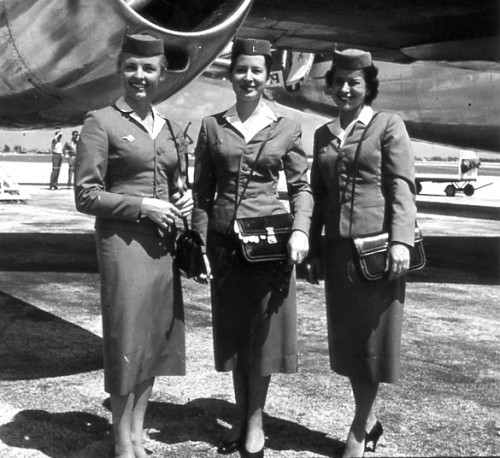
Three Stewardess near Jet Engine; possibly PanAm (from the Archives of the Museum of Flight; Copyright The Museum of Flight Collection.)

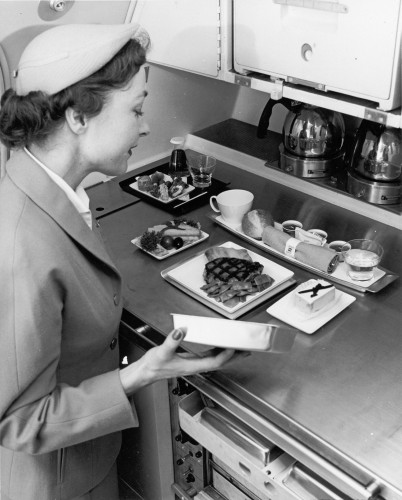
Style in the aisle galley

A United Airlines Stewardess with food service in the Galley, circa late 1940’s early 1950’s. Copyright The Museum of Flight Collection

Style in the Aisle

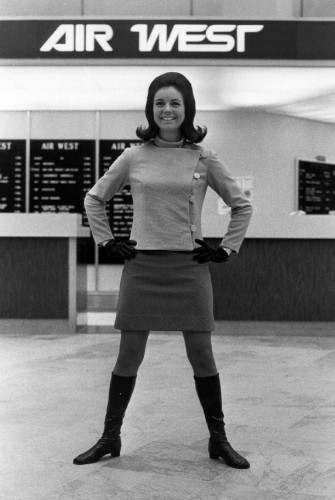
“Fashion designer, Oleg Cassini created a futuristic look for the flight attendants of Air West during the carrier’s brief existence prior to its purchase by Howard Hughes. The basic uniform consisted of a textured polyester dress and a jacket with an unconventional side-buttoning configuration. The pieces came in a selection of bright, solid colors inspired by the natural colors found at Air West’s destinations, including fern green, Pacific blue and canyon red.”  Copyright Delta Airlines.

Souvenir Sunday at Kona International Airport

It’s Souvenir Sunday, the day StuckatTheAirport.com celebrates the fun, inexpensive items you can find  in airport shops.

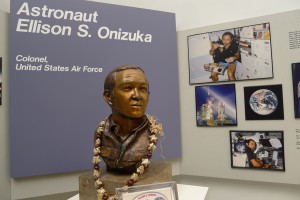
This week our souvenirs come from the souvenir shop at the Astronaut Ellison S. Onizuka Space Center, which is located right next to the charming, open-air terminals at Kona International Airport.

Ellison Onizuka

The center is part museum/part education center and is dedicated to the memory of Ellison Onizuka, who was Hawaii’s first astronaut and one of the crewmembers who perished aboard the Challenger Mission on January 28, 1986.

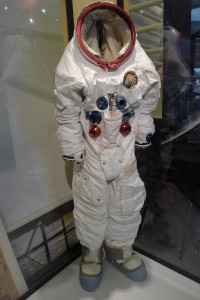
Space Suit at Onizuka Space Center Kona Airport

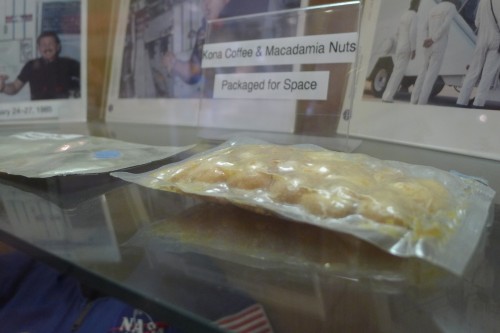
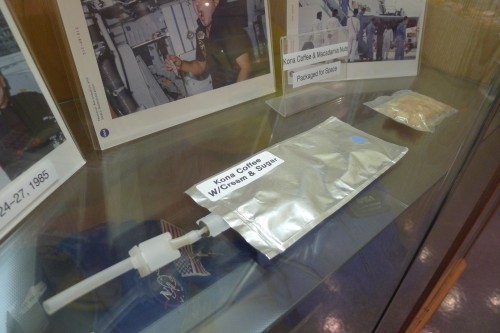
The Onizuka Space Center is jam-packed with hands-on activities that explain space and space concepts as well as a wide variety of displays that include a piece of a moon rock, an Apollo 13 space suit and memorabilia that includes the freeze-dried macadamia nuts and Kona coffee NASA developed for Ellison Onizuka so that the Hawaiian astronaut would feel at home in space.

Onizuka freeze-dried macadamia nuts for space

Onizuka's freeze-dried Kona Coffee for space

The museum is just a 30-second walk from the main part of Kona International Airport and is a much better way for you and your kids to spend your time than sitting out in the sun in airport’s post-security area.

Even if you don’t want to explore the space center’s exhibits, consider stopping in to check out the gift shop. It’s has a carefully selected assortment of space-related books, games and space-related souvenirs.

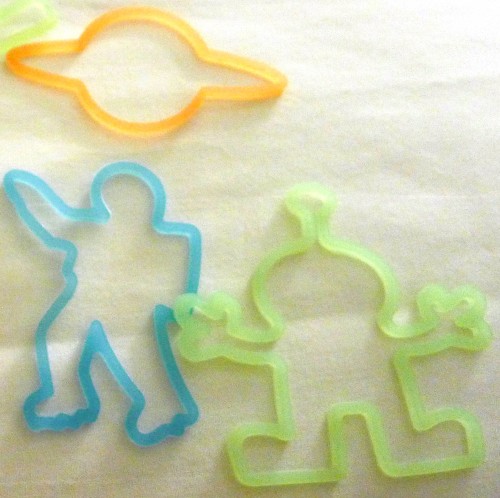
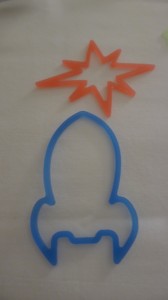
That’s where I picked up these cool, inexpensive and easy-to-carry fashion accessories: glow-in-the dark, Space Shaped Rubber Bands.

Silly banz space shaped

souvenir sunday pick

If you find a great souvenir while you’re stuck at the airport, please snap a photo and send it along.

The favorite souvenirs here at StuckatTheAirport.com are inexpensive (around $10), “of” the city or region and ideally, a bit offbeat. And if your souvenir is featured on Souvenir Sunday, you’ll receive a special airport or airline-related souvenir.

Style in the aisle: exhibit of vintage flight attendant fashions

This should be fun:

At the end of January, Seattle’s Museum of Flight will open up the clothes closet again for a fresh new exhibit of vintage flight attendant uniforms and airline memorabilia.

Museum of Flight Style in the Aisle

‘Most of the uniforms on display in the exhibit are from the flamboyant 1960s and 1970s. The collection includes creations by Parisian designer Jean Louis, Italian designer Emilio Pucci, and Hollywood designer Oleg Cassini. Trans World Airlines, Western Airlines and Braniff International represent a few of the airlines that flew the groovy garb featured in the exhibit. Rare articles also include a 1936 United Air Lines uniform, and a 1945 Northwest Airlines ensemble accented with a mink stole.”

The Museum of Flight had a similar exhibit back in 2008 that included “stewardess” uniforms ranging from “nurse togs” from the 1930s to the fab fashions from the 1960s and 1970s. So many flight attendants who visited that first exhibit Donated memorabilia and uniforms they’d saved that the museum decided to expand and bring back the display.

Museum of Flight Style in the Aisle

Style in the Aisle will be at Seattle’s Museum of Flight (a short bus or taxi-ride runs from Seattle-Tacoma International Airport) from January 29 through May 30, 2011.

Check back soon for a slide-show featuring more fashions from the exhibit.

All photos courtesy the Museum of Flight