Aviation history

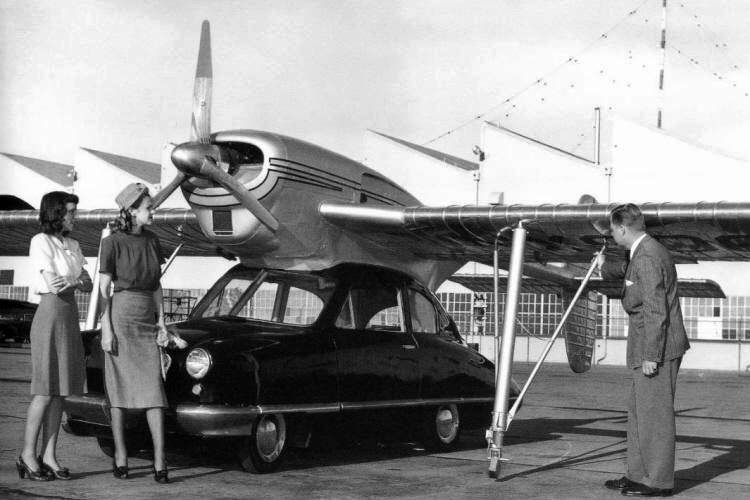
Fancy a flight to Paris? Charles Lindbergh did.

LINDBERGH_SpiritofStLouis

Spirit of St. Louis courtesy Smithsonian Air & Space Museum

So much chatter these days about amenities we want on long trip from say, New York to Paris, so let’s just take a moment today to tip our hats to Charles Lindbergh, who left New York for for Paris on the morning of May 20, 1927.

Thirty-three hours, 30 minutes, and 3,610 miles later he landed safely at Le Bourget Field, near Paris.

He was flying alone. So no one brought him a meal, a pillow a blanket or even a tiny bag of peanuts.

Read more about the plane and the flight here.

Fashion for flight attendants yet to fly

eastern uniform snippet

Detail of an Eastern Air Lines flight attendant uniform from the 1970s. Courtesy uniformfreak.com


The group trying to bring back Eastern Air Lines, the iconic Miami-based carrier that operated from the 1920s until 1991, has been filing paperwork, shopping for airplanes and dreaming about what crew members will wear in the aisles.

In January, the Eastern Air Lines Group filed its initial application with the U.S. Department of Transportation and starting putting together operating manuals for submission to the Federation Aviation Administration.

The company, which acquired the old Eastern name and logo in 2009, is now in discussions with major aircraft leasing companies for a fleet of new aircraft.

“We expect to conclude arrangements in the next few weeks,” said Eastern’s president and CEO Edward Wegel.

The airline plans to complete all regulatory requirements by the end of 2014, but the timeline for actually take-off, first as a charter operator and, later, with scheduled service, is up to the FAA and DOT.

While it waits for approvals, Eastern has asked Miami Fashion Week organizers to invite top fashion designers from South Florida to create uniforms for the airline’s modern-day flight attendants.

“The flight attendants will be recruited from the region and the company wants to capture, as much as possible, the look and feel of the Miami/Caribbean/Latin American landscape in the styling of the new uniforms,” read the official contest rules.

Designers have been asked to submit sketches and mood boards for four outfits, plus a design for uniforms that might be worn in 2050. Winning designs will be announced during Miami Fashion Week, which runs May 15-18.

“Previous Eastern Air Lines uniforms used a classic houndstooth print, which I love,” said designer Nikki Poulos , one of the invited contestants.

She created a new houndstooth print as part of her entry.

Houndstooth and Tropical print for Eastern Air Lines by Nikki Poulos

Houndstooth and Tropical print for Eastern Air Lines by Nikki Poulos. Courtesy of the designer and Miami Fashion Week


“Look closely at the print and you will see the Eastern Air Lines logo as the main graphic element,” said Poulos. She also created a tropical print using the airline’s signature colors of navy, turquoise and white – with an added splash of lime green – to capture the South Florida environment.

Unfortunately, given the turbulent nature of the U.S. airline industry, it may be quite a while before the winning Eastern Air Lines uniform gets to fly.

According to an unofficial compilation of airline bankruptcies put together by airline trade group Airlines for America, there have been 196 U.S. airline bankruptcies since 1979, with 49 of those bankruptcies taking place since January 1, 2001.

“You now have four very large airlines – American, Delta, United and Southwest – dominating the industry,” said Joshua Schank, president and CEO of the Eno Center for Transportation, “And the history of failure for start-ups in this industry has caused investors to be wary.”

This past March, for example, Florida Express Jet abruptly canceled planned service it had announced between several Sunshine State cities.

PEOPLExpress, which like Eastern, is trying to create a new airline with an old name, “doesn’t seem to be making a great deal of progress,” said George Hamlin, president of Hamlin Transportation Consulting, “But there are a few notable exceptions, including JetBlue and Virgin America, which took many years to achieve a profit,” he said.

Eastern still has name recognition and nostalgia for the ‘good old days’ of flying on its side.

“It was one of the largest airlines in the world and retains good brand equity as it was the largest airline to fly to Latin America and the Caribbean and also operated the famous Eastern Shuttle between New York, Boston and Washington,” notes Eastern’s Wegel.

But that may not be enough.

“The chance of any airline startup working out is now well under 50 percent,” said Schank, “The chances of reviving an old brand are even worse.”

(A different version of my story about Eastern Air Lines first appeared on NBC News Travel.)

Trailblazing Women of Boeing

(My story about the Women of Boeing first appeared on the Runway Girl Network)

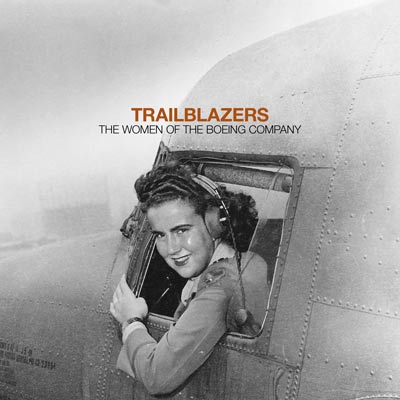
Trailblazers book

Women have played an important role in the history of the Boeing company, beginning in 1916 when seamstress Rosie Farrar was hired by William Boeing to stitch together linen wings for the early B & W seaplanes.

By 1918, women made up almost 25 percent of the company’s employee base, notes Betsy Case in Trailblazers: The Women of The Boeing Company, and since then women have had an important role in every aspect of the company.

Dozens of these trailblazing women, many with the word “first” amongst their accolades, are featured in Case’s new book, which pays tribute to the Pacific Northwest “Rosies” who built Boeing bombers during World War II and to those who have had important roles as aviators, engineers, leaders and trendsetters.

Included are photos and short biographies of women such as Bessie Marie Dempsey, who became the first female aeronautical engineer at Boeing after a career as a ballerina, vaudeville dancer and Hollywood starlet. (She appeared in the Marx Brothers movie “A Night at the Opera,” under her stage name, Yvonne St. Clair.)

Close to a dozen of the women featured in the book, including Boeing’s first female line supervisor and the company’s first female test pilot, gathered in Everett, Washington at the Future of Flight Aviation Center and Boeing Tour in March (Women’s History Month) to celebrate the book release and share some of their stories.

Here are short profiles of just a few of the women who attended:

Diana Rhea 65th

Diana Rhea joined Boing as a clerk in the parts ordering group at the start of World War II and went on to become the first female manager in Manufacturing Engineering. According to Trailblazers, Rhea played an active role in the company’s progression from manual parts ordering to more modern, mechanized methods. Now, with 71 years of uninterrupted service, she’s Boeing’s longest-working employee.

Patricia Beckman

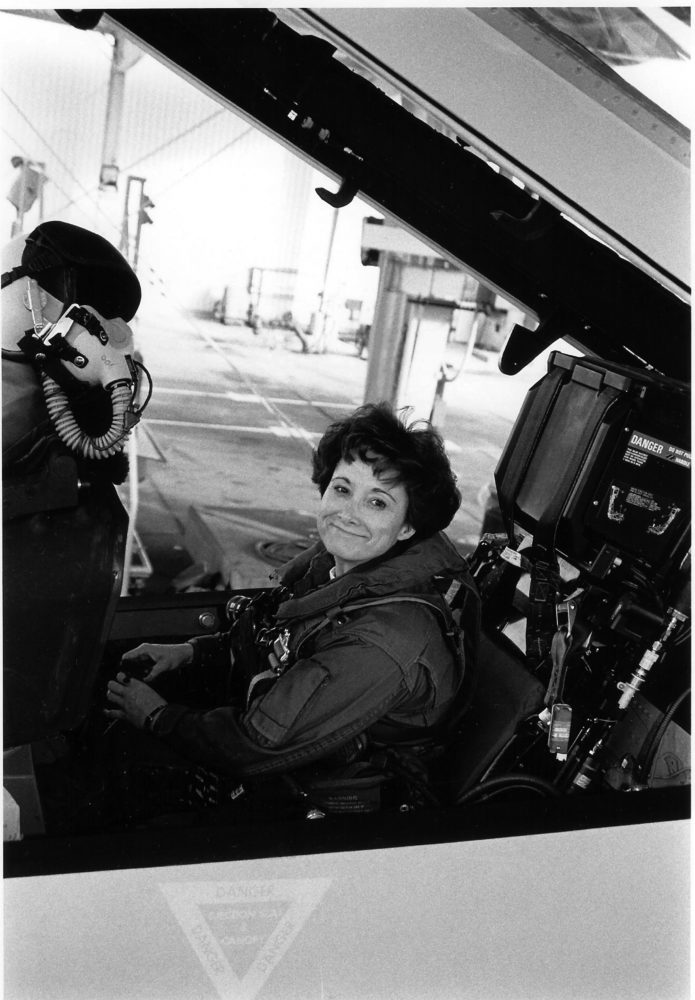
Patricia “Trish” Beckman spent 28 years on active duty in the U.S. Navy and went on to serve at Boeing in production flight testing for the 737. “I flew the first flights on 737s and flew with the customer,” explained Beckman. “Then, as a navigator I also helped the customer cross the Pacific – to China, usually. And as a navigator, I’ve also done three around the world trips in the 777, 737 and the 787.”

According to Trailblazers, in 2010 Beckman was honored by the Women in Aviation, International Pioneer Hall of Fame for being the first woman to qualify as a crewmember in the F-15 and the first American woman to qualify as a crewmember in the F/A-18. She now supports F-18 flight tests for Boeing.

Suzanna Darcy-Hennemann-1

Suzanna Darcy-Hennemann was the first woman to join the elite Boeing Engineering Flight Test group as a test pilot and she’s now the Boeing chief training pilot for instructors worldwide.

“My team does all the ground school training, full-flight simulator training and training in the airplane for airline customers,” she explained.

Based in Renton, Wash. Darcy-Hennemann said she always knew she wanted to fly but that when she started out there were no women flying in the military or with the airlines.

“So I got an engineering degree so that no one could tell me I didn’t have a good enough degree to get a flying job,” she said.

She then took flying lessons and came up through civil aviation positions. “I kept working my way through all my licenses and was chosen as a production test pilot and worked in flight test for 23 years – basically taking planes out for factory test drives,” she said.

She then worked as an experimental test pilot, eventually becoming chief pilot for the 777 for experimental flight testing and, now, chief training pilot for instructors around the world.

Sandra Jeffcoat

Sandra Jeffcoat was the first African American woman to become a member of the Boeing Technical Excellence Program and was the winner of the 2005 National Women of Color in Technology award.

In Trailblazers, she explains how her career in information technology began as a dare and that her expertise in a complex database system led her to Boeing in 1989, where she helped “clean up a defense contract in trouble.”

Now, like many other women in leadership roles at Boeing, “I find it important that we give back by mentoring others and bring them along,” she said.

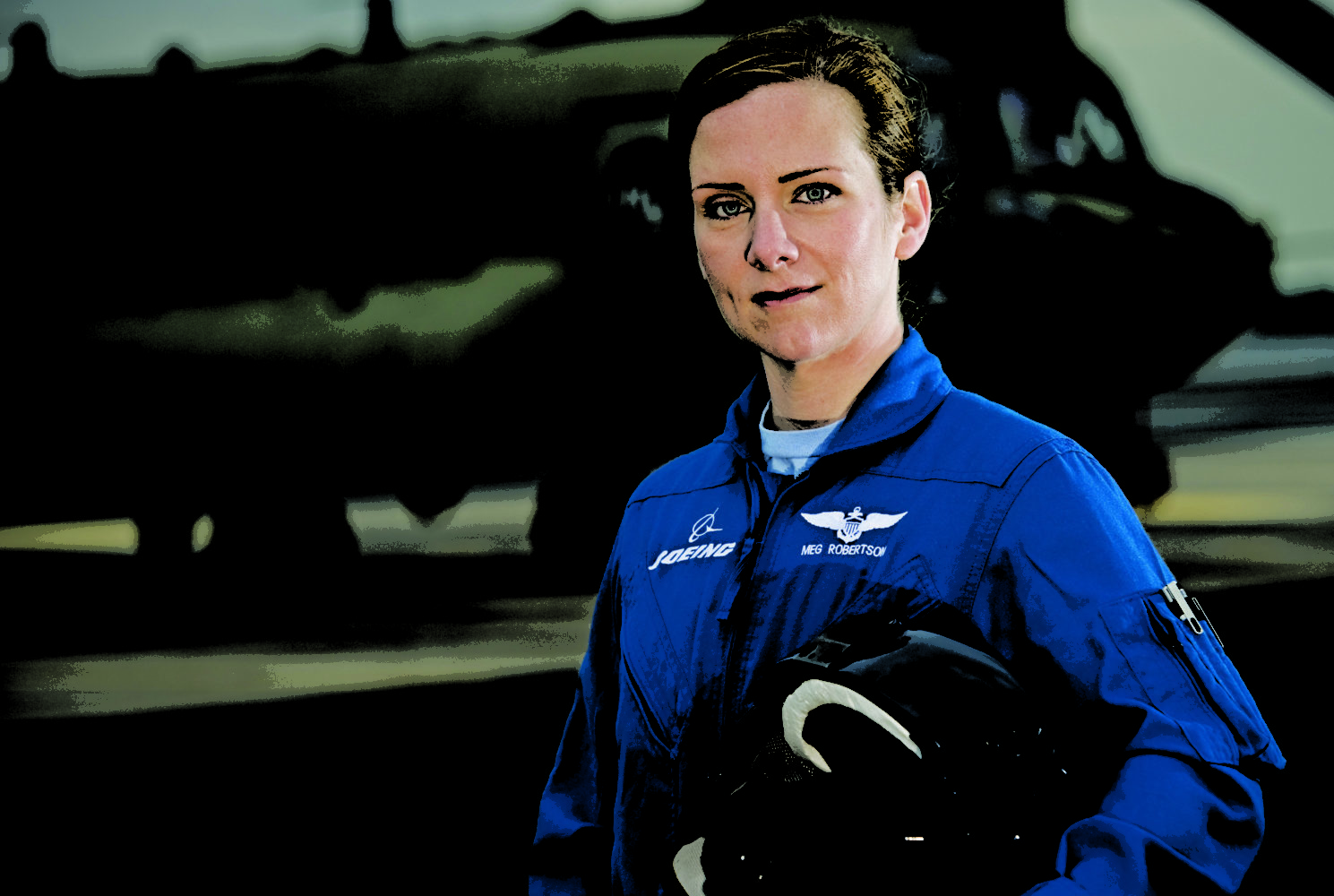
Megan Robertson

Megan Robertson makes Boeing’s Trailblazers roster as the first female pilot to conduct a Chinook helicopter test flight. Based in Philadelphia, she’s been flying for about 15 years, the past seven with Boeing.

Robertson said she loves her job, in part, because of the role the Chinook helicopters have in the world.

“Anytime there’s any kind of relief mission in the world, if you flip on the news you’ll probably see a Chinook helicopter hovering somewhere in the background,” said Robertson. “And that’s what makes what I do so exciting: I get to see a helicopter that I fly doing these great missions around the world.”

In Trailblazers, Robertson shares some of the advice she gives during career presentations, which includes the importance of building a resume, always learning and practicing leadership. “Care about what you do,” she says, “seek out opportunities and don’t let anyone ever say no to you.”

Thanks to Trailblazers author Betsy Case and the Boeing Company for sharing photos, audio and additional information for this story.
Note left on plane suggests cockpit is “no place for a woman.”

westjet note

With International Women’s Day (March 8) around the corner comes a reminder – written on an airplane cocktail napkin – that the struggle for women’s equality continues.

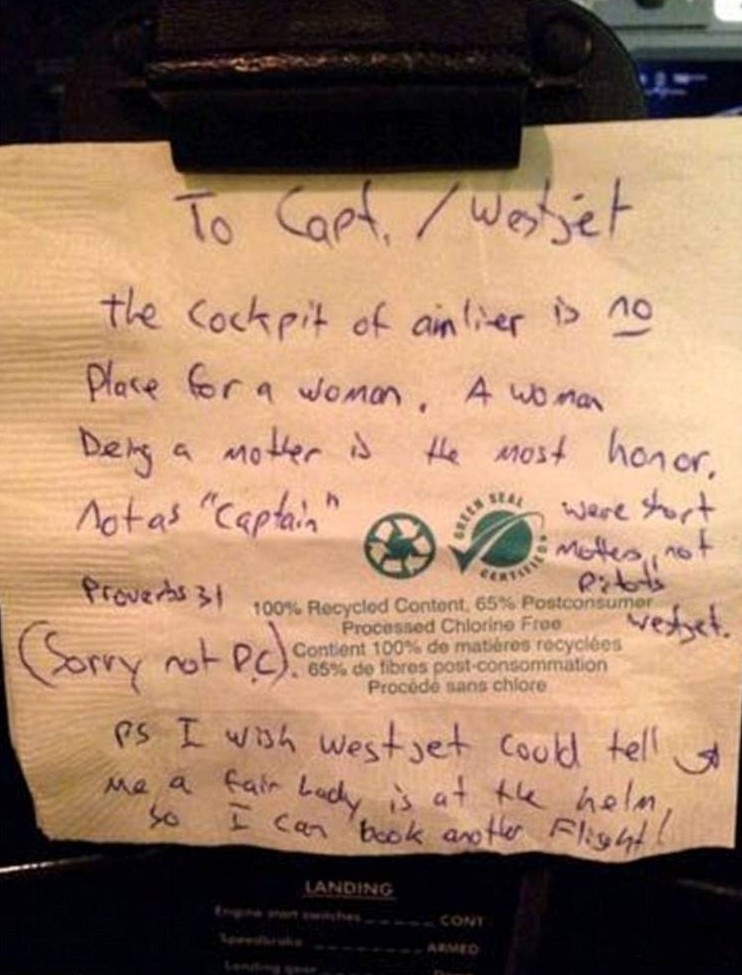
“The cockpit of an airliner is no place for a woman,” began a note scrawled on a napkin and left behind by a passenger on a recent WestJet flight from Calgary to Victoria, B.C.

“Were (sic) short mothers, not pilots” continued the note, in which a passenger who signed his named as David also referenced a bible verse and said he wished the airline would tell him when “a fair lady is at the helm” so he can be sure to “book another flight.”

The plane’s pilot, Carey Steacy, shared the note on her Facebook page with a response that said in part, “…I have heard many comments from people throughout my 17 year career as a pilot. Most of them positive….. You were more than welcome to deplane when you heard I was a “fair lady.” You have that right…”

Steacy’s Facebook post has since been removed, but many news outlets and individuals have re-posted the note.

“My first reaction was shock, Steacy told CTV Vancouver, “I have to think that that’s very much not a common feeling among the general public.”

Canadian carrier WestJet currently has 1,111 male pilots and 58 female pilots. Its subsidiary regional airline, WestJet Encore, has 87 male and 10 female pilots.

“We are enormously proud of the professionalism, skills and expertise of our pilots, and we find this note very disappointing,” the airline said in a statement.

Women in the aviation industry have rallied behind Steacy and commended her for responding to the sexist note with dignity and class.

“Some might say the crude note did not deserve a response, but it is important to do so,” said Barbara Williams, Interim Executive Director at the International Women’s Air and Space Museum in Cleveland, Ohio. If only “to remind us all that women continue to achieve and play an important part in the aviation world’s history.”

“Most women pilots would just say that the airplane does not know whether or not the pilot is a woman, so it does not behave any differently,” said Martha Phillips, president of The Ninety-Nines, the International Organization of Women Pilots.

New worries over fate of the Spruce Goose

Spruce Goose from outside

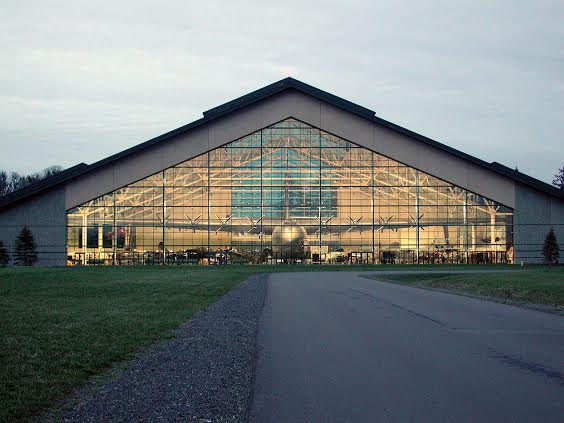
Spruce Goose as seen from outside the museum – Courtesy Evergreen Aviation & Space Museum


In McMinnville, Ore., the financial troubles of a private aviation services company are causing big headaches for the museum that is home to Howard Hughes’ H-4 Hercules, the flying boat better known as the Spruce Goose.

On Dec. 31, Evergreen International Airlines, a subsidiary of troubled Evergreen International Aviation, filed a petition for Chapter 7 bankruptcy. The possible demise of the cargo carrier has tourists, aviation buffs and many in the museum world concerned about the fate of the affiliated Evergreen Air & Space Museum.

In Oregon’s wine country, about 40 miles southwest of Portland, the museum welcomes about 150,000 visitors a year. The collection includes everything from a Lockheed SR-71 Blackbird to a Boeing B-17 Flying Fortress.

But the centerpiece of the collection is undoubtedly the original Spruce Goose.

Built primarily of lightweight birch because of World War II restrictions on metals, the airplane has the world’s largest wingspan (320 feet) and made its only flight—of less than a mile—on Nov. 2, 1947, with Hughes himself at the controls. It then was put in storage.

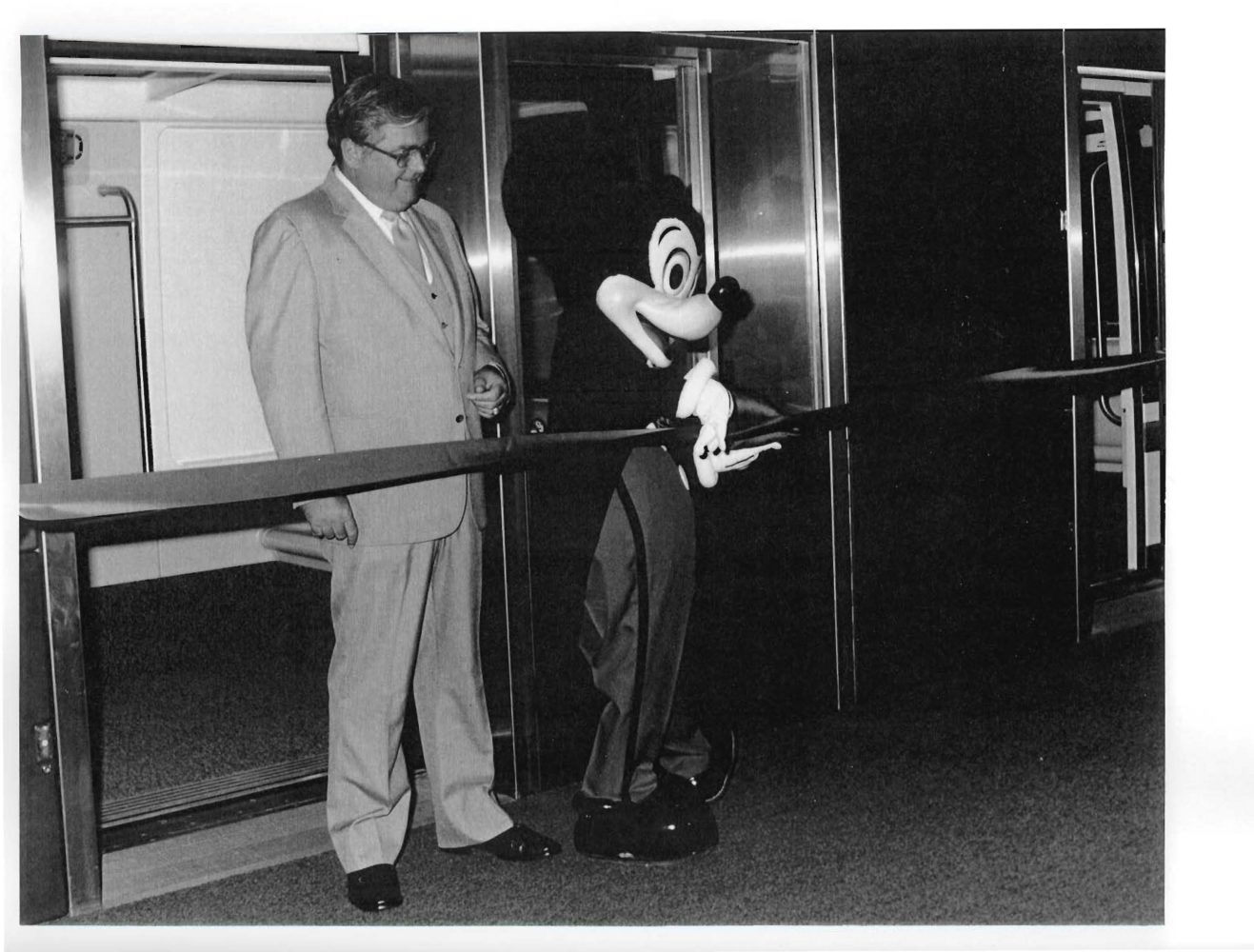
During the 1980s, the craft was displayed under a dome in Long Beach, Calif., next to the Queen Mary cruise ship. Disney briefly managed that money-losing complex. In the early 1990s, however, the Spruce Goose was shipped to Oregon in pieces and reassembled inside a new building at the Evergreen Aviation & Space Museum.

Although an Oregon Department of Justice investigation is underway into possible inappropriate commingling of company and museum funds, officials at the museum have issued statements reassuring the public that the artifacts, especially the Spruce Goose, are safe; that the museum is an independent, financially stable nonprofit; and that, with its adjacent aviation-themed water park, it remains open for business.

Still, “there has been some confusion,” said Judiaann Woo, director of global communication at Travel Oregon.

“People just hear a bit of the story and think, ‘Oh, that’s closed. Let’s go somewhere else,’ ” she said. “But this is a major attraction that people from all over the world come to see, so we want to make sure the public knows it’s still there.”

Others in the aviation and museum world feel the same way.

Spruce Goose and others inside the museum

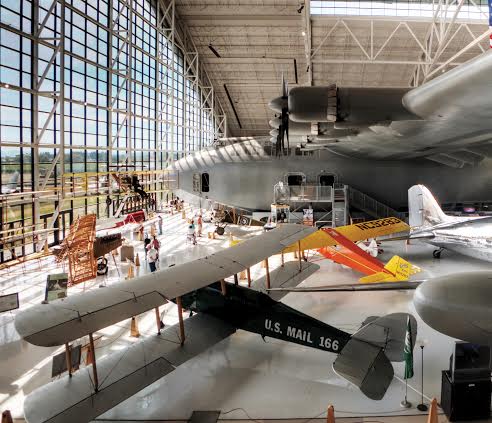
Spruce Goose inside the Evergreen Aviation & Space Museum. Photo courtesy of the museum.


“This is the museum that stepped up to save the Spruce Goose at a time when one of the possibilities was for it to be cut up and pieces of it sent all over the world,” said James Kidrick, president and CEO of the San Diego Air & Space Museum.

He considers a visit to the Spruce Goose to be “one of those boxes you’d want to check off if you have an interest in science, space, aviation and things that made this nation great,” he said. He hopes the museum does not suffer too much negative fallout from the financial woes of Evergreen International Aviation.

If it does, it won’t be the first—or the last—museum to stumble.

“We do hear of museums having difficulty, and many small museums have closed throughout the years,” said Ford Bell, president of the American Alliance of Museums. “But rarely is it one with a major collection like the one in McMinnville.”

But it does happen. In December, financial problems forced the Higgins Armory Museum in Worcester, Mass., to close after 83 years of operation. It housed one of the world’s important collections of arms and armor.

Most of its treasures are being transferred to the Worcester Art Museum and will remain accessible to the public, but “the concern we have when a museum is in financial trouble is for the collection,” Bell said. “We don’t want collections to disappear and become inaccessible to the public.”

And most communities don’t want a local museum to close its doors.

“Museums are tremendously important economic engines for their communities,” Bell said. “So in the case of the Evergreen Aviation & Space Museum in Oregon, I would encourage people to go visit it now and hope that they figure out a way to make sure it remains viable.”

(My story about the Evergreen Aviation & Space Museum first appeared on CNBC Road Warrior)

Happy Birthday, Finnair

Finnair comic

Cover photo of the limited edition, Finnair-themed Donald Duck comic book distributed November 1, 2013 Finnair long-haul flights.

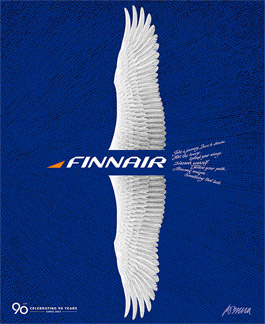
Finnair turned 90 on November 1 and kicked off a year of celebrations by handing out copies of this Finnair-themed Donald Duck comic book to passengers. The airline also had Finnish graphic designer Erik Bruun design a special anniversary poster.

Finnair_Joutsen_90year_Eric_Bruun

Looking forward to more stylish and fun anniversary items from Finnair.

Hidden Treasures: Air & Space Museum and beyond

In my new book, Hidden Treasures: What Museum Can’t or Won’t Show You, I’ve included (of course) a few aviation-related items.

The folks at the Daily Planet, the Air & Space Museum’s blog, took notice and this week included a story about the book and the featured items from the museum’s collection.

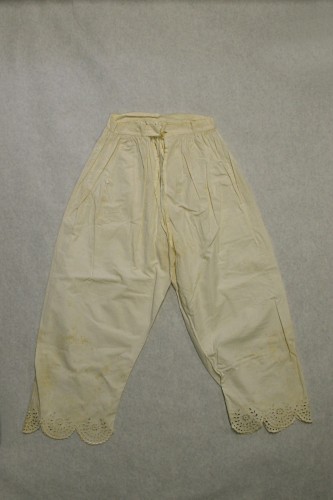
They started with Katharine Wright’s knickers. The ones she likely wore beneath the lovely, white lace dress she chose to wear when she accompanied her brothers, Orville and Wilbur, to the White house to receive the Aero Club of America award. The dress and the knickers and a wide variety of other items relating to the history of women and aviation are at the International Women’s Air & Space Museum in Cleveland, Ohio.

Ohio_Cleveland_WrightKnickers-333x500

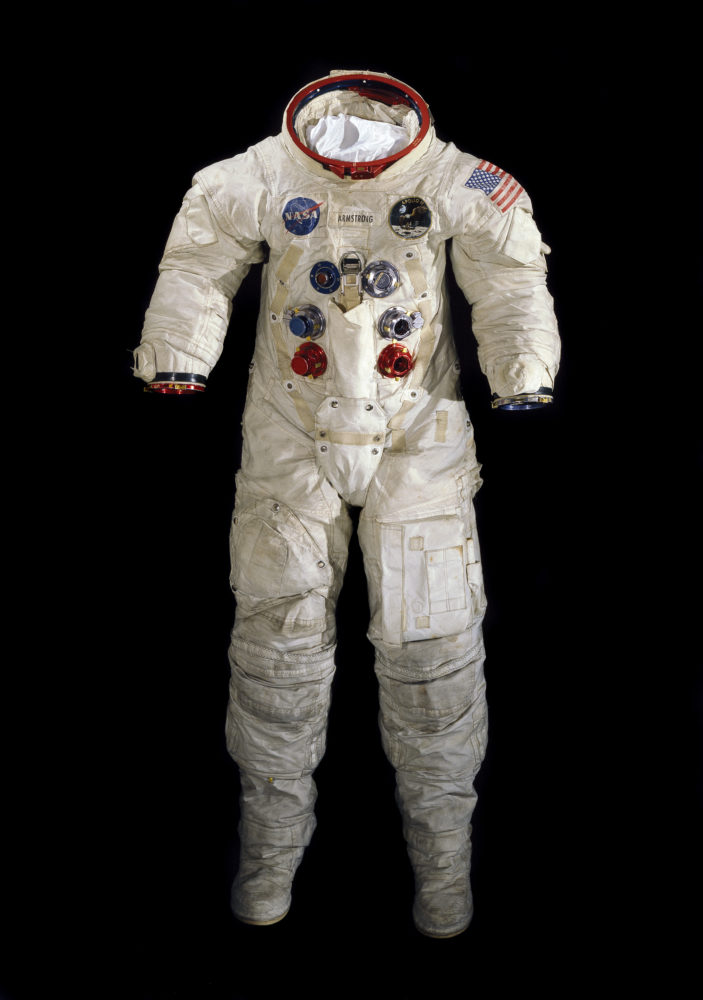
The Daily Planet story also notes that Hidden Treasures features Neil Armstrong’s spacesuit. It was designed to withstand the trip to the moon and back, but wasn’t expected to last longer than six months on earth – so is now kept in a cold vault at the Steven F. Udvar-Hazy Center in northern Virginia.

Neil Armstrong's spacesuit. Courtesy National Air & Space Museum

Neil Armstrong’s spacesuit. Courtesy National Air & Space Museum

Other aviation-related items you may want to read about:

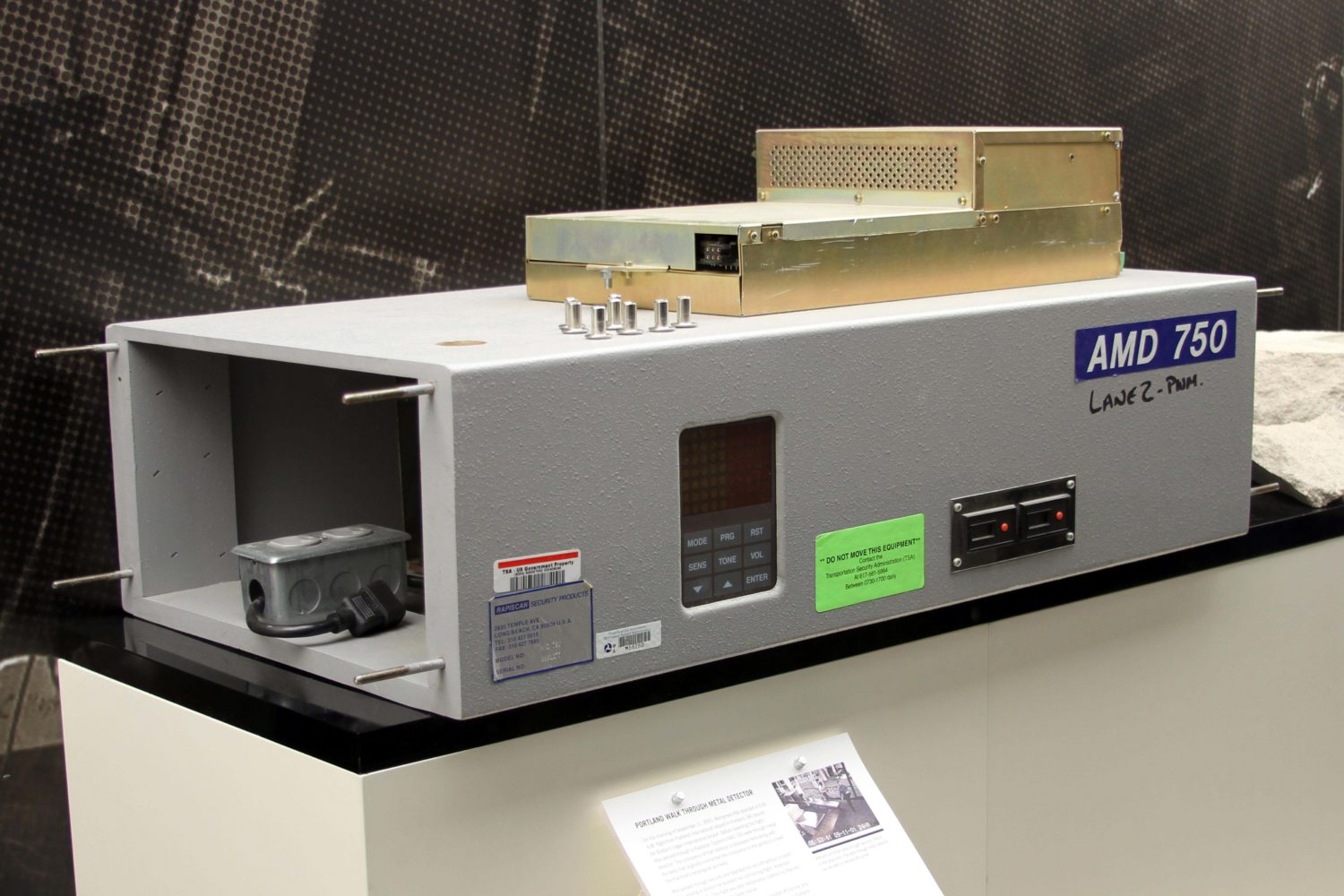
The metal detector that screened terrorists at the Portland, Maine, airport on the morning of September 11, 2001. That’s on display at the TSA Museum at TSA headquarters in Washington, D.C., which is only accessible to employees and invited guests.

A metal detector which screened hijackers on the morning of September 11th.

A metal detector which screened hijackers on the morning of September 11th.

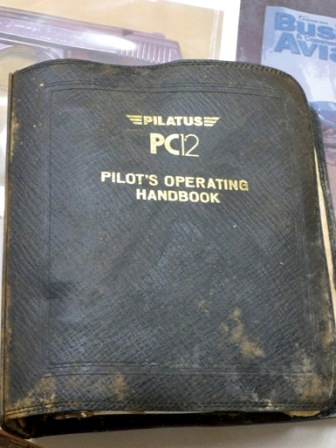
And the manual Colton Harris-Moore – the Barefoot Bandit- purchased (likely with a stolen credit card) to teach himself how to fly after stealing – and crashing – a small plane.

barefoot bandit

Here’s another link the Smithsonian Air & Space Museum’s blog post about the items and here’s another link to the book: Hidden Treasures: What Museums Can’t or Won’t Show You

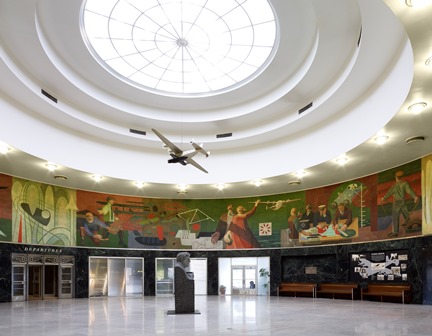
The mural at LaGuardia Airport’s Marine Air Terminal

"Flight"  James Brooks  Marine Air Terminal, Queens NY

In the new book Murals of New York City: The Best of New York’s Public Paintings from Bemelmans to Parrish, Glenn Palmer-Smith includes the story of the WPA-era mural Flight, by James Brooks, in the Marine Air Terminal at LaGuardia Airport.

Flight was the last and largest mural produced under the auspices of the WPA and is 237 feet long by 12 feet high and, appropriately enough, tells the story of the history of flight.

Here’s Palmer-Smith’s description:

“The narrative flows from the mythology of Icarus and Daedalus to the genius of da Vinci and the Wright brothers. Pre–World War II aerial navigators are shown plotting their routes with paper maps and rulers. The culmination of man’s dream arrives at the golden age of the ‘flying boat,’ when glamorous Pan Am Clipper seaplanes would land on water after a flight from Lisbon, Rio, or any city with a sheltered harbor, and taxi up to the Marine Air Terminal dock.”

In 1952, after being on the wall for just a decade, the mural was painted over. It was the height of the McCarthy era and officials at the Port Authority thought the imagery somehow looked too socialist.

“In particular, these self-appointed art critics took exception to the mural’s suggestion that air travel would be available one day for ordinary people and not just the military and the rich,” notes Palmer-Smith.

Lucky for us, the mural had been sealed in varnish and was eventually discovered, restored and finally rededicated in 1980. It’s now listed in the National Register of Historic Places.

(Photo: Photo by Joshua McHugh. From Murals of New York City:The Best of New York’s Public Paintings from Bemelmans to Parrish. Mural: James Brooks, Flight, 1942. All art by James Brooks is © Estate of James Brooks and Charlotte Parks/Licensed by VAGA, New York, NY. The Port Authority of New York & New Jersey.)

Lindbergh’s plane back at Lambert-St. Louis Int’l Airport

You may remember the tornado that hit Lambert-St. Louis International Airport in April, 2011, causing millions of dollars in damage.

The repair bill might have been much more had not Charles Lindbergh’s plane – a 1934 Model D-127 Monocoupe which had hung in Terminal 1 over the C Concourse checkpoint since 1979 – been moved to a storage hangar just a few weeks earlier in preparation for terminal renovations.

STL_LindberghMonocoupe

According to the Missouri History Museum, which received the plane in 1940, Lindbergh flew this airplane regularly, but didn’t really love it. And even though he’d had it personalized extensively, he wrote that “it is one of the most difficult planes to handle I have ever flown. The take-off is slow…and the landing tricky…[it] is almost everything an airplane ought not to be.”

During the 30 years the airplane had been suspended from the STL ceiling it gathered a great deal of dust and was subject to a great deal of stress. So while the monocoupe was in storage, the museum gave it a conservation make-over and on Sunday, October 20, 2013 returned the plane to its original spot in the airport.

The nine-hour installation process is documented in this time-lapse video.

Re-hang of the Lindbergh Monocoupe at Lambert International Airport from Missouri History Museum on Vimeo.