Aviation history

PDX llamas + D.B. Cooper Hijacking Anniversary

Those charming therapy llamas, Panda and Beni, will be pretending to be reindeers at Portland International Airport (PDX) this holidy season with visits starting Tuesday 24 and repeating every week until Christmas with visits scheduled on December 3rd, 11th, 18th and 23rd.

The lovely llamas start their visits in the pre-security area of the main terminal at 10 am and mosey along to greet passengers in the concourses.

54th Anniversary of the D.B. Cooper Hijacking. Still unsolved.

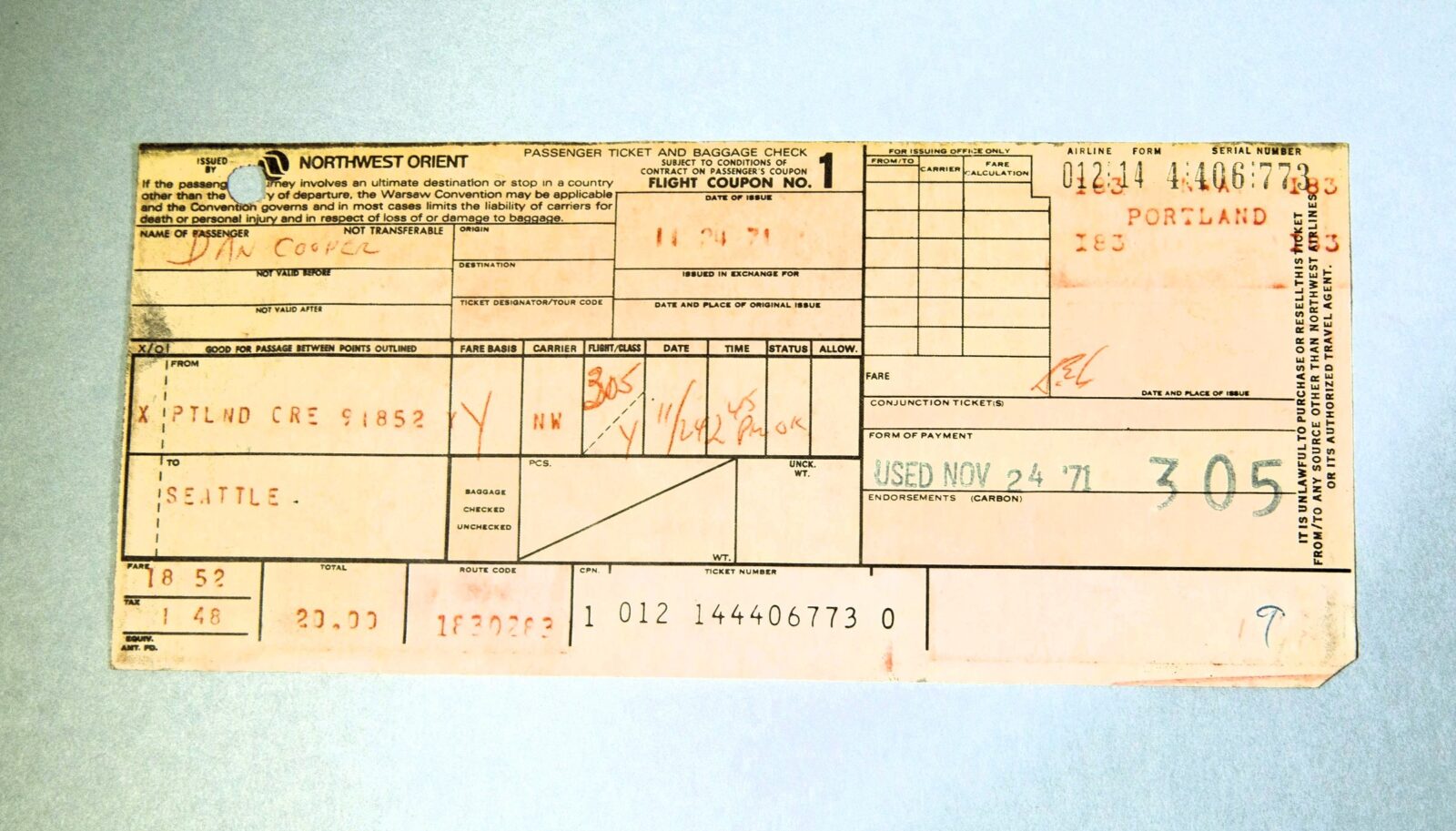
Today, November 24th, marks the 54th anniversary of the day in 1971 when a man using the name Dan Cooper purchased a ticket on Northwest Orient Flight 305 from Portland to Seattle.

“Cooper” paid $20 for his ticket and shortly after the plane took off from Portland he handed a flight attendant a note saying he had a bomb in his breifcase. He then demanded $200,000 in $20 bills and four parachutes.

The flight landed in Seattle, the other passengers were released and Cooper then demanded that the crew fly him, the money and the parachutes to Mexico City.

But somewhere over southwest Washington, possibly near Ariel, Washington, Cooper lowered the rear steps of the airplane and jumped out..

In 1980, a youg boy came upon $5800 worth of rotting bundles of $20 bills from the original ransonm money along a river bank. But no trace of D.B. Cooper (as news reports mistakenly ID’d him) have ever been found. This remains the world’s only unsolved airplane hijacking case.

Clyde “Upside Down” Pangborn’s very old sandwich

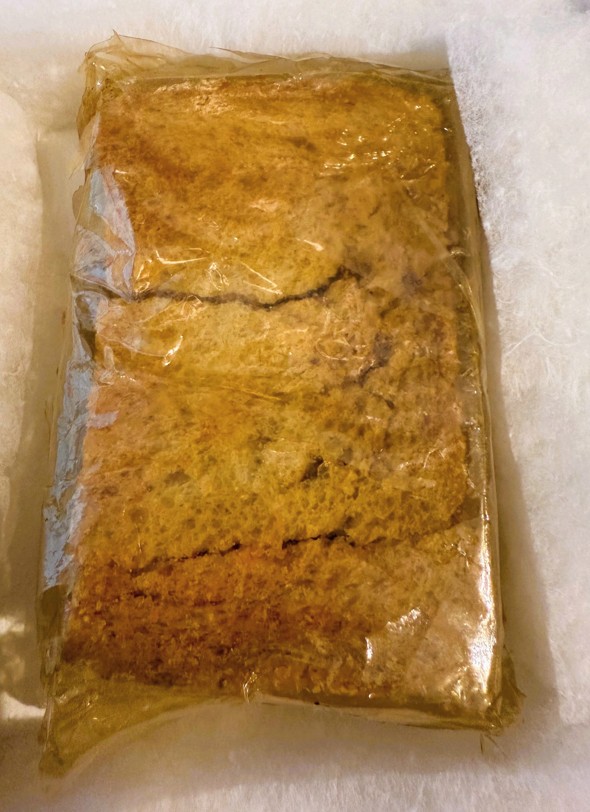
This old, stale sandwich locked away in a museum in Washington state has a special connection to an aviation daredevil who made a record-setting flight.

The first non-stop trans-Pacific flight was completed on October 5, 1931, by Clyde “Upside Down” Pangborn and co-pilot Hugh Herndon, Jr.

Hoping to set a record and claim a $25,000 prize, the duo flew from Misawa, Japan to East Wenatchee, WA, in 41 hours and 15 minutes (some say 13 minutes) in a modified Bellanca Skyrocket named Miss Veedol (after the motor oil).

A permanent exhibit at the Wenatchee Valley Museum & Cultural Center tells the story of Pangborn (a Washington native), his career as a barnstormer and stunt flyer, and the record setting flight.

On display are historic photographs and a wide range of artifacts, including the bent propeller that is now all that is left of Miss Veedol.

But the museum has more Pangborn-related artifacts in storage.

Most notably, half a sandwich wrapped in cellophane and nestled inside a box in a humidity-controlled storage room.

The sandwich likely flew with Pangborn on the famed 1931 flight.

Or it may have flown with him earlier, in the 1920s, and taken as a souvenir when Pangborn was wowing spectators as a stuntman in a flying circus, doing aerial stunts such as loops, flying upside down, changing planes in mid-air, and completing auto-to-airplane transfers.  

Anna Spencer, the Collections Coordinator for the museum, went looking for the sandwich a few years back for a Pangborn-related anniversary. “It was exciting to find it and shocking to see the state of it. I assumed we’d find a pile of mold, but it had been preserved extremely well.”

Here’s a “Curator’s Corner” video the museum put together at the time.

The sandwich was donated to the museum by a man who found it inside a red tobacco tin among his late father’s belongings. Inside the tin was a neat handwritten note stating that the sandwich had flown on the 1931 flight.

Another clue: a Smithsonian Air & Space article notes that in 1931 Miss Veedol took off from Japan with “915 gallons of fuel, 45 gallons of oil, sandwiches, tea, and chicken.”

However, when taken out of the tin, the cellophane-wrapped sandwich was taped up with a label that said, “Clyde Pangborn Sandwich 1926.” 

Museum officials haven’t had the sandwich carbon-dated. But it’s a good bet this is indeed a sandwich from the flight.

More about Clyde Pangborn

Clyde Pangborn learned to fly loops and to fly upside down when he served in the Army. In 1921, he formed the Gates Flying Circus with his friend, Ivan Gates, but in 1931, he switched from barnstorming to attempts at breaking aviation records.

In July 1931, in their Miss Veedol airplane, Pangborn and Herndon failed to beat Wiley Post’s record of flying around the world. They turned their attention to a challenge offered by a Japanese newspaper, offering a $25,000 purse for the first non-stop trans-Pacific flight from Japan to the United States.

In pursuit of that prize, Pangborn made modifications to the Miss Veedol. He reinforced the fuselage, added a fuel tank, and figured out a way to jettison the landing gear – and 300 pounds – once the plane was in the air.

The experienced stunt flyer planned to land the plane on its belly.

At liftoff from Misawa, Japan on October 4, 1941, Miss Veedol had no radio, no life raft, and no emergency equipment.

The scheme to discard the landing gear after take-off worked, but Pangborn had to use his aerial stunt skills to crawl out on the wing and remove two struts that were left hanging and would have interfered with the planned belly landing.

The plane landed – on its belly – in Wenatchee, WA, 41 hours, 13 minutes and 13 (or 15) minutes later.

Celebrating National Aviation Day

A quick round-up of some fun and educational items for National Aviation Day, celebrated each year on August 19 – Orville Wright’s birthday.

Here’s a fun throwback from Pee-wee’s Playhouse.

From the SFO Museum archives

This popped up when we clicked “random object” on the SFO Museum’s Aviation Collection website. Give it a try and see what you get.

From the Smithsonian National Air & Space Museum

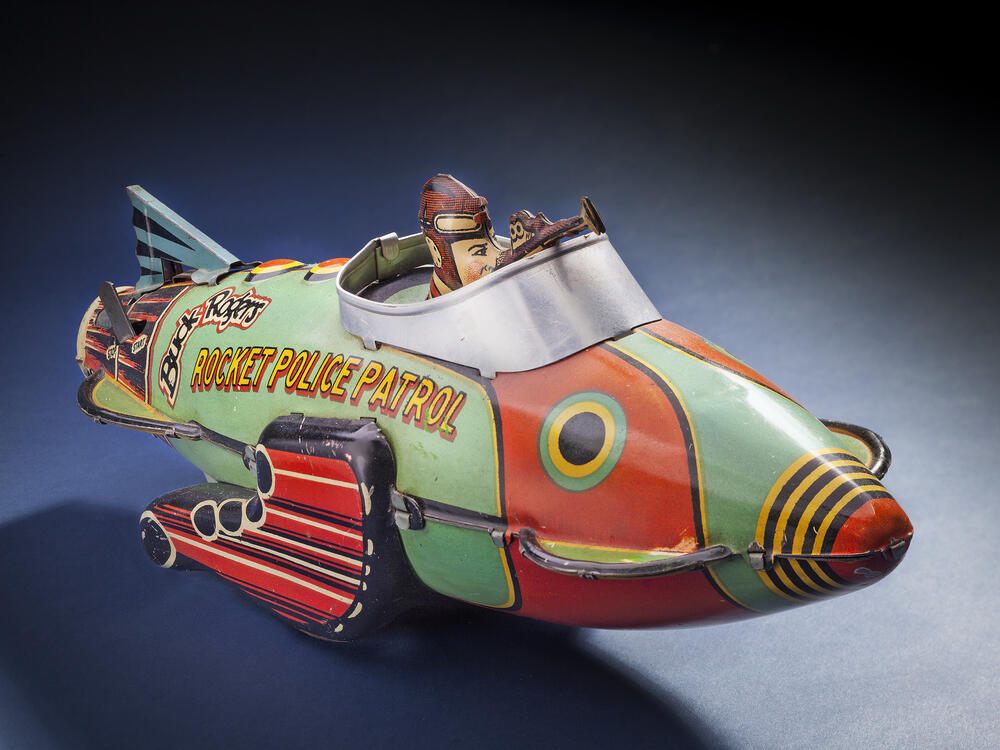
We love this fish-like Buck Rogers spaceship toy from the collection of the National Air & Space Museum.

Balloon Basket from the National WWI Museum and Memorial

The National WWI Museum and Memorial in Kansas City has an extensive collection of artifacts that trace the evolution of aviation from early observation balloons to legendary biplanes. They shared this video of their rare observation balloon basket.

Happy 90th birthday, Phoenix Sky Harbor Int’l Airport. Party on!

Phoenix Sky Harbor International Airport (PHX), which calls itself ‘America’s Friendliest Airport,’ was surely the funnest airport to be at this week during an anniversary party commemorating the purchase of the rural airport in 1935.

90 years ago, ‘Sky Harbor’ was nicknamed ‘The Farm’ time because of its location. And back then, the purchase price was $100,000.

At the airport’s 90th birthday party, local leaders presented a proclamation and made some speeches.

Then it was time for a 90s-themed dance party and a parade of airport Navigator Buddies from the pet therapy program dressed in neon, as rock stars, as movie characters from “Clueless,” sports heroes, and more.

After all the dancing was over, airport personnel and the pups paraded through Terminal 4 and then boarded the PHX Sky Train to Terminal 3.

PHX has been celebrating its 90th anniversary all year with monthly events hosted in the Culture Corner, located post-security in Terminal 3. Check here to see if something will be happening next time you’re visiting PHX.  

Other anniversary activities at PHX include trivia with Amelia, the Airport’s mascot and music through the decades as part of the weekly Traveling Tunes programming.

The Airport Museum also has a special 90th anniversary exhibition on display in Terminal 4 called “From Farm Field to Airfield,” showcasing the airport’s beginnings and its significant milestones over the years.

You can read and see the exhibit from home starting here.

And, as a nice bonus, PHX travelers can stop by the Airport Information Counters to pick up a commemorative 90th anniversary airport trading card. Super collectible!

PHX Party photos by Mark Skalny Photo, courtesy of PHX

IND airport exhibit honors Hoosiers in Flight

The Indianapolis Airport Authority and the Indiana Aviation Hall of Fame join forces for a new exhibit at Indianapolis International Airport (IND) honoring Hoosiers in Flight.

The exhibit honors Hoosier natives and state institutions with significant roles in aviation history and is located in the IND Bag Claim, near Carousel 3.

The list includes the first flight at Kitty Hawk, the Apollo 11 mission, Amelia Earhart, the Tuskegee Airmen and Rolls Royce.

Here’s a sample of the people, places and achievements honored in the exhibit:

Wilbur Wright, a Millville, Ind., native flew the first airplane flight in 1903 at Kitty Hawk, North Carolina.

Margaret Hamilton, from Paoli, Ind., invented software engineering and wrote the code for the Apollo 11 mission, helping to put Neil Armstrong on the moon in 1969.

Lewis A. Jackson, an Angola, Ind., native combined his aviation skills with his education degree to become the Director of Training for the 99th Pursuit Squadron of Tuskegee Airmen during World War II.

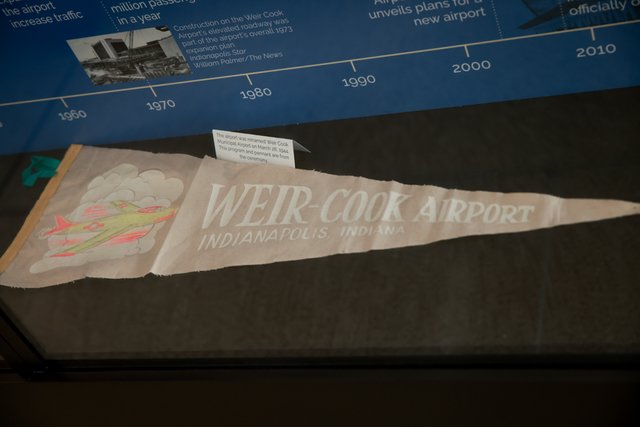
Col. Harvey Weir Cook, a Wilkinson, Ind., native, a military hero, and the namesake of the Indianapolis International Airport campus, was instrumental in educating the public in the 1930s about the history of flight and aviation via his radio show sponsored by Pennant Syrup.

Purdue University. Amelia Earhart joined the staff in 1935 as the “Counselor on Careers for Women” and during her four years there encouraged many women to join Purdue’s aeronautics engineering program.