aviation

Congrats to newly minted commercial pilot Eskil Skute

Here’s a heartwarming story

In 2013, the Stuck at the Airport team attended Aviation Geek Fest in Seattle.

The annual event was put together by the Boeing Future of Flight aviation center in Everett, WA, Airline Reporter founder David Parker Brown and Seattle’s Museum of Flight.

Among the attendees that year were Per Skute and his 12-year-old son, Eskil. They had traveled to the event from Norway.

After meeting them and hearing about their adventures, which included losing their luggage on the way over, we told Eskil that if he wrote a report about his trip, we’d post it on this site.

He did write a report. And although he was not yet fluent in English, his enthusiasm was clear as a bell. So we posted it as written, with just a few edits for length.

Here’s an excerpt:

My trip to Seattle was totally awesome!!!… We where a lot at the future of flight. We where a lot up on the roof and watched planes land and take off. We saw the Dreamlifter take off. That whas very cool:) next day we where going to the Boeing 737 factory. We where first at the Museum of Flight. I loved museum of flight. The sr-71blackbird and mig 21fishbed and more…

When we comed to the boeing factory we where taked up to a Big room with three Big tv’s. We where not allowed to take pictures inside. When i comed out to where They builded boeing 737 i where like woow. It was huge. I saw a lot of airplanes in Lines ahead. I saw sas, westjet, hainan airlines,northwest airlines and united. It was hot inside.

Becoming a commercial pilot

In 2022, we learned that Eskil had continued to follow his interest in aviation. His dad wrote to tell us Eskil was on his way to Texas to complete training to be a pilot.

And last week, a note arrived from Eskil’s dad letting us know that Eskil is now an official pilot. It said, in part:

Wanted to let you know that we (my wife and myself) had the pleasure of joining Eskil on his first flight as a real pilot for BRA in Sweden on an ATR-72. We met you when Eskil was 12 years old and already quite determined to be a pilot. It wasn’t until 3 years ago that he couldn’t let his dreams just pass.

As a parent it is extremely satisfying to watch your kids fulfill their dreams. So this has been a great day.

Just wanted to give a little thank you for your article 12 years ago that was one of the many small things that pushed him in the right direction.

We’re delighted to have been a small part of this big story.

Congratulations, Eskil! We’re very proud of you!

Korean Air: behind the scenes, tech-wise

Last month I joined Korean Air as a judge for a kids art show in LA, a paint-the-plane event in Seoul, and a tour of the airline’s farm, water bottling plant and various tech centers.

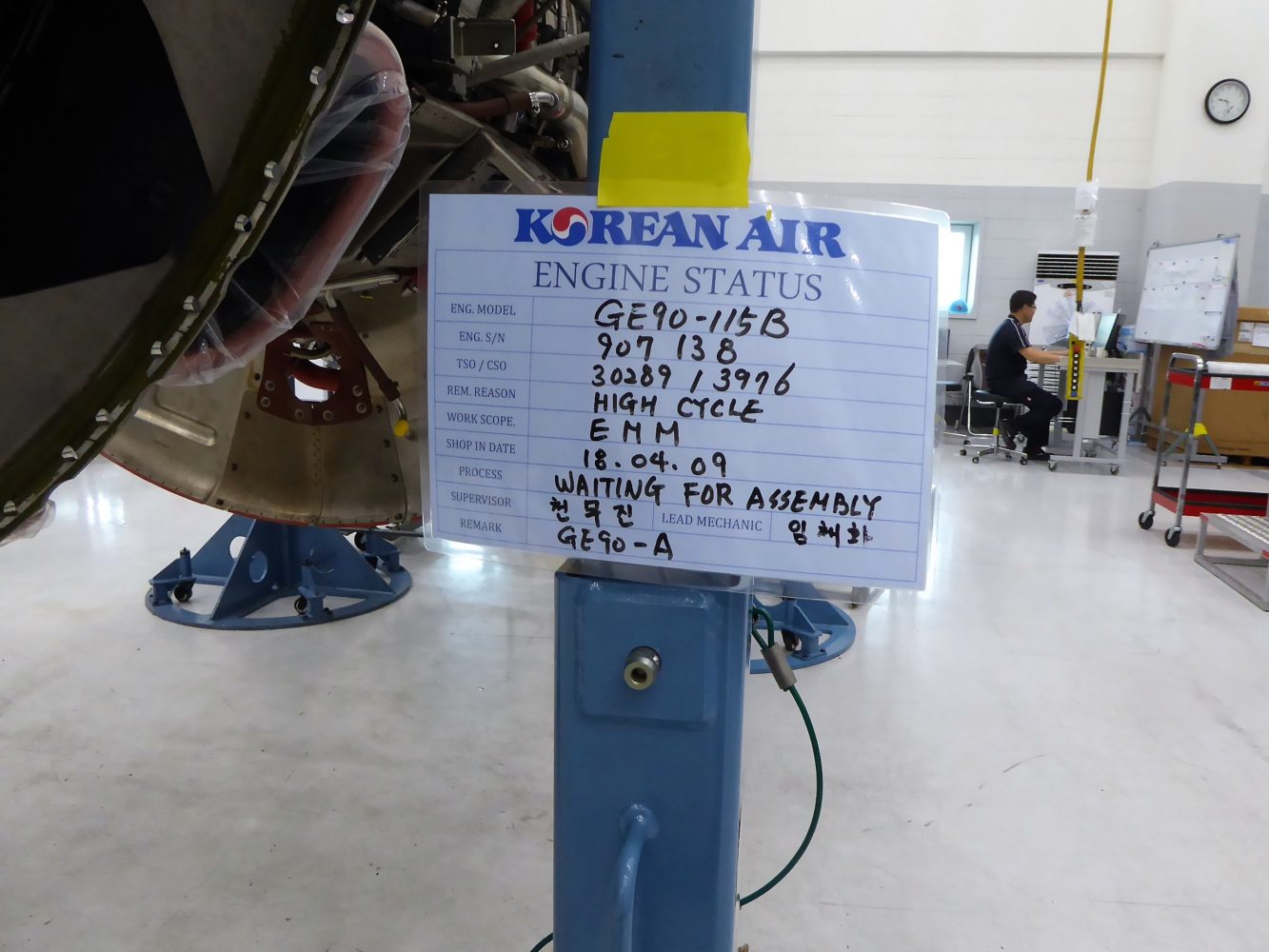
Here are some snaps and part of the story about the tech center and engine test cell I put together for USA Today’s Today in the Sky.

At its sprawling Tech Center in the port city of Busan, South Korea, Korean Air performs a wide variety of services for its own fleet and for many other airlines. In Incheon, Korean Air and aerospace manufacturer Pratt Whitney operate the world’s largest engine test facility as a joint venture.

The Paint Hangar

In Busan, South Korean, the Tech Center’s environmentally-friendly paint hangar has repainted hundreds of aircraft for Korea Air and other airlines since it was established in 1998.

During the visit, a Korean Air 777-200 was well into its 9-day repainting process. On the to-do list:  repainting four Qantas A380s between May 2019 and November 2020.

Tech Center

This Korean Air 747 cargo plane was parked inside a 2-bay maintenance hangar undergoing an extremely thorough, required, multi-week inspection known as a D-check, during which all parts of the aircraft are evaluated.  According to Korean Air, this type of heavy maintenance is performed on more than 100 aircraft a year.

Inside other buildings at the Tech Center, parts are being manufactured for both Boeing and Airbus (including Sharklets for the Airbus A320).

Elsewhere, hundreds of technicians perform maintenance and repair for aircraft operated by commercial airlines and for Korean and US aircraft, including F-15 and F-16 fighters, CH-53 helicopters and a wide variety of other aircraft we were not permitted to photograph.

Engine Test Cell center in Incheon

Korean Air’s $80 million Engine Test Cell (ETC) opened in 2016, and is a joint project with Pratt Whitney.

The ETC is designed to test the world’s largest jet engines, with a maximum thrust of up to 150,000 pounds.

Currently the largest and most powerful commercial jet engine is on the Boeing 777 and has a thrust of 115,000 pounds, but Korean Air’s ETC is ready for the next generation of supersized engines, which are already in production.

Before this center was created, Korean Air had to send its engines elsewhere to be tested, said Bill Kim, manager of Korean Air’s Engine Test Cell facility. The airline had to pay upwards of $8,000 to transport each engine overseas and then wait up to a month for an engine to get tested and returned.

“Here the turn-around time is far less: just two days,” said Kim, which means far less downtime and less need for Korean Air and other airline customers to purchase as many spare engines, which can cost up to $30 million dollars each.

To see the full story – and all 33 photos – see the original story Behind the scenes at Korean Air’s tech and engine-test facility on USA TODAY’s Today in the Sky.

(All photos by Harriet Baskas).

First 787 Dreamliner test plane now an attraction in Japan

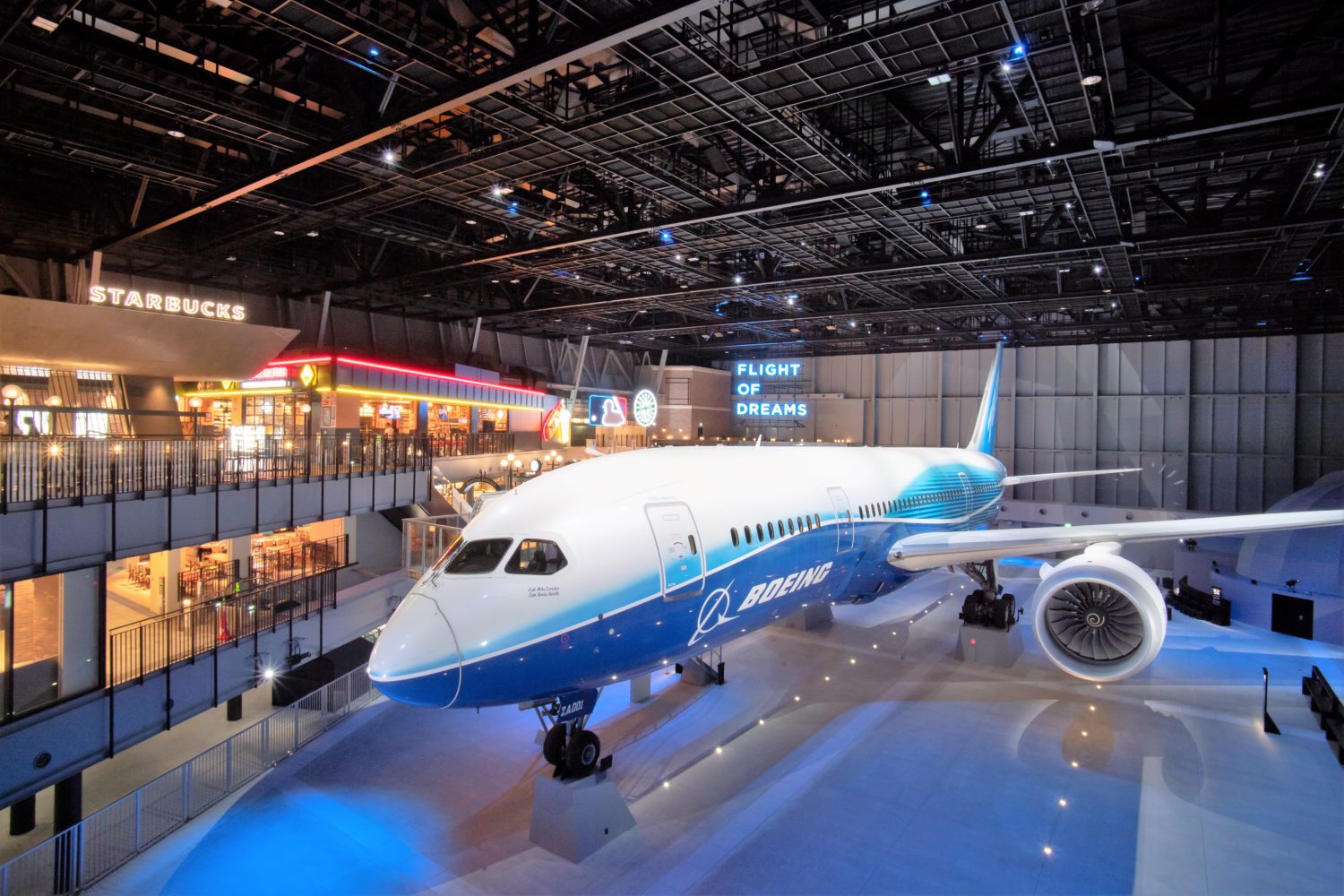
The first Boeing 787 Dreamliner test plane, which first flew December 15, 2009, is now the main attraction at an aviation theme park called Flight of Dreams that opened this week in Japan at Chubu Centrair International, an airport built on an artificial island south of Nagoya.

I had a chance to visit the attraction shortly before it opened and learn about this unique project.

Courtesy Flight of Dreams

The four-story complex is built between the airport’s two terminals and welcomes visitors to a Flight Center with high-tech and hands-on aviation experiences, including a look inside the 787’s cockpit and a virtual tour of Boeing’s Everett, WA factory.

Many of Boeing’s Japanese aerospace partners are based in the Nagoya area and produce an estimated 35% of all the parts that go into the 787 aircraft.

That includes the main wing and fuselage sections, which are so big that they must travel from Centrair to Boeing’s U.S. assembly plants in Everett, WA and North Charleston, S.C. in Boeing’s 747-400 Large Cargo Freight Dreamlifters.

Boeing donated the first 787 built to Nagoya’s Centrair International Airport in 2015 to honor the role the airport and the people of the region played – and continue to play – in the Dreamliner’s development and production. And instead of just parking the aircraft on the airport grounds, Centrair decided to build a destination aviation theme-park around the plane.

The second and third floors of the facility, dubbed Seattle Terrace, overlook the 787 and include branches of some of some of Seattle’s iconic shops and restaurants, including Starbucks (of course), Pike Brewing, Fran’s Chocolates, Beecher’s Handmade Cheese, Pike Brewing, and several others.


As with all theme parks, visitors exit through the souvenir shop, which is itself quite the attraction.

The first Boeing Store outside the United States is here and is stocked with around 500 aviation-related items, including furniture and artwork made from re-purposed airplane parts and many Boeing-branded items that will only be sold in this store.

Learn more about the attraction – and see a slide show of 29 photos in my story about the Flight of Dreams attraction on USA TODAY.

Souvenir Sunday: 747-themed amenity kits on United

United Airlines is going to retire its Boeing 747 fleet on November 7 and to mark the occasion the airline is giving out 747-themed Polaris amenity kits starting Monday, October 23, through January 2018.

Silver kits go to first class customers, while blue kits will be handed out to business class fliers. In addition to the usual amenity kit items, each kit contains a pack of five 747 trading cards, so you can swap with your friends.

Passengers on United’s premium transcontinetnal routes (EWR-SFO, EWR-LAX, BOS-SFO) will receive (smaller, but just as charming) commemorative kits as well.


Thanks for visiting StuckatTheAirport.com.  Subscribe to get daily travel tidbits.

Exquisite airplane models on view at SFO Museum

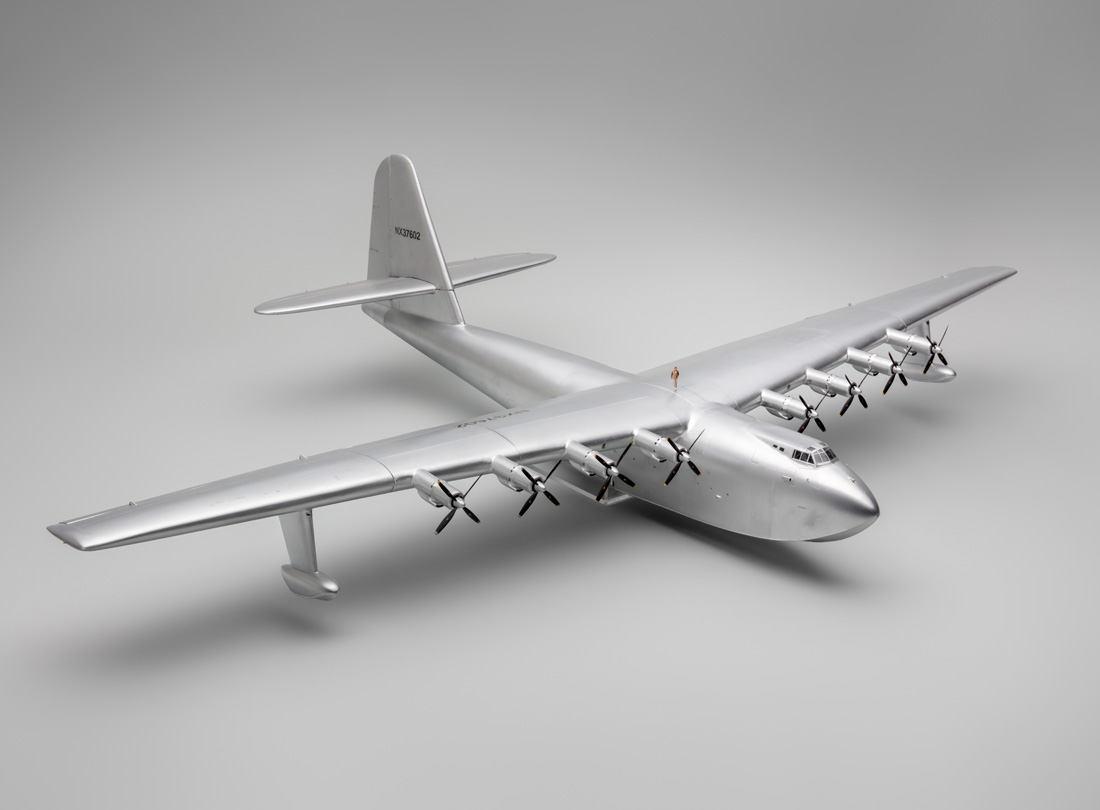
Hughes H-4 Hercules (“Spruce Goose”) model. Courtesy SFO Museum

A new exhibition from the SFO Museum at San Francisco International Airport features almost  three hundred 1:72 scale (one inch = six feet) models of pioneer, sport and commercial aircraft made with plastic, wood, metal, wire, string, and epoxy and detailed with paint and decals.

Air France Concorde SST (Super Sonic Transport) model aircraft. Courtesy SFO Museum

The models come from the collection of Jim Lund, a Bay Area native who made aircraft models as a kid and returned to the practice as an adult.

“Numerous models were constructed or modified from kits produced by manufacturers worldwide,” exhibit notes tell us,  and “In the many instances when no kit was available, Lund crafted the model parts from scratch based on manufacturers’ plans using the ‘vacuform’ process—a method that creates plastic parts from his hand-carved wood forms.”

Aviation Evolutions: The Jim Lund 1:72 Scale Model Airplane Collection is on view pre-security on Depatures Level 3 through May 13, 2018.

Here are some more examples of what’s on view.


American Airways Curtiss Condor T-32 airliner model aircraft. Courtesy SFO Museum


SCADTA (Sociedad Colombo Alemana de Transporte Aéreo) Junkers F.13 airliner model aircraft . Courtesy SFO Museum


Dornier Do X flying boat airliner model aircraft. Courtesy SFO Museum

CVG celebrating National Aviation Day – with hot dogs, ice cream

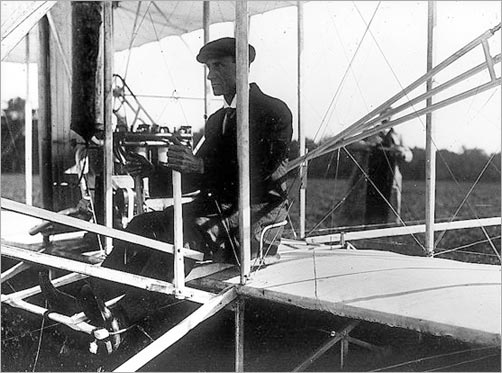
Courtesy Henry Ford Museum


Cincinnati/Northern Kentucky International Airport (CVG) is celebrating National Aviation Day (Aug 19), which commemorates the history and Orville Wright’s birthday, with ice-cream, chili and aviation-themed giveaways.


More than 2,000 arriving passengers will be treated to Gold Star Chili cheese coneys (hot dogs) and Graeter’s Ice Cream. There will also be a band, giveaways and other surprises at the Welcome Point of the CVG Terminal.


CVG will also host a scavenger hunt on social media for passengers to find Wilbur Wright in the Terminal and two Concourses. Hints will be shared on Twitter and prizes will be awarded to the first passengers who spot Wilbur, snap a photo with him, and share on CVG’s Twitter account.


And what’s National Aviation Day without some plane spotting? At 2 p.m., there will also be free Mr. Softee ice-cream (first-come, first-served) and aviation-themed treats out at the airport’s airplane viewing area (1459 Donaldson Hwy, Erlanger, KY). 


Black Cat Appreciation Day

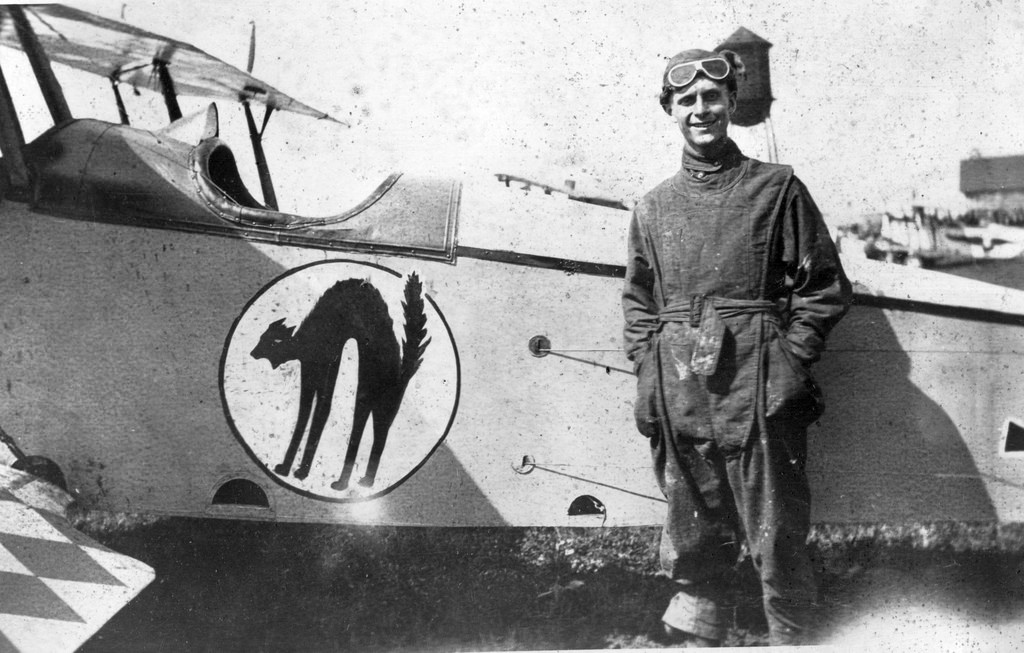
August 17 is evidently Black Cat Appreciation Day, so we bring you this photo of a member of the 13 Flying Black Cats – an early aerial stunt team – from the archives of the San Diego Air & Space Museum.

The Flickr caption on this photos says: 1st Lieut. Frank B. Estell stands by his “Texas Longhorn” Jenny at the North Memphis Driving Park, Memphis, Tennessee, on April 12, 1919.

Souvenir Sunday: summer reading

Browsing for and buying a book – an actual book – in an airport bookstore is a treat I especially enjoy before a long flight.

Sometimes I choose a title that catches my eye, but most often I pick up something that’s been on my ‘to read’ list.

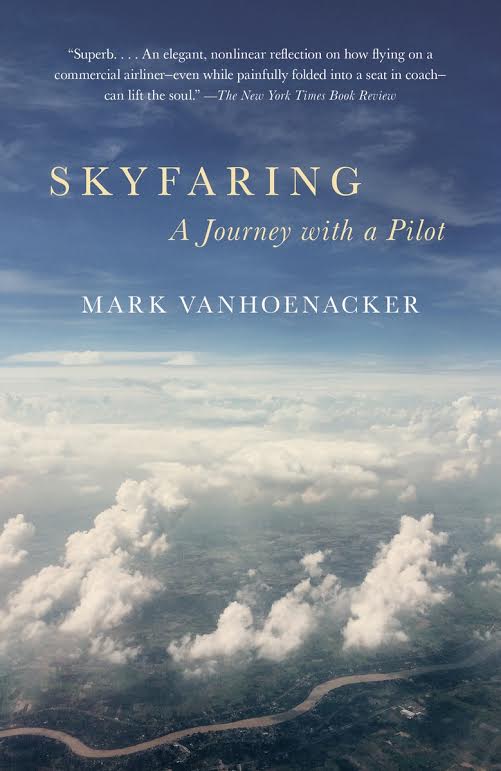
Today the choice is the just-out-in-paperback edition of Mark Vanhoenacker’s Skyfaring: A Journey with a Pilot (Vintage Departures)

Skyfaring

The New York Times review of the book says this is “an unusual entry into the air-travel genre. For one thing, the author is a commercial pilot, flying the Boeing 747 from London to cities across the globe. For another, he doesn’t speak of disasters, not even in passing…..”

Sounds promising and appropriate for in-flight reading, doesn’t it?

Vanhoenacker …”can put one in mind of Henry James,” the review continues.

“In “Skyfaring” we regularly come upon phrases like “the water gyre of the planet,” “technical rectitude,” “the ichthyology of our sea-sky” and “the light-filled clerestory of the world.” This is a volume that seeks to leave high contrails in your mental sky, and it does so in a manner that is nearly always appealing.”

Even better.

Now let’s just hope my seatmate isn’t a talker…

Giant new aviation pavilion at Seattle’s Museum of Flight

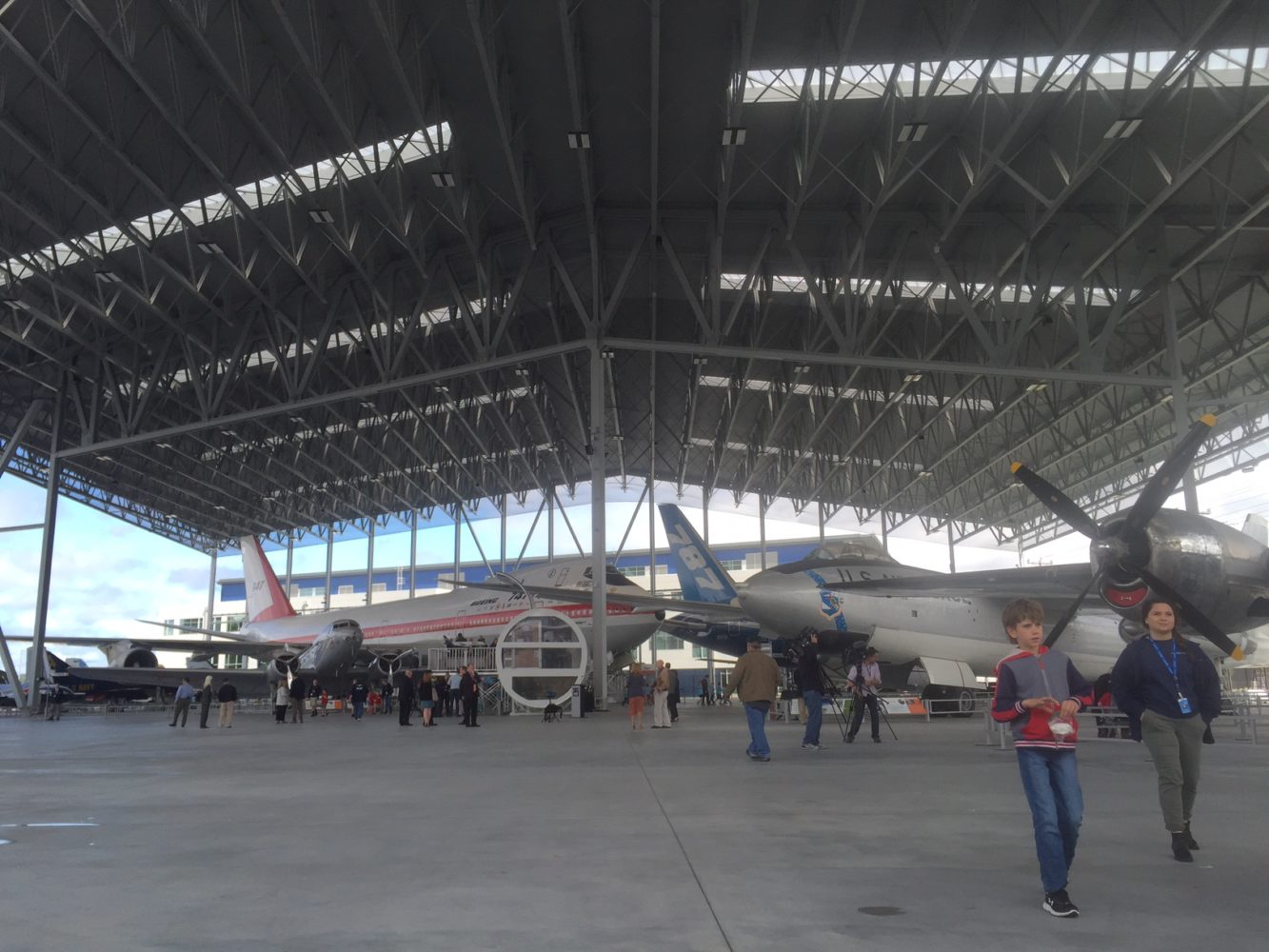
Seattle’s sprawling Museum of Flight will double its gallery space with the official opening of a 3-acre Aviation Pavilion this Saturday.

aviation pavilion

The 9-story roofed outdoor gallery currently displays 15 commercial and military airplanes, including a Boeing 787 Dreamliner, the first Boeng 747 prototype, the only Concorde on the west coast and a FedEx Air Cargo exhibit housed inside a 727 freighter.

Tucked under the wings of the 747 is a mini-airport for kids.

Also on display: a Douglas DC-2 airliner from the 1930s, three big bombers (World War Two’s B-17F Flying Fortress and B-29 Superfortress), and the Cold War’s B-47 Stratojet.

The Museum’s rare, flyable 1932 Boeing 247, Boeing 727 prototype, and the first jet Air Force One will be moved over from the Museum’s Airpark across the street to the Pavilion in the fall.

Aviation pavilion 2


Airline industry, non-profits save lives with flights

Airbus Foundation

Courtesy Airbus Foundation

Airlines are reporting profits and being urged to join humanitarian efforts to help plug a $15 billion funding hole in global disaster relief.

The call comes on the heels of a United Nations report that found while at least $40 billion in annual humanitarian aid is needed annually to help victims of natural disasters and armed conflicts worldwide, today the world spends only $25 billion a year on securing and getting food, water, shelter, medical supplies, support teams and other emergency resources to people in need.

That’s twelve times the amount spent 15 years ago, the report notes. But with so many in need now, new disasters cropping up all the time and the high costs associated with rushing humanitarian relief to where it will do the most good, creative solutions are needed.

And that’s where alliances between airlines, aircraft manufactures and a variety of non-governmental organizations come in.

Through its foundation, aircraft manufacturer Airbus has been filling some otherwise empty, new aircraft being delivered to customers from its factories in Hamburg, Germany and Toulouse, France with humanitarian relief supplies destined for disaster-hit regions and communities in need.

“The flights are happening anyway and the pilots and the fuel are already paid for,” said
Airbus Foundation spokeswoman Deborah Waddon, “The NGOs arrange for the cargo, we make donations for the cost of the cargo, the loading is often done for free and the airlines cover just an incremental fuel cost for the extra cargo.”

Since 2008, airlines such as Emirates, JetBlue, South African Airways, Thai Airways, Vietnam Airlines and a handful of others have worked with Airbus on at least 30 delivery flights that have brought more than 250 tons of humanitarian relief to areas of Nepal, Columbia, Thailand, Africa and Haiti. On more than 15 occasions, Airbus has also used its test planes to deliver additional supplies quickly in the aftermath of disasters.

For example, a test aircraft loaded with 50 humanitarian staff and about 22 tons of food and medical aid flew to Nepal in 2015 after the devastating earthquake. And a Nepal Airlines aircraft delivery flight was used to transport more than five ton of relief goods and medical equipment to Kathmandu.

“Transporting supplies is one of our main expenses, so this way we can support more people,” said Olaug Bergseth, a senior officer for corporate partnerships with the International Federation of Red Cross and Red Crescent Societies, one of the NGOs that works closely with Airbus. “It’s faster, it’s more efficient and it’s cheaper.”

Courtesy Boeing


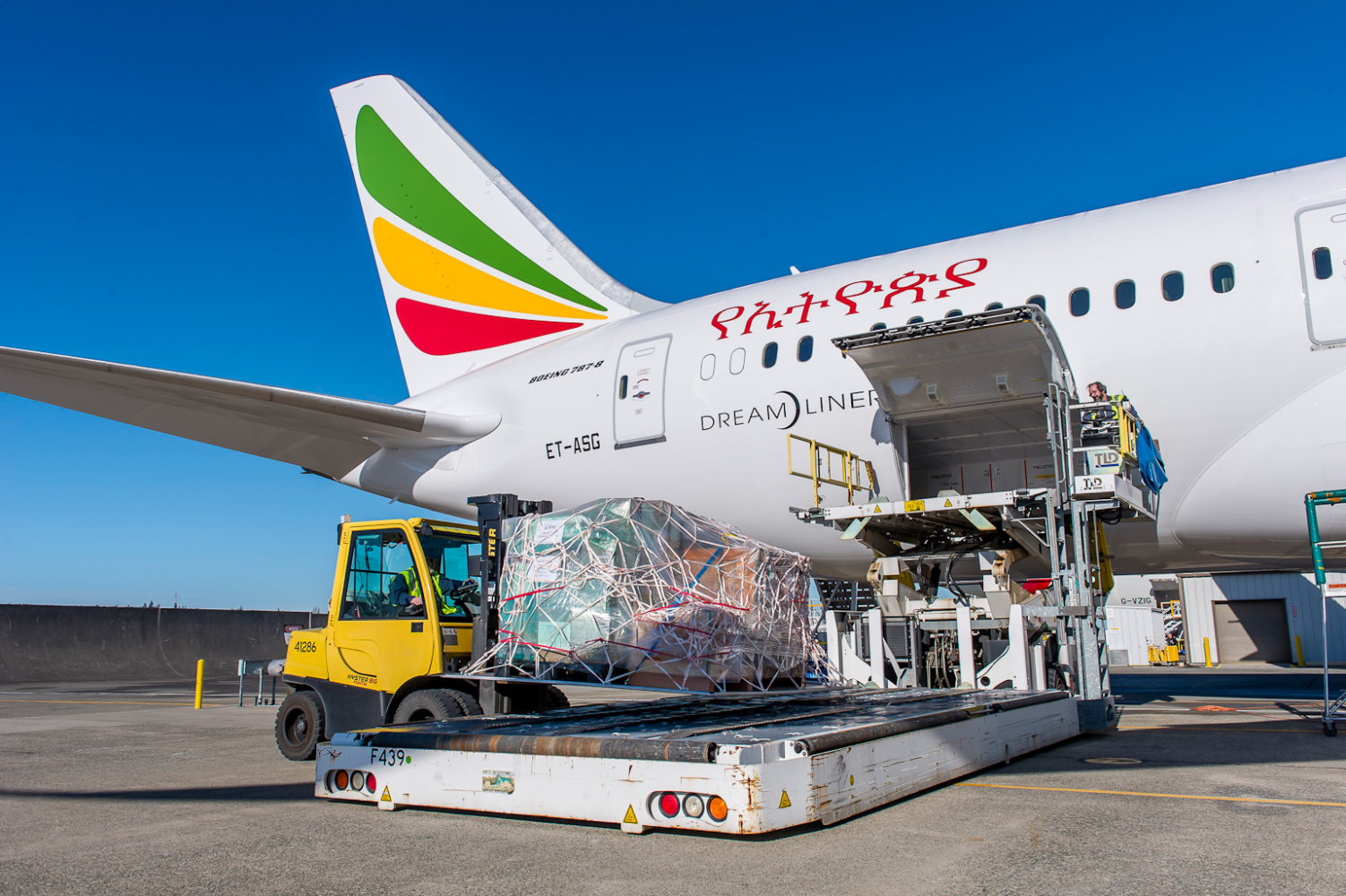
Through its Humanitarian Delivery Flight program, the Boeing Company also works with nonprofit and NGOs to load everything from medical supplies and clothing to educational materials into the empty cargo space of new airplanes for transport and delivery to areas of need.

Since 1992, Boeing’s program has made 180 humanitarian delivery flights, working with more than 50 airline customers to deliver more than 1.4 million pounds of supplies.

At least 26 of those humanitarian delivery flights have been on Ethiopian Airlines, which has also helped its neighbor, Somalia, by bringing back needed supplies.

“These flights have helped transform lives with their precious cargo,” said Bill McSherry, vice president of Government Operations at Boeing Commercial Airplanes.

Airlink worked with Avianca Airlines to get earthquake relief supplies to Ecuador

Courtesy Airlink

Delivery flights don’t always get relief supplies exactly where they need to go, so Boeing often teams up with Airlink, a Washington, D.C. nonprofit disaster relief organization that works with more than 35 airlines and more than 60 NGOs, to transport supplies and relief workers.

“We focus a lot on disaster response, but also on what you might call slow-burn events, such as an education program in Africa that is teaching children not to play with land mines and other remnants of war,” said Airlink Executive Director Steven Smith.

Smith notes that since more than 60 percent of humanitarian funding goes to supply chain costs, the transportation and coordination services airlines and Airlink provide can help NGOs stretch budgets and be more effective.

During the recent Ebola crisis in West Africa, for example, Airlink sent healthcare workers and 100 shipments of aid for 37 different NGOs using 11 airlines.

And more recently, Airlink used donated miles and funds from Air Canada, Alaska Airlines and United Airlines to send 19 military veterans from Team Rubicon USA and Team Rubicon Canada to Fort McMurray in Alberta, Canada to help out residents returning home after devastating wildfires destroyed more than 2,400 homes.

(My story about airline industry efforts to help save lives first appeared on CNBC in a slightly different form.)