Clyde Pangborn

Clyde “Upside Down” Pangborn’s very old sandwich

This old, stale sandwich locked away in a museum in Washington state has a special connection to an aviation daredevil who made a record-setting flight.

The first non-stop trans-Pacific flight was completed on October 5, 1931, by Clyde “Upside Down” Pangborn and co-pilot Hugh Herndon, Jr.

Hoping to set a record and claim a $25,000 prize, the duo flew from Misawa, Japan to East Wenatchee, WA, in 41 hours and 15 minutes (some say 13 minutes) in a modified Bellanca Skyrocket named Miss Veedol (after the motor oil).

A permanent exhibit at the Wenatchee Valley Museum & Cultural Center tells the story of Pangborn (a Washington native), his career as a barnstormer and stunt flyer, and the record setting flight.

On display are historic photographs and a wide range of artifacts, including the bent propeller that is now all that is left of Miss Veedol.

But the museum has more Pangborn-related artifacts in storage.

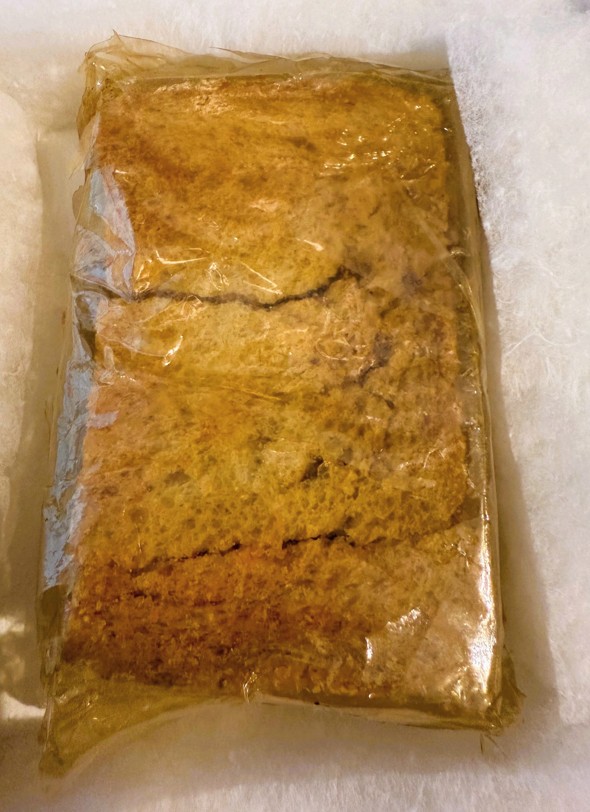
Most notably, half a sandwich wrapped in cellophane and nestled inside a box in a humidity-controlled storage room.

The sandwich likely flew with Pangborn on the famed 1931 flight.

Or it may have flown with him earlier, in the 1920s, and taken as a souvenir when Pangborn was wowing spectators as a stuntman in a flying circus, doing aerial stunts such as loops, flying upside down, changing planes in mid-air, and completing auto-to-airplane transfers.  

Anna Spencer, the Collections Coordinator for the museum, went looking for the sandwich a few years back for a Pangborn-related anniversary. “It was exciting to find it and shocking to see the state of it. I assumed we’d find a pile of mold, but it had been preserved extremely well.”

Here’s a “Curator’s Corner” video the museum put together at the time.

The sandwich was donated to the museum by a man who found it inside a red tobacco tin among his late father’s belongings. Inside the tin was a neat handwritten note stating that the sandwich had flown on the 1931 flight.

Another clue: a Smithsonian Air & Space article notes that in 1931 Miss Veedol took off from Japan with “915 gallons of fuel, 45 gallons of oil, sandwiches, tea, and chicken.”

However, when taken out of the tin, the cellophane-wrapped sandwich was taped up with a label that said, “Clyde Pangborn Sandwich 1926.” 

Museum officials haven’t had the sandwich carbon-dated. But it’s a good bet this is indeed a sandwich from the flight.

More about Clyde Pangborn

Clyde Pangborn learned to fly loops and to fly upside down when he served in the Army. In 1921, he formed the Gates Flying Circus with his friend, Ivan Gates, but in 1931, he switched from barnstorming to attempts at breaking aviation records.

In July 1931, in their Miss Veedol airplane, Pangborn and Herndon failed to beat Wiley Post’s record of flying around the world. They turned their attention to a challenge offered by a Japanese newspaper, offering a $25,000 purse for the first non-stop trans-Pacific flight from Japan to the United States.

In pursuit of that prize, Pangborn made modifications to the Miss Veedol. He reinforced the fuselage, added a fuel tank, and figured out a way to jettison the landing gear – and 300 pounds – once the plane was in the air.

The experienced stunt flyer planned to land the plane on its belly.

At liftoff from Misawa, Japan on October 4, 1941, Miss Veedol had no radio, no life raft, and no emergency equipment.

The scheme to discard the landing gear after take-off worked, but Pangborn had to use his aerial stunt skills to crawl out on the wing and remove two struts that were left hanging and would have interfered with the planned belly landing.

The plane landed – on its belly – in Wenatchee, WA, 41 hours, 13 minutes and 13 (or 15) minutes later.

Stuck at the Airport: Travel Tidbits

Clyde Pangborn’s Uneaten Sandwich

An old, stale sandwich locked away in a Washington state museum is drawing fresh attention to an aviation daredevil and the 90th anniversary of a record-setting flight.

The sandwich is said to have traveled with Clyde “Upside-Down” Pangborn. But when? It could have been in 1926, when he was wowing spectators as a stuntman in a flying circus, doing aerial stunts such as loops, flying upside down, changing planes in midair, and completing auto-to-airplane transfers. Or it could have been in October 1931, when Pangborn and co-pilot Hugh Herndon, Jr. set a transpacific record by flying nonstop from Misawa, Japan, to East Wenatchee, Washington, in 41 hours and 13 minutes (some say 15 minutes).

Either way, the sandwich that is tucked away a the Wenatchee Valley Museum & Cultural Center is really, really old and gaining new attention because this month is the anniversary of Pangborn’s record-setting flight. Read more about Pangborn and the sandwich in the story we wrote for The Points Guy.

(Photos courtesy of the Wenatchee Valley Museum & Cultural Center).

Alaska Airlines unleashes the Kraken plane

In Seattle, the home base of Stuck at The Airport, we have a new hockey professional ice hockey team, called the Kraken.

The city is pretty darn excited. And so is Seattle-based Alaska Airlines, which is the Kraken’s official airline.

To celebrate, the airline is flying a custom Kraken-themed plane on routes to the team’s away games in cities Alaska Airline serves.

And here’s a nice perk: now through the end of the hockey season, Kraken fans who wear the teams’ jersey can board early on all Alaska flights departing from Seattle-Tacoma International Airport (SEA) and Paine Field (PAE).

Phoenix Sky Harbor Int’l Airport Moves a Mural

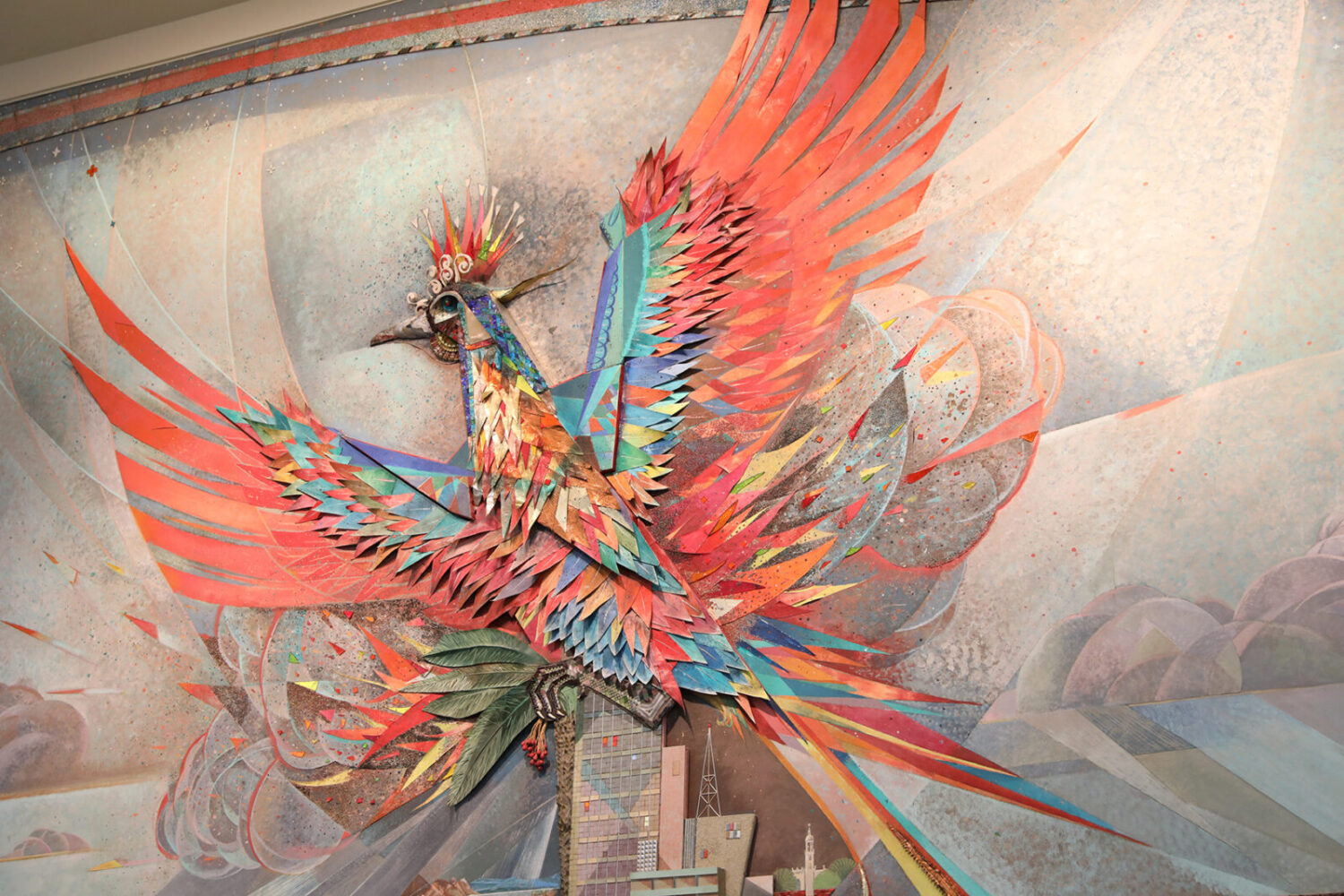
A large 3-part mural by Paul Coze that has been greeting travelers inside Phoenix Sky Harbor International Airport for decades has a new home in the airport’s Rental Car Center.

Here’s a time-lapse video of the move.

“The Phoenix,” is a triptych 75 feet wide and 16 feet high and is believed to be the first piece of public art commissioned by the city that was chosen through a public process. The mural debuted when Terminal 2 opened in 1962.

The imagery in the mural includes depictions and symbols that relate to the area’s first inhabitants, the Hohokam, as well as modern tribes and Latino heritage. Also represented are wagon trains, railroads, cattle ranching, mining, and technology. Besides paint media, 52 different materials, including glass and ceramic mosaic tiles, soil and sand from around the state, plastics, aluminum, and gemstones, are used in the mural construction.

So you can imagine that moving this mural was a delicate undertaking. But it looks like it worked out just fine.