Sleeping

4 ways to sleep, work or be alone when you’re stuck at the airport.

My column for CNBC this week is a round-up of options for finding a place outside airport lounges to sleep, have a quiet conversation or just have a little quiet time to yourself.

——————————————————————————————————————-

Business travelers once looked to airline club rooms as calm oases offering quiet areas to relax, work, conduct important phone calls or, perhaps, catch a nap.

But now it’s not unusual for airline-operated and independent lounges to be as crowded and noisy as the congested airport terminals and gate hold areas many frequent travelers are willing to pay a fee to avoid.

Alternatives exist. Sort of.

Outside the United States, travelers seeking alone time might check into one of the Napcabs equipped with beds, worktables, touch screens, WiFi and baggage storage inside Germany’s Munich or Berlin-Tegel Airports.

Elsewhere, Yotel offers cozy, cabin-like hotel rooms equipped with futon-like beds, WIFI, flat screen TVS and bathrooms inside airport terminals in Amsterdam, London (Heathrow and Gatwick), Paris CDG and, soon, Istanbul and Singapore. 

In the United States, travelers seeking sleep, a place to work or a quiet place to have a phone conversation have an increasing range of options.

Downtime at Dulles?

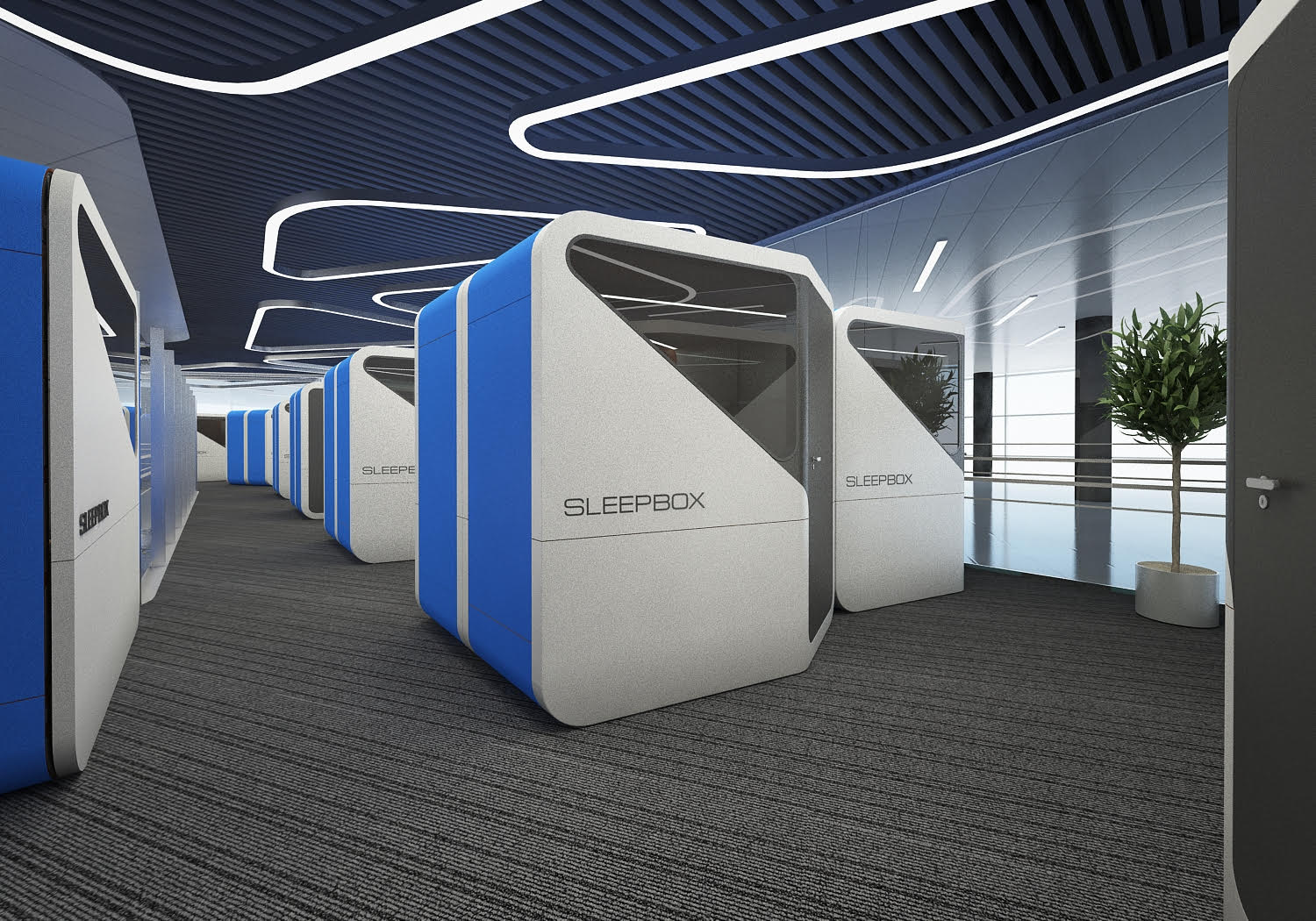
Boston-based Sleepbox plans to cut the ribbon on a post-security micro-hotel on Concourse A at Dulles International Airport next week.

The 16 stand-alone modules have no bathrooms, but are soundproof spaces with mood lighting, WIFI, Bluetooth capability, fold-down work tables, space for storing luggage and beds with memory foam mattresses. Bookings are made via the same smart phone app that allows guests to unlock their room and control features such as the temperature and mood lighting in their unit

Pricing: Average hourly rate for compact rooms (about 30 square feet) is $25 per hour. Standard rooms (45 square feet): $35 per hour. After the first hour, additional 15-minute increments are $5 for the compact room, $7.50 for the standard-room. Rates top out at $120 for a 12-hour stay in a compact room and $140 for 12-hours in a standard room.

Room to relax

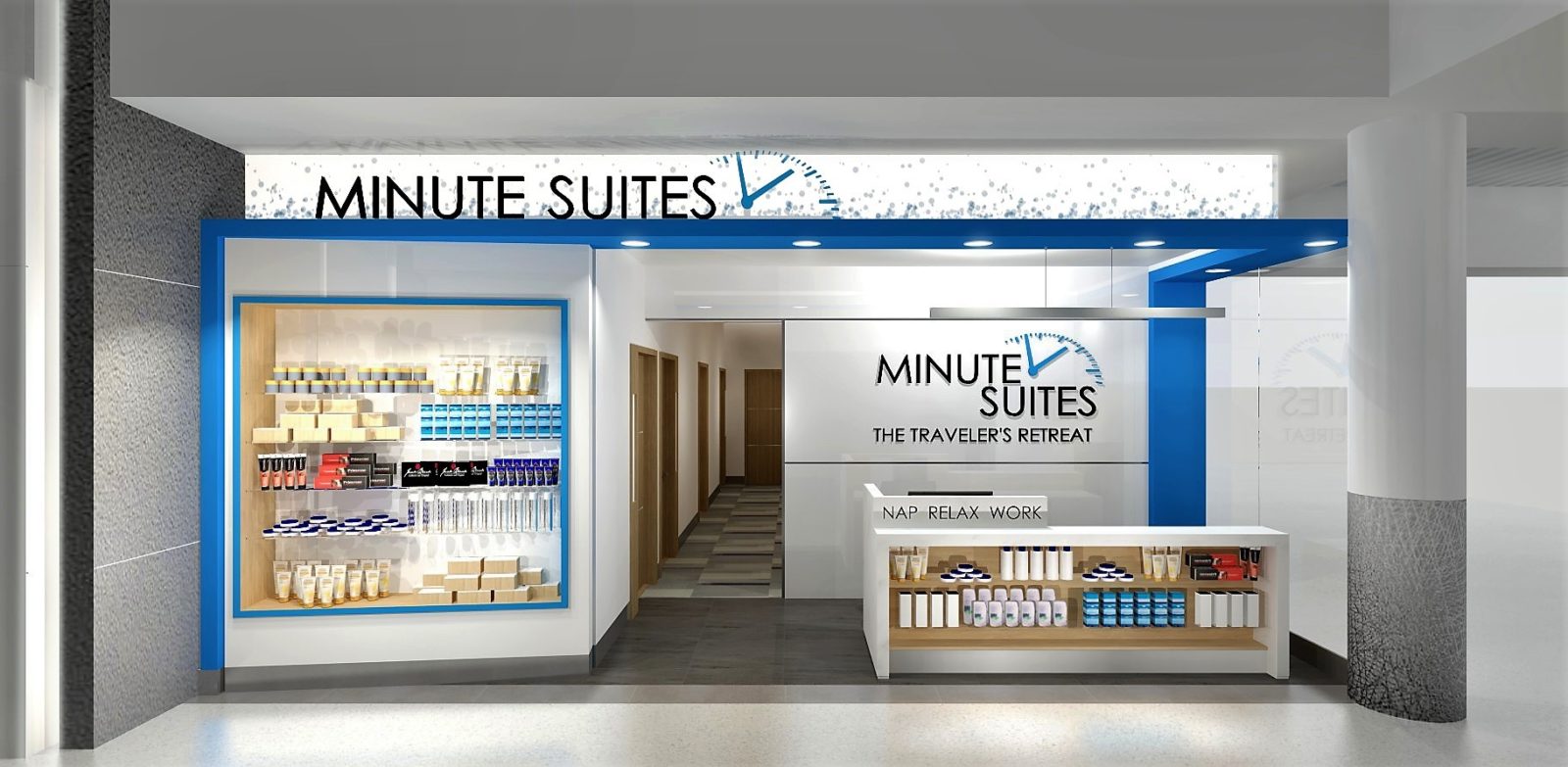
Minute Suites is a short-stay hotel chain with six post-security locations in four airports: two in Atlanta’s Hartsfield-Jackson International Airport (Concourses B&T); two in Dallas-Fort Worth International Airport (Terminals A&D), one in the Charlotte Douglas International Airport atrium and one in the A/B Connector at Philadelphia International Airport.

The basic 56-square-foot suites have sofa daybeds with a pull-out trundle beds, sound-masking systems, HDTVs (with DirectTV and Netflix) that can also be used as computers, WIFI, and desks. A few suites in the DFW location are larger.

The company is adding four additional locations in ATL airport, a second location in Charlotte and has just announced Baltimore/Washington International Airport (BWI) as its next city. Plans to open branches in four additional airports are being finalized now.

An uptick in the number of millennial travelers is helping drive Minute Suites’ expansion.

A recent Hipmunk travel survey found that more than half of all millennials (54.4 percent) would like  airports to offer nap rooms  

“The second most requested amenity was board games,” said Minute Suites co-founder and CEO Daniel Solomon, “And we have now added board games and other desired services such as exercise cycles and yoga mats to our locations.”

Rates for Minutes Suites start at $42 per hour and drop to $32 per hour after two hours. The overnight rate (8 hours) is a flat $155. Showers (available in DFW Terminal D) and Charlotte Douglas International Airport are $20, with suite rental; $30 without. 

Want to be alone? Step into a Jabbrrbox

Phone-booth sized workspaces from Jabbrrbox, offering travelers private, quiet places to work and make phone calls, are available at New York’s LaGuardia Airport Terminal B, Pittsburgh International Airport (Concourse B and C) and on Concourse B at Cincinnati-Northern Kentucky International Airport (CVG).

Two new booths were installed in New York’s John F. Kennedy International Airport Terminal 4 this week.

Users make reservations using touchscreens on the exterior of each unit and, once inside, will find WIFI, a desk, chair, power panel and another, larger, touchscreen that is used to control the color and brightness of the booth lights, track flight status and take photos.

Jabbrrbox pricing is $10 for 15 minutes, $15 for 30 minutes, $30 for an hour and $60 for two hours.

Work, stand, stretch

Business travelers who need to work but who also want to stretch their legs before or between flights can do both at the complimentary Varidesk co-working space at Dallas-Fort Worth International Airport.

Opened in December and located in Terminal C, the staffed workspace has about two dozen height-adjustable standing desks, 75 charging ports and a conference room with moveable walls.

Varidesk chief marketing officer, Sean Scogin, says the company plans to open co-working spaces at other airports soon and may add its new state-of-the-art phone booth to the mix.

Have you found a good way to get out of the fray when you’re stuck at the airport? Share a tip below.

More snaps from Incheon’s new Terminal 2

Courtesy Korean Air

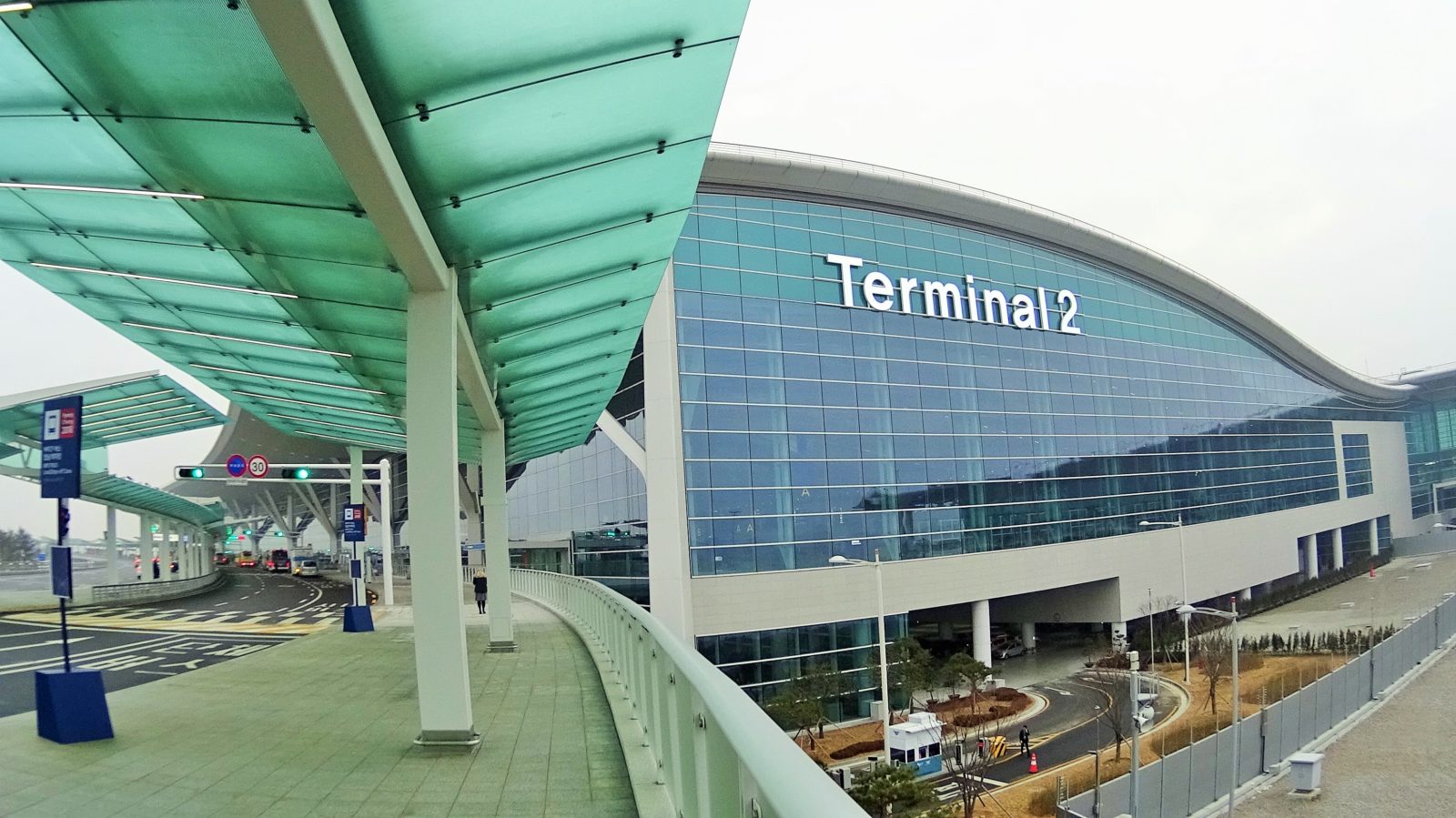
I’ve got a full review of the new Terminal 2 at Seoul’s Incheon Airport up on the Today in the Sky blog at USA TODAY, but sharing some more snaps from my visit here.

The terminal officially opened on January 18 – just a few weeks before 2018 PyeongChang Winter Olympic Games- and it’s a keeper.

Four airlines will use the terminal:  South Korea’s flag carrier Korean Air, Delta Air Lines, Air France and KLM Royal Dutch Airlines.

Photovoltaic panels on the roof and natural greenery inside the terminal help keep the air fresh and lower heating and ventilation costs. A fleet of robots help passengers find their way.

Photo -by Harriet Baskas

Korean music and cultural performances are offered throughout the day and two Korean Traditional Cultural Experience Centers offer passengers the opportunity to try their hands at a Korean craft.

Photo by Harriet Baskas

Beyond shopping and eating, there are activities to keep travelers entertained, including a large Kids Zone, the IT Experience Zone with VR soccer and flying (plus a coffee-making robot) and, in the transfer zone, a ‘digital gym’ that encourages jumping, stepping and other activites.

Photo by Harriet Baskas

There’s also plenty of art and an observation deck with a cafe, views of the airfield and exhibits about the airport.

Photo by Harriet Baskas

New hope for sleeping in airports

My “At the Airport” column in USA for July 2017 was mostly about a new company hoping to bring relief for travelers stuck at the airport with an easy to install napping pod. I’m posting a slightly different version of that column here on Stuck at the Airport in case you missed it.


Airports and the passenger experience may soon change thanks to everything from biometrics, robots and customer data mining to augmented reality, ride-sharing, autonomous transportation and new screening technologies.

All that – an more – was on the agenda recently at a gathering of industry leaders that included airport employees with the word “innovation” in their job titles.

The Airport Innovation Forum, organized by the American Association of Airport Executives, capped off with a Shark Tank-style competition in which five startups competed for a spot in the Airport Market Match program.

I was part of a panel of judges that included innovation experts from Microsoft and Amazon and an aviation industry insider. And while we grilled the contestants for details on their business plans, it was up to forum attendees using an instant electronic polling system to choose the winners.

Competing ideas included an app designed to help visually impaired travelers navigate airports (Loud Steps), a mobile app to monetize passenger loyalty (Venuetize), and a platform that analyzes mobile device location data for insights on passenger behavior (Kiana Analytics).

But the two (tied) winners were Bellevue, WA-based Alitheon, a company whose proprietary computer technology can very accurately and security authenticate, track, trace and monitor baggage without the need for barcodes, tags or RFID chips, and the passenger-friendly “sleep vending machines” created by Boston-based Sleepbox.

Airport naps as innovation

Airport operators and security teams will be most interested in the services of contest winner Alitheon, but being able grab a bit of shut-eye when you’re stuck at the airport ranks high on most every traveler’s wish list.

“We think we have a solution that can eliminate one of the worst airport experiences,” said Peter Chamber, Sleepbox Chief Operating Officer and co-founder,

The self-contained, plug-in Sleepbox units are just that: efficiently-designed 45-square foot boxes with a window to the outside and, inside, a bed, storage space for carry-on luggage, a wireless stereo system, fold down work table, wall mirror, lighting and electrical outlets. Units come in three sizes: basic (“InnerSpace”), single or double.

The original design called for the united to have self-changing sheets, with a new set-up unwinding from a bed-linen roll after each use. And while Chambers still likes that idea, the current design has an attendant doing clean-up duty.

Positive reaction and a flurry of “We need this now!” press coverage in response to a prototype Sleepbox set up for three months in 2011 at Sheremetyevo International Airport in Moscow, Russia and success with a hotel-use set-up in Stockholm convinced the creators they had a good idea.

Of course, they aren’t the first to have this idea.

Road warriors may remember Laptop Lane from the late 1990s. The company rented fully-equipped private mini-offices with desks, computers, Wi-Fi, walls and locking doors in, eventually, about two dozen airports nationwide. While these units didn’t have beds, they were often rented by travelers who needed a place to nap.

For a short time around 2004, stylish sleep pod chairs from Metro Naps, with special sleep music and a gentle wake-up program of lights and vibrations, were available to weary travelers at Vancouver International Airport.

Prices and stay requirements vary for each style of napping nook, but today travelers will find sleeping cabins by NapCabs in both Munich Airport and Berlin-Tegel Airport in Germany, GoSleep sleeping pods in the Abu Dhabi and Dubai airports and Minute Suites – equipped with daybed sofas, HDTV (that can be used as a computer) and work tables – in Philadelphia International Airport, Dallas-Fort Worth International Airport and in Hartsfield-Jackson Atlanta International Airport.

The Yotel hotel chain also offers airport sleeping cabins with beds, work spaces, TV and private bathrooms (with showers) in London’s Heathrow and Gatwick Airports, in Paris Charles de Gaulle Airport and in Amsterdam Schiphol Airport.

Chambers believes there’s room for the Sleepbox concept in the airport (and hotel) napping market in the United States and says the company currently recently presented its proposal to install a bevy of Sleepbox units (10 to 20) in a former airport lounge at a major US hub.

The recent Airport Shark Tank win offers Sleepbox needed exposure and credibility, said Chambers, “It’s always difficult getting a new idea into an airport, but being part of AAAE’s  start-up accelerator program will help match us up with airports where we can pilot the project.”


Napping pods for JetBlue’s T5 at JFK

Complimentary napping pods coming to JetBlue's T5 at JFK Airport

Airport amenity of the week?

NYC-based JetBlue Airways has teamed up with MetroNaps to bring free napping pods to JetBlue’s Terminal 5 at John F. Kennedy International Airport.

Four MetroNaps Energy Pods were unveiled Tuesday and offer travelers complimentary 20-minute “JetNaps” on a first-come, first served basis.

MetroNaps says their pods offer “an ergonomically perfect, gravity-neutral position that optimizes circulation and encourages a reinvigorating, restful siesta” with visors for “serene seclusion” and soothing sounds piped in to block out noise.

There are even storage bins for tucking away carry-on bags and coats.

These are napping pods – not sleeping pods – so after the 20 complimentary minutes the pod will wake you up.

Not by shaking you and yelling “Hey, you – get outta’ here!” but by raising up out of a recline position and gently waking you with a combination of lights, music and vibration.

Just don’t let the bed bugs bite..

Rocking around Boston Logan Airport

There are lots of airports that have rocking chairs scattered about these days, but at Boston Logan International Airport many of the chairs have been painted by local artists.

I spotted this one recently on my way to an early morning flight in Terminal B.

Logan Chair

I bet these ladies would have loved to spend their dwell time in a rocking chair, but I spotted them at Boston’s North Station – which only has hard wooden benches.

Train station ladies

Quiet please: sleep pods at Helsinki Airport

Helsinki sleep pods

Helsiniki sleep pods

Sleep pods have arrived (again) at Helsinki Airport in Finland.

Back in 2013, the airport ran a test program that included several free rest and relax options.

Travelers favored sleep pods over larger rest areas and that has led to the installation of 19 GoSleep pods at the airport.

Each pod consists of an ergonomic seat that can be turned into a bed. Pillows and blankets are available, carry-on luggage can be stored under the seat and there’s a pull-up cover designed to block out light and noise.

As a bonus – there’s a power plug in each sleep pod for charging phones and laptops.

Sound cozy?

The cost of checking into the sleep pod seems pretty reasonable: 9 Euro per hour – at current exchange rates, about US $10.

Long layover? Bring your pajamas.

Uni-Solution chair


If you want to relax or catch a nap at most airports you have few options beyond slumping uncomfortably in a chair or trying to find a spot in a less-trafficked part of a concourse and stretching out on the floor.

Some airports try to help.

Boston, Philadelphia and Charlotte Douglas International in North Carolina are among the growing number of airports with rocking chairs scattered throughout the terminals. And lounge-style chairs are provided at airports in Amsterdam, Paris and Singapore, and in Los Angeles’ Tom Bradley International Terminal, which opened Sept. 8.

The options expand if you’re willing to open your wallet for the privilege of closing your eyes.

At Amsterdam’s Schiphol and London’s Heathrow and Gatwick airports, you can book a small, short-stay room at a Yotel that includes a bed, flat-screen TV, full bathroom and Wi-Fi.

For about $40 travelers can catch an hour of zzzs in the Napcabs at Munich Airport or in the Snoozecubes at Dubai Airport.

At airports in Dallas/Fort Worth, Atlanta and Philadelphia, Minute Suites offers rooms with a daybed, TV, sound-masking system, desk and Wi-Fi at hourly rates that start at $34.

“Sixty-two percent of our guests are there to sleep, the remainder to relax or work,” said Daniel Solomon, co-founder and CEO of Minute Suites.

Minute Suites will open a second location at Dallas/Fort Worth International Airport next year and has signed on to open at branch at Chicago’s O’Hare International Airport as well.

And in an effort to create a “calm and peaceful space for passengers to relax, rest and even sleep” Helsinki Airport in Finland will soon replace a gate waiting area with a hushed zone.

Scheduled to open by the end of September, the Relaxation Area will be free to passengers and offer a variety of resting and napping options, including a Uni-Solution chair, several versions of a Silence Sound chair and a sleeping tube just coming out of production.

The area is free to travelers, who will be polled as part of a study being conducted in cooperation with Aalto University School of Business. Questions will include which chair they like best, how such an area should be operated and how the services compare with membership lounges.

The pilot program is being run by a city-owned development company, Vantaa Innovation Institute, as part of its Airport Concepts project. Six Finnish companies are providing products for the pilot, which is costing about $63,000 and will include decorative elements that reflect the country’s culture.

“We hope to catch all kinds of passengers and offer a service for those who don’t use airport lounges,” said Ilmari Halme, development coordinator for Vantaa Innovation Institute.

(My story about resting and napping options at airports first appeared on CNBC Road Warrior)

Sleeping on airplanes

Some people have no trouble falling asleep on airplanes.

“They sit down, close the window shade and immediately go to sleep. It doesn’t look like they need any help at all,” said Carol Landis, a professor at the University of Washington in Seattle who researches sleep and the health consequences of disturbed sleep.

Others just stay awake on airplanes no matter what. “Maybe it’s because of an underlying anxiety about the reason for the trip, or about flying, or because they’re trying to sleep sitting up rather than lying down,” said Landis.

But squeezing in even a short in-flight cat nap can make a big difference in your trip. “You’ll feel like a new person when you wake up,” said Sara C. Mednick, author of “Take a Nap! Change Your Life” and an assistant professor of psychology at the University of California, Riverside. “All studies show the more you sleep, the better.”

But how can you catch those 40 winks while squeezed in a metal tube going more than 400 mph?

Landis and Mednick agree on the basics.

“Don’t drink caffeinated coffee, tea, soda or eat chocolate or anything else with caffeine for six to eight hours before a flight and during it,” said Landis. Bring along earplugs and an eyeshade to block out light and sound. And pack a pillow and a blanket. “Your body temperature drops when you sleep,” said Mednick, “so being sufficiently warm is important.”

Thinking of taking a sleeping pill? Think twice. “We usually discourage sleeping medications,” said Dr. Flavia Consens, an associate professor at the University of Washington in the departments of neurology and anesthesiology and pain medicine who is a specialist in sleep medicine. “There’s less oxygen while you’re flying, and these medications lessen your drive to breathe. There’s also a concern that when travelers take these pills they don’t move around, and on a long flight, that increases the chances of DVT or deep vein thrombosis,” the formation of blood clots known sometimes as economy class syndrome.

To help passengers snooze, some airlines offer a variety of onboard sleep aids, including mood lighting, “do not disturb” stickers and other amenities.

“Right now the industry standard in long-haul business class is seats that can be turned into horizontal beds,” said Raymond Kollau, founder of airlinetrends.com. “And for some economy class fliers, Air New Zealand offers the ‘Skycouch,’ which is three standard economy seats which can be changed into a single horizontal space.”

On late night departures, All Nippon Airways (ANA) hands out ‘Sleep Support Kits’ that include aromatherapy cards (‘Relax’ and ‘Refresh’) that emit a lavender or an ‘ANA Original Aroma’ scent when a small button is pressed. “And British Airways offers sleep advice podcasts from sleep expert Chris Idzikowski, aka Dr. Sleep, on its in-flight entertainment system and on its website,” said Kollau.
advertisement

Podcasts and other audio programs that may help you sleep might soon be a regular feature on other airline entertainment systems as well. At the recent Airline Passenger Experience Association conference in Seattle, IFE Services announced that it is now the exclusive seller of the pzizz sleep system to airlines. The software application creates audio soundtracks that promise to either induce a power nap of between 10 and 90 minutes or a deep sleep of up to 10 hours.

If the program is offered for free, it can’t hurt to give it a try, but sleep experts say you’d be better off spending your money on an upgrade instead of a pre-recorded program.

“There’s no research that shows these special programs work,” said Mednick. “There’s music you learn to listen to that might help you sleep, but there’s no music that’s a sleep inducer.”

Instead, Mednick suggests bringing some of your sleep rituals from home with you onto the airplane. “Brush your teeth, change your clothes, and get into something that resembles pajamas. We are creatures of habit, so if you can create or simulate the sleep habits you have at home, the more your body will respond.”

(This originally appeared on msnbc.com Travel’s Overhead Bin)

Coming soon – if you’re lucky – to an airport near you

My At the Airport column for USAToday.com this month, Coming soon – if you’re lucky – to an airport near you, features some of the new amenities I saw on exhibit in Philadelphia at the recent conference of Airports Council International – North America, or ACI-NA.

Airport chairs

During the conference, workshops were offered on everything from saving energy to dealing with security threats and how to get more passengers to “follow” airports on Twitter.  But the real fun was on the exhibition hall floor. There, vendors displayed everything from the latest in airport seating (cup holders and USB plugs, thankfully, seem to be the next big thing) to new, high-tech machinery for shooing wildlife off runways.  But here are the amenities I found most intriguing.

Napping nooks

Last year, Minute Suites debuted “sleep rooms” at Hartsfield-Jackson Atlanta International Airport (Concourse B, next to Gate B15).  Each room has a day bed, work desk, complimentary Wi-Fi, a 32” HDTV, and sound masking system tools. The company is opening another branch at Philadelphia International Airport (PHL) in March 2011, and is in talks with at least three other airports for more.

Minute Suites

Minute Suites airport sleep room

Unique Retreat, another company making napping nooks, should be opening its first branch at San Francisco International Airport before the end of the year in the International Terminal, Boarding Area A.

Cigar lounges

Bahamas-based Graycliff cigars opened boutiques with specially-ventilated cigar lounges attached at Nassau International Airport last November and at Nashville International Airport in March.

Graycliff cigar lounge at Nashville Airport

Each lounge has an admission fee ($10 in Nassau; $4 in Nashville) and Graycliff reps say they’re exploring setting up this type of smoking lounge at other airports as well.

Eat, buy, play

The Food Network is bidding on several airport locations for themed restaurants that will be called Food Network Kitchens.  And ZoomSystems, which makes those oversized airport vending machines (officially: “automated shops”) to sell products from Best Buy, The Body Shop, Sephora and other retailers will soon be installing airport ZoomShops to dispense apparel associated with a major sport.

Skip the cellphone lot; park at the plaza

“Cell phone lots on steroids” is how the folks at Airport Plazas are marketing the service centers they’re planning to build  on airport properties but separate from the terminals. Patterned after highway plazas offering fuel and food, these 24-hour service centers might have amenities ranging from a gas station, a food court, a car wash and a convenience store to free Wi-Fi, a pet hotel, a pharmacy and a bank.

The company opened its first airport plaza recently at Newark Liberty International Airport. There, amenities include an environmentally-friendly gas station, a dual-bay car wash, a service station bay and a 7-Eleven convenience store.

Future airport plazas are planned for New York’s John F. Kennedy International Airport, Cincinnati/Northern Kentucky International Airport, Southwest Florida International Airport (Fort Myers) and Utah’s, St. George Municipal Airport.

Sound promising?  What should they work on next?