Airport guides

FWA: 5 Things We Love About Fort Wayne Int’l Airport

5 Things We Love About Fort Wayne International Airport (FWA)

We’re back with another episode in our “5 Things We Love About…” series highlighting features and amenities at airports about the country and the world.

Today we land at Fort Wayne International Airport (FWA) in Indiana.

1. Free cookies at FWA

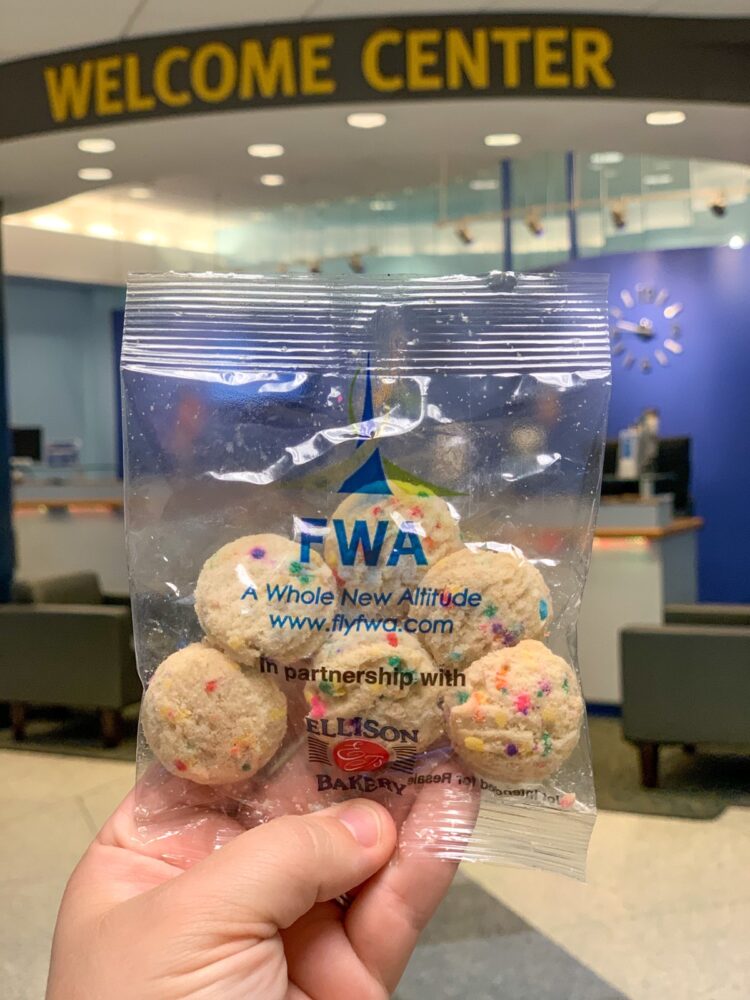
Without a doubt, Fort Wayne International Airport has one of the best airport amenities we’ve encountered: free cookies for all arriving passengers.

On our first visit to FWA, a seatmate told us that we’d get a cookie on arrival. We thought they were making a joke. But it turned out they were not kidding at all.

The cookies are baked at Ellison Bakery, just across the street from the airport. And FWA has been handing out these delightful welcome snacks for more than 20 years.

The cookies are clearly a hit: in June 2020 the airport handed out its “3 Millionth Cookie” and debuted a new style of cookie. Now, instead of one cookie, every arriving passenger at Fort Wayne International Airport is welcomed with a package that’s filled with several miniature cookies. The flavors include Birthday Cake and Chocolate Chip and several other varieties are rotated in.

2. Local brands at FWA

FWA puts an emphasis on local brands in the airport. Chapman’s Brewing Company out of Angola, Indiana serves a touch of Northeast Indiana with locally brewed beer on tap. And Conjure Coffee brings a sampling of Fort Wayne’s local coffee scene to FWA.

3. Customer service at FWA

We told you about the cookies that the Hospitality Hosts hand out to passengers at FWA. In any airport, that would check the box for customer service.

But FWA doesn’t stop there. The airport’s Customer Service Agents (CSAs) also provide complimentary curbside luggage service, wheelchair assistance, a parking lot shuttle, and other services.

4. Hospitality PAWS

Hospitality PAWS is FWA’s certified therapy dog program.

All the pups are highly trained and certified through the Alliance of Therapy Dogs and show up with their trainers at select times during the week.

5. More to come at FWA

Project Gateway is FWA’s expansion and improvement project. On the agenda: the Parking Lot Rehabilitation Project, East and West Terminal Apron Improvement Project, and the FWA West Terminal Building Expansion. That last piece will add additional gates, a new Mother’s Room, an upgraded Children’s Play Area, and expanded ticketing area, a modernized exterior façade, and more.   

Did we miss your favorite feature of Fort Wayne International Airport? Let us know in the comments section below. And feel free to nominate the next airport to be featured in the “5 Things We Love About…” series.

Touring Van Nuys Airport (VNY) with Vinny

Airports are missing us as much as we are missing airports.

And because the pandemic is keeping visitors away, California’s Van Nuys Airport (VNY) now has a new virtual tour for anyone interested in learning about what goes on at this busy general aviation airport.

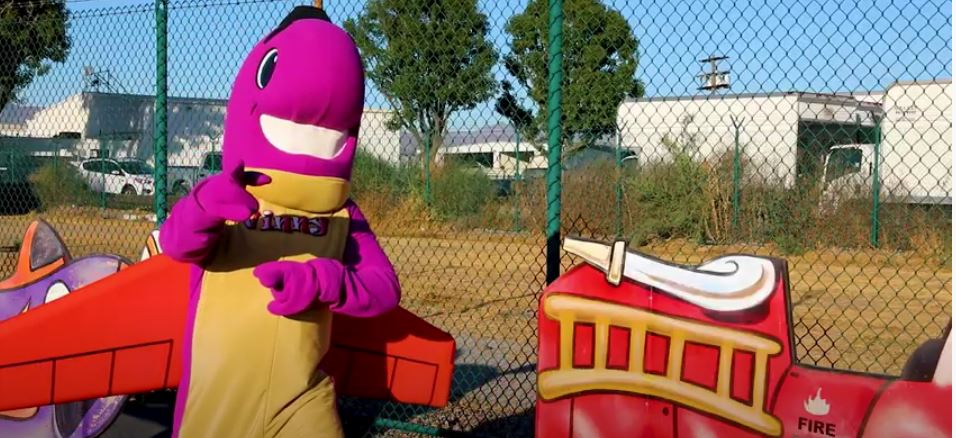
The 12-minute video is hosted by airport mascot Vinny and geared for young kids. But there are plenty of great images and lots of useful information about airport operations to make this an educational visit for anyone.

Along the way, you’ll see propeller planes, jets, and helicopters and meet the airport’s firefighters and police officers.

And then, of course, there’s Vinny.

For even more fun, the Van Nuys Airport also has coloring books and aviation-themed activities on its website.

IND: 5 Things We Love About Indianapolis International Airport

Stuck at The Airport’s “5 Things We Love About…” series is back for the new year celebrating more features and amenities at airports around the country and the world.

Today we land at Indianapolis International Airport (IND)

.

5 Things We Love About Indianapolis International Airport (IND)

Indianapolis airport art
From Ron Baron’s ‘Baggage Claim” at IND Airport

1. All the Art at IND

Connections, by Cameron McNall and Damon Seeley at IND Airport

IND has a wonderful collection of permanent and temporary art collections displayed throughout the airport. Many of the pieces were created by artists or poets who live in Indiana or have ties to the Hoosier state.

2. The food at IND

IND is one of those airports where you want to arrive hungry.

The “World’s Best Shrimp Cocktail is served with a signature and very spicy cocktail sauce at Harry & Izzy’s steakhouse in Concourse A. The list of other eateries with local connections includes the Sun King Brewing Co., Shapiro’s Delicatessen, and Tinker Coffee. And check out this Reis and Irvy’s robotic yogurt kiosk.

3. Racing Cars in the IND Terminal

Indianapolis is home to the Indy 500, the largest single-day sporting event in the world. So IND airport displays vintage racing vehicles from the vault at the Indianapolis Motor Speedway Museum.

Passengers will also hear revving engine sound effects in the pedestrian bridge.

4. Largest Airport Solar Farm

IND lays claim to being home to the world’s largest airport solar farm. The field of panels creates enough energy to power 3,675 average American homes per year. For more energy, the airport has human-powered charging bikes.

5. Souvenir Shopping at IND

Souvenir shopping at IND? Fun options include made-in-Indiana candy at Natalie’s Candy Jar; books by Indiana authors at INK by Hudson and, for a splurge, a crystal basketball from Scoreboard on Concourse A.

Did we miss one of the features you love about Indianapolis International Airport? If so, drop a note in the comments section below. Also let us know which airport you’d like to nominate to be featured in our series next.

RDM: 5 Things We Love About Redmond Municipal Airport – Roberts Field

Welcome to another episode of our 5 Things We Love About… series, which celebrates features and amenities at airports around the country and the world.

Today we land at ‘The Aviation Gateway to Central Oregon’: Redmond Municipal Airport (RDM), a small airport 15 miles north of Bend that has plenty of charm – and some surprises.

As usual, if we miss something you love about Redmond Municipal Airport, please leave a note in the comments sections below.  And be sure to take a look at the other airports on our 5 Things We Love About.. series.

5 Things We Love About Redmond Municipal Airport (RDM)

1. Bigfoot at Redmond Municipal Airport

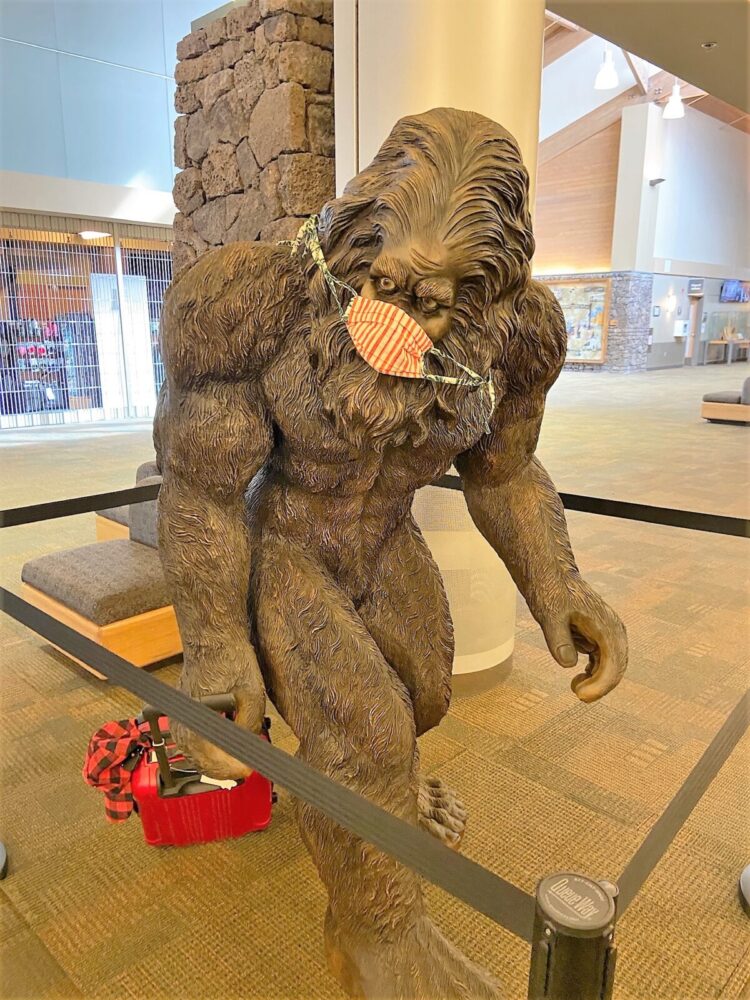
RDM is in Bigfoot country. And while few have ever seen the elusive creature alive in the wild, this Bigfoot statue lives in the terminal year-round.

2. Art and nature in the RDM terminal

The 100′” by 60″ American Flag quilt, above, was stitched together by 18 local women artists using various hand quilting techniques.

The tree, below, is an example of the beautifully gnarled and twisted Western Juniper trees that can be seen growing in the high desert of Central Oregon. RDM’s juniper tree is thought to be about 500 years old. A baby compared to the oldest juniper tree in Oregon, which is on a ridge east of Bend and may be more than 1600 years old.

3. Rocking chairs at RDM

We’re happy to see another airport with welcoming rocking chairs for passengers.

4. Kids play area and Flybrary Library

RDM has fun play areas for kids pre and post-security with activities for children of various ages. The airport’s Take One/Leave One ‘Flybrary’ is a partnership with the local library.

RDM also has a free flight-themed coloring book that’s easy to download.

5. Views of the Cascade Mountain Range from RDM

On clear days, you should be able to get a great view of the Cascade Mountain Range from RDM airport.

This viewing plaque will help you identify the 3 Sisters, Broken Top, Mt Bachelor, and other mountains.

If we missed one of your favorite amenities at Redmond Municipal Airport (RDM), please let us know. And if you spot Bigfoot in the wild near the airport, be sure to snap a photo and a send it along to StuckatTheAirport.com.

What are the best new airport amenities of 2020?

Despite challenges, airports landed welcome new amenities this year

[This is a slightly different version of the story we prepared for USA TODAY]

Despite the challenges set out by COVID-19 this year, airports pressed forward and introduced new features, new art, new technologies, and new amenities for passengers.

For example, in January 2020, Hartsfield-Jackson Atlanta International Airport (ATL), went smoke-free, one of the last major U.S. airports to do so. And in February, Milwaukee Mitchell International Airport (MKE) introduced a coat-check service. It is still the only U.S. airport offering this service.

Courtesy MKE

Here are some other new amenities airports introduced in 2020. Keep in mind that some may be temporarily unavailable due to health concerns.

New art, attractions, and a new terminal

Courtesy LaGuardia Gateway Parnters

As part of the much acclaimed rebuild of New York’s LaGuardia Airport, in November a 25-foot-tall water feature turned on in Terminal B, In addition to displaying various patterns and shapes, the water falling from the towers’ nozzles serves as a backdrop for projected laser shows.

During November, Denver International Airport (DEN) celebrated the arrival of the 27-foot-tall ‘Luminous Wind’ sculpture at the light rail station stop right before the airport.

Courtesy Denver International Airport

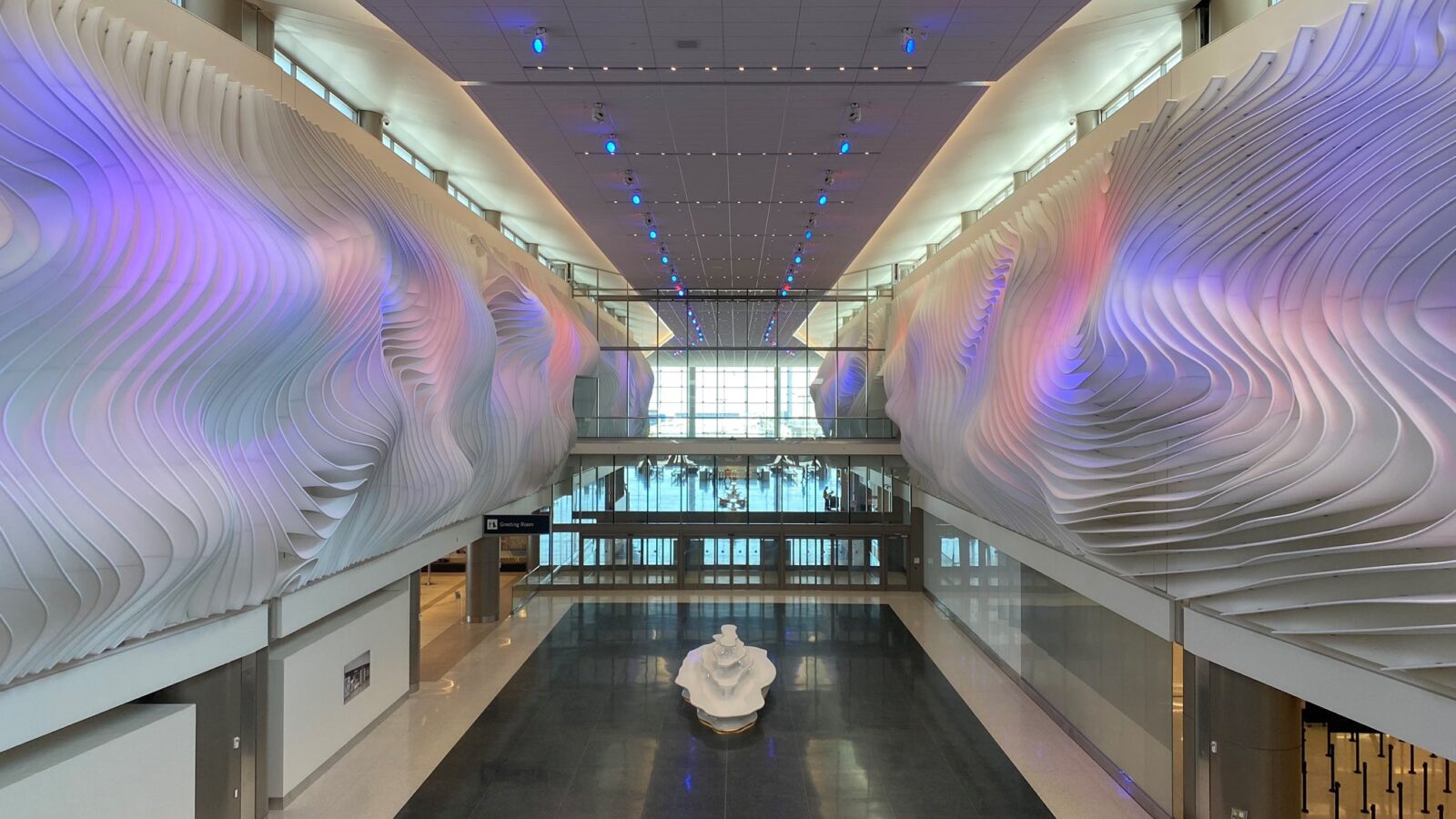
And in September and October, Salt Lake City International Airport (SLC) debuted its new Terminal B. This is the first phase of the first new hub airport built in the U.S. in the 21st century.

Courtesy Salt Lake City International Airport

New Observation Decks and a record-breaking sky bridge

In February San Francisco International Airport (SFO) opened the SkyTerrace. The pre-security deck in Terminal 2 is open to the public and offers 180-degree views of the busiest section of SFO, where all four runways intersect.

Seattle-Tacoma International Airport (SEA) claimed a spot in the record books in February with the installation of a 780-foot long pedestrian bridge that is now the world’s longest structure over an active taxiway.

Courtesy Port of Seattle

And as part of its Gate Expansion Program, in November, Denver International Airport (DEN) unveiled an outdoor deck on the west side of Concourse B. In addition to outdoor seating, the deck has a pet relief area and fire pits.

Courtesy Denver International Airport

Entertainment

While most airports had to put their in-terminal music and performance programs on hold, airports continued to offer entertainment.

Almost two dozen airports banded together in August and again in May for JetStream music festivals. The free, multi-hour livestream events featured musicians from the entertainment line-up offered by the participating airports.

Over the summer, California’s Ontario International Airport (ONT), which has served as movie set for some popular films, set up movie screens and drive-in movie nights. In October, Akron-Canton Airport (CAK) and Nebraska’s Lincoln Airport (LNK) had drive-in movie nights for Halloween-season movies.

Courtesy ONT Airport

And Dallas Fort Worth International Airport (DFW) debuted an entertaining Coca-Cola themed lounge in Terminal D complete with charging stations, seating, activities, and memorabilia-filled exhibits.

Courtesy DFW Airport

Fresh Services for health and safety

Of course, in response to the COVID-19 health pandemic, airports have been focusing time, energy, creativity and, of course, money on making sure the terminals are clean and safe for travelers.

Since March, airports throughout the country have sprouted hand-sanitizing stations, PPE vending machines, and temperature-check programs. They have developed contactless systems for bag check, check-in, security screening, and boarding. And both Grab and At Your Gate have expanded their offerings for in-airport food ordering and delivery.

Cleaning and sanitizing robots have joined the permanent staff at airports in Pittsburgh, San Antonio and many other cities.

Courtesy PIT Airport

In May, Louisville Muhammad Ali International Airport (SDF) introduced a virtual information booth. Los Angeles International Airport, Baltimore Washington International Airport (BWI), and Denver International Airport (DEN) now offer similar services. And as the holiday season kicks off, COVID-19 testing stations, many in partnership with airlines, are quickly proliferating at airports across the nation.

Courtesy SDF Airport

Did we miss a new airport amenity you spotted in 2020? Please let us know in the comments section below.

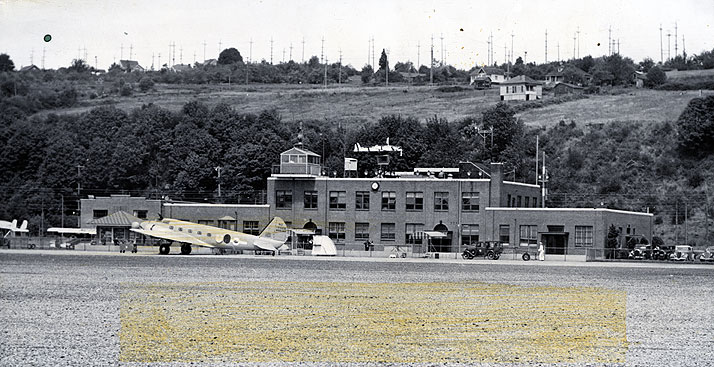
A photo tour of the aviation-themed art at Boeing Field

Then – Courtesy Washington State Historical Society

Boeing Field, officially King County International Airport (BFI), is located about 4 miles south of downtown Seattle and is one of the busiest general aviation airports in the country.

A lot of avgeeks head to this airport for planespotting and there’s a dedicated outdoor viewing area on the north side of the terminal.

But today we want to share some photos of the aviation-themed artwork that is both in and outside of the terminal building.

The images and the descriptions come to us courtesy of Seattle’s 4Culture, which funds a wide range of cultural projects in King County. When Boeing Field’s circa-1928 Air Terminal Building was being refurbished and renovated for a 2003 reopening, 4Culture commissioned a collection of site-specific art for the terminal that celebrates aviation.

30,000 Feet – by Brad Miller

Brad Miller. 30,000 Feet, 2003. Rulers, neon, and color photographs. King County International Airport, Seattle, WA. King County Public Art Collection. Photo: Joe Freeman

30,000 one-foot wooden rulers flank the entry to the airport’s terminal building. They are arranged into two enormous arrows that point toward the ceiling and a pair of illuminated photographs.

One is a picture of clouds in a royal blue sky and is the view passengers often see when they’re flying at 30.000 feet in a commercial airplane.

The other photo is smaller and suspended below the first photo. This photo depicts a lush, dark evergreen forest that a passenger flying in a small aircraft at 2,000 feet might see.

Luminaries by Norman Courtney 

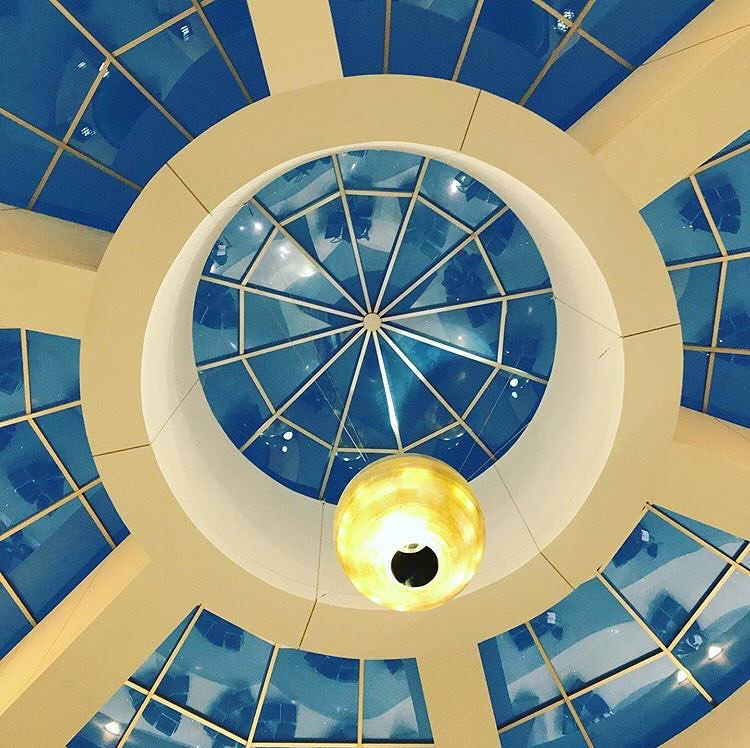
Norman Courtney (1947 – 2017). Luminaries, 2003. Aluminum, stainless steel, and glass. King County International Airport, Seattle, WA. King County Public Art Collection. Photo: Joe Freeman 

Bejeweled like 1930s pendants, these functional artworks by Norman Courtney reference Art Deco design elements and the history of the terminal building. They also conjure that era’s space-age imagery.

Our Place in Space – by Paul Marioni and Ann Troutner 

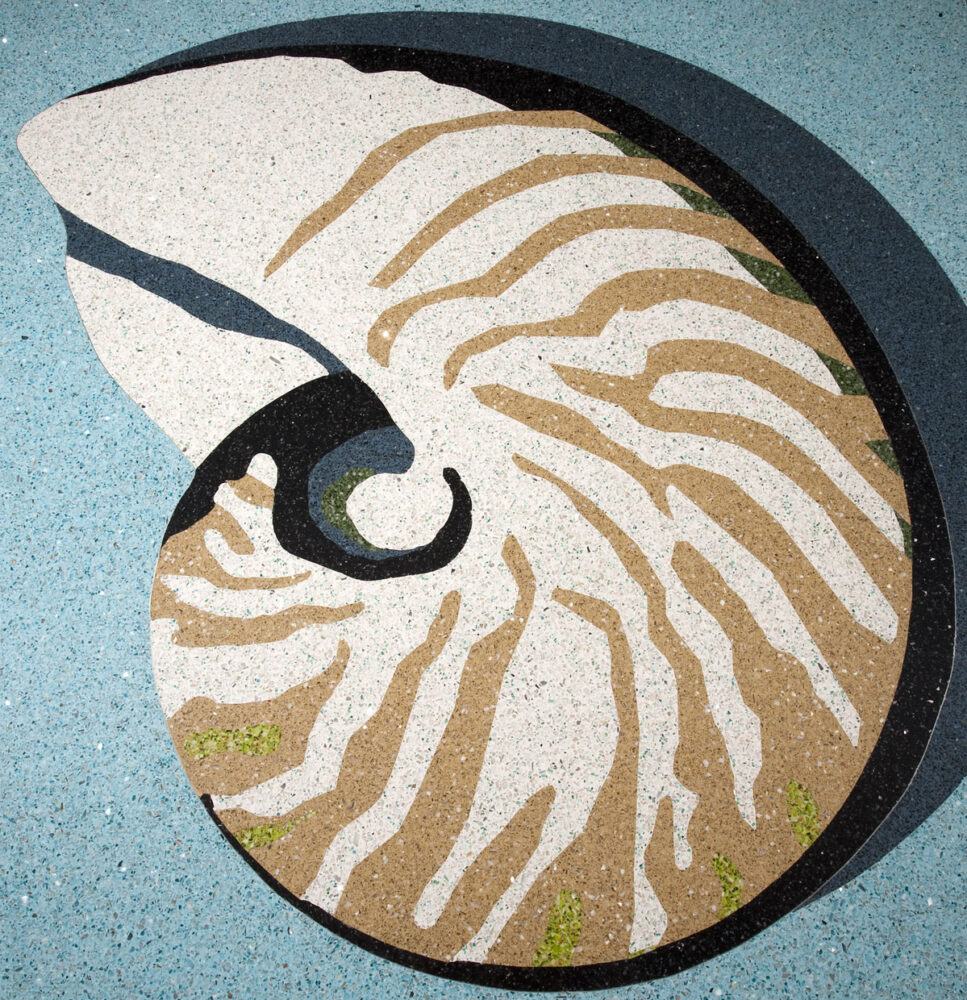
Paul Marioni and Ann Troutner. Our Place in Space, 2003. Glass terrazzo. King County International Airport, Seattle, WA. King County Public Art Collection. Photo: Joe Freeman 

The terrazzo floor inside the terminal building depicts the connection between the earth, the moon, and the cosmos. 

The building’s front doors open to a series of land and sea forms that represent North America. From there, a dark blue expanse sparkles with embedded glass, suggesting deep space—vast, fragile, and flecked with countless stars and other astronomical objects.

On the other side of the room, an image of the moon evokes cycles of waxing and waning, light and dark. When people walk from the entryway to the ticket counter they are walking to the moon.

Metropolis Fence Peter Reiquam 

Peter Reiquam. Metropolis Fence, 2004. Powder coated steel.  King County International Airport, Seattle, WA. King County Public Art Collection. Photo: Joe Freeman 

A fictional skyline with thunderclouds, searchlights, and a vintage Boeing 307 stretches across the steel fence by Peter Reiquam that links the main terminal building with the administrative building at King County International Airport.

All art photos courtesy of 4Culture.

BDL: 5 Things We Love About Bradley International Airport

Our “5 Things We Love About…” series celebrates features and amenities at airports around the country and the world.

Today we land at Bradley International Airport (BDL), in Windsor Locks, Connecticut, about 15 miles from Hartford. BDL is New England’s second largest airport and has a great tagline: Love the Journey

5 Things We Love About Bradley International Airport (BDL)

1. Rocking chairs at Bradley Int’l Airport

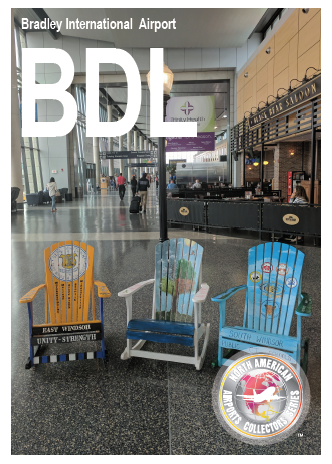
Rocking chairs scattered throughout the terminal are decorated by area high school students to showcase a school, town or region.

2. Art & exhibits highlighting area attractions

Two art pieces from the Dr. Seuss Museum in Springfield, MA (20 miles away) are displayed at Bradley International Airport. Travelers will also find two scale Lego models showcasing Connecticut’s iconic Mark Twain House and Museum as well as the Goodspeed Opera House.

3. Souvenir shopping at Bradley International Airport

You will find plenty of fun souvenirs in the BLD shops, including lobster lollipops and other items reflecting of the region to university themed apparel, such as clothing and memorabilia from Yale University and UConn, the University of Connecticut.

4. Therapy dogs at BDL

To help passengers “Love the Journey,” BDL airport partners with Bright Spot Therapy Dogs, Inc. for its therapy dog program.

5. The New England Air Museum at BDL

The 90,000-square-foot New England Air Museum is the largest aviation museum in the region and it is located right next to Bradley International Airport.

The collection includes more than 100 aircraft ranging from early flying machines to supersonic jets. More than half of the aircraft are on display in three large exhibit hangars and in an outdoor display area.

The museum has a large assortment of engines, artifacts and historical exhibits, including this wicker balloon basket from the 1870s built and flown by Plymouth, Connecticut native and aeronaut Silas Brooks that is believed to be the oldest surviving American-built aircraft.

Bonus: Sheraton Hotel at BDL Airport

The Sheraton Hartford Hotel is located in the terminal at Bradley International Airport. AvGeek alert: in addition to an indoor pool, the hotel has many rooms offering great views of the runway.

Did we miss one of your favorites amenities at Bradley International Airport (BDL)? Is there an airport you’d like to see featured in the “5 Things We Love About...” series on Stuck at The Airport? If so, please leave a note in the comments section below.

PIE: 5 Things We Love About St. Pete-Clearwater International Airport

The ‘5 Things We Love About…” series on Stuck At The Airport celebrates features and amenities at airports around the country and the world.

Today we land at Florida’s St. Pete – Clearwater International Airport (PIE).

Originally named Pinellas International Airport – that’s where the airport call letters PIE come from – the airport was renamed St-Pete Clearwater International in 1958 to capitalize on the airport’s location on tourist-friendly Tampa Bay, north of St. Petersburg.  

© James Borchuck 2010 (727) 420-5867

5 Things We Love About St. Pete – Clearwater International Airport (PIE)

Photo by James Borchuck

1. The art at PIE

The public art collection at PIE includes the 45-foot blown glass wall, SunSkySea, by Guy Kemper (above), glass vessels by Duncan McClellan, terrazzo floor tile inserts by Kelly Taaffe Noto and lots more.

2. PIE PUPS

The PIE PUPS program brings therapy dogs to the airport to help de-stress travelers. PIE also has new Bark Parks in the parking lots.

3. Family-Friendly Amenities

Bonus amenities at PIE includes a kid’s play zone designed by the Great Explorations Children’s Museum that features simulated flights and a lego table with airplanes. 

4. Local favorite Mazzaro Italian Market

Local favorite Mazzaro Italian Market has a branch at PIE featuring Italian hot and cold sandwiches and flatbreads and signature cocktails.

5. Aviation History

PIE airport’s location on Tampa Bay, north of St. Petersburg is credited as being the birthplace of commercial air transportation. 

On January 1, 1914, barely a decade after the Wright Brothers’ pioneer flight at Kitty Hawk, the first ticket for air travel was sold by the St. Petersburg-Tampa Airport line to a fare-paying passenger. 

St. Petersburg mayor A.C. Phiel (center in the photo below) paid $400 to be the first passenger on the St. Petersburg Tampa Bay Airport Line on a flight that marked the beginning of commercial air transportation. 

A replica of the Benoist amphibious airplane flown that inaugural flight is on display in the PIE baggage claim.

Courtesy Courtesy National Air and Space Museum Archives.

SAN: 5 Things We Love About San Diego International Airport

SAN: Five Things WE Love about San Diego International Airport

Our “5 Things We Love About…” series celebrates features and amenities at airports around the country and the world.

Today we land at San Diego International Airport (SAN), North America’s second-ever carbon neutral airport.

We know that due to health concerns, some amenities we love may not currently be available. We’re confident they’ll be back.

5 Things We Love About San Diego International Airport (SAN)

1. The art at San Diego International Airport

San Diego International Airport has a robust art program with great permanent public art pieces and temporary exhibitions.

Above are some snaps of The Journey by Jim Campbell. The light ribbon is both the Airport Authority’s largest commission and largest scale artwork and is made up of 38,000 suspended LED pendants spanning six feet wide by 700 feet long. Located in Terminal 2, the artwork has images of people swimming, dancing and walking, and birds in flight, fluttering throughout the sculpture.

2. SAN is home to the California Least Tern

The San Diego International Airport is home to the California Least Tern (Sterna antillarum browni, “CLT”), a federally listed endangered seabird species. The airport provides the tern with a nesting habitat and easy access to foraging opportunities in nearby San Diego Bay.

3. SAN has its own beer

San Diego International Airport (SAN) partnered with local brewery Ballast Point and industrial water purification company, Water Works, Inc., to brew a beer – called SAN Test Pilot.

The water for SAN Test Pilot comes from condensate that drips from the bottom of air conditioning units attached to jet bridges. The Airport’s Environmental Affairs team began collecting the dripping condensate in 2014 and currently captures about 100,000 gallons per year from 18 of the most heavily used jet bridges at terminals 1 and 2.

In addition to making beer, the water is used to wash sidewalks, equipment, vehicles and building exteriors and in the cooling towers that control the temperature in the terminals.

4. SAN’s artist in residence program

In addition to a performing arts program, San Diego International Airport has a performing arts residency program that gives area groups space to develop new work and the opportunity to perform.

The program kicked off in 2016 with the Fern Street Circus and since then has hosted a wide variety of performance groups, including an aerial dance theater.

5. SAN’s Innovation Lab

SAN’s Airport Innovation Lab is a 16-week accelerator program that helps entrepreneurs, start-ups, and other businesses get a healthy foothold in the airport industry.

The program provides testing for the ideas and a one-year technology-intensive collaborative program. 

Past Innovation Lab start-ups you may recognize include Fuel Rod and At Your Gate.

 Did we miss your favorite amenity at San Diego International Airport (SAN)? If so, drop a note in the comments section below.

And please take a look at the other airports featured in the ‘5 Things We Love About..” series. Let us know which airports you’d like to see added.

Not a joke: Berlin’s Brandenburg Airport (BER) ready to open.

After 9 years of delays and false starts, Germany’s third-largest airport, Berlin Brandenburg “Willy Brandt” Airport (BER) is scheduled to open on October 31, 2020.

We won’t be able to be there for the opening, but we’re looking forward to a visit once this COVID-19 business is resolved.

In the meantime, here’s a recap of our 2014 visit to the airport site, when we joined a bus tour of the unopened airport.

Our report first appeared on USA TODAY.

Berlin  Brandenburg Airport is late for an important date

The highlight of my late June visit to the unopened and much-delayed Berlin Brandenburg  Willy Brandt Airport was racing down a runway as a passenger in a tour bus going more than 60 miles per hour.

It was also one of the saddest parts of the tour.

That’s because due to technical glitches, cost overruns, corruption and project mismanagement, tour buses – not airplanes – are likely the only vehicles that will be barreling down the BER runways for quite some time.

Under construction since 2006, Berlin’s much-needed new airport was designed to serve 27 million passengers, with an initial opening target date of November 2011.

That date was pushed back to June 3, 2012, and, despite trial runs during which the airport authority did tests of the baggage carousels, check-in desks, and security checkpoints, and simulated what it termed “all imaginable scenarios,” a problem with the airport’s fire safety and suppression system was discovered.

With just four weeks’ notice, opening day was called off.

Since then multiple target dates for a new opening day – six or seven, it’s hard to keep count – have come and gone. Now all the company managing the project will say is that “an opening date is expected to be announced at the end of the year.”

2016 has been bandied about as the next possible opening date, but additional problems and embarrassing operational revelations keep cropping up.  

In May, there was an announcement of a suspected corruption case involving bribes for the awarding of contracts. In early June, there was out-of court settlement between the airport management company and airberlin, the major tenant at Berlin’s outdated Tegel Airport, over claims the airline felt it was due because of delays in the switchover.

And at the end of June, it was revealed that the engineer responsible for designing the new airport’s fire safety system was in fact just a draftsman, not a real engineer, and had been fired.

Besides showing off any progress, one reason the airport authority offers BER tours “is because it’s important that people don’t only read about the airport in the newspaper and see the reports on TV,” said an airport spokesman.

Tour buses stop first at a 105-foot-tall observation tower offering a bird’s eye view of the unopened airport terminal, the unused runways, empty parking lots, and assorted other facilities-in-waiting.

At the bottom of the tower is an airport information center, with a scale model of the airport and a glass cabinet of souvenirs emblazoned with the BER logo.

The staff on duty the day I visited said they don’t sell many of these souvenirs to tourists. And they seemed amused when I asked about purchasing some BER t-shirts, baseball caps, tote bags, inflatable plastic beach balls, and small, plastic lunch boxes.  

Our tour bus then drove slowly past the very quiet office, cargo, and airport security facilities and by the railway station, where empty trains run each day to make sure systems remain working.

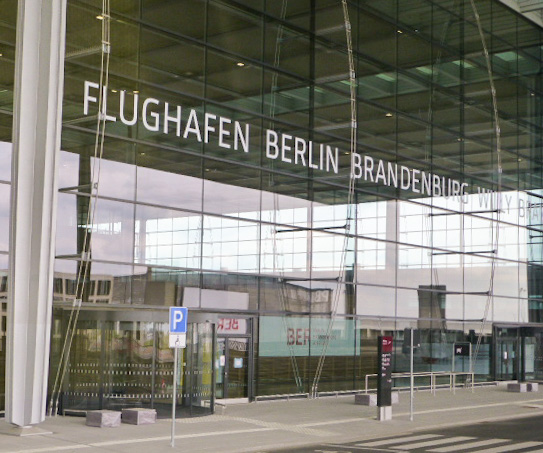
Photo ops of the front of the main terminal building were only offered from inside the bus, but the terminal’s glass façade offered a glimpse of “The Magic Carpet,” by Pae White. The large, red, work of art, one of several pieces specially-commissioned for the airport, hovers over the check-in lobby.

Out back, the bus pulled up at BER’s one A380-compatible gate, which has a jet bridge draped with Olaf Nicolai’s “Gadget,” a piece of art that looks like a string of giant pop beads and is designed to change colors to match those of the livery of the airplane at the gate.

Tour-goers were allowed off the bus here and invited up a set of not-quite-finished stairs for a look at a gate area where seats were installed, but still wrapped in plastic, and ceiling panels gaped open.

“It’s not unusual for big projects like this to be over budget,” said Johann Bammann, a retired architect whose tour ticket was a gift from a friend. But delays are dragging on too long, he said, “it’s time for the city to have a new front door.”

After a stop near the control tower, the bus made that dash down the runway, stopping to let passengers out to run around and pose for photos.

“It’s just unbelievable. I can’t understand why it’s taking such a long time to open this airport,” said Barbel Liedtke, a former Berlin-based Pan Am Airlines employee taking the tour with a friend. “But I’m sure there are a lot of people to blame.”