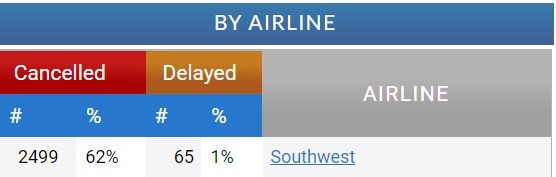
Early Wednesday morning, Flightaware.com was showing almost 2500 Southwest Airlines flights canceled. That leaves thousands of passengers still stuck at airports around the country.
All other domestic airlines now have their schedules back on track since the last weekend’s bad weather. But not Southwest. The airline continues to suffer from staffing problems, software and technology failures, and other challenges.
Southwest Airlines CEO Bob Jordan offered apologies. ( See below). And the airline is offering to cover the costs of hotels, car rentals, and tickets on other airlines in an effort to help out inconvenienced passengers.
If your plans have been ruined, here’s a link to begin filing for that reimbursement. Also be sure to check your credit card for any travel delay benefits it may offer.
The Department of Transportation has vowed to investigate.
But that isn’t really doing much right now to fix the problems and headaches this meltdown has caused. Nor will it make up for ruined holidays and family gatherings, and missed meetings, weddings, funerals, and other important events people were trying to get to.
On the heels of wide-scale disruptions, we're working diligently to Safely recover our operation & accommodate displaced Customers & Crews. We know this is unacceptable & sincerely apologize. If your travel was impacted, explore self-service options here: https://t.co/B6L8HR9Yqcpic.twitter.com/mLWndYMned
Not only are Southwest Airlines passengers still stuck at airports all over the country, baggage is pilling up in bag claims. And many people won’t get flights home until after January 1.
This is the Southwest Airlines baggage claim at @FlyTPA. There’s well over 1,000 bags stacked here. People searching through bag tags here say they haven’t seen their luggage in days @BN9 pic.twitter.com/lvpPeINugZ
Southwest Airlines is the focus of passenger anger after canceling thousands of flights and leaving people stranded. @SecretaryPete joined @JudyWoodruff to discuss how the Department of Transportation will hold Southwest accountable.https://t.co/TArbsnQNEM
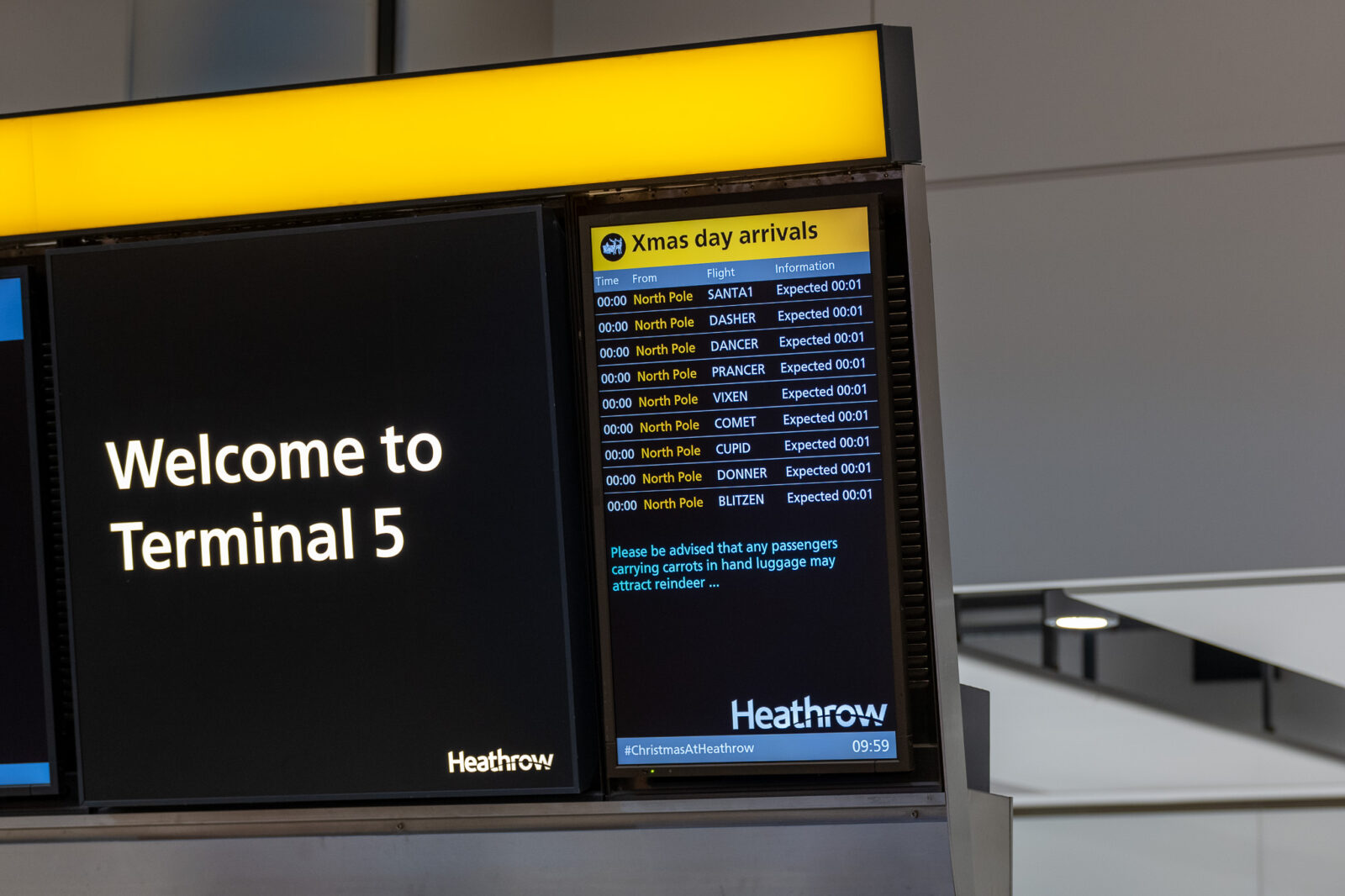
For everyone except Santa and his reindeer, flying this holiday has been a mess.
There’s so much snow in upstate New York that Buffalo Niagara International Airport (BUF) is staying closed until at least 11 a.m. on Wednesday, December 28.
And the airport’s award-winning snow removal team is so overwhelmed with snow that is has called on other airports to help them deal with this blizzard.
“Our crews are working around the clock and @PITairport will be sending additional snow plowing equipment to assist our team,” the airport shared in a Tweet.
The Buffalo Airport will remain closed until Wednesday, Dec. 28 at 11 a.m. Our crews are working around the clock and @PITairport will be sending additional snow plowing equipment to assist our team. Visit https://t.co/kYwXuaMsRD for updates. pic.twitter.com/kY1KzuZAhj
— Buffalo Niagara International Airport (@BUFAirport) December 26, 2022
Southwest Airlines Meltown
Thousands of flights have been canceled and all airlines are having a tough time getting passengers and their suitcases from here to there.
But Southwest Airlines operations seem to have broken down – or frozen up – completely.
At 1 am Tuesday morning, FlightAware.com was showing more than 2,600 cancellations within, into, or out of the United States, with most of those being on Southwest Airlines alone.
The airline cancelled more than 2900 flights on Monday and has already canceled 2460 flights for Tuesday.
The next few days may get even worse.
In a media release late Monday, Southwest said, “With consecutive days of extreme winter weather across our network behind us, continuing challenges are impacting our Customers and Employees in a significant way that is unacceptable.”
The airline said “our heartfelt apologies for this are just beginning.” But it added: “As we continue the work to recover our operation, we have made the decision to continue operating a reduced schedule by flying roughly one third of our schedule for the next several days.”
But it may be more serious than that.
Tweets like this were shared Tuesday night from cities all over the country confirming that Southwest customers are being told no flights will be rebooked until after December 31.
As in “next year.”
BREAKING: @SouthwestAir says to passengers at Hobby Airport they are not rebooking tickets for canceled flights until after Dec. 31. @houstonpolice increasing security presence in anticipation of this announcement to a line of hundreds, who have been waiting 5 hours to rebook. pic.twitter.com/hXzXf3DtZn
That means that a lot of people whose flights have already been canceled are going to have to wait even longer to get on a plane.
The Department of Transportation has taken notice, calling Southwest’s rate of cancellations and delays and report of poor customer service “unacceptable” and saying it “will examine whether cancellations were controllable and if Southwest is complying with its customer service plan.”
USDOT is concerned by Southwest’s unacceptable rate of cancellations and delays & reports of lack of prompt customer service. The Department will examine whether cancellations were controllable and if Southwest is complying with its customer service plan.
Airline trade group IATA – the International Air Transport Association – is hosting a gathering of journalists in Geneva, Switzerland this week and laying out a wide variety of reports, predictions, and challenges.
IATA reports that in 2023, as air travel rebounds from COVID-19 restrictions, the global airline industry expects to post a small net profit of $4.7 billion, with more than 4 billion passengers taking to the skies. That’s a 0.6% net profit margin and the industry’s first profit since 2019.
In 2021 and 2022 airlines lost billions of dollars due to the pandemic.
The 2023 return to profit is a “great achievement considering the scale of the financial and economic damage caused by government-imposed pandemic restrictions,” said IATA Director General Willie Walsh. But he warned that many airlines will continue to struggle next year and into the future.
And he lashed out at airports – and their charges to airlines – as adding to the struggle.
“It’s very important that everybody understands just how fragile the recovery is,” said Walsh. “But the margins we are operating with are very small and we cannot tolerate a situation where airports in particular attempt to gouge airlines and their passengers by significant increases in airport charges. Every single cent matters.”
The Airport Industry Responds
As you might imagine, Walsh’s comments about airports don’t sit well with the airport community.
And Luis Felipe de Oliveira, the World Director General of airport trade group Airports Council International (ACI) swiftly responded to Walsh’s comments about airports and airport charges.
“Attacking industry partners does not reflect the collaborative spirit the industry needs for the common goal of providing safe, reliable, and efficient air transport,” said de Oliveira.
“Like airlines and other areas of this ecosystem, airports are businesses too and affected by cost rises in the industry outside of their control. It is a reality we’re all facing—high costs of energy, inflation, and staff shortages.”
de Oliveira noted that airports had a 49% drop in aeronautical revenues during 2020-2021. Costs have gone up, he said, while revenues are not keeping pace.
“It is important to remember that airports are infrastructure-intensive businesses—meaning they have unavoidable high fixed costs. What’s more, significant investment will be needed going forward to meet demand and transition to sustainable energy sources,” said Oliveira. “Airlines have been able to increase their tariffs during the last year, which is different from the airports that need to follow regulatory frameworks.”
In the end, “aviation is one ecosystem,” said Oliveira. “We must focus on the benefits to passengers and communities. And for this, all parts of the ecosystem need to be healthy.”
On Monday, the Transportation Department fined a half-dozen airlines more than $7 million for failing to provide timely refunds to customers.
The DOT said the six airlines have also now collectively paid more than half a billion dollars to people who were owed a refund due to a canceled or significantly changed flight.
Frontier Airlines is the only U.S. airline on the list. And it got the biggest fine: $2.2 million. According to the DOT, the airline has issued $222 million in refunds.
Here’s a list of the other airlines fined and the amount of refunds they are required to pay:
The fines assessed and the required refunds provided are:
Air India – $121.5 million in required refunds paid and a $1.4 million penalty
TAP Portugal – $126.5 million in required refunds paid and a $1.1 million penalty
Aeromexico – $13.6 million in required refunds paid and a $900,000 penalty
El Al – $61.9 million in required refunds paid and a $900,000 penalty
Avianca – $76.8 million in required refunds paid and a $750,000 penalty
You Can Now Take the Metro to Dulles International Airport
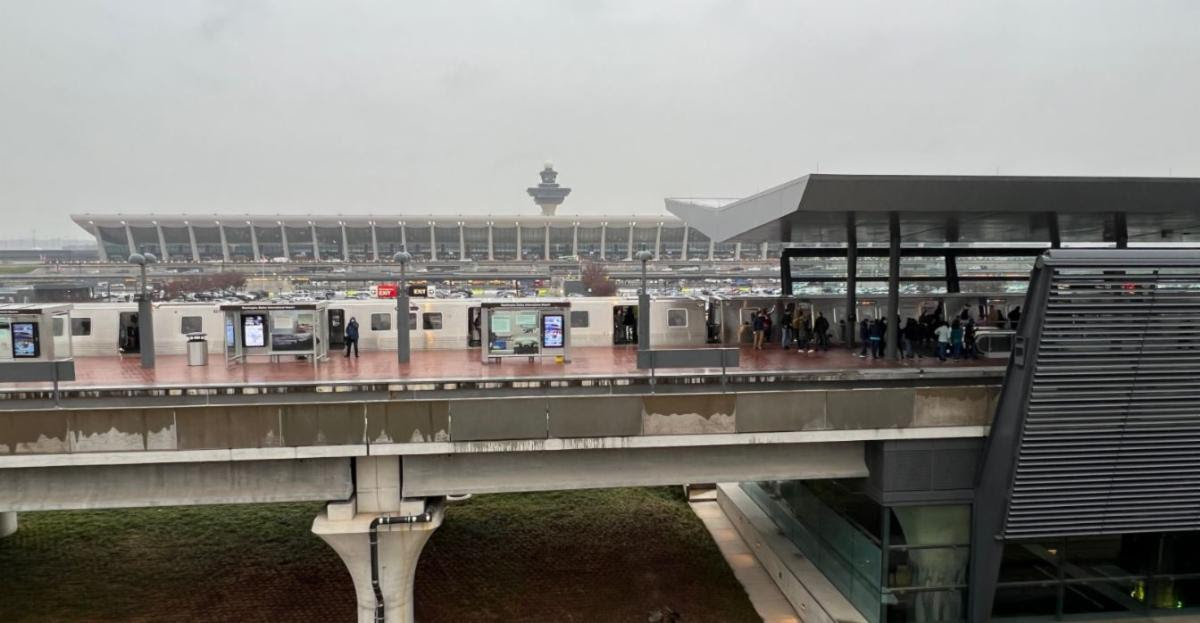
With the opening of the long-awaited Silver Line Metrorail station at Dulles International Airport (IAD) on Tuesday, travelers and airport employees can now take the train directly to Dulles from downtown Washington, D.C.
The new station at Dulles is connected to the main terminal by an indoor pedestrian tunnel with moving sidewalks. Transit time from Metro Center in downtown D.C. is estimated at 53 minutes. And, depending on when you ride and where you access Metrorail, the fare will be between $2 and $6. Trains will leave the Dulles Silver Line station about every 15 minutes.
Now one of these pods has been installed at the Museum of Modern Art in New York City.
Located under the lobby escalators on the Museum’s ground floor, the free-to-use pod not only provides a private, comfortable space for parents to pump or breastfeed, this one doubles as a gallery space.
Courtesy Mamava
The interior of the pod features reproductions of artworks by noted artist Betye Saar, including Anticipation (1961), which depicts the artist pregnant with her third child, In the Sunflower Patch (1963), and Flight (1963), depicting the early years of her daughter’s life. There’s also a quote by Saar in the pod, in which she reflects on motherhood, birthing, and her printmaking practice.
Great idea, right? Maybe airports will add art to their Mamava lactation pods too.
In addition to museums and airports, Mamava now has lactation pods in train stations, corporate offices, schools, hospitals, military bases, retail, universities, sports stadiums, and zoos. You can locate them with a free locator app.
Big news in the airline world. JetBlue is buying Spirit Airlines. Price tag: $3.8 billion.
Read these stories to learn more.
We’re proud to announce JetBlue & @SpiritAirlines will come together to create a bigger, better JetBlue. After closing, we will offer 1700+ daily flights to 125+ destinations—and the low fares and award-winning service you know and love. Learn more: https://t.co/K0uz5rX3A1pic.twitter.com/CjKzkhLJXO
We’ve announced plans to combine with @JetBlue to deliver low fares & award-winning service to 77 million Guests on 1,700+ daily flights to over 125 destinations in 30 countries. Creating a national low-fare challenger to the dominant Big Four US airlines. https://t.co/NYJkp5PPvcpic.twitter.com/wgfn3R5vvL
JetBlue has agreed to buy Spirit Airlines for $3.8 billion in a deal that would create the nation's fifth largest airline if approved by U.S. regulators.https://t.co/LvKYwqm2Kd
JetBlue reached a deal to buy Spirit for $3.8 billion, creating the fifth-largest U.S. carrier after a fierce bidding war with Frontier https://t.co/63gjYsT2wi
“Customer satisfaction with North American airlines climbed to unprecedented highs for all of the wrong reasons during the past two years,” Michael Taylor, travel intelligence lead at J.D. Power said in the report’s release statement. “Fewer passengers meant more space on airplanes, less waiting in line, and more attention from flight attendants. But that business model was simply not sustainable.”
Now, Taylor says, volumes are surging, some pandemic-era constraints are still in place, and passenger satisfaction declined in all three study segments—first/business, premium economy, and economy/basic economy.
The charts below show how passengers ranked North American carriers by segment, using eight measurement factors: aircraft; baggage; boarding; check-in; cost and fees; flight crew; in-flight services; and reservation.
The overall score was 798 – on a 1,000-point scale – which is down more than 20 points from a year ago.
You’ll see that JetBlue and Alaska Airlines topped the rankings in the First/Business segment; JetBlue and Delta Air Lines finished first in the Premium Economy sector; and that Southwest and JetBlue led in the economy segment.
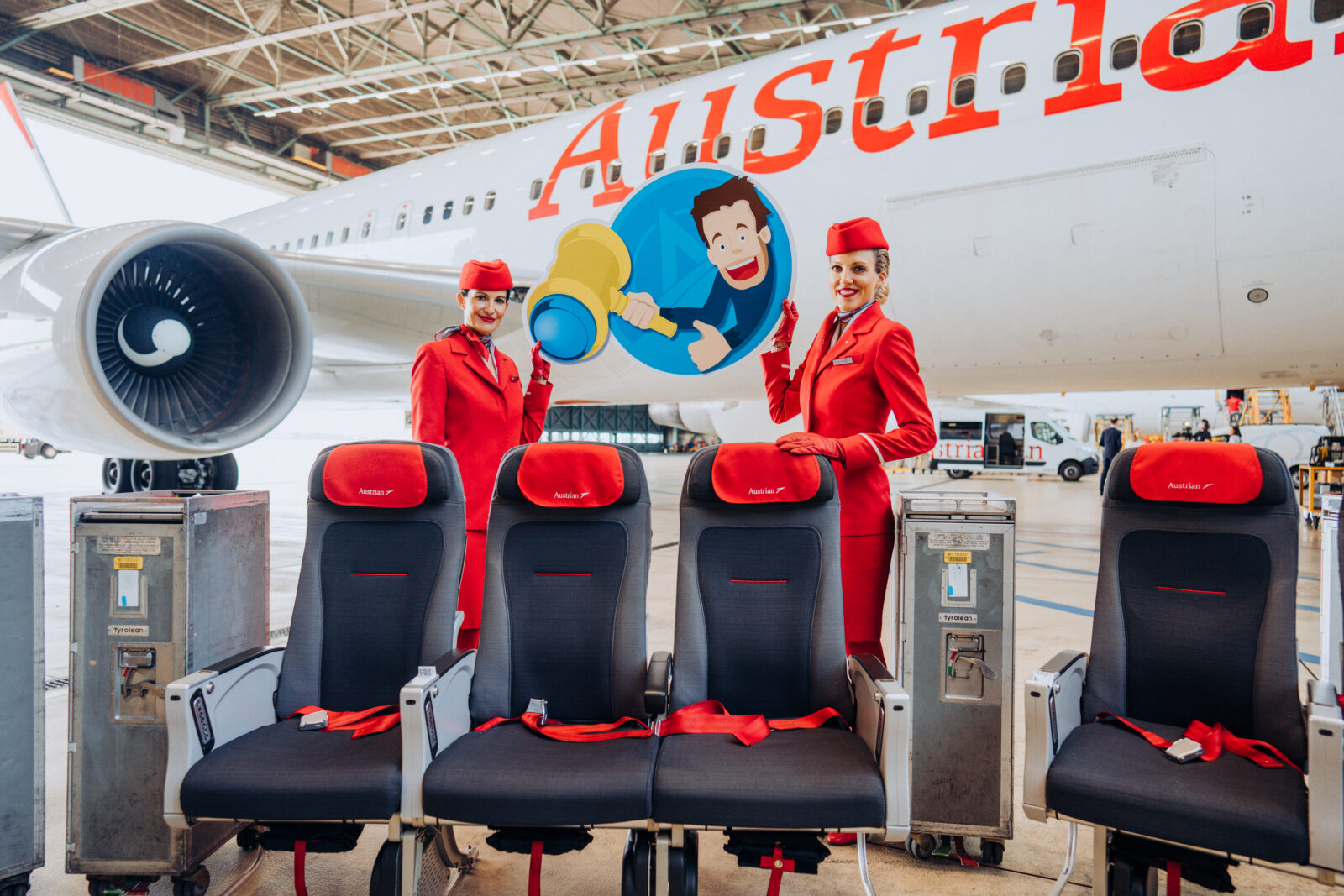
Austrian Airlines is auctioning off Economy Class airplane seats from its Boeing 767 fleet and 170 flight trolleys and donating the proceeds to the nonprofit Nachbar in Not (Neighbor in Need) to support people in Ukraine.
The seats saw service on transatlantic flights and were removed to make way for Premium Economy Class seats. The starting price for the double and triple rows varies between $250 and $380.
Austrian Airlines says that, like the seats, the drink trolleys (starting auction price $52) have “seen the world” and are now waiting for new purposes as, perhaps, “a nice piece of furniture, home bar trolleys, or sturdy toolboxes.”
“As the red-white-red flag-carrier, which has been connecting Austria with Europe and the world for more than 60 years, we are very pleased to share a piece of aviation history – and thereby help people in need,” said Austrian Airlines CCO Michael Trestl in a statement. “With this charity project, we want to make at least a small contribution to ease the suffering of the Ukrainian people.”
Bidding open now
Bidding on the auction items is open now, with the final acceptance of bids (notification to bid ‘winners’) on May 21.
You can see the seats and drink trolleys being auctioned online or in-person in Austria, where you’ll also need to go to pick your auction items.
“We thank Austrian Airlines and AURENA [the auction house} for this charitable project for the benefit of Nachbar in Not,” said Martina Schloffer, Dep. Head of International Cooperation at Austrian Red Cross. “Millions of people are currently suffering and depend on humanitarian aid. The donations will allow us to facilitate needs-based assistance, like water, food supplies, hygiene products or medicines.”
[This is a slightly different version of a story we wrote for NBC News online]
There are subscriptions for just about everything these days, including streaming services, pet toys, meal plans, even crime-solving kits, and every year there are millions more people willing to pay for them.
According to an international survey by Zuora Subscribed Institute, 78 percent of U.S. adults paid for subscription services last year. The financial services firm UBS predicts the subscription business will continue to grow by 18 percent a year, to $1.5 trillion by 2025.
The travel industry has stayed on the sidelines for much of the subscription boom. But that’s changing. Airlines, rental car companies, and a growing number of hotels and resorts are introducing or expanding their subscription plans to attract the work-from-anywhere workforce and the growing number of leisure travelers who want to go to more places and stay longer.
The industry is “jumping on the subscription bandwagon because it locks in customers and increases profits,” said trends expert Daniel Levin of the Avant-Guide Institute, a travel and trends consulting company. For the right travelers, subscriptions can offer “the one-two punch of lower prices and greater convenience.”
But subscription deals also come with restrictions and fees that can make them costly if travelers’ circumstances change.
Subscribe and Fly
In 2009 and 2010 JetBlue offered the All You Can Jet pass, which gave pass holders unlimited flights for a month.
For very frequent travelers, American Airlines currently offers AirPass, a twist on the $ 250,00-lifetime unlimited travel pass sold in the early 1980s.
Now, for a $10,000 to $30,000 upfront payment, flyers can lock in access to fixed-rate fares on American Airlines and several partners and get enhanced travel flexibility and lots of VIP amenities, including lounge access, upgrades, and other perks. Customers that renew their membership each year may roll over unused funds. Those that don’t, lose them.
In February, Alaska Airlines launched a new subscription program.
For a fixed monthly rate of $49 to $550 and a yearlong commitment, Flight Plan subscribers can take up to 24 round trips, depending on the plan, among 16 airports in California, Nevada, and Arizona, including Los Angeles, Reno, Phoenix, and Las Vegas.
One of those subscribers is Eli Cohen, a qigong instructor who splits his time between San Francisco and Palm Springs, California. He is well-acquainted with the way ticket prices can swing up and down on that route. When the cost of a round trip soared to $400 last month, he decided to subscribe. Now, “instead of $400 for one round-trip flight, I’ll pay $600 and get six flights for the year,” he said. “And I’m also looking at flying for vacation to Los Angeles and San Diego.”
Alaska won’t disclose sign-up numbers, but “we are tracking just ahead of our full-year projections,” said Alex Corey, Alaska Airlines’ managing director of business development and products. He also said 1 of 3 new subscribers hadn’t flown Alaska in at least three years and that most have committed to more flights than they had taken with the airline at any time in the past.
Henry Harteveldt, a travel analyst and the founder of Atmosphere Research, said, “There has never been a more compelling time for airlines to consider developing subscription products than now.”
He adds, “The travel business is like the soda business. The only way for brands to grow their market share is by stealing customers from their competitors. And fewer travelers view themselves as loyal to airlines and hotel brands than in 2019.”
Smaller airlines, including Volaris, a Mexico-based low-cost carrier, and FlySafair, a low-cost South African airline also offer subscription plans, and several other airlines in South America and Europe are expected to announce plans soon, said Iñaki Uriz, the CEO of Caravelo, a subscription platform for the airline industry.
“Before the pandemic, airlines were in their comfort zone and felt they had everything under control,” he said. Now, with the big drop-off in business travel and the rise of remote work, “airlines are much more willing to risk change, evolve and innovate.”
Subscribe and Stay
Hotel operators and other lodging companies are also embracing the subscription model to build relationships with 20- and 30-something travelers, who intend to blur the line between work and travel and are comfortable with monthly fees.
Selina, for instance, is an upscale hostel network based in Panama geared toward remote workers and what it calls “digital nomads.” The company has more than 90 properties in 18 countries, including the U.S., Brazil, and Costa Rica. Its CoLive subscription package starts at $450 a month for dormitory-style accommodations with shared bathrooms, communal kitchens, and common workspaces. Private rooms can run $3,000 a month or more, depending on the location. Subscribers can stay up to 30 days in one location or switch locations up to three times during the month.
The Dutch boutique hotel chain citizenM, known for its hip and high-tech design, is about to roll out a retooled and renamed version of a subscription plan it launched during the pandemic when travel was in deep trouble. For Ernest Lee, the chain’s chief growth officer, that was the point.
Before the pandemic, “we were never in the right position to risk our existing business because market conditions were quite stable,” he said. “But once your occupancy goes down to single digits, you are emboldened to try new ideas.”
One of those ideas was Global Passport, which cost $1,500 a month, for up to 29 consecutive nights at its properties in Europe, the U.S., and Asia. The plan was discontinued as the new one was being developed.
Subscription travel also comes in luxury versions. Inspirato is one of the industry’s biggest luxury travel membership companies. Its Inspirato Pass includes access to vacation homes and luxury hotels around the world, as well as experiences and travel planning. There is a $2,500 enrollment fee, a monthly fee of $2,500, and no minimum commitment. There are certain rules around booking stays, and two weeks is the maximum for one location.
Kathryn Wong, who travels frequently with her husband, said they were thinking about buying a vacation home. They signed up for Inspirato, instead. “I tracked all our Inspirato trips last year and compared our $30,000 in dues to the [prices] the actual resorts display for each trip,” she said. The value of the trips turned out to be more than twice the costs of the membership, “and we saved time in not having to do research and trip planning.”
Subscribe and Drive
If any part of the travel industry has been hit hard by the huge fall-off in business travel, it’s the rental car business, which relied heavily on corporate accounts.
The industry is just “dipping a toe in the water” with subscription programs, said Mike Taylor, the practice lead for travel intelligence at J.D. Power. Enterprise and Hertz have plans in which renters pay a set monthly fee, without a long-term commitment, and have the option to switch cars multiple times each month.
Enterprise’s plan costs $1,499 a month, with a two-month minimum and a $250 enrollment fee. The plan is available only in Minnesota, Missouri, and Nevada. Insurance is included, and drivers can swap out vehicles four times a month.
Hertz also has a two-month minimum, and it costs about the same at the high end, but it has a wider range of programs than Enterprise, one of them as low as $599 a month. At the moment, the plan is full because of supply chain issues, and the same shortage of rental cars that some travelers may remember drove prices into the stratosphere last year.
Taylor said he expects more car rental companies to come around to subscriptions. Younger generations are comfortable with the subscription model, he said. “And they are also the higher-margin renters.”
Individuals, organizations, and corporations are gathering humanitarian aid for the Ukrainian people fleeing the Russian invasion. Airlines are joining the effort and encouraging travelers to pitch in too.
United Airlines award bonus milies for donations
United Airlines MileagePlus members can donate cash or miles to the airline’s signature relief partners – Airlink, Americares, American Red Cross, and World Central Kitchen – by visiting united.com/UkraineSupport.
United will be matching the first five million miles donated and the first $100,000. To encourage donations, United is also awarding bonus miles to anyone who gives $50 or more.
Donate $50 – $99 and earn 250 bonus miles
Donate $100 – $249 and earn 500 bonus miles
Donate $250 or more and earn 1,000 bonus miles
“The human tragedy we are witnessing in Ukraine is horrifying and has shocked us all so we’re doing our part to quickly help get aid to the people who desperately need relief,” said United President Brett Hart. “Our partners have been on the ground for more than a week and it’s clear they need more resources to fulfill their mission of flying workers and supplies to and from the frontlines of this crisis.”
American Airlines
Throughout March, American Airlines funds collected online and on flights to and from international destinations and Hawaii by flight attendants through American’s partnership with UNICEF’s Change for Good program will go to support UNICEF and its humanitarian response in Ukraine.
The carrier says the funds will help reach vulnerable children and families in Ukraine and provide assistance with basic services including water, sanitization, immunization, and health care, as well as schooling and learning support and emergency cash assistance for up to 7.5 million children.
“It is deeply troubling to see the humanitarian crisis unfolding as a result of the conflict in Ukraine,” said Brady Byrnes, Vice President of Flight Service for American. “Our purpose at American Airlines is to care for people on life’s journey and in order to truly fulfill that purpose, we must step up when it matters most.”
The UNICEF Change for Good program is an alliance between the UNICEF and the international airline industry to convert spare change donated by customers traveling on aircraft into critical services and supplies for vulnerable children around the world.
In addition, all AAdvantage miles donated to American’s Miles for Social Good program during March will be directed to Airlink to help transport physicians and relief workers to Eastern Europe to assist with humanitarian relief in Ukraine. Airlink is a global humanitarian organization delivering critical aid to communities in crisis by providing airlift and logistical solutions to nonprofit partners responding to disasters around the world.
We’ll add more airline efforts to support Ukrainian refugees as we find them.
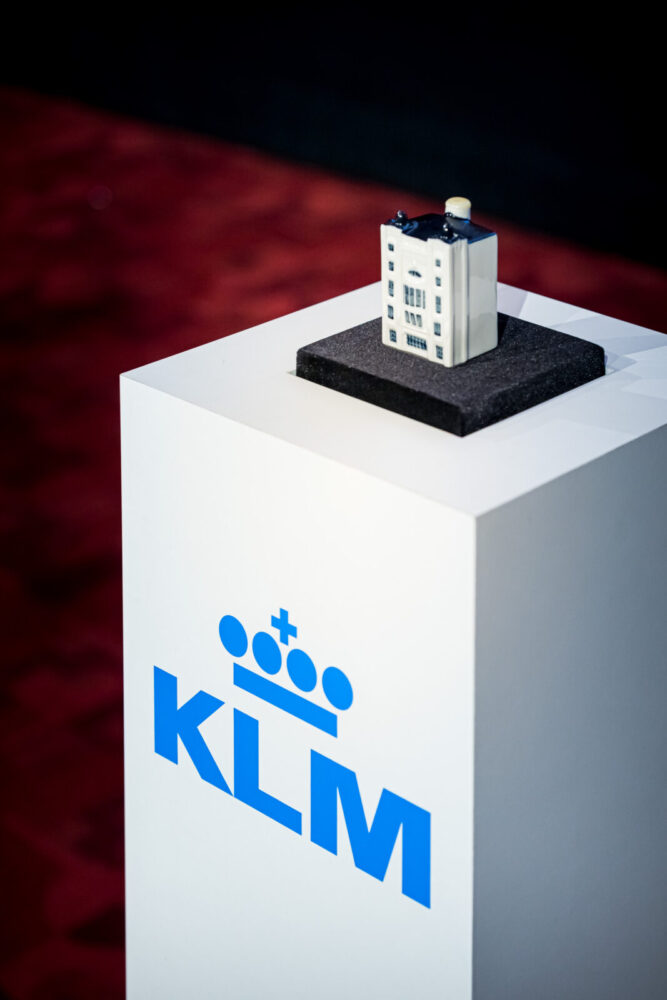
Each year on its anniversary – October 7 – KLM, Royal Dutch Airlines, unveils a new miniature Delft House.
This year’s house – #102 – arrived on time and is a tribute to the glamorous, historic Tuschinski Theatre in Amsterdam, which is about to celebrate its centenary.
We will be back soon with more details about the houses and the event, but running to catch a flight back to the U.S.
In the meantime here are some snaps from the ‘reveal’ celebration, courtesy of KLM.
Do you have a collection of KLM’s miniature Delft houses? Let us know about your favorites in the comments section below.