Museums

How much does it cost to go to the zoo, the museum or aquarium? It can depend.

Airline-style dynamic pricing has landed at zoos, museums, aquariums and other attractions.

So it can be difficult to tell what the ticket price will be on the day you want to pop by.

My latest story for NBC News Online looks at some of the pros and cons of static, variable, plan-ahead and dynamic pricing at attractions.

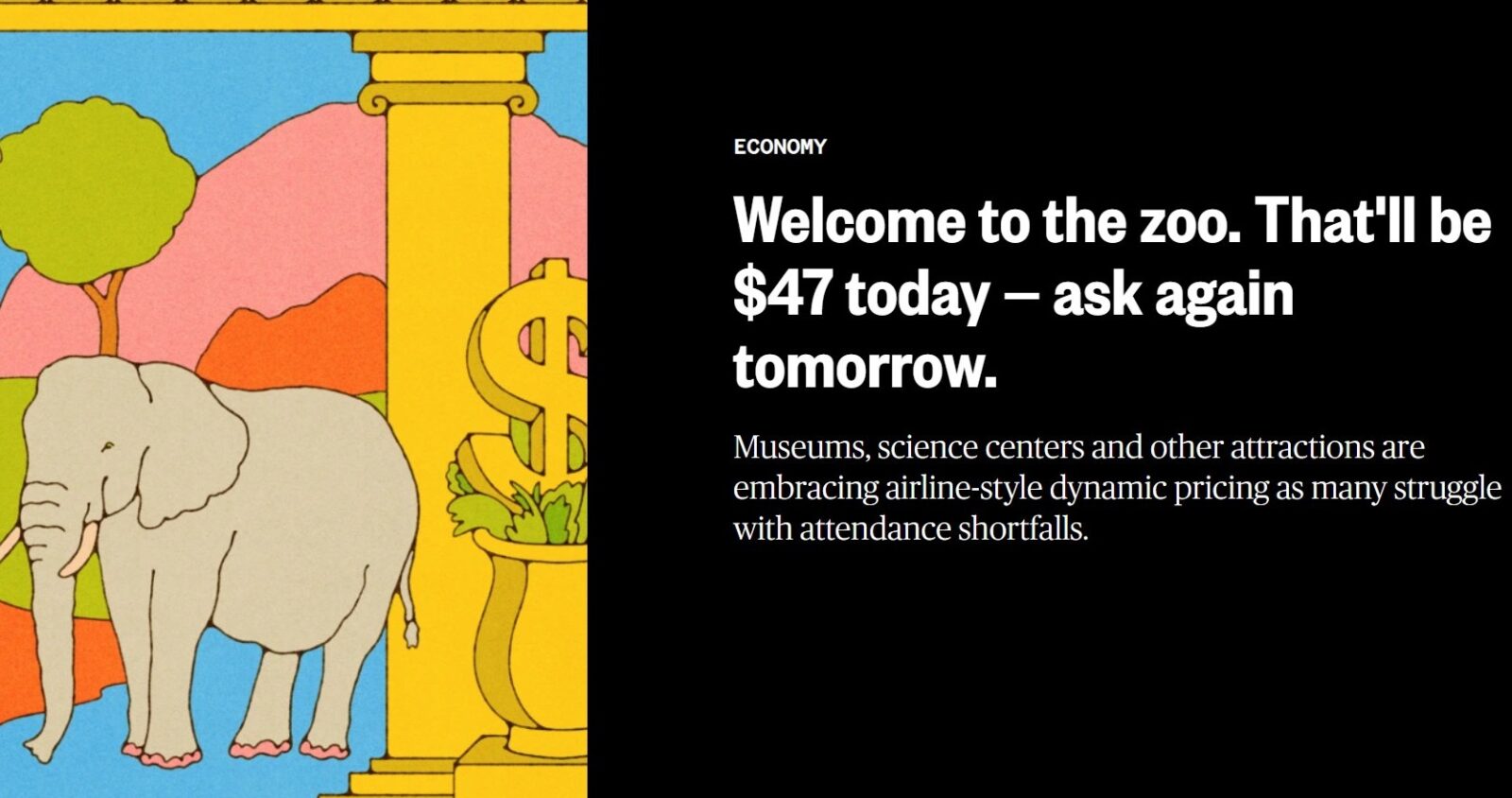
Here’s a link to the story: “Welcome to the zoo. That’ll be $47 today. Ask again tomorrow,” which is also posted below.

How much will it cost to visit a museum, zoo or aquarium this summer?

The answer, increasingly, is: It depends.

John Linehan can rattle off almost two dozen factors that Zoo New England’s dynamic pricing contractor, Digonex, uses to recommend what to charge guests.

“It’s complicated,” said Linehan, president and CEO of the operator of two zoos in eastern Massachusetts.

Before adopting dynamic pricing, the organization was changing prices seasonally and increasing entry rates little by little. “As we watched that pattern, we were afraid some families were going to get priced out,” he said of the earlier approach. “I’m a father of four and I know what it is like.”

Now, Zoo New England’s system provides cheaper rates for tickets purchased far in advance. That, coupled with the zoo’s participation in the Mass Cultural Council’s discounted admissions program for low-income and working families, “puts some control back in the consumer’s hands,” Linehan said.

The zoo is one of many attractions embracing pricing systems that were earlier pioneered by airlines, ride-hailing apps and theme parks. While these practices allow operators to lower prices when demand is soft, they also enable the reverse, threatening to squeeze consumers who are increasingly trimming their summer travel budgets.

Before the pandemic, less than 1% of attractions surveyed by Arival, a tourism market research and events firm, used variable or dynamic pricing. Today, 17% use variable pricing, in which entry fees are adjusted based on predictable factors such as the day of the week or the season, Arival said. And 6% use dynamic pricing, in which historical and real-time data on weather, staffing, demand patterns and more influence rates.

The changes come as barely half of U.S. museums, zoos, science centers and similar institutions have fully recovered to their pre-Covid attendance levels, according to the American Alliance of Museums. That has led many to pursue novel ways of filling budget gaps and offsetting cost increases.

“There’s a saying: ‘No margin, no mission,’” Linehan said, “and we charge what we need to make ends meet while delivering on our mission.”

How much are prices going up?

Entry costs are climbing even at attractions that aren’t using price-setting technology. The broad “admissions” category in the federal government’s Consumer Price Index, which includes museum fees alongside sports and concert tickets, climbed 3.9% in May from the year before, well above the annual 2.4% inflation rate.

In 2024, the nonprofit Monterey Bay Aquarium raised adult ticket prices from $59.95 to $65 and recently upped its membership rate, which includes year-round admission, from $95 to $125. “Gate admission from ticket sales funds the core operation of the aquarium,” a spokesperson said.

While the Denver Art Museum has no plans to test dynamic pricing, it raised admissions fees last fall, three years after a $175 million renovation and a survey of ticket prices elsewhere, a spokesperson said. Entry costs went from $18 to $22 for Colorado residents and from $22 to $27 for out-of-state visitors. Prices rise on weekends and during busy times, to $25 and $30 for in- and out-of-state visitors, respectively. Guests under age 19 always get in free thanks to a sponsored program.

Like many attractions, the art museum posts these prices on its website. But many attractions’ publicly listed ticket prices are liable to fluctuate. The Seattle Aquarium — which raised its price ranges last summer by about $10 ahead of the opening of a new ocean pavilion — also uses Digonex’s algorithmic recommendations.

During the week of June 8, for example, the aquarium’s online visit planner, which displays the relative ticket availability for each day, offered out-of-state adult admissions as low as $37.95 for dates later in the month and as much as $46.95 for walk-in tickets that week. In addition to booking in advance, there are more than half a dozen other discounts available to certain guests, including seniors and tribal and military members, a spokesperson noted.

How will you know what a ticket costs?

At many attractions, however, admission fees aren’t even provided until a guest enters the specific day and time they want to visit — making it difficult to know that lower prices may be available at another time.

“Some attractions are doing a daily analysis of their bookings over the next several days or weeks and making adjustments” to prices continuously, said Arival CEO Douglas Quinby. Prices might rise quietly on a day when slots are filling up and dip when tickets don’t seem to be moving, he said.

Digonex, which says it provides automated dynamic pricing services to more than 70 attractions worldwide, offers recommendations as frequently as daily. It’s up to clients to decide how and whether to implement them, a spokesperson said. Each algorithm is tailored to organizations’ goals and can account for everything from weather to capacity constraints and even Google Analytics search patterns.

Data-driven pricing can be “a financial win for both the public and the museum,” said Elizabeth Merritt, vice president of strategic foresight at the American Alliance of Museums. It can reduce overcrowding, she said, while steering budget-minded guests toward dates that are both cheaper and less busy.

But steeper prices during peak periods and for short-notice visits could rankle guests — who may see anything less than a top-notch experience as a rip-off, said Stephen Pratt, a professor at the University of Central Florida’s Rosen College of Hospitality Management who studies tourism.

“Because of the higher prices, you want an experience that’s really great,” he said, transforming a low-key day at the zoo into a big-ticket, high-stakes outing. “You’ve invested this money into family time, into creating memories, and you don’t want any service mishaps.”

That could raise the risk of blowback at many attractions, especially those grappling with Trump administration cuts this summer. Some historic sites and national parks have already warned that their operations are under pressure.

What’s next?

Consumers should expect more price complexity to come. Arival said 16% of attractions ranked implementing dynamic pricing as a top priority for 2025-26. Among large attractions serving at least half a million guests annually, 37% are prioritizing dynamic pricing, up from the 12% that use it currently.

For visitors, that could mean hunting harder for cheaper tickets. While many museums are free year-round, others provide lower rates for off-season visits and those booked in advance. It’s also common to reduce or waive fees on certain days or hours, and many kids and seniors can often get discounted entry.

“It may take a bit of research,” said Quinby, “but it’s still possible to find a good deal.”

Here are a few other ways to keep admissions costs low:

Ways to save on museum tickets:

  • Ask your local library. Many have museum passes that cardholders can check out.
  • Bundling programs such as CityPassGetOutPassGo City, and others allow visitors to save money on admissions to a range of attractions.
  • Bank of America’s Museums on Us program offers cardholders free entry to many institutions during the first full weekend of each month.
  • For the past decade, Museums for All has been providing free or reduced entry at more 1,400 U.S. museums and attractions to anyone receiving SNAP food assistance benefits.
  • And each summer, the Blue Star Museums program offers museum discounts to actively serving military personnel and their families.

Postcard from Pittsburgh, PA

The Stuck at the Airport team is spending a few days in Pittsburgh, Pennyslvania exploring the airport, of course, but also the museums, restaurants, shops and assorted attractions.

A couple of highlights so far:

Pittsburgh food tour

We joined these adorable kids, their parents and a gaggle of other enthusiastic explorers on a tasting tour of Pittsburgh’s historic market neighborhood – the Strip District – led by Richard, one of the extremely knowledgable and engaging guides from ‘Burgh Bits & Bites Food Tours, which offers tours of half a dozen Pittsburgh neighborhoods and can create custom tours as well.

Heinz History Center

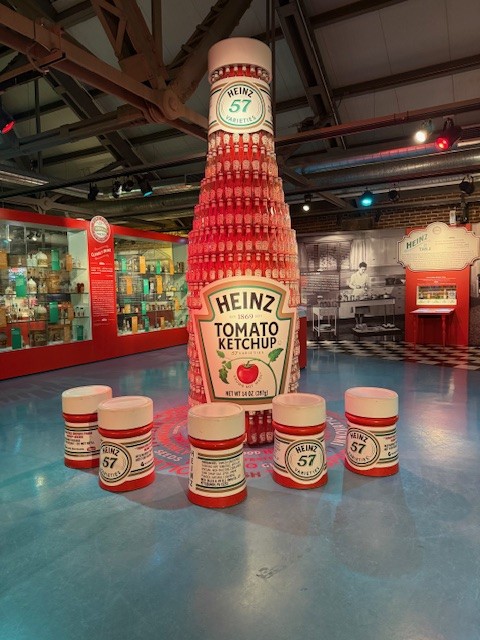
Yes, the Heinz History Center tells the more-interesting-than-you’d imagine story of the H. J. Heinz company. But that’s just one of thousands of the Western Pennsylania stories told in six floors of artifact-filled exhibits that include everything from props and set pieces from from the “Mister Rogers’ Neighborhood” TV set to memorabilia and dozens of interactive activities in the sports museum spread out over two floors of the center and covering everything from football and hockey to car racing, golf, boxing and more.

More places on our ‘go’ list

National Park Week. Free admission on Saturday

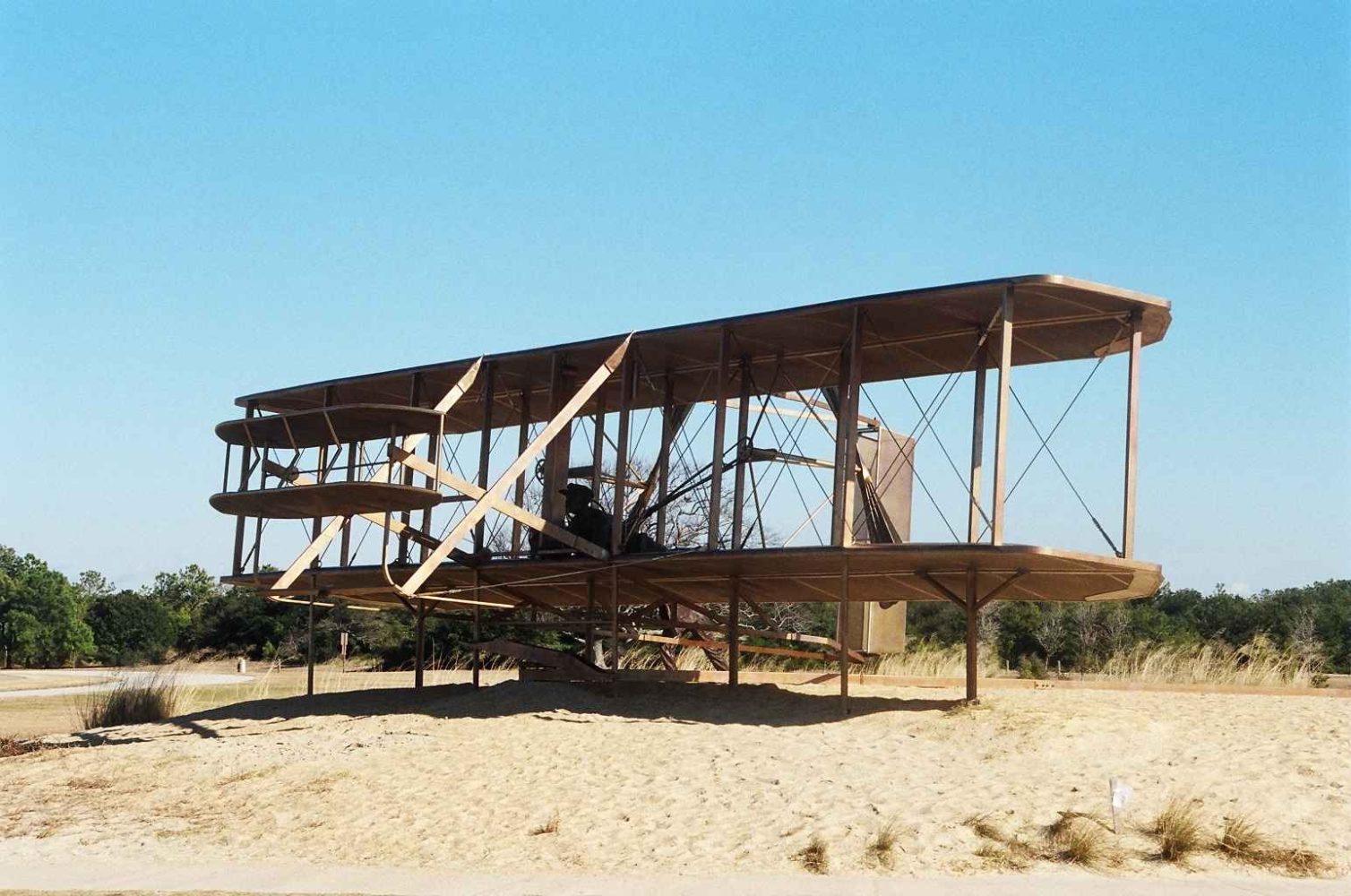
(Sculpture at the Wright Brothers National Monument _courtesy National Park Service)

Most national parks and monuments offer free entry year-round. But there are popular sites that charge visitors an entry fee.

Except, that is, on the handful of days when park fees are waived nationwide.

And Saturday, April 19 – the first day of National Park Week (April 19 to 27), is one of those days.

So, find a park and make it a fun, free day.

The Corning Museum of Glass – new exhibition

In Corning, New York, the Corning Museum of Glass opens its newest temporary exhibition, Brilliant Color, on May 11.

The exhibition celebrates all things colorful in glass with a color wall of rainbow glass and delightful examples of how people of the past brought color into their lives through the science and innovation of beautiful glass objects.

(courtesy of CMoG)

Summer festival season in: Chicago

Chicago hosts the well-known Lollapalooza and the Chicago Blues Festival each summer, but also plenty of other fun ticketed and non-ticketed events, including the Chicago Pride Fest, the Windy City Smokeout, the Chicago Air and Water Show, the Chicago Jazz Festival and several others.

Take a look at the line-up here.

Three places we’d go

The weekend is coming up and, given all the stressful news, we could use a weekend away.

Here are three places on our “We’d go there” list.

Fly to Vancouver International Airport for the cherry blossoms

Vancouver is always a treat, and landing at Vancouver International Airport (YVR) right about now comes with some bonus cherry blossom treats.

Visit Seattle for free museum admissions

In Seattle, museums around the city offer free admission on the first Thursday of each much.

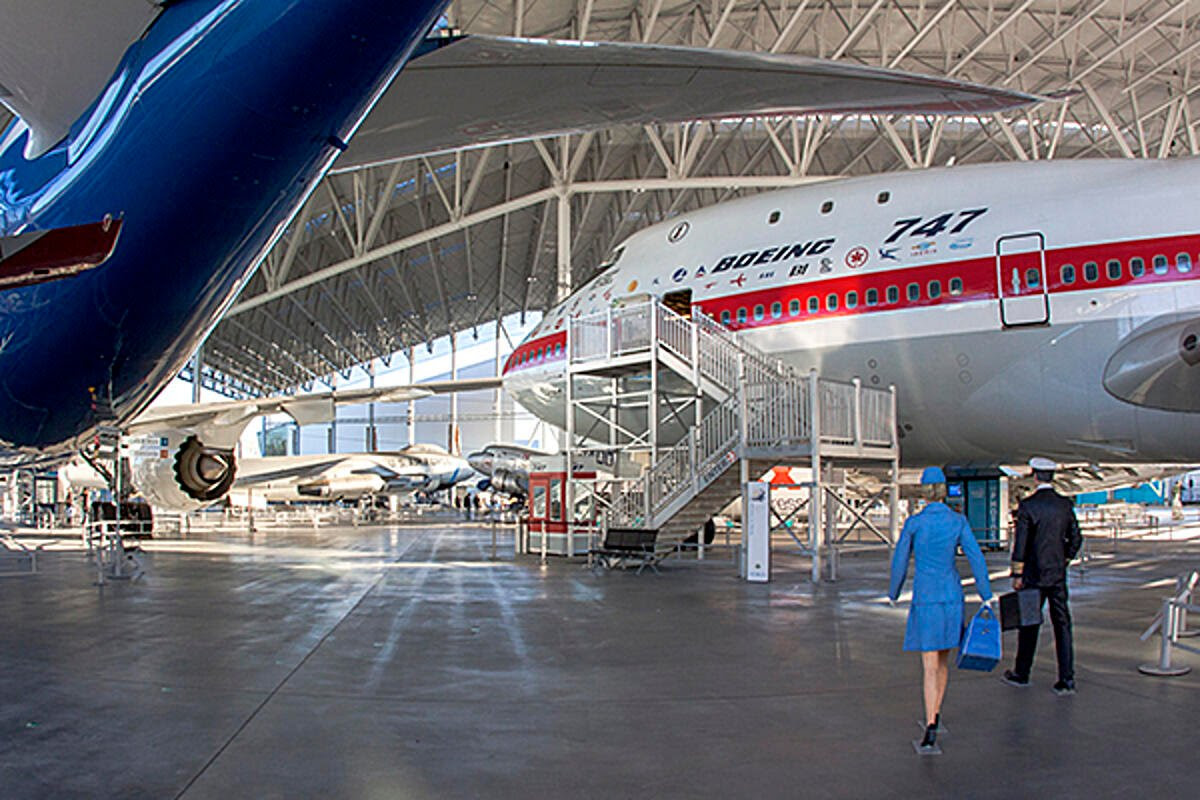
The Museum of Flight is on the list, as is the Seattle Art Museum, the Burke Museum, The Museum of History and Industry (MOHAI) The National Nordic Museum and many others.

Tennessee seems cool

We visited Nashville for the first time last summer and vowed to return to Tennessee.

This list of spring and summer festivals throughout the state is filled with great events to build a trip around, including the Tennessee Tulip Festival in Eagleville this weekend, the Flower & Food Festival at Dollywood in Pigeon Forge from April 18 through June 8, and the World’s Biggest Fish Fry in Paris, TN from April 19 to 27 with a parade, carnival, demolitions debry, rodeo, catfish races and more.

Museum Monday: Vancouver BC’s Museum of Anthropology

It’s been a while since we had a chance to visit the Museum of Anthropology at the University of British Columbia’s Vancouver campus.

The whole museum was closed for more than a year while seismic upgrades were made to the spectacular Great Hall, which has 50-foot-tall glass walls and displays of Northwest Coast poles, house posts, carved figures, canoes, feast dishes and other objects primarily from the mid-19th century.

Work by contemporary artists are mixed in here and there, and there are other temporary exhibitions as well as permanent galleries, including the Koerner European Ceramics Gallery, which displays one man’s collection of over 600 objects.

Beyond the Great Hall, our favorite part of the museum is the Multiversity Galleries displaying more than 16,000 objects from the museum’s permanent collection in open storage and in enticing pull-out drawers.

Impossible to see in one visit, many of the exhibit groupings were created in consultation with members of the communities whose relatives and ancestors made the pieces on display.

Where to see: one of D.B. Cooper’s parachutes

(D.B. Cooper pink parachute courtesy Washington State History Museum)

The only unsolved commercial airline hijacking in the U.S. remains the November 24, 1971 hijacking of Northwest Orient flight 305 to Seattle by someone who has come to be known as “D.B.” Cooper.

(Sketch courtesy FBI)

In 1971, Cooper boarded a Boeing 727 on Thanksgiving eve, November 24, that was heading from Portland, Oregon to Seattle.

During the flight, he passed a flight attendant a note saying that he had a bomb and would blow up the plane unless he was given $200,000 in $20 bills and some parachutes.
His demands were met and he parachuted out of the plane, with the money, somewhere over southwest Washington State.

In 1980 some of the money was found along the banks of a river. But Cooper remains at large.

And the mystery lingers on.

Cooper’s hijacking demands included four parachutes. He got them but didn’t choose the pink nylon reserve parachute that the Washington State History Museum in Tacoma, WA is displaying this fall.
The parachute was part of the evidence the FBI recovered for its hijacking investigation and has since been given to the museum for safekeeping and occasional display.

You can see this parachute and contemplate what you think happened to Cooper and the money from September 22 through November 16, 2014.

If you can, come by the museum on November 14 for the History After Hours program.

I’ll be there for a presentation about some of the weird and wonderful objects, like the D.B. Cooper parachute, that museums rarely or never display.

Here’s a short video about D.B. Cooper from Seattle’s public TV station.

Postcard from Paris: a museum most tourists miss

The Stuck at the Airport team is in Paris this week. Lucky us, right?

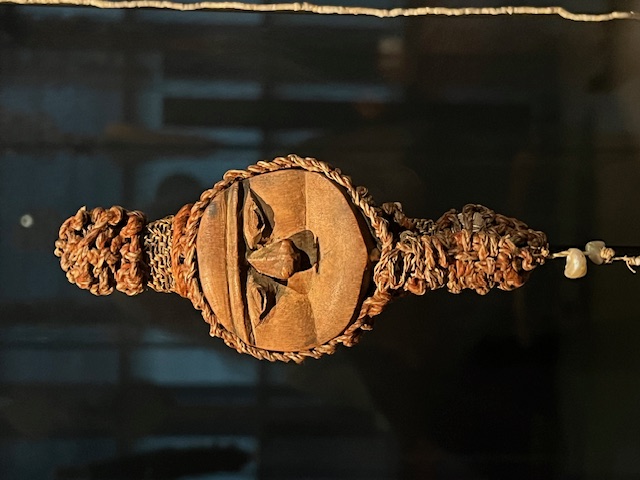
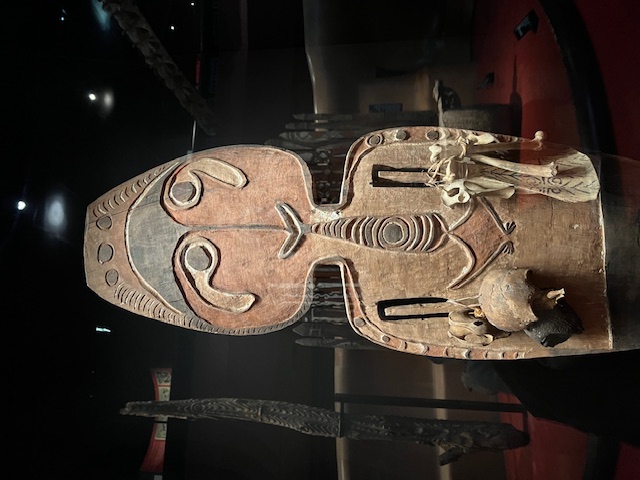
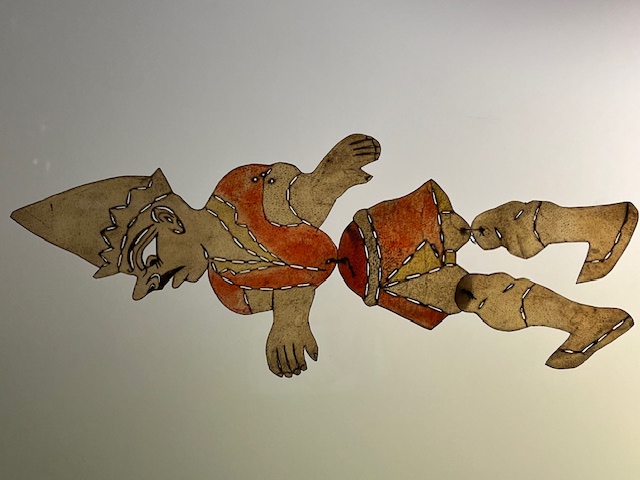
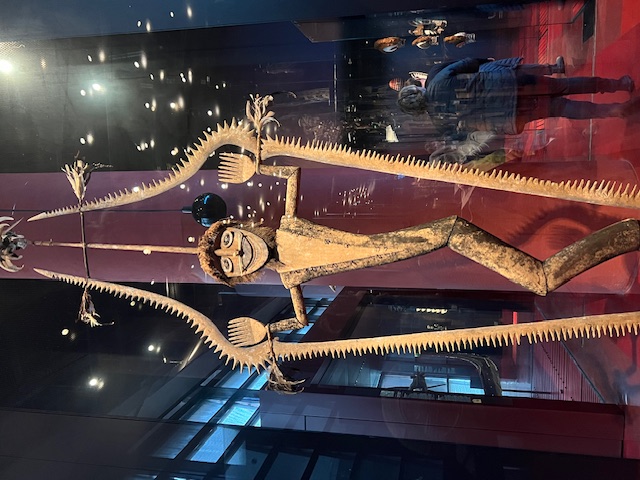
First stop: the Eiffel Tower, of course. But only because it was on the way to a great museum: The Musée du quai Branly-Jacques Chirac, which does a wonderful job of displaying, promoting, and explaining the indigenous arts and culture of Africa, Asia, Oceania and the Americas.

Jet lag set in before we could see everything the museum has to offer. But we were glad we took a long walk along the Seine and spent our first day on the ground not waiting in line at The Louvre or another over-visited spot.

Here are some snaps from what we highly recommend you add to any itinerary that includes Paris.

,

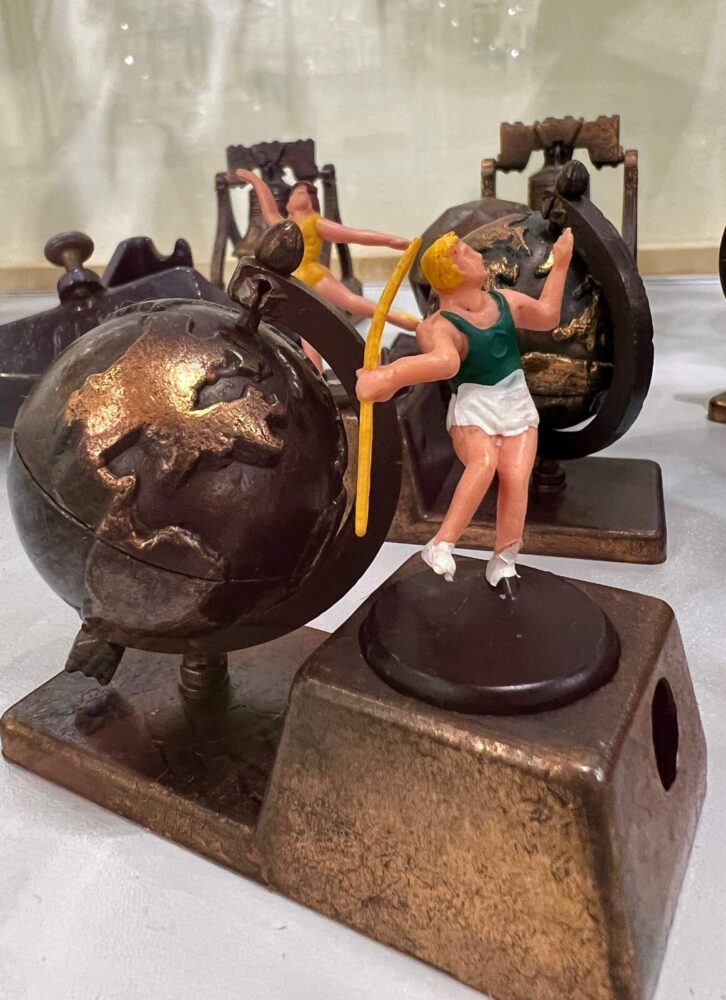
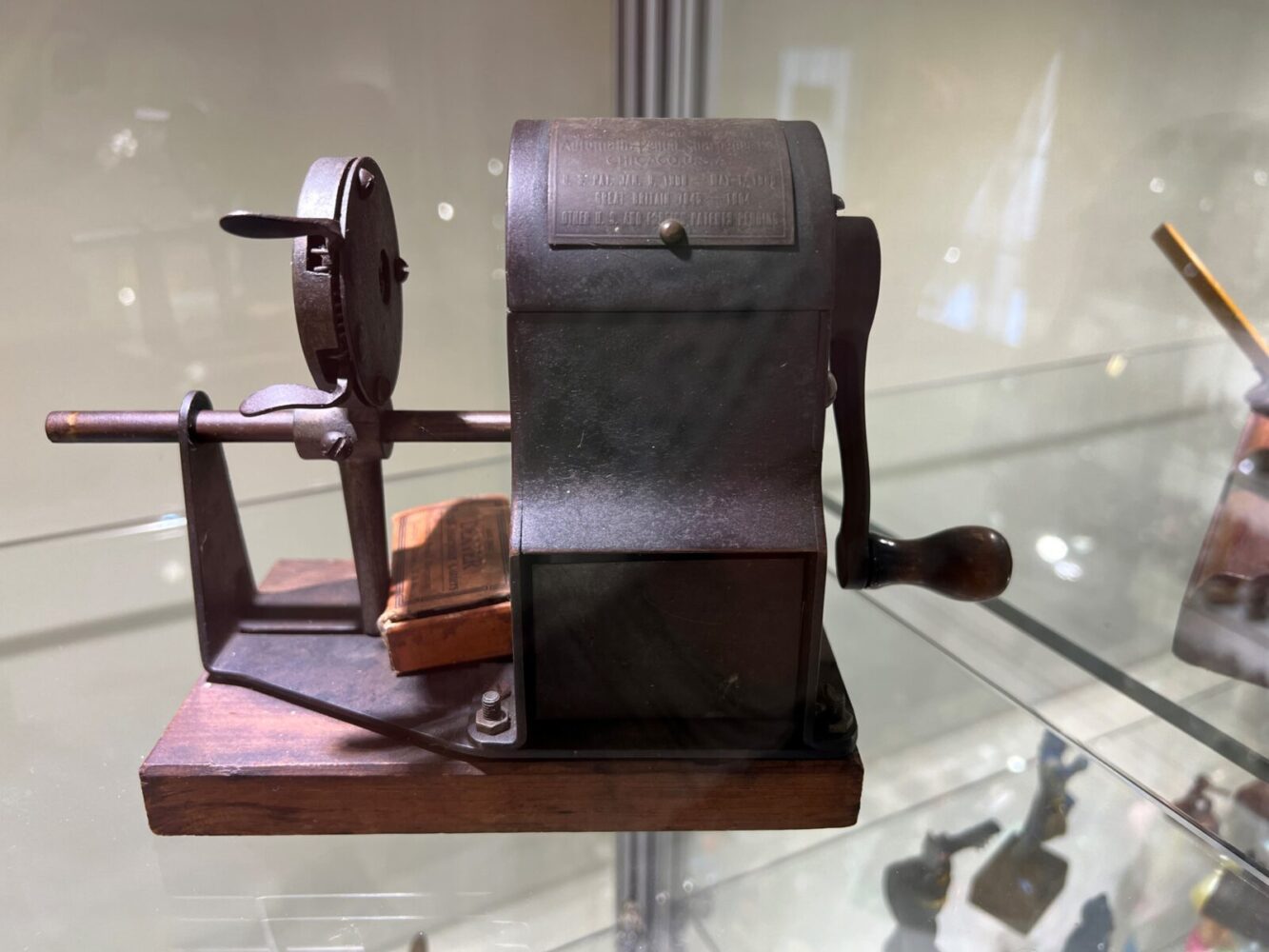
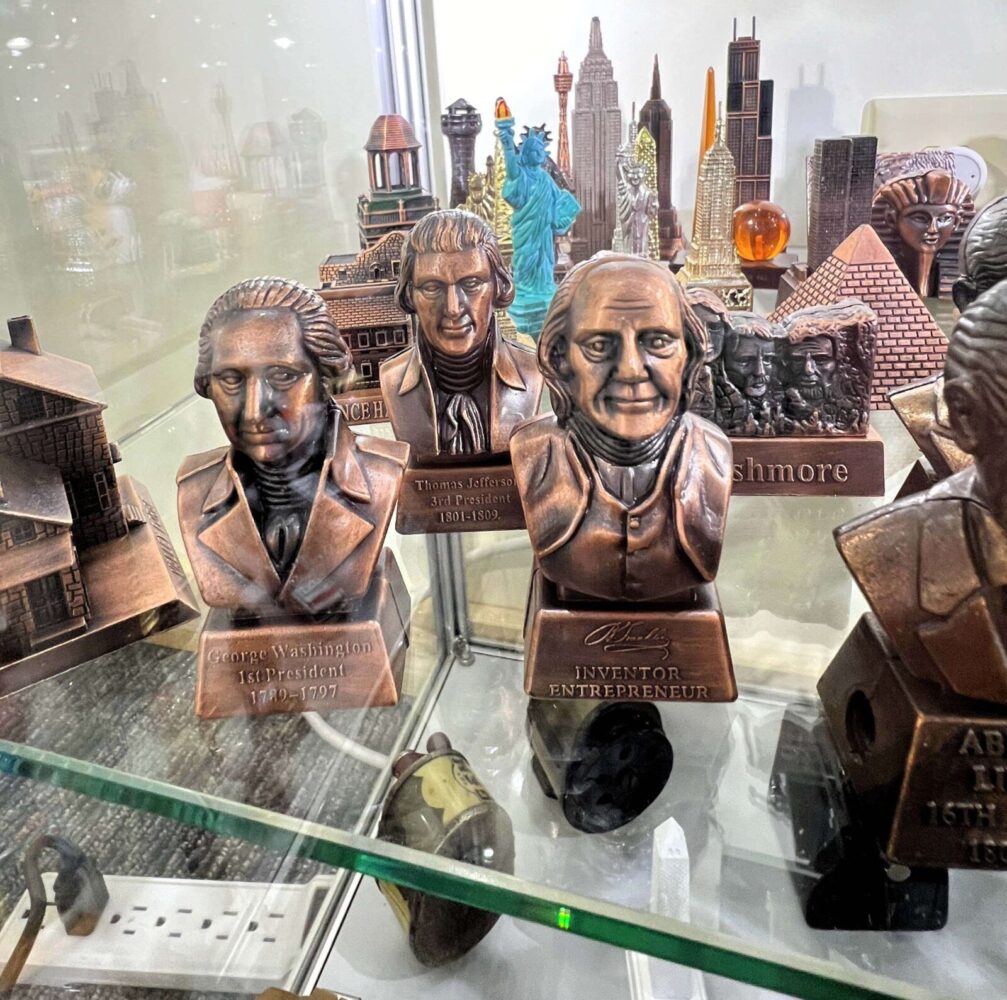
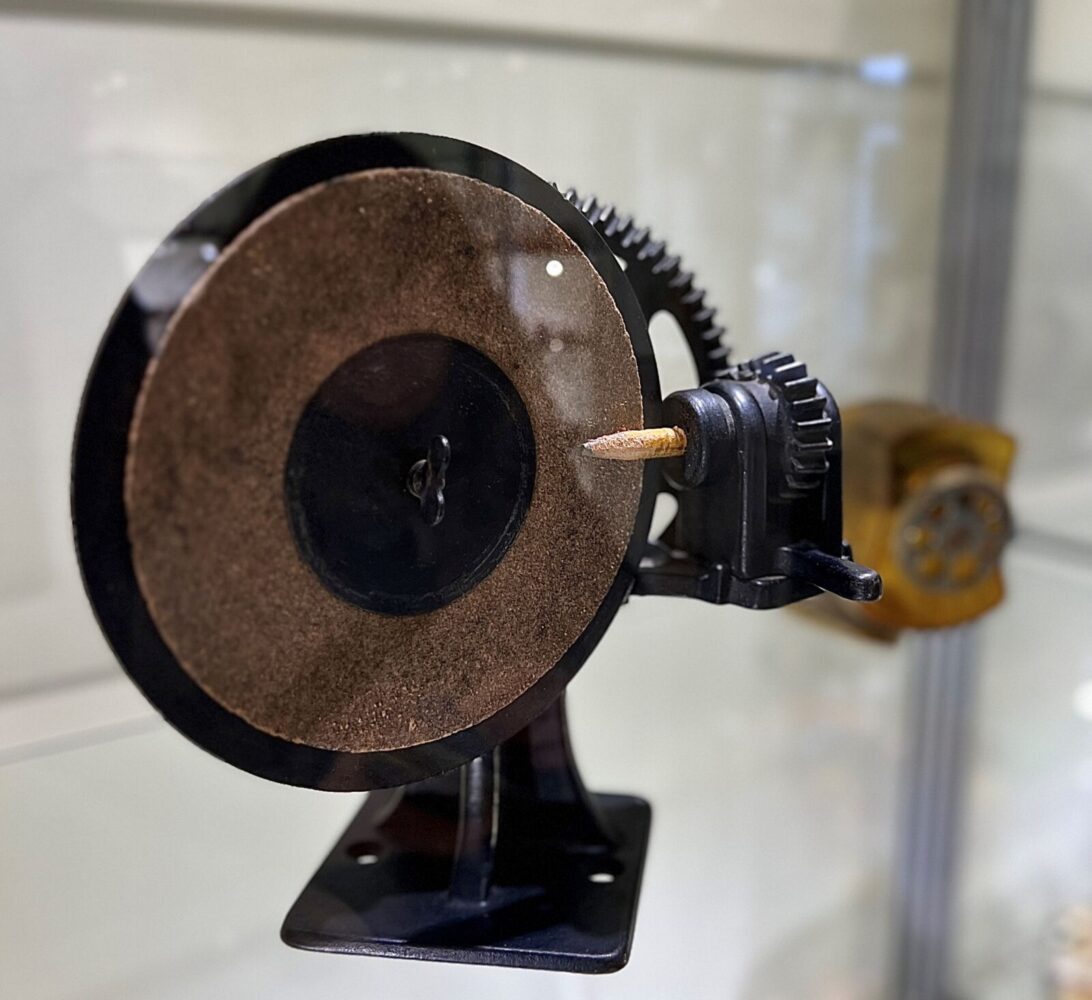
Museum Monday: The Pencil Sharpener Museum

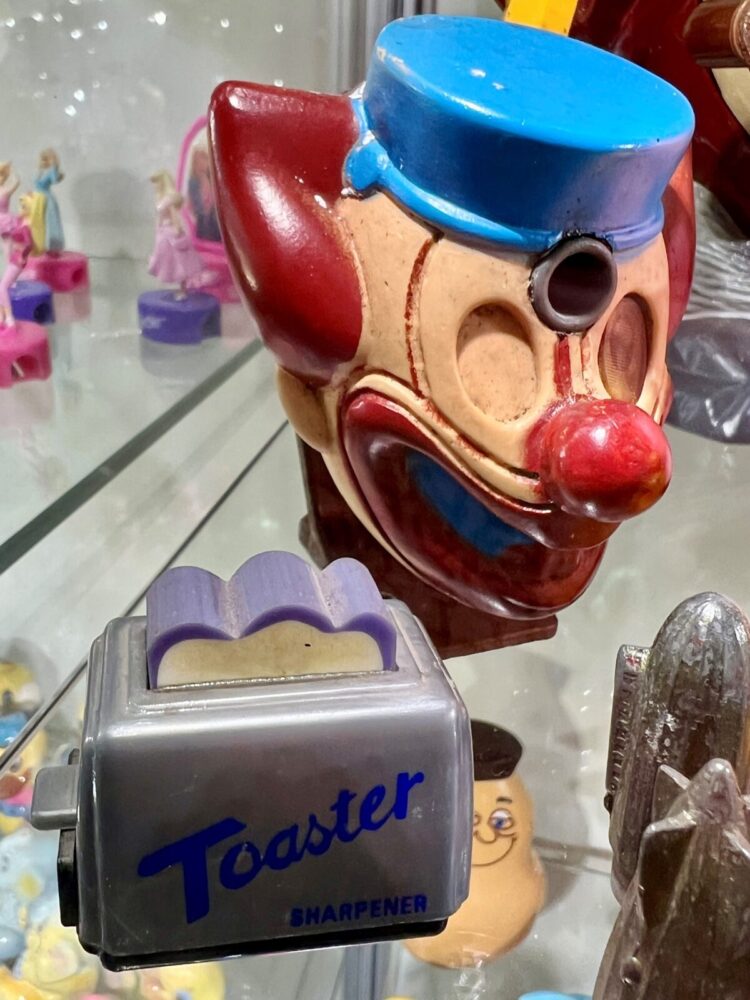
The Pencil Sharpener Museum in Logan, Ohio is open again, and the 5,000 sharpeners in the collection are now housed in a new building at the Hocking Hills Regional Welcome Center.

This is the world’s only Pencil Sharpener Museum and it includes 4000 pencil sharpeners collected by the late Rev. Paul Johnson, plus a new addition of 1000 pencil sharpeners donated by the family of antiques collector Frank Parades, who discovered pencil sharpeners dating back to the 1800s.

Here are some of our favorite images of pencil sharpers from the collection, but we’re sure sharp-eyed visitors will discover their own.

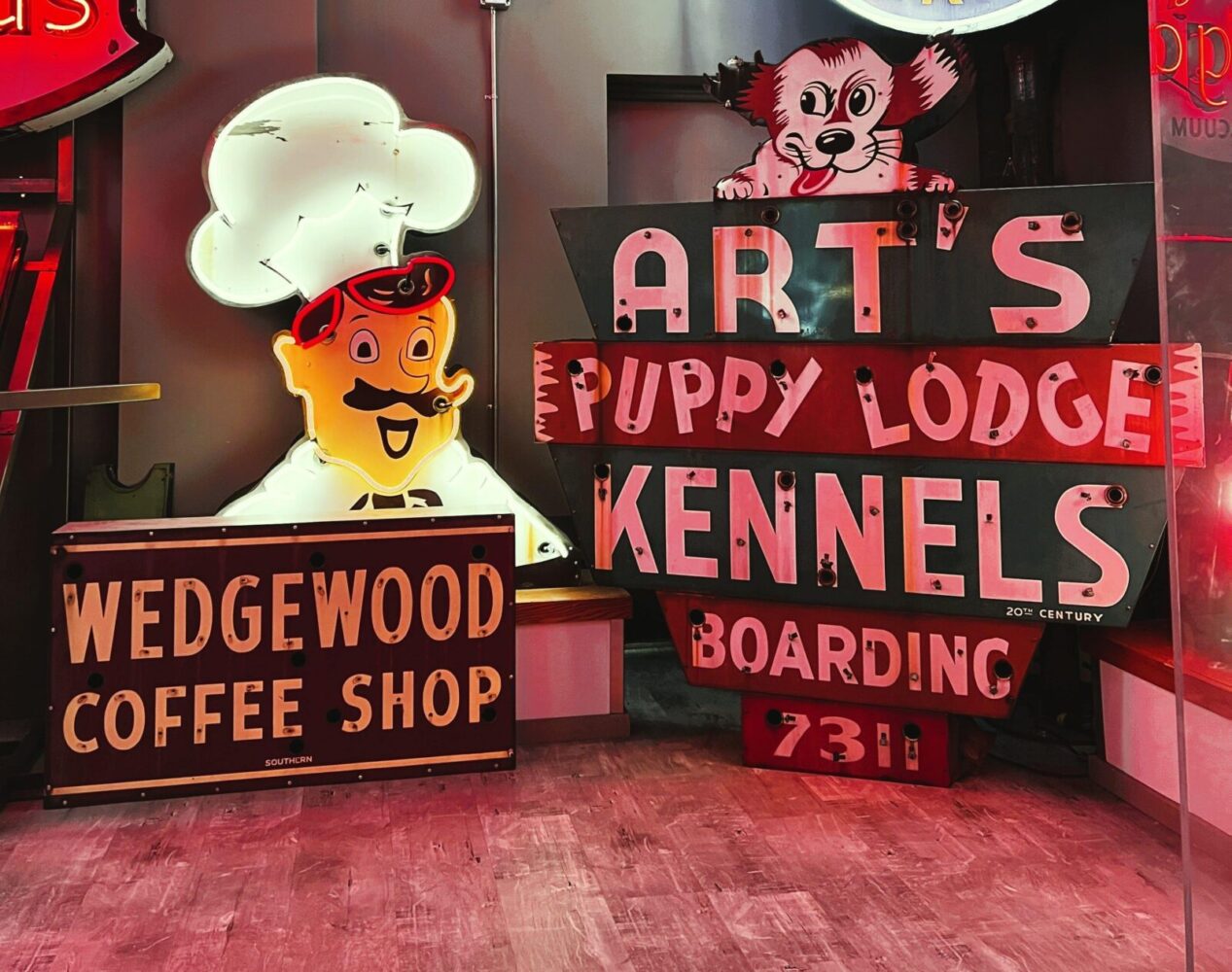
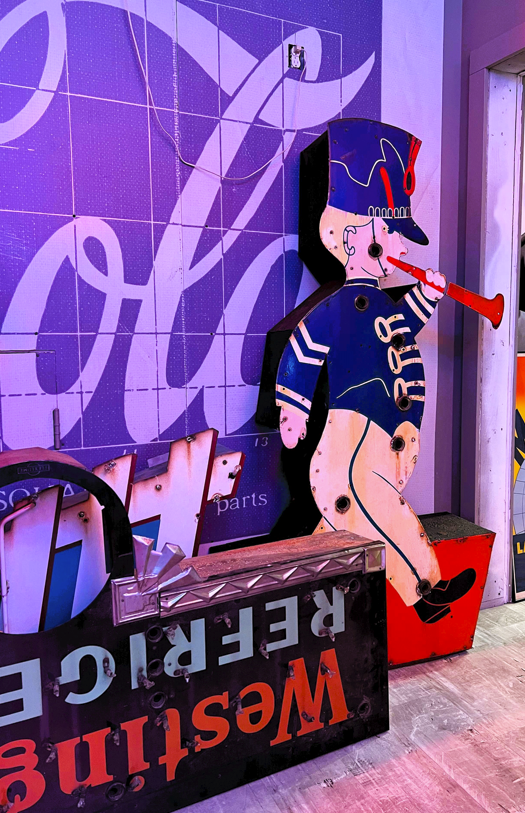
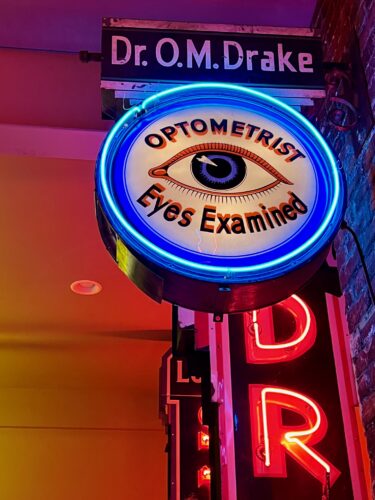
Snaps from the National Neon Sign Museum

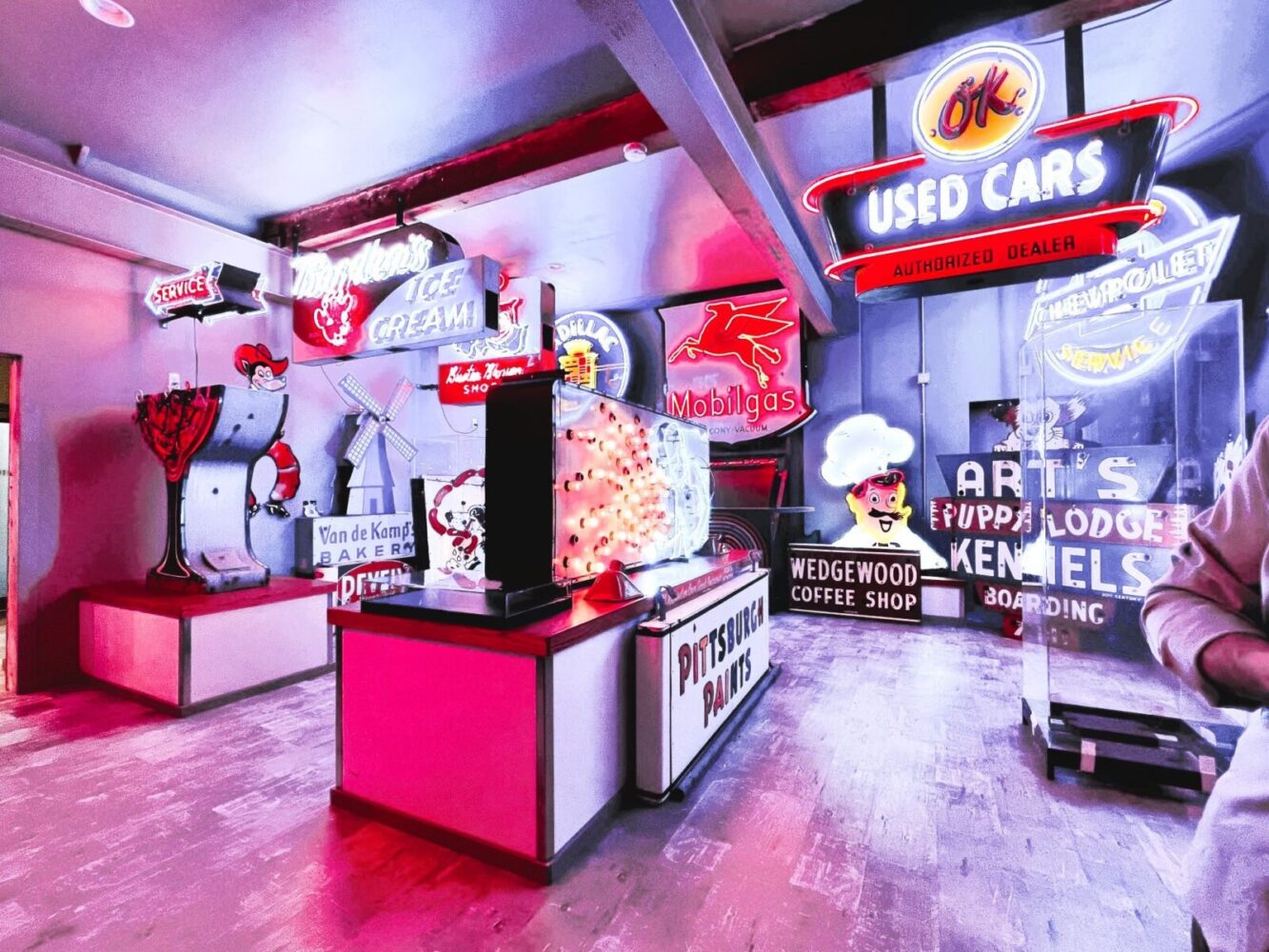
On a recent road trip through Oregon’s Columbia River Gorge, the Stuck at the Airport museum reporter came upon the National Neon Sign Museum in the charming town of The Dalles, Oregon.

Unfortunately, the museum was closed the day were were in town. Fortunately, museum director David Benko answered the phone when we called and agreed to open the museum for a special tour.

Benko is a longtime neon sign collector, a neon expert, and a skilled neon sign designer who has amassed more than 300 neon signs as well as a vast collection of artifacts related to the invention of neon and its evolution as an advertising tool.

He’s turned the Elks Temple in The Dalles into a neon sign shrine, with a movie theater for showing films about neon; an exhibit devoted to Georges Claude, the French engineer who invented neon tubing; rooms filled with brightly lit neon advertising signs; and an event space designed to look like a small town Main Street in the era when every shop had a neon sign.

This one’s a winner and a great reason to plan a trip to The Dalles, Oregon.

Cool places & events to add to your ‘go’ list

Kentucky’s new GLASS National Art Museum

The Stuck at the Airport art team is based in Seattle, which is home to world-renowned glass artist Dale Chihuly, the Chihuly Garden and Glass attraction, the Refact Glass Festival, and a bubbling glass art community. Down the road, in Tacoma, WA, there’s an entire Museum of Glass.

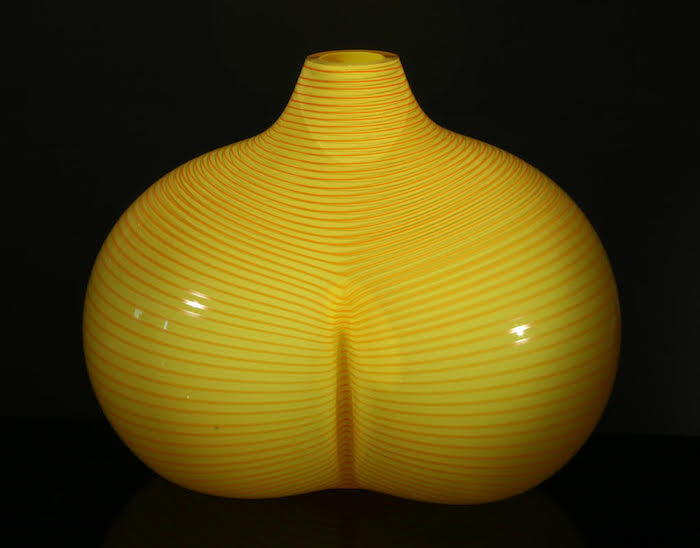
But we’re putting the newly opened GLASS National Art Museum, in Danville, Kentucky on our ‘go’ list. The just-opened museum is built around the collection of Stephen Rolfe Powell, an artist known as a hot glass master of color who died in 2019. He was highly regarded in the international glass world and his glass sculptures are in the collections of major art museums. He was also a professor at Danville, Kentucky’s Centre College for more than 35 years, where he founded a glass program.

The Art Center of the Bluegrass, a multipurpose space in Danville, acquired Powell’s collection and is displaying it along with works by other prominent glass artists. 

Find the Glass National National Art Museum at 408 West Main Street, Danville, KY. Hours: Tuesday – Friday 10:30 am – 6:30 pm. Admission: free.

(Photos courtesy GLASS National Art Museum).

Circus dinner theater: Teatro Zinzanni at Lotte Hotel Seattle

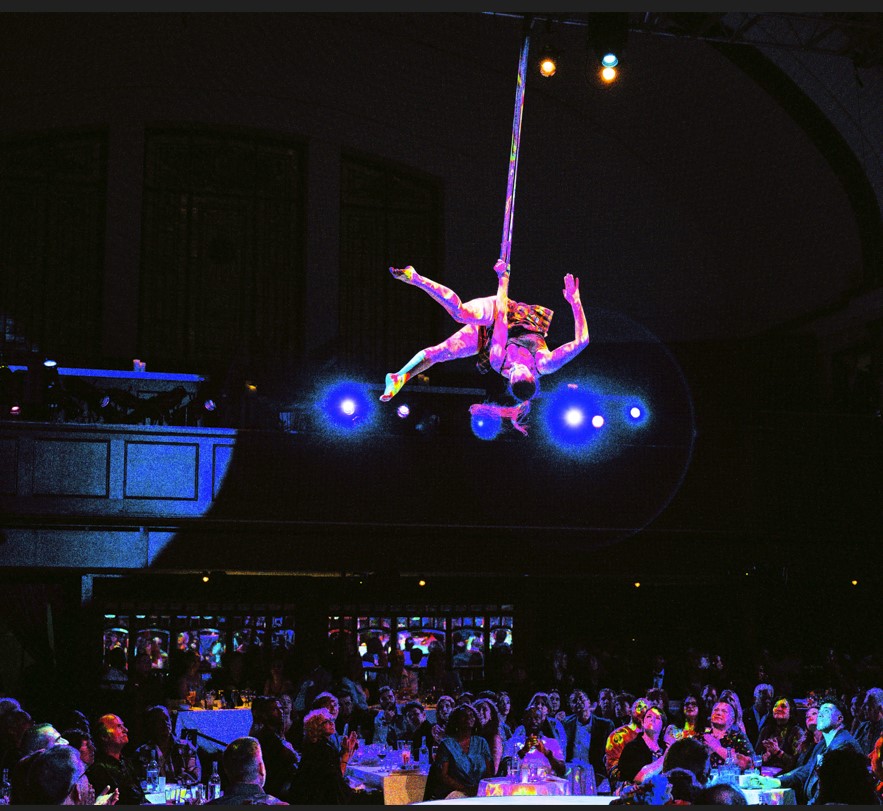
(Elena Gatilova in Teatro ZinZanni Residency at Lotte Hotel Seattle. Photo by Nate Watters)

Love, Chaos & Dinner. And maybe an overnight stay.

If you live in or near Seattle or are looking for a reason to head that way this holiday season or sometime before the end of March 2024, the rollicking theatrical cirque experience that is Teatro Zinzanni is a must-do.

The sumptuous dinner show is wacky and, at times, a wee bit racy. And there’s a stellar cast that leans into some tried and true vaudeville traditions while offering a steady stream of impressive and often heart-stopping acrobatics and funny stuff performed on and above the stage and, sometimes, in the audience.

There’s a storyline to the evening, but with all the singing, the shtick, and the ‘how can they do that?! feats on the trapeze and elsewhere – that won’t matter.

This is Teatro Zinzanni’s 25 anniversary and over the years the company’s giant cabaret tent has been in residence in several locations in and around Seattle.

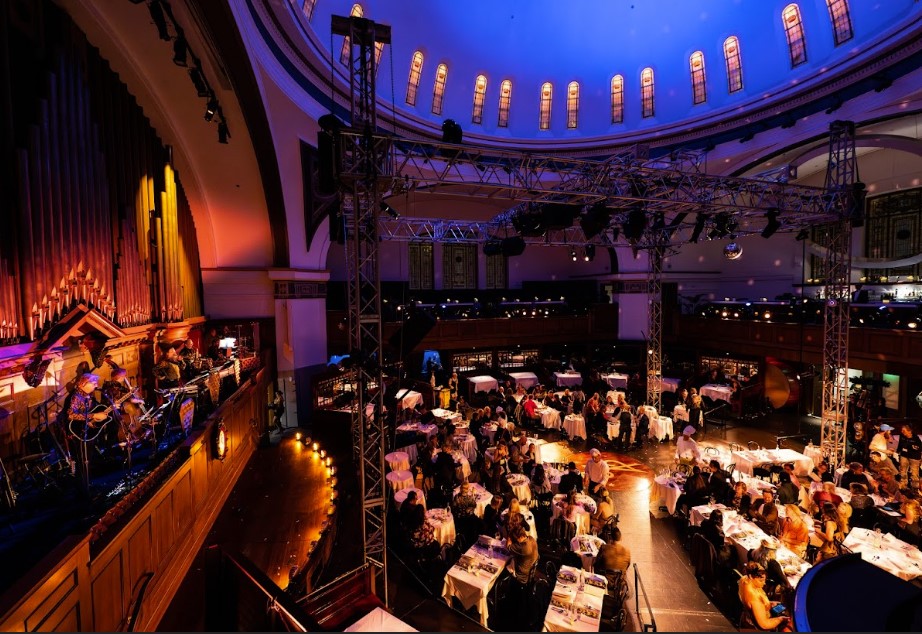
This season, Teatro Zinzanni is in residence in the Grand Ballroom of the Sanctuary at Lotte Hotel Seattle so there’s no room for the entire tent.

But the mirrored walls, the wooden booths, the in-the-round seating, and the elevated live orchestra Teatro Zinzanni fans have come to expect are all here. And it’s clear that the Sanctuary, formerly the oldest church in downtown Seattle, is a perfect venue thanks to lots of stained glass, a 58-foot-high domed ceiling, and plenty of history.

Sleepover after the show

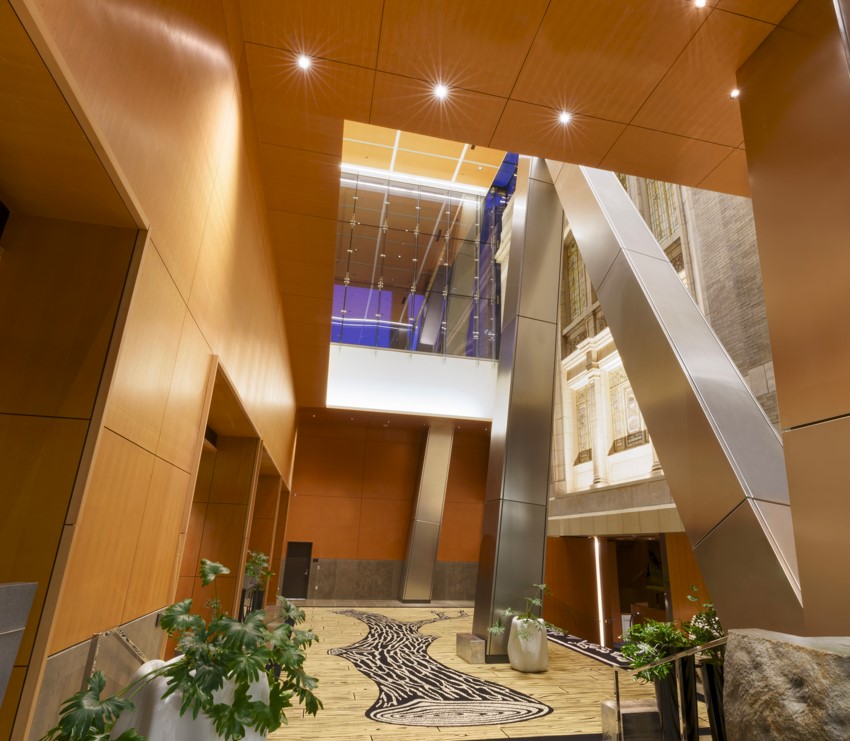
Lotte Hotel Seattle is one of the newer, high-end hotels in Seattle and an overnight here is a great pairing with an evening at Teatro Zinzanni.

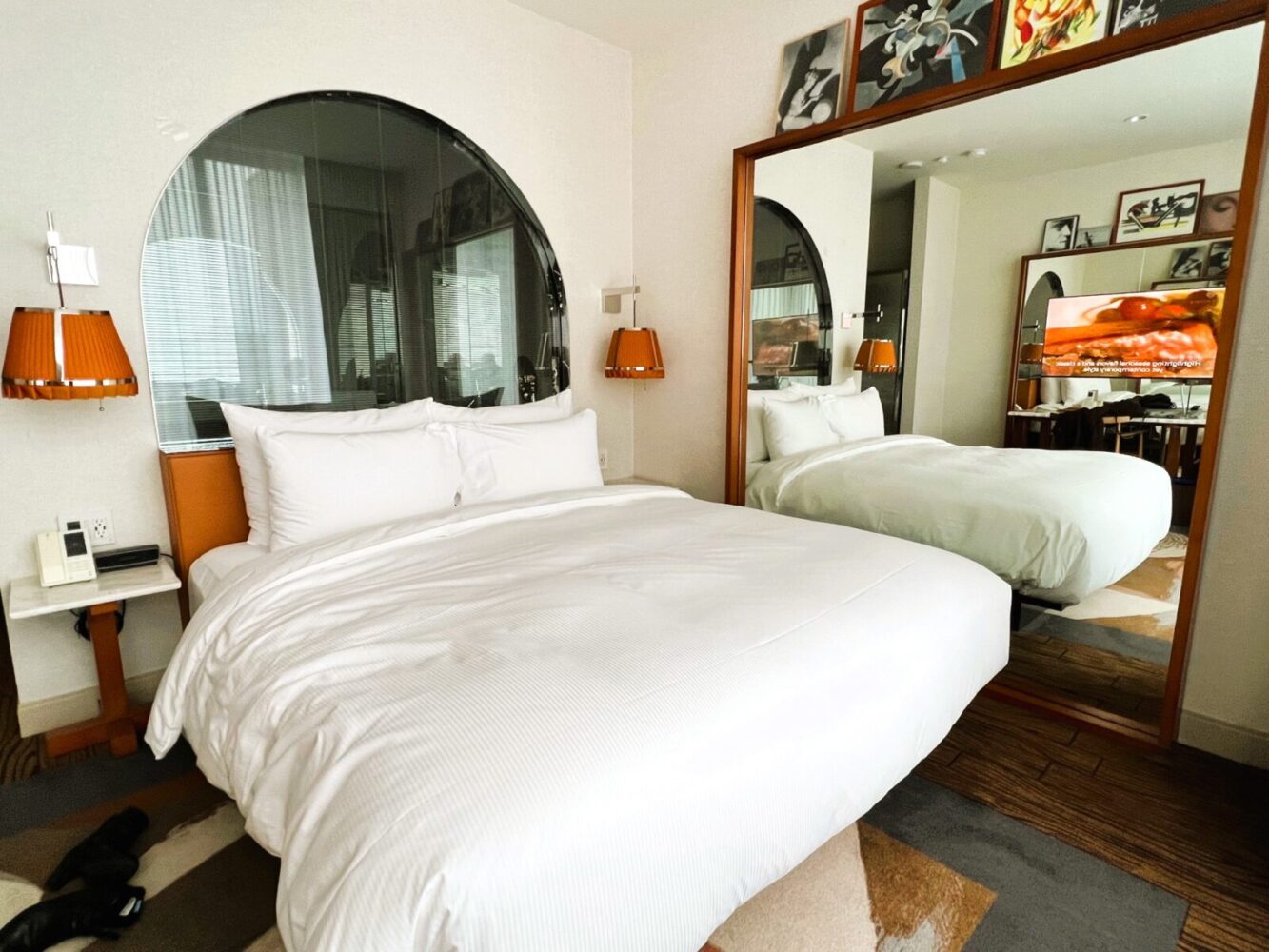
Designed by industrial French designer Phillipe Starck, the hotel has 189 rooms, a spa, plenty of meeting space, great views over the city, the waterfront, and Elliott Bay, plus a cocktail lounge and restaurant on the top floor with a very reasonably priced Happy Hour.

The guestrooms have floor-to-ceiling windows, large mirrors, fun art, spacious bathrooms clad in travertine stone, and a cozy decor that takes inspiration from Pacific Northwest forests.

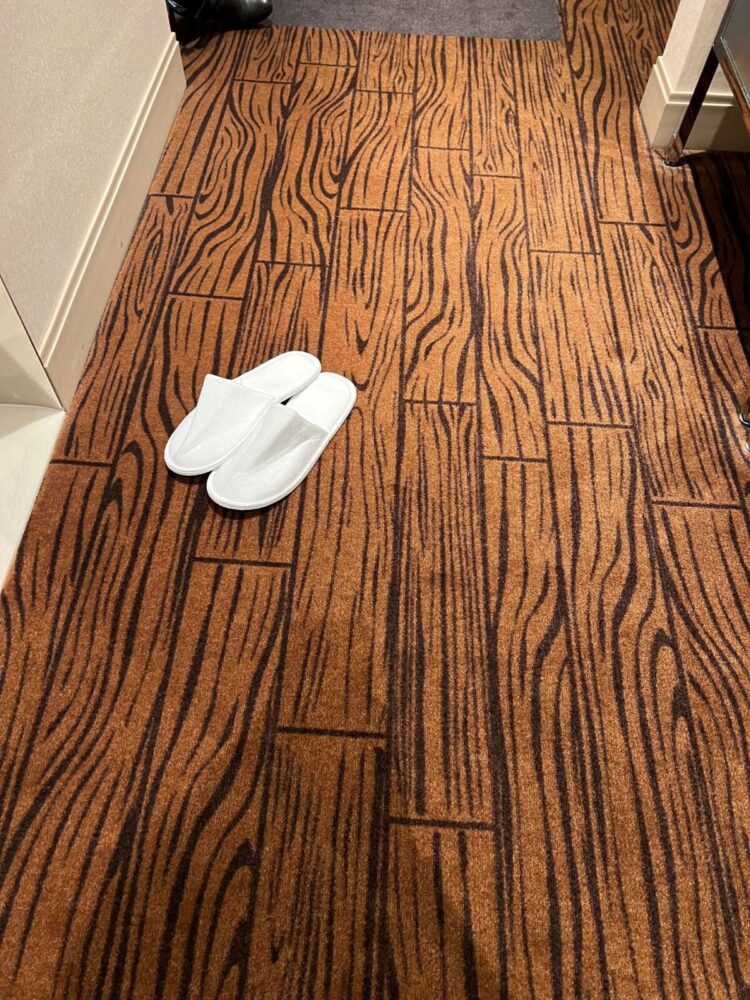
We spotted a lot of fun wood (real and referenced) throughout the hotel, from the front desk made out of a log from a 3,000-year-old Sequoia tree to the ‘wood’ carpeting in the hallways and in the rooms.

They’ve even got a discount package for anyone attending a Teatro Zinzanni show.