flying cars

Fire up the flying car & go see this hovercraft exhibit


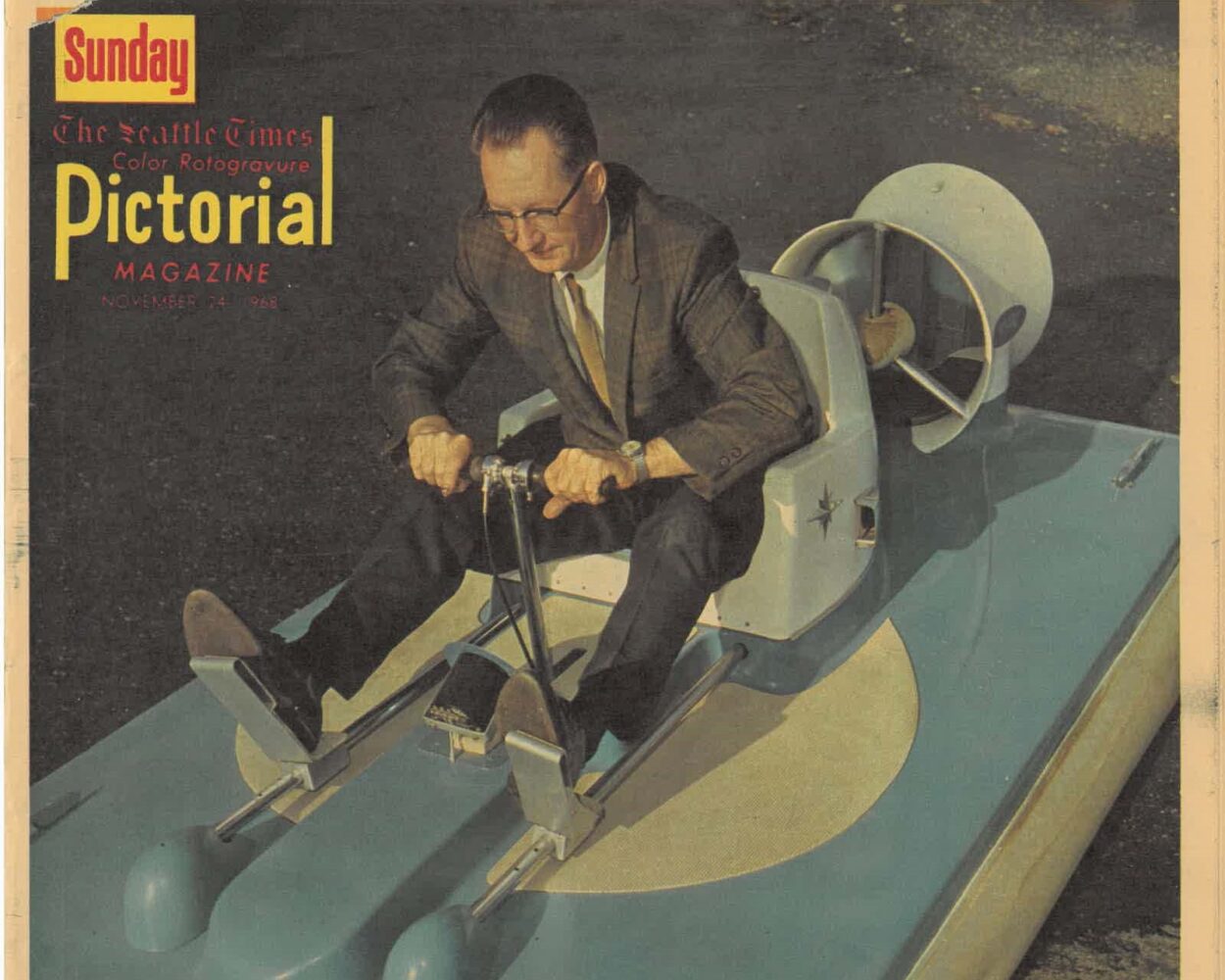
The promise of flying cars for everyone hasn’t quite materialized, but the Washington State History Museum‘s newest exhibition reminds us that a unique hovercraft, or air-cushion vehicle (ACV) was invented by amateur engineer and Washington resident, Walter A. Crowley, in 1958.

Back then, the AeroGo company’s futuristic vehicle was called the Terra Skipper. It had a 10-horsepower engine, could hover over land or water and could move at speeds up to 30 mph using air casters to lift it off the ground and a rear fan for thrust and steering.

As the Smithsonian Institution explains, the concept of using an air cushion to travel with minimal friction over water and other level surfaces dates back to the eighteenth century. But Crowley invented the first air-cushion vehicle in the United States.

Personal hovercrafts never became a thing. But the technology is used today for aerospace engineering, aeronautics, by the U.S. Marines and others.

We’re looking forward to learning more when the Hovercraft exhibit opens at the Washington State History Museum. Exhibition dates are June 3, 2025 through March 8, 2026.

Here’s the Crowley Hydro-Air vehicle now in the collection of the Smithsonian Institution.

Hovercraft image Courtesy Smithsonian National Air and Space Museum

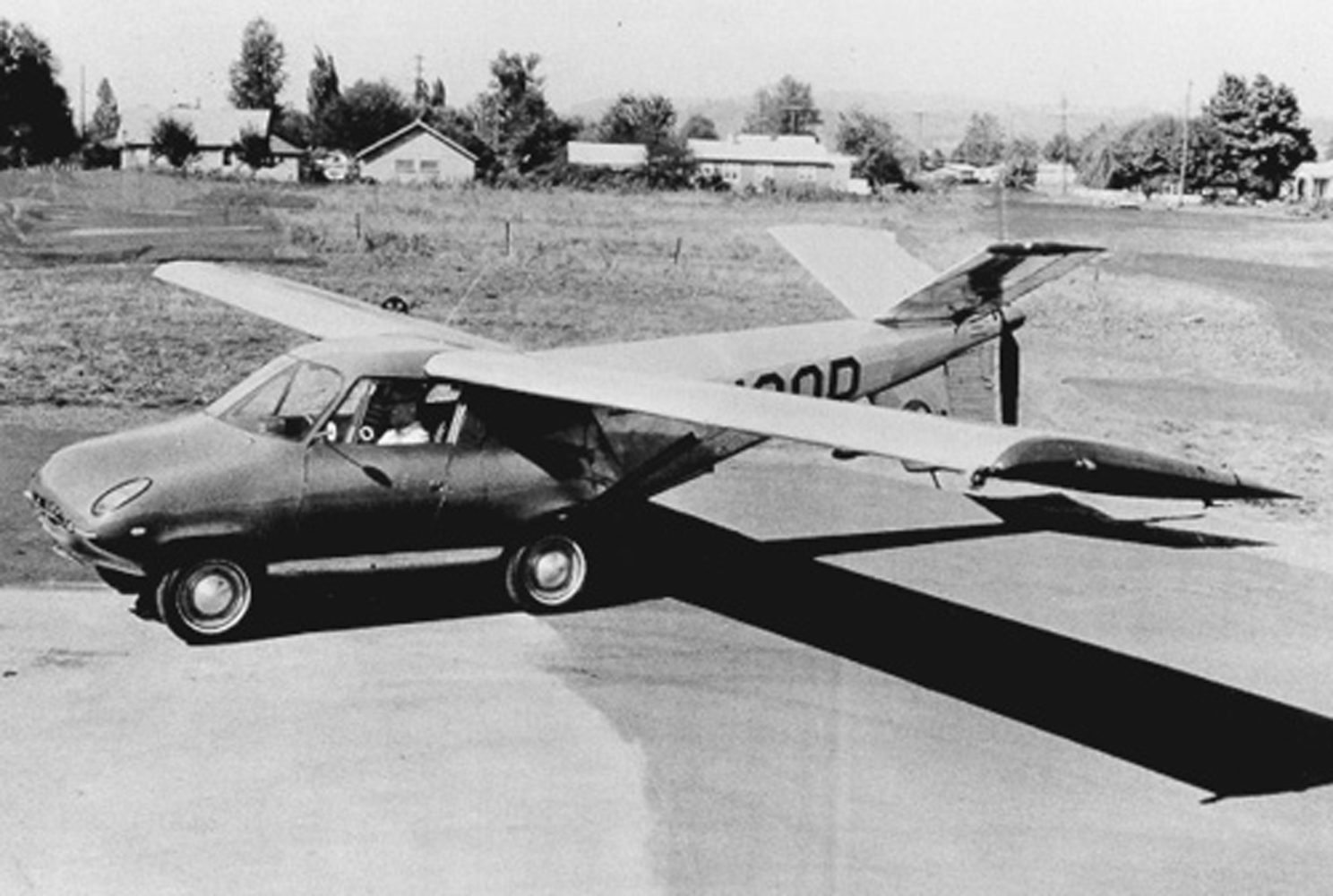
Here’s another ‘space-age’ invention that hails from Washington State. The Aerocar, first designed and built by Moulton Taylor in 1949.

A version of the car can be seen today at Seattle’s Museum of Flight.

Aerocar photo by Cortney Kelley, from 111 Places in Seattle That You Must Not Miss

Why don’t we all own flying cars?

Cars. Airplanes. Both are great ways to get around.

But wouldn’t it be great if the two were put together so the same vehicle could get you where you needed to go no matter what the traffic conditions?

Lots of people have been working on making that dream of flying cars – or roadable aircraft – a reality.

But we’re not there quite yet.

These short videos about Robert Fulton Jr.’s Airphibian – on display at the Smitshsonian National Air & SpaceMuseum; Moulton’s Taylor’s Aerocar – see one at Seattle’s Museum of Flight – and the this-could-be-yours for just $98,000 Jetson One – (a nod to flying car in The Jetsons cartoon show) – prove that it could happen.

What would make your trip to the airport more fun?

(Early flying car – the Aerocar)

I’m excited, honored – and a bit nervous – about being a moderator for several sessions during Monday’s Passenger Experience Conference in Hamburg, Germany.

The topics my presenters will be tackling in the Covergence and Mobility stream range from how mobile technology might better (or ever) tie together the many ways we now have to travel through the world (bikes, taxis, car share, trains, planes, etc…) to how – and when – we might eat or do other things along the way.

I’ll be sharing notes, pictures and musings here and on Twitter (@hbaskas) about these presentations and the new and exciting products and ideas that are presented throughout the week at the Aircraft Interiors Expo and several related events being held in Hamburg this week.

Standy by and please feel free to send your questions to me here – or via Twitter (@hbaskas) – about what’s in store for getting to and from airports and for flying on airplanes.


Flying cars? Not so new

I’m working on a few articles about this weekend’s grand opening LeMay-America’s Car Museum, in Tacoma, Washington and running through the list of treasures in their collection: a 1916 Pierce-Arrow Brougham, a  1930 Dusenberg Model J, a 1942 Chevrolet Blackout, and a 1963 Chevrolet Corvette Sting Ray to name just a few.

1942 Chevrolet Blackou from the LeMay Museum

The list of cars reminds me of one my favorite cars – the Taylor Areocar III, one of the sassy two-passenger cars, first made by Moulton Taylor in 1949, that was a commuter’s dream machine: it has a rear propeller and a tow-able set of wings so that drivers could easily escape a highway backup.

Early flying car - the Aerocar

.

The car is now on display at the Museum of Flight in Seattle.

Maggots and flying cars. Need we say more?

Besides the story about the Charlotte-bound US Airways plane that had to return to the gate in Atlanta because maggots started dropping from an overhead bin (watch video at your own risk…)

…the best aviation-related story making the rounds today was about yet another FAA-approved flying car. The Christian Science Monitor’s story about the Terrafugia Transition includes some very cool photos and a video describing the prototype of a two-seater car that can be transformed into an airplane – and purchased for $194,000.

It does seem promising but, The Jetsons aside, it’s not new. Back in 1949, Vancouver, Washington resident Moulton Taylor created a car that did the same thing.

The final version of that car, the Aerocar III, which was actually the sixth version of the car, is on display at Seattle’s Museum of Flight.

Flying car

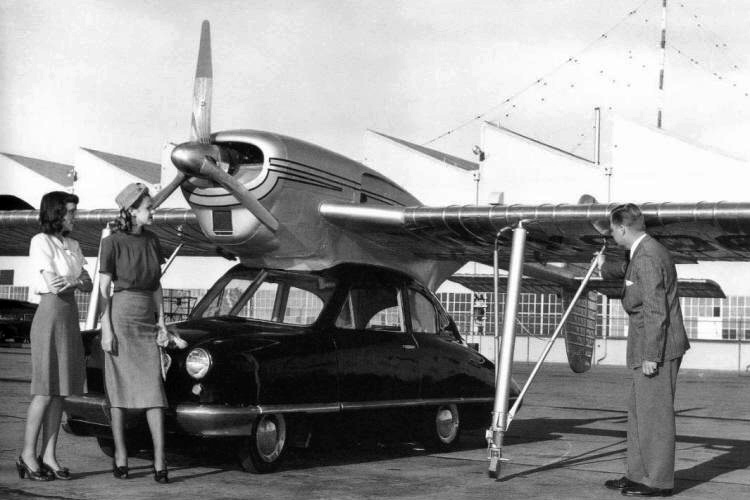
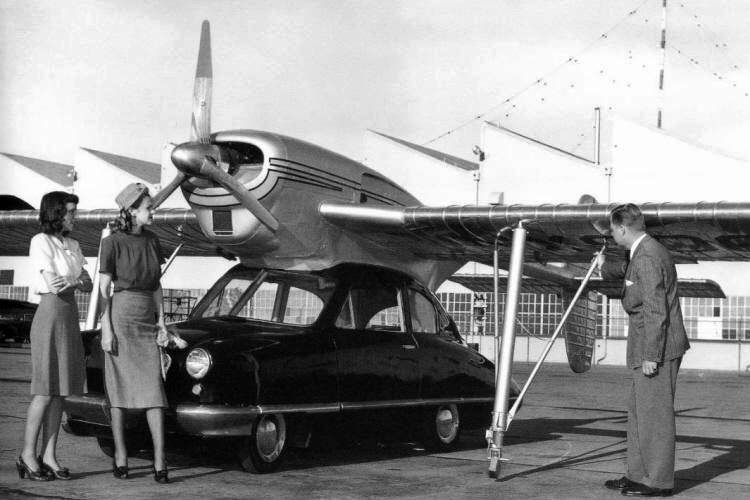
Taylor wasn’t the first to make a flying car. The Smithsonian Institution displays the Waterman Aerobile, which first flew in 1937.

And, from 1950, the Fulton Airphibian

Both the Airphibian and the Aerobile are on display in the Smithsonian Institution National Air and Space Museum at the Steven F. Udvar-Hazy Center near Dulles International Airport.