Airport security

Stop worrying: TSA will accept your driver’s license

Sea-Tac security line

Rumors – and plenty of misinformation – have been flying around about the REAL ID Act – passed by Congress in attempt to prevent the fraudulent issuance and use of driver’s licenses and identification cards – and whether or not the TSA would soon stop accepting driver’s licenses as an acceptable form of identification at airports.

Part of the problem was that the Department of Homelands Security was dragging its heels about setting up a definite timetable for implementing the air travel part of the act.

But the agency finally issued a statement with some set dates.

On its website DHS now says that driver’s licenses issued by all states will be accepted as valid forms of ID until January 22, 2018.

So relax. You – and the states where driver’s licenses don’t yet comply with the national standards – have two years to work this out.

After January 22, 2018, DHS says:

Passengers with a driver’s license issued by a state that is still not compliant with the REAL ID Act (and has not been granted an extension) will need to show an alternative form of acceptable identification for domestic air travel to board their flight.

Passengers with driver’s licenses issued by a state that is compliant with REAL ID (or a state that has been issued an extension) will still be able to use their driver’s licenses or identification cards.

And, starting October 1, 2020, every air traveler will need a REAL ID-compliant license, or another acceptable form of identification, for domestic air travel.

“Right now, no individual needs to adjust travel plans, or rush out to get a new driver’s license or a passport for domestic air travel,” said secretary of Homeland Security Jeh Johnson in announcing the timetable.

Bets? How many firearms will TSA find at airports?

ATL GUNS

Each Friday, before I close my office and head to Happy Hour, I check the TSA Blog for the Week in Review posting of the number of firearms (loaded and unloaded) and other prohibited items (inert explosives, big knives, anti-tank weapons, etc.) discovered at airport checkpoints.

You should too.

The blog (and TSA’s Instagram account) offers an informal course on the wide variety of items TSA deems too dangerous to be allowed on airplanes, yet which travelers continue to bring to airports.

TSA find _ Keychain is actually a punching weapon prohibited on planes by TSA

The numbers don’t spike on particular holidays or on Mondays but the tally of firearms, especially, keeps going up.

On June 4, 2014, for example, TSA reported that 18 firearms were discovered in carry-on bags around the country, breaking the previous record of 13 found in one day, set in 2013.

In early November, another record was broken. With two months still to go in the year, the number of firearms discovered at checkpoints had reached 1,855.

That blew 2014’s tally past the overall 2013 total of 1,813. By the close of business on December 15, this year’s tally had grown to 2,097.

“I think the rate is increasing because more and more people are carrying [weapons] throughout the country. It can actually be difficult for people who carry all the time because the gun becomes an extension of them, just like their cell phone and wallet,” said Jeff Price, author of Practical Aviation Security.

“Oops, I forgot that was in there,” is the most common explanation given by passengers found with firearms in a carry-on bag. But there are people, like the guy nabbed this week at JFK Airport with parts of a disassembled .22 caliber firearm hidden inside a PlayStation 2 console, who certainly know what they’re toting. “Some of these people are just tools trying to get one over on TSA and the system, but there are also those who may be affiliated with terrorist groups that decide to test the system to see what they can get through,” said Price.

TSA_GiantScissors

Thanks to ever-more-sophisticated technology, TSA is confident it is catching 100 percent of all the firearms coming through checkpoints. But Todd Curtis, founder of AirSafe.com, pegs the find rate at closer to 90 percent.

“The technology TSA has isn’t perfect,” said Curtis, “But in most cases, if someone is dense enough to try to take a weapon through the checkpoint they’ll be caught.”

Whenever TSA does spot a firearm in a carry-on bag at a checkpoint, the screening process stops until law enforcement responds and retrieves the weapon. And it’s local laws, not the TSA, that determine if any criminal charges are filed against a passenger.

Criminal charges or not, passengers found with firearms at airport checkpoints are subject to civil penalties, ranging from $1,500 up to $11,000. In 2013, TSA assessed nearly $1.7 million in civil penalties for firearms discovered in carry-on bags nationwide.

What happens to the firearms also depends on local laws. While local law enforcement allows TSA to photograph firearms (and other prohibited items) discovered at checkpoints, “TSA doesn’t take possession of any firearms,” said TSA spokesman Ross Feinstein, “Local law enforcement might confiscate the weapon as evidence or give it back the passenger to return it to their home or to put it in their vehicle.”

Beyond firearms, of course, TSA officers encounter an extremely wide variety of other prohibited items at airport checkpoints, including machetes, hatchets, swords, giant scissors, brass knuckles, cannonballs, bear repellant and, this past October, an unloaded cannon.

“Maybe someone has a lucky inert grenade they brought back from some war, or a nice cane was given to them and they forgot that the thing is actually a sword,” said Price, “It’s the people that are carrying stuff like chainsaws that make me wonder.”

(This story first appeared on the Runway Girl Network in a slightly different version.)

Are TSA PreCheck centers easy-access?

TSA PreCheck Enrollment Center at IND Airport - courtesy TSA


No balloons fell from the ceiling last week when the U.S. Department of Homeland Security celebrated the fact that over 500,000 travelers have handed over personal data – and $85 – to join the Transportation Security Administration’s expedited airport screening program since the first public enrollment center opened at Indianapolis International Airport in December 2013.

Today, the Global Gateway Alliance, a group that advocates for improvements at the New York metropolitan area airports, released a report offering TSA advice on how to push the PreCheck enrollment numbers higher.

There are currently about 300 PreCheck application sites nationwide processing, altogether, more than four thousand new applications a day. Twenty-eight of those sites are in airports (LAX and ATL each have two), with many others co-located at pre-existing sites in strip malls, office and industrial parks, and a few chiropractic offices contracted to do credentialing for airport and railroad workers and for truck drivers hauling hazardous materials to and from port facilities.

The range of off-airport sites “makes it easier for the traveling public to apply for TSA PreCheck,” said TSA’s Feinstein. But putting enrollment centers “in places where people actually congregate, which can be conveniently accessed, would raise awareness and participation the program,” the GGA suggests.

In the New York area, the TSA currently has enrollment centers at Terminal C at LaGuardia and in Terminal 4 at JFK. GGA’s report urges TSA to expand throughout area airport terminals “to reach travelers at the point when they are most likely to be thinking about airport security.”

Have you applied for the PreCheck program? How did it go?

(My story about TSA Precheck centers first appeared on USA TODAY).

Sign-ups for TSA PreCheck occur in unusual places

TSA PreCheck Enrollment Center at IND Airport - courtesy TSA

Have you signed up for TSA’s PreCheck program yet? If you do, you may be in for a surprise when you go to the application center to get fingerprinted and have your documents reviewed. Some of the sites are in strange places – as I found out when researching this story for my At the Airport column on USA TODAY.


The Transportation Security Administration is dialing down its program of “free samples” for passage through PreCheck lanes at airports.

Soon the only way to way to guarantee the buzz that comes with keeping your shoes on and your laptop and 3-1-1 baggie in your carry-on at the checkpoint will be to pay for it.

You can do that now through one of the Trusted Traveler Programs offered by U.S. Customs and Border Protection or by paying TSA $85 and visiting a designated application center for fingerprinting and document review.

That’s where things can get interesting.

In 2013, TSA adjusted its contract with MorphoTrustUSA to include the operation of what is now more than 300 (and counting) PreCheck application sites. Twenty-eight of those sites are currently in airports (LAX and ATL each have two) but for efficiency, many of the other PreCheck processing sites are in locations where Morpho was already doing credentialing for transportation workers at airports and railroads, and for truck drivers who haul hazardous materials and access port docks.

Penny Watermeier works for a travel management company in Omaha and was sent to an office in a suburban complex to complete her TSA PreCheck application.

“There were three other people there when I went,” said Watermeier, “Two were doing blood samples for the railroad and there was one other PreCheck candidate. I was in and out of the facility in less than 15 minutes and received my known traveler number within 10 days.”

Declaring the process “seamless and painless,” Watermeier also took the opportunity to do some shopping at Costco, which was across the street.

There was no Costco in sight when Bill Chandler and his wife drove from their home, an hour south of the Tallahassee Regional Airport in Florida, to Valdosta, Ga., to complete the TSA PreCheck process.

“We knew a good restaurant in Valdosta, so being retired, we decided to take a two hour drive, do whatever TSA needed and have lunch and come home,” he said via e-mail.

They imagined a nice day trip, but once they pulled up to the address Google maps directed them to, “We could hardly believe what we saw. We thought it was a scam,” said Chandler.

The couple backed out, drove around, checked their coordinates, and determined they were indeed in the right place.

“We walked in and a child was wailing in a back room. My wife went back and checked to see if the child was OK and I got in line with truck drivers getting permits to haul hazardous materials.”

While a bit unconventional, it was no scam.

“The process was easy and the lady was nice and we promptly received our TSA PreCheck approval in the mail,” said Chandler.

A study of sites listed on the Department of Homeland Security Enrollment Center Locator reveals other convenient, but seemingly non-traditional sign-up locations.

In both Knoxville and Johnson City, Tenn., the enrollment center is inside The UPS Store.

Helpful directions for the enrollment center at the River Wall Mall in South Charleston, W.Va., alert drivers to the fact that the mall entrance is “between Burger King and Krispy Kreme Doughnuts” and that they’ll pass a Mattress Warehouse before arriving at the front door.

In Moline, Ill., travelers and truckers mingle with patients in the waiting room of Birdsell Chiropractic & Acupuncture Clinic.

“We were already doing drug screening and physicals for truck drivers and after sending in some billing we were approached about doing fingerprinting for hazmat and TSA PreCheck,” said company owner Melissa Birdsell in a phone interview between patients.

Because Moline is just a few miles from Davenport, Iowa – the home of a major chiropractic school – the area is densely populated with chiropractors. “So this is a soft way of meeting people in the community, getting some new patients and is better than doing free spinal screenings in the malls,” said Birdsell.

The opportunity to get his company’s services in front of thousands of potential new customers is also what made Mark Hultquist, owner of Computer Renaissance in St. Cloud, Minn., say yes when MorphoTrust came calling in 2008.

“They were moving to computerized fingerprint instead of the old style of fingerprinting with ink and probably approached us because we were a computer store and would be familiar with that technology,” said Hultquist.

Above the fee his company receives for processing PreCheck and other applications, “these programs bring more than 2,000 people a year through our door who would not otherwise even know we exist.”

That cross-promotion of services also works to the advantage of the South Lafourche Library in Cut Off, La., which is located in a former Walmart building that also houses the parish government office that processes PreCheck and other programs used by many of the offshore oil and gas workers that work out of the nearby port.

Although the Enrollment Center Locator points applicants to the library, “our job is to help people and give information, so we’re happy to redirect them to the correct office,” said librarian Katina Gaudet. “But sometimes people who come in here for directions also go home with a library card.”

Since December 2013, when TSA began allowing passengers to passengers to enroll in TSA PreCheck for a fee, close to 475,000 people have signed up, with an additional 4,000 people joining each day, according to the TSA.

Serene security checkpoint for ORD Airport

It happened at Dallas-Fort Worth International Airport and and Charlotte Douglas International Airport.

Now security checkpoint 3 in Terminal 1 at Chicago’s O’Hare International Airport has gotten a temporary “chill-out” makeover too.

At least for the summer.

ORD CHECKPOINT

SpringHill Suites by Marriott, working with the Transportation Security Administration and airport advertising companies, has made the checkpoint look more like a relaxing hotel lobby than a sterile airport checkpoint by adding modern furniture, a video wall, calming lighting, soothing music and comfortable seating before and after the checkpoint.

During the promotion, SpringHill Suites has promised to bring over surprises and giveaways so travelers will keep “smiling along their journey.”

It’s all good, except for the fact that the checkpoint lounge will likely not last beyond the busy summer travel season.

ORD CHECKPOINT ORGANGE SOFA

Wrapping luggage may add extra layer of security

courtesy Secure Wrap

Some air travelers might be more determined to fly with only carry-on bags or add extra security to checked baggage after recent news of an alleged theft ring by workers at Los Angeles International Airport.

Others, however, may rely on plastic.

For about $15 per bag, luggage wrapping companies such as Seal & Go, TruStar and Secure Wrap encase suitcases in multiple layers of Saran Wrap-like plastic.

“I do it every time I fly out of San Juan Airport,” said Allisan Konrath, a customer service representative based in Chicago. “When I started years ago, too much luggage was being pilfered before flights.”

Wrapping stands are plentiful at many international airports but hard to find in the U.S. beyond the pre-security Secure Wrap stations in some terminals at Miami, JFK and George Bush Intercontinental Airport in Houston, which together wrap about 1.6 million pieces of luggage a year.

A wrapped suitcase might make a baggage handler think twice before rifling through your luggage. However, it won’t stop the Transportation Security Administration from opening your bag if needed.

TSA screens all checked bags using Explosive Detection System (EDS) machines. And while “the vast majority of bags screened by the EDS do not involve any physical inspection, bags that alarm may be opened and inspected before being reintroduced to the system,” said TSA spokesman Ross Feinstein.

In some U.S. airports, Secure Wrap employees re-wrap bags that have been opened by the TSA.

“TSA does a great job of screening all luggage,” said Daniel Valdespino, executive director of Secure Wrap. “But many customers worry about what happens next.”

Wrapping bags may offer some added security, but keep this in mind. “At some point, after all the wrapping and unwrapping and wrapping, that bag will be handled by a human again,” said personal security expert Robert Siciliano. “And humans sometimes steal.”

(My story about wrapping luggage in plastics first appeared on NBC New Travel)

TSA opens first enrollment center for PreCheck program

Spokane Airport TSA

Looking to get through airport security faster?

TSA is now letting passengers apply to get into the PreCheck program offering expedited screening, but for now you’ll have to go through Indianapolis International Airport to complete it.

Those using PreCheck lanes do not need to remove shoes, light jackets or belts, and may leave their laptops and bag of 3-1-1 compliant liquids and gels in their carry-on bags.

Travelers can begin the application online by providing basic information and make an appointment to visit an enrollment center to finish the process.

The first enrollment center will be located in Indianapolis International Airport’s concession-filled, pre-security Civic Plaza, between a shop called Cultural Crossroads and the exit from concourse B.

Over the next few weeks, TSA plans to open additional enrollment centers in the New York City area, the Washington, D.C. metro area and in Los Angeles. By the spring of 2014, the TSA plans to have more than 300 enrollment centers open around the country.

Until now, eligibility for the PreCheck program has only been available through programs such as the U.S. Custom and Border Protection’s Global Entry program and through airline frequent flier programs.

“TSA PreCheck is enabling us to move away from a one-size-fits-all approach to transportation security, as we look for more opportunities to provide the most effective security in the most efficient way,” TSA Administrator John S. Pistole said in a statement.

According to TSA, travelers will be able to visit an application center to pay the non-refundable $85 application fee and provide required biographic information (name, date of birth, address, etc.), fingerprints and identity and citizenship/immigration documentation. Those seeking to enroll may also begin their application online and make an appointment before visiting an enrollment center.

TSA’s PreCheck program allows qualified traveler to receive expedited checkpoint screening at more than 100 airports nationwide when flying on nine participating airlines: Alaska Airlines, American Airlines, Delta Air Lines, Hawaiian Airlines, JetBlue Airways, Southwest Airlines, United Airlines, US Airways and Virgin America.

Approval is not immediate: TSA said applicants will be able to check their status online within five days and written responses should take approximately two to three weeks.

If approved, travelers will receive a Known Traveler Number and a five-year membership in the PreCheck program.

(My story on TSA PreCheck first appeared on NBC News Travel)


TSA wants airports to monitor exit lanes

exit-sign

Just one week after the tragic shooting that killed an on-duty Transportation Security Administration employee, the nation’s airport officials and the TSA remain embroiled in a dispute over the agency’s decision to stop staffing exit lanes at airport security checkpoints by the end of the year.

In April, the TSA ordered airports to take over monitoring the exit lanes in early 2014, saying the agency does not consider exit lanes part of its screening function.

Transferring that task to airports would allow the agency “to focus on the priority of screening passengers and baggage” and cut $88.1 million a year from its budget, said TSA spokesman Ross Feinstein.

However, the idea doesn’t sit well with many airport authorities and industry trade groups who charge the agency with shirking duties, ignoring input and rushing in a plan that will add millions of dollars to airport operating budgets.

“Our position is quite simple: We believe first and foremost that exit lane monitoring is the responsibility of the TSA,” said Keith Brune, director deputy of operations and facilities at Philadelphia International Airport. He estimates that taking over staffing of the airport’s exit lanes could cost the airport up to $3 million a year.

Public areas near airport checkpoints “are nearly as vulnerable as any other public place,” said Jeff Price of Leading Edge Strategies, an aviation management training and consulting company.

In the Nov. 1 shooting at Los Angeles International Airport, authorities believe the suspect may have entered the secure area of the airport through a gateway normally used by travelers exiting the terminal.

And in early January, 2010, a man breached the exit lanes at Newark Liberty International Airport so that he could kiss his girlfriend goodbye. The TSA shut down one of the airport’s terminals for three hours, stranding thousands of passengers, and the man was later located and arrested.

Many airports now have petitions filed with the TSA asking for a reconsideration of the exit-lane ruling. Others are working with their congressional delegations in hopes of having the ruling rescinded or delayed. And some are considering filing or joining lawsuits.

“It’s something we didn’t want to do, but TSA’s plan will end up costing us about a million dollars per year,” said Patrick Hogan, spokesman for Minneapolis-St. Paul International Airport.

The TSA currently staffs exit lanes at about a third of the nation’s airports. Other airports either staff the lanes themselves or, in some cases, share the responsibility with the TSA. A few, including Seattle-Tacoma International, Philadelphia International and McCarran International Airport in Las Vegas, have begun installing some unmanned, automated exit lanes.

If the TSA’s exit-lane plan is implemented, “it will result in the closure of exit lanes at McCarran International Airport,” said Rosemary Vassiliadis, director of aviation for Clark County, Nevada. Others airports may offer fewer exit lanes per concourse as well, resulting in a longer walk for some passengers to reach the baggage claim or the curb.

But at most airports the only outward change passengers might notice “is that the person staffing the exit lane may be wearing a different uniform,” said Mark Crosby, chief of public safety and security at Portland International Airport.

“Ultimately, though, it will be passengers who will pay,” for the change, said Price.

“Airports don’t have the cash to absorb the cost of staffing the exit lanes. So passengers might see higher parking fees or higher prices at the concessions. The changes may seem subtle, but they will be there.”

(My story about exit lanes at airports first appeared on NBC News Travel)

The LAX Shooting and guns at airports

Friday night the details of how – and why – a man showed up at Los Angeles International Airport with a rifle and shot his way through Terminal 3 are still being pieced together.

A lot is already known.

The man doing the shooting has been identified as 23-year-old Los Angeles resident Paul Anthony Ciancia.

A TSA officer – 39-year-old Gerardo I. Hernandez – was killed and perhaps a half dozen other people, including two other TSA officers, were injured.

And thousands of passengers at LAX and other airports around the country had a travel day seriously disrupted.

More than 700 flights were canceled or delayed. Close to 50 were diverted to other airports.

And pretty much everyone is shocked and freaked out.

Here’s a link to a story from by Brian Sumers and Larry Altman that does a really good job of describing the events of the day. Sumers was one of the reporters on-site and tweeting from LAX most of the day.

A lot more details will surely be revealed in the days ahead and we’ll be horrified by them all.

In the meantime, as it does most every Friday afternoon, the TSA released a tally of the number of guns found – but luckily not fired – at airport security checkpoints this week.

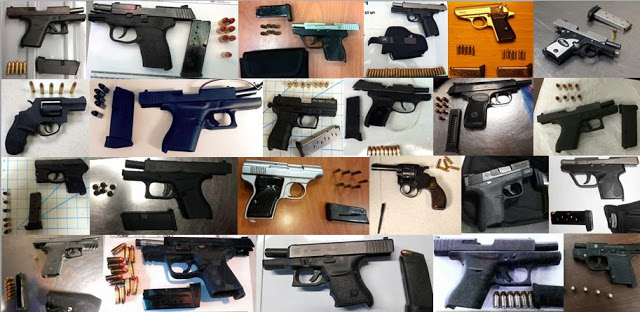
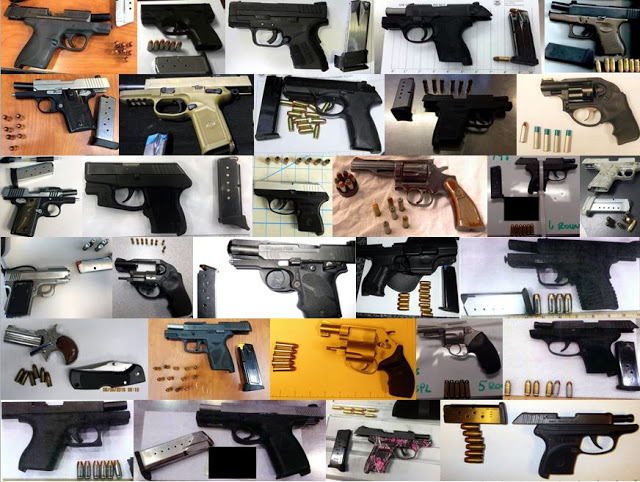
This week 29 guns were discovered at airport security checkpoints. 27 were loaded. 9 had rounds chambered.

And, as we know, one loaded rifle was used to wreak havoc at LAX airport.

TSA GUNS OCTOBER

Courtesy TSA


TSA: 99 firearms at checkpoints in 3 weeks

One thing we missed the past few weeks was the TSA Week in Review, which includes a report of the firearms and other prohibited – and sometimes really wacky – things TSA officers find at airport security checkpoints.

On Friday, we got a round-up that covers September 17, 2013 through October 17th, 2013 (dates inclusive of the partial government shutdown) and learned that during the past three weeks 99 firearms were found at airport checkpoints.

Of those 99 guns, 84 were loaded and 29 had rounds chambered.

SEA firearm 10-16 (2)

Courtesy TSA

What other prohibited items did your fellow passengers try to bring on board airplanes the past few weeks?

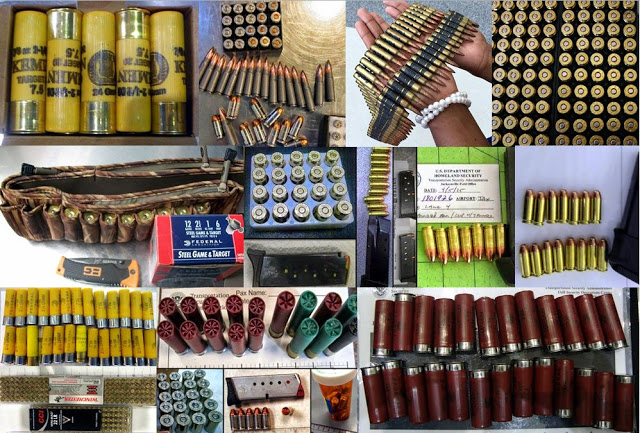
Fireworks, stun guns, daggers, inert hand grenades, brass knuckles and assorted other items.

Read the full list here.