airport design

We’re floored: PDX will bring back the iconic carpet

Portland International Airport (PDX) warmed the hearts of airport carpet fans everywhere with its Valentine’s Day announcement promising the return of the iconic PDX carpet to a few spots in the new main terminal.

The teal, purple and pink design, which is said to represent the pattern of the airport’s north and south runways, had been in the airport since 1988. And many travelers had come to love it. Or at least to associate it with leaving and coming home.

And when social media became a thing, people started taking photos of their feet on the carpet and sharing the photos around.

After 30 years underfoot, though, the carpet needed replacement. And to the dismay of all the fans of the old PDX carpet, in 2015 PDX officials took out 13 acres of the old carpet and replaced it with this new carpet pattern.

People still miss and love the old carpet design, which can be found on socks, t-shirts, and other merchandise. And, for now, in one spot inside the Tender Loving Empire shop in Concourse E, near Gate E5.

So as a gift to the fans of the old PDX Carpet, when the new main terminal opens in 2024 several areas in the pre-security area will sport newly woven carpet with the old, iconic design.

You can read the story we wrote about the carpet comeback for The Points Guy site. But we want to also celebrate and remember cool carpets at other airports around the country. Most should still be underfoot. But keep in mind that many have been doing renovations and updates during the pandemic and may have new patterns now.

If we missed your airport, or if your airport has a new pattern, please let us know and we’ll add/update.

Ocean-inspired carpeting at Orlando International Airport – MCO

Guitar impressions at Nashville International Airport (BNA)

Airplanes in the carpeting at Phoenix Sky Harbor Int’l Airport (now blue)

Aerial view of the Sacramento Delta in the carpet at Sacramento International Airport (SMF).

What will we find at the airport of the future?

What will the airports of the future be like?

We hope to find movie theaters, art galleries, salons, and someplace to do laundry.

Fentress Architects asked architecture students from around the world what they thought about the airport of the future for its annual Fentress Global Challenge (FGC), This year’s competition challenged students to envision airport mobility in the year 2100.

Students could choose between locating their terminals at an existing airfield, such as at Hartsfield-Jackson Atlanta International (ATL), or at a yet undeveloped site.

“Various modes of transport were explored including pods for intra-airport transport.  Mag-lev cars, drones, hyperloops, hydrofoils, and air-rails were among the methods of inter-airport transport proposed,” Fentress reports. “Additionally, several different types of aircraft were studied including anti-gravity, vertical take-off, rockets, and spaceships.”

Entries were evaluated on five criteria, including technology and sustainability. Some submissions envisioned airports that would be able to create their own biofuel from algae and symbiotic bacteria. Others created floating structures that sought to restore coral reefs and ocean ecosystems. 

Here are images from the ten shortlisted entries. A jury of renowned airport architects, directors, planners, and scholars will announce a winner on December 1, 2021, and there will be cash prizes for First, Second, and Third Place.  Two People’s Choice Awards will be given, so you can cast your vote here.

Why we want to fly to Auckland Int’l Airport

We’re (finally) getting serious about planning plane trips and visiting airports.

And one airport on our “to do” list for when borders reopen is Auckland International Airport (AKL) in New Zealand.

Especially now that we know about an award-winning landscape project by the San Francisco-based landscape architecture and urban planning firm Surfacedesign.

The six-square-mile design will progress in phases through 2024. And, according to Surfacedesign, it is influenced by New Zealand’s centuries-old agrarian traditions, from its indigenous Maori settlers and European immigrants in the 1800s.

contact info: blake marvin | blakemarvin@gmail.com


The design incorporates large geometric patterns inspired by sacred Maori stone fields; which are mounded-rock terraces that provided protection against weather and intruders. Other influences come from herringbone hedgerows planted by New Zealand’s European immigrants. There are also abstract shapes referencing Auckland’s natural volcanic and coastal topography. And “V” patterns found in bird flight, which are also significant in Maori culture.

The overall plan also connects existing greenspaces and creates nearby recreational opportunities—including a mountain bike park and 45 acres of new open space.

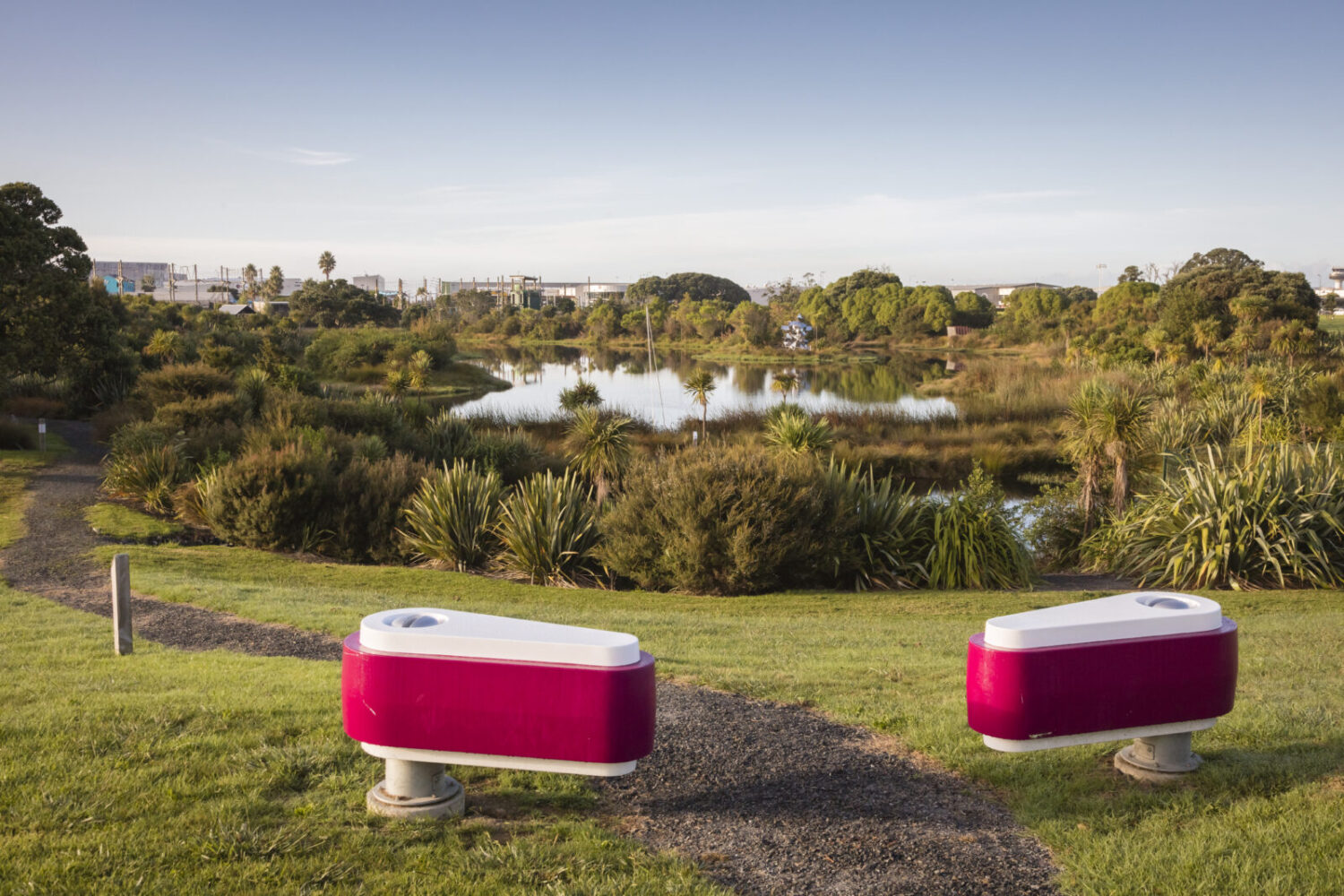
Sounds intriguing, right? Our favorite part: the pinball flippers!
             

All photos by Blake Marvin.

DEN: 5 Things We Love About Denver International Airport

While we wait for air travel to rev back up, the “5 Things We Love About…” series on Stuck at the Airport is celebrating some of the features and amenities at airports around the country and the world.

Today we are giving some love to Denver International Airport (DEN), from it whipped marshmallow-peak tents to the aliens we’re sure are somewhere in – or below – all those acres.

Keep in mind that some of the features we love at DEN may be temporarily unavailable due to health concerns.  We are confident they will be back.

If we’ve missed an amenity you love at Denver International Airport, leave a note in the comments section below. The same goes for suggesting an airport you would like to see featured in a future “5 Things We Love About…” episode.

Here are the airports included in the “5 Things We Love About…” series so far.

5 Things We Love About Denver International Airport (DEN)

1. The DEN Tents

The 21 “tents” that make up the main terminal at Denver International Airport are described as echoing the peaks of the Rocky Mountains, Native American teepees, billowing thunderheads or, perhaps, canvas-covered wagons toiling westward over the Great Plains.

2. The art at DEN

DEN is known for its unusual and eclectic art collection.

One favorite is “Mustang”.  Nicknamed, Blucifer, the blue 32-foot cast-fiberglass sculpture with neon red eyes is hard to miss on the Peña Boulevard approach to the airport.  “Mustang” was created by Luis Jiménez who, sadly, died after a piece of the sculpture fell on him while he was working on it.

DEN hosts temporary art exhibitions and has lots of permanent public art works, including Gary Sweeney’s “America, Why I Lover Her,” in the Jeppesen Terminal.

3. DEN’s CATS

DEN has more than 100 dogs and one actual cat in its CATS (Canine Airport Therapy Squad) program.

4. DEN’s Talking Gargoyle

“Notre Denver,” by Terry Allen, is an artwork featuring two cast bronze gargoyles sitting inside suitcases that watch over the east and west baggage claim areas.

These two gargoyles are charming, but they don’t talk. And due to construction at DEN, this work is in storage through 2021.

But DEN’s talking gargoyle, named Gregoriden, is on duty.

He’s set on a timer and says something to passersby every 5-10 minutes. Visit him on level 5 in the terminal near Southwest baggage claim.

5. DEN’s Gate Expansion Project

The gate expansion project at DEN will add 39 new gates across all three concourses. Better yet, the project is adding a post-security outdoor patio on each concourse featuring pet relief areas, outdoor seating, and fire pits.

Fire pits! We can’t wait!

Adorable airports of the future

Airports around the world are getting makeovers. In some countries, new ones are being built.

Travelers are excited about that, of course, but so are architects and people who appreciate great design.

In this article from Architectural Record, the Airport Construction Council notes that at least $70 billion is being spent over five years, beginning in 2017, to modernize 50 medium and large U.S. airports.

Most of that money and effort is going toward revamping, expanding or constructing terminals.

Some of the other airports and airport terminal projects featured in this article include Pittsburgh International Airport, Singapore Changi Airport and JFK Airport.

Courtesy Pittsburgh International Airport
Photo by Harriet Baskas

The new Terminal B at LaGuardia Airport is mentioned as well.

Courtesy HOK and WSP

Winning designs for the airport of the future

What will airports look like in the year 2075?

For seven years, Fentress Architects has been running a contest asking students for their ideas about what the airport of the future might look like.

This year, students from more than 50 countries registered about 500 ideas.

Here are the winning proposals. Which are your favorites?

1st Place: Infinity Airport

This design takes inspiration from the torus knot, which appears like two overlapping infinity symbols.

“The general shape of this airport concept combines the complexity of the form and the ideology of infinity by creating the circular and endless concourse system,” explains winner Daoru Wang, of North Carolina State University.

2nd Place: Newark Airport Biophilic Headhouse and Community Nexus

The project uses a rail access and a consolidated terminal to explore the concepts economic analyst John Kasarda described in Aerotropolis, explains Samantha Pires, at the New Jersey Institute of Technology in Newark.

This project “brings economic development to the community that it serves,” said Pires. “It proposes that the Airport of the Future should not be governed by fear and ‘security theater’ that runs modern airports. [Instead] it should be a place for community engagement, job opportunities and a catalyst for neighborhood development and benefit.”

3rd place: London Heathrow 2075

“In this design, a drive-through concept sits below the airport terminal allows aircraft traffic and waiting times to be reduced,” explains winner Christopher Johnson, at the University for the Creative Arts in Farnham, UK,

“Technological innovations suggest a reduction in physical passports, security and immigration as it moves to an online environment.”

People’s Choice Awards –Y3M

“This design envisions integration of an Elon Musk-like Hyperloop tube system and capsule fuselage technology,” explain winners Chai Yi Yang and Ng Yi Ming of the University of Malaya, Kuala Lumpur, Malaysia…. “[T]he new model suggests a seamless transition from rail to flight—elementary yet expeditious.”

People’s Choice Award #2:  Six Lane City

“Today, O’Hare International Airport in Chicago extends over 12 square miles, most of which are not fully exploited. We decided to create a new form of city, 650 feet above ground level, which will be built on top of the existing lanes or runways of the airfield,” said winners, Riki Rozenberg, Evelyn Kreslavsky, Mai Whiteson at Tel Aviv University.

Our goal is to create an aerotropolis—an airport which integrates residential solutions, economic opportunities and cultural experiences, which, we think, will bring people closer together.”

First place wins $10,000; 2nd place $3000 and 3rd place $2000. Two People’s Choice Award winners receive $1000 each.

Airports are not islands: there are cities out there

While airports are indeed unique, intriguing  – and sometimes frustrating – places all their own, they don’t exist in vacuums. Travelers have to get to them and from them.

The film below explores the relationship between the city and its airports; in this case New York City and its multiple airports.

The film was created on the occasion of the AERIAL FUTURES: Urban Constellations think tank in New York City, and explores ways we might improve air travel and urban life by better connecting cities and airports.


Delta breaks ground on its new LaGuardia terminal.

Maybe – someday – we’ll love New York’s LaGuardia Airport. Again.

Signs are pointing in the right direction.

On Tuesday Delta Air lines broke ground on its $4 billion, 37-gate facility at LaGuardia – part of the over-all transformation of the airport we’ve been promised.

Delta’s CEO, Ed Bastian, was there, along with New York Gov. Andrew M. Cuomo and a variety of local and regional dignitaries.

“The groundbreaking at Delta’s facilities represents another step forward as we build an entirely new airport at LaGuardia,” Cuomo said in a statement. “Together with our private-sector partners, we are making rapid progress to create the world-class gateway to the Empire State that New Yorkers deserve.”

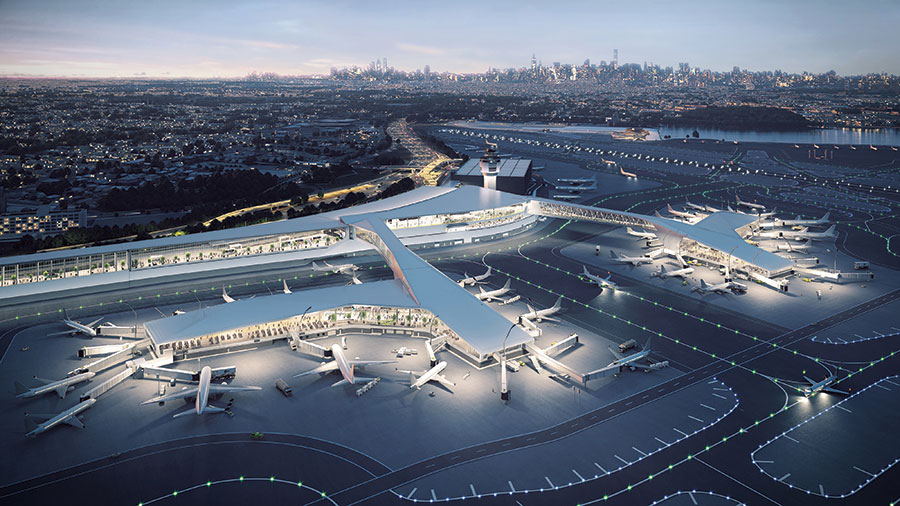
Delta’s new terminal promises four concourses with 37 flexibly-sized gates to accommodate Delta’s full fleet; a new, larger Delta Sky Club with a Sky Deck; new hold rooms with more seating; 30 percent more concessions space; and “sustainable and scalable technology befitting of an airport of the future.”

“We know the new LaGuardia is one that New Yorkers will be proud to call their hometown airport,” said Delta’s Bastian. “And we are confident that this investment will further cement Delta as the No. 1 airline in New York, with the best customer service and experience on the ground as well as in the air.”

Here are some drawings released by Gov. Cuomo’s office showing what’s in store. Let’s hope the art and greenery makes it to the final cut.


More on being old in an airport

Baskas had a tough time trying to lift a suitcase over the lip of the bag claim carousel while wearing an  'aging' suit

Here’s a bit more on my experience walking around Seattle-Tacoma International Airport in an ‘aging suit,’ with architects from Corgan as my guides.

The suit, developed in Germany and also referred to as a GERT (or Gerontological Test suit), is a collection of accessories that get attached to different areas of the body to temporarily add impairments that simulate being old – up to 30 years older than you are.

I wore spongy overshoes that made it hard to know when my feet were actually touching the floor; knee and elbow wraps, and a neck brace, to limit my movement and simulate joint stiffness; earmuffs to lower my hearing by about 10 dB; and blurred goggles to reduce my vision.

To make it even hard to walk around the airport, Michael Steiner, a senior associate at Corgan, added a heavy padded vest to my outfit, which brought the ensemble’s weight to somewhere around 30 pounds.

Wearing all that, I headed out into the terminal to experience being ‘old in an airport.’

The blurry goggles made it difficult to see which floor number to push in the elevator.
The spongy shoes made it difficult to know where I was stepping, especially when it came time to get on and off the escalator.

At baggage claim it was really difficult to lean over, grab my test suitcase and pull it up over the lip of the metal wall.

My walk through the airport was escorted, but in this age of “If you see something, say something,” here I was wearing a strange outfit that either made me look like I’d been an accident – or was out to hurt someone else – but no one approached me either to find out what I was up to – or to offer help.

True, I couldn’t quite see or hear other people with those decibel-reducing earmuffs and fuzzy goggles on, but that was exactly the point of putting the suit on in the first place, said Corgan’s Michael Steiner,

“An airport is an incredibly chaotic and busy place, even for someone who is perfectly healthy,” he said, “Take away some of the sensory inputs such as sight, hearing and mobility and couple those with a busy environment and you’ll get a different viewpoint of how someone decides to move through the space to get where they need to go.”

Or decides that they won’t bother to try to make their way through the airport at all.

Harriet Baskas wearing 30 pounds of 'aging suit' apparatus for test walk through SEA airport

(See my At the Airport column on this experience on USA TODAY)

Taking an airport walk as an old person

Harriet Baskas wearing 30 pounds of 'aging suit' apparatus for test walk through SEA airport

Monday’s assignment was another one for the books: go the airport, meet a couple of guys from the Dallas-based Corgan architecture and design firm, let them outfit me in a weighted vest, knee pads, padded shoes and assorted other items that simulate being 30 years older than I am, and take a walk.

The goal? To experience the challenges of moving through a busy, crowded airport without the pep, eyesight and navigational fearlessness of a much younger person.

I’m writing up the details of this educational and exhausting day for tomorrow’s At the Airport column on USA TODAY, but here’s a pic of me trying to get a suitcase up and over the lip of a bag claim carousel.

No laughing please…

Baskas had a tough time trying to lift a suitcase over the lip of the bag claim carousel while wearing an  'aging' suit