Art

Robert Rauschenberg was an avgeek

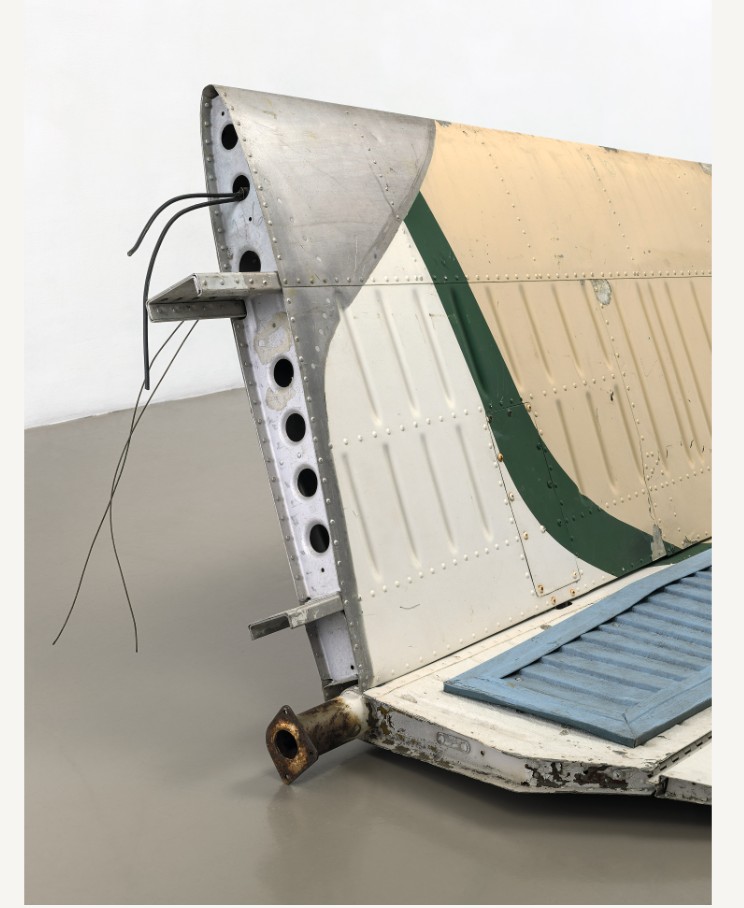
(“Mercury Zero Summer Glut” 1987, courtesy Robert Rauschenberg Foundation)

October 22 marks the 100th anniversary of the birth of postmodern artist Robert Rauschberg, who died in 2008 and this year there are wide range of exhibitions and activities to mark the centennial.

One of those is Smithsonian Books’ publication of The Ascent of Rauschenberg: Reinventing the Art of Flight, written by Carolyn Russo, who is the curator of the art collection at the Smithsonian’s National Air and Space Museum.

Rauschenberg is most famous for his groundbreaking “Combines,” which are painting and sculpture hybrids that often incorporated everyday objects and a connective tissue through it all was his fascination with flight. 

Throughout his body of work, Rauschenberg skillfully intertwined himself thematically with the subject of flight—spanning birds in nature, aviation, and the vastness of space,” Russo writes.

Her book includes more than 150 images of Rauschenberg’s work, from lithographs inspired by the Apollo 11 launch that NASA invited him to witness and document, to a Combine featuring a taxidermied eagle that evokes Roman mythology.

Here are couple of images from the book.

(“Wing Swing Glut, 1988” – ©Robert Rauschenberg Foundation and  Ron Amstutz)

(“Autobiography” (1968) courtesy Robert Rauschenberg Foundation)

Fresh airport art in Austin and Miami

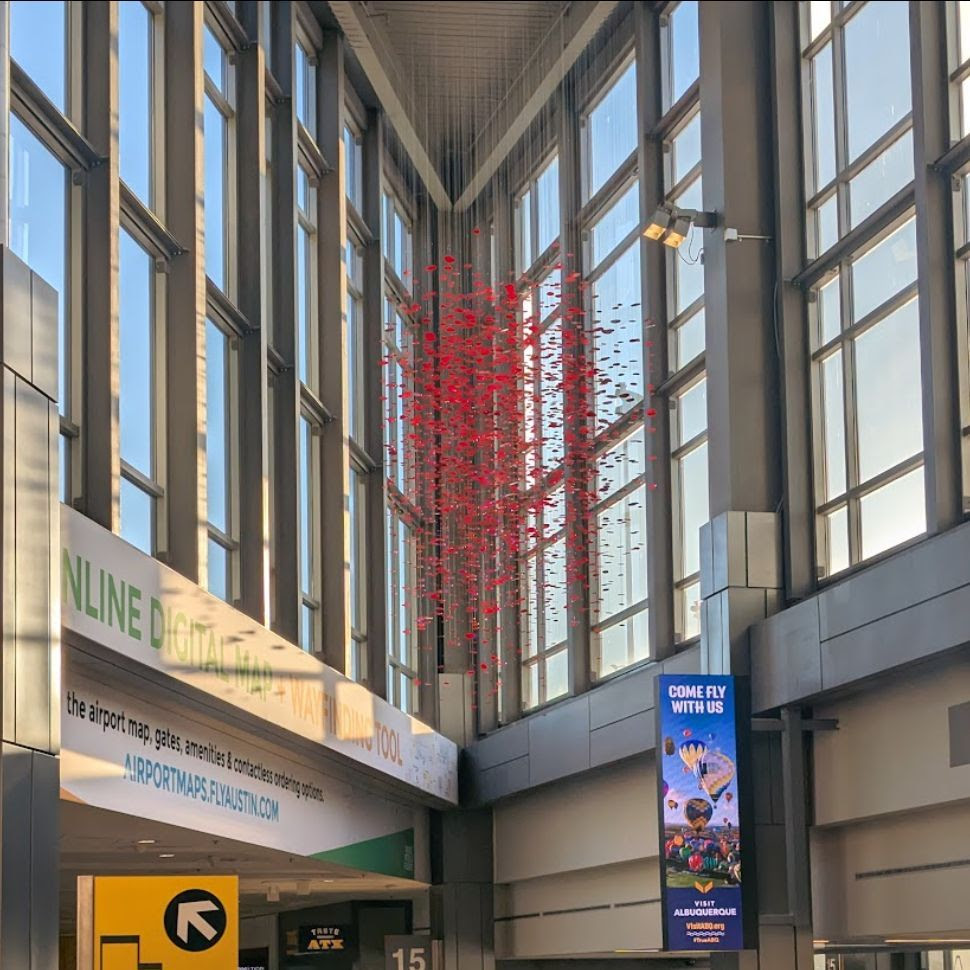
Convergence / Austin is a new site-responsive work at Austin – Bergstrom International Airport (AUS) by Austin-based artists, Beili Liu Studio.

The work spans 16 feet by 12 feet, includes 400 vertical strands holding 3,200 elements, and fills the high bay triangular area across from Gate 15 in the main AUS Barbara Jordan Terminal.


Quilt exhibit at MIA Airport

(Courtesy of MIA Galleries, Miami International Airport)

Curious Geometries is the newest art exhibition at the Gate D31 Gallery at Miami International Airport (MIA).

On display through March 9, 2026, the exhibition features large-scale, sewn and quilted artwork by local artist Regina Durante Jestrow, who uses repurposed fabrics from Miami and other locations.

Fresh (upcycled) art at Albany Int’l Airport

New York’s Albany International Airport (ALB) and Southwest Airlines are marking 25 years of Southwest service to the Capital Region with art.

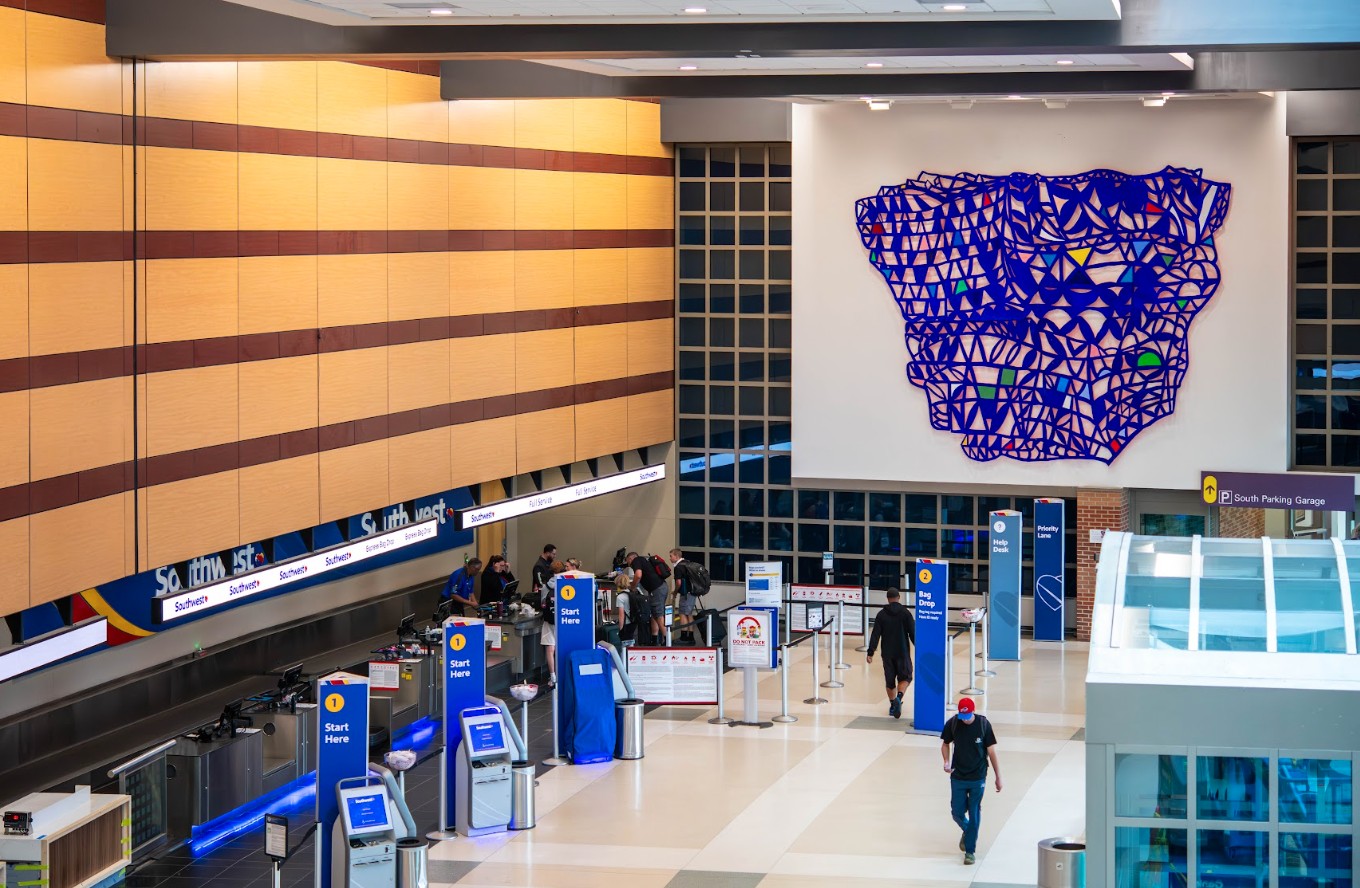
A new large-scale sculpture titled Treasure Map, by Hudson Valley artist Ruby Palmer, is now on display in the terminal.

The work was made entirely of aircraft seat leather from Southwest’s Repurpose with Purpose initiative, which promotes sustainability through creative upcycling of retired aircraft seat leather.

A wide variety of objects, including travel gear, have been made with old seat leather, but Treasure Map is the first sculpture to come out of the initiative.

There will be a party to celebrate both the anniversary and new artwork on Saturday, September 13, 2025, from 2:00 to 4:00 PM next to the Southwest ticket at Albany International Airport, where Treasure Map is installed.

Guests will have the opportunity to meet the artist and enter prize drawings to win an original artwork by the artist, plus 25 round-trip tickets to any Southwest destination.

Welcoming back, Calder, to PIT Airport

[This is a slightly different version of a story we wrote for the Pittsburgh International Airport’s Blue Sky News]

Check out the Calder sculpture at PIT Airport

It is black and white, weighs 600 pounds and is 28 feet long and equally wide.

And it will be impossible to miss it at Pittsburgh International Airport’s new landside terminal.

“Pittsburgh,” the kinetic mobile by famed artist Alexander Calder that has dangled from ceilings in the city’s airport terminals, on and off, for almost 70 years, has been reinstalled in the brand-new terminal’s atrium space to serve as both a gently waving welcome and farewell for all passengers and pre-security guests.

First installed in 1959 over the rotunda of the Greaterer Pittsburgh Airport terminal that opened in 1952, the mobile spent some time at the Carnegie Museum of Art before moving to the current PIT terminal in 1992.

As such, the sculpture has been part of the airport’s art program since before the airport even had much of an art program, said Keny Marshall, PIT’s Manager of Arts and Culture.

“People just expect to see the Calder at the airport,” said Marshall. And while the new landside terminal was not designed around the sculpture, its “place of prominence” was determined in collaboration with the architects – Gensler + HDR, in association with luis vidal + architects – to highlight the piece and to give the public a better view of it, he said.

PIT Calder Mobile

“Pittsburgh” is made of black steel rods and white aluminum paddles and is balanced so that elements move with just the slightest breeze to allow the activation of the mobile. The piece has been in storage for the past two years in preparation for its move to the new terminal.

In its previous location above PIT’s post-security Airside Center Core, the Calder mobile was in “an architecturally cluttered space” where few passengers stopped to take time to look at it, said Alex Taylor, an associate professor in the Department of History of Art and Architecture at the University of Pittsburgh who has studied Calder’s work extensively.

“When I’d go to the airport, I would stop with my carry-on to watch the work for as many minutes as I could spare before I had to get to the gate,” said Taylor, “But it always felt like I was the only one.”

Carol Brown would also make sure to visit the Calder during her trips through the modern-day terminal. The former county parks director was instrumental in getting the sculpture restored when it was hung incorrectly at the old terminal with its metal sections painted first yellow and green (Allegheny County’s colors) and then pink. Once it was restored, Brown advocated to have it put in the then-new 1992 terminal.

“I would always stop to say ‘Hi, Calder,’ when I went through the terminal. And I am looking forward to being able to say that again in the new terminal,” said Brown.

That will be easy to do. In the new landside terminal, the mobile will hang in the large open atrium space with an overlook offering multiple viewing angles, said Marshall.

Experts from Ohio-based McKay Lodge Art Conservation Laboratory, the company that took the Calder down from its previous spot and packed it for storage, will be on hand to unpack the sculpture and put it back up.

It will be an unusual challenge. A special lift is needed to attach the sculpture to the new terminal’s ceiling, which is almost 80 feet high.

And luckily, PIT airport owns a special piece of machinery – the Teupen Leo 26 aerial lift –  that can easily handle the task, said Renee Piechocki, a longtime public art consultant for PIT.

And because each piece of the sculpture is carefully cantilevered off the next, “as soon as you add a piece, everything changes. Only once the sculpture is fully assembled does it gracefully balance in the space,” said Marshall.

When the new terminal opens sometime this October, passengers and the public will be able to see the sculpture from eye level or above on the pre-security departure level of the new terminal.

On the arrivals level, one floor below, people will be able to look up at the sculpture and walk beneath it, explained Marshall.

What other airports have Calder sculptures?

(Courtesy Calder Foundation, New York / Artists Rights Society )

Other airports have, or once had, Calder mobiles.

Among them is the artist’s 45-foot-long mobile titled “.125” (above) that currently hangs in the Departure Hall of Terminal 4 at John F. Kennedy International Airport.

A Calder mobile named “Brass in the Sky,” once hung in Marshall Field & Co.’s Cloud Room Restaurant at Chicago’s Midway Airport.

And a 40-foot-wide Calder work titled ‘Red, Black and Blue” made its way from Dallas Love Field (DAL) to Dallas Fort Worth International Airport (DFW) and to Milwaukee Mitchell International Airport (MKE) before finally landing at the Milwaukee Art Museum.

Valued now at about $12 million, PIT’s Calder mobile may be the airport’s most valuable and well-known work in a growing art collection.

“But you don’t need an art degree to understand why it is the centerpiece of the new terminal,” said Piechocki.

Like the multi-tiered sculpture, Piechocki imagines there will be multiple layers of responses to the mobile in its new space.

For those already familiar with the sculpture from the existing terminal, she hopes the reaction is “Wow, they finally gave the Calder the place it deserved. It looks amazing.”

For someone who has never been to Pittsburgh and who knows art, the reaction might be, “Oh my god! Is that a Calder?”

And for someone who is just a little grumpy and stressed out at the airport who might not know anything about art? Piechocki hopes they might pass by the sculpture and “be subconsciously a little less stressed out because they’re looking at a beautiful thing moving through the air.”

Here’s a snap of PIT’s Calder sculpture from the recent install. We can’t wait to see it in person!

(All photos courtesy Pittsburgh International Airport, except where noted)

Relax in cool rocking chairs at Bradly Int’l Airport

Bradley International Airport (BDL) now has 9 new painted rocking chairs in the terminal, thanks to some creative high school students from Connecticut and Western Massachusetts.

In the spring, the airport gave nine participating schools unfinished wooden rocking chairs with an invitation to paint the chairs with a design that represents their town or state.

The finished chairs, now adorned with images that celebrate local landmarks, picturesque scenes, historical references and school pride, are back at the airport and located post-security in the terminal.

If you’re traveling through Bradley International Airport, take a moment to enjoy the painted rocking chairs and some of the permanent and temporary art exhibitions and live music offered through the BDL Art & Music program.