The wildfires in the Southern California Metro area are causing widespread devastation.
Support is flowing in. But more is needed.
Here are a few ways you can join airlines in contributing money or miles.
Alaska Airlines and Hawaiian Airlines are donating $100,000 to the Los Angeles Fire Department Foundation and five million Mileage Plan miles to the American Red Cross for disaster relief related to the Los Angeles wildfires.
You can contribute donate miles, with all donations matched up to five million miles until January 17, 2025. Here’s a link to get started.
From now through January 22, 2025, American Airlines AAdvantage members can earn 10 bonus miles for every dollar donated to the Red Cross with a minimum $25 donation.
More than one million dollars has been raised already. Here’s the link to make your contribution.
Delta Air Lines is contributing $1 million to the American Red Cross to help those affected by the wildfires sweeping across California.
United Airlines has donated $100,000 to two local California nonprofits, the LA Regional Food Bank and California Fire Foundation. The carrier will match additional donations up to $150,000 and 5 million miles. Here’s a link to make your contribution.
This week IATA, the International Air Transport Association, released its 2025 outlook, covering everything from the number of people expected to fly, to financial outlooks for the industry and the progress (or not…) on the industry’s goal of producing enough sustainable aviation fuel (SAF) to help airlines combat climate change.
Here are some highlights:
5.2 billion people are expected to take to the skies during 2025. That’s a 6.7% increase over 2024 and the first time the total expected passengers will exceed the 5 billion mark.
IATA expects the average airfare in 2025 to be $380, which is 1.8% lower than 2024.
In 2025, global airline industry revenues will exceed $1 trillion for the first time, representing almost 1% of the global economy. Airlines also have $940 billion in costs and retain a net profit margin of just 3.6%, said Willie Walsh, IATA’s Director General, “Put another way, the buffer between profit and loss, even in the good year that we are expecting of 2025, is just $7 per passenger.”
Airlines face some significant risks
IATA notes that there are strong geopolitical and economic uncertainties facing the airline industry, including multiple conflicts around the world and the incoming Trump Administration, which could create tariffs and trade wars that dampen both air cargo demand and business travel.
Offsets and carbon capture as well as new technologies such as electric and hydrogen are elements of the plan, but the production of enough sustainable aviation fuel (SAF) is the major component.
Unfortunately, while the amount of sustainable aviation fuel being produced is increasing, it’s going slower than planned.
“Governments are sending mixed signals to oil companies which continue to receive subsidies for their exploration and production of fossil oil and gas,” said IATA’s Willia Walsh, “And investors in new generation fuel producers seem to be waiting for guarantees of easy money before going full throttle.”
There are strings, of course. And more to the story.
You need to be flying in business class on an intercontinental flight. And the houses are just 4 inches high.
But they are filled with Dutch gin and are part of a series of Delft Blue miniatures in the shape of a notable historic or landmark building in the Netherlands or abroad.
KLM began the tradition of gifting a miniature Delft Blue house filled with gin to first and business-class passengers back in the 1950s.
It was a way to get around rules about tax restrictions that once limited the value of the gifts that airlines could give to passengers. A cocktail that just happened to be served in a keepsake miniature house was within the rules.
The houses became so popular that in 1994, on the carrier’s 75th birthday, KLM issued a catch-up batch of houses so that the number of houses would line up with the airline’s age.
Now a new miniature Delft Blue house is released to great fanfare each year on October 7, KLM’s birthday.
The 105th KLM Delft Blue House
This year’s house – the 105th in the series – honors a 17th-century house in Amsterdam known as the House on Three Canals.
Built in the Dutch Renaissance style and renovated several times since 1687, this Dutch national monument has a different canal on three sides of the building.
“It’s one of the most photographed monuments in the city,” said historian Marz Zegeling. “This building – which was originally two buildings – has three different façades, or faces and is still revealing secrets,” such as a hidden hatch leading to a secret hiding spot, he added.
Zegeling is the author of “Little Kingdom by the Sea,” a regularly updated 2-book set with detailed descriptions and histories of each building in the KLM Delft Blue house series.
On October 7, Marjan Rintel, the President and CEO of KLM, presented the first copy of the Delft Blue miniature of the House on Three Canals to Arthur van Dijk, the King’s Commissioner in the province of North Holland.
KLM’s birthday and the new Delft Blue miniature house reveal comes at a “challenging time” for the carrier, Rintel acknowledged in a pre-event press conference. While the airline is investing billions in new, more efficient aircraft is also embarking on a campaign aimed at reducing costs, increasing productivity and increasing network capacity, especially on long-haul flights.
For now, though, KLM’s Delft Blue miniature house program is safe from cuts.
“We will look at everything but not the Delft Blue houses,” Rintel said, “We’re well known for it and it will stay as part of our brand.”
You can get a KLM miniature house as a complimentary amenity when flying business class on an intercontinental KLM flight, on eBay and in antique shops throughout Amsterdam.
And you can track your collection using the KLM Houses app.
Condor, the German airline with the candy stripe livery in an assortment of fun colors, has added a pink-striped livery to one of its Airbust A320 aircraft to mark Breast Cancer Awareness Month, which runs through October.
Condor’s “Fly Pink” plane joins the “FlyPink” initiative founded by QantasLink pilots in 2015.
The initiative supports the National Breast Cancer Foundation (NBCF) and contributes to local breast cancer charities around the world.
This is the first new livery color for Condor since it launched in 2022 with five other colors.
The cabin of the “FlyPink” Plane will also sport pink on headrest covers and on special “safety cards” which have detailed information on breast cancer prevention, according to a Condor statement.
There’s also pink-striped Condor merchandise, including umbrellas, water bottles and beach towels, for sale in the Condor Shop and on board. The proceeds from these items will be donated to Brustkrebs Deutschland e.V., a breast cancer prevention and research association in Germany.
Alaska Airlines has a long-running and very popular Wine Flies Free program that allows members of its mileage plan program to check a case of wine without having to pay an extra baggage fee when flying from 32 West Coast cities in Washington, Oregon, Idaho and California.
As a great and valuable bonus, in Oregon, Washington and Idaho your Alaska Airlines boarding pass gets you free wine tastings at participatng wineries.
Now Avelo Airlines is joining the wine-flies-free bandwagon with its own version of the program.
The airline doesn’t service as many cities as Alaska does, but beginning on National Wine Day (May 25), Avelo customers can begin checking a case of wine for free from the Bay Area’s Charles M. Schulz Sonoma County Airport (STS) in Santa Rosa, CA.
Avelo currently offers nonstop flights from Sonoma to Salem, Oregon (SLE), Bend/Redmond (RDM), Boise (BOI), Glacier Park International Airport (FCA) in Kalispell, MT, Las Vegas (LAS), Hollywood Burbank Airport (BUR) and Palm Springs (PSP).
“We know that visiting the vineyards and sampling Northern California’s world-famous wines is one of the most appealing reasons for visiting the Sonoma County region,” said Avelo Airlines Founder and CEO Andrew Levy, “It is our hope Avelo’s new Wine Travels Free program will make our Customers’ trips to California Wine Country that much more enjoyable and memorable.”
On both Alaska and Avelo, you must be at least 21 years of age to take advantage of this perk. And on both airlines one case of wine is considered to be a single box or case containing up to 12 bottles and weighing 50 lbs or less.
Let’s raise a glass to airlines that let wines fly free.
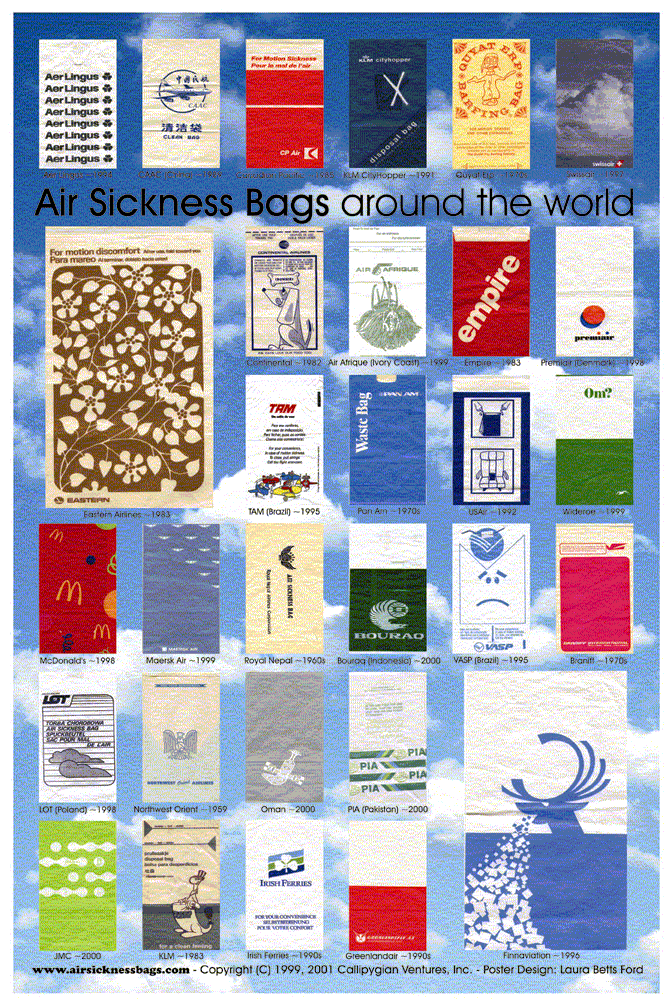
No one wants to get sick on an airplane. But if you feel ill, it’s good to know there’s usually an air sickness bag in the seatback pocket.
And, as there is for most everything, there are people who are serious about collecting (unused) airline barf bags.
This short film includes interviews with some of the world’s air sickness bag collectors. The film also notes that this travel amenity shares its 75th anniversary with Dramamine, a medication designed to combat air sickness that may, some worry, signal the demise of collectible airline barf bag.
Between the storms in many regions of the country and the grounding of all Boeing 737-9 MAX aircraft for inspection, there are a lot of flight cancellations, schedule disruptions, and airline travel alerts.
Here are links to the current travel advisories and waivers (as of early Tuesday, January 9, 2024) in effect for some of the major airlines. Be sure to check your airline’s website for the latest updates on these advisories,
Alaska Airlines
On its website, Alaska Airlines is advising travelers that due to Boeing 737-9 MAX aircraft inspections and winter weather in the Northeast, they are offering a flexible travel policy for travelers who want to change or cancel their flights. Original travel dates include January 9.
American Airlines
American Airlines has a travel alert for close to 60 cities that may be affected by severe weather in the Eastern US and Canada. The airline will waive your change fee if you traveling in any fare class and are scheduled to fly January 9-10 and can travel instead January 9 – 15. See here for more details on American Airlines’ travel advisory.
JetBlue has also issued travel alerts for winter weather in the Midwest and the Northeastern US.
In the Midwest, the airline will waive change/cancel fees and fare differences for customers traveling through January 9 to or from Chicago (ORD), Detroit (DTW), Kansas City (MCI), Milwaukee (MKE), and Minneapolis – St. Paul (MSP). The travel alert covers about 15 airports in the Northeast. Customers may rebook their flights through January 13.
Southwest Airlines
Southwest Airlines has travel alerts posted for the Midwest and the East Coast.
United Airlines
For those scheduled to fly on a Boeing 737-9 MAX airplane, United Airlines offers these options:
You can reschedule your trip and have the change fees and fare differences waived. Your new flight must be a United flight departing by January 18, 2024. Tickets must be in the same cabin and between the same cities as originally booked. Trips rebooked after January 18, 2024, will still have the change fee waived, but there may be a fare difference. Cancelling and getting a full refund is also an option.
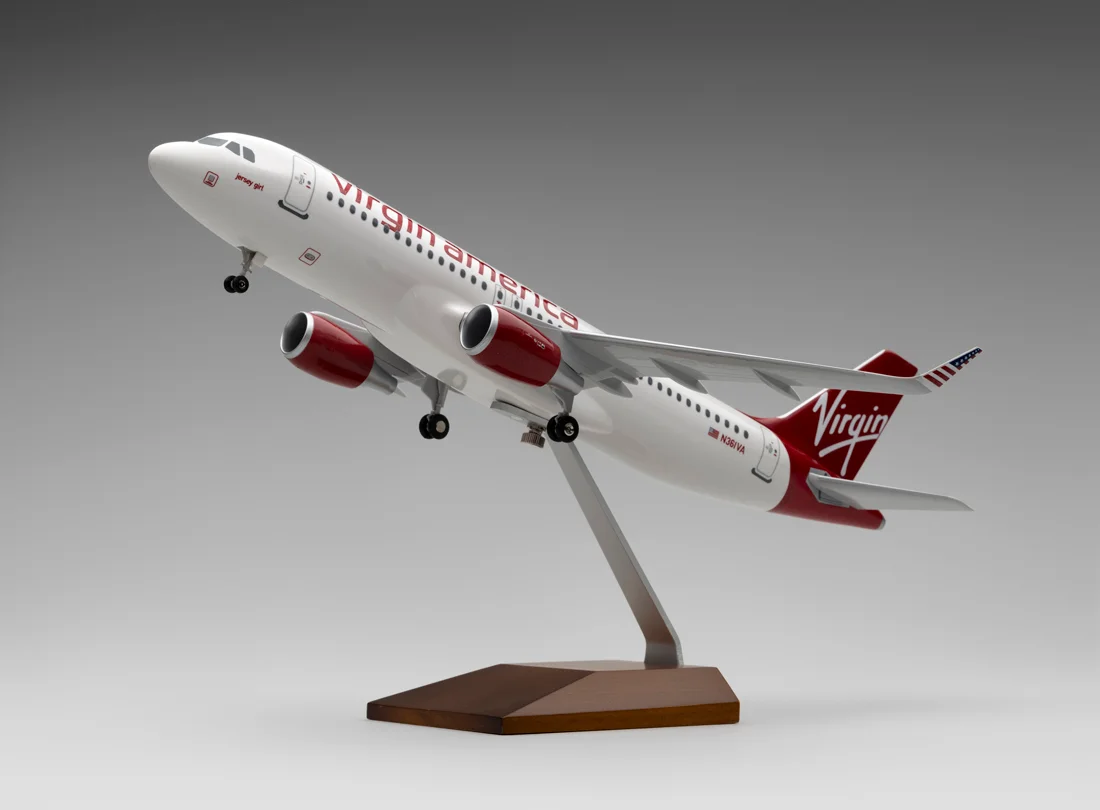
The carrier began operating in 2007 and became a passenger favorite thanks to leather seats, cool cabin mood lighting, premium entertainment systems, a super-catchy award-winning safety video (see below), and its high-energy flight and ground crews dressed in hip, casual uniforms.
Virgin America’s planes had cool names, such as Jefferson Airplane, Legally High, and Let There Flight. And when new routes were kicked off, Richard Branson would often show up
The airline ceased operations in 2018 following its acquisition by Alaska Airlines. But the airline lives on in the collection of the SFO Museum at San Fransisco International Airport (SFO).
A new exhibition at SFO, titled VX Forever: The Legacy of Virgin America includes flight and ground crew uniforms and accessories, inflight service items, promotional material, seats, photographs, and ephemera.
Look for the free Virgin America exhibit pre-security in the Aviation Museum and Library in the International Terminal of San Francisco International Airport through November 17, 2024.
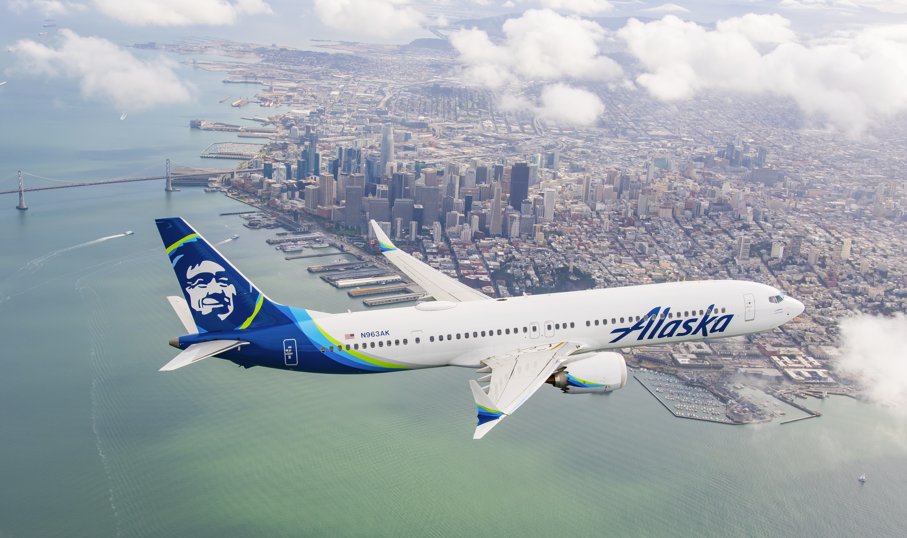
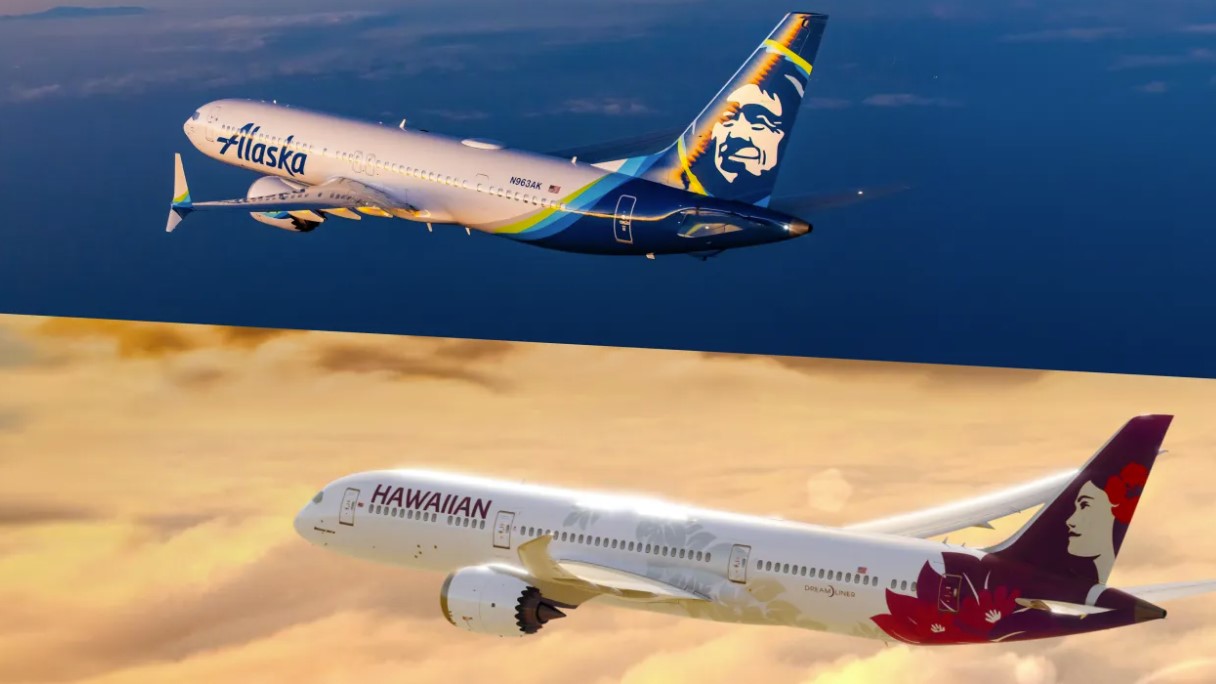
On Sunday, Alaska Airlines and Hawaiian Airlines announced a plan to merge in a deal that has line Alaska Airlines buying Hawaiian Airlines for $1.9 billion.
“This combination is an exciting next step in our collective journey to provide a better travel experience for our guests and expand options for West Coast and Hawai‘i travelers,” said Ben Minicucci, Alaska Airlines CEO in a statement.
Peter Ingram, Hawaiian Airlines President and CEO said, “Since 1929, Hawaiian Airlines has been an integral part of life in Hawai‘i, and together with Alaska Airlines we will be able to deliver more for our guests, employees, and the communities that we serve.”
What does this mean for travelers?
While many details are still unknown, and some are likely to change before the deal officially goes through (a 12 to 18-month process) here are some of the highlights of this weekend’s announcement, from a message sent to customers on Sunday evening by Alaska’s Ben Minicucci:
The brands will remain: The Virgin America name was retired after it was purchased by Alaska Airlines. But Alaska Airlines says it plans to keep the Hawaiian Airlines brand on airplanes, at airports, and elsewhere. “It will exist alongside the Alaska Airlines brand, supported by a single operating platform and industry-leading loyalty program,” Minicucci said in his statement.
There will be more destinations: The deal will bring a combined network of 138 destinations, including non-stop service to 29 international destinations such as Tokyo, Seoul, Sydney, and Auckland, as well as over 1,200 global destinations through the oneworld Alliance, Alaska notes in its statement. The combined airline will have a fleet of 365 narrow- and wide-body airplanes, according to Alaska.
Headquarters to remain in Seattle: The new combined organization will be based in Seattle and headed by Alaska Airlines CEO Ben Minicucci, but Honolulu will become a new key hub.
What about ticket prices? There is where this deal could have a downside. “Competition between airlines is the single biggest cause of cheap flights,” notes Going’s Scott Keyes, “A merger between these two airlines—whose route maps have dozens of flights that overlap—would result not in more cheap flights for consumers, but fewer.”
How do the flight attendants feel about this?
On Sunday, the Association of Flight Attendants-CWA, AFL-CIO (AFA), which represents over 6,800 Flight Attendants at Alaska Airlines and 2,200 Flight Attendants at Hawaiian Airlines, released a statement:
“Our first priority is to determine whether this merger will improve conditions for Flight Attendants just like the benefits the companies have described for shareholders and consumers. Our support of the merger will depend on this.
“As a practical matter, our union Constitution and Bylaws provides a detailed process for this review with AFA leadership from each airline. Mergers take time – this will not happen overnight. Our union will continue to press forward in negotiations at Alaska Airlines. Alaska Flight Attendants, joined by Hawaiian Flight Attendants, will be on the picket line on Dec. 19 as holiday travel takes off.”