Air Travel

Airlines test new ways to board planes

The task seems straightforward enough. Get passengers from inside the terminal onto a plane quickly and efficiently so the flight can leave on time.

But if you’ve ever stood in the aisle waiting as another passenger s-l-o-w-l-y takes off a coat, fiddles around for a book and then attempts to cram an overstuffed bag into the overhead bin, you know how tedious the process can be.

Airlines would also like to hurry it up. Not just because slow boarding makes already cranky travelers even crankier but because time is money for airlines, and planes earn their keep only when they’re flying.

Most carriers now give first-class passengers and elite frequent fliers a head start down the Jetway; they then board by groups, from back to the front or from window seats toward the aisle.

In March, United Airlines created clearly marked lanes for five different boarding groups.

“We also started going to a window-middle-aisle boarding method,” said United spokesman Charles Hobart. “This reduces the interference that may occur in the aisle as a result of someone having to move to allow another customer to sit in a window or middle seat.”

On many flights, American Airlines gives early-boarding privileges to passengers who won’t be using space in the overhead bins. And Southwest Airlines, which doesn’t assign seats, “lines people up like schoolchildren and avoids the ‘mad rush’ to the door,” said a flight attendant who tweets as @PeanutsnCoke.

“By allowing people to naturally flow to the seat where they want to sit among the available options in front of them, the time savings is unmistakable,” said Southwest spokesman Brad Hawkins. “Across 3,400-plus flights each day, that saved time realizes incalculable savings not only for Southwest but for our customers. Less time to board the whole plane translates into less time sitting and awaiting departure.”

Some airlines will allow passengers to jump ahead in the boarding line for a fee. Others, like Spirit Airlines, “charge a heavy fee for carry-on luggage,” said Raymond Kollau of Airlinetrends.com. “But this seems to be an effective way to encourage passengers to check their luggage and shorten aircraft turnaround times.”

Future boarding scenarios?
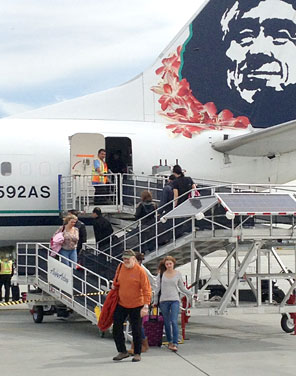
Alaska Airlines boarding ramp

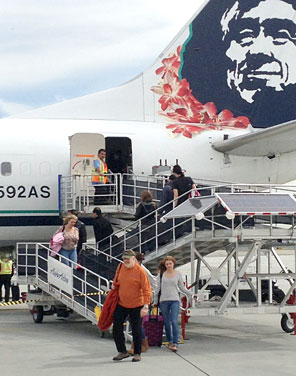
In some airports in Mexico and at some smaller U.S. airports without boarding bridges, Alaska Airlines boards passengers from both the front and rear doors.

Last spring, with the help of a solar-powered boarding ramp made by Keith Consolidated Industries of Medford, Ore., the carrier began testing the use of both boarding doors on some planes at Seattle-Tacoma International Airport (its home base airport) and Mineta San Jose International Airport in California.

The motorized ramp is driven to the backdoor of the aircraft, and three switchbacks covered in a nonslip material offer a gentle slope that makes it easy to pull a rolling suitcase or push a wheelchair from the ground level to the rear door of the aircraft.

“It’s powered entirely by solar panels but can also be hitched to a tug if necessary,” said Alaska Airlines spokeswoman Marianne Lindsey.

Testing is scheduled to continue through year-end, and while the carrier isn’t shaving 10 or 15 minutes off boarding times, Lindsey said, dual-door boarding is speeding things up a bit.

“What this initiative really is about is providing our customers with a more hassle-free flying experience, i.e., saving time boarding and deplaning, which gives customers back time,” Lindsey said. “It’s also right in line with our environmental goals.”

Another option being experimented with is seats that slide out of the way.

Hank Scott, a former Australian Navy pilot who now teaches aeronautical engineering in Colorado, was sick of standing in the aisle behind people who didn’t move very quickly.

“I thought the process would go faster if I could just walk around them.”

Scott’s solution is the Side-Slip Seat, which can be moved a few inches out of the way during the boarding and deplaning process to help widen the aisles.

“We’re looking at a 50 percent improvement in the rate you can get people on an off the aircraft,” said Scott, who hopes to have the seats certified by the Federal Aviation Administration at the end of the year.

And then there’s the Jason Steffen approach.

Steffen, a Lindheimer Fellow in the physics department at Northwestern University, recommends boarding passengers in a line so that when they enter the airplane their seats are spaced two rows apart.

“For example, the first passengers would be 30A, 28A, 26A, 24A, 22A, etc. If speed is the primary goal, I believe that this method is the fastest.”

No airline has adopted the plan, but on Oct. 16, as part of a four-part PBS special called “Making More Stuff with David Pogue,” his method will be tested against that of Southwest Airlines.

“They currently have among the fastest, if not the fastest, boarding method,” Steffen said.

But perhaps not for long.

(My story ‘Airlines test new ways to board planes’ first appeared on CNBC Road Warrior)
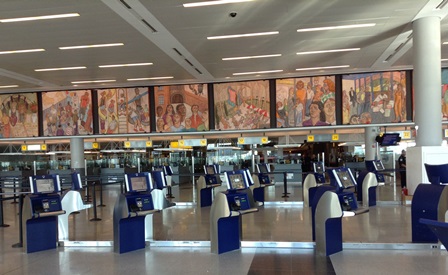
Automated passport control machines speed up travel

Passport Kiosks ready to go at JFK_courtesy Delta Air Lines

Courtesy Delta Air Lines

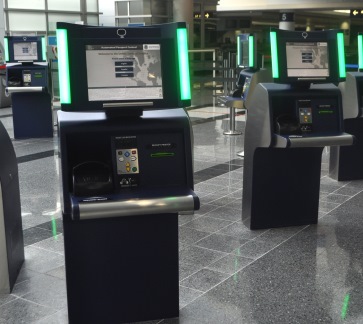
On Monday, arriving U.S. passengers from international flights at JFK International Airport’s Terminal 4 began using automated passport machines to speed their trip through customs.

Similar self-service machines already in use at Chicago’s O’Hare International Airport Terminal 5, and at two airports in Canada (Vancouver and Montreal) are already helping to significantly cut down wait times at customs that, at times, have forced arriving international passengers to stand in line for up to five hours or to be held back on a plane.

JFK is the busiest U.S. entry point for international travelers, and 40 automated passport kiosks have been purchased by Delta for use in Terminal 4, where it is the largest tenant among more than 30 airlines. At JFK, only U.S. citizens will initially be able to use the machines, but soon Canadian citizens should be able to use the machines as well.

Delta would like the Custom and Border Protection agency to increase staffing and improve scheduling to accommodate peak arrival times. “But we don’t know how long that will take,” said Delta spokeswoman Leslie Scott. “This is something proactive we can do now as an investment in the customer experience. Because if a passenger has enjoyed the in-flight meals, the lie-flat bed and other aspects of an international flight having to stand on line for hours on arrival really ruins the experience.”

ORD KIOSKS

Courtesy Chicago O’Hare International Airport

According to the Chicago Department of Aviation, since July 1, when the automated passport control technology was rolled out at O’Hare Airport’s Terminal 5, daily passenger volume has increased by 21 percent, to over 15,000, but wait times during peak arrival periods have been reduced by 33 percent.

The number of passengers waiting over 60 minutes per day at O’Hare has been reduced by nearly 60 percent, and the number of passengers waiting for over two hours has been eliminated almost entirely. The number of passengers missing their connecting flights has been drastically reduced as well.

At O’Hare, only U.S. citizens could initially use the kiosks, but this month the program was expanded to include Canadian citizens as well.

(O’Hare also has another program in place that gets people through customs quicker: in International Terminal 5 a program called “1-Stop” is available to arriving passengers with proper documentation and only carry-on luggage.)

Several vendors, including the Vancouver Airport Authority, IBM and SITA, make and market the technology and the hardware, which will be rolled out at several other airports in North America in the next few months.

Machines made by SITA at Orlando International “are deployed but not yet in use,” said SITA’s Sean Farrell. “We’re just waiting for U.S. Customs and Border Protection to certify the system, but right now that agency is on furlough.”

Toronto Pearson plans to launch its automated passport control kiosks, being built by IBM, in mid-November.

Houston’s Bush Intercontinental Airport has 20 kiosks that should be operational by the end of the year.

On its own, Dallas/Fort Worth International is developing and building 30 automated passport reading kiosks that should be up and running by early November.

And 36 automated passport machines, purchased at a cost of $3.5 million by the Miami-Dade Aviation Department, will be installed in November at Miami International.

“It’s pretty well documented that we’ve had challenges in our international arrivals area,” said Miami’s airport spokesman Greg Chin. “Our peak waiting times have been as much as two to three hours, and this is one of the ways we’re trying to mitigate the challenges.”

Visitor makeup is 70 percent U.S. citizens at O’Hare versus 70 percent non-U.S. visitors at MIA, said Chin, “And because U.S. citizens are easier to process, we don’t think our reduction will match [O’Hare’s] 30 percent but we hope to at least approach that.”

(A slightly different version of this story first appeared on CNBC Road Warrior. This is an updated version.)

Solar-powered boarding ramps – in Seattle?

As we head into the dark, dreary and drippy season here in Seattle, my first question about the solar powered boarding ramps being tested by Alaska Airlines was “How can that possibly work?”

Alaska Airlines boarding ramp

The answer to that question – and a host of others relating to efficiently getting passengers on and off a plane – will show up soon in a story I’m working on for the CNBC Road Warrior.

If you’ve got an opinion – or a fresh idea – on how to streamline the boarding process please add a comment below. You might end up part of the story.

World’s Worst Airports?

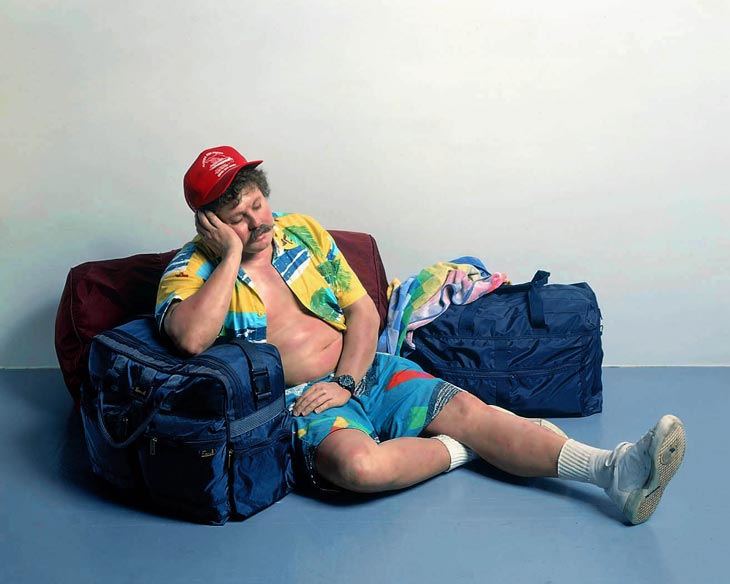
Traveler by Duane Hanson

Traveler – By Duane Hanson


Any airport, even an amenity-rich one, can feel like hell if you’re stuck there when you really want or need to be somewhere else. Just ask Edward Snowden.

But many travelers have very specific reasons for loathing the time they spend at certain airports. For my July “At the Airport” column on USA Today Travel, I asked readers for the “worst” and got a suitcase full of nominations.

Worst US Airport?

Cheryl-Anne Millsap of Spokane, WA dreads Denver International Airport. “I always seem to get stuck there for one reason or another,” she said. “There’s no hotel and it’s a boring place to spend 6, 8 or 9 hours.”

John Barth, a media executive in St. Louis, describes New York’s LaGuardia Airport as “a dump and an utter disgrace. It’s filthy, crowded and there’s no room for what must be a massive business clientele.”

Jason Rabinowitz, editor of NYCAviation.com, agrees. “Before you even get to LGA, you are in a bad mood because it’s not connected to any meaningful public transportation, just a very slow city bus. Once inside, check-in areas are tiny, security lines overflowing, and your cell phone will most likely stop working because it has no signal. And Wi-Fi isn’t free.”

Los Angeles International Airport gets thumbs down from Jill Jackson, who lives in Washington, D.C. “It’s grubby, confusing and too cramped for space. And I always have to wait in line for 20 minutes just to buy a bottle of water,” she said.

Courtney Rugen hates stopping at Kansas City International Airport because it’s “inconvenient to have to go outside security to get food – or anything.” And Jeff Lutz, a Detroit-based marketing director, doesn’t like Washington’s Dulles International Airport because “it feels like you have to take a lengthy shuttle or leave security in order to move anywhere,” which makes for bad connections.

The “worst signage” on roads approaching Dallas/Fort Worth International Airport turns DFW into a “very confusing” place for Laurie Lee Cosby, a voice instructor from Fort Worth, while financial consultant Seth Bailey finds Philadelphia International Airport “kind of dirty, with staff [that] isn’t that friendly.”

With many others, Bryan Smith, a supply chain security consultant in Pennsylvania ranked Newark-Liberty International Airport (EWR) as “the worst domestic airport.” Charlotte-based photographer Jamey Price finds the EWR security lines “always obscenely long; to go in each terminal you have to re-enter security, so to change airlines you have to renegotiate TSA and it always seems to make you late, or nearly late for the next flight.”

Not even small airports escaped being called “the worst.” At Colorado’s Montrose Regional Airport Travel, “there will be a long period of inactivity, then three large jets from different airlines and different cities will be scheduled to land within a ten minute span,” said travel and food writer Larry Olmstead. There’s only one luggage belt, so “once you get your luggage there is no place to go and on a busy day, every square foot of the terminal is jammed. Lines for departures stretch outside into the street, even in winter.”

Worst International Airports?

On work trips, New Yorker Bill Thayer is unhappy if he has to connect through Orly Airport in Paris. “I’ve been there on a number of hot summer days, making the packed bus rides from the gate to the airplane even more painful. Plus, there are seemingly giant crowds at every gate,” he said.

Victoria Van Camp considers the larger Paris Charles de Gaulle Airport to have “the most confusing layout in the world, with signs pointing to heaven” when they mean “go straight.”

Aaron Gayhart of Atlanta, Georgia doesn’t want to go back to Jomo Kenyatta International Airport in Nairobi, Kenya anytime soon. “It was built to accommodate 2.5 million people and it now averages double that, so it’s extremely overcrowded and cramped,” he said. When he was there, “it was dirty, hot, stinky and full of people asleep on the ground and scam artists eyeing tourists.”

And then there’s Chad’s N’Djamena International Airport. We thought NY-based healthcare communications professional Peter Cleary was exaggerating when he described it as “the worst airport ever.” But after learning about his bug-filled evening there when the air-conditioning was out, we may have to agree.

Cleary arrived to find that a door had been propped open for fresh air and “the light near the door attracted a biblical amount of bugs. Literally every surface of the classroom-sized departure lounge was crawling with insects.”

He tried sweeping the bugs off his bags and turning in a slow circle to keep new bugs from crawling over his shoes and up his pant legs. “Some of the bugs were so big you could actually feel them through your shoes as you kicked them away,” he said.

The evening went from bad to worse when it was time to board the plane and passengers were sent outside for an open bag security check. “This provided ample opportunity for larger bugs to join their smaller friends that had already worked their way into my luggage,” said Cleary. So when he landed in Ethiopia he dumped his luggage in the nearest garbage bin rather than take the suitcases – and all those bugs – home.

BONUS

After reading this story full of nominations for the worst airport, John Walton, Director of Data for Routehappy (a website that ranks flight on a happiness scale) pulled this list of ‘worst airports’ as rated by the site’s users.

Here’s the top of the list:

Amman Queen Alia, Jordan (AMM)
Nairobi Jomo Kenyatta, Kenya (NBO)
Guangzhou, China (CAN)
Moscow Domodedovo, Russia (DME)
Phuket, Thailand (HKT)
Bali Denpasar, Indonesia (DPS)
Mumbai, India (BOM)
Manila Aquino, Philippines (MNL)
Berlin Schoenefeld, Germany (SXF)
Hobart, Australia (HBA)
Krakow, Poland (KRK)
London Luton, UK (LTN)
San Juan, Puerto Rico (SJU)

Please feel free to add your nominations for the worst airport below.

United offers baggage/upgraded seating subscriptions

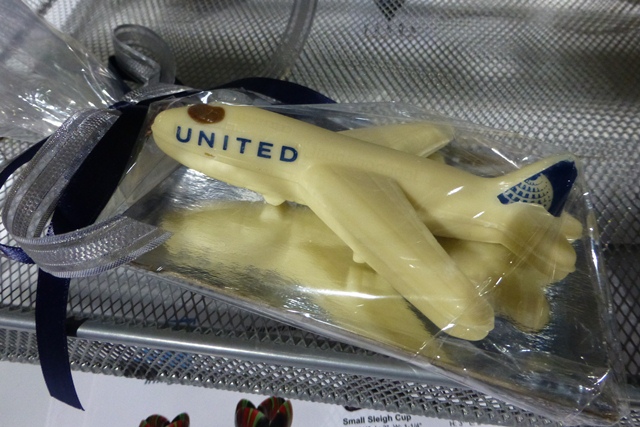
United Airlines white chocolate

On Monday United Airlines announced subscription programs offering customers either a year-long access to seats with extra legroom in the Economy Plus section of the cabin, or a year’s worth of pre-paid checked baggage fees.

United says it is the first domestic carrier offering these services in subscription form.

Prices start at $499 for the Economy Plus subscription and $349 for the checked-bag program and go up depending on which region of the world you choose (Continental US or beyond) and how many companions you bring along.

Are the plans a good deal?

Baggage subscription fee

United Airlines passengers flying on an economy ticket within the continental US – and to Hawaii or Alaska – currently pay $25 to check their first standard bag and $35 for the second bag.

With a baggage subscription, a traveler pays a yearly fee of $349 (plus a $50 initiation fee; currently waived). Travelers may add a second checked bag to the package for a $50 yearly fee, the bags of one companion for $100 and the bags of up to eight companions on the same reservation for $300.

The subscription only covers bag fees in the continental United States, so someone flying to Hawaii or Alaska would need to add on the North America/Central America option for an addition $100. Adding additional regions will rack up additional fees.

“With this program, a traveler would need to check a standard bag on 14 one-way, continental US flights before they broke even on their investment,” said Tim Winship, publisher of FrequentFlier.com. “That’s 7 round-trips. And if you are traveling that often it’s going to be true for most people that they’ll earn elite status in United’s frequent flier program, which already includes bag fee waivers as one of the perks.”

Economy Plus Subscription

Travelers purchasing an economy class seat on United can upgrade to Economy Plus at the time of purchase, if those seats are available. “The prices of those seats vary,” said May, “It can start at $9 and go up to $215.”

The Economy Plus subscription package starts at $499 (the $50 initiation fee is currently waived) and includes automatic upgrades to Economy Plus seats – when available – in the continental United States only. To add Alaska and Hawaii, a traveler would need the North America/Central America upgrade, for $100. Adding a companion to the package costs $200 and adding up to eight companions on the same reservation is $400.

Finding the value tipping point on this option “is a bit of a quandary,” said Winship. “I used a figure of $40 for a domestic flight upgrade. And using that figure it turns out that it would take 13 flights before that subscription price gets covered.”

“If you’re flying that much you may want to consider elite status on another airline that gives you these seats for free,” said Brian Kelly, founder of thepointsguy.com.

He can see some of United’s Premier Silver elite members buying this package because, due to a recent change in United’s frequent flier program, that group must now wait until check-in to claim their complimentary Economy Plus seat.

“Otherwise, casual travelers should probably just buy the one time passes,” said Kelly.

Overall, “I find the subscription plans puzzling,” said Winship. “Presumably the market for this is the traveler between the infrequent leisure traveler and the elite traveler. But the cynical way of looking at it would be that the targets for these subscriptions are gullible travelers who don’t really understand the value proposition here.”

(My story: United offers baggage/upgraded seating subscriptions first appeared on NBC News.com Travel in a slightly different version.)

Cockpit Confidential: Interview with pilot/writer Patrick Smith

How fast is a plane going when it leaves the ground?
Where do flight numbers come from?
And is it still possible for passengers to visit the cockpit?

CockpitConfidentialBookCoverwithmap


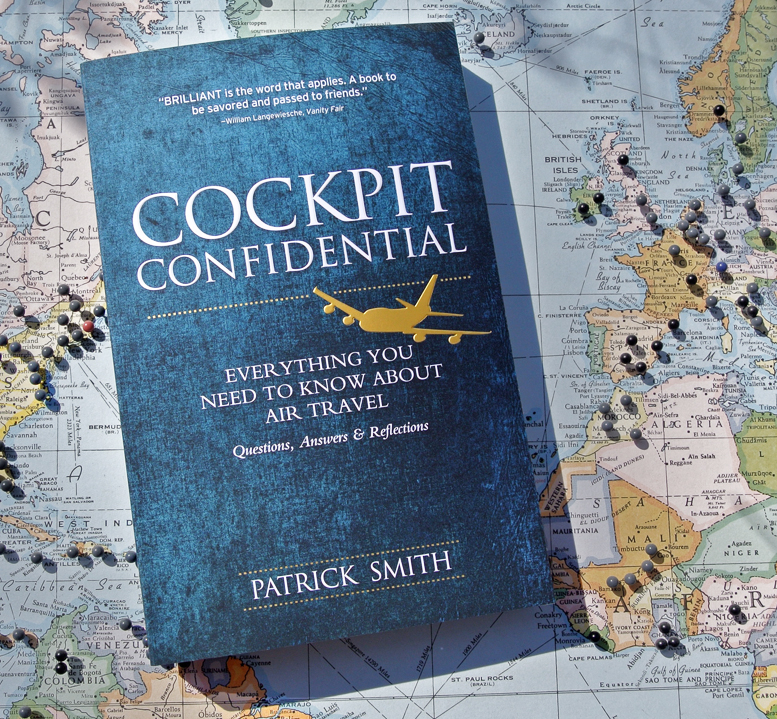
These are just a few of the puzzlers commercial airline pilot and air travel writer Patrick Smith tackles in his new book: Cockpit Confidential: Everything You Need to Know About Air Travel: Questions, Answers, and Reflections,” out this week from Sourcebooks.
Based on questions he began gathering during his stint as the “Ask the Pilot” columnist on Salon.com and for his 2004 Ask the Pilot book, this new book covers air travel, airports, airplanes and some of the scary things that do – and do not – happen on airplanes.

A glossary of aviation-related terms to help travelers speak “airline” is included as well.

Smith clearly understands the contempt passengers have for many aspects of modern-day air travel, but he is also an unabashed fan of flying and of the magic and drama that goes into getting from here to there.

Here’s an excerpt from my interview with Smith about some of the topics covered in the book, about his first airplane ride and about the TSA’s plan to allow small knives back on airplanes.

Your bio tells us you’re a pilot for a major airline. Which one?

Smith: I wish I could tell you. It’s an airline you’ve heard of, but airlines don’t want people out there appearing to speak on their behalf. I will tell you I’m pro-flying: despite the hassles of travel, flying today is remarkably affordable – airfares are half of what they were thirty years ago – and it is astonishingly safe.

Patrick Smith first flight

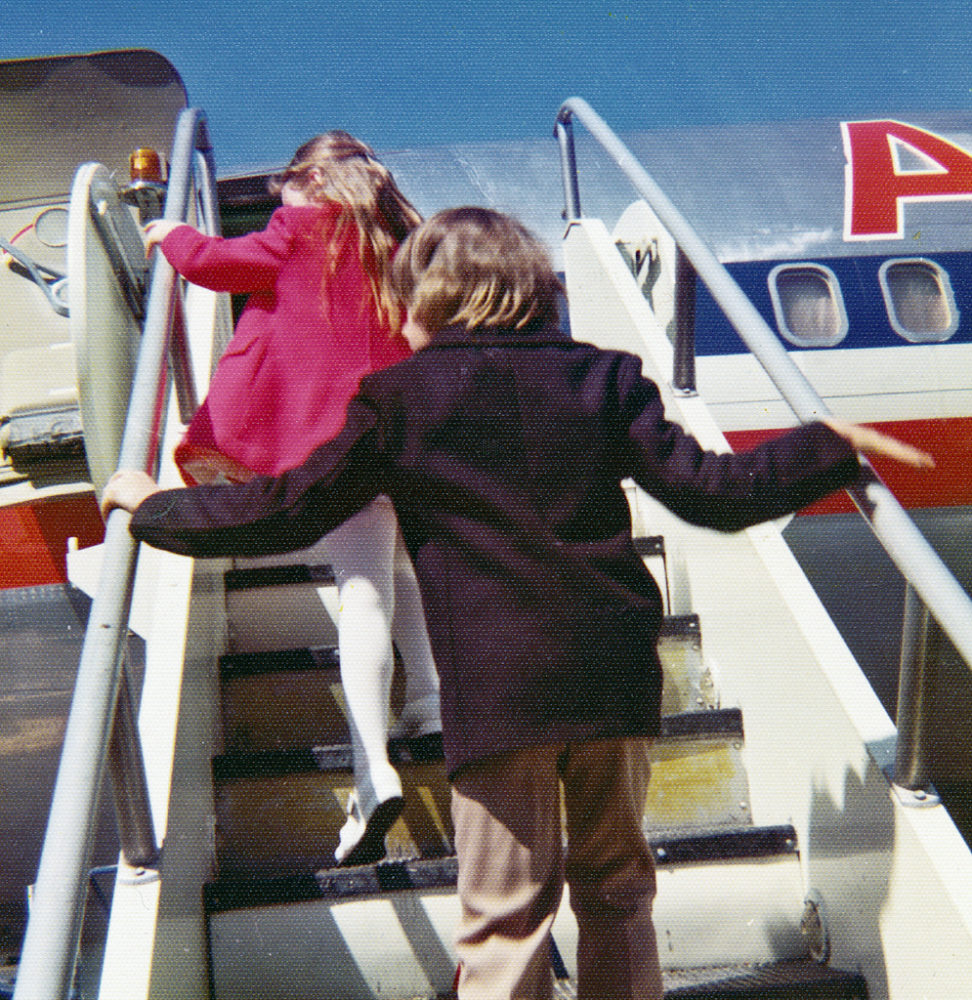
Smith and his sister boarding a plane for his first flight. Courtesy Patrick Smith


Do you remember your first airplane ride?

Smith: I recall almost everything about it! It was in 1974 and the plane was an American Airlines 727. I especially remember the sandwiches they served, which came with a double helping of cheesecake for dessert.

On airplanes, some pilots barely communicate with passengers, while others chat away on the PA giving everything from sports scores and weather updates to detailed descriptions of landmarks on the ground below. Are there rules about this?

Smith: It’s up to the pilot and there’s no formal training for this, although there are some guidelines in our manuals. I try to be concise and keep passengers informed, and I will point out things below. Greenland can be spectacular and I know people may be sleeping or watching a movie when we’re flying over, but it’s just such a great view that I will break in and tell people to look out at the glaciers and mountains down there because they’re so cool.

Even if I’m snoozing, I’d hate to miss a chance to see Greenland from the sky. Which brings me to: how do pilots stay awake on very long flights? Are you up there in the cockpit singing silly songs and doing jumping jacks?

Smith: No, on those long flights we’re not sitting up there in the cockpit the entire time. On flights longer than 8 hours – and some can be up to 15 or 16 hours – we bring extra crew members along and we swap out. There are designated seats or rest areas on airplanes that can be underneath the cabin or in an upper compartment. Some are surprisingly comfortable, almost luxurious, and make it very easy to get rest and to sleep.

Pilots spend a lot of time in the air, of course, but you must also pass through a lot of airports. Do you have some favorites and/or pet peeves?

Smith: When you compare and contrast US airports with those in other countries, especially in Asia, international ones wins out. Incheon International Airport in South Korea is probably my favorite: it’s immaculately clean and quiet, there’s a museum, free showers and a hotel inside of immigration, so if you have a long layover you can check in without having to go through customs.

I find many US airports to be very loud with all those airport and TSA announcements on the public address system, messages being run over each other and the TV monitors running constantly at every gate. Those noise levels go a long way to making an already stressful experience more stressful.

Speaking of the TSA, what do think of TSA’s plan to take small knives and some previously banned sports equipment off the prohibited items list for carry-on items?

Smith: Apparently TSA feels there is no longer any point, pardon the pun, in rummaging through bags to confiscate small knives and scissors when there are thousands of ways to contrive a weapon that’s at least as dangerous a two-inch hobby knife.

Obviously I’m not in favor of any policy that would make it easier for somebody to physical attack and injure a colleague, but from TSA’s perspective the new rules free up resources and allow guards to look for more potent threats, including bombs and improvised explosives.

(A slightly different version of my interview with Patrick Smith about Cockpit Confidential first appeared on NBCNews.com Travel)


TSA: OK to fly with small knives, golf clubs, other items.

Zurich chocolate knife

For the first time since the 9/11 terror attacks, the Transportation Security Administration (TSA) will allow small knives and some previously prohibited sports equipment onto airplanes as carry-on items.

TSA_Permitted Items one

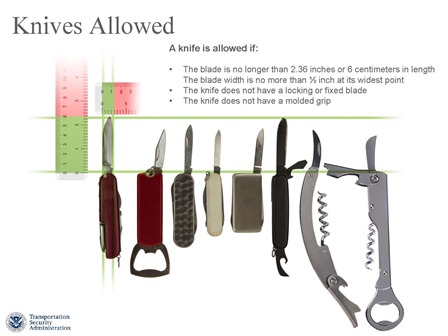
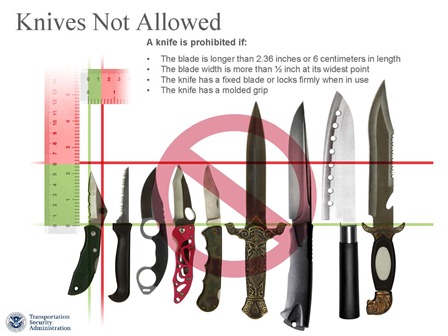
According to the TSA, passengers will be able to carry-on knives that are less than 2.36 inches long and less than one-half inch wide. Larger knives, and those with locking blades, will continue to be prohibited, as will razor blades and box cutters, guns, firearms, and the dozens of other things listed on the published list of prohibited items.

TSA_NOT Permitted KNIVES

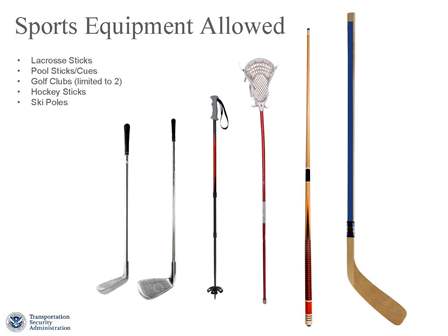
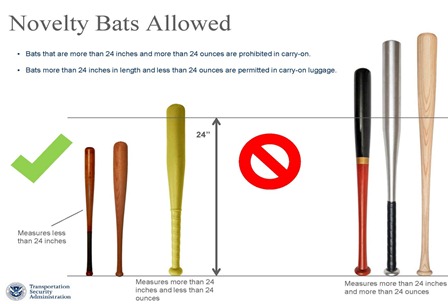
TSA will also soon permit sports equipment such as billiard cues, ski poles, hockey sticks, lacrosse sticks up to two golf clubs to be carried onto airplanes. Souvenir, novelty and toy baseball bats — such as wiffle-ball bats — will also be allowed.

The relaxed rules take effect April 25.

TSA_Sports items Permitted

TSA_BATS Permitted

TSA said the new regulations will allow its officers to better focus efforts on finding “higher threat items such as explosives,” and was made as part of the agency’s overall risk-based security approach.

But the Flight Attendants Union Coalition issued a statement saying they are unhappy with this move, calling it a “poor and shortsighted decision” by the TSA.

“As the last line of defense in the cabin and key aviation partners, we believe that these proposed changes will further endanger the lives of all Flight Attendants and the passengers we work so hard to keep safe and secure,” the statement said.

TSA believes the items it will now allow in airline cabins are “unlikely to result in catastrophic destruction of an aircraft,” and that policies already put in place — hardened cockpit doors, federal air marshals, crewmembers with self-defense training — reduce the likelihood of passengers breaching the cockpit.

“All TSA is doing is catching up with the rest of the world,” said Douglas R. Laird, president of aviation consulting firm Laird & Associates and former head of security for Northwest Airlines. After 9/11 the TSA “overreacted,” said Laird, and put restrictions in place “in the heat of the moment” that exceeded those in other countries.

Removing small knives and some sports equipment from the list prohibited items “will help align TSA’s list with international standards and help decrease the time spent rescreening or searching bags for these once prohibited items,” said TSA spokesperson Nico Melendez. The changes also enable officers to focus on “the greatest threats … which increase security for passengers and improves efficiency, improving the checkpoint screening experience.”

(Images courtesy TSA)

(A slightly different version of my story about the TSA’s decision to take small knives and sports equipment off the prohibited items list is on NBC News.com.)

Spotted at Las Vegas Travel Goods Show

I spent a long day walking the aisles of the 2013 Travel Goods Show underway this week in Las Vegas. Here are few fun items I encountered along the way.

Flight 001

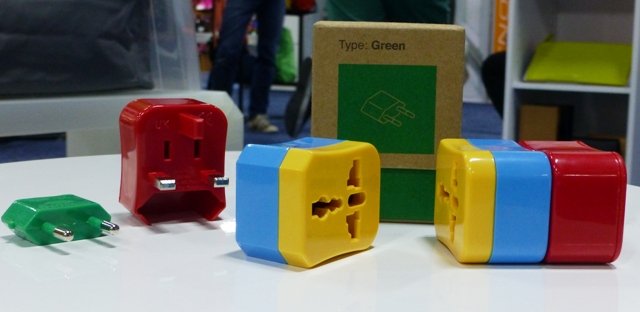
Everyone travelers needs – and probably has – some power adapters. Flight 001 has created a set that is not only fun to look at but easy to figure out how to use.

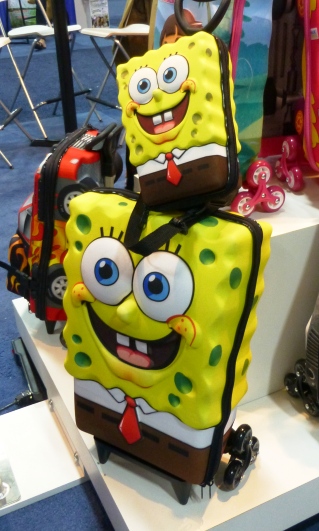
Travel Goods_Sponge Bob

Booth after booth is filled with really cool suitcases and travel packs for kids. I got a kick out the 3D roller bags and backpacks from MAXTOYUSA

Travel Goods FLANABAGS

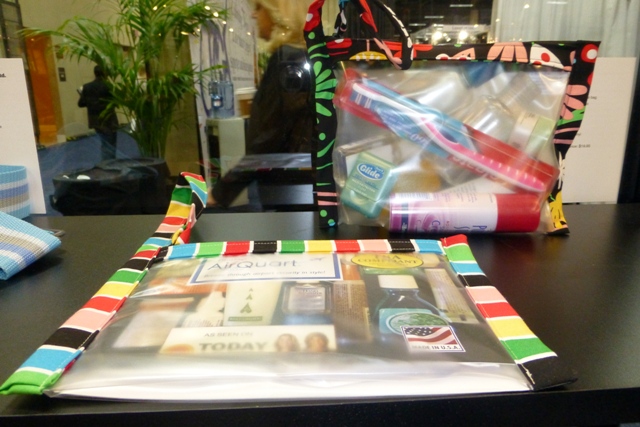
These AirQuart travel bags from Flanabags are not only made in the USA (Massachusetts and South Carolina), they are stylish and see-through, sturdier than those zippered sandwich bags and easier to clean.

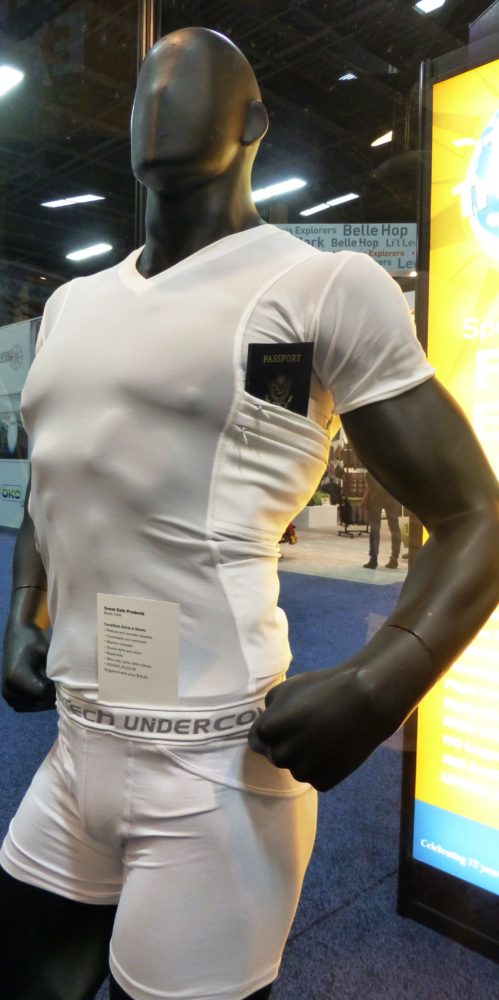
Travel Goods_Concealment

Safety is always a big issue for travelers and there are loads of travel bags and accessories designed to improve safety and security for you and your belongings. For those who want to keep their valuables close by, shirts, belly bands, socks, underpants and other products from Travel Safe Products all have concealment pockets that offer a good option.

More fun – and some wacky – travel gear to come…

Travel Tidbits: blizzard, extra points and free Wi-Fi

Snowstorm

Thanks to Storm Nemo, on Thursday evening I was one of the hundreds of thousands of travelers who had to cancel important weekend plans that involved flying to the east coast.

Then I had to sit on the phone for hours trying to work out a new and, it turns out, quite expensive new plan.

For those of you still trying to figure out your options, here’s a link to a list of many of the change-fee waiver policies airlines have posted.

In other news…. Dallas Fort Worth (DFW) International Airport announced that it is the latest airport to join the Thanks Again program, which offers travelers frequent flyer miles or points for qualifying purchases made at the airport for things such as parking, food and retail items. Travelers at DFW will also be able to get points or miles for stays at the airport hotels, such as the Grand Hyatt, and at Paradise 4 Paws, the airport’s pet hotel.

170 other airports already participate in the Thanks Again program – which requires a simple sign-up and registration of a credit-card.

And during the month of February passengers at John F. Kennedy (JFK), LaGuardia (LGA) and Newark Liberty International (EWR) airports – as well as passengers at some New York City subway stations – will be able to get complimentary Boingo Wi-Fi sessions courtesy of Norwegian Cruise Line, which is celebrating a new ship, the Norwegian Breakaway.

That should come in handy if you end up stuck at one of those airports – or in the city – this weekend due to Storm Nemo.

Travel tidbits: LinkedIn for travelers; win tickets to South America

Another site for travelers to bookmark:

Are you on LinkedIn? It’s a good way to connect with others in your field and now it’s another place to go to chat about travel issues and read articles related to travel. This week LinkedIn introduced “Jet: The Business Traveler Network,” which includes a running, curated, feed of news articles from around the web.

Sometime it really pays to go out for to eat South American cuisine

LAN TICKETS

Leave to LAN Airlines to knock people’s socks off. On Wednesday representatives from the airline showed up at Bocanova Restaurant in Oakland and gave everyone in the restaurant – 200 people – tickets to South America! Last year, the airline did the same thing for a restaurant full of people in New York City.

Jealous? The airline is also giving away tickets to South America to people who don’t eat out in Oakland or New York but are on-line. As part of its “Only in South America” campaign, the airline is giving away tickets daily from January 25-30 on www.facebook.com/LANAirlinesUSA.