Unruly airline passengers may face fines and the wrath of crew members and other passengers.
Now, under a new partnership between the Transportation Security Administration (TSA) and the Federal Aviation Administration (FAA), unruly passengers may also end up kicked off the TSA PreCheck roster.
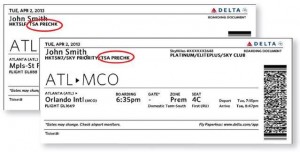
TSA PreCheck gives travelers access to expedited security screening. Precheck-qualified travelers don’t need to remove shoes, laptops, belts, light jackets, or take out their bag of lotions and liquids. The fee is $85 for five years and requires fingerprinting and a background check.
Under the new partnership, the FAA will share information with TSA about passengers facing fines for unruly behavior. And TSA may then remove those passengers from TSA PreCheck screening eligibility.
“If you act out of line, you will wait in line,” FAA Administrator Steve Dickson said. “Our partnership aims to promote safe and responsible passenger behavior. One unruly incident is one too many.”
“TSA has zero tolerance for the unruly behaviors, especially those involving physical assault occurring aboard aircraft,” said TSA Administrator David Pekoske. “This partnership with FAA will help ensure the safety and security of all passengers and hold those who violate federal regulations accountable for their actions.”
Other ways to lose TSA PreCheck Status
On its website, TSA spells out other actions that might cause a traveler’s PreCheck status to be revoked ‘for a period of time.’
The list includes refusing to wear a mask, making a bomb threat, or bringing a firearm to an airport or onto an aircraft:
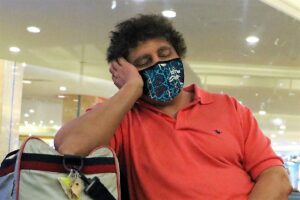
If you commit certain violations of federal security regulations, such as refusal to wear a mask in U.S. transportation systems covered by the January 31, 2021 Security Directive and subsequent amendments, assault, threat, intimidation, or interference with flight crew, physical or sexual assault or threat of physical or sexual assault of any individual on an aircraft, interference with security operations, access control violations, providing false or fraudulent documents, making a bomb threat, or bringing a firearm, explosive, or other prohibited item to an airport or onboard an aircraft, you are denied expedited screening for a period of time.
Once again, it looks like someone is having a little too much fun with the Transportation Security Administration’s social media accounts.
The TSA has a handy “What Can I Bring?” tool that is part of the agency’s standing offer to help travelers figure out what they may and may not put in their carry-on bags and in checked luggage.
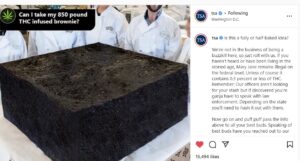
But not everything is covered. Hence the question: “Can I take my 850-pound THC infused brownie?”
See the TSA’s answers to that question and their advice on a few other travel items below.
And have a great weekend, wherever you are traveling.
Have you found a tree-mendous noble fir you just can’t leave home without this holiday? Yule be happy to know this wood be pine by us. Branch out though and talk with your airline, they’ll tell you whether it’s truly oak-y or not. More travel questions? @AskTSA here on Twitter. pic.twitter.com/TcuEQ10DAZ
“Pack your own lunch!” At least that’s what cheese said. Whatever solid food meats your needs go ahead and pack it. Even if it's in your snackle box. Do you know what else pears well with this gouda idea? Our "What Can I Bring?" tool, found here: https://t.co/kF698f1APcpic.twitter.com/MkYa59zOhi
While there are still fewer passengers flying on commercial planes due to the pandemic, there is an uptick in the number of firearms people are bringing with them to U.S. airports.
The Transportation Security Administration (TSA) announced this week that so far this year its officers have found a record number of firearms at airport security checkpoints.
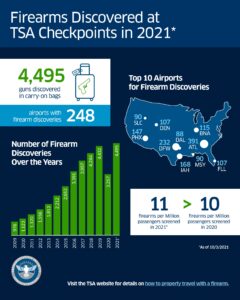
As of October 3rd, with three months yets to go in 2021, TSA officers had stopped 4,495 passengers with firearms. That already surpasses the previous year-long record of 4,432 firearms caught throughout all of 2019.
In 2019, TSA found 5 firearms per million passengers. So far this year, TSA discovered 11 firearms in carry-on bags at airport checkpoints per million passengers.
Here are Top 10 airports for firearms discoveries so far this year. Note that the most firearms have been found at Hartsfield-Jackson Atlanta International Airport (ATL), and that three Texas airports (DFW, IAH, and DAL) are on this list.
We’re still missing the corny communications TSA’s Blogger Bob Burns once shared with the public, but Lisa Farbstein and the team on duty now are doing a great job of keeping the public informed with light but serious messages about what can and cannot go through airport security checkpoints.
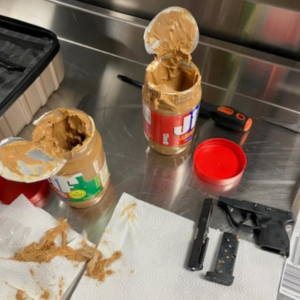
Assault rifles aren't allowed on airplanes so there's no need to bring a gun magazine for an assault rifle with you. Besides, it's prohibited from being brought onto a flight. This one detected in a carry-on bag recently by @TSA officers at @PHLAirportpic.twitter.com/7PYHllDPvB
— Lisa Farbstein, TSA Spokesperson (@TSA_Northeast) July 19, 2021
The tweets about the guns and other weapons people try to take through airport security checkpoints always alarm us, but this Tweet and the story of a TSA officer finding and returning a lost diamond is very heartwarming.
.@TSA at @JFKairport returned this diamond that fell out of a newlywed's ring at one of the checkpoints recently. The traveler was relieved to find out that the stone was found. "Our trip went from a chaotic moment to one at peace." Here's the full story: https://t.co/qDveY6xcBqpic.twitter.com/bhHjZ3IFUg
— Lisa Farbstein, TSA Spokesperson (@TSA_Northeast) July 19, 2021
BREAKING: @TSA screened 2,137,584 people at airport security checkpoints nationwide yesterday, Friday, June 25. It was the highest checkpoint volume since the start of the pandemic and the 8th day so far this month that volume surpassed 2 million. #MaskUp
— Lisa Farbstein, TSA Spokesperson (@TSA_Northeast) June 26, 2021
As airline passenger volume ticks up, many passengers are packing something the Transportation Security Administration and airlines would rather they’d leave home: a combative attitude.
“Passengers do not arrive at an airport or board a plane with the intent of becoming unruly or violent; however, what is an exciting return to travel for some may be a more difficult experience for others, which can lead to unexpected, and unacceptable, behaviors,” said Darby LaJoye, TSA Senior Official Performing the Duties of the Administrator.
The Federal Aviation Administration (FAA) is reporting an alarming spike in incidents of unruly passengers.
Here is part of a table from the FAA showing all the cases investigated that cited violations of one or more FAA regulations or federal laws.
There are 3,082 incidents so far in 2021, compared to fewer than 200 cases in any of the past five years.
You’ve no doubt seen and read about all the crazy incidents on planes with passengers refusing to comply with federal regulations to wear face masks. But not as well-publicized are the incidents that have been taking place in airports.
TSA shared this in a statement:
“Two separate incidents this month have triggered referrals to law enforcement for passengers in Louisville, KY and Denver, CO. In Louisville, a passenger allegedly assaulted two TSOs while attempting to breach the exit lane and is facing state criminal charges for criminal trespass, fleeing and evading police, misdemeanor assault, and resisting arrest. The Denver incident involved a passenger allegedly biting two TSOs and remains under investigation. Both passengers also face a potential civil penalty of up to $13,910 for each violation of TSA security requirements.”
Here’s something that may help:
In early July the TSA is restarting its Crew Member Self-Defense (CMSD) training. Under the voluntary program, which was paused due to COVID-19 restrictions, Federal Air Marshals train flight crew members in defensive measure techniques for responding against an attacker in a commercial passenger or cargo aircraft.
During the training, flight crew members learn to identify and deter potential threats, and if needed, apply the self-defense techniques against attackers. The four-hour training is offered to flight crew members free of charge and is held at 24 locations around the United States.
“Through this training program, TSA’s Federal Air Marshals are able to impart their specialized expertise in defending against and de-escalating an attack while in an aircraft environment,” said LaJoye, “
Sara Nelson, the president of the Association of Flight Attendants-CWA, would like the course to be compulsory.
This training was suspended due to COVID, but it’s time to restart and make the voluntary course compulsory as intended originally by Congress. Thanks to the @TSA Federal Air Marshals who lead these classes. We’re going to need a lot more of you! Watch…https://t.co/A5dcRPPVKMpic.twitter.com/QyO9J9TNtK
Assaulting or threatening a member of the flight crew is a federal crime and perpetrators may face civil penalties, criminal fines, or imprisonment. In May 2021 alone, the FAA proposed civil penalties ranging from $9,000 to $15,000 against five airline passengers for allegedly interfering with and, in two cases, assaulting flight attendants who instructed them to obey cabin crew instructions and various federal regulations.
Hey airline passengers, don't hold up the flight with your bad behavior! It can cost you $35,000 or worse, jail time. Do you really want to spend your vacation in jail? #FlySmartpic.twitter.com/uhMwl4Vmj8
It has become a tradition for the Transportation Security Administration (TSA) to release an annual “Top 10” list of the ‘best’ things the agency’s officers find travelers’ checked and carry-on bags.
The list for 2020 has just been issued in video form (below).
What made the TSA list?
#10 was a sling shot.
#9: Knives hidden in a hollowed out book.
#8 was a stash of 107 Roman candles found New York’s LaGuardia Airport in early November 2020.
#7: A smoke grenade found at Dulles International Airport
#6 A shark in a jar, found at Syracuse Hancock International Airport (SYR) in November.
A traveler brought this dead baby shark submerged in a glass container of an unknown chemical to the @TSA checkpoint at @SyracuseAirport recently. Due to the chemical nature of and quantity of the liquid, it was not allowed on the plane. However, cartoon baby sharks are allowed. pic.twitter.com/YKmHoS6wsS
— Lisa Farbstein, TSA Spokesperson (@TSA_Northeast) November 6, 2020
#5 Again at LaGuardia in November, 2020. TSA officers spotted what looked like a pipe bomb in a carry-on bag. “When one of the end caps was removed, a partially smoked cigar was found inside,” TSA reports, “It turned out that the item was a homemade humidor for a traveler’s cigars.”
#4 Marijuana concealed inside checked bags, discovered at Boston Logan International Airport (BOS).
Update/Clarification: These concealed bags were actually bags of marijuana found during checked baggage screening @BostonLogan. @MassStatePolice took possession of the items. TSA officers are trained to look for and detect threats including artfully concealed items. https://t.co/E2sjFJsnD1
#3 In July, while scanning checked baggage at Newark-Liberty International Airport, TSA officers found an assault rifle, a high-capacity magazine, four boxes of hollow-point bullets, three magazines, one of which was fully loaded, and two additional boxes of rifle ammunition “artfully concealed” (as TSA says) in the lining of a checked bag.
#2 In September at John F. Kennedy International Airport TSA officers spotted two large electronic items wired to what appeared to be a tampered power source. It looked like an improvised explosive device but was later identified as a solar panel wired to the batteries to power the electronic item.
#1 Here TSA’s list of great ‘catches’ veers into the “aw, that’s romantic.”
These two lovebirds are TSA canine handlers at Newark Liberty International Airport. They got married in June and, of course, Obelix and Proto were on hand to help celebrate.
Here’s the full TSA video of the Top 10 Catches of 2020.
For your entertainment, we’ve include a few Top 10 lists from past years too.
And here’s why we still really miss TSA’s Bob Burns.
Travel was way down in 2020. But that didn’t stop those who were getting on airplanes from having firearms in their carry-on bags.
In a report released today, TSA says its officers found 3,257 firearms on passengers or in their carry-on bags at checkpoints. Of those firearms caught, about 83 percent were loaded.
In 2019, TSA officers stopped a record 4,432 firearms, of which 87 percent were loaded.
Firearems were found at 234 airports.
Here are Top 10 Airports where TSA found firearms at the checkpoints
AIRPORT (CODE)
TOTAL
1
Hartsfield-Jackson Atlanta International Airport (ATL)
220
2
Dallas/Fort Worth International Airport (DFW)
176
3
Houston’s George Bush Intercontinental Airport (IAH)
126
4
Phoenix Sky Harbor International Airport (PHX)
124
5
Denver International Airport (DEN)
104
6
Nashville International Airport (BNA)
94
7
Fort Lauderdale-Hollywood International Airport (FLL)
87
8
Orlando International Airport (MCO)
79
9
Las Vegas McCarran International Airport (LAS)
72
10
Salt Lake City International Airport (SLC)
71
While firearms aren’t allowed in carry-on bags (for obvious reasons…) airline passengers may fly with firearms if they are properly packed as checked baggage. There are state and local firearms laws that passengers must be sure to comply with.
What happens if you’re found with a firearm in your carry-on?
In some cities, local police are called over and may file criminal charges.
TSA says it can assess civil penalties that vary by the number of previous offenses and whether the firearm was loaded at the time. Fines can exceed more than $10,000. range.
Rushed, distracted travelers unwittingly gave the Transportation Security Administration a cash tip of more than $926,000 last year.
TSA gets to keep the cash and currency travelers forget to pick up when they empty their pockets into the bins at the airport security checkpoints.
And that cash adds up.
During Fiscal Year 2019, which ended in September 30, 2019, TSA collected $926,030.44 in unclaimed money. That included $18,899.09 in foreign currency.
The amount of unclaimed money TSA collects has been increasing each year. But for the first time, the total collected actually decreased year over year. In FY 2018, travelers left behind $960,105.49.
For 2019, here the Top 5 airports where travelers left behind the most cash:
John F. Kennedy International Airport – $98,110
San Francisco International Airport – $52,668.70
Miami International Airport – $47,694.03
McCarran International Airport – $44,401.76
Dallas/Fort Worth International Airport – $40,218.19
And here are the totals from previous years:
FY 2013 – $638,142.64
FY 2014 – $674,841.06
FY 2015 – $765,759.15
FY 2016 – $867,812.39
FY 2017 – $866,839.56
FY 2018 – $960,105.49
Hold onto your cash
Don’t want to unwittingly leave a tip for TSA at the checkpoint?
Take a moment to organize your stuff before you get to the airport and again before you get on the TSA checkpoint line.
Instead of emptying your pockets into the bin, put loose change, bills and anything in your pocket into a small bag or pouch that you put inside your carry-on bag or purse.
As we head into the Memorial Day holiday and a slight uptick in air travel, the Transportation Security Administration rolling out some new rules for the security checkpoint screen area in response to COVID-19.
Some of these strategies are already in place. Others will show up at checkpoints by mid-June.
Scan you own boarding pass
Still no word about TSA taking passenger temperatures, but TSA officers will now ask passengers to place their paper or electronic boarding pass on the ticket readers themselves. TSOs will still examine your document, but they won’t touch it.
Clear bags for food
TSA also now asks passengers to put any carry-on food items in a clear plastic bag and place that bag in a bin at the checkpoints.
“Food items often trigger an alarm during the screening process; separating the food from the carry-on bag lessens the likelihood that a TSA officer will need to open the carry-on bag and remove the food items for a closer inspection,” TSA says in a statement.
“This allows social distancing, reduces the TSA officer’s need to touch a person’s container of food, and reduces the potential for cross-contamination. TSA Precheck members do not need to remove items from their bags,” TSA adds.
If you haven’t flown since the pandemic arrived, you’ll see TSA checkpoint officers wearing facial protection and gloves. Passengers are also asked to wear masks at checkpoints as well and be prepared to lower their masks if requested. At many airports, masks are now required throughout the terminals and on the planes.
(Our story about TSA workers helping airport workers during the pandemic first appeared on CNBC in a slightly different version.)
The steep decline in air travel due to the COVID-19 pandemic has triggered layoffs, furloughs and shortened work hours for many airport employees, including wheelchair attendants, baggage handlers, janitorial crews and concessions staff.
But in a growing number of cities their co-workers from the Transportation Security Administration, who continue to receive paychecks, are stepping up to help. They’re hosting temporary food pantries in airports around the nation and providing free lunches and dinners to their struggling colleagues. They’re also donating their time to make masks and other essential items for communities in need.
Unite Here, a union representing hospitality workers, estimates that 42,000 of its members in the airport industry are currently out of work. Most of those lost jobs are in airport concessions and airline catering, where wages range from $9 to $16 an hour.
That’s just Unite Here members. The Airport Restaurant and Retail Association (ARRA) estimates 120,000 to 125,000 airport employees are currently out of work.
Some of those workers may eventually get called back. But for now, their incomes are disrupted, and many could use some help.
Food pantries to the rescue
As a thank-you for the support they received while working without paychecks during the 2018/2019 partial government shutdown, TSA officers at Denver International Airport on April 30 hosted a food pantry in support of airport and air carrier colleagues working with reduced hours or partial paychecks.
“Our team rallied to collect thousands of non-perishable items for the pantry,” said Larry Nau, TSA Federal Security Director for Colorado, “133 airport employees shopped the pantry and took home items for a total of 538 family members fed.”
On April 24, Transportation Security Administration employees at Ronald Reagan Washington National Airport (DCA) opened a free food and toiletries pantry to assist airport employees laid off or working with reduced hours or paychecks.
TSA officers are donating cash, products and gift cards to keep the pantry stocked with items such as cereal, evaporated milk, soup, pasta, toothpaste, soap, laundry detergent, feminine products, diapers and deodorant.
And in early April, TSA employees at Dulles International Airport (IAD) opened a free pantry for affected airport community members that is stocked with everything from donated dried and canned goods and toiletries to toys for employees who have kids at home.
IAD has the greatest @TSA employees, #ManagerMike thanks you for all you do to keep the airport secure and for this great example of giving back! Folks as you can see, the shelves are getting empty so please make donations if you can! https://t.co/EozTgt579ppic.twitter.com/5nH3YJ9W8e
Twice in early April, TSA officers at Rhode Island’s T.F. Green Airport (PVD) chipped in to buy and deliver pizza dinners for fellow airport workers, including airline employees, wheelchair attendants and housekeeping staff.
“Providence is a small airport and the employees who work here are like family,” Christopher Primiano, TSA stakeholder liaison at PVD Airport, told CNBC, “We know this could go on for some time so we’re looking into what else we can do, from donations and food drives to bake sales. We want to help and give back as much as we can.”
On April 10, TSA employees at PDX bought pre-made lunches for around 300 airport employees. They did it again on April 21, partnering with local employees from Customs and Border Protection (CBP) and the Federal Aviation Administration (FAA) to donate lunch and supplies to an equal number of airport workers.
As part of its “TSA Gives Back” program, early last month TSA officers at Green Bay-Austin Straubel International Airport (GRB) in Wisconsin chipped in to buy and deliver pizza, dessert and balloons to airline and car rental employees at the airport who are experiencing shrinking paychecks.
— Lisa Farbstein, TSA Spokesperson (@TSA_Northeast) April 3, 2020
And, at McGhee Tyson Airport (TYS) in Knoxville, Tennessee, TSOs are collecting donations and arranged for Second Harvest, the community food bank, to supply food boxes to about 300 airport employees.
Following instructions from an online video, TSA officers at EWR made 200 face masks out of 100 pairs of brand-new socks purchased with funds donated by TSA employees. Each sock-mask was placed in a separate plastic zippered bag along with an instruction card and all 200 masks were delivered to two area homeless shelters.
TSOs at Newark Liberty Airport have also used their downtime at the checkpoints to make home-made get-well cards and write notes of support for health care workers and COVID-19 patients in isolation at a nearby medical center.