Aviation history

Dallas Fort Worth International Airport turns 50

Dallas Fort Worth International Airport (DFW) turns 50 on January 13 and is kicking off a year-long party to celebrate.

Events begin Saturday morning with 50th-anniversary giveaways including a special limited edition Coca-Cola bottle, selfie stations, and surprise performances in select terminals during the day.

Passengers arriving on AA Flight 3589 from Little Rock, Ark., will receive a special water arch celebration and greeting at the gate in honor of the first flight to arrive at DFW from the city in 1974.

Then, on Saturday night, buildings in both Dallas and Fort Worth will be lit with DFW Airport’s primary brand color – orange – to commemorate the airport’s golden anniversary. This includes the Omni Dallas Downtown, Bank of America Plaza, One Arts Plaza, KPMG Plaza, AT&T Headquarters and Discovery District, Hunt Building, 1900 Pearl Street, 1900 N. Akard Street and Reunion Tower in Dallas, and City Hall and the 7th Street Bridge in Fort Worth.

While we wait for more details about what other anniversary surprises will roll out the rest of the year, here are some photos and history about the airport, courtesy of DFW and the Frontiers of Flight Museum.

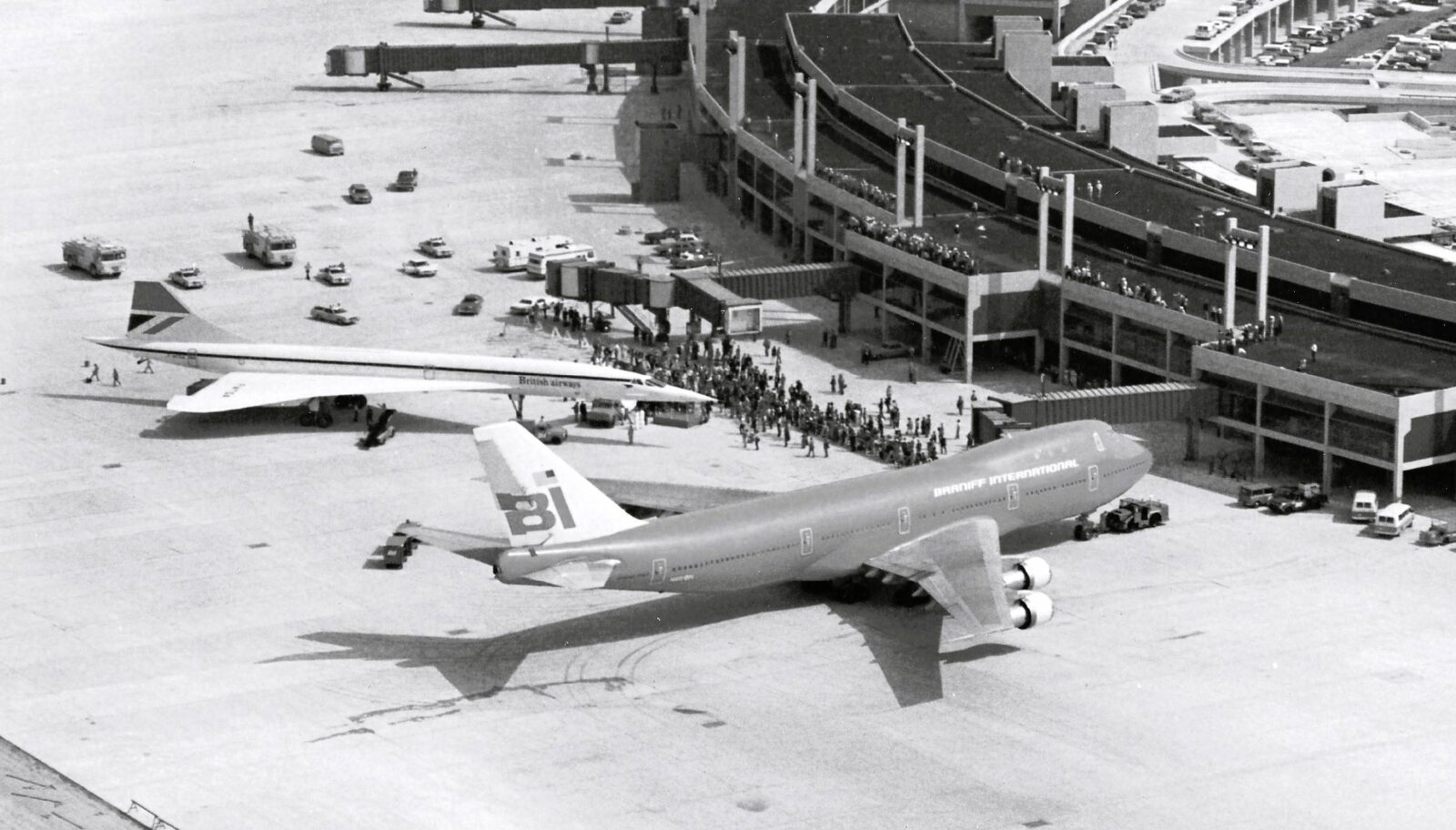
Here’s a shot of Braniff Jets lined up at DFW in the late 1970s.

THEN AND NOW

1974 2023 
 World’s largest airport by land area  Third largest airport by land area 
 Four terminals  Five terminals (sixth to break ground in 2024) 
 Three runways  Seven runways 
 66 gates  171 gates 
 Nine airlines  28 airlines 
 6.8 million passengers  80 million passengers (estimated)
 75,000 tons of cargo  791,192 tons of cargo (FY)

More tidbits about DFW Airport

DFW was the first US Airport to be visited by the supersonic Concorde

Courtesy Frontiers of Flight Museum

On September 20, 1973, the first day of a four-day dedication ceremony that took place before DFW officially started commercial operations in January 1974, the airport welcomed a supersonic British Airways/Air France Concorde. Two days later, on September 22, 1973, tens of thousands of people attended a dedication ceremony that included an air show and exhibits.

The DFW dig

(Courtesy Frontiers of Flight Museum)

During the DFW excavation, workers uncovered an almost complete fossil of a 70-million-year-old plesiosaur, a 25-foot-long reptile that lived in the ocean during the time of dinosaurs. For a while, the fossil was displayed in Braniff’s Terminal 2W (now Terminal B), but today, DFW’s plesiosaur is locked away in storage at an area university.

For more great photos and stories about Dallas Fort Worth International Airport, see Bruce Bleakley’s book published on DFW’s 40th anniversary. It’s chock full of photos, appropriately titled Dallas/Fort Worth International Airport, and is part of Arcadia Publishing’s Images of Aviation series.

Digging into the history of Dallas Fort Worth International Airport

(The Concorde visits DFW Airport – courtesy Frontiers of Flight Museum)

Dallas Fort Worth International Airport (DFW) turns 50 in January 2024 and the Stuck at the Airport team has been doing a little digging into the airport’s history.

We’ll be back with more finds, but we wanted to share this short video we found presented by the former director of the DFW Records Department. The video shows some treasures in the Dallas Fort Worth International Airport archives, including the pre-computer drafting tools used to design the airport and the dinosaur bones found onsite.

John Wayne Airport marks a milestone

John Wayne Airport (SNA) is celebrating a century of flight in Orange County, California with an exhibition and a history timeline.

The airport traces its history back to 1923, when aviation pioneer Eddie Martin founded a flying school and Martin Aviation, one of the nation’s oldest aviation firms.

To celebrate the one-century mark, the John Wayne Airport Arts Program has created an exhibition showcasing the history of flight in Orange County from the airfield’s inception to the present-day airport.

Included are images and information from the 1950s, when the airfield played host to drag racers and souped-up custom cars.

The exhibition will be on view at John Wayne Airport through January 2024, pre-security on the upper Departure Level in the walkway Gallery between Terminals B and C.

(All photos courtesy John Wayne Airport)

Will the Bomber Gas Station’s B-17 fly?

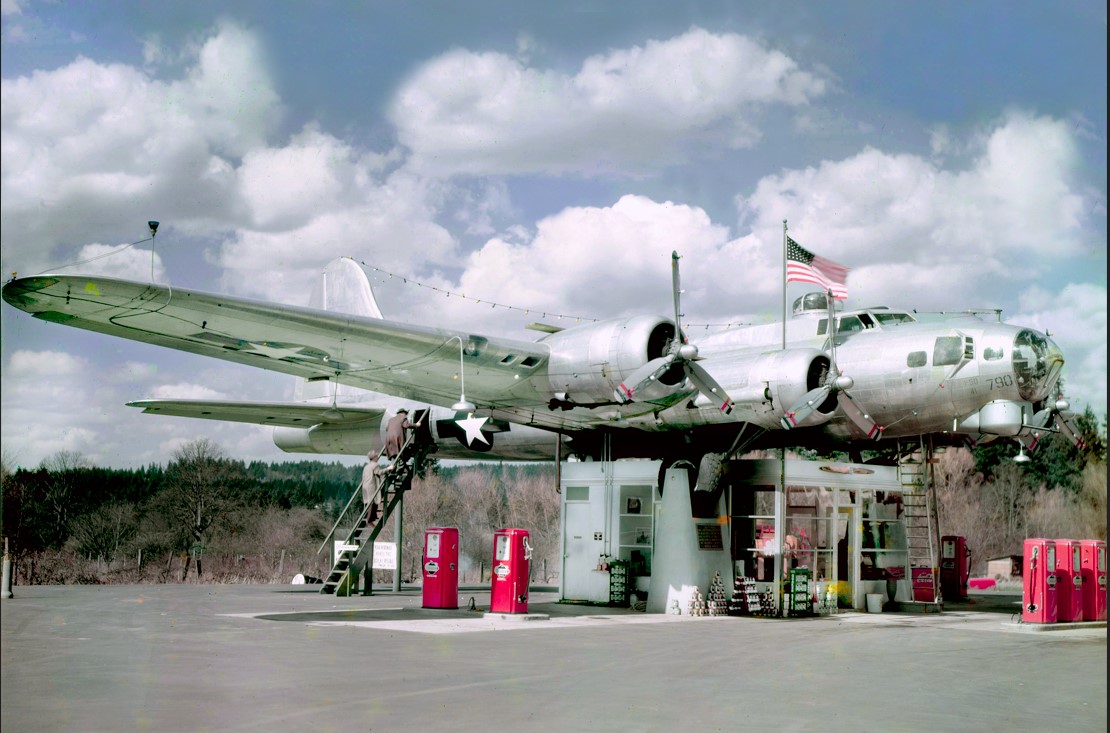
The Stuck at the Airport road trip team visited Oregon recently to check on the status of a World War II-era B-17 Flying Fortress that served for years as a roadside attraction along the highway in Milwaukie, OR, not far from Portland.

The non-profit B-17 Alliance is restoring the B-17 in Hangar “C” at Oregon’s historic McNary Field/Salem Municipal Airport and we were delighted to get a tour.

You can learn more about the project, and the history of this airplane on the B-17 Alliance Foundation’s site and in the piece we put together for The Points Guy site. But here’s a short version of the Gas Station Bomber story.

Milwaukie, Oregon gas station owner Art Lacey purchased a decommissioned B-17 bomber, one of the iconic four-engine “Flying Fortresses” used by the U.S. Army Air Force in World War II, in 1947 and used the “Lacy Lady” to turn his service station into a roadside attraction.

Into the late 1950s, motorists could climb up into the airplane for a look-around while their automobiles got filled up and serviced and then have a meal at the adjacent Bomber Restaurant.

The gas station closed in 1991 and in 2014 the B-17 Alliance moved the plane to a hangar at Salem Municipal Airport for restoration.

The group estimates that in addition to thousands of hours of volunteer time, it will take more than $6 million to get the airplane airworthy by, perhaps, 2037.

What we’re watching: The Mechanician

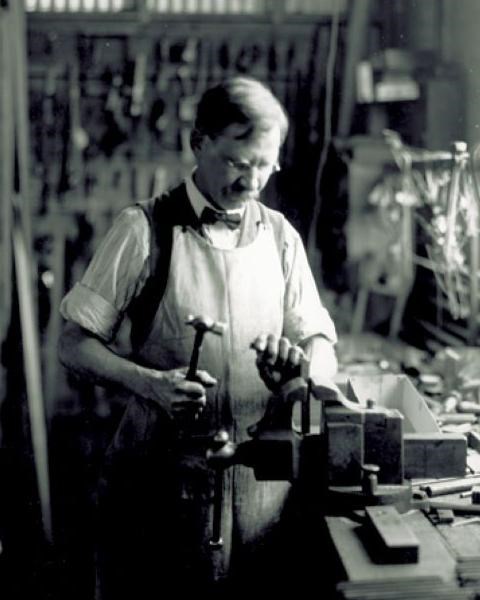
(Courtesy State University Archives)

The Wright Brothers didn’t do it alone.

Their sister, Katharine Wright, was an essential part of the team. She ran the brothers’ bicycle shop when they were off doing gliding tests in Kitty Hawk. And she was essential when it came to taking care of the Wright Brothers’ business and social matters.

And, without Charles E. Taylor, the Wright Brothers’ planes would have never gotten off the ground.

Taylor, a self-taught machinist, worked as a repair person in the bicycle shop. And it was Taylor who Orville and Wilbur turned to when they needed a wind tunnel to help them with improvements for the 1902 glider.

It was also Taylor who designed and built the first successful airplane engine for the Wright Brother’s first pioneering powered flight in 1903.  And it was Taylor who improved and fixed the engines for many years after.

Thanks to this story in the Metropolitan Airport News, we learned all about Charles E. Taylor. And about a short film that highlights his mostly forgotten role in aviation history and in the Wright Brothers’ story.

See the film, by Joshua Lang and Natalie Wong, below. Be sure to watch for the rare footage of Taylor describing how he created parts from scratch.

(Charlie Taylor at the Wright Company factory in 1911. Courtesy Wright State University Archives)

What we’re reading: His Majesty’s Airship

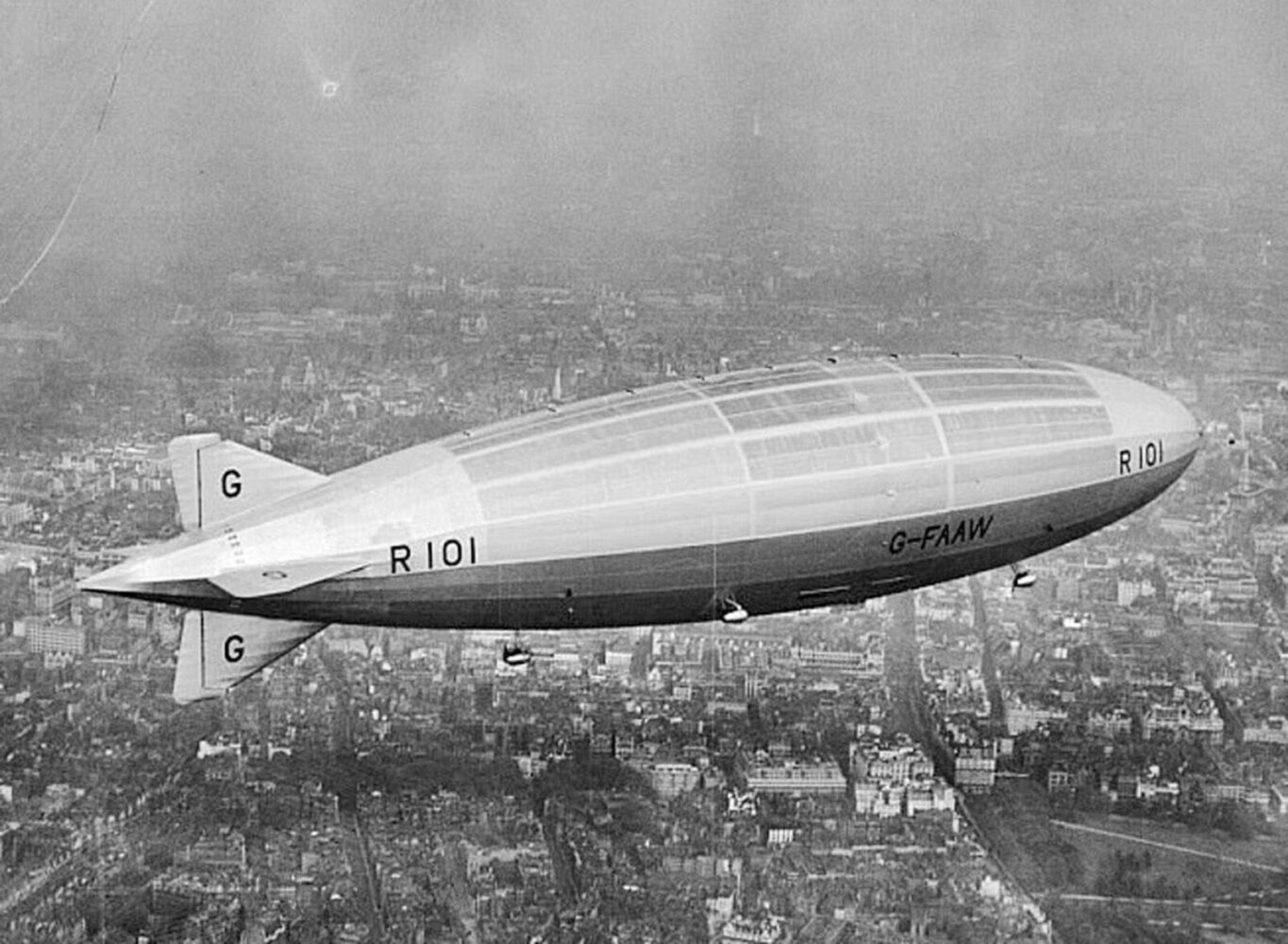
(R101 during a test flight over Westminster, London in 1929. Credit: Alamy)

We’re just past the anniversary of the May 6, 1937 crash of the Hindenburg. The zeppelin – or rigid airship – famously met its demise in Lakehurst, New Jersey, killing 36 people; 13 passengers, 22 crewmembers, and one worker on the ground.

But when you read S.C. Gwynne’s new book, His Majesty’s Airship: The Life and Tragic Death of the World’s Largest Flying Machine, you’ll wonder why zeppelins were still flying by that time at all.

Gwynne’s book is about the R101, a 777-foot-long zeppelin that crashed in 1930.

At that time it was the largest, most technologically sophisticated, and most expensive aircraft ever to fly. And it was designed to be better than any of the airships Germany had constructed.

For a zeppelin, (or blimp), it was quite swanky. R101 had two floors of fifty heated sleeping berths, bathrooms, cooking, and dining facilities, and a smoking room.

In October 1930, the maiden voyage of the steel-framed, linen-draped, hydrogen-filled airship was supposed to take fifty-four passengers from England to India and back – a 10,000-mile journey.

But as Gwynne thrillingly and meticulously documents in this book, the building of R101 and the entire journey were doomed by bad decisions, inflated egos, faulty technology, and bad luck.

On October 5, not long after leaving England, the British airship R 101 carrying 54 people crashed on a hill in Beauvais, France. 8 people escaped, but 2 of those people died later from their injuries bringing the total death count to 48.

Meet the author of His Majesty’s Airship

S.W. Gwynne, a Pulitzer Prize finalist, and a New York Times bestselling author, is currently on a book tour in support of His Majesty’s Airship.

The Stuck at the Airport book club is going to see Gwynne at Town Hall in Seattle on May 15. He’s also making stops in Hudson, OH (May 10), Corte Madera, CA (May 16) and other cities.

From the SFO Museum: Matchbooks & Air Sickness Bags

The SFO Museum at San Francisco International Airport (SFO) has more than 150,000 objects related to the history of commercial aviation and to the airline industry.

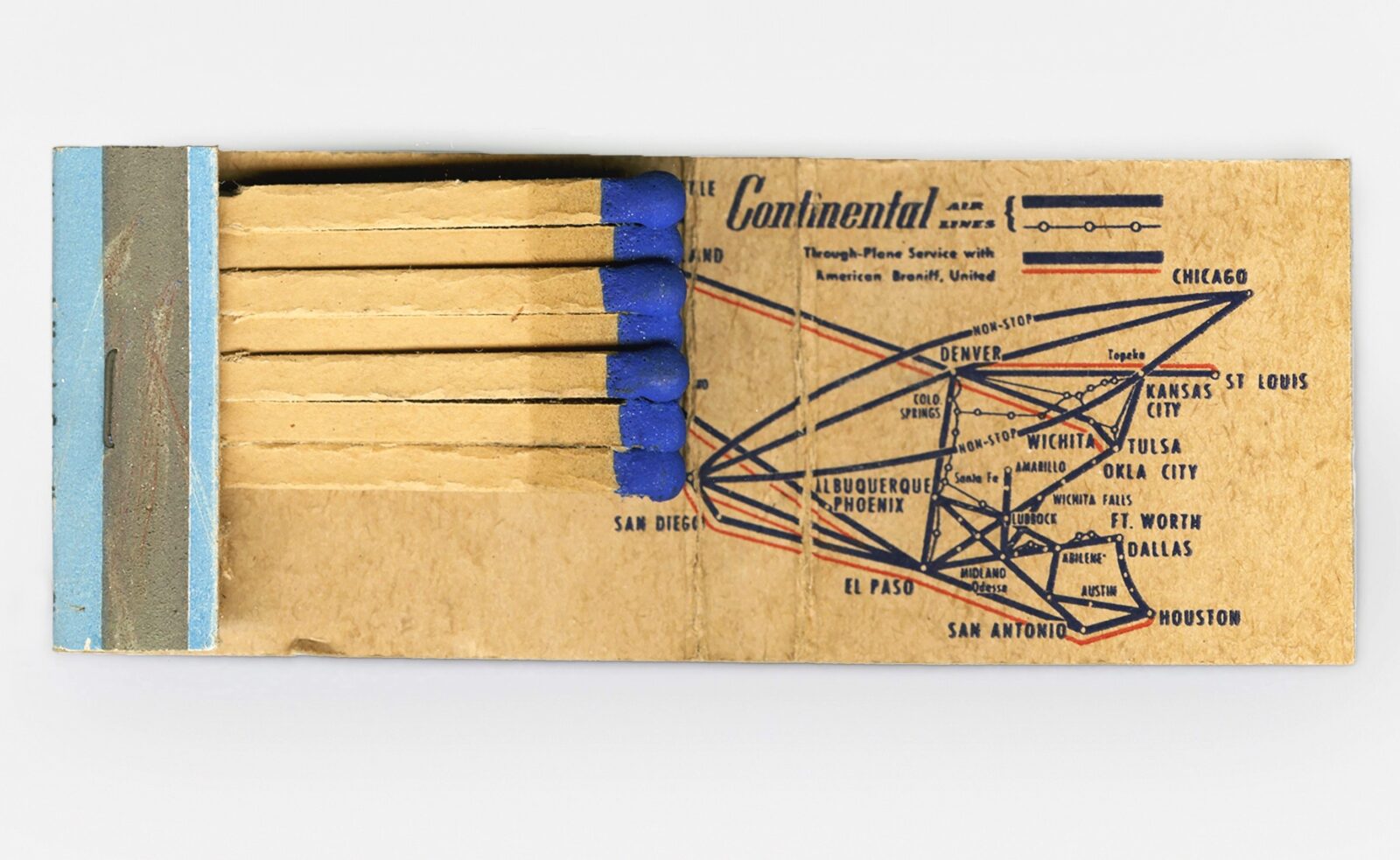
As part of its 52 Objects series this year, they’ve pulled out this matchbook showing the route map for Continental Airlines.

Squeezing as much as possible onto a promotional item is nothing new. A while back we found this air sickness bag in the SFO Museum database which could be used for scoring a gin rummy game and/or turning in your film for processing.

Museum Monday: Amelia Earhart Hangar Museum

Famed aviator Amelia Earhart was born in Atchison, Kansas on July 24, 1897, and lived there until 1908, when her family moved to Des Moines.

Today Atchison honors its most famous hometown hero with a wide variety of attractions.

Those include the Amelia Earhart Birthplace Museum, a life-size statue of Earhart in the arboretum known as the International Forest of Friendship, and the annual Amelia Earhart Festival, held the third weekend of July.

Atchison is also home to the Amelia Earhart Earthwork, a one-acre portrait created by Kansas artist Stan Herd in 1997 using plants, stone, and other materials.

Courtesy Kansas Tourism

New: Amelia Earhart Hangar Museum

The general aviation airport in Atchison is, no surprise, called the Amelia Earhart Memorial Airport.

And it now sits adjacent to the Amelia Earhart Hangar Museum which will have its grand opening on April 14, 2023.

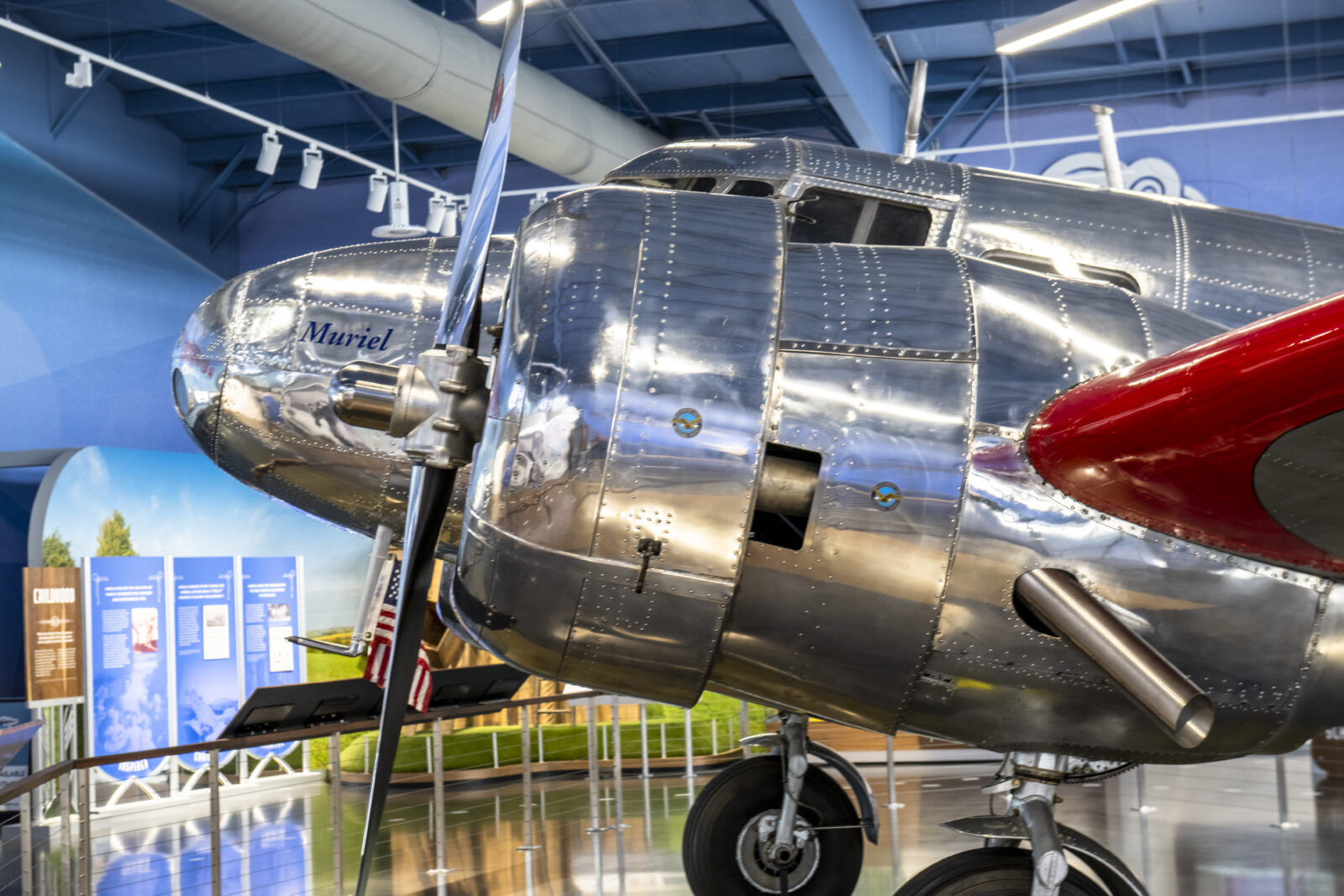
The museum centerpiece is the world’s last remaining Lockheed Electra 10-E airplane.

And this plane is named Muriel, in honor of Amelia Earhart’s younger sister, Grace Muriel.

The fully restored Lockheed Electra is identical to the plane Earhart and navigator Fred Noonan were flying in 1937 when they disappeared during their ill-fated attempt to fly around the world.

Surrounding the plane are 14 interactive STEM-inspired exhibit areas and activity stations. Visit them all and you’ll learn about Amelia Earhart of, course, but also some history, culture, science, technology, aviation, engineering, mathematics, and more.

Museum visitors can scroll through digitized images of Earhart’s mechanic logbooks, compare the inner working of airplane engines then and now, learn about celestial navigation, practice packing the plane, and squeeze into the full-scale replica of Muriel’s cockpit.

After listening to recordings of radio interviews with the real Amelia Earhart and watching an uncanny computer-generated Amelia Earhart video, museum visitors can try ‘being’ Amelia Earhart.

Museum admission includes a chance to fly Earhart’s red Lockheed Vega 5B in a virtual reality simulator. And the flight programmed includes the same route and challenges (bad weather, mechanical problems, etc.) Earhart faced during her 15-hour flight on May 20-21, 1932 when became the first woman to fly nonstop and alone across the Atlantic.

The Amelia Earhart Hangar Museum in Atchison, Kansas will have its grand opening on Friday, April 14.

(Read more about the museum in our story on Runway Girl Network).

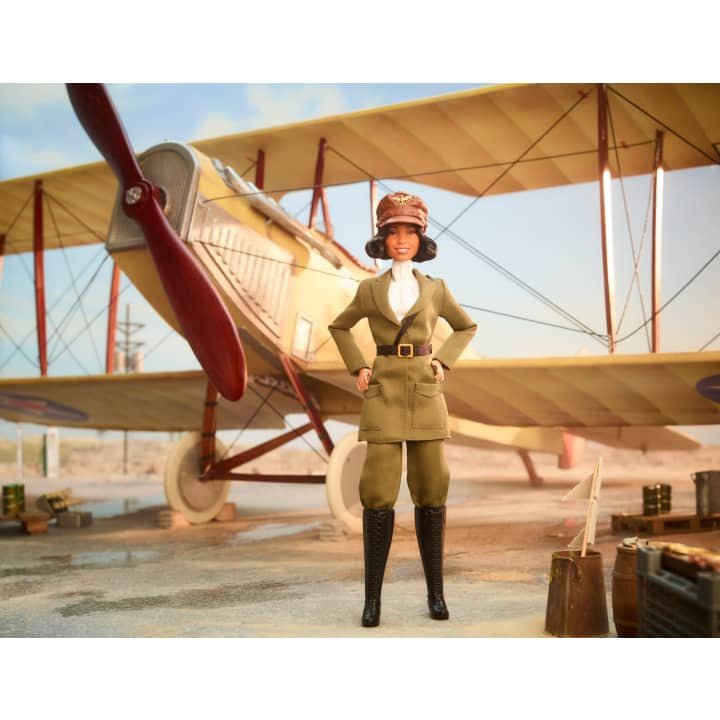
Bessie Coleman honored with Barbie ‘Inspiring Women Series’ Doll

Mattel, maker of the iconic Barbie doll, has an Inspiring Women series that pays tribute to courageous women with Barbie dolls in their honor.

Chimpanzee expert Dr. Jane Goodall, tennis star Billie Jean King, author Maya Angelou, astronaut Sally Ride and First Lady of Song, Ella Fitzgerald, are among the women who have been honored with dolls in this special Barbie series.

And now Bessie Coleman, the first Black and Native American female aviator, and the first Black person to earn an international pilot’s license, has a Barbie doll in her image as well.

The dolls is sculpted in Coleman’s likeness and wears a traditional olive-green aviator suit, with tall lace-up boots and a “BC”-initialed cap.

To celebrate Coleman’s birthday, on January 26, customers flying on American Airline’s Flight 771 from Dallas to New York received the new doll.

American Airlines also hosted a special program for aviation students at the Ronald E. McNair public school 5 in Brooklyn, New York.

The Bessie Coleman story is impressive and inspiring

Coleman was born in 1892 in Atlanta, Texas, one of 13 children, and moved to Chicago in 1915.

She wanted to earn a pilot’s license, but flight schools in the United States wouldn’t accept her. So she applied to – and was accepted into – a flight school in France. There she she earned her license in June 15, 1921, in just seven months. She went on to take more training to learn the acrobatic stunts, such as walking on an aircraft’s wings, that she became known for.

On September 3, 1922, in Long Island, New York, Coleman made the first public flight by an African American woman in the United States. By 1925 she had become a popular barnstormer, performing acrobatic feats in air shows – and giving lectures – across the United States. Sadly, an aviation accident in 1926 took her life.

Courtesy Smithsonian Institution National Air & Space Museum

In addition to being honored this year with a Barbie Inspiring Women Series doll, Coleman also landed on the newest U.S. quarter. On January 3, 2023, the United States Mint released a quarter featuring pilot Bessie Coleman as a part of the American Women Quarters Program. Coleman’s quarter is marked with the date June 15, 2021, to honor the 100th anniversary of the date she became the first African American woman to earn a pilot’s license.   

Louisville Muhammad Ali Int’l Airport turns 75

Louisville Muhammad Ali International Airport (SDF) is celebrating its 75th anniversary with a special banner exhibit, “SDF Through the Years,” in the Jerry E. Abramson Terminal.

The 13-banner exhibit features historical photos from the 1940s to
the present and includes images of visits by United States Presidents, celebrities, as well as key airport partners such as UPS and the Kentucky Air National Guard 123rd Airlift Wing.

Here’s a preview.