ground transportation

Dude, where’s my ride? Airports move Uber/Lyft away from curbside

At many airports, curbside pick-up is moving away from the curb.

On October 29, Los Angeles International joins the growing list of airports where curbside traffic has gotten so bad that taxis and ride-hailing services such as Uber to Lyft are no longer permitted to pick up at passengers at the curb.

“We have heard from our guests that the current system with ride pickups can be frustrating.” “said Keith Wilschetz, Deputy Executive Director for Operations and Emergency Management at Los Angeles World Airports, said in a statement

“Frustrating” is a polite way of describing how excruciating and time-consuming using a ride-app at LAX can be.

During peak times, app users now often spend upwards of 45 minutes to an hour between waiting for their ride to arrive curbside and sitting in traffic to get out of the Central Terminal Area.

“That’s if the drive doesn’t cancel on you,” said LAX spokesman Heath Montgomery.

At LAX, bad curbside traffic is about to get worse as the airport construction associated with terminal redevelopment and the new automated people mover begins.

“We will be losing more than 30% of our curb front, so doing nothing is not an option,” said Montgomery.

The solution at LAX is to move the pick-up area for both taxi and ride app users away from the terminal curbsides entirely to a new area, dubbed “LAX-it,” just east of Terminal 1.

Passengers will be able to walk to the new pick-up area from some of the terminals and a shuttle will pick-up passengers at all terminals in a dedicated lane on the lower/arrivals level lane.

LAX officials say getting from the airport to the pick-up lot should be no more than 15 minutes (from most terminals) and exiting the terminal should be faster because drivers no longer must battle backups in the Central Terminal Area.

Once it rolls out on October 29, the LAX-it system will no doubt need some tweaks.

For now, some passengers are worried the new system will be confusing and pick-up time will be no shorter than it is now. In a statement, Lyft said it looks forward to working with LAX on providing “the best possible pick-up and drop-off experience for all users,” but Uber outlined its long list of concerns with the plan in a letter to airport officials.

How do other airports tackle curbside congestion?  

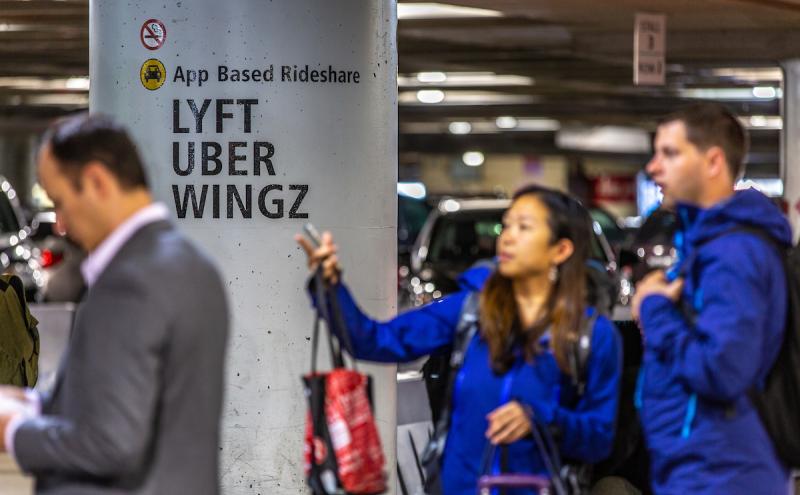
Back in 2016, Seattle Tacoma International Airport worked with ride-app providers to move pick-ups inside the airport parking garage, adjacent to space set already aside for other commercial ground transportation operators.

“We have since made traffic flow process improvements,” said SEA spokeswoman Kate Hudson, “We’re lucky in Washington state that cars must have front and near license plates as it allows passengers to locate their vehicle from both angles.”

The Port of Seattle staffs the ride-app pick-up area and contracts for additional ambassadors during peak times. 

With a goal of diverting at least 45% of ride-hailing pick-up activity away from the terminal roadways, in summer 2018 San Francisco International Airport relocated pickups for Uber Pool, Express Pool and Lyft’s shared categories to the Domestic Parking Garage. And in March 2019, Uber X and Lyft offered their customers the option to be picked up in the Airport’s Domestic Hourly Garage at $3 less than the curbside rate.

“To date, these measures have only shifted about 21% of [ride-hailed] pickup activity off the terminal roadways, falling short of the 45% diversion rate,” said SFO spokesman Doug Yakel, so as of June 5, 2019 SFO relocated all domestic terminal pickups for ride-apps, including Uber, Lyft, and Wingz, from the curbside to the 5th floor of the Domestic Hourly Parking Garage.

In mid-November 2018, Austin-Bergstrom International Airport (AUS) moved the pick-up area for all taxis and ride-app companies to the ground level of the airport’s Rental Car Facility.

“In the new space, dedicated taxi lanes are to the immediate left, while three ride share pick-up lanes are on the right,” said AUS spokesman Bryce Dubee, “The three ride share lanes are color-coded in blue, red and yellow with corresponding numbers 1-4 so that both passengers and drivers have a specific spot to meet up.”

The overall walking distance is about 750 feet, so before the switch was made the airport purchase four ADA-compliant 12-passenger electric shuttles to provide transport between lower-level locations and also leased an electric autonomous vehicle to transport passengers on the upper level of the garage.

Looking ahead, at the end of this month, Boston Logan International Airport (BOS) will move both pick-ups and drop-offs for app ride passengers to new dedicated curb areas.

The new areas – conveniently located in the Central Parking – will be protected from the weather, brightly lit, and connected to all terminals via moving walkways,” said BOS spokeswoman Samantha Decker. “The new areas will also provide all the services passengers expect, including luggage carts, wheelchair services, and bag check service.”

(My story about airports relocating pick-up spots for Uber, Lyft, Wingz and taxis first appeared on USA TODAY)

Travel Tidbits from an airport near you

Boston Logan Airport – and others – are reminding travelers that Uber & Lyft driver are planning a strike today, which might make getting to and from this and other airports a bit more complicated.

Delta Air Lines announces a “Reclaim My Status” loyalty benefit for its customers. Nice.

And the newest exhibit at St. Louis Lambert International Airport is curated by the Griot Museum of Black History.

Batik Story Quilts: Yoruba and Other Cultural Proverbs, displays Batik tapestry quilts made by artist Tunde Odulande.  

The exhibit includes seven quilts:

The Fairytale of the Blue Ghosts and Their Magical Spree,” Musicians Make Music While the Audience Makes Orchestration,” “Has Man Finally Arrived?,” “If you Don’t Know Where You Are Going, Any Road Will Do,” and “Our Heritage” are on display across from carousel 1 in the Terminal 1 Baggage Claim area.

Sweet Mother” and “Mask of Peace” are on display near the A Concourse entrance. Batik Story Quilts: Yoruba and Other Cultural Proverbs is on display at STL through October 23, 2019 

Boston Logan Airport studying pick-up/drop-off fee for passengers

I got Caught in Boston magnet

Would you pay a fee to drop someone off at the airport – or to swing by and pick them up?

Along with the hassle of dealing with traffic, that may soon be something to add to the decision making process of heading out to Boston Logan International Airport.

The Massachusetts Port Authority, which operates Logan airport, is going to pay for a study to evaluate this option, the Boston Globe Reports, to see pick up and drop off fees might help alleviate curb congestion, air pollution and other traffic maladies brought on by the 20,000 cars that just swing through the airport each day.

Charging for airport pick-ups and drops offs is irritating, but not new. Drivers entering the roads near Dallas-Fort Worth International Airport pay a $2 toll if they’re on the grounds for eight to 30 minutes, which airport officials believe is enough time to make a pick up or drop off and maybe squeeze in a hug. (The toll is $4 if a car is only on the airport grounds for eight minutes or less, which is a  clue a driver is using the airport grounds as a short-cut to somewhere else.)

Some airports in the United Kingdom charge drivers to enter airport roadways as well.


EWR or JFK? Cabs in NY know which is faster.


United Airlines recently spent $120 million renovating Terminal C at Newark Liberty International Airport.

Now the airline is using New York taxis in a creative ad campaign designed to convince New Yorkers to fly out of Newark instead of JFK.

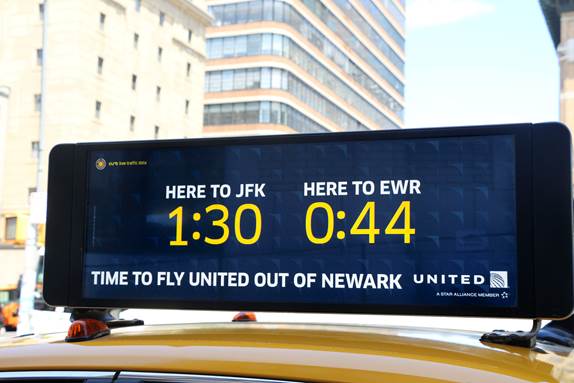
And to prove that Newark Liberty airport (EWR) is closer to New York City than John F. Kennedy International Airport, United fitted 125 New York City taxis with GPS software that shows a real-time comparison of the travel times between the city and both JFK and EWR airports on a digital display on top of the cab.

“The digital displays are synced with data from the Curb application and update in real time with every change in a taxi’s position and evolving traffic patterns,” United Maggie Schmerin explained, “It represents the first time live traffic data has ever been used to dynamically display messaging on top of a taxi.”

Convincing?

Ride review: ReachNow car share to the airport

ReachNow

Seattle, like many hip cities, has a variety of car-share and ride-on-demand services – including Uber, Lyft, Zipcar and car2go.

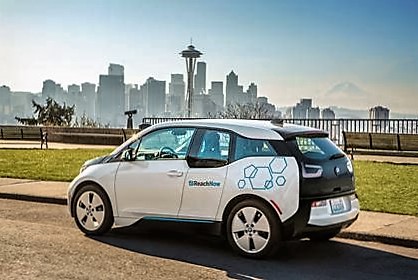
Back in April, we got another – BMW Groups’ ReachNow, which set up its North American headquarters here and announced plans to expand this car sharing program to three other cities by the end of 2016 and, eventually to 10 North American cities.

The fleet of cars caught my eye, and includes the BMW i3, the BMW 3 Series and the MINI Cooper, but my main question was: Will I be able to drive one of the cars to or from the airport?

Back then, I couldn’t.

But starting August 10, nicely coinciding with a week-long summer trip out of town, ReachNow started its airport service, which allows members to pick up a car anywhere within the Home Area, drive to Sea-Tac Airport and park at the Wally Park Premier Garage in one of the 30 spots dedicated for ReachNow cars. From there, it’s a quick shuttle van ride to the terminal.

It works the other way too – from the airport, back into the city – and, thankfully, the cars are accessible at 2 a.m., which is when my flight home to Seattle from Boston landed and I decided to take my test drive.

Finding the car in the garage and exiting the lot was a snap and I felt safe on the 18 mile ride home in a Mini Clubman, which I could park near my front door.

I had promotional credit to cover the ride and the bill ($0.41 per minute) came to considerably less than my other options at that time of night, which were a taxi, a shared van, an Uber ride, or calling in a favor from a friend.

Want to try it out – now or later? ReachNow is offering free lifetime membership as well as that $0.41 per minute introductory rate through the end of August and they’re landing in Portland, Oregon in mid-September.

Airport amenities to be thankful for

My At the Airport column on USA TODAY each December is a round-up of some of the best new amenities airports have introduced through the year.

Here are some of the highlights from 2015.

SFO airplane cocktail shaker


Taming transportation

During 2015, a wave of airports around the country, including those in Chicago, Las Vegas, Louisville, Sacramento, San Diego and Washington, D.C. (both DCA and IAD) hammered out deals with ride-hailing services such as Uber/UberX, Lyft, Sidecar and Wingz to legally pick up and drop off passengers at the terminals.

Look for that trend to continue in 2016.

Helping others

Following the lead of airports in Denver and Columbus, Ohio, in January 2015 — when all the Super Bowl fans were flocking to town — Phoenix Sky Harbor Airport put out spare change collection boxes to begin raising money for the on-site USO hospitality center. In April, Lehigh Valley International Airport (ABE) in Allentown, Pa., added change collection stations to raise funds for a variety of local charities.

Helping moms

During 2015 many airports made space for properly equipped lactation stations for nursing mothers. Chicago O’Hare International Airport now has three Mother’s Rooms, while lactation stations and nursing rooms have been added at Minneapolis-St. Paul International Airport, Milwaukee’s General Mitchell International Airport, Jacksonville International, Spokane International, Newark Liberty, JFK, LaGuardia, Pittsburgh International, Boise Airport and others.

Soothing stress, helping health

More airports are adding pet therapy programs to help fliers deal with the stress of traveling.

In September, Sacramento International Airport introduced the Boarding Area Relaxation Corps, (B.A.R.C.), which welcomes pet therapy dogs and their handlers to the airport twice a week, while in October, Denver International Airport introduced the Canine Airport Therapy Squad, referred to as C.A.T.S.

Other stress-reducing and health-inducing amenities we noted during 2015 included the beach oasis — complete with Adirondack chairs, umbrellas and artificial turf — set up inside Philadelphia International Airport during snowy February, and the healthy eating campaign at Dallas/Fort Worth International Airport that handed out free fruit for travelers, along with prizes.

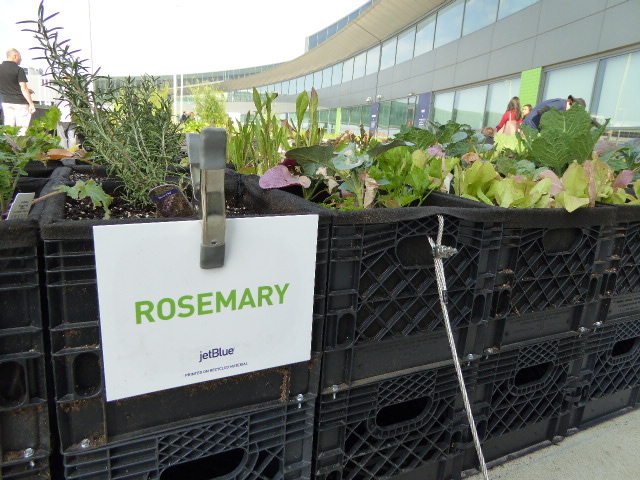
Complimentary treadmill desks were installed this year at Minneapolis-St. Paul International Airport and, at JFK Terminal 5, JetBlue opened a rooftop lounge complete with dog walk, and created a farm out in front of the terminal where a wide variety of herbs and vegetables are now growing.

Fuel for the flight

Healthy airport dining options — both sit-down and take-away — are on the rise  and, in addition to the many upgraded great restaurants (and bars) rolled out this year, we saw the introduction of several free apps, including Grab and AirGrub, that allow travelers to order ahead, skip the line and streamline the task of purchasing a meal inside the airport to take to the gate or onto the plane.

Unique amenities, events and milestones

While SFO and DEN airports offer a mobile car-washing service in their airport parking lots (fees range from $24.95 to $49.95), travelers who park in the garages or in the outside parking lot at Spokane International Airport can get their cars washed for free. (Technically introduced at the end of 2014, I learned about this unique amenity in early 2015 and hope it catches on.)

In addition to being named the Grand Marshal of the Starlight Parade for the Portland Rose Festival, during 2015 the quirky carpet being replaced at Portland International Airport continued its reign as a social media darling, leading passengers to take a closer look at airport flooring nationwide.

To help with the year-long celebration marking the 20th anniversary of Denver International Airport, the Colorado Lottery created a special edition $2 scratch ticket game featuring four iconic images of the airport and, picking up on the newest old-fashioned craze, this year Dallas Love Field has a giant coloring wall in the terminal. Whenever the picture gets filled in, all they have to do is wipe the surface clean and start over.

Dallas Love Field _coloring wall


Did you spot a cool new amenity at an airport during 2015 that I didn’t mention?

Please share your fave in the comments below.

Travel Tidbits: rides, babies & parks

SFO exhibit

Ride-hailing services got the go-ahead to serve some airports just in time for the busy Thanksgiving weekend:

Lyft can now pick-up and drop off passengers at O’Hare International Airport and Chicago Midway, but Uber is still working out its paperwork. And Mineta San José International Airport (SJC) gave the green light to Wingz.

OHare mother's room chair

OHare Mother's Room sink

Chicago’s O’Hare International Airport has opened a third “Mother’s Room.” This one is located past security in Terminal 1, B Concourse across from Gate B10. The other Mother’s Rooms at ORD are in theTerminal 3 Rotunda area and Terminal 5 near Gate M14.

MIA EVERGLADES GRASS

Clyde Butcher, Big Cypress #2.

And, to help mark the National Park Service’s Centennial Year, Miami International Airport is hosting an exhibition of black-and-white photography by Clyde Butcher featuring images of South Florida’s three national parks: Everglades National Park, Dry Tortugas National Park and Biscayne National Park.

Airports making deals with Uber, Lyft etc.

My “At the Airport” column on USA TODAY this month is an update on what’s happening with ride-hailing services at airports. Here’s the story:

Temporary sign at PIT Airport marks where Uber pick-ups are allowed.

After detours and disputes, many major airports are successfully hammering out deals with ride-hailing services such as Uber, Lyft and Sidecar.

That means more and, often, less expensive ground transportation options for many travelers.

Earlier this month, the Metropolitan Washington Airports Authority announced that, beginning Nov. 1, Uber and Lyft would be added to the list of authorized ground transportation options at Washington Dulles International and Ronald Reagan Washington Airports.

At the end of August, the Los Angeles City County approved a permit process that will allow Transportation Network Companies (TNCs), as the ride-hailing services are also called, to pick up passengers at Los Angeles International Airport.

Lyft, which already has operating agreements with 16 airports, is currently going through the permitting process at LAX, said airport spokeswoman Nancy Castles, but while representatives from Wingz, Opoli and Uber say they intend to apply, as of last week, no other TNC, had submitted an application for a permit.

“In the meantime, TNCs may continue to drop off passengers at LAX, but they cannot pick up customers,” Castles said.

In July, San Diego International Airport signed permits allowing Uber and Lyft to join ride-hailing service Opoli in offering pickup and drop-off service at the airport and, at the beginning of September, UberX began operating legally at Sacramento International Airport.

Airports in Seattle and other cities are working on and/and or close to announcing agreements with ride-hailing services as well, and if Chicago Mayor Rahm Emanuel’s new budget plan moves forward, ride-hailing services will soon be officially allowed to pick up and drop off passengers at O’Hare and Midway Airports.

“It wasn’t a question of when services such as Uber and Lyft were coming to airports or how to keep them out,” said Kevin Burke, President and CEO of ACI-NA, the organization which represents most commercial airports in North America, “The big challenge for airport directors was how to regulate the services,” given the various governing models in place at the nation’s airports, he said.

To help move things along, ACI-NA put together a task force that examines the services and offers suggestions to airports on how to negotiate a deal that works for everyone.

“Airports want to provide options for passengers that are coming in and leaving, and if Uber and Lyft are viable options, then we should be providing them,” Burke said. At the same time, though, airports need to make sure passengers are safe and airports need to protect themselves as legal entities, he said.

In 2013, airports in the U.S. and Canada earned $3.1 billion from parking and ground transportation fees, so airports need to make sure the agreements they work out with ride-hailing services protect that revenue as well.

“As we move along we’ll see more and more airports solving these challenges,” Burke said,” but each airport has a different story and there will likely be some snags.”

One of those snags is in Florida, where last week Broward County Commissioners spent more than six hours debating regulations that would have allowed Uber to operate at Fort Lauderdale-Hollywood International Airport.

“They provide a very good service, our customers want to see that service, and we want to work with them to get that service here,” said Kent George, director of the Broward County Aviation Department, but negotiations between Uber and the county have “been difficult.”

George said while the airport looks at ground transportation services more as a customer service than a revenue center, he’s confident Uber won’t walk away from the large South Florida market, which includes 26 million annual passengers at Fort Lauderdale, 40 million passengers Miami International Airport and more than 7 million annual passengers at Palm Beach International Airport.

“The airports are working together and I believe we will eventually get to ‘yes’,” George said.

It’s getting easier to take the train to the plane

PHX SkyTrain_courtes Phoenix Sky Harbor International Airport

In the United States, getting between the airport and downtown can sometimes be the most irritating part of a trip.

But when DART Rail Orange Line trains begin serving Dallas/Fort Worth International Airport later this year, Dallas will join Seattle, Washington, D.C., San Francisco, Chicago, Atlanta and an increasing number of other cities with rail links that make it easy for business and leisure travelers— and airport employees—to make that journey.

“The vast majority of public transport to airports is by buses,” said Deborah McElroy, executive vice president for policy and external affairs at Airports Council International-North America. “But airports are increasingly recognizing that rail transportation is favorably viewed by passengers; especially those from other countries where rail to the airport is more common.”

This summer Burbank Bob Hope Airport will open its $112 million Regional Intermodal Transportation Center directly across the street from the Bob Hope Airport Train Station, with service by commuter rail and Amtrak.

“The line runs north from Downtown L.A. through Glendale and Burbank, then turns west traversing the San Fernando Valley to Ventura County and coastal points north,” said airport spokesman Victor Gill, “and we’ve already broken ground for a second Metrolink stop directly at the airport on a separate line that runs north from Burbank to the Santa Clarita Valley (Magic Mountain territory)/Palmdale/Lancaster.”

In April 2013, the Utah Transit Authority opened Airport TRAX, a six-mile light-rail line to Salt Lake City International Airport. That was the same month Phoenix Sky Harbor International Airport’s Sky Train began service between Terminal 4 (the airport’s busiest terminal), and Valley Metro Light Rail. The free system will eventually make stops at the airport’s other terminals, but has already carried 3 million passengers, said Heather Lissner, PHX airport spokeswoman.

In addition to making it easy for travelers to get to and from the airport, Lissner says locals have been taking the Sky Train to the airport on dates. “People park in East Economy or ride the light rail to connect with the PHX Sky Train then enjoy dinner in Terminal 4 at one of our pre-security restaurants and look at the various art exhibitions in the terminal,” she said.

At Miami International Airport, a 2.4 mile Metrorail extension opened in 2012, and the airport’s Central Station should be complete by the end of 2014, adding links to Amtrak and the region’s Tri-Rail service.

By the end of 2014 the 3.2-mile, $484 million Oakland Airport Connector—a people mover linking the airport to the Coliseum/Oakland Airport BART Station—is scheduled to open as well.

“We already have regular bus service between OAK and the BART station,” said Oakland International Airport spokesman Scott Winter, “but the new line will add a new level of convenience and, most importantly, reliability, as it cruises above traffic below.”

A rail link to an airport is not just convenient; according to a joint study released in November 2013 by the U.S. Travel Association and the nonprofit American Public Transportation Association (APTA), which advocates for public transportation. (APTA dates to 1882, and its initial meetings focused on the price of oats for the horses that pulled transit vehicles.) “Rail cities” can have a financial edge, the report contended.

“We found that cities with airport rail connections have a competitive advantage in generating revenues for the private sector and the overall city tax base compared to similar cities that do not have direct rail connection to the airport,” said Darnell Grisby, APTA’s director of research and policy.

The study compared hotel performance in six cities with airport rail service—Atlanta, Chicago, Washington, D.C., Minneapolis, Portland, Ore., and San Francisco—to hotel performance in popular convention cities without direct airport rail service—Las Vegas, New Orleans, Orlando, Fla., Sacramento, Calif., and Tampa, Fla.

Hotels in rail cities were found to receive nearly 11 percent more revenue per room than hotels in cities without an airport rail connection. According to the study, that higher revenue per room translates to a potential $313 million in revenue per year for the rail cities.

While cost and other concerns can be a deterrent, building a rail line to an airport can be an economic generator that makes a city more appealing to meeting, event and convention planners, said Erik Hansen, senior director of domestic policy at the U.S. Travel Association.

“The decisions of these planners can generate millions of dollars in spending at hotels and local restaurants,” said Hansen. “And if they’re going to put anywhere from 1,000 to upwards of 25,000 people on the road at a single time and have them leave an airport at a single time, they want transportation options.”

With some of those issues certainly in mind, the Metropolitan Washington Airports Authority is moving ahead with a two-phase plan for improved rail service to Dulles International Airport that includes constructing a 23-mile extension of the existing Metrorail system.

Denver International Airport has partnered with the Regional Transportation District to add a 22.8-mile commuter rail connection from DEN to downtown Denver that is scheduled to open in 2016.

In Los Angeles, studies are underway to decide how best to connect the Metro Rail system with Los Angeles International Airport. And Orlando International Airport has announced plans to spend $470 million to build an automated people-mover system to support a variety of future travel connections, including intercity rail service between Orlando, Miami and the airport.

The people mover planned for Tampa International Airport may someday link to a regional transportation center and there’s promise of a mass transit link as part of New York City’s LaGuardia Airport Central Terminal overhaul.

“It certainly depends on the airport community and who they are competing with,” said McElroy of ACI-NA, “but a number of airports have indicated that they believe having a rail link from the airport to downtown is a key factor in being competitive in the global airport market.”

(My story about rail service to airports first appeared on CNBC Road Warrior in a slightly different version.)

SFO Airport readies for possible BART strike

Portrait

Bay Area Rapid Transit (BART) workers may go on strike early Monday, August 5, 2013  (again…).

If they do, it will be a big pain in the neck for travelers heading to or from San Francisco International Airport (SFO).  To help out, the airport has issued some transportation options and advice, including:

Other transit and shared rides

SFO is recommending that travelers use shared van services, the Caltrain commuter rail or SamTrans bus to the airport and look for updates information on transit options on www.511.org or www.flysfo.com/bart-strike.

Other options include taxis and the ride-share services such as Lyft, UberX, Sidecar and InstantCab.

Free SFO buses

If there is a BART strike, SFO will operate free buses between the airport BART station and the Millbrae Caltrain center. Buses will drop off and pick up passengers at the departure level of the International Terminal, outside the airport BART station.

Free buses will also operate at regular intervals between the airport and the South San Francisco (Oyster Point) ferryboat terminal. A map of these bus routes, along with other supplemental transit options, can be found here.

Kiss & Fly; Cell Phone Lot

If you are getting picked up or dropped off at SFO by car, the airport encourages you to use the Kiss-and-Fly curb at the rental car facility. From there you catch the AirTrain to the terminals.

SFO also offers a free cell-phone parking lot. It’s next to the Long Term Parking surface lot five minutes north of the terminals.