It’s not overdoing it to say that the Stuck at the Airport safety and security team is a bit obsessed with the topic of firearms at airports.
We can’t go down the rabbit hole that is the gun control discussion here.
But we do get quite alarmed every time the U.S. Transportation Security Administration (TSA) shares statistics about the number of firearms passengers try to take with them through airport security checkpoints.
The rules for flying with firearms are pretty clear
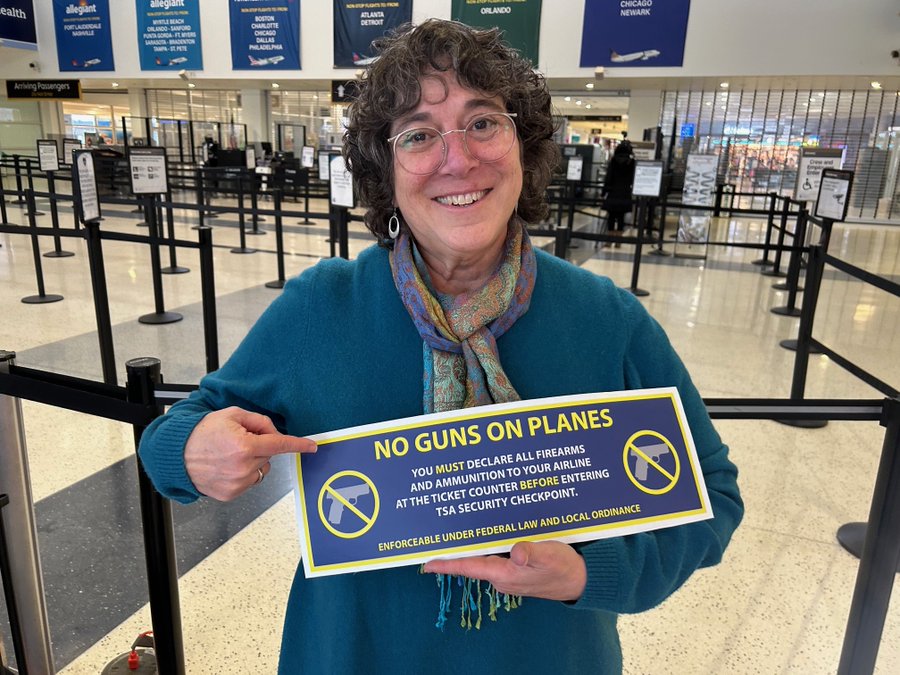
Firearms are prohibited at security checkpoints, in the secure area of an airport and in the passenger cabin of an aircraft, according to the TSA.
Even if a passenger has a concealed carry permit or is in a constitutional carry jurisdiction.
Yet, travelers continue to show up at airport checkpoints with guns.
The Transportation Security Administration (TSA) reports that it intercepted 5,028 firearms at airport security checkpoints during the first nine months of 2024.
This total represents an average of 18.3 firearms detected per day, according to the TSA.
And – here’s where we get freaked out – TSA says that more than 93% of those guns were loaded.
TSA used to report what percentage of the guns they found at checkpoints had a bullet in the chamber. But we haven’t seen those stats in a while. (We’ll ask….).
Here are some more firearms-at-airports stats shared today by the TSA.
TSA screened more than 678 million passengers through the first three quarters of 2024.
That is a record-setting number of passengers compared to the more than 638 million passengers TSA screened during the same period of 2023 – and is an increase of nearly 6.3%.
The rate of firearms discoveries at TSA checkpoints during the most recent quarter (July – September) was 7.5 firearms per one million passengers.
Here’s their chart:
The “good news” is that with the uptick in passengers, this is a slight decrease from the same period in 2023 when officers discovered 8.1 firearms per one million passengers.
But still – a lot of “oops, I forgot that loaded gun was in my carry-on bag” incidents at airport checkpoints.
What happens if TSA discovers you’ve got a firearm on your person or in your carry-on at the security checkpoint?
TSA says it does not confiscate or seize firearms.
Instead, it says that if a passenger has a firearm on their person or in their carry-on luggage, TSA contacts local law enforcement to safely take possession of that firearm.
And, depending on local laws, the passenger may be arrested or issued a citation.
For its part, TSA can also impose a civil penalty of up to $15,000. For a first offense, passengers with TSA PreCheck lose their eligibility for that program for five years. A second offense results in permanent disqualification from the program, along with additional civil penalties.
Bottom line: unless you go through the proper procedures to travel with your firearm, leave that firearm at home.
(Photo up top courtesy of Library of Congress – Bain Collection)
Pop quiz: Can you take your gun on a plane in your carry-on bag?
The answer is no.
But the message isn’t getting through. No matter how many times and in how many ways the Transportation Security Administration crew tries to remind travelers of that fact.
In 2023, TSA officers found 6,737 firearms in carry-on bags at airport security checkpoints.
That’s up from the 6,542 firearms detected in 2022. And it’s a scary new record.
Even more alarming: of all the guns TSA found in carry-on bags at airport checkpoints nationwide in 2023, approximately 93 percent were loaded.
The TSA didn’t share how many of those loaded guns had a bullet in the chamber. (They used to).
.@TSA officers at @ReaganAirport prevented three individuals from bringing these handguns onto flights on Friday. Three in one day! Shaking my head. Police confiscated each gun, issued criminal citations and TSA will likely slap each with a pricey federal civil penalty. pic.twitter.com/XSRDb5GkEr
— Lisa Farbstein, TSA Spokesperson (@TSA_Northeast) December 16, 2023
Top 10 list of airports where TSA found the most guns
In 2023, firearms were caught at 265 airport checkpoints.
Here’s a TSA chart showing the 10 airports where TSA found the most guns. Hartsfield-Jackson Atlanta International Airport (ATL) tops the list with a total of 451 firearms. Three Texas airports are on the Top 10 list.
Top 10 airports with guns caught by TSA at checkpoints in 2023
Rank
Airport (Code)
Total
1
Hartsfield-Jackson Atlanta International Airport (ATL)
451
2
Dallas/Fort Worth International Airport (DFW)
378
3
Houston’s George Bush Intercontinental Airport (IAH)
311
4
Phoenix Sky Harbor International Airport (PHX)
235
5
Nashville International Airport (BNA)
188
6
Denver International Airport (DEN)
178
7
Orlando International Airport (MCO)
164
8
Tampa International Airport
144
9
Fort Lauderdale-Hollywood International Airport (FLL)
135
10
Dallas Love Field (DAL)
The numbers have been climbing. This chart shows firearms caughtby TSA at checkpoints from 2008 to 2023
Year
Nationwide
2023
6,737
2022
6,542
2021
5,972
2020
3,257
2019
4,432
2018
4,239
2017
3,957
2016
3,391
2015
2,653
2014
2,212
2013
1,813
2012
1,556
2011
1,320
2010
1,123
2009
976
2008
926
Can you take your gun in your checked bag?
The answer is yes. But.
TSA says travelers may pack firearms in checked baggage if they are unloaded and packed in a locked hard-side case.
Ammunition must be in its original box and can be packed inside the hard-side case, next to the firearm. Even if the box of ammunition is not full, the bullets must be in their original case. The case with the firearm should be brought to the airline check-in counter to be declared to the airline representative.
Last Thursday the State Department advised travelers from the U.S. to “exercise increased caution” worldwide because of the Israel-Hamas war, citing “the potential for terrorist attacks, demonstrations or violent actions against U.S. citizens and interests.”
The warning “means what it says,” said Jeffrey Price, an aviation security expert and professor of aviation and aerospace science at Metropolitan State University of Denver. “Don’t go to areas where they are actively capturing or killing U.S. citizens, and be careful when going to countries where you could be put in harm’s way simply by being there.”
But what about trips to Barcelona or Singapore or even just Baton Rouge? Here’s what to consider if you’ve got travel plans on the books or are making them now, given the conflict in the Middle East.
All-purpose safety precautions
In addition to telling U.S. travelers to reconsider travel to Israel and the West Bank and to avoid any travel to Gaza, federal officials also recommend staying especially alert in popular locations anywhere tourists gather globally.
They suggest following State Department accounts on social media for updates and joining the Smart Traveler Enrollment Program [STEP] to make it easier for the agency to get in touch with American travelers abroad in case of emergencies.
The State Department has alerts of various levels in effect for many countries because of conflict and other risk factors, but “worldwide caution” advisories are less common. The last one was issued in August 2022 after a U.S. drone strike killed a high-level Al Qaeda leader.
Some national security experts regard last week’s global alert “as one of the most urgent issued in light of the extremely high tensions throughout the Middle East,” said Howard Stoffer, a professor of international affairs at the University of New Haven and a former senior official in the State Department’s Foreign Service.
“This type of alert usually lasts a relatively short time,” he said, but the current one “may last for some period of time.”
What should you do?
If you’re planning upcoming travel, you can monitor the State Department’s travel advisories for any destinations on your itinerary both before and during your trip. The Council on Foreign Relations, a nonpartisan think tank, also maintains an interactive Global Conflict Tracker that provides additional information for specific areas around the world.
Experts warn against slipping so deeply into vacation mode that you risk losing sight of potential shifts in the political or security situation on the ground.
“Be aware of your surroundings and be sure to cooperate with any increased security measures,” Price said.
Stoffer said, “Stay alert and listen to the news carefully when out there.” Otherwise, exercise the same good judgment you would under any other circumstances, like steering clear of major protests and making sure friends and family back home know where you are.
Air travel
Israeli flag carrier El Al Airlines is the only airline that continues to fly between the U.S. and Israel, although its website notes that “there may be a change in the departure times of some flights.”
Major U.S.-based airlines that previously offered regular service to Tel Aviv, including American, Delta,and United, have issued travel alerts for the Middle East and suspended all flights to Israel.
United has also issued a travel alert for its flights to Amman, Jordan, but service there is continuing.
The suspensions include direct flights out of major hubs such as Atlanta, Boston, Chicago, New York City, San Francisco, and Washington, D.C., as well as connecting flights on partner airlines, said Scott Keyes of the flight deal website Going.
With Delta having already extended the dates of its rebooking provisions, Keyes said, “It’s all but certain other U.S. airlines will extend their travel waivers for at least as long as the escalated hostilities continue.”
At airports and other transportation hubs, “travelers can expect to see a larger law enforcement and canine presence,” said Robert Langston, a spokesperson for the Transportation Security Administration.
The TSA is operating at a “heightened level of security as a result of world events and the current threat environment,” he said. Officials there and at its parent agency, the Department of Homeland Security, will continue to monitor the situation and adjust their security measures as needed.
Security checkpoint lines at airports could get longer because of the increased measures, Price said, but “if things are getting out of hand, TSA can also speed up lines by reducing random checks.”
Cruises
A handful of cruise lines have made changes to scheduled sailings in the Eastern Mediterranean and the Middle East, said Aaron Saunders, a senior editor at Cruise Critic.
“The changes range from the cancellation of full sailing seasons to adjustments to itineraries that remove select ports,” he said.
Windstar Cruises, Royal Caribbean, and MSC are among the cruise lines that have pulled all their ships out of the region because of the conflict, Cruise Critic has reported, while Norwegian Cruise Line has informed passengers on a coming Rome-to-Athens cruise that stops in Israel will be skipped.
“Cruise lines have teams dedicated to monitoring the latest news and updates and reserve the right to adjust their plans as they see most fit,” Saunders said.
He encourages anyone with a cruise reservation to watch for emails from the operator for updates on specific sailings, as well as any compensation being offered for significantly affected ones. For those considering a cruise to the region, “we strongly recommend purchasing travel insurance,” Saunders added.
Travel Insurance
Many travel insurance policies already provide cancellation and interruption benefits in the event a terrorist attack affects a trip, according to published guidelines from the travel insurance comparison platform SquareMouth.
But in most cases, those benefits kick in only for policies purchased before the date of the attack, meaning such coverage would apply for the current conflict only on insurance taken out on or before Oct. 6.
Travelers with coming trips to Israel who have cancellation and interruption benefits may be reimbursed for 100% of their trip expenses if they need to cancel, SquareMouth noted. Travelers planning to visit Israel as part of trips may also be covered if they need to cut their itineraries short.
Citing the lingering effect of the COVID-19 pandemic and the public’s ability (and reluctance) to obtain a REAL ID driver’s license or identification card, federal officials have once extended the deadline for when fliers must have a federally compliant REAL ID.
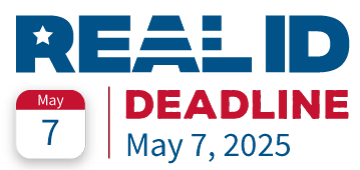
On Monday, the Department of Homeland Security announced that the deadline for enforcement of REAL ID has been extended from May 3, 2023 to May 7, 2025.
That means states and travelers now have two more years to meet the deadline of making sure travelers have compliant driver’s licenses and identification cards.
During the pandemic, many states closed license centers or severely limited the hours of operations. Many states also extended the expiration dates on driver’s licenses and moved all operations online. That made it difficult for states to make real progress on issuing REAL ID-compliant driver’s licenses and identification cards.
“We welcome the DHS announcement postponing the implementation of REAL ID requirements for individuals boarding commercial aircraft,” said Kevin M. Burke, president and CEO of Airports Council International – North America (ACI-NA) in a statement. “Despite previous extensions to REAL ID implementation, the saturation of REAL ID compliant licenses and identification cards remains low.”
How low?
According to the U.S. Travel Association, an estimated 83 million Americans (34%) currently do not have any form of ID that meets the REAL ID requirements.
What is REAL ID ANYWAY?
Passed by Congress in 2005 following a 9/11 Commission recommendation, the REAL ID Act establishes minimum security standards for state-issued driver’s licenses and identification cards.
Under the regulations and the new deadline, beginning May 7, 2025, every traveler 18 years of age or older will need a REAL ID-compliant driver’s license or identification card, state-issued enhanced driver’s license, or another TSA-acceptable form of identification (i.e a passport) to pass through security checkpoints for domestic air travel.
IDs – driver’s licenses and passports – are one of the top items left behind at airport checkpoints. And TSA destroys IDs that remain unclaimed after 30 days.
Replacing a driver’s license is a hassle. Replacing a passport is an even bigger hassle. So we don’t advise using your passport for domestic travel instead of getting a REAL ID compliant license or ID card,
Let’s give credit to the TSA officers at Fort Lauderdale-Hollywood International Airport (FLL) who cracked the case of the passenger whose carry-on luggage contained a raw chicken with a gun hidden inside.
TSA takes offenses like this seriously. But the agency isn’t above cackling and crowing about finds like this on Twitter, Facebook, and Instagram.
“There’s a personal fowl here…” TSA noted in its Instagram post, adding that “The plot chickens as we barrel our way closer to Thanksgiving.”
The chicken puns didn’t stop there.
Far from it.
Courtesy OSU Special Collection & Archives, via FlickrCommons
TSA said it was thankful its officers “are always working around the cluck to keep you safe” when noting the “hen you believe it?” find at the Fort Lauderdale airport.
“We hate to beak it to you here, but stuffing a firearm in your holiday bird for travel is just a baste of time. This idea wasn’t even half-baked; it was raw, greasy, and obviously unsupervised. The only roast happening there is this poor packing choice.
Feather you like it or not, there are rules for traveling with guns and ammunition. So, don’t wing it; roost over the proper packaging info through the link in our bio.“
Guns in chickens are the least of it
While the gun-in-a-chicken scheme is unusual, TSA officers have a lot of experience spotting guns at Florida airports
Earlier this month the TSA noted that so far this year a record 700 guns had been found at Florida airport checkpoints and nearly every one of these guns was loaded. “Most had ammunition chambered,” TSA said.
Here’s some of the breakdown, as of November 3:
Orlando International Airport (MCO): 129 guns;
Ft. Lauderdale -Hollywood International Airport (FLL): 120 guns:
Tampa International Airport (TPA): 102 guns;
Miami International Airport (MIA): 83 guns;
Jacksonville International Airport (JAX): 58 guns;
Southwest Florida International Airport (RSW): 37 guns;
TSA says in Florida, and in many other states, most passengers found with firearms at the checkpoint are arrested or issued notices to appear in court.
“Passengers face a civil penalty from the TSA that can reach as much as $13,910 and that is imposed regardless of whether the individual is arrested by our law enforcement partners,” TSA reminds travelers. And “If the traveler is in the TSA PreCheck program, those privileges will be lost for a period of time, possibly permanently.”
Don't be like this passenger @Reagan_Airport and leave your gun in a carry-on. Become more seasoned in travel knowledge and properly package your firearm in checked bags. And don't forget to declare it with your airline. Learn more here: https://t.co/Zm2XnorDx7pic.twitter.com/fjOd1ixqGh
Nationwide, TSA officers detected 5,972 firearms on passengers or their carry-on bags at checkpoints last year. As of mid-September 2022, more than 4,600 guns had been found. And given the uptick in firearm ‘finds’ the TSA has been reporting around the country, it’s a good bet that the tally will break a record again this year.
Examples include the Spot Saver program at Seattle-Tacoma Internation Airport (SEA), the LAX Fast Lane at Los Angeles International Aiport, the EWR Virtual Line at Newark Liberty International Airport, MCO Reserve at Orlando International Airport, PHX Reserve at Phoenix Sky Harbor International Airport (PHX), and JFK T4 Reserve at John F. Kennedy International Airport.
There are also a few other checkpoint reservation programs operating at airports around the country.
Some are limited to certain airlines, specific checkpoints, or concourses, and may be offered during limited hours. Be sure to read the rules and directions on your airport’s website.
Miami International Airport (MIA) just joined the list
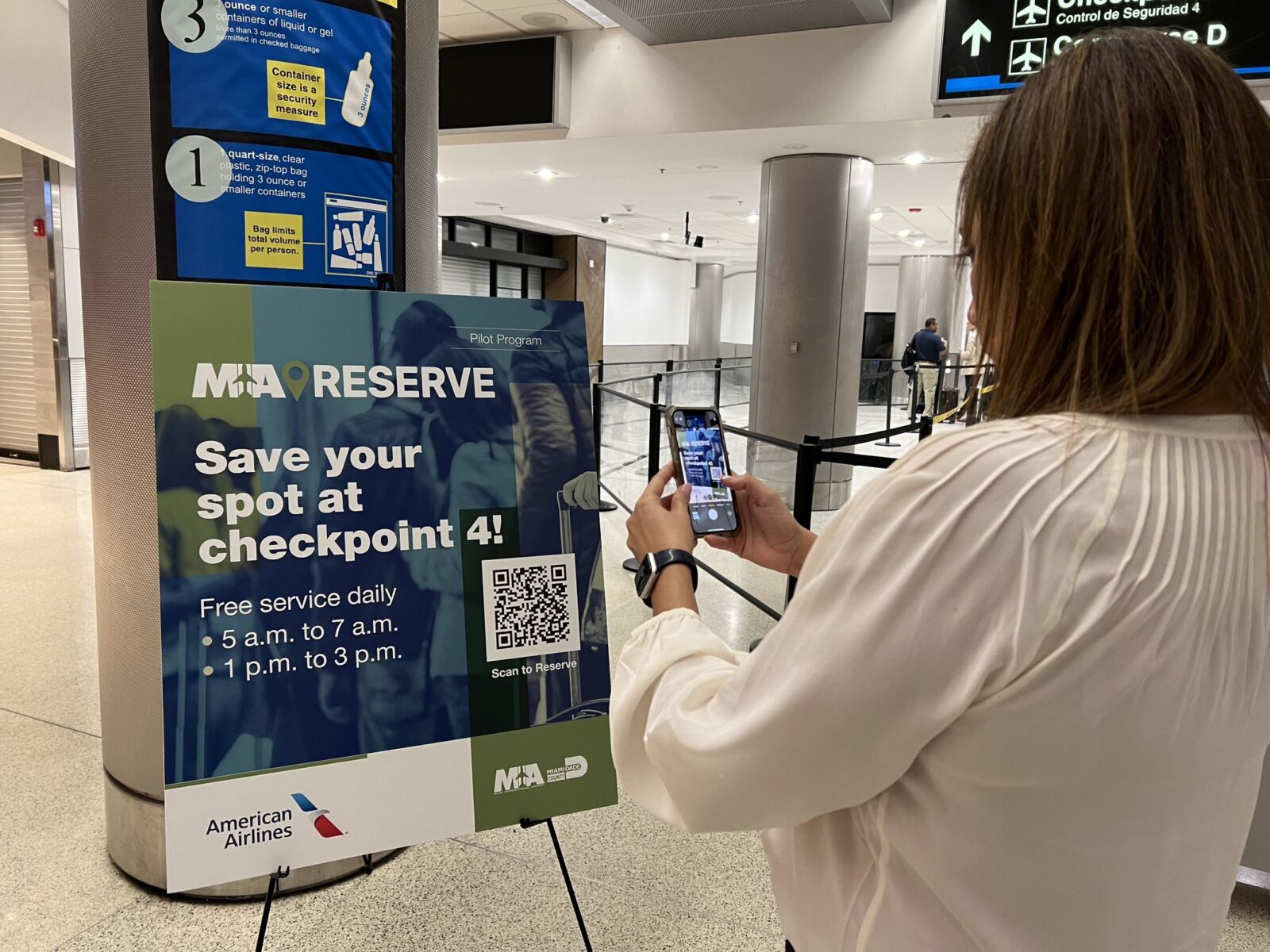
MIA Reserve is a six-month pilot program for passengers flying from MIA airport on American Airlines.
During the trial, passengers may reserve a checkpoint screening time, for free at MIA TSA Checkpoint 4 from 5 am to 7 a.m. and from 1 p.m. to 3 p.m.
Reservations are limited and can be scheduled up to 72 hours before a flight.
Citing a shortage of security workers in the coming months, Amsterdam’s Schiphol Airport (AMS) will once again reduce the number of passengers allowed in the airport.
This time the airport is reducing the number of daily passengers by 18%, through at least October 31. In a statement released last week, Schiphol officials said they expect to continue applying limits on the number of daily passengers until at least the end of the year.
That’s bad news for passengers and for airlines.
AMS had set a limit of 67,500 departing passengers per day during September and 69,500 during October.
The new maximum will be 54,500 per day for the rest of September and 57,000 per day in October.
London’s Heathrow Airport and several others also have passenger capacity limits in place at least through the end of October.
Long – sometimes very long – checkpoint security lines are back at airports in the United States and around the world.
That’s why the StuckatTheAirport.com convenience reporter is a big fan of any program that gets travelers through the lines faster. With the least amount of hassle. And for free.
Paid programs such as TSA Precheck or CLEAR get you on shorter, expedited lines. And we’re big fans of those programs.
But at an increasing number of airports, there are free programs in place that allow travelers to make a reservation for the security checkpoint line.
Airports where you can make a checkpoint reservation
The list includes the Spot Saver program at Seattle-Tacoma International Airport (SEA); the PHX Reserve program at Phoenix Sky Harbor International Airport (PHX); the DFW Security Fast Pass program at Dallas Fort Worth International Airport (DFW) ; the LAX Fast Lane at Los Angeles International Airport (LAX); and the EWR Virtual Line at Newark Liberty International Airport (EWR).
Other programs include t; the MCO Reserve line at Orlando International Airport (MCO); and the JFK Reserve line for Terminal 4 at John F. Kennedy International Airport (JFK).
In Canada, the YYC Express program expedites the security checkpoint experience at Calgary International Airport (YYC).
CLEAR operates many of these free programs with its virtual queuing technology. And now the option to reserve a time to go through the airport checkpoint has spread to Europe.
You can now reserve extra access to the security controls at BER: The new service #BERrunway is free and offered in #BER_T1. Simply select the desired time online 3 days before departure and make your trip less stressful. ➡️ https://t.co/oD5wsgm1nWpic.twitter.com/wvi5zulQZK
— BER – Berlin Brandenburg Airport (@berlinairport) August 25, 2022
BER Runway, at Germany’s Berlin Brandenburg Airport (BER), now allows travelers to plan ahead and reserve a dedicated security time slot.
Here’s how the program works:
On an airport’s app or website, enter your flight information, the number of travelers in your group, and the time slot during which you’d like to go through security. At BER and most participating airports, slots can be reserved as far ahead as 72 hours before a flight. In some airports, it is also possible to reserve a slot when you arrive at the airport.
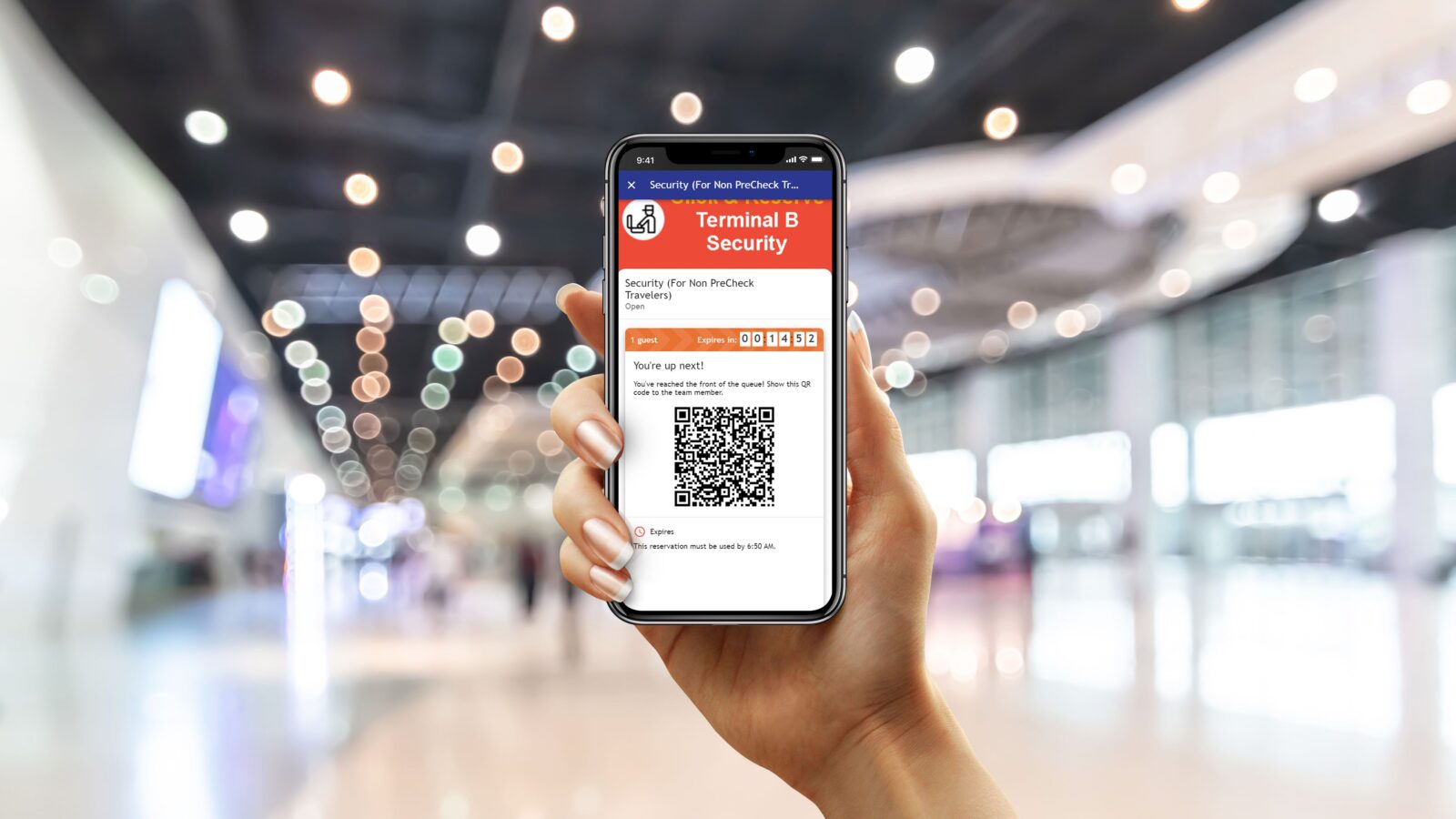
Then, show up at the dedicated checkpoint lane at the time you’ve reserved. Show the QR you received with your completed reservation. Then go through security without waiting in a very long line.
In BER and other airport, the programs may operate during limited times, in specific terminals. If you’ve got TSA PreCheck or the paid CLEAR service, you don’t need this service.
Summer travel is back in full force and that means long lines to go through airport security checkpoints.
Having a paid TSA Precheck or CLEAR membership will get you on shorter, expedited lines. But at an increasing number of airports, there are free programs in place that will also help you shorten the wait times, the unknowns, and the hassles of going through airport security.
CLEAR free Reserve Program
CLEAR offers a paid, identity program that allows many travelers to skip to the front of a checkpoint line. But the company also partners with some airports to offer a free program that allows any travel to reserve a time slot for going through airport security on a dedicated security lane. This can give passengers a more predictable and stress-free travel experience.
Here’s how the program works:
On an airport’s app or website, enter your flight information, the number of travelers in your group, and the time slot during which you’d like to go through security. At most participating airports, slots can be reserved as far ahead as 72 hours before a flight. In some airports, it is also possible to reserve a slot when you arrive at the airport.
Then, show up at the dedicated checkpoint lane at the time you’ve reserved; show the QR you received with your completed reservation; and go through security without waiting in a very long line.
The programs may operate during limited times, in specific terminals, be branded a bit differently at each airport, and is generally not available (or needed) for travelers who already have TSA PreCheck or the paid CLEAR service. So be sure to read the instructions carefully.
Here are the airports where the CLEAR program is currently operating:
*Phoenix Sky Harbor International Airport (PHX) – PHX Reserve ( Terminals 3 and 4)
*Calgary International Airport (YYC) – YYC Express – Checkpoint E
Keep an eye out for other airports that may adding this great amenity this summer and be sure to take advantage of reserved airport checkpoint times when you can.
A new amenity that may soon become an airport staple is a program that allows travelers to reserve a time to pass through the TSA checkpoint.
Seattle-Tacoma International Airport (SEA) offers this service – called SEA Spot Saver – from 4 am to noon – at several checkpoints.
Now Dallas Fort Worth International Airport (DFW) is piloting a similar program.
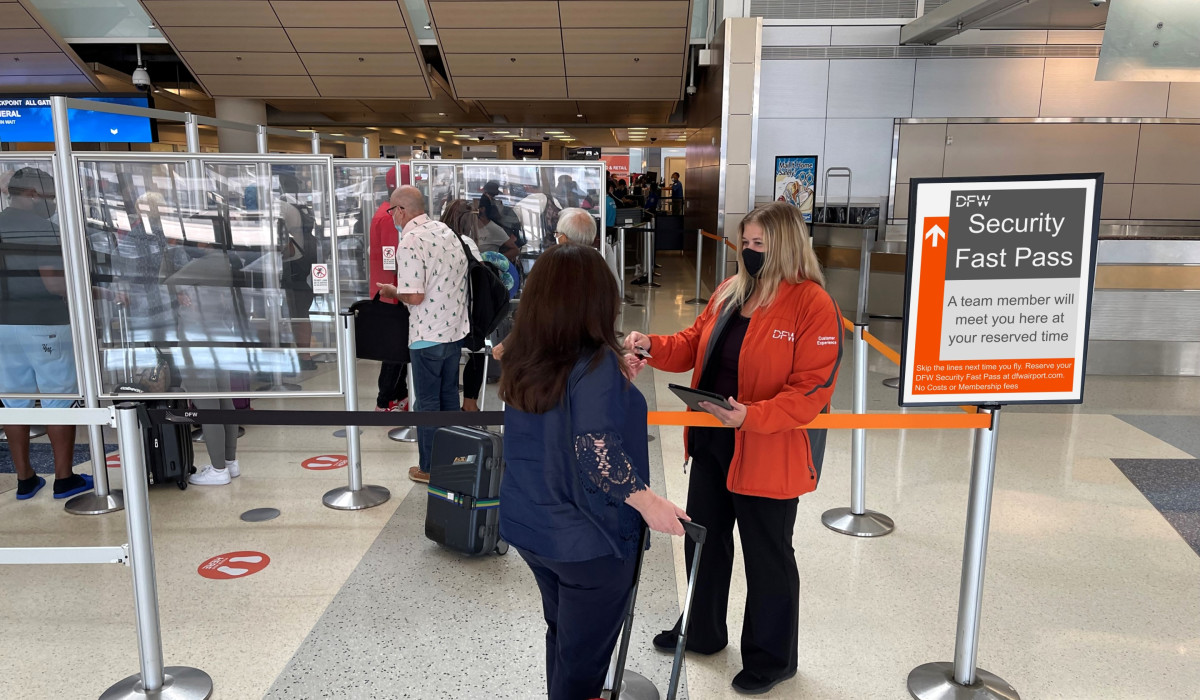
Launched this week, the DFW Fast Pass program allows travelers who don’t have TSA Precheck or Clear to make a reservation to go to the front of the checkpoint line at the Terminal D checkpoint D18. There is no cost to use the service and reservations can be made up to 7 days in advance.
And, as a nice bonus, DFW is giving passengers who use the service a complementary food or retail offering (while supplies last).
Today, our Fast Pass service pilot program launches at the 📍D18 TSA checkpoint!
It allows travelers to reserve the time they will arrive for screening, and provides an escort to the front of the regular (non-Pre-Check or Clear) TSA line.
As part of DFW’s Terminal C renovation, the airport shared a timelapse video of its “High C” gates being moved onto piers at the terminal. Take a look – this may be the way all airport terminals get built in the future.
We're celebrating an incredible milestone in our renovation of Terminal C!
Construction on the six modules that will make up our High C gates is complete and they've been carefully moved to their new home at the terminal! The project is scheduled to be completed in Summer 2022. pic.twitter.com/idLiaEE8ga
Incorporating many community traditions and the dedication of hundreds of volunteers, the 111-year-old Pendleton Round-Up – one of the country’s oldest rodeos – is back this year and ready to roll in a tiny town in eastern Oregon that is so very Old West.
The festivities include Main Street Cowboy shows, an outdoor cowboy breakfast, and the Westward Ho! Parade, which may be the largest non-motorized parade in the U.S. The real action though is in the historic Pendleton Round-Up Arena, where the classic greeting isn’t ‘hello’ or even ‘howdy,’ but ‘Let’er Buck!” Events includeBareback Bronc Riding, Saddle Bronc Riding, Bull Riding, and Steer Roping, among others.
This rodeo even has its own whiskey. The multi-million-dollar annual licensing fee helps boost the rodeo’s operating budget and contributes to the economic well-being of Pendleton. The town has a year-round population of about 16,000 but welcomes more than 50,000 visitors during the Round-Up.
The uptick in air travel brings with it an uptick in airport security wait times. So airports around the country are getting creative in testing new ways to keep those lines from getting out of hand.
BREAKING: @TSA screened 2,028,961 individuals at airport security checkpoints yesterday, June 11. It is the first time throughput topped 2M since the start of the pandemic. The last time checkpoint volume was above 2M was 15 months ago, on March 7, 2020. https://t.co/Fp5cBJAjm8
— Lisa Farbstein, TSA Spokesperson (@TSA_Northeast) June 12, 2021
The “virtual queuing” test at SEA runs through August 31, 20201 from 4 a.m. to noon (the airport’s peak travel period). The program gives passengers who have neither TSA Pre-Check nor CLEAR memberships a way to streamline their security checkpoint experience by getting an appointment time (with a 15-minute window) to access the security line.
There is no fee to use the program, which is set up at two SEA checkpoints and open to all passengers.
At Boston Logan, the test is running through July 7 in Terminal B, from 4 a.m. to 8 a.m. Tuesday through Saturday.
The program at BOS is in partnership with the accesso, a company that provides virtual queuing for theme parks and attractions around the world. At BOS, the Virtual Security Line lets passengers use their mobile devices to reserve a spot in the line. They are then notified (with a countdown clock) when it is their time to approach the checkpoint, get their QR code scanned, and enter the checkpoint line.
We hope these test programs work out and convince these and other airports to make virtual cueing for checkpoint times a permanent amenity.
In the meantime, keep in mind that security checkpoint lines are usually longer in the summer. But now we have physical distancing, out-of-practice travelers, and lots more nervous travelers, so be sure to pack your patience when you head to the airport now.