Today we celebrate the opening of another real bookstore at an airport. Green Apple Books is now open at Harvey Milk Terminal 1 at San Francisco International Airport (SFO).
Green Apple Books is now open in Harvey Milk Terminal 1! 📚🍏
Shop books, newspapers, magazines, vinyl, CDs, audiobooks, gifts, and more before you fly. ✈️ pic.twitter.com/wGKjH26ATM
— San Francisco International Airport (SFO) ✈️ (@flySFO) June 13, 2024
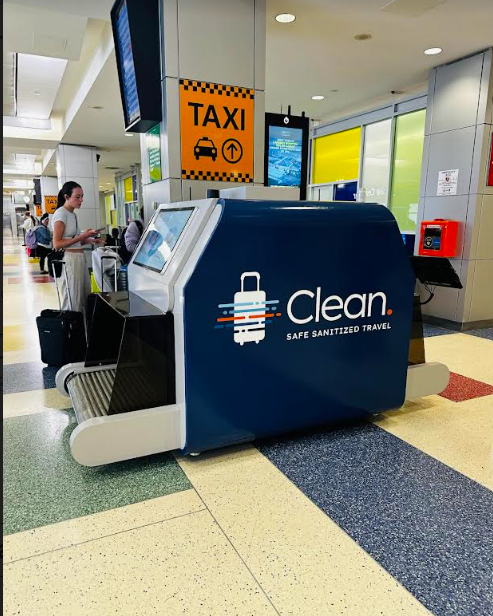
How dirty is your luggage?
When was the last time you sanitized your luggage?
If the answer is ‘never,’ then you might be a candidate for the Clean luggage sanitation machine, which will debut this week at JFK Terminal 7 as part of a pilot project.
The promise: the machine uses UV-C light to eliminate 99.9% of viruses, bacteria and other harmful pathogens from your luggage in seconds.
Confident that your carry-on bag is OK to take on the plane?
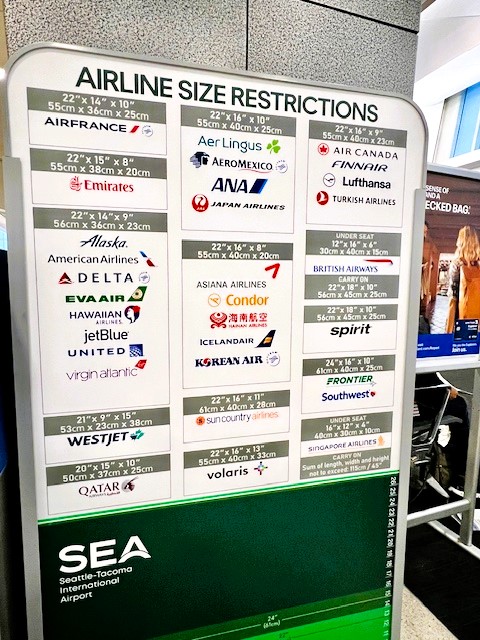
We were until we spotted this sign in the boarding areas at Seattle-Tacoma International Airport (SEA).
It lists the carry-on bag restrictions issued by each airline. And very few of them are the same.
The chart evidently strikes fear – of confusion – in the hearts of many other travelers as well.
We posted a snap of this chart on social media just before boarding an early morning flight and by the time we landed, four hours later, there were more than 16,000 views.
Yes, there are different airplanes and different-sized overhead bins. But wouldn’t it make shopping for a carry-on bag a bit easier if the airline size restrictions and maximum measurements for those bags were a bit simpler and more uniform?
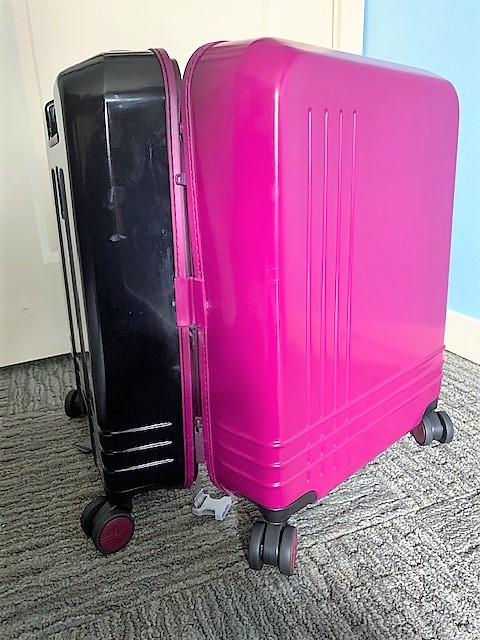
A week before COVID-19 made staying home the right thing for us to do, we had the chance to test drive the Roam luggage carry-on we were invited to design for ourselves.
We’ve been reading about these bags. And besides offering a line of 4 carry-ons and check-ins that are super light and durable, Roam lets each customer customize the color of their suitcase, from the front and back shells to the zipper, the wheels and the handle.
Here’s how our Jaunt XL turned out.
Pretty, right?
If we were to do it again, we’d go a bit wilder with the colors, but this design still stands out in a crowd.
We’re grounded, for now, so the bag has only been road-tested once.
But our Roam bag made it home nick-free after traveling as checked luggage to and from London, through a half dozen London Underground stations and a neighborhood with bumpy sidewalks.
Books we may have time to read
We love the fact that books show up in the Stuck at the Airport mailroom. But we don’t always have time to sit down and read them.
The upside of sheltering in place is that now we do.
Here are two recent arrivals we’ll spend time with this week.
The book is filled with scientific tidbits, insider tips, recommended hikes and notes on all sorts of wonders to explore in 60 national parks around the country.
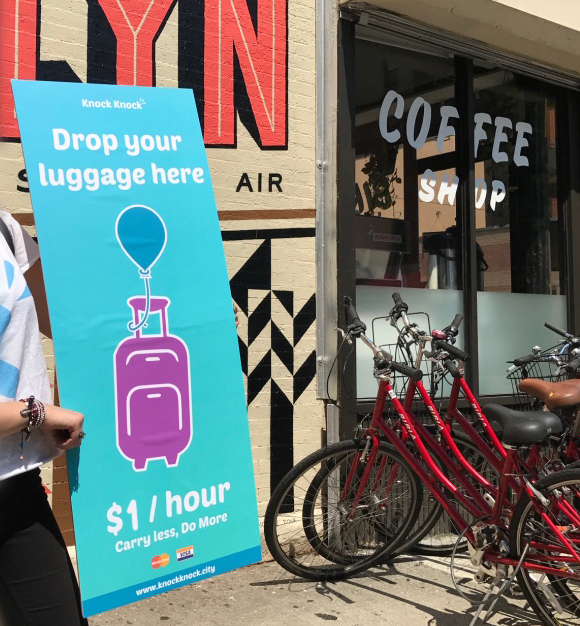
There’s that ‘in-between’ time – when you arrive in a town before hotel check-in time, or when you checked out of your hotel or Airbnb and want to do some sightseeing – when you need a place to leave your luggage.
Hotels will sometimes store your gear, but in a story for CNBC this week, I found a group of apps that match travelers seeking short-term bag storage with coffee shops, restaurants, gift shops and other businesses with strage room to spare.
When dropped off, security ties are usually attached to bags to prevent tampering. Insurance is included in the fee and, after pick-up, users are invited to rate the experience online.
Storage fees vary and are charged by either the hour or the day:
Both Knock Knock City and LuggageHero charge $1/hour or $10/day with a one-time handling fee of $2/bag. Bounce charges $5.99/day. Nannybag charges $6 per bag for the first day and $4 per bag for each additional day. Stasher’s fees are $6/day/per item and Vertoe’s fees start at $5.95 per day/per item (overnight storage counts as two days) and vary by location.
The storage-app ‘industry’ is still young and most company founders I spoke with said they decided to get into the business after finding themselves lugging their luggage around a city after checking out of an Airbnb.
“We started in New York City and Brooklyn with people offering bag storage in their apartments on Craigslist, like Airbnb for luggage,” Selin Sonmez, co-founder of Knock Knock City, told me, “But we found the business hours posted for some people’s homes weren’t reliable or always accurate and others required users to walk up flights of stairs with their suitcases.”
Knock Knock City now also operates in San Francisco, Boston,
Washington, D.C., Seattle, Philadelphia, Chicago and Miami and only partners with
ground floor venues that have strict business hours. Sonmez said any location with
an average star rating below 3.5 (out of 5) is removed.
Like the other luggage storage app services, the list of Knock
Knock City partner sites is eclectic. Customers can store their bags at bike
shops, clothing stores, restaurants, a massage therapist’s office, an eyebrow
bar, at hotels and in hostels.
In addition to helping businesses put unused or underutilized
space to income-producing use, “We’re helping local economies by getting
travelers to explore neighborhoods and getting foot traffic in the doors,” said
Sonmez.
That’s the pitch that convinced ATLAS Workbase, a coworking space by Seattle’s Space Needle,
to sign up as a Knock Knock City site.
“There are a lot of Airbnb rentals in this area and a lot of
tourists, so it solves a real need,” said Kim Burmester, ATLAS Workbase vice
president of sales and marketing, “But our real goal is to get traffic in here as
our key target audience is the traveling professional.”
As convenient as storing a suitcase at a coffee shop for a few hours may be, travelers who don’t want to deal with any baggage hassles have other options.
Travelers can send luggage (and golf bags, ski and snowboard gear or bicycles) ahead with door-to-door shipping services such as Send My Bag, Luggage Free or LugLess (part of the Luggage Forward family) that offers both drop-off and door-to-door luggage shipping services. (Pricing depends on destination, weight and how soon you want your bag to arrive).
Or, for $9.95/month and $99 per
standard U.S. shipment, you can skip worrying about making travel arrangements
for your suitcase altogether.
Dufl sends customers a suitcase to be filled with clothes or accessories
and then picks up the suitcase and stores the items in a “virtual closet.”
Customers can request that the suitcase, filled with any of the stored items, be
waiting for them at a hotel and then, after their trip, return the suitcase and
the clothes back to Dufl for dry cleaning and storage until the next trip comes
around.
My story for CNBC this week highlights some of the cool gear and gadgets that will be on display later this week in Las Vegas at the annual industry-only Travel Goods Show.
Carry-on bags and checkable suitcases seem to make up the bulk of the products vendors bring to the show. But there are also oodles of travel accessories on display, and many of those are quite useful and clever.
Here are just a few of the items that caught my eye:
Luggage that weighs itself
If you shop for shoes, clothes or books or liquor when you travel, your suitcase will weigh a lot more on the way home. A new suitcase from GetSet Luggage has a built-in battery-powered scale that weighs the bag as you pack.
See-through luggage
This product is sort of puzzling: tranparent luggage.
At least three companies are planning to display their versions of transparent or translucent luggage at this year’s Travel Goods Show. Traveler’s Choice calls their version The Millennial, so maybe see-through luggage has a generation-specific appeal.
Socks with pockets
My household has a variety of clothing with hidden pockets. These snazzyPocket Socks are getting added to the collection.
Gear for your Grab ‘n Go
We thought attachments for carry-on bags that let you tote coffee cups were pretty cool, but Hontus Milano Group is bringing out a carry-on bag with a built-in insulated pocket for keeping foods (or medication, cosmetics and other temperature-sensitive items) hot or cold.
There are more items in my full story on CNBC – but these are definitely my favorites. Which of these new travel products would you buy?
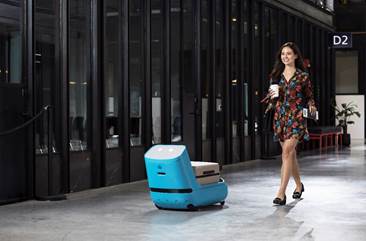
Wouldn’t it be nice to have a cute little robot to tote your carry-on around the airport and to the gate?
KLM is testing that idea out with its prototype self-driving cart – called KLM Care-E – that is designed to escort a passenger through the airport and carry their luggage for them.
The airline will be testing this out at JFK and SFO this summer, drawing stares and collecting data on autonomous technology at airports along the way.
KLM says the units will use non-verbal sounds to greet passengers after security and somehow prompt them to scan their ticket barcodes.
Then the unit will use GPS data to navigate through the terminal to their gate and – somehow – understand if a passenger wants to stop at a shop, restaurant or restroom along the way.
(Will the cute little blue cart wait outside the restroom with your stuff or try to go with you into the stall? That’s my first question..)
KLM says Care-E will move at 3 mph (the average human walking pace) and is designed to know if there’s a boarding gate change.
“We wanted to surprise our customers with an airport concept that was an extension of our friendly, smiling staff,” said Boet Kreiken, Executive Vice President Customer Experience at KLM. “We have the ambition to revolutionize the delivery of care through the power of existing innovations and move diagnostics from the laboratory to where our customer really is. ”
KLM worked with product development firm 10xBeta to create these e-carts, which are scheduled for 2-day long trials at JFK and SFO in July and August.
Sadly, KLM says it is only testing the interaction between machines and humans and has no plans to roll out permanent or additional Care-E carts anytime soon.
Starting today, January 15, airlines will no longer allow passengers to checkg or carry on “smart luggage” with non-removable lithium batteries.
Powered luggage began appearing on the market a few years ago and some new versions of these high-tech bags can weigh themselves, be locked remotely, report their locations, provide power for gadgets, offer rides to the gate and follow travelers around.
The extras are enticing, but industry-wide concern over lithium batteries igniting and starting fires led the International Air Transport Association to instruct its almost 300 airline members to restrict carriage of certain bags:
“Effective 15 January 2018, for IATA member airlines, baggage with removable installed Lithium batteries (“smart luggage”) must be carried as carry-on baggage or the battery must be removed. With the battery removed the bag can be checked-in. If the battery cannot be removed, the bag is forbidden for carriage.”
Citing “safety management and risk mitigation,” American Airlines was among the first to alert its customers to the impending rule change. The carrier also said the standard question it asks customers checking bags – “Have you packed any e-cigarettes or spare batteries for laptops, cellphones or cameras?” – would be altered to include smart bags.
Other airlines are changing their check-in and boarding procedures as well.
“Throughout our guests’ journey, we will remind them to remove all lithium batteries from checked luggage, or disconnect and turn off batteries being stored in the overhead bins,” said Alex Da silva, a Hawaiian Airlines spokesman, “We are also training employees on the various types of smart bags so they may assist customers.”
Some smart luggage manufacturers are scrambling to redesign their smart bag products to comply with the new airline rules. Others are making sure customers know how, and how easily, the lithium batteries can be removed from their bags. And companies who have smart bags without lithium batteries are touting that feature.
“We believed that there would come a time when lithium batteries could be seen as a safety issue. So we purposely powered our luggage with AAA batteries to avoid any of these potential future rulings,” said Emran Sheikh, President and CEO of luggage manufacturer and distributor Heys International.
Sheikh and others emphasize that it is the type of battery used in some “smart” luggage designs that is the problem, not the category of ‘smart luggage’ in general.
“The airline industry’s recent attention to safety surrounding lithium ion batteries should boost our confidence that the travel industry is monitoring current trends and updating their own best practices to reflect modern travelers’ habits and needs,” said Michele Marini Pittenger, president of the Travel Goods Association, “Consumers can expect to see luggage manufacturers respond accordingly and release new iterations of smart luggage featuring even safer power sources.”
(My story on new smart luggage rules first appeared on CNBC in a slightly different form.)
If Santa brought you some new-fangled “smart” luggage that can not only carry your clothes but charge your gadgets, weigh what you’ve packed and give you a motorized ride to the gate, be sure to check that the battery can removed.
Airlines don’t want the lithium batteries that power these smart bags in airplane cargo holds because (as we learned from hoverboards and the Samsung Galaxy Note 7 smartphone fiasco) there’s concern over lithium batteries igniting and starting fires.
Alaska, American, Delta, Hawaiian, Southwest and United are among the airlines that have posted notice that, come January 15, 2018, customers will only be permitted to board with smart bags that have batteries that can be removed.
Smart bags traveling as carry-ons must be powered off and any smart bags traveling as checked luggage must have their batteries removed and brought into the cabin as carry-on.
The latest in luggage, travel gear and on-the-go gadgets goes on display each year at the International Travel Goods Show in Las Vegas.
It’s anyone’s bet which of the products displayed by the more than 500 brands in attendance will take flight, but some of these new products have a great chance
Luggage scooter
Villagio of Miami’s Transmover 3-wheeled scooter has a TSA-approved detachable, rechargeable battery, a space to attach luggage (even a pet carrier) and may be a harried travelers’ answer to that long walk out to the gate.
And it’s fun. The scooter’s 12 mph top speed and 12-15 mile range can provide entertainment on a long layover inside or outside of the terminal. (MSRP: $550-$595 for the electric model; $250-$295 for the non-electric model)
Window tablet bag
Italian designer Nunzia Palmieri created a clever and sophisticated line of women’s business-style handbags and shoulder bags featuring a front pocket that can be used to store and cushion an iPad or tablet or, with the cushion removed, provide working access to the tablet via a clear window. At this year’s International Travel Goods Show Palmieri is expanding the collection to include a men’s line of leather and fabric travel bags with tablet-shaped windows as well. MSRP: starting at $228.
One bag becomes two
Thule luggage maker is rolling out a new Subterra collection that includes four rolling luggage pieces and four travel backpacks.
The 22-inch 2-wheel Subterra Carry-On (MSRP: $279.95) has a compression panel that makes it easy to pack more items and to keep clean clothes separate from dirty ones. The versatile, 22-inch Subterra Luggage piece (MSRP: $319.95) can be filled and checked as one piece or split into two smaller, independent pieces of luggage that are carry-on compliant.
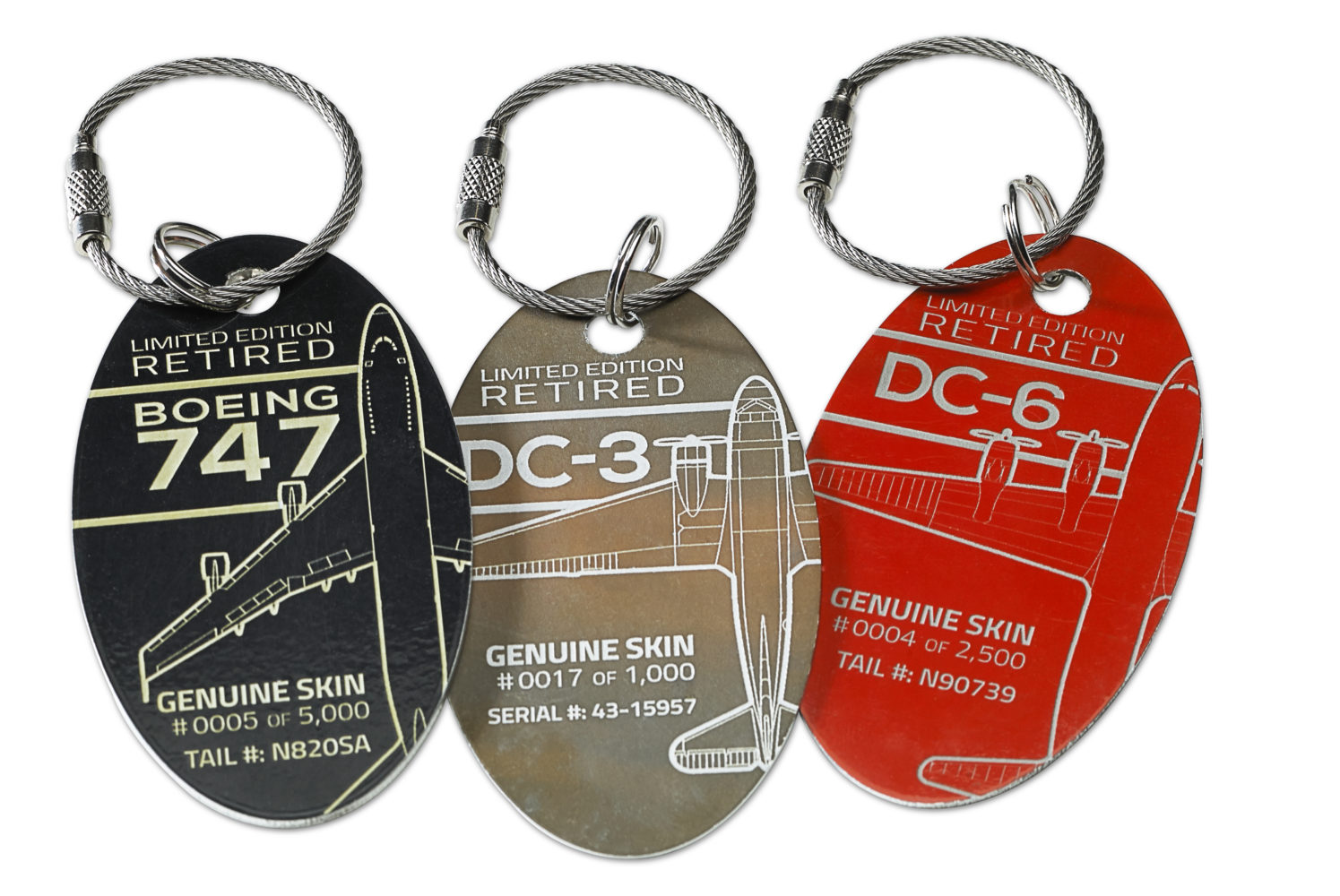
Luggage tags made from airplane fuselage
MotoArt Studios is well-known among airplane aficionados for the conference tables, office furniture and decorative items, such as mirrors, it makes from old Boeing 747 engine turbofan housings, airplane wings and other bits of retired aircraft.
The company has recently expanded its line of offering to include serial-numbered luggage tags ($25 to $100) made from the skin of retired airplanes.
“We include the tail number of the aircraft so you can look up the history of your plane,” said Dave Hall of MotoArt Studios, “And it will tell you how much the aircraft originally cost, what year it was built and the airlines that flew it.”
Sniff, but don’t eat these purses
For fun – and for candy fans – American Jewel has a line of colorful, scented Jelly Belly-branded purses (wristlets), hairbrushes and bracelets. Wristlet “flavors” include Blueberry Muffin, Birthday Cake, Rainbow Sherbert, Green Apple Bubblegum, Pink Lemonade, Roller Rink Pink and Tutti-Frutti.
Drink and Twist
Buying bottled water on the road at $5 (or more) a pop can get expensive, but packing an empty reusable water bottle to fill at the airport or in the hotel gym can take up valuable suitcase space.
A good fluid-carrying solution? Collapsible bottles, such as HydraPak’s clever 1 liter Stash model (MSRP: $23) which twists and crushes down to an easily-packable quarter of its size and comes in outdoor-inspired colors such as Malibu, Mojave, Mammoth and Sequoia.
Sit on this
Toronto-based Airopedic, which has been making ergonomic office furniture since the mid-1980s, has created a self-inflating, portable ergonomic seat to take to sports arenas, into airports, onto airplanes and to other places where comfortable seating isn’t reliably available.
The seat weighs in at 1.6 pounds, has carrying straps and mesh side pockets for storage and a pressure control button to enable seat density adjustments that the manufacturer suggests will make sitting on the Airopedic Portable Seat (MSRP: $65) feel like “sitting on a cloud.”
(My story about accessories and luggage from the 2017 International Travel Goods Show appeared in a slightly different version on CNBC.)