Animals

Vote for TSA’s Cutest Canine

Here’s something cute and furry for a Friday.

National Dog Day is coming up on August 26. And in preparation for that holiday, the Transportation Security Administration (TSA) is having a contest to pick the cutest canine from its roster of more than 1000 dogs trained to sniff out explosives.

Four furry finalists were in the running, chosen from those nominated by their handlers.

To narrow it down to a winner, the first match-up took place on Wednesday, August 19 between two of the finalists.

And it looks like Kajila from Honolulu’s Daniel Inouye International Airport (HNL) won that round.

On Thursday, August 20, the public was asked to pick their favorite between pup Lexa-Alexey from Dallas Fort Worth International Airport (DFW) and Ron, who works at Oakland International Airport (OAK).

Voting in this second round ends early Friday morning.

On Friday, August 21, the winners of the first two rounds will go head to head, with the overall winner to be announced on August 26, National Dog Day.

You can vote on TSA’s InstagramTwitter and Facebook.

TSA’s explosives detection canines have serious job descriptions.

They’re tasked with screening passengers, cargo, mass-transit, and maritime systems, and they support other security missions. Each dog is specially trained and paired with a TSA handler.

If you see these dogs at the airport, you may want to pet them.

Don’t do that.

TSA says that “While TSA canines are sociable, they are working dogs and they should not be petted or fed by anyone except their handlers.”

Reno-Tahoe Airport has cute anti-virus pup protocol

Worried about catching germs at airports?

We are too. But airports around the world are going all out to keep travelers and germs apart during this scary coronavirus time.

But for those worried about germs that may be spread by petting those stress-busting therapy pups, Reno-Tahoe International Airport (RNO) has some good news.

In addition to all the COVID-19 precautions they are taking, Reno-Tahoe Airport is also sanitizing the pups on the Paws 4 Passengers team after each ‘use.’

So go ahead. If you’re traveling you can safely pet those pups. RNO is operating with safe pup-cleaning-protocol.

And we suspect other airports are doing this too.

Know about other creative ways airports are keeping you germ free? Let us know!

Remember the emotional-support chicken?

Last year about this time, there was quite a stir about airlines tightening up their rules about the definition of emotional support animals.

Delta Air Lines got the ball rolling by issuing a new policy banning service and support animals under four months of age regardless of flight length. The new policy also banned emotional support animals of any age on flights longer than eight hours.

Other airlines followed Delta’s lead.

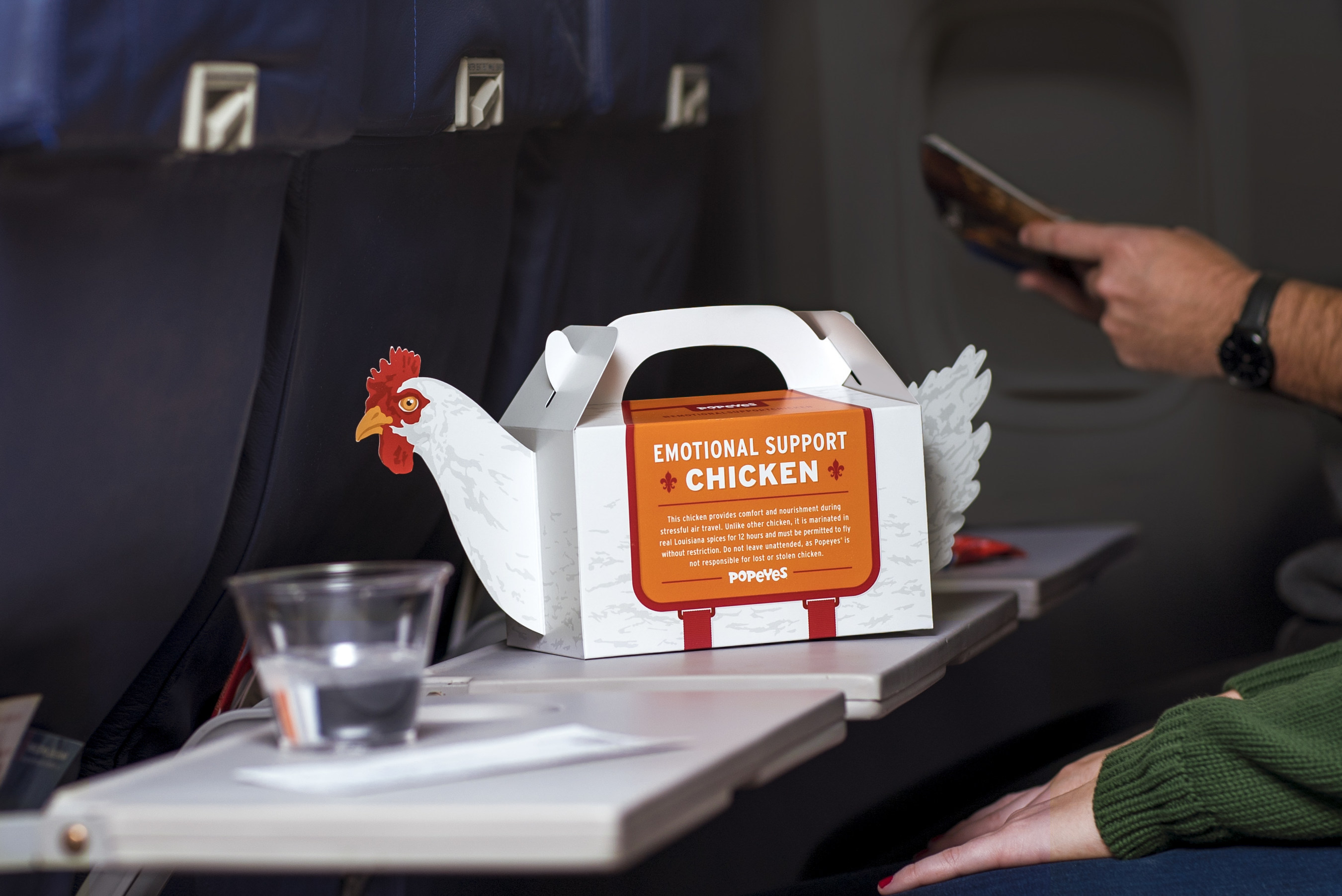
Then, right as the Christmas travel rush kicks, Popeye’s at Philadelphia International Airport (PHL) shares news of a meal on its menu being served in a chicken-shaped box.

The box was labeled as an “emotional support chicken.”

The cocky campaign was a nod to news stories about the wide variety of animals, including peacocks, pigs, monkeys and spiders that try to take onboard for free.

 “We appreciate how comforting emotional support animals are and wanted to create our own version,” said Hope Diaz, CMO of Popeyes Louisiana Kitchen, “The good news is that our emotional support chicken is permitted to fly without any restrictions – one less worry for busy travelers!”

Should they bring that emotional support chicken (in a box) back?

Airports show off their dogs

Airports around the country celebrated National Dog Day (August 26) with announcements of new pet therapy programs and celebrations of their working pups.

Let me know which airport pup tweets we missed and we’ll try to add them in!

Tampa Int’l latest airport to tighten leash on pets

Last year, Portland International Airport and several other airports followed the lead of airlines in tightening the leash on what consitutes an ’emotional support’ animal and the expected and acceptable behavior of pets in the terminals.

The move came in response to increase incidents of aggressive pets and, in some cases, of pets biting and attacking passengers and employees in airports.

Now Tampa International Airport (TPA), which last May was in the news when a dog traveling as an emotional support animal gave birth to puppies in the terminal, has joined the herd in stepping up its enforcement of restricting non-service animals at the airport.

The aim of TPA’s new policy is reducing injuries to pets and people as well as enhancing cleanliness and sanitation at the airport.

Starting this week, TPA will begin educating pet owners about the airport policy which, it notes, has been in place for decades but loosely enforced.

The policy states that traveling non-service animals (i.e. pets) must be properly confined in a pet carrier or controlled on a leash when they are in the airport.

In addition, pets that are not traveling, such as those greeting arriving passengers in the Main Terminal, are not allowed at TPA.

At the end of March, pet owners who are not following the rules will receive warnings and there could be citations for non-compliant guests.

LIke other airport, TPA is experiencing record passenger growth and a record numbers of animals in the terminals. And TPA paramedics, police and maintenance staff are responding to an increased number of injuries to people and pets and cleaning up hundreds of pet ‘accidents.’

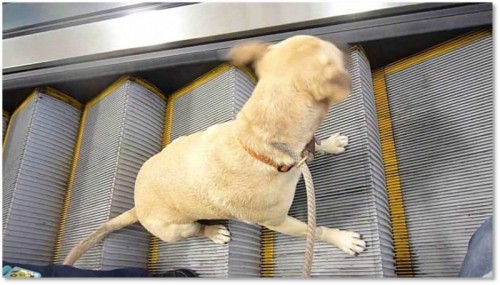
TPA’s policy enforcement was endorsed by the Humane Society of Tampa Bay, which says the policy is a necessary measure to reduce animal incidents such as paw injuries on escalators.

What do you think of this trend? Do you bring your pet to the airport? Have you seen witnessed pets misbehaving at airports?

A pet traveling as an emotional support animal gave birth to puppies last year at Tampa International Airport.

Puppy Bowl at Denver Airport

Football fan or not, it’s hard not to love the Puppy Bowl pre-game event that is now a Super Bowl-day tradition.

The event is so cute – and so good for promoting the adoption of puppies and dogs (and cats), that Denver International Airport holds is own Puppy Bowl.

DEN’s fourth annual Puppy Bowl will take place in the main terminal from 10 a.m. to noon on Friday, ­Feb. 1.

The “players” will include eight adoptable puppies and two adoptable adult dogs from the Denver’s animal shelter/humane society, called the Dumb Friends League.

Pets featured at the DEN Puppy Bowl will be available for adoption the following day or following week at the Petco Adoption Center in Denver on a first-come, first-serve basis.

If you’re not able to attend the event in-person, be assured the airport will be sharing snaps of the puppies in action on social media (#DENPuppyBowl) and showing all the DEN Puppy Bowl “game footage” on the DEN Facebook page after the event.

Will this emotional support chicken fly?

Misbehaving emotional support animals on airplanes ruffle lots of feathers lately and have caused carriers to tighten up their rules.

But the emotional support chicken that Popeyes let fly at its Philadelphia International Airport location (in Terminal C) is designed to get laughs and to fill stomachs.

P

On Tuesday, Popeyes rolled out a special fried chicken meal (a 3-piece tender combo) that comes packaged inside a cardboard carrier that is shaped like a chicken.

On the box is a label that identifies the container as an “Emotional Support Chicken.”

The cocky campaign is a nod to the wide variety of animals – including peacocks, pigs,monkeys and spiders – that passengers try to insist must fly in the cabin for free because they are providing important emotional support for their owners.  

Popeyes is going for giggles with this emotional support chicken, introduced just in time for the stressful holiday travel period.

 “We appreciate how comforting emotional support animals are and wanted to create our own version,” said Hope Diaz, CMO of Popeyes Louisiana Kitchen, “The good news is that our emotional support chicken is permitted to fly without any restrictions – one less worry for busy travelers!”

Stuck at the Airport is declaring Popeyes’ emotional support chicken a top contender for the airport amenity of the week. 

Delta tightens leash on emotional support animals- again.

Delta Air Lines is issuing a new round of rules for service and support animals . 

Don’t be surprised if these rules are adopted soon by other airlines. 

Delta’s new policy goes into effect December 18. Under the new rules, service and support animals under four months of age will be banned from any Delta flight.

Delta will also no longer allow emotional support animals – of any age – to be booked on flights longer than eight hours.

If you purchased a ticket before December 18th and have requested to travel with an emotional support animal, Delta will still allow you and your emotional support animal to travel.

Come February 1, 2019, however, emotional support animals will not be accepted on flights longer than eight hours, regardless of booking date.  

“These updates support Delta’s commitment to safety and also protect the rights of customers with documented needs, such as veterans with disabilities, to travel with trained service and support animals, ” said John Laughter, Senior Vice President – Corporate Safety, Security and Compliance.

Delta said the updated policy comes on the heels of an 84 percent increase in reported incidents involving service and support animals from 2016-2017. 

Those incidents include urination/defecation, biting and an attack by a 70-pound dog. Delta also notes that its updated support and service animal age requirement aligns with the vaccination policy of the CDC and the eight-hour flight limit for emotional support animals is consistent with principles outlined in the U.S. Department of Transportation’s Air Carrier Access Act.

The full policy, including rules about what kind of animals can be considered service or emotional support animals, is on the Delta website

The new rules don’t apply to animals traveling in the cabin inside closed carriers as pets on paid tickets. 

Move over therapy dogs, New Orleans Int’l Airport has ‘gators


You’ve likely seen or heard about the therapy animals that visit airports around the country to help de-stress travelers.

Most airports have dogs, but San Franciso International Airport’s team includes a pig, Denver International Airport’s team boasts a cat and Cincinnati/Northern Kentucky International Airport regularly hosts minature horses.

What’s next?

How about alligators?

On Fridays at Louis Armstrong New Orleans International Airport the Audubon Nature Institute brings live alligators to the baggage claim area and encourages passengers to pose for an “MSY Gator Selfie.”

Brave travelers can also touch the baby gators, which are one to three years old and up to three feet long, according to an airport spokeswoman.

MSY airport does have a dog therapy team – the MSY K-9 Krewe (a nod to the krewes, or groups, that organize parades and balls in New Orleans) – but alligator visits and gator selfies are another way the airport is working to enhance the passenger experience.

Bees delay a plane in South Africa

As I reported in a recent At the Airport column for USA TODAY, airports deal with all sorts of unwanted wildlife, from worms to whales.

At King Shaka International Airport in Durban, South Africa, the unwanted wildlife was a swarm of bees.

On Sunday, Mango Airlines reported that a swarm of  about 20,000 bees was discovered building a nest inside on of its airplane engines, causing a delay to several flights.

Bee removal experts were called in and successfully gathered up and removed the bees. According to South Africa’s News 24 website,  the bees were taken a beekeeper’s home and will be likely be transferred to an area macadamia farm or to another beekeeper.

Incidents of bees swarming airplanes aren’t all that unusual. In March, 2017, an American Airlines flight from Miami to New York’s JFK airport was delayed by about four hours due to a swarm of bees that had landed on the side of an airplane.

Bee careful out there.