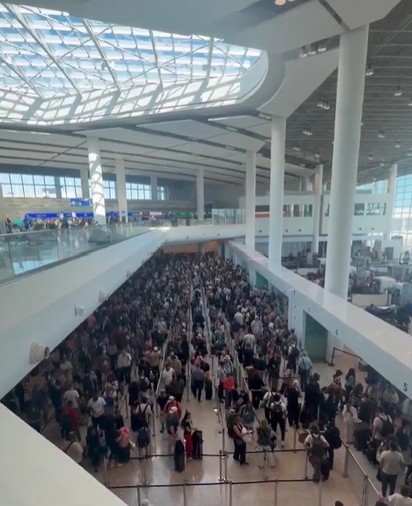
Transportation Security Administration (TSA) officers have been working without pay since February 14th due to the ongoing partial government shutdown.
The result is severe staffing shortages, reduced screening capacity and extremely long (in some cases, hours long) security lines at many airports.
Rather than pay the TSA workers, the Trump Administration announced over the weekend a plan to deploy U.S. Immigration and Customs Enforcement (ICE) agents at some major US airports beginning Monday.
The initial list of airports where travelers may see ICE agents wasn’t made public on Sunday. But as of Monday morning, these airports reportedly have ICE agents on duty:
ATL – Atlanta,
ORD – Chicago,
CLE – Cleveland,
RSW- Fort Myers, FL,
IAH/HOU in Houston,
MSY – New Oreleans,
JFK – New York,
EWR- Neward,
PHL – Philadelphia,
PHX – Phoenix, PIT – Pittsburgh
SJU – San Juan, Puerto Rico.
In a statement on Sunday, Atlanta Mayor Andre Dickens said the city has been informed that ICE agents will be on site at Hartsfield-Jackson Atlanta International Airport (ATL) beginning Monday.
“According to federal officials, these personnel will be assigned to support operational needs directed by the Transportation Security Administration (TSA), including line management and crowd control within the domestic terminals,” Dickens said in the released statement.
He added that “Federal officials have indicated that this deployment is not intended to conduct immigration enforcement activities,” and that the plan is for federal personnel to report to TSA “for the duration of the assignment.”
White House border czar Tom Homan told CNN on Sunday that ICE agents at airports would only be there to help with functions that don’t require special TSA training, “such as guarding an exit so [TSA officers] can get back to the scanning machines and move people quicker.”
But Transportation Secretary Sean Duffy had a different take. He suggests that many ICE agents are already trained in duties TSOs perform.
ICE agents “run those same type of security machines at the southern border, right? Packages come through or people come through. They run similar assets,” Duffy told ABC News’ “This Week.”
Transportation Secretary Duffy says ICE agents are trained and can assist with airport security, following Trump's announcement that he will send them to airports Monday. https://t.co/BZcaShBZDq
— ABC 7 Chicago (@ABC7Chicago) March 23, 2026
“Putting untrained personnel at security checkpoints does not fill a gap. It creates one.”
Unions representing flight attendants and TSA Officers (TSOs) are among the many groups alarmed and opposed to the idea of deploying ICE agents at airports.
In a joint statment, unions representing U.S. flight attendants said:
“TSOs can’t simply be replaced. They undergo a six-month training program in which they learn to screen passengers while evaluating and managing risks within the unique context of an airport—especially how to identify disguised or disassembled weapons and explosives. This is expertise and training that ICE agents simply do not have, and cannot learn quickly.”
Today, AFA, @APFAunity, IBT Local 135 & @iamairtransport union leaders representing 100K aviation‘s first responders released stmt demanding TSA Officers be paid to keep our airports secured w/ people who are trained to do so, not adding to havoc of ICE. https://t.co/y7nUJh8nsQ
— AFA-CWA (@afa_cwa) March 22, 2026
“More than 50,000 TSA employees have worked without pay for over five weeks. Hundreds have quit. And Washington’s answer isn’t to pay them. It’s to send ICE agents to do their jobs,” said Everett Kelley, National President of the American Federation of Government Employees (AFGE), the union representating TSA officers, in a statment.
“Putting untrained personnel at security checkpoints does not fill a gap. It creates one,” he warned.
