Posts in the category "Airline policies":

American Airlines brings back May Happy Hour

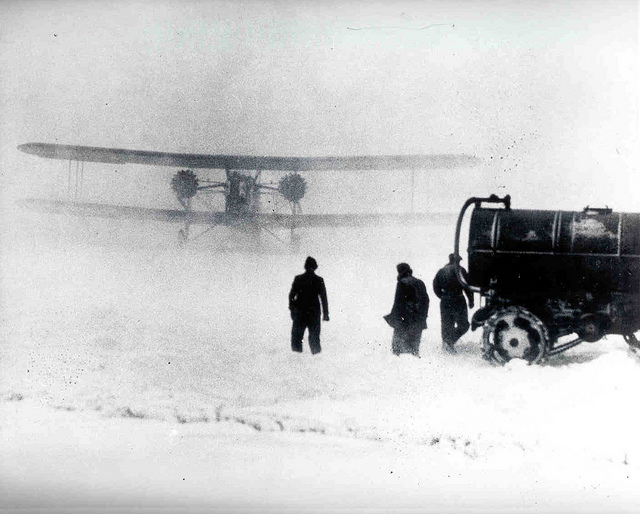
May is coming right up and to celebrate American Airlines is bringing back its 5@5 Happy Hour.

(Courtesy UW Digital Collections via Flickr Commons)


Throughout the month of May, American, American Eagle, and American Connection passengers will be able to purchase cocktails, wine, beer and margaritas for $5 (instead of $6-$7) on domestic, Canada, Caribbean and Mexico flights departing between 5 p.m. and 5:59 p.m.

Those prices last the entire flight, so if you’re planning on having an in-flight drink (or two), here’s to an on-time departure.

Hats off – or on – for airline pilots


[Photo: Brian Losito/Courtesy Air Canada]


Next time you’re at the airport, keep a close eye on the pilots heading to work. Like the Air Canada pilots pictured above, they all look pretty snappy in their uniforms.

But are they wearing their caps?

It could depend on whether or not that pilot is worrying about hat hair. Or looking dorky.

Or whether or not their employer still makes that hat an optional uniform accessory.

Here’s the Capless Captains story I wrote about the topic for msbnc.com.


Airlines to airline pilots: You can leave your hat on. Or not.

Last month, American Airlines changed its operations manual to let pilots know it’s OK to go hatless. The carrier is just the latest among North American airlines that have made the hat an optional part of airline captains’ and first officers’ uniforms.

“The reason we made it optional is because it got to be too hard to police,” said George Tucker, American’s chief pilot at San Francisco International Airport. “Hats just seem to be slowly fading away.”

The rule about wearing a hat “is determined airline by airline,” said Doug Baj, spokesperson for the Air Line Pilots Association, International. “However, there are some uniform manual policies that still technically require it.”

For several years now, wearing hats has been optional for flights crews on Alaska, Southwest and several other airlines.

United Airlines changed its hat policy about four years ago. “Hats are part of our pilot uniforms, but are not required,” said spokesperson Megan McCarthy.

Hat hair and mistaken identity
Pilots have a range of opinions about hats, with some saying it makes them look more professional and others saying that they are frequently mistaken for skycaps.

Mike Cingari, a San Francisco-based pilot for American, is delighted that after 27 years, he’s now free to leave his hat at home.

“I’m against hats. They mess up your hair, promote baldness and it looks really stupid to be walking around with a hat on,” said Cingari. “Plus you have to remember it.”

Cingari has found that sometimes his hat causes confusion inside the airport or out on the curb. “Passengers ask you directions to the bathroom or think you’re a skycap and ask you to take their bags,” he said.

Karsten Stadler, an assistant chief pilot at Southwest Airlines, has also been mistaken for someone else when wearing his pilot’s hat. “I once had a man get very angry with me for not bringing the van around in time. But as many pilots say they’ve been confused for someone else, there are others who say the hat helps them get recognized,” said Stadler.

Although his employer now allows pilots to forgo their hats, Kent Wien says he’ll probably continue to wear his pilot cap to and through airports.

Wien, who writes the “Cockpit Chronicles” column for the Gadling.com travel blog, said: “It kind of finishes off the uniform and gives a more professional appearance. I think passengers want to see that. Otherwise, you don’t look much different than the ticket agent or a crew member.”

There’s also the issue of safety. American Airlines’ Tucker makes sure his hat is always with him. “Because if, God forbid, I have that day when I have to do an emergency evacuation on my airplane, part of my responsibility is to get passengers together and move them away from the plane. The hat is a visible symbol, and we know customers respond to authority,” said Tucker.

Hatted vs. hatless
“It’s like the white coat on the doctor,” said Janet Bednarek, a history professor specializing in aviation history at the University of Dayton in Ohio. “You want to be able to tell the captain from anyone else.”

While some airlines are just now ditching the pilot hats, others, such as JetBlue and Virgin America, never had hats as part of the official uniform. “Our pilots’ all black uniforms are functional yet hip,” said Virgin America spokesperson Abby Lunardini. “We do not require caps … but we have found that our pilots do prefer a uniform shirt that has epaulettes or markings that differentiate them from in-flight and guest service teammates.”

At least two North American airlines still require a pilot to wear a full uniform, including a hat, whenever they’re in the public’s view: Air Canada and Delta Air Lines.

“The hat helps identify the pilots and makes them stand out from other crew members, passengers and business people,” said Captain Jay Musselman, director of flight standards and quality for Air Canada.

Hats reflect “leadership and professionalism,” said Delta Air Lines spokesperson Gina Laughlin. “The hat and double-breasted blazer give Delta pilots a sharp, professional appearance.”

Frank Abagnale thinks the airline pilot hat can also be a test of authenticity.

He should know. In the 1960s, Abagnale gained notoriety for forging more than $2 million in bad checks and for adopting a variety of fake identities, including a doctor, a lawyer and, most famously, a Pan American World Airways pilot. Abagnale, whose exploits were depicted in the movie “Catch Me If You Can,” is now a fraud prevention consultant for corporations and the FBI and explained, via e-mail, why he thinks pilots should keep their hats:

“The emblems on their hats, as well as their wings, are actually two of the most difficult things for someone to obtain … removing the requirement of the hat makes it one step easier to assume the role of a pilot.”


Continental ditches the pretzels

Flying Continental? Don’t expect to be served a complimentary “beverage snack.”

airplane cookies

As I wrote in a story for msnbc.com Travel today (No more pretzels? Airlines ditch free snacks),

On March 1, Continental Airlines stopped serving free pretzels and cookies to domestic passengers flying coach. The new policy is designed to better align its in-flight snack and beverage service with its merger-partner United Airlines.

“We’ve removed the beverage snacks — pretzels and Biscoff — in an effort to reduce costs and align ourselves with the rest of the industry,” said Continental Airlines spokesperson Andrew Ferraro. “Our partner, United Airlines, has the same policy.”

The move could save the airline an estimated $2.5 million a year. Both airlines will continue to offer complimentary beverage service.

This is clearly a reflection of standardizing the onboard experience between United and Continental,” said Henry Harteveldt, an airline and travel analyst for Forrester Research. “Sadly, instead of elevating the United onboard experience, Continental has chosen the lowest common denominator.”

Harteveldt suspects the move may also be tied to — or blamed on — rising fuel costs.

“With fuel costs surging, once again we see an airline take its business problems out on its passengers. I’m sure Continental hopes that by removing the complimentary snacks, more people will buy the snack items the airline sells onboard.”

In addition to Continental and United Airlines, American and US Airways are among the other major domestic U.S. carriers that have already dropped complimentary in-flight snack service.

Not all airlines are rushing to follow this trend. Yet.

Alaska Airlines continues to serve a variety of complimentary snacks on its morning and afternoon flights.

Air Tran Airways continues to serve complimentary Biscoff cookies and pretzels in coach. “At this time we do not have any plans to change that,” said airline spokesperson Judy Graham-Weaver.

Delta Air Lines currently offers complimentary peanuts, pretzels or Biscoff cookies to passengers on flights of 250 miles or more. “There are no changes planned currently,” said airline spokesperson Morgan Durrant.

Continuing a tradition begun by Midwest Airlines, Frontier Airlines still bakes and serves complimentary chocolate-chip cookies to all passengers after 10 a.m.

Southwest Airlines continues to serve free snacks. According to its latest corporate fact sheet, in 2010 the airline served 19 million complimentary bags of pretzels, 87.6 million bags of peanuts, 18.4 million Select-A-Snacks and 29 million other snacks. “We’re always looking at enhancements and new offerings,” said spokesperson Brad Hawkins.

JetBlue Airways also continues to offer coach passengers unlimited, complimentary snacks. During 2010, the airline handed out more than 4 million bags of complimentary chips, said JetBlue spokesperson Allison Steinberg.

“As airlines like Continental continue to make these decisions (to drop snacks), Delta and Southwest, which both still offer complimentary snacks, become that much more of the passenger’s friend,” said Harteveldt.

Raymond Kollau of airlinetrends.com doesn’t believe legacy carriers should allow low-cost carriers to claim complimentary in-flight snacks as a signature service. “One solution for legacy carriers is to team up with brands.” He mentioned the successful free in-flight Wi-Fi campaigns that have been paid for by Google and other companies and said it can also work for food.


Cellphones on airplanes? Debate continues.

Should passengers be allowed to use their cellphones on airplanes? In the U.S. it’s not allowed. Outside the United States, some carriers already allow it.

Here’s my recent msnbc.com article on the topic.  After you read it, please add your vote to the on-line survey .

(Last time I checked, 85% of voters said “On airplanes, everyone should just shut up and fly.”

What do media magnate Arianna Huffington and Hollywood heartthrob Josh Duhamel have in common? They’ve both been busted for using their cell phones on airplanes.

Over the weekend, on a New York-bound flight from Washington, D.C., Huffington reportedly failed to turn off her mobile device, inciting the ire of an unimpressed cabin mate. Last month, Josh Duhamel was escorted off a plane in New York because he wouldn’t turn off his BlackBerry.

These high-profile skirmishes are two of the latest examples in the debate over whether to allow in-flight cell phone conversations.

In Europe, the Middle East and Asia, airlines that wire planes for connectivity can install special equipment to allow passengers to use their own cell phones to make and receive calls.

Domestic airlines own about 90 percent of the world’s connected planes, but federal regulations still ban the use of in-flight mobile calls.

And while Uncle Sam doesn’t outlaw mid-air communications made using Skype or other Voice over Internet Protocol (VoIP) services, every U.S. carrier offering broadband has directed service providers such as Aircell/Gogo and Row 44 to block all voice calls and disable the VoIP function.

The disconnection may get wider.

At the end of 2010, more than 2,000 airplanes were wired for connectivity. “We expect that number to increase by 50 percent this year, to roughly 3,000 planes worldwide,” said Amy Cravens, a market analyst for In-Stat.

With more international carriers jumping on the connectivity bandwagon, much of that growth will likely be represented by jets owned by airlines planning to, or already providing, mobile phone service.

And unless something changes in the U.S., some analysts worry the only travelers who will be unreachable by mobile phone will be those flying in U.S. airspace.

International travelers chat away


After deciding that mobile phones posed no threat to safety, the European Aviation Safety Agency lifted its ban on in-flight cell phone use in 2007.

Since then, OnAir, AeroMobile and a variety of their equipment partners have been working with many international airlines to install equipment that allows mobile phone calls in addition to other entertainment and communication services.

Oman Air, Egypt Air, Libyan Airlines, Qatar Airways and Royal Jordanian are among the airlines that currently offer in-flight voice calls on many of its aircraft. British Airways allows mobile phone use on a single route: an all-business class flight between London and New York. Malaysia Airlines and others are conducting trials before committing to a formal rollout of a mobile phone service.

“Emirates is the airline everyone is watching with regard to passenger acceptance of in-flight calls; and of course, whether the service is commercially viable,” said Raymond Kollau, a market and trend analyst for Airlinetrends.com. The carrier operates 90 jets equipped with in-flight connectivity.

“People have been able to use their mobile phones on our planes for about three years now,” said Patrick Brannelly, Emirates’ vice president for product, publishing, digital and events.

Cell phone users made between 15,000 and 20,000 calls per month from Emirates flights in 2010, Brannelly said. “Each call averaged about two minutes. And during that year we had only one complaint,” he said. “Now the complaint we’re hearing from passengers is why we don’t have the mobile phone service on every aircraft.”

But not all international carriers are rushing to provide the service.

Based on feedback from a 2008 test of in-flight mobile phone service, Air France spokesperson Karen Gillo said the airline now considers mobile phone calling “a future option … [We] don’t have any current plans to implement it fleet-wide.”

Ryanair offered in-flight mobile calling for a while on 50 aircraft, Kollau said. “However, OnAir, who provided the service, decided to stop the partnership reportedly because of a dispute in revenue sharing.”

While Lufthansa recently relaunched its FlyNet onboard Internet system, which could allow voice communication, the airline’s research suggests it’s not a good idea. “Repeated surveys among our customers show that our passengers value a quiet environment without cell phone usage,” said spokesperson Christina Semmel.

Cathay Pacific Airways, though, is determined to offer voice calling to passengers. The airline offers broadband Internet service, and supports BlackBerrys and other smartphones. “When we tested this suite of services with our passengers, all were popular, but voice calling was certainly the most polarized,” said Alex McGowan, head of product for the airline. “We recognize that some passengers are against the concept, and we will ensure that their fears around the ‘nuisance’ factor are not realized.”

Calling U.S. carriers


Back in the states, the regulatory ban and public debate over in-flight phone calls continues, but opposition may be waning.

In 2005, the Bureau of Transportation Statistics asked about 1,000 households if, barring safety issues, cell phones should be allowed on airplanes. Thirty-nine percent said “definitely” or “probably.” Four years later, nearly 48 percent of respondents gave the same answers.

The “Halting Airplane Noise to Give Us Peace” Act of 2008, the so-called Hang-Up Act, was approved by the House Transportation and Infrastructure Committee but never became law. However, parts of that proposal, which sought “to establish prohibitions against voice communications using a mobile communications device on commercial airline flights” could end up in another bill that comes before the new Congress.

The Association of Flight Attendants opposes the use of cell phones in the cabin. “As first responders, we must be able to assess the cabin for any suspicious activity. If 50 passengers are on their cell phones, holding 50 separate conversations, it makes it increasingly difficult to identify any potential threat to the safety and security of the cabin,” said Veda Shook, president of AFA International.

Those phone conversations may be taking place before the jet takes off, but Mary Kirby, senior editor for Flight International, said flight attendants won’t have to deal with them in the air. “There are a finite number of communication lines — typically six to 12 lines per aircraft — which limits the number of simultaneous calls at any one time,” she said. “And aircraft noise drowns out much of the sound.”

As for passengers worried about having to listen to a seatmate yapping away on the phone, costly roaming charges usually dissuade long phone calls. And although a Southwest passenger was recently charged with misdemeanor battery for striking a teenager who didn’t turn off his iPhone when requested, Kirby said: “I am not aware of a single issue of air rage due to in-flight cell phone use.”

Flying Food: Complimentary meals in economy class a thing of the past

Delta Air Lines - Biscoff -

Complimentar Biscoff cookies on Delta Air Lines, courtesy Susan Chana Elliott

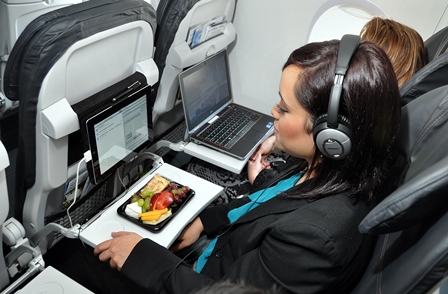
My column this week on msnbc.com -  Free meals on planes fly into the sunset - is all about the demise of “free” meals for economy class passengers on domestic airlines. It’s also about the efforts airlines are making to convince travelers to buy their meals on board.

Delta Air Lines Fruit Plate

Delta Air Line fruit plate

Working on the story was especially fun, because there’s not only a reader survey accompanying the story, but a slide show of airline snacks and meals and a photo gallery of airplane meals sent in by readers.

Snacks for sale on Hawaiian Airlines

Here’s the story:

On a Continental Airlines flight this summer from Newark to Seattle, one of my seatmates made a wisecrack about the “mystery meat” in the complimentary in-flight meal.  “Say what you want,” snapped the flight attendant, “Continental is the last airline serving free meals and soon they’re going bye-bye. I bet you’ll complain then too.”

She was right about the complimentary meals.

Today Continental Airlines, which recently merged with United, begins selling buy-on-board meals on all domestic flights less than six hours. Hawaiian Airlines continues to offer its passengers complimentary meals, plus a premium option for purchase (bestsellers: sushi and cheeseburgers), but Continental is the last major domestic airline to jettison free meals.

Hawaiian Airlines sushi

Hawaiian Airlines sushi

“What Continental served to coach passengers wasn’t exactly a four course meal. It was more like a roll with a piece of meat,” said aviation expert Mike Boyd of Boyd Group International. “I won’t miss it. But now that the free meals are gone, I’m sure some people will complain.”

Continental’s chief marketing officer, Jim Compton, terms the move away from free-food a reflection of “today’s market and customer preference.” But cutting out complimentary meals will save Continental an estimated $35 million a year. Not that much dough when an airline’s success is measured in billions of dollars, but still significant in an era when every penny counts.

Do meals matter?

Beyond marking a mile-high-meal milestone, will anyone really care that Continental has cut its complimentary meal service? “I doubt it,” says Mary Tabacchi, an associate professor of food and beverage management at the Cornell University School of Hotel Administration. “Economy class passengers voted with their feet a long time ago. Schedules and cost now come first and food is way down in the rankings. Meals on Continental were just a bonus.”

For now, most airlines continue to offer complimentary coffee, tea, water and soft drinks. Some continue to serve snacks.

JetBlue in-flight snacks

Free snacks on JetBlue

Continental’s Mary Clark says “Our complimentary snacks are still offered with beverage cart service on most flights; cookies in the morning and pretzels for the rest of the day/evening.” Southwest Airlines passengers can snack on peanuts or pretzels on all flights.

Complimentary snacks on AirTran and United include small bags of pretzels or Biscoff cookies. Delta Airlines adds peanuts into that mix.

Midwest Airlines became famous for its complimentary, warm chocolate chip cookies and, now that the airline has merged with Frontier, the cookie tradition continues.

Alaska Airlines hands outs a complimentary snack mix and, on some longer flights, Cougar Mountain cookies. Alaska passengers going to Hawaii are also treated to a small serving of Mauna Loa Macadamia nuts and a complimentary Mai Tai or passion orange guava juice.

JetBlue offers passengers unlimited servings of chips, cashews, animal crackers and other items. And each month regional Horizon Air offers passengers a different Northwest wine and microbrew at no extra charge.

Beyond snacks

The list of fresh meals offered on US Airways changes six times a year. The airline’s Valerie Wunder says the airline uses Twitter votes and in-flight testing to see which buy-on-board meals and snacks are passenger favorites. “That’s how we decided to drop instant oatmeal and instant soup but keep the popular Pringles and Blue Diamond almonds.”

During October, to celebrate its 3rd year of flying to Hawaii, Alaska Airlines is selling Hawaiian-themed meals, such as the Hawaiian Breakfast Skillet, on all flights 2.5 hours or longer. Alaska’s Marianne Lindsay says the airline’s food and beverage team works year-round with a design chef from LSG Sky Chef, one of three major in-flight catering companies, to create meals that feature many regional food items. “We also post the chef’s email address in our inflight magazine,” she said.

Spirit Airlines lists its food for purchase in its on-board magazine, not online as most other airlines do. The airline sells soft drinks ($3), animal crackers, instant soup and other snack items ($2-$4) and offers mix-and-match value meals for $3 to $14 dollars. For example, a single beer or wine is $6, but if you buy three drinks at once, the package price is $14.

On Virgin America, which rolled out its new menu on October 1st, passengers use their seat-back touchscreens to order (and pay for) a meal or a snack anytime during a flight. Suggested food and drink pairings are offered at a discount before each order is completed. “We do pretty well because the menu system allows people to browse,” say Virgin America spokesperson Abby Lunardini. “We know on average people are willing to spend $21 on ancillary items such as movies, premium TV, Wi-Fi, food and cocktails. And we’re hitting that target.”

Competition on the ground for meals in the air

As they did with baggage fees and fees for extra legroom, aisle seats and other unbundled airline amenities, passengers are getting used to the idea of buying their own in-flight meals.

But that doesn’t mean they’re buying those meals on airplanes.

In Zagat’s 2009 airlines survey, 19% of travelers said they’d willingly pay for snacks on domestic flights. Only 6 percent of those surveyed said if a free meal isn’t offered they typically purchase buy-on-board meals.

Are travelers filling up on Pringles or going hungry instead? 7% said they were, but 56% of those Zagat surveyed said they bought their in-flight meals at the airport.

All those brought-on-board meals are pushing those who prepare buy-on-board menus to work harder.We are absolutely competing with airport food,” said Rob Gallagher, Virgin America’s catering manager, “Airports are now doing so many wonderful things with food.”

Hans Miller, CEO of Airside Mobile, agrees. “The average passenger spends more than $8 on food per trip at the major airports. Airlines and airports are just beginning to see themselves in competition for those food sales as well as other service-oriented revenue.”

“That competition means passengers are getting better in-flight snack and meal choices,” said Bill Gillen, an executive chef for LSG Sky Chefs, which creates menu items for American, Alaska, US Airways and Virgin America. “In the past it was just putting things together. Now there’s a lot more thought going into offering things that are interesting, innovative and a good value. Like the shaved roast turkey sandwich with corn bread stuffing some airlines will be offering during the holidays. People love that!”

What else will travelers love? United Airlines is hoping passengers will love ordering, and paying for, their in-flight meals before they even get on the plane.

United Airlines brunch

You can now pre-order brunch on some United Airlines transcontinental flights

Last week the airline introduced two $24.99 brunch options, with chocolate and sparkling wine, for customers flying transcontinental p.s. (premium service) flights between New York’s Kennedy airport and Los Angeles or San Francisco.

The twist: meals must be ordered on-line, 72 hours before a flight.

Will $25 premium pre-purchased meals be the next big thing in flying? Henry Harteveldt, an airline and travel analyst for Forrester Research doesn’t think so. “I believe a premium meal offering would have consumer appeal. But I am concerned that, even with sparkling wine, this is too expensive.”

  • Subscribe to Posts Via Email or RSS

    Subscribe Via Email
    Subscribe Via RSS
  • My USAToday Airport Guides


    • See all airport guides »

  • Posts by Category

  • Browse posts on the site by category:

  • See all categories »