in-flight entertainment

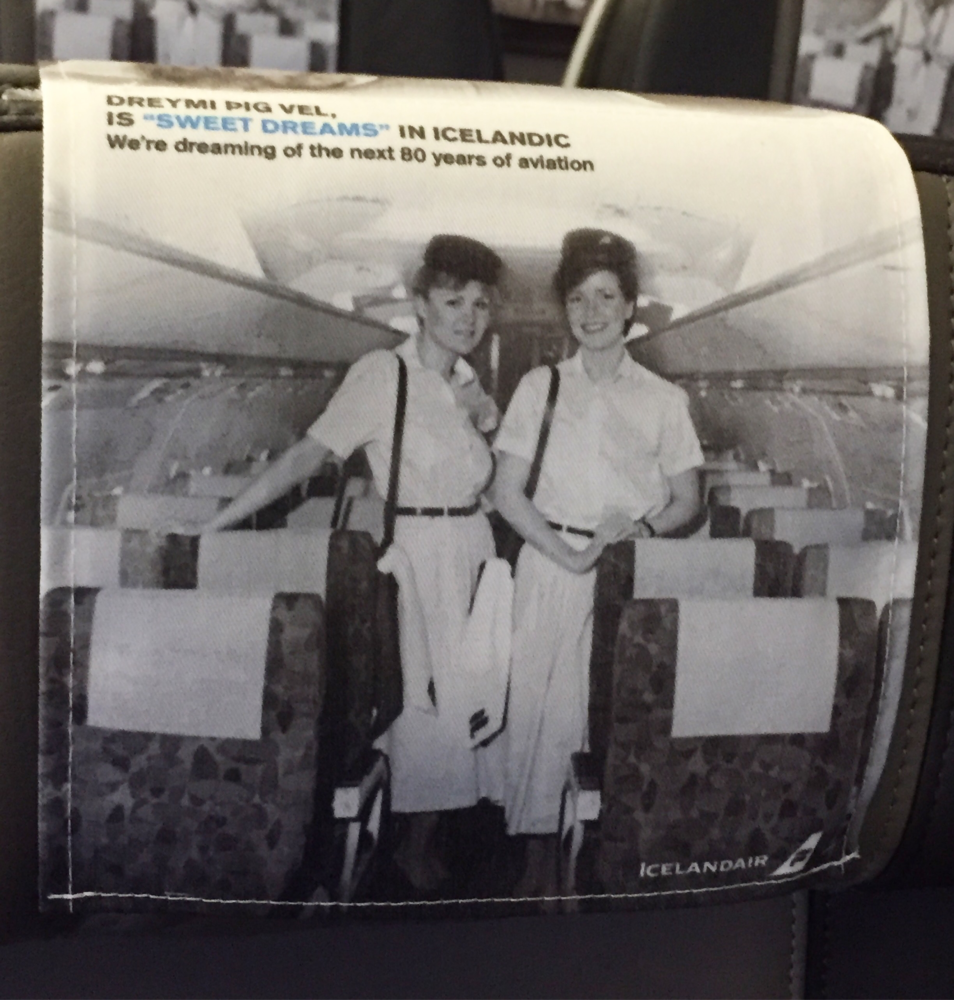
Icelandair’s in-flight immersive theater experiment

Last week Icelandair tried something new: an 11-hour immersive theater production that took place on a flight from London to New York, with an on-the-ground bonus performance during a short layover in Reykjavik.

I got to ride along.

The cast was a mix of professional actors from the London theater group, Gideon Reeling, and real airline employees, including pilots, engineers, accountants, ground workers and cabin crew, who had volunteered to attend a special stage school.

The characters ranged from film stars and flight attendants from various decades to a perky party planner, a stone-faced volcanologist, a ram farmer and a pair of barefoot, beaded hippies. And the plot was built around Icelandair’s 80-year history, its can-do philosophy and themes of empowerment for women.

The show – such as it was – took place on board, as the characters mingled with passengers, telling stories about their role in what turned out to be a kooky and somewhat complicated family all headed to a party for Edda who  (spoiler alert…) never appeared.

I’m finishing up a story for NBC News about the event, but here are some snaps from the flight.

Alaska Airlines extends free in-flight entertainment

Alaska Tablets

Passengers on Alaska Airlines will be able to use their personal electronic devices to access the airline’s full range of ‘Alaska Beyond’ inflight entertainment for free through March 31st.

But starting April 1, it will cost $1.99 to get access to movies and TV shows beyond a basic selection of complimentary offerings.

The new entertainment service was introduced in mid-December and is available now on more than half of Alaska’s mainline aircraft and should be on nearly all of the airline’s planes by April 2015.

For those not traveling with their own personal electronic devices, starting Feb. 1, Microsoft-branded Inflight Entertainment tablets will be available to rent on long-haul flights for $8-10 and will feature movies, TV, XBOX games, music, digital magazines, and Internet access on WiFi-equipped flights.

As with Alaska’s old rentable tablets, First Class customers and MVP Gold75Ks will be able to use the new tablets for free.

Get smart: free classes on Virgin America flights

Classroom

Courtesy National Library of Australia, via Flickr Commons

You might learn something new next time you take a Virgin American flight.

Starting February 1, free audio and video lectures from the popular series The Great Courses will be available on the airline’s Red in-flight entertainment system.

The series library runs to more than 530 titles and covers everything from history and music to science, literature, language, health, nutrition and personal development.

Virgin America will be offering these course samples:

• Neil deGrasse Tyson’s Inexplicable Universe; from the course, The Inexplicable Universe: Unsolved Mysteries (video)

• Cook Like a Pro Chef: Lessons From The Culinary Institute of America; from the course, The Everyday Gourmet: Rediscovering the Lost Art of Cooking (video)

• Sneferu – The Pyramid Builder; from the course, Great Pharaohs of Ancient Egypt

• Um, Well, Like, You Know; from the course, The Secret Life of Words: English Words and Their Origins

• Did Slavery Really Cause the Civil War?; from the course, The Skeptic’s Guide to American History

• The Enlightenment and an Introduction to the Classical Era; from the course, How to Listen to and Understand Great Music

• What is Big History?; from the course, Big History: The Big Bang, Life on Earth, and the Rise of Humanity

• Junk-Food Monkeys: What Happens When Baboons Eat like Us?; from the course, Being Human: Life Lessons from the Frontiers of Science

• Becoming a Spy; from the course, Espionage and Covert Operations: A Global History

• Making High-Stakes Decisions; from the course, The Art of Critical Decision Making

• Not All Carbs Are Created Equal; from the course, Nutrition Made Clear

• Creative Nonfiction: Writing Great Beginnings; from the course, Writing Creative Nonfiction

• How People Respond to Incentives; from the course, Thinking Like an Economist: A Guide to Rational Decision-Making.


Alaska Airlines offers free entertainment on personal devices

alaska-beyond-10

Alaska Airlines is joining the ranks of airlines offering in-flight entertainment directly on passengers’ personal electronic devices.

The new entertainment service, part of what the airline is calling its new Alaska Beyond ‘experience,’ kicks off today on 50 of Alaska’s 737 planes and will be available for free though Jan. 31, 2015.

Alaska plans to equip nearly all of its fleet with the new in-flight entertainment service by April 2015, but starting February 1, 2015, the programming will offer some complimentary content, with premium movies and TV shows available for purchase at $1.99.

Connected fliers get movies on their gadgets

United-inflight-pde-

Courtesy United Airlines

United Airlines is joining the ranks of carriers that can bypass seatback screens and deliver on-demand, in-flight entertainment directly to gadgets brought on board by passengers.

“We’ve noticed more and more customers have their own personal electronic devices when they fly, so it just makes sense to provide this service,” said United Airlines spokeswoman Karen May.

The service, provided by Panasonic, will allow passengers with Wi-Fi enabled devices to access over 150 movies and TV shows stored in on-board servers.

Apple users will access the content through United’s new iOS app; laptop users will just need to open a browser. An app for Android devices is still under construction.

United will begin testing the new service this week on a Boeing 777 flying between the mainland and Hawaii. “We’ll then gradually expand the personal device entertainment system to other 777s flying to Hawaii and then to other fleet types that currently don’t have on-demand seatback entertainment systems,” said May.

Programming will be different than that offered via the on-demand seatback system and will be changed quarterly at first and eventually refreshed monthly. During roll-out, the service will be offered to passengers for free, “but I can’t say it will always be that way,” said May.

United is not the first to begin offering on-demand programming to passengers’ personal devices. “Many airlines are rolling out this ‘from the Netflix server on the plane to your device via Wi-Fi’ option for passengers,” said John Walton, direct of date for Routehappy. Fliers get a wide range of content “often for no more than the price of downloading it from iTunes and, for airlines, it’s a lot cheaper and lighter than installing a seatback entertainment system,” he said.

For a fee, passengers on many American Airlines, Delta and US Airways flights can stream on-demand movies and TV shows via Gogo Vision. Other airlines streaming to passenger devices include Air Canada, El Al, Norwegian, Scoot and Virgin Australia. “Southwest offers streaming video plus streaming live TV, while Qantas offers streaming to the airline’s own iPads, which are rigged to the seat in front of you in a kind of sling,” said Walton.

It seems like a trend, but experts say Hollywood is making sure seatback in-flight entertainment (IFE) systems aren’t going away just yet.“Major airlines are still making significant investments in fixed IFE systems and backseat screens on wide-body aircraft because they want to offer the latest Hollywood blockbusters to passengers on long-haul flights,” said Raymond Kollau, founder of airlinetrends.com, an industry and consumer trends research agency.

“This so-called early-window content is restricted to fixed seat-back systems and select airline-owned tablets because of the perceived risk by Hollywood that their latest releases will get copied when streamed to passenger devices,” said Kollau.

But that barrier may not last long.

“Many airlines would like nothing better than to rip out embedded systems,” said Mary Kirby, founder of the Runway Girl Network, “and the moment Hollywood relents on early window to personal electronic devices, or connectivity can support streaming over the pipe, is the moment that embedded IFE will go the way of the dodo bird.”

(My story about changes in in-flight entertainment first appeared on NBC News Travel).

In-flight stand-up coming to Virgin Atlantic’s Little Red


branson

Airlines spend millions of dollars trying to outdo each other with in-flight entertainment that includes movies, games, network shows and other canned or streaming options. Yet beyond satellite TV feeds, the only live in-flight entertainment passengers often get might be the antics of a drunk in first class or the sound of a talented flight attendant singing or rapping their way through the safety instructions.

But later this month passengers may be in for a surprise when flying between London and Manchester or Edinburgh on some Virgin Atlantic flights operated by Little Red, the airline’s domestic carrier which launched earlier this year.  The airline has booked live, pop-up performances by comedians also scheduled to appear at the popular Edinburgh Edinburgh Fringe Festival, which runs through August 26th.

And next month the airline plans to offer a series of in-flight acoustic music concerts with artists from Scotland and Manchester.

The program, called Little Red LIVE, hasn’t started yet and will be only be on a handful of flights, said airline spokeswoman Nadia Basil, but when show dates and the entertainers are confirmed the airline promises to share details via Facebook and Twitter.

While somewhat unusual, live in-flight events are not unheard of.

“We’re seeing everything from in-flight concerts to fashion shows,” said Mary Kirby, editor-in-chief of the Airline Passenger Experience magazine. “Wizz Air’s ‘mile high’ fashion show immediately springs to mind.”

Kirby notes that beyond the in-flight entertainment value these events offer to passengers, the performances will have added corporate value because of their ability to generate “talkability” about the airline brand.

The performances will no doubt be captured on mobile devices by tech-savvy passengers and uploaded to YouTube, Vine and other video sharing sites. “With the added benefit of inspiring news stories and conversation about Little Red on social media. I see it as a win/win for both the airline and its passenger,” said Kirby.

Whenever they begin, whichever flights they’re on and however they will be captured, the in-flight comedy and music performances will have to be brief. Little Red flights between London and Edinburgh are 90 minutes and between London and Manchester, just 70 minutes.

(My story about Virgin Atlantic’s Little Red LIVE events first appeared on CNBC’s Road Warrior.)


The future of in-flight entertainment? Sort of up in the air…

While a short promotional movie called Howdy Chicago was shown to passengers on an plane that flew over the Chicago World’s Fair in 1921, there were no regular in-flight movies until 1961, when Trans World Airlines (TWA) began offering that novel perk to its first-class customers.

Video games (1975), seat-back video (1991) and live in-flight television (2000) followed, and today passengers in all classes, on both long and short haul flights, have come to expect some sort of airline-provided, in-flight entertainment.

And they get it. Often on personal, seat-back multi-channel systems that deliver everything from creatively produced safety videos to movies, games, live television, shopping opportunities and, increasingly, access to the internet.

But tech-savvy passengers toting tablets, laptops, smartphones, e-readers, and other portable electronic devices are giving airlines and the traditional in-flight entertainment systems a run for their money. This has forced providers to re-think how they use technology to entertain and interact with passengers in the sky.

I got a good look at how that process is evolving earlier this month in Long Beach, Calif., when I served as one of the judges for an award given out by the Airline Passenger Experience Association (APEX) at its annual expo. The event also featured educational sessions about the wide variety of technological changes coming to in-flight entertainment systems, plus a giant hall filled with exhibitors representing products, services and content you may experience on a future flight.

Breaking down all the tech-talk , the good news is that from the latest movies and games to documentaries, kids programming and health and wellness videos, there will be no shortage of in-flight entertainment options. Seat-back screens and systems are unlikely to go away, and in fact they may soon get even snazzier, with high definition, 3-D movies and games, and even holographic offerings on the horizon. But airlines are also scrambling to work out how to deliver that same programming, plus Wi-Fi, streaming and internet-delivered content, to travelers on their own or airline-provided devices.

For example, JetBlue just announced that in early 2013, it plans to offer free in-flight Wi-Fi, with plans to equip 30 planes with what it promises will be super-fast service. After that, checking e-mail and touring the internet should remain free, but there will be a fee for watching films.

Delta Air Lines also recently announced plans to upgrade its Wi-Fi equipped airplanes and offer passengers the ability to stream programming directly to their personal devices using a service called Gogo Vision. Fees for that programming will start at $.99 for TV shows and $3.99 for full-length movies. And here’s a nice touch: If you don’t finish watching something on the plane or want to download another program to watch at home or in your hotel later, you’ll have access to that material on that same device (if you’ve got access to the internet) after your flight for 24 hours. Look for that on 800 of Delta’s two-class domestic aircraft by the end of 2013.

Of course, accessing all this programming on your personal electronic devices means you’ll be asking your batteries to give it their all, unless you’re lucky enough to have a (working) USB port or power outlet at your seat. And that brings up another issue: Will airlines add the juice to power devices to the menu of items for sale in-flight?

Don’t be surprised if it comes down to that. The airline industry already earns more than $32 billion a year in ancillary revenue from ‘unbundled’ services such as baggage fees, change fees, in-flight meals and Wi-Fi, and in one of the expo workshops a presenter pointed out that airlines have a “prime opportunity to monetize the onboard experience” because passengers are easily influenced on board and “have a higher propensity to spend.” So if you’re going to spring for the movie, perhaps you’ll won’t mind paying a bit more to make sure you’ll be able to watch that movie the entire way through.

Not everything on view in the Expo exhibition hall was super high-tech.

Recognizing that so many passengers now travel with their own tablets, e-readers and other portable electronic devices, Smart Tray International was there to introduce a tray table with what seemed to be a common-sense, built-in groove for holding those devices upright.

And while Uplifted, a fitness company from Perth, Australia, had rented a booth in hopes of selling airlines a nicely-produced exercise video that mixed in moves from yoga, Pilates and Tai Chi that passengers can do at their seats, company founder Sally Dollas also had a stash of instructional workout pamphlets on heavy paper that were a snap to hang on the latch of an upright tray table.

A few highlights from the APEX EXPO

I’m attending workshops and roving the booths at the exhibit hall during the APEX 2012 EXPO, a sprawling event dedicated to exploring and, hopefully improving the airline passenger experience. The exhibit hall is bulging with booths dedicated to movies and other forms of in-flight entertainment and the technology with which that entertainment is delivered.

Here’s a sampling of some of the things that have caught my eye.

Hungry?

Stathis Kefallonitis of branding.aero and Nikos Loukas of inflighfeed.com offered a tasting workshop that explored how flavors and certain brands of food can strengthen an airline’s image and a passenger’s in-flight experience. (Disclosure: I made a dinner of the samples I was supposed to be evaluating during the workshop.)

Need a place for your PED?

Lots of people are traveling with their own portable electronic devices these days and the folks at Smart Tray have a booth with a simple-yet-elegant tray table design that has a slot in it to hold up these devices.

Cramped much?

Much of the in-flight entertainment being flogged consists of Hollywood films. But there are also a fair number of other offerings, including educational programming and wellness instructional videos from the likes of Uplifted, a company from Perth, Australia. In addition to an in-flight workout video, this company has a new in-flight exercise pamphlet that attaches to an upright tray table so you can follow along with the printed exercise instructions.

Will in-flight Wi-Fi kill seat-back entertainment?

(From my post earlier this week for msnbc.com’s Overhead Bin)


On the ground, the Internet, Wi-Fi and portable mobile devices have completely transformed everything from shopping, working and dating to how we get our news and entertainment. But what about off the ground?

One of the last spaces yet to be completely changed by the Internet is the airline cabin, where in-flight entertainment systems with content controlled by the airline and delivered on seatback screens are still the norm.

But now that in-flight Wi-Fi is fast becoming ubiquitous and affordable — in some cases, free — and as an increasing number of people travel with their own mobile devices, many predict seatback systems will soon go the way of LPs, cassette tapes and film cameras.

“Connectivity will destroy the walled garden,” said Greg Dicum, co-founder and president of MondoWindo, a company that provides web-based, location-aware content to passengers traveling on Wi-Fi equipped planes. “I see no seatback systems on new planes in five years. Especially not on planes flying heavily traveled routes less than five hours in North America, Europe and Asia.

Dicum made his comments at the 2011 Airline Passenger Experience Association (APEX) Expo in Seattle.

“It’s going to be harder to compete,” he said. People with their own devices who can get to a browser are going to be able to get much better content. And I, for one, would rather have the airline carry my bag or give me some legroom than buy me talking dog movies I have no intention of viewing.”

In an exhibition hall filled with scores  of companies selling the latest in in-flight entertainment equipment and content, few agreed with Dicum’s declarations.

“It may happen. It probably will happen, but so far it’s not happening,” said Adrian Lambert, the head of marketing for IFE Services, a provider of in-flight entertainment. “Airlines moves quite slowly.”

“Yes, more people will bring their own devices, but are my mom and dad going to take an iPod or iTouch with them on vacation?” said Christopher Mondragon, senior manager, design and brand development for Thales Avionics, a provider of in-flight entertainment and connectivity systems.

As he demonstrated one of the company’s latest products — a screen that can be operated by gestures instead of a touchpad — and shared details about the company’s experiments with 3-D programming, he added, “I think it’s going to be more about merging technologies, being innovative and providing a unique experience to any age group.”

What do you think?  WILL in-fight Wi-Fi made seat-back entertainment systems on airplanes obsolete?