Decorative vases and ornamental pots at the SFO Museum
Jardinières – ornamental vessels, plant stands and vases of various shapes and sizes – reflected the Victorians’ love of elaborate ornamentation.
And in Indoor Eden: Victorian Jardinières, the newest SFO Museum exhibition at San Francisco International Airport (SFO), vessels on display are adorned with botanical patterns, butterflies and sea life, as well as historical and Japanese-inspired motifs, with thick, rich glazes.
Find the full exhibit at SFO in the International Terminal, Departures – Level 3, pre-security.
And while Denver International Airport (DEN) doesn’t currently have a beekeeping program, honey is readily available in the terminal.
Björn’s Colorado Honey has four retail kiosks at DEN (two on Concourse A and two on Concourse B), plus a retail store on Concourses B.
There’s also a lovely new Scandinavian-inspired cafe designed by Denver firm Neoera on Concourse C, near Gate 30. The cafe serves up honey-infused coffee and tea and offers a full selection of honey and hive-based skincare products.
Images: Jess Blackwell Photography
East Coast airports shovel; Fargo International Airport keeps warm
Many airports in the path of the Winter Storm Hernando are still grappling with canceled flights and record amounts of snow that needs to get cleared away.
Another winter storm… 🥶
And once again, our dedicated snow removal teams are at it nonstop, day and night, to keep BDL open.
As our airline partners continue to adjust schedules into tomorrow, passengers are advised to check the status of their flight before coming to BDL. pic.twitter.com/EGwQjcQQRT
First, there’s the winter storm, named Hernando, making its way along the east coast, especially in the mid-Atlantic and Northeast regions, accompanied by blizzard warnings for many areas.
Airlines have already proactively canceled thousands of flights and offered passengers the option to cancel or change their flight plans with no fees.
Mid-afternoon on Sunday, flight tracking site, Flightaware, was showing more than 3,000 flights within, into or out of the United States canceled, as well as more than 4,000 delays.
More than 4,500 flights are currently canceled for tomorrow.
Airports and airlines are on the alert.
We are closely monitoring a major winter storm expected Sunday night into Monday that is forecast to bring heavy snowfall across the region. Both New York and New Jersey have declared states of emergency, and travel conditions are expected to be hazardous, with impacts likely at… pic.twitter.com/v7YeGmRwWp
We’re closely monitoring Winter Storm Hernando that will impact travel on the East Coast starting Sunday. If you’re scheduled to fly through an impacted airport, we encourage you to take advantage of our flexible options https://t.co/zvwkMQ954S and move your flight before or…
If you do have plans to fly in the next few days, make sure to prioritize your safety (and your sanity) and rearrange plans if you can.
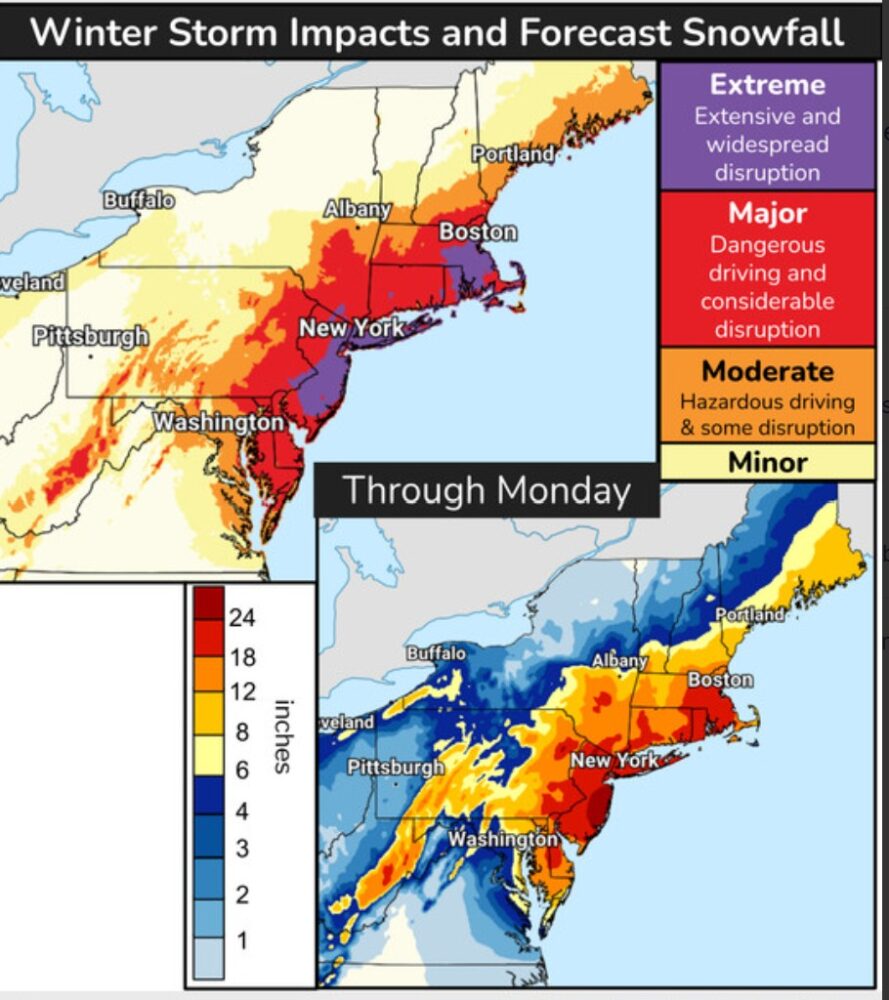
The map below was shared by the National Weather Service early Sunday morning.
DHS shuts down Global Entry, but changes course & decides to keep TSA PreCheck open
At this time, TSA PreCheck remains operational with no change for the traveling public. As staffing constraints arise, TSA will evaluate on a case by case basis and adjust operations accordingly.
As if the travel woes from the winter storm aren’t enough, at 6 am on Sunday morning the Department of Homeland Security (DHS) shut down Global Entry, the Custom and Border Protection program that offers expedited entry into the United States at airports and at border crossings.
The reason? The DHS says it is due to the partial government shutdown.
TSA PreCheck was initially included in that announcement, but the agency has decided to keep PreCheck open.
For now.
Both PreCheck and Global Entry are paid programs designed to move vetted travelers through security lanes faster.
Despite an earlier announcement, the U.S. Department of Homeland Security has confirmed that — at this time — TSA PreCheck remains operational. If staffing constraints arise, TSA will adjust operations accordingly. Guests are encouraged to arrive early and anticipate longer than… pic.twitter.com/5NFlRnuNa8
Airlines are, understandably, canceling thousands of flights due to snowy, icy, sleety and dangerous weather conditions around the country right now.
But even with few or no commercial flights arriving or departing, airports do their best to stay open and opeartional. That means crews are working around the clock to keep runways cleared and open.
Some examples shared today.
ALERT: Airlines have canceled all flights at the airport today. Check with your airline for confirmation and rebooking options. Please stay home and off the icy roads. https://t.co/pAxOy2PtzSpic.twitter.com/FzP8txOhuU
Our crews have been on the airfield all night keeping runways clear, and we’ll continue this work throughout the day as flights continue to depart and arrive.
If you’re traveling, check directly with your airline for the most up-to-date information on delays or cancellations. pic.twitter.com/4xjaY2vwro
— Pittsburgh International Airport (@PITairport) January 25, 2026
Here's a look at snow clearing operations on the apron at Terminal 1.
Our teams use front-end loaders to load large volumes of snow into inground and portable snow melters. This process enables us to keep critical apron surfaces cleared of snow to support airport operations. pic.twitter.com/gTX0WM4aZX
BNA® is open and working around the clock. Ice remains our greatest challenge, and we are in a constant state of resupply with orders of deicing fluid, salt and other materials. Friction tests are ongoing, and safety remains our top priority. More info: https://t.co/9V5ilVCUsv. pic.twitter.com/esquxyKJQ7
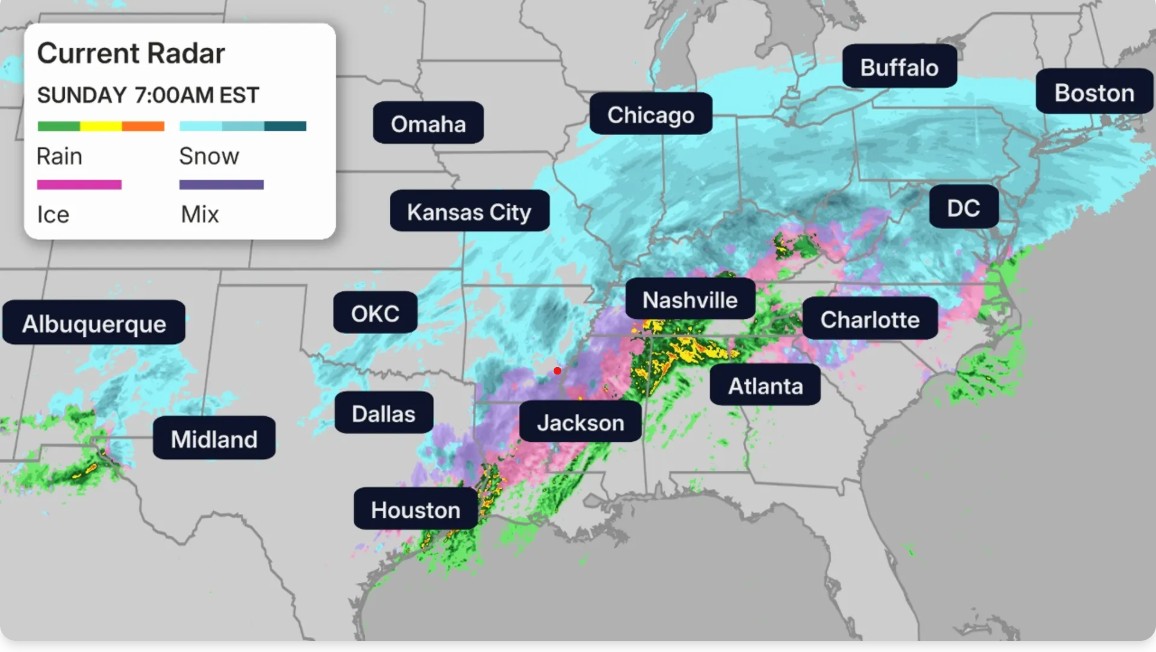
The Weather Channel map, above, snapped at 7 am East Coast time on Sunday morning, shows which parts of the country are experiencing snow, rain, ice or a mix of it all.
Flights and airports in this large section of the country are experiencing mass cancellations, but air traffic everywhere is being affected as airplanes can’t get from here to there.
Flight tracking service Flightaware is reporting close to 10,000 flights into, out of or within the United States canceled for today alone, on top of tens of thousands canceled over the past few days.
And it’s a good bet many of the flights currently tagged as ‘delayed’ will end up getting canceled as well.
If you have a flight scheduled today or, like us, over the next few days, check to see if its already canceled and try to make new plans.
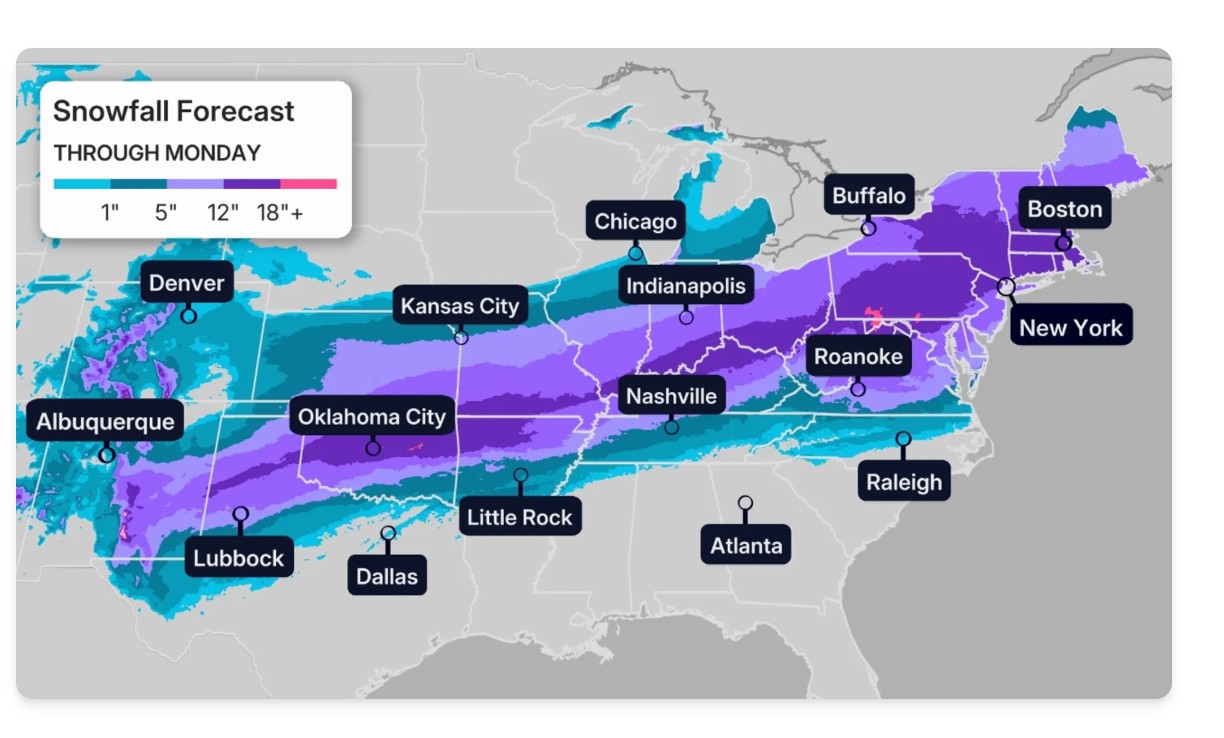
This map from the Weather Chanel is chilling in so many ways.
If, like us, you’ve got any flights or other travel planned in the next few days, in or out of the path of this major storm predicted to drop more than a foot of snow in many parts of the country, be prepared for delays, cancellations and hassles.
To help, below are the links to the travel waiver policies U.S. airlines have posted. In most cases, airlines are offering travelers the option to cancel their flights for a full refund/travel credits or to alter flight plans with no with change fees. That is, if you can find and book a new flight scheduled within the few days covered by the waiver policy.
Keep in mind that if your flight is canceled by the airline they may rebook you first. And as the storm continues, airlines will updata and likely extend the dates that waiver policies are in effect.
We are closely monitoring Winter Storm Fern and its potential impact on travel in the coming days. As always, our team is here for you every step of the way.
Visit our Travel Alerts page for the latest updates, flexible travel options and resources to stay prepared:…
As we prep for Winter Storm Fern, flight cancellations are impacting airports in North Texas, Oklahoma, Arkansas, Louisiana and Tennessee. Monitor or adjust your travel in the Delta app or on https://t.co/lVlOjYwO0A. https://t.co/ebw2ODQ7Uo
While airlines are bracing for the storm, airports are revving up the engines on those giant snow plows.
There’s gonna be 0 to 500 inches of snow this wknd. It will be cold. Not hot, but cold. And windy. Probably, but maybe not. The winter weather advisory will start as soon as Giant Eagle runs out of milk 🥶
P.S. We have plows. Like really, really big ones, so don’t worry about…
— Pittsburgh International Airport (@PITairport) January 23, 2026
Our Snow Team is standing by and we will be ready either way.
Stay safe, stay warm, don't hoard the milk and toilet paper, and check with your airline before heading to the airport pic.twitter.com/WnNp2BDh1b
Keeping the airport safe is a team sport! A huge shoutout to our Snow Team, who are working tirelessly to keep the runway open and operational during the winter storm. ❄️ pic.twitter.com/QhC91hdp2S
— West Virginia International Yeager Airport (@flycrw) January 5, 2025
Winter Storm Blair is disrupting travel across the Midwest and East Coast and causing thousands of flight delays. As of late Sunday evening, here’s what airlines were posting in terms of travel waivers and alerts:
As always, be sure to check with your airline before venturing to the airport for your flight.
Alaska Airlines: “We are offering a flexible travel policy to/from Baltimore (BWI), Cincinnati (CVG), Cleveland (CLE), Columbus (CMH), Detroit (DTW), Indianapolis (IND), Kansas City (MCI), Nashville (BNA), Philadelphia (PHL), Pittsburgh (PIT), Raleigh (RDU), St Louis (STL), Dulles (IAD), Washington D.C. (DCA), and Wichita (ICT) if you would like to change or cancel your flight.”
American Airlines: Travel waiver in effect for trips to, from or through more than 40 airports. If you are scheduled to travel January 4 – 6, 2025 you can change your ticket to fly instead through January 9, 2025
Delta Air Lines: Travel waiver in effect for travel to, from or through more than 20 airports. “When rebooked travel occurs on or before January 10, 2025, in the same cabin of service as originally booked, the fare difference will be waived.”
Jet Blue: A travel waiver is in effect for these airports: Nashville, TN (BNA), Philadelphia, PA (PHL), Pittsburgh, PA (PIT), Raleigh-Durham, NC (RDU), Richmond, VA (RIC), and Washington, DC (DCA). “Customers may rebook their flights for travel through Wednesday, January 15, 2025.”
Southwest Airlines: Travel advisory in effect for 16 cities. Travelers “may rebook or travel standby (within 14 days of their original date of travel between the original city pairs and in accordance with our accommodation procedures) without paying additional charges.”
United Airlines: The travel waiver is in effect for more than 10 airports. The new flight must be a United flight departing by January 13, 2025.
Florida residents are just starting to deal with the aftermath of Hurricane Milton. As they do, airports that had closed for the storm’s duration are reopening.
Airlines are resuming some flights, but anyone flying to or from the region should check with their airline for updates. In many cases travel alerts and change fee waivers have been extended for travel originally scheduled through October 12.
Here are some of the airport updates as of late Thursday evening.
After assessing the damage to its facilities, Tampa International Airport (TPA) announced plans to reopen at 8 A.M on Friday morning.
Orlando International Airport suspended operations Wednesday and will resume some flight operations on Friday as well.
Operational Update/8 – Hurricane Milton Although we’ll receive a few domestic arrivals this evening, no departures or international flights will occur. Please don’t come to the airport for a departing flight tonight. Departures begin tomorrow. Check with your airline for updates. pic.twitter.com/PoUxvgLmiU
St. Pete-Clearwater International Airport(PIE) closed Tuesday afternoon after the last flight departed and remains closed “until further notice,” according to a Facebook post on Thursday.
Miami International Airport (MIA) and Fort Lauderdale-Hollywood International Airport (FLL) are open, but there are still many flight delays.
#WeatherAlert No. 4: FLL is open and operational. Some flight cancellations and delays continue after #HurricaneMilton's landfall over Florida's Gulf Coast. #FLLFlyers are reminded to check their airline for flight status updates before coming to the airport. (Updated: Thursday,… pic.twitter.com/AYOa5L82qc
— Fort Lauderdale-Hollywood Int'l Airport (FLL) (@FLLFlyer) October 10, 2024
First, it was Hurricane Helene. Now Hurricane Milton is heading toward Central Florida and is expected to arrive with vengeance midweek.
Airlines are already canceling flights, posting travel advisories and offering fee waivers for flight changes.
Airports are issuing operational updates and reminding travelers that they are not public shelters.
Here are the policies and status announcements we spotted on Sunday evening.
If you are traveling this week, be sure to check (and recheck) for flight changes.
Operational Update – Hurricane Milton Our airport is open and operational while we continue to monitor the status of Hurricane Milton. We'll be sure to post updates should operational changes occur. Please check with your airline directly in regards to your specific flight. pic.twitter.com/sf4HR9rhdG
The St. Pete-Clearwater International Airport (PIE) issued a statement saying that it was waiting for evacuation orders from Pinellas County officials before deciding when to close the airport, but that all flights in or out of PIE on Allegiant were already canceled on Wed (Oct 9) and Thurs (Oct 10).
Airline travel alerts ahead of Hurricane Milton
Here are the links to travel alerts and change fee policies for airlines ahead of Hurricane Milton’s arrival. They’re likely be updated as the storm arrives.
BREAKING: Hurricane Helene has made landfall in the Florida Big Bend region as a Category 4 hurricane. Tune in to The Weather Channel for continuing coverage. pic.twitter.com/triYphRMlm
Travelers heading to or from Florida, Georgia and many parts of the U.S. southeast found Tampa International Airport (TPA) closed and hundreds of flights canceled or delayed throughout the region on Thursday as Hurricane Helene made landfall.
The delays and cancellations will continue Friday and through the weekend and airlines are waiving change fees and offering passengers the options to make alternate plans.
Extreme heat makes flying harder. Airlines and airports say they aren’t sweating it.
(This is a slightly different version of a story we wrote for NBC News )
It’s been another summer of record-smashing temperatures and record-smashing air travel.
Airports and airlines say they can handle both.
U.S. airlines expect to carry 271 million passengers across the globe this summer, up 6.3% from last season, according to the trade group, Airlines for America.
Carriers have added flights and seats to accommodate the uptick. It comes in a year when the Earth had its hottest June ever. Last week there were two days in a row with record-breaking planetary heat records.
Nevertheless, the aviation industry is adjusting to “a new normal” of scorching temperatures during the busy summer travel period, said Kevin Burke, president and CEO at Airports Council International – North America.
So far, airports have managed “to adapt to these conditions” by working with airlines to tackle safety risks and operational challenges, he said.
The U.S. Department of Transportation tracks “extreme weather” delays caused by conditions like tornadoes, blizzards or hurricanes but not those due to heat. And while the share of delay minutes caused by weather overall has declined in the last few decades, heat-related snags have been turning up in recent years.
In July 2022, a scorching heat wave in Europe caused runway damage at London’s Luton Airport, briefly suspending flights. In June the year before, Alaska Airlines canceled and delayed flights due to record-breaking heat that had raised tarmac temperatures to 130 degrees Fahrenheit in Seattle and Portland and affected operations in California, Texas, Arizona and Louisiana. Ground crews were offered to take breaks in air-conditioned “cool down vans.”
In Las Vegas, which is seeing record-high temperatures again this summer, officials at Harry Reid International Airport (LAS) say the larger, heavier aircraft used for long-haul flights can have a harder time taking off.
It’s physics: “Airplanes perform better aerodynamically at cool temperatures when the air is denser,” said Patrick Smith, a pilot and founder of “Ask the Pilot,” an air travel blog. Very hot weather reduces aircraft engines’ thrust, requiring a longer runway to achieve liftoff and gain altitude.
To address that challenge in Vegas, “the air traffic control tower will institute a configuration change for takeoffs to the east, which avoids the mountainous terrain,” said LAS spokesperson Amanda Mazzagatti. “That configuration can cause slight delays for departures as it reduces the number of takeoffs per hour,” she said.
High temperatures sometimes require aircraft to reduce their weight before getting up in the air by shedding baggage, fuel or even people, said Robert Thomas, an assistant professor at Embry Riddle Aeronautical University in Daytona Beach, Florida. Making these adjustments before takeoff “can also cause delays and anger passengers,” he conceded.
High heat can pose mechanical challenges, Smith said. “Engines also are subject to internal temperature limits beyond which operation isn’t permitted, and when it’s really hot outside these limits are easier to exceed. I expect it to happen more frequently as climate change causes more extreme weather events, including extreme heat waves.”
But in Phoenix this year, where temperatures have soared well into the 100s this month, officials at Sky Harbor International Airport (PHX) insist they’re “well prepared for Arizona summers,” with runways that can accommodate takeoffs and landings in hot conditions.
Preparations for the summer weather begin each spring, said airport spokesperson John Trierweiler. Aviation department employees take a mandatory heat-safety course, and this year PHX added a video on the subject for all airport staffers, he said. During extreme heat, the airport urges employees to stay hydrated, take frequent breaks, and, if they’re working outdoors, to cool off inside every hour.
Southwest Airlines said it has things under control even though severe heat is “arriving earlier and persisting throughout the summer” at Sun Belt airports where the carrier has a large presence, said spokesperson Chris Perry.
Like other airlines, Southwest keeps planes cool by running air conditioning on the ground and asking passengers to close window shades and open overhead air vents upon arrival.
Atlanta-based Delta Air Lines also asks passengers to take these steps, said spokesperson Drake Castaneda.
When cabins get uncomfortably hot, employees can pause boarding and wait until it cools down, even if that means a delay, he said.
Perry said Southwest hasn’t experienced any widespread heat-related delays or cancellations lately, but he acknowledged reports of exploding soda cans due to high temperatures.
“We’re aware of the issue and have been taking steps to keep onboard beverages cooler,” he said.
High temperatures are also pushing airports and carriers to adjust their ground operations and upgrade infrastructure, ACI-NA’s Burke said. Some airports are installing “smart glass” to reduce solar heat transmission into terminals, replacing aging central plant equipment with higher-efficiency technologies and improving electrical power systems.
Carriers are also paying attention to pets. Delta, Southwest and United Airlines don’t allow pets to travel in cargo holds any time of year. Alaska and American do, but there are summertime restrictions.
Alaska Airlines, which has year-round breed restrictions for short-nosed dogs and cats, only allows pets to travel when the weather at both the departure and arrival cities is between 45 and 85 degrees. For much of this summer, Alaska isn’t accepting pets in baggage compartments on flights arriving or departing between 10 a.m. and 9 p.m. at more than two dozen airports.
American Airlines also imposes breed restrictions year-round and doesn’t accept pets as cargo whenever temperatures surpass 85 degrees. From May 1 through September 30, the airline also prohibits pets in cargo on flights originating, connecting or terminating in Phoenix, Tucson, Las Vegas or Palm Springs, California.
“If we find that temperatures become unsafe during travel,” the carrier tells customers, “we’ll take your pet to a local kenneling facility — at no charge — for a comfort stop to play, eat and sleep until temperatures return to a safe range.”
(Photo up top courtesy U.S. National Archives, via Flickr Commons)