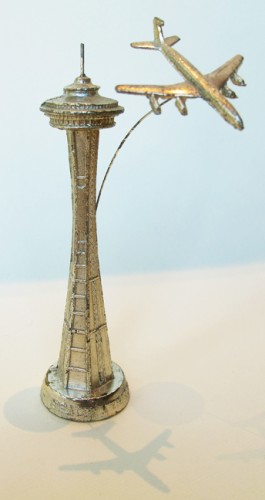
The Stuck at the Airport headquarters is located in Seattle, a city we’ve lived in and loved for decades. We don’t claim to know everything about the city as it grows and changes, but we know a lot. And we’re happy to share our favorite spots in a variety of ways. The latest comes in […]
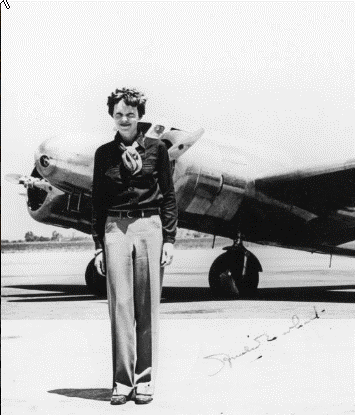
The StuckatTheAirport airport review team is heading to Charlotte Douglas International Airport (CLT) for a short residency and, if we had them, we’d be filling our Amelia Earhart-branded suitcases with our gear. (image from Purdue University Libraries, Karnes Archives and Special Collections) According to the Smithsonian Air & Space Museum, Earhart luggage was sold into […]
A fun new exhibit on view at Minneapolis-St. Paul International Airport (MSP) features a very Minnesotan art tradition: crop (or seed) art. The seed‑crafted mosaics on display feature curated and award-winning selections from the more than 450 entries of crop art entered into the 2025 Minnesota State Fair Crop Art and Scarecrow Competition, which debuted […]
There are loads of “best” lists when it comes to travel. And Travel + Leisure’s World’s highly regarded “World’s Best” awards were just released for a wide variety of travel categories based on more than 600,000 votes cast by more than 200,000 of its readers. Domestic and International Airports were voted on under the “Trains, […]
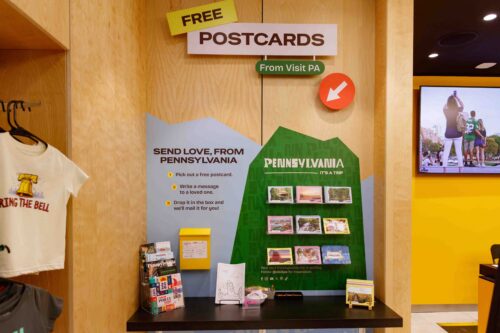
The Stuck at the Airport shopping and souvenir team loves free stuff. But who doesn’t? So we’re delighted to learn that along with tourist informaton, the new Visitor Center at Philadelphia International Airport (PHL) features a postcard station where travelers can pick up complimentary postcards and have them mailed for free. And we’re (already) declaring […]
The Stuck at the Airport headquarters is located in Seattle, a city we’ve lived in and loved for decades. We don’t claim to know everything about the city as it grows and changes, but we know a lot. And we’re happy to share our favorite spots in a variety of ways. The latest comes in […]
The StuckatTheAirport airport review team is heading to Charlotte Douglas International Airport (CLT) for a short residency and, if we had them, we’d be filling our Amelia Earhart-branded suitcases with our gear. (image from Purdue University Libraries, Karnes Archives and Special Collections) According to the Smithsonian Air & Space Museum, Earhart luggage was sold into […]
A fun new exhibit on view at Minneapolis-St. Paul International Airport (MSP) features a very Minnesotan art tradition: crop (or seed) art. The seed‑crafted mosaics on display feature curated and award-winning selections from the more than 450 entries of crop art entered into the 2025 Minnesota State Fair Crop Art and Scarecrow Competition, which debuted […]
There are loads of “best” lists when it comes to travel. And Travel + Leisure’s World’s highly regarded “World’s Best” awards were just released for a wide variety of travel categories based on more than 600,000 votes cast by more than 200,000 of its readers. Domestic and International Airports were voted on under the “Trains, […]
The Stuck at the Airport shopping and souvenir team loves free stuff. But who doesn’t? So we’re delighted to learn that along with tourist informaton, the new Visitor Center at Philadelphia International Airport (PHL) features a postcard station where travelers can pick up complimentary postcards and have them mailed for free. And we’re (already) declaring […]
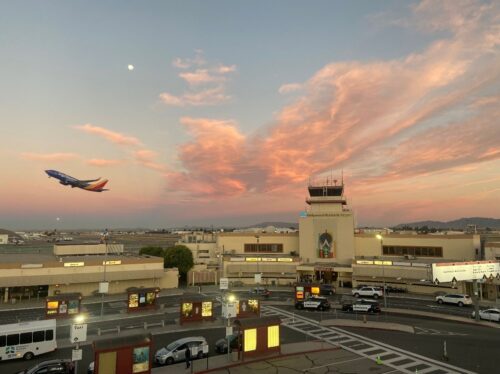
Officially, it’s still Bob Hope Airport. But in 2016 this mid-sized airport was rebranded as Hollywood Burbank Airport (BUR) to raise awareness about the airport’s convenient location just north of downtown Los Angeles. Awareness about BUR will get another boost in October, when the airport’s $1.3 billion replacement terminal opens just north of the current […]
If you’d rather spend the hours before your next commercial flight in a private luxury terminal instead of crammed in with other travelers in an airline lounge or at the gate, you’re in luck. PS, the private luxury terminal company with locations at Los Angeles International Airport (LAX), Hartsfield-Jackson Atlanta International Airport (ATL) and Dallas […]
The Stuck at the Airport team is getting ready for a summer filled with with visits to more than a dozen airports/ And we’re deep into booking tickets and hotel stays in Boston, Portland, Burbank, London, Glasgow, Frankfurt, Munich, our homebase city of Seattle and in cities we’re still studying. So we’re keeping an eye […]