Security

TSA eases airport security routine for wounded warriors

Staff Sgt. Guillermo Tejada lost both legs to an improvised explosive device in Afghanistan in 2010. Now rehabilitating in San Diego, Tejada travels regularly to compete in hand-cycling races and marathons.

When flying out of San Diego International Airport, Tejada receives the royal treatment. “They’re waiting for us at the curb and take us through the whole process of checking in and going through security,” he said.

Getting through airport security can be stressful on anyone. For wounded military service members, it can be a nightmare.

The Transportation Security Administration recently expanded a program to make the checkpoint experience for wounded warriors as simple as possible.

“Depending on the airport, the assistance provided can be meeting the passenger curbside when they get to the airport, assisting with checking of bags, getting boarding passes, and assisting through screening,” said TSA spokesperson Nico Melendez.

TSA’s Wounded Warrior Accommodations program is available 24 hours a day, 7 days a week. While TSA doesn’t directly provide all the services Melendez listed, it will — if alerted — coordinate a wounded warrior’s airport experience with airport staff, USO volunteers and airlines.

Many of the severely injured service members are traveling to or from hospitals and military bases, but many are going home, to a new duty station or on vacation.

The program has been active at a few airports for several years, serving more than 5,000 wounded military personnel traveling through Washington’s Reagan National Airport since 2010, Melendez said. In the past year, 1,500 people have been assisted at San Diego International Airport, according to Cheryl Paine, the TSA official who coordinates the program there.

Pre-check and other expedited, risk-based screening programs for people 75 and older and for those age 12 and under are now in place at most airports, so Melendez said it’s  possible to offer the wounded warrior program nationwide. “If we know who they are and know they are coming through, we can expand the pre-check program and tailor it to their limitations and needs,” he said.

“After a decade of war we have more and more wounded warriors going through airports,” he said. “If they don’t know these tools are available it won’t do them any good.”

(My story – TSA eases airport security routine for wounded warriors – first appeared on msnbc.com’s Overhead Bin.)
Massachusetts woman arrested for false bomb threat on JetBlue

Talk about fighting dirty.

Today a Massachusetts woman was arrested after being charged in federal court for making threats and false reports she made to authorities about explosives being carried by a passenger on board a JetBlue flight that ended up getting diverted.

It turned out no explosives were on board. The person Nicole Anna Miller (23) claimed had explosives was her cousin and the two were having some sort of dispute.

Still, Miller was charged for allegedly making a series of phone calls to JetBlue saying, among other things, that a passenger on a flight from Logan International to O’Hare International was carrying explosives. The flight was diverted and forced to land at Buffalo.

Miller had an initial court appearance today, July 3, and will go back on July 6th for a detention hearing. If convicted, she faces up to five years in prison, followed by three years of supervised release and a $250,000 fine.

TSA tally: 40 guns among items found at airport checkpoints

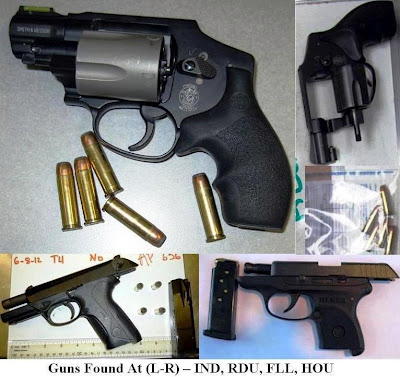
Geeky, I know, but I really look forward to reading the TSA.gov weekly blog post offering a round-up of items TSA officers find at airport checkpoints. The list is always scary, alarming, puzzling and just plain sad. How can so many people just “forget” they’ve got a loaded gun and a large quantity of bullets in a purse or travel bag?

According to the TSA blog, last week 40 firearms – 29 loaded – were found in carry-on bags at airport checkpoints around the country. Some of the people carrying the guns received citations; others got arrested.

Other items on the list this week include 11 stun guns, including one that looks just like a cell phone, and a live blasting cap, a bomb component which TSA’s Blogger Bob Burns helpfully explains, is “a small explosive charge that sets off a larger explosive charge.”

Photos courtesy TSA.

TSA checkpoint finds: swords, knives, guns and one chastity belt

Swords? Not in your carry-on.

The TSA’s Friday round-up of things found at airport security checkpoints is always mystifying, scary and entertaining.

Among the items nabbed between June 1 to June 7, 2012 were: 22 guns (18 of them loaded), swords hidden inside a guitar case and a cane, a multi-tool knife hidden in a thermos, Co2 distraction grenades and an inert detonator (whatever those are).

Among the illegal and prohibited items discovered on people during body scans: a punching weapon, strike anywhere matches, drugs, drug paraphernalia and a half full bottle of whiskey.

“And while it isn’t prohibited,” TSA’s Blogger Bob Burns wrote on the TSA Blog, “a passenger wearing a chastity belt alarmed the body scanner at one of our checkpoints. I’m sure you can imagine where an undergarment such as this might be a problem at a security checkpoint. Especially if there is no key.”

What did I tell you? Mysterious, scary and downright entertaining….

TSA eases screening procedures for older travelers

Sea-Tac security line


Here’s good news for travelers aged 75 and older.

The Transportation Security Administration (TSA) announced Friday that it has concluded a four-airport pilot program and will begin offering modified checkpoint screening to passengers age 75 and older at airports nationwide.

Tested since March, 2011 at airports in Chicago, Denver, Orlando and Portland, Ore., the new measures mirror those instituted nationwide last fall for children age 12 and under. That means elderly travelers will no longer have to remove their shoes and light outwear during screening. They will also be allowed a “do-over” through the advanced imaging technology to clear any anomalies.

The new rules will go into effect at all airports by the end of the summer, but no schedule or list has been released that reveals which airport will join the program when.

n a statement released late Friday, TSA said it anticipates these changes “will further reduce – though not eliminate – the need for a physical pat-down for these passengers,” but that travelers may still be required to remove their shoes or undergo a pat-down “if anomalies are detected during security screening that cannot be resolved through other means.”

In the past year, TSA has implemented several initiatives designed to ease screening requirements for many passengers, including PreCheck, an expedited screening program now in place at 15 airports, with plans to add about 20 more airports by the end of the year.

In addition, the hours of the TSA Contact Center (TCC) have recently been extended. Passengers with questions, feedback or concerns about TSA procedures can now reach the TCC (866-289-9673) from 8 a.m. until 11 p.m. (Eastern) Monday through Friday, and on weekends and federal holidays from 9 a.m. until 8 p.m. (Eastern).

TSA catches man with knife in walker

I suspect the TSA only shares information about some of the ways people try to sneak items through airport security checkpoints. But the stories the TSA does share are getting kind of wild.

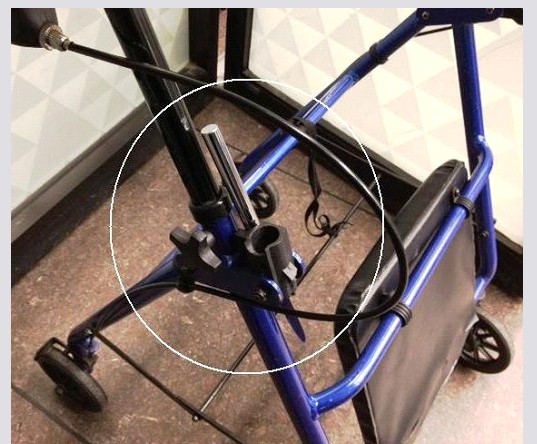
Like this one: TSA officers at JFK International Airport found a knife “artfully concealed” on the walker of a man passing through a security checkpoint.

“Walkers don’t pass through checkpoint metal detectors, and instead they are inspected by TSA officers,” the TSA said in a statement. “It was during the inspection process that an alert officer spotted the knife, which was tucked alongside the frame of the walker.”

Pickpocket-proof undies & other gear to protect your valuables

A long-planned adventure can quickly turn to mush if a pickpocket makes off with your passport, cash, credit cards or keys.

“We get reports fairly regularly about wallets going missing and things being taken from purses,” said Mike Kelly, president and CEO of On Call International, a company that provides travel assistance and emergency medical evacuation services. “It seems to happen a lot in heavy tourist zones in London, Italy and even some Asian countries. One expert believes that in Rome more than 300 tourists get their pockets picked each day.”

To protect yourself, Kelly and others suggest staying hyper alert in touristy areas, leaving valuables at home or in a hotel safe and making sure purses and wallets are secure and out of sight. Many experienced travelers and former pickpocket victims also swear by a variety of thief-thwarting travel gear.

In addition to a line of widely available line anti-theft and safety-savvy wallets, backpacks, shoulder bags, purses, pouches and other items made by Pacsafe, here are some other potentially pickpocket-proof products.

 Travel bands

 Beth Whitman, founder of the travel website Wanderlust and Lipstick and Wandertours, likes the body bands for women offered by Dovetail Travel in Peace.

The collection includes two products: The Travel Band, which is a waistband that wraps around your hips, and the Travel Wing, which is a pocket worn against your back and over your bra. “These aren’t meant to replace a money pouch that you’d want to have easy access to,” said Whitman, “But both are great options for times when you want to keep your valuables safe and don’t need to access them.”

The Dovetail set (Travel Band, Travel Wing, portfolio and carry-case) is $48 and available at Dovetail Travel in Peace.

Pickpocket-proof pants

 After a run-in with a team of pickpockets in Xian, China Adam Rapp decided he wanted travel pants that provided the security of a money-belt. His answer: pick-pocket proof shorts and long pants called P^cubed. “All our hip pockets have the ability to be single or double secured and our rear left cargo pocket has an internal passport sized pocket which would give you triple security,” said Rapp. “In order for a pick-pocket to get into that pocket – they would have to undo 2 zippers and 2 buttons.”

Currently available only in men’s sizes (a women’s line should be available by September 2012), P^cubed pants are available from Clothing Arts, in many outerwear stores and in major travel catalogs. Price: about $80 to $110.

Pickpocket-proof skivvies

After having her pockets picked repeatedly during several years of travel, Johanna Denize created a line of underwear with hidden pockets. “I had tried money belts, neck pouches and even hiding my money in my socks, but wasn’t happy with those solutions,” she said. Panties with hidden pockets work because “no one but the person wearing our clothes will ever know where the valuables are hidden.”

Denize’s products includes a boy short for women and a boxer brief for men, both with two pockets with secure zippers on the front, as well as T-shirts, tank tops and Long Johns with pockets. There are available on Clever Travel Companion () or Amazon. Price: about $25-$35.
Pocket-enhanced panties and briefs are also offered by Stashitware. “They come with a huge dedicated pocket that is easily accessible for placement of items or retrieval of items,” said company owner Philip Scott. “When properly worn and used they are pickpocket proof.”

Scott said his instructional video , “scares most viewers,” (it shows everything from cash, cigarettes, condoms, cell phones and lighters being hidden away) but he insists it “does prove the holding capacity and ease of access of the pocket underwear.”

Stashitware styles include men’s boxers, women’s briefs, bikinis and thongs (Price: $5.50 to $12) and are available are available on the Stashitware  website.

(My story about pickpocket-proof pants first appeared on msnbc.com’s Overhead Bin)

Tracking a toddler’s airport pat-down

I spent much of Monday morning trying to track down the parent who posted the video (below) of a 3 year-old in a wheelchair getting a very thorough pat-down at an airport security checkpoint.

It turned out the video was shot in 2010 and had been posted on YouTube over the weekend. But that didn’t stop it from going viral.

Here’s my story about the video – and the TSA’s response – that posted on msnbc.com.

A video shot in 2010 showing a 3-year-old boy receiving a pat-down from a TSA agent went viral today. The toddler was wearing a cast and sitting in a wheelchair.

In an annotated videotape of the incident posted March 17 on YouTube, the father is heard reassuring his son, whom he calls “Rocco,” while a TSA officer is seen patting down the squirming boy and taking swabs of the chair and the cast. After asking the parents to lift the boy’s shirt and offering them the option of going to a private screening area, the officer is also shown swabbing the boy’s back.

The video has been viewed more than 400,000 times. [updated]

Before conducting the check at the Chicago Midway Airport, the TSA officer tries to reassure the boy by asking what he likes — “Tigers? Animals?” — and then asks the boy to sit up. During the inspection he also tells the parents what he is doing and tells Rocco that he’s a good boy.

Comments added to the video by his father, said, “I was told I could NOT touch him or come near him during this process. Instead we had to pretend this was ‘OK’ so he didn’t panic.”

Reached Monday morning,  the boy’s father, Matt DuBiel, said the video was made in spring 2010 during a family trip to Disney World.

“We had a baby five weeks ago, and I was looking at some old family videos on Saturday night, and I got incensed and emotional watching it.”

DuBiel says he posted it on YouTube to share it with family members who have heard him talk about the incident but who hadn’t seen the video.

Noting that the incident took place more than a year ago, TSA, in a statement, said: “Due to the fact that this passenger was traveling in a wheelchair and had a cast he would have been unable to pass through the walk-through metal detector or imaging technology and therefore received alternative screening, a pat-down and use of explosives trace detection.”

“It doesn’t matter when it was,” said DuBiel. “That’s the TSA and that is my son. And he is wearing a body cast. The TSA agent did the best he could with a ridiculous situation, but someone should have stepped in and said, ‘That’s enough.’ ” He said he didn’t make a fuss at the time because he was worried about getting the whole family through security. The family was traveling to Disney World.

“At the time, they didn’t  have the rules in place for children that they have now. But, regardless of the new or old rules, my position is that it’s unacceptable to treat a toddler this way.”

Last fall, the TSA revised its rules for children 12 and under, saying they no longer have to remove their shoes at security checkpoints. The agency’s policy for Children with Disabilities states that “if your child is unable to walk or stand, the Security Officer will conduct a pat-down search of your child while he/she remains in their mobility aid, as well as a visual and physical inspection of their equipment.”

“While recognizing that terrorists are willing to manipulate societal norms to evade detection, our officers continue to work with parents to ensure a respectful screening process for the entire family at the checkpoint,” TSA said Monday.


What the TSA found at airports – last week

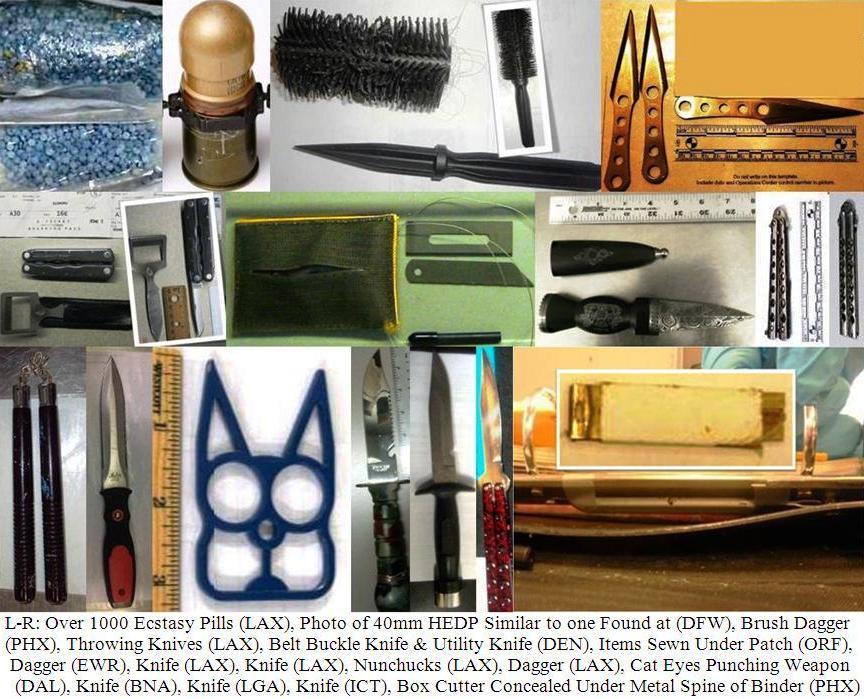
Once again, I find myself perusing the TSA’s weekly round-up of prohibited, illegal and downright bizarre items found at airport checkpoints and thinking… “What’s with people?”

Grenades, pistols, knives and my favorite from last week: thousands of hits of ecstasy stashed in someone’s underpants.

Here’s the photo of last week’s finds from the TSA.gov blog.  Wacky but, when you get right down to it, really quite alarming.