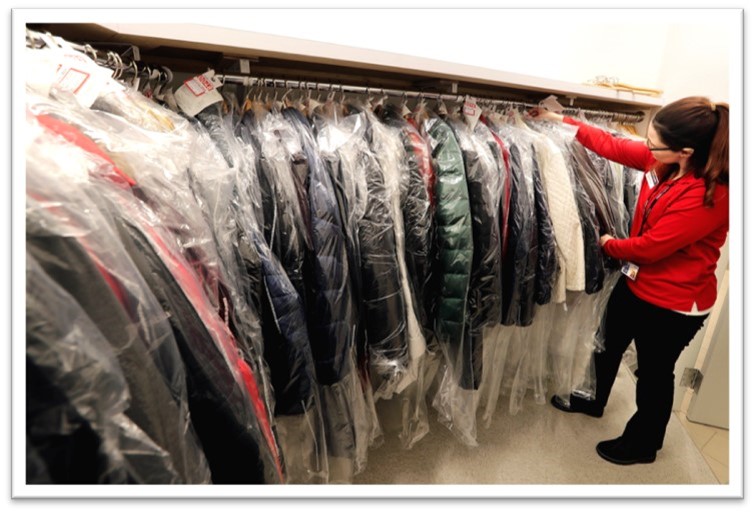
The service is set up inside the Summerfest Marketplace store, which is located pre-security in the airport’s concession mall and is available to all travelers on all flights, seven days a week.
The coat check service means travelers heading to warm climates can wear their coats to the airport, leave them at the coat check and then pick them up at MKE when they fly back home.
Better yet: checking a coat is just two dollars per day, with a maximum charge of ten dollars.
So snow birds can leave their coats behind for the entire season.
We think other airports could and should offer this helpful amenity.
And, as we have for several winters, we’re declaring MKE’s coat check service the Airport Amenity of the Week.
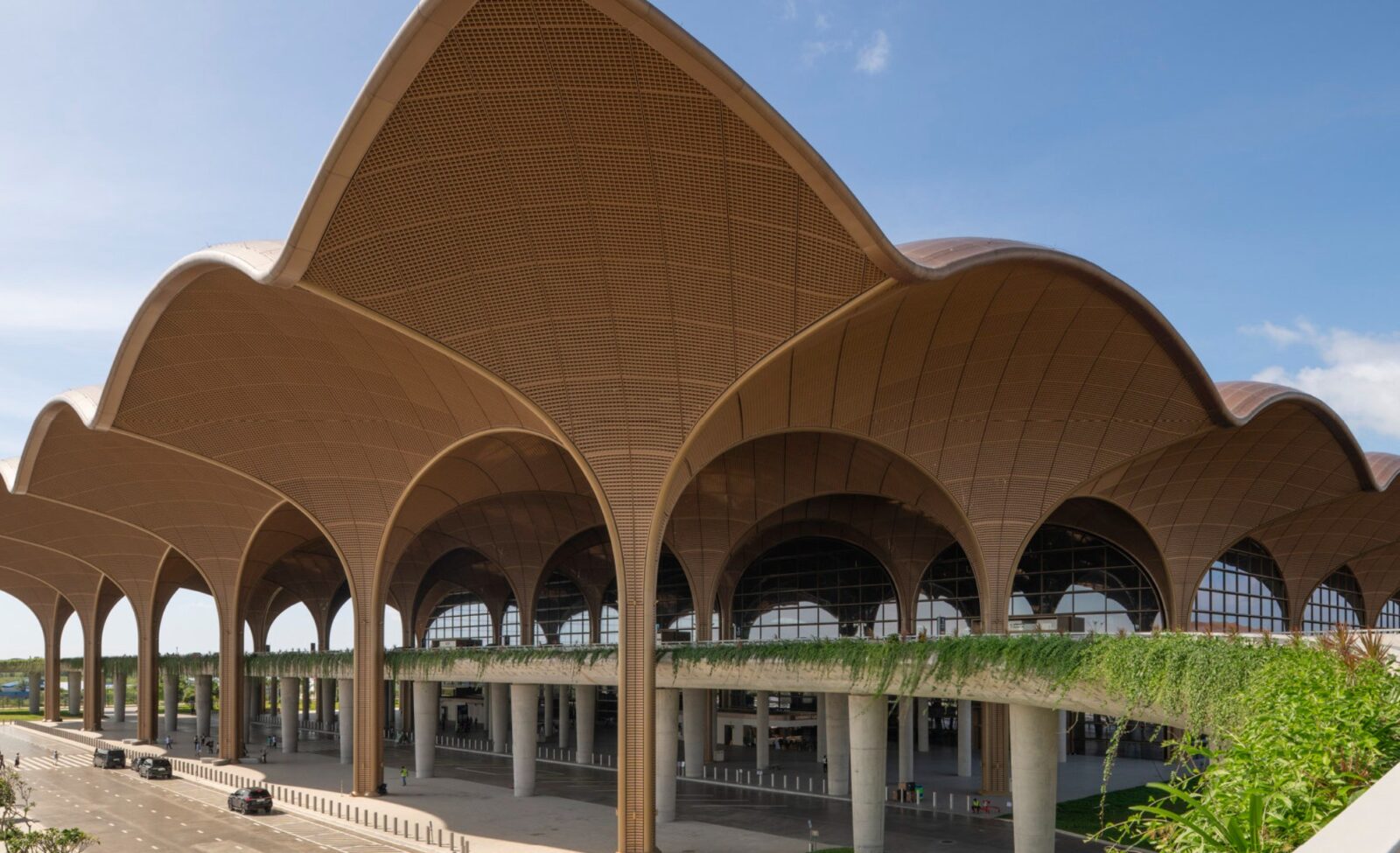
The $2 billion airport has three runways and replaces the old Phnom Penh International Airport, which was nearly 70 years old and sported only one runway.
Located about a dozen miles from the city center, the state-of-the-art terminal is designed by Foster + Partners and blends contemporary design with Khmer heritage.
Sustainability was a key goal for the project and there’s an onsite photovoltaic farm that provides most all of the terminal’s energy.
Inside the terminal, structural trees support a steel grid shell that filters daylight.
Below, the vast open terminal space features real, mature trees.
Expansion is already on the drawing board but for now, Techo International Airport currently has 32 gates serving 31 airlines with 44 direct routes. There are currently two lounges, a Plaza Premium Lounge and a Plaza Premium First lounge. Major carriers include Cathay Pacific, Singapore Airlines, Etihad, Turkish Airlines, Air Cambodia, with more international connections soon.
You’d think that after hiring the best architects and builders and spending billions of dollars, a new airport terminal would be ready to spring into action when the work is done.
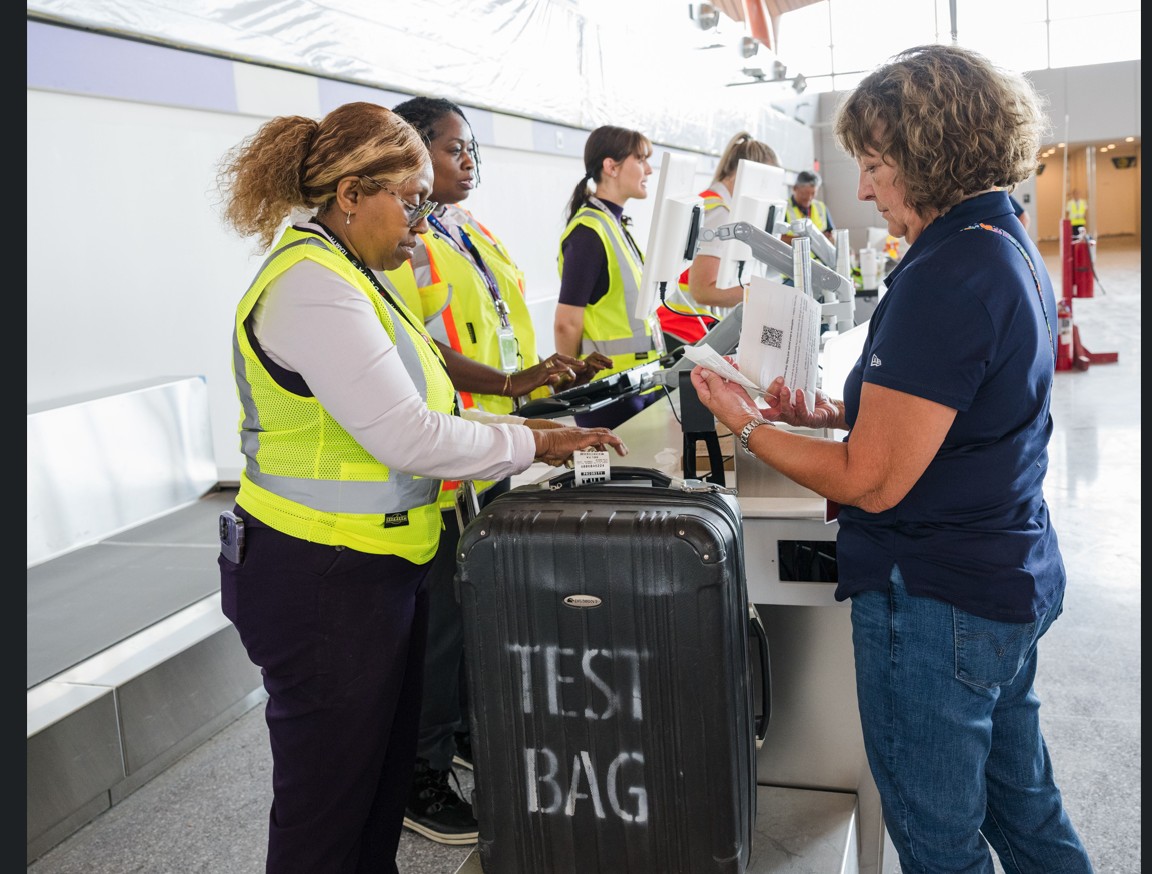
But before flights begin to come and go from a new terminal, airports usually run a dress rehearsal day with volunteers pretending to be passengers.
Why ask fake passengers to test airport terminals?
Pittsburgh International Airport (PIT) is putting the finishing touches on a new $1.7 billion terminal set to open in October. Architectural and engineering firms Gensler, HDR and Luis Vidal + Architects designed the terminal and all systems and areas have been completed and rigorously tested.
“But construction and operational readiness aren’t equal,” Daniel Bryan, the consultant leading PIT’s operational readiness and transition team, said. Before the official opening date can be set and announced, PIT is conducting two public trial days, or dress rehearsals, where volunteers act as passengers to help make sure everything — and everyone — is truly ready for the big day.
The first terminal-wide test took place Saturday, Sept. 20, and included about 1,000 of the 18,000 people who responded to the airport’s initial call-out for volunteers.
Pretend passengers traveling on a pretend peak travel day were asked to do all the things real passengers do when they travel from the curb to the gate — checking bags, skis and golf clubs, going through the security checkpoint and finding their gate.
“This will be the first time we’ll see the building come alive,” Bryan said, so the team planned to check the acoustics, the public address system levels, signage and more. The test day was also a day for airport staff to do a run-through for the first day.
San Diego International Airport’s new terminal
It was the same story at San Diego International Airport (SAN) on Sept. 14. Opening day for is Sept. 23 for the $3.8 billion Terminal 1 designed by Gensler in partnership with Turner-Flatiron.
All went well, with adjustments planned in response to feedback that the paging system was too loud in some areas and not loud enough in others, and that better signage was needed for the outdoor dining deck and the oversized baggage belt.
What did Kansas City International Airport learn from its test?
All systems worked well, said airport spokesman Justin Meyer, and in response to volunteer feedback, the airport ordered more hefty paper towels for the restrooms.
Then there was the problem of test day volunteers missing their fake flights because they were spending too much time checking out the terminal.
San Diego International Airport’s existing Terminal 1, built in 1967, closes on Tuesday, September 23, and the swanky new light-and-art-filled $3.8 billion Terminal 1 officially opens.
(A few flights will arrive at new T1 on the evening of September 22).
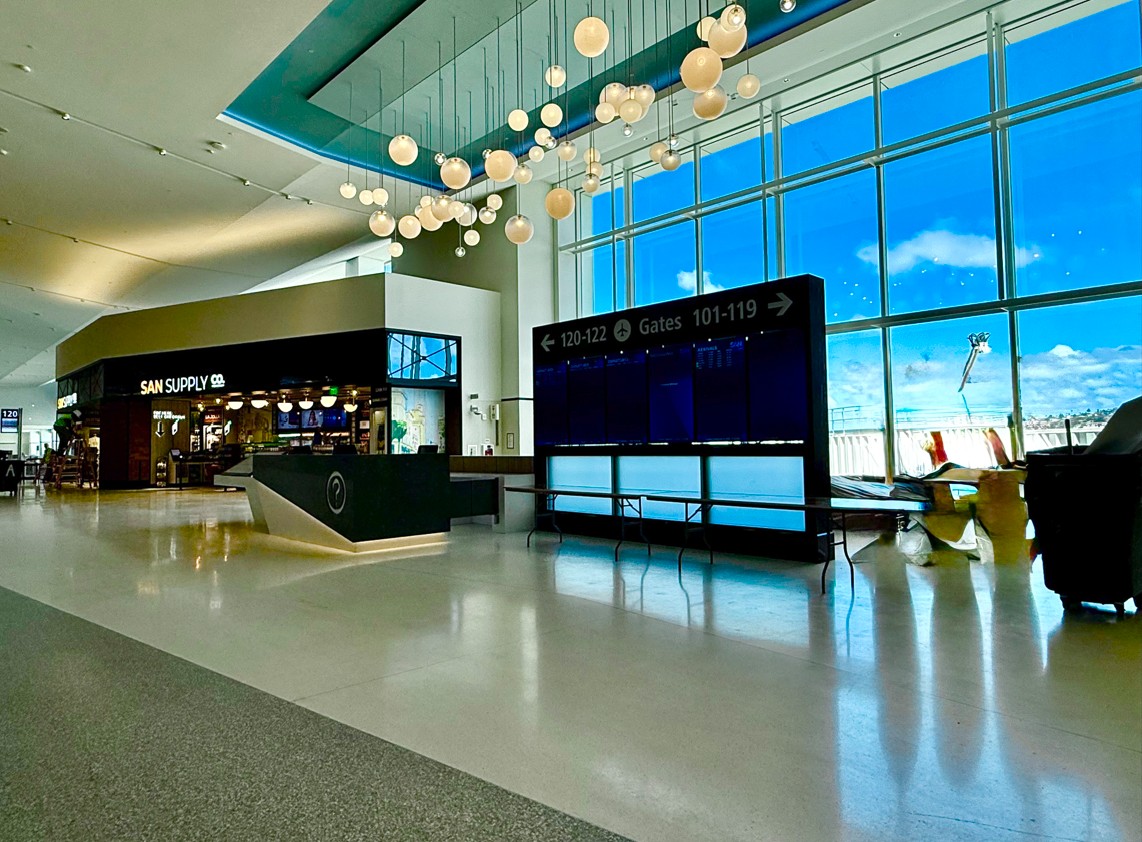
Designed by the Gensler architecture firm in partnership with Turner-Flatiron, the new terminal boasts five impressive commissioned art pieces – including Matthew Mazzotta’s jellyfish-inspired Rise, up above -, an outdoor patio with views of San Diego Bay and downtown, 13 security lanes, 7 bag claim carousels, and more.
We had a chance to tour the terminal as finishing touches were being put in place. Here are a few snaps from our tour.
Views galore
The terminal was designed to be “open and inviting – a glassy pavilion in a garden,” said Gensler’s Terence Young, Principal, Design Director and Project Designer. Passengers can see out to the airfield from plenty of spots along the concourse, but the coziest seating is likely the area behind the center information bank.
Cool concessions
New Terminal 1 at San Diego International Airport opens with 5 specialty stores and a dozen food and beverage outlets.
The summer sale at Scandinavian Airlines (SAS) runs through Tuesday, August 26 with some very inviting discounted routes from John F. Kennedy (JFK), Boston Logan International Airport (BOS), Miami International Airport (MIA), Seattle-Tacoma International Airport (SEA) and Toronto Pearson International Airport (YYZ) to destinations in Scandinavia and Europe.
Discounted travel can be made now for SAS flights from October 1, 2025, through May 26, 2026.
We’re looking at flights from Seattle to Copenhagen.
Listen up at SFO Airport for seals, parrots, cable cars and more
Travelers at San Francisco International Airport (SFO) must travel through temporary walkways connecting Terminal 3 (T3) to the F gates while renovations under way.
Not happy with leaving the corridor walls blank and bland, the design team at architectural firm Gensler has turned the walk into a sensory journey through San Francisco.
On this ‘City of Icons’ walk, travelers will hear audio recordings of seals barking at Pier 39, the chatter of the Mission, the music of the Fillmore, and the wild parrots of Telegraph Hill.
Listen closely and you’ll also hear the sounds of buses, trolleys, and the rumble of the city’s cable cars.
[Our story about the premiumization of airports first appeared on NBC News]
Pittsburghers are so excited to see the new $1.7 billion airport terminal that Pittsburgh International Airport is opening this fall that 18,000 of them applied for 2,000 test day slots even before the date was set.
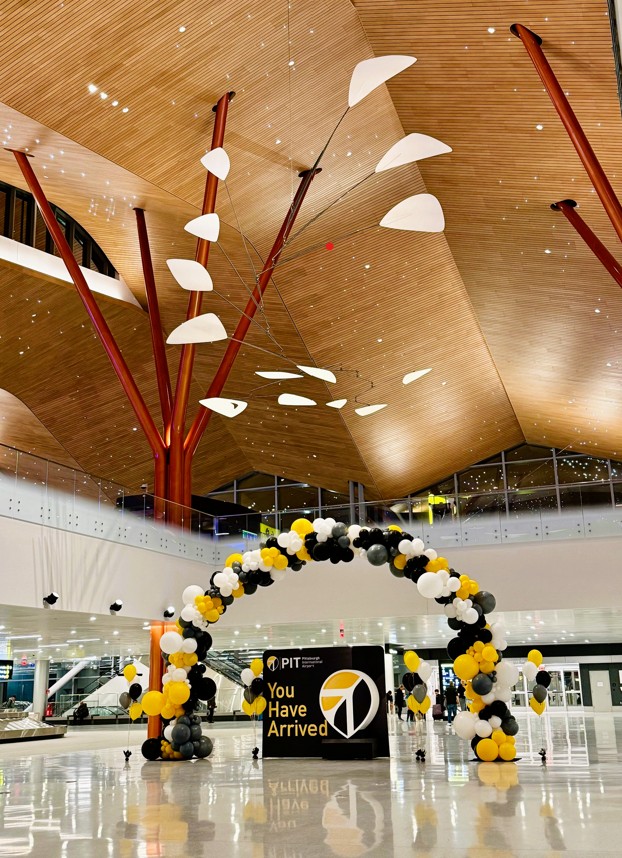
The lucky volunteers chosen to drive to the airport and fly nowhere will be among the first “passengers” to pass under the soaring wood ceiling dotted with more than 4,000 constellation lights and grab some fresh air while enjoying a snack on one of the four pre- and post-security outdoor green terraces.
They’ll be greeted by Alexander Calder’s reinstalled 28-foot-long hanging mobile, which is named for the city. Then they will make their way through a facility powered by the airport’s own microgrid and staffed by some employees whose kids spend their days playing at the airport’s on-property day care center.
In addition to being more efficient and high-tech, the new terminal is designed to “elevate the passenger experience,” said airport CEO Christina Cassotis.
Airports everywhere are undergoing makeovers, amplifying VIP-style services and other amenities that offer travelers expanded options for their journey. Airlines are installing premium cabin upgrades, and lounge spaces are getting larger and snazzier.
The $19 billion makeover underway at John F. Kennedy International Airport in New York includes two new terminals and modernizations of two existing terminals. New Terminal One, which will be JFK’s largest terminal, will open in phases beginning in 2026 and include more than 300,000 square feet of dining, retail, lounge and recreational space.
Partners building JFK’s $4.2 billion Terminal 6, also set to open in phases starting in 2026, say travelers will find a “digital-first, boutique guest experience.”
The recent $1.5 billion transformation of JFK Terminal 4, currently the airport’s largest terminal, is “distinctive, personalized and not cookie-cutter,” said Belinda Jain, vice president, Customer Experience & Commercial at Terminal 4 operator JFKIAT. Its commercial offerings are intended to reflect life in New York, with regular pop-ups and eight lounges, including Capital One’s largest lounge to date.
While many airport upgrades reflect expected growth in passenger traffic and some long-delayed infrastructure investments, the “premiumization” of many services and the flurry of new lounges may be a response to airports being – or feeling – more crowded. Travelers have been willing to open their wallets to improve their experience and feel “special.”
To lounge or not?
At many airports, the experience on the concourse is nice enough that you don’t need to access a lounge to have robust Wi-Fi, power outlets, comfortable seating, pleasant surroundings and plentiful concessions, said travel analyst Henry Harteveldt, president and founder of Atmosphere Research.
Yet 14% of the 5,000 U.S. airline passengers his group surveyed earlier this year said they have ongoing access to airport lounges through paid memberships, qualifying credit cards or flights, and spend status with an airline, said Harteveldt.
“We all want something that not everybody else has. And these lounges also appeal to the innate snob in all of us. In some cases, the lounges are above the general concourse area, meaning you are literally looking down on the people in the main terminal area,” said Harteveldt.
In a recent survey of more than 10,000 global travelers who take two or more trips a year, airport lounge operator Airport Dimensions found that 66% of U.S. travelers said they’d be willing to purchase premium services such as priority check-in, fast-track lanes, paid waiting areas and lounges access to improve their airport experience.
The survey found that so-called affluent leisure travelers were significantly more willing to pay for those premium services than others. These travelers, also known as ALTs, are defined as taking three more trips a year and their propensity to spend at airports.
“These are people traveling by choice, not just necessity,” said Chris Gwilliam, Airport Dimensions’ senior vice president of Global Business. “And they are willing to spend when the experience feels worth it.”
Those with big budgets who want an even more premium experience can access luxury terminals when flying commercial from some airports.
Going private at commercial airports
PS, which opened a private, gated terminal for affluent travelers at Los Angeles International Airport in 2017, opened a second location at Hartsfield-Jackson International Airport in 2023. It plans openings for airports in Dallas/Fort Worth and Miami in 2026.
Services include private security screening, on-site customs and immigration facilities, spa services, chef-prepared meals, private suites or shared private lounge access and chauffeur service to the airplane. Fees range from $1295 for individual access to close to $5,000 for a private suite for up to four travelers.
Demand for private travel experiences has skyrocketed since the pandemic along with the general desire to splurge on travel, said Amina Belouizdad Porter, CEO of PS. “It’s a trend that we have benefited from.”
Even non-affluent fliers are ponying up.
Concierge services for every budget
SkySquad is a service that expedites check-in and escorts travelers from the curb to the gate for prices ranging from $79 (walk-up) to $149 (pre-booked) for up to six people at a growing number of airports, The Bethesda, Maryland-based company had its busiest month ever in December at Fort Lauderdale-Hollywood International Airport (FLL), where the company can only service customers of Spirit Airlines, an ultra-low-cost carrier.
“We helped over 2,900 groups at FLL that month, which shows that travelers across all price points value a VIP experience,” said company founder Julie Melnick.
There are other widely available ways to get preferential treatment. The expedited screening lane accessible with TSA Precheck is available at more than 200 airports. Pricing varies by enrollment provider, but can be around $85. For $209 a year, travelers can join CLEAR+ and cut to the front of the security checkpoint line at more than 59 airports.
“Travel is hard, and it’s only getting harder,” said Annabel Walsh, CLEAR’s senior vice president for marketing. Services like CLEAR’s, she said, give travelers “a faster, more predictable, premium experience when they need it most.”
At these airports, you can be at the gate to meet a friend or family member arriving on a flight.
You can spend every last second with someone until they have to board their flight, instead of saying goodbye at the curb or the security checkpoint.
Or you can just go and hang out at the airport by yourself or with a friend and shop, eat, watch planes do their thing, listen to live music or have a date night.
The airport is upgrading the Indulge MSY Guest Pass program to make it even easier for non-ticketed guests to access areas beyond the security checkpoint.
Now, in addition to signing up online, eligible guests can use a self-service in-terminal kiosk and get a pass within minutes.
That means it’s even easier to get access to live music and more than 40 dining and shopping options, including local favorites like Emeril’s Table, MoPho, and Fleurty Girl at MSY.
The self-service kiosk is on Level 1 of baggage claim, between doors 2 and 3.
Entry requires standard security screening through the Transportation Security Administration (TSA) general boarding lanes, and guests aged 18 and older must present a valid REAL ID or passport.
The Indulge MSY Guest Pass program is available daily until 8 p.m.
We’re making this the Airport Amenity of the Week.
That’s because, starting August 11, 2025, CLE is launching a guest pass program called The Hopkins Hangout Pass.
The program allows non-ticketed guests to apply for a pass that will give them access to the secure side of the airport to greet an arriving traveler, spend more time with a friend or family member before a flight or just hang out at the airport to shop, dine or watch planes take off and land.
Guests must submit their request at least 24 hours in advance, but not more than a week in advance and can begin applying for passes on August 6th. Here’s the Hopkins Hangout Pass portal.
Passes will be limited to 100 per day, and guests will only be allowed past security from 7 am until 10 pm.
What other airports offer gate passes to non-ticketed guests?
CLE joins a growing list of airports that offer gate passes to non-ticketed guests. The list includes:
And we hope that Pittsburgh International Airport (PIT), the first airport to offer a gate pass program for non-ticketed passengers, will revive its MyPITPass program when the new landside terminal opens, sometime this fall.
Have we missed any airport gate programs? Let us know!
Today, let’s give some to Long Beach Airport (LGB), which came in 2nd, behind PDX, on the list of the 50 Best Airports in America put together by The Washington Post.
The 2nd place award ranking notes LGB’s ease of navigation and its outdoor courtyard, which are just two of the many features the airport, which has trademarked itself as ‘america’s coolest airport’, is proud of.
LGB also boasts a newly renovated 1941 historic terminal, a $17.8 million project which was recently recognized at the 37th Annual Long Beach Heritage Preservation Awards.
The renovation included the restoration of Works Progress Administration (WPA)-era mosaics by Grace Clements that were (re)discovered when the maintenance team took up the carpet.
Made in 1941, the mosaics pay tribute to Long Beach’s origins in aviation, oil and communications with images of a large map, birds, a ship, an oil well and a hand dialing a telephone.