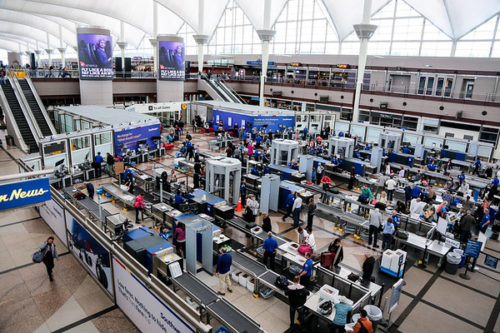
As we head into the Memorial Day holiday and a slight uptick in air travel, the Transportation Security Administration rolling out some new rules for the security checkpoint screen area in response to COVID-19.
Some of these strategies are already in place. Others will show up at checkpoints by mid-June.
Scan you own boarding pass
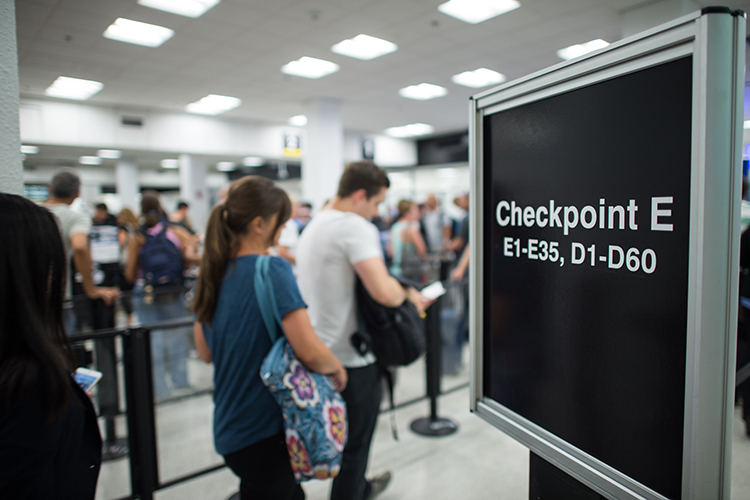
Still no word about TSA taking passenger temperatures, but TSA officers will now ask passengers to place their paper or electronic boarding pass on the ticket readers themselves. TSOs will still examine your document, but they won’t touch it.
Clear bags for food
TSA also now asks passengers to put any carry-on food items in a clear plastic bag and place that bag in a bin at the checkpoints.
“Food items often trigger an alarm during the screening process; separating the food from the carry-on bag lessens the likelihood that a TSA officer will need to open the carry-on bag and remove the food items for a closer inspection,” TSA says in a statement.
“This allows social distancing, reduces the TSA officer’s need to touch a person’s container of food, and reduces the potential for cross-contamination. TSA Precheck members do not need to remove items from their bags,” TSA adds.
If you haven’t flown since the pandemic arrived, you’ll see TSA checkpoint officers wearing facial protection and gloves. Passengers are also asked to wear masks at checkpoints as well and be prepared to lower their masks if requested. At many airports, masks are now required throughout the terminals and on the planes.
(Our story about TSA workers helping airport workers during the pandemic first appeared on CNBC in a slightly different version.)
The steep decline in air travel due to the COVID-19 pandemic has triggered layoffs, furloughs and shortened work hours for many airport employees, including wheelchair attendants, baggage handlers, janitorial crews and concessions staff.
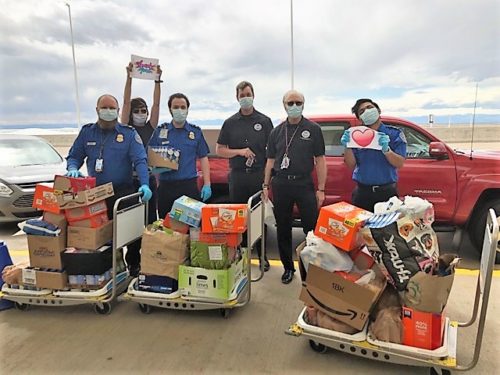
But in a growing number of cities their co-workers from the Transportation Security Administration, who continue to receive paychecks, are stepping up to help. They’re hosting temporary food pantries in airports around the nation and providing free lunches and dinners to their struggling colleagues. They’re also donating their time to make masks and other essential items for communities in need.
Unite Here, a union representing hospitality workers, estimates that 42,000 of its members in the airport industry are currently out of work. Most of those lost jobs are in airport concessions and airline catering, where wages range from $9 to $16 an hour.
That’s just Unite Here members. The Airport Restaurant and Retail Association (ARRA) estimates 120,000 to 125,000 airport employees are currently out of work.
Some of those workers may eventually get called back. But for now, their incomes are disrupted, and many could use some help.
Food pantries to the rescue
As a thank-you for the support they received while working without paychecks during the 2018/2019 partial government shutdown, TSA officers at Denver International Airport on April 30 hosted a food pantry in support of airport and air carrier colleagues working with reduced hours or partial paychecks.
“Our team rallied to collect thousands of non-perishable items for the pantry,” said Larry Nau, TSA Federal Security Director for Colorado, “133 airport employees shopped the pantry and took home items for a total of 538 family members fed.”
On April 24, Transportation Security Administration employees at Ronald Reagan Washington National Airport (DCA) opened a free food and toiletries pantry to assist airport employees laid off or working with reduced hours or paychecks.
TSA officers are donating cash, products and gift cards to keep the pantry stocked with items such as cereal, evaporated milk, soup, pasta, toothpaste, soap, laundry detergent, feminine products, diapers and deodorant.
And in early April, TSA employees at Dulles International Airport (IAD) opened a free pantry for affected airport community members that is stocked with everything from donated dried and canned goods and toiletries to toys for employees who have kids at home.
IAD has the greatest @TSA employees, #ManagerMike thanks you for all you do to keep the airport secure and for this great example of giving back! Folks as you can see, the shelves are getting empty so please make donations if you can! https://t.co/EozTgt579ppic.twitter.com/5nH3YJ9W8e
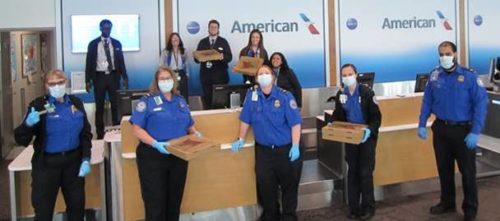
Twice in early April, TSA officers at Rhode Island’s T.F. Green Airport (PVD) chipped in to buy and deliver pizza dinners for fellow airport workers, including airline employees, wheelchair attendants and housekeeping staff.
“Providence is a small airport and the employees who work here are like family,” Christopher Primiano, TSA stakeholder liaison at PVD Airport, told CNBC, “We know this could go on for some time so we’re looking into what else we can do, from donations and food drives to bake sales. We want to help and give back as much as we can.”
On April 10, TSA employees at PDX bought pre-made lunches for around 300 airport employees. They did it again on April 21, partnering with local employees from Customs and Border Protection (CBP) and the Federal Aviation Administration (FAA) to donate lunch and supplies to an equal number of airport workers.
As part of its “TSA Gives Back” program, early last month TSA officers at Green Bay-Austin Straubel International Airport (GRB) in Wisconsin chipped in to buy and deliver pizza, dessert and balloons to airline and car rental employees at the airport who are experiencing shrinking paychecks.
— Lisa Farbstein, TSA Spokesperson (@TSA_Northeast) April 3, 2020
And, at McGhee Tyson Airport (TYS) in Knoxville, Tennessee, TSOs are collecting donations and arranged for Second Harvest, the community food bank, to supply food boxes to about 300 airport employees.
Following instructions from an online video, TSA officers at EWR made 200 face masks out of 100 pairs of brand-new socks purchased with funds donated by TSA employees. Each sock-mask was placed in a separate plastic zippered bag along with an instruction card and all 200 masks were delivered to two area homeless shelters.
TSOs at Newark Liberty Airport have also used their downtime at the checkpoints to make home-made get-well cards and write notes of support for health care workers and COVID-19 patients in isolation at a nearby medical center.
During the partial shutdown of the federal government in 2019, many TSA employees continued to show up for work despite missing paychecks.
To help them out, airport employees, airlines and airport concessionaires around the country joined with social service agencies and the local community to stock pantries with food and goods.
'Unprecedented': Food bank provides emergency meals for unpaid TSA workers amid shutdown https://t.co/p48VrzEaNE
Now at some airports, TSA workers are returning the favor by setting up food pantries and special meals for airport employees who have had hours cut or who have been put out of work because there are so few passengers in airports.
IAD has the greatest @TSA employees, #ManagerMike thanks you for all you do to keep the airport secure and for this great example of giving back! Folks as you can see, the shelves are getting empty so please make donations if you can! https://t.co/EozTgt579ppic.twitter.com/5nH3YJ9W8e
And at T.F. Green International Airport (PVD) in Rhode Island, TSA officers chipped in and bought pizza dinners – twice so far – for their fellow airport workers, including wheelchair attendants and airline employees.
Courtesy TSA
We’ll update this list of good-deeds as we hear of my examples.
So Transportation Security Administration officers are among the workers who must still show up for work.
Unfortunately, it turns out TSA workers aren’t immune to COVID-19 and there are have been some TSA officers who have tested positive for the virus. So it’s possible some passengers may have been exposed to the virus by these officers at some airports.
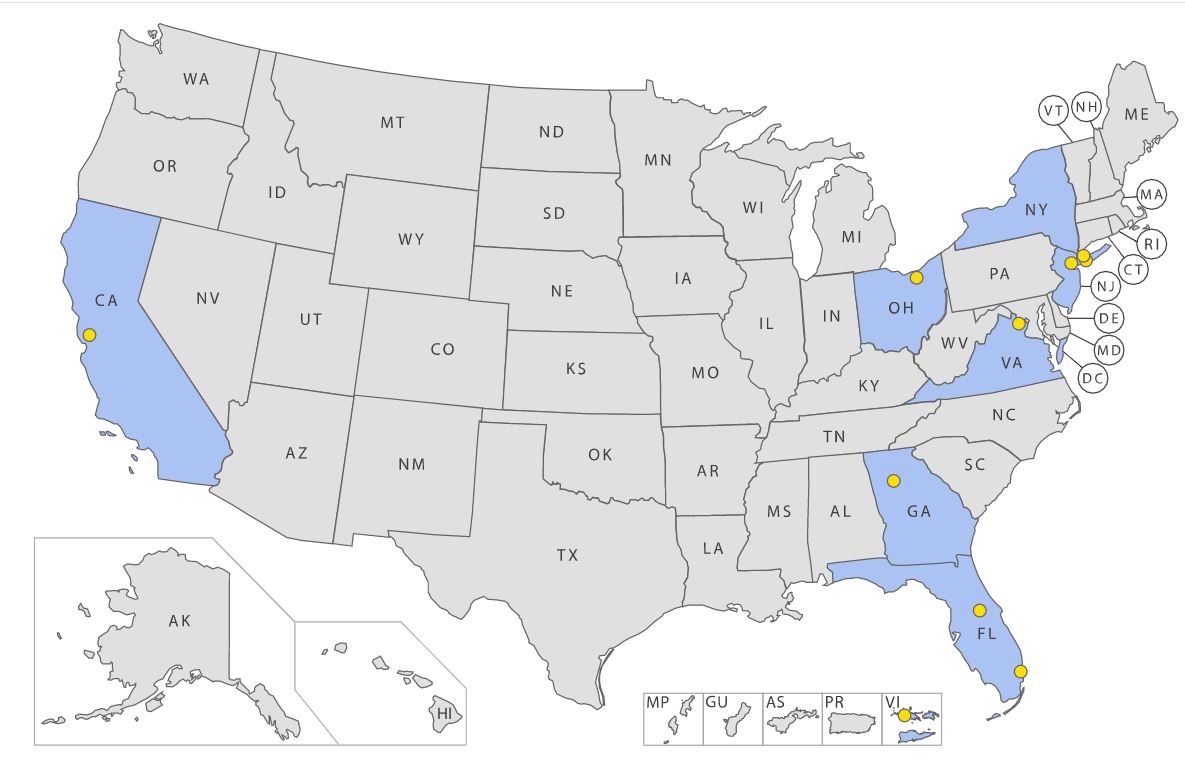
As of March 23, TSA said 25 screening officers had tested positive for COVID-19. An additional five non-screening employees who TSA says “have relatively limited interaction with the traveling public,” have tested positive for the virus as well.
Here’s the list of where TSA officers tested positive for the virus:
Newark-Liberty International Airport (EWR)
John F. Kennedy International Airport (JFK)
Hartsfield-Jackson Atlanta International Airport (ATL)
Orlando International Airport (MCO)
LaGuardia Airport (LGA)
Cleveland Hopkins International Airport (CVG)
Cyril E. King International Airport (STT; St. Thomas, VI)
Washington Dulles International Airport (IAD)
Norman Mineta San Jose International Airport (SJC)
Fort Lauderdale – Hollywood Int’l Airport (FLL)
Louis Armstrong New Orleans International Airport (MSY)
TSA says it continues to work with the CDC and state and local health departments to monitor local situations.
In the meantime, passengers will find that at some airports TSA has closed some checkpoints and is staffing others with reduced hours.
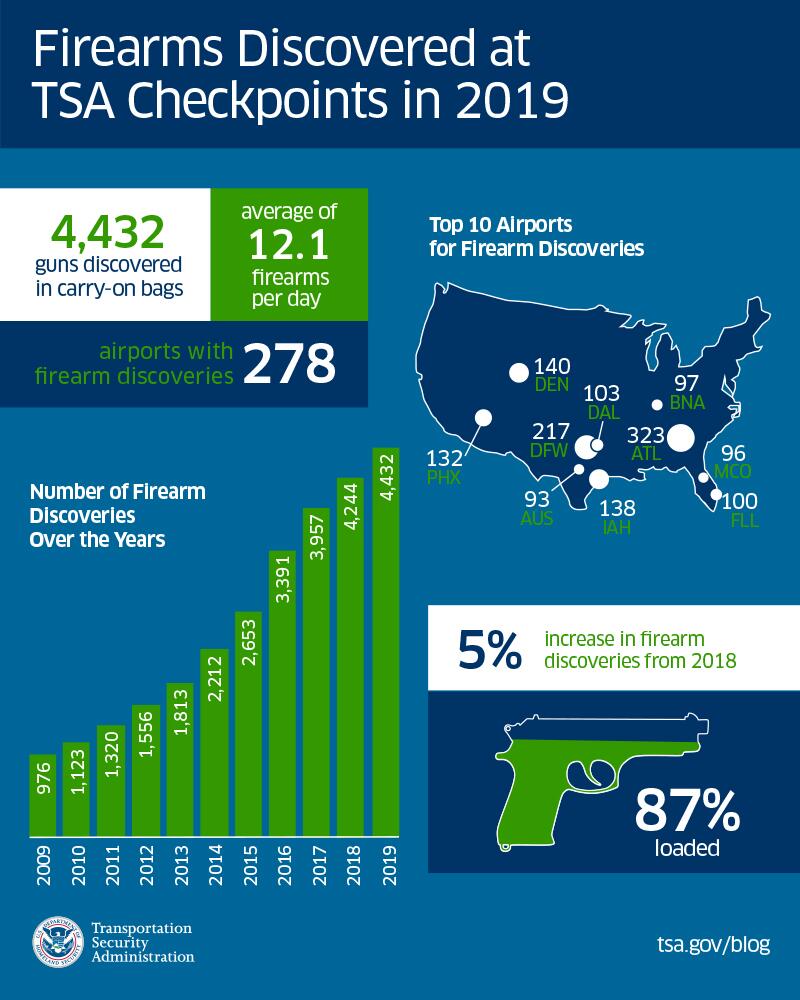
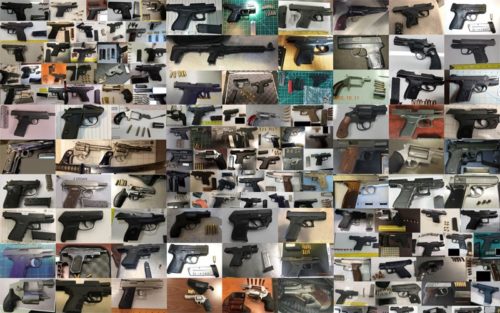
In its annual Year in Review, the Transportation Security Administration (TSA) today shared the tally of the number of firearms its officers found at airport checkpoints around the country all last year.
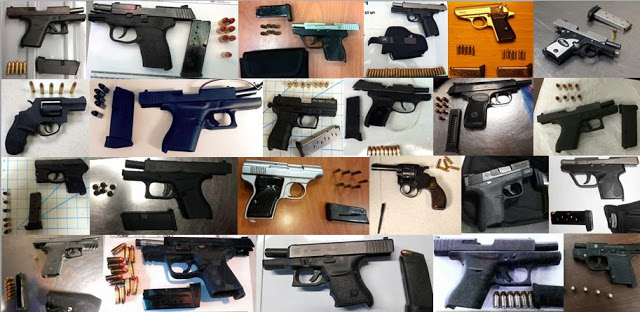
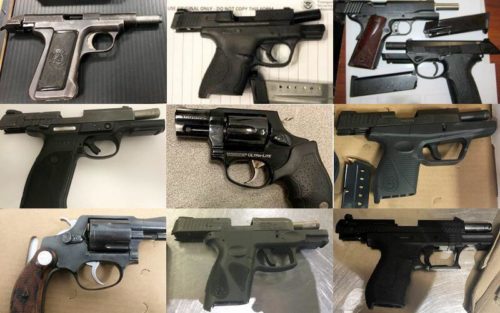
The total: an alarming and record-setting 4,432 firearms were found at airport security checkpoints in 2019.
That’s an average of 85.2 firearms per
week, or 12.1 firearms per day.
It’s also a 5% increase the 4,239 firearms discovered at
airport checkpoints in 2018.
Here are some more stats from TSA’s 2019 firearm finds:
*Of the 4,432 firearms found, 3,863 were found loaded. And1,507 of those firearms had a round loaded.
*TSA found guns at 278 of the country’s 440 federalized airports, but firearms showed up more often at some airport than others.
Here are the Top Ten Airports where the most firearms were found:
Hartsfield-Jackson Atlanta International Airport (ATL): 323. That’s 25 more firearms than were found at ATL in 2018
Dallas/Fort Worth International Airport (DFW): 217
Denver International Airport (DEN): 140
George Bush Intercontinental Airport (IAH): 138
Phoenix Sky Harbor International Airport (PHX): 132
Dallas Love Field Airport (DAL): 103
Fort Lauderdale-Hollywood International Airport (FLL): 100
Nashville International Airport (BNA): 97
Orlando International Airport (MCO): 96
Tampa International Airport (TPA): 87
For the record, firearms aren’t allowed past airport security
checkpoints. But TSA says many firearms owners say “Oops, I forgot that was in
my bag,” when their weapons are found at the airport.
Being caught with a gun at the airport can get you arrested,
fined more than $13,000 per violation and cause you to lose your TSA Precheck
status, should you have that.
Resolved to fly more in 2020? How to keep your stuff.
In 2019, airline passengers tried to take hundreds of thousands of prohibited and banned items through airport security checkpoints in the United States.
It doesn't matter how "lovely" this pink and gold handled knife is with pink hearts, the word "Love" emblazoned on the handle and 3 small pink hearts cut into the blade. It's still just another knife, prohibited from being carried onto a plane. Caught by #TSA at @tfgreenairport. pic.twitter.com/SExqafS3qr
— Lisa Farbstein, TSA Spokesperson (@TSA_Northeast) December 31, 2019
Transportation Security Administration officers found hatchets, inert grenades, fireworks, firearms (most of them loaded) and so many knives that the TSA doesn’t even keep a count.
Instead, the agency boxes them up, weighs them and hands pallets of knives and other “voluntarily abandoned” property over to state agencies to be sold as surplus property.
A man brought this revolver to the @TSA checkpoint at @tfgreenairport on Sunday and was arrested by the police. He told officials that he had no idea how it came to be in his possession. pic.twitter.com/ykP3hee3US
— Lisa Farbstein, TSA Spokesperson (@TSA_Northeast) December 30, 2019
TSA officials say passengers who don’t want to leave a banned item behind at the checkpoint have a few options:
If
the item is approved for checked baggage, a passenger can put the item in a
carry-on bag and go check it in or ask the airline to retrieve an already
checked back and put the item in there.
Another option: Airport Mailers and some other companies have kiosks set up near security checkpoints at many airports where travelers may package up items and pay to mail them home.
— Lisa Farbstein, TSA Spokesperson (@TSA_Northeast) December 27, 2019
But
it’s not just items on TSA’s “no fly’ list that get left
behind at airports.
Each
month, TSA also collects and catalogs 90,000 to 100,000 other items that are
perfectly legal to travel with, but which are inadvertently left behind at
airport checkpoints by harried and distracted travelers.
Those
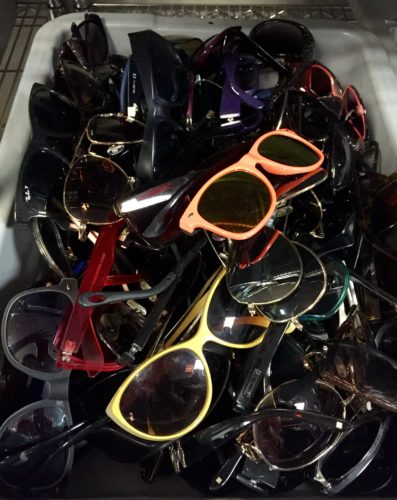
items range from scarves and sunglasses to laptops, smartphones and some odd
“How did they forget THAT?” items such as bowling balls, violins, gold teeth
and urns and boxes filled with human cremains.
On a post-holiday tour of TSA’s Lost & Found room at Reagan National Airport, we spotted plenty of those items, as well as multiple bags filled with left behind IDs.
We also saw shelves lined with ballcaps, CPAP breathing machines, winter coats, car key fobs that will cost $200 or more to replace, car seats, canes and fully packed carry-on bags.
It’s
easy to see how hats and scarves get left behind in the bins, but what about
laptops, entire carry-on bags and other essential items?
Besides
the “people are in a rush,” factor, TSA spokeswoman Lisa Farbstein has some
theories:
“When
it comes to laptops, many brands are grey and the same color as the checkpoint
bins, so it can be easy to overlook your laptop,” says Feinstein. “Also, if a
bin has an advertisement in the bottom, travelers’ eyes may be drawn to the ad
and cause them to miss the driver’s license and keys still in the bin.”
The number of bins people use may also contribute to the pile-up in the Lost & Found. If you’ve scattered your stuff across multiple bins (coats here, electronics there, a flat laptop and an ID in another bin), you may overlook items in the last bin as you rush to take your stuff out and stack up the used bins.
The pile of canes?
“It’s not that we have so many miraculous recoveries at TSA checkpoints,” says Farbstein, “I think attendants and family members helping wheelchair users who also have canes often forget to pick up the canes once they’re through the checkpoint.”
Keeping
your stuff out of Lost & Found
TSA keeps items left behind at security checkpoints for a minimum of 30 days and posts phone numbers on its website where travelers can contact the Lost & Found department at each airport.
(Keep
in mind that airports and airlines will have their own lost and found
procedures for things left in the terminals and on airplanes.)
To improve your chances of getting your stuff back – or not
losing it in the first place – Farbstein offers these tips:
Tape a business card or some other form of ID to
your laptop or smartphone. “So many models are alike, so this can make all the
difference in getting yours back,” said Farbstein.
Before you get to the checkpoint, or while
you’re standing online, take time to consolidate all your miscellaneous items
(i.e. scarves, hats, gloves) and take everything out of your pockets (keys,
phones, wallets, etc.). Instead of putting small items in a bin, put them in
your carry-on in an extra plastic bag you’ve packed just for that purpose. If
you don’t put loose items in the bin to begin with, you eliminate the chance of
leaving anything in the bin on the other side.
Pay attention to everything you put in the bins,
including things that may have a high emotional value. “A laptop may cost thousands of dollars, but I can assure
you that an old beat-up stuffed animal that a child has left behind is valuable
to the parent who is now dealing with a crying child,” says Farbstein.
Help is on the way
Looking forward, as part of a $96.8 million contract
awarded last year to Smiths Detection, in 2020 most large and major airports in
the United States will be getting computed technology 3D X-ray scanners at the
checkpoints. This new machinery will allow travelers to keep their electronics
in their carry-on bags and reduce the chance of so many laptops and other
gadgets getting left behind.
(My story: “How to avoid leaving stuff behind at the TSA checkpoint” first appeared on CNBC in a slightly different version)
The Transportation Security Administration has added nine new domestic and international carriers to the pre-check expedited screening program.
New airlines joining the program are: Air India, Asiana Airlines, China Airlines, Eastern Airlines, Elite Airways, EVA Airways, Japan Airlines, TAP Air Portugal and Volaris.
This brings the total number of airlines participating in TSA Precheck program to 65 domestic and international carriers. (The full list of participating airlines is below.)
Whether you’re enrolled in TSA Precheck or not, it’s helpful to know how long you’ll be waiting in line.
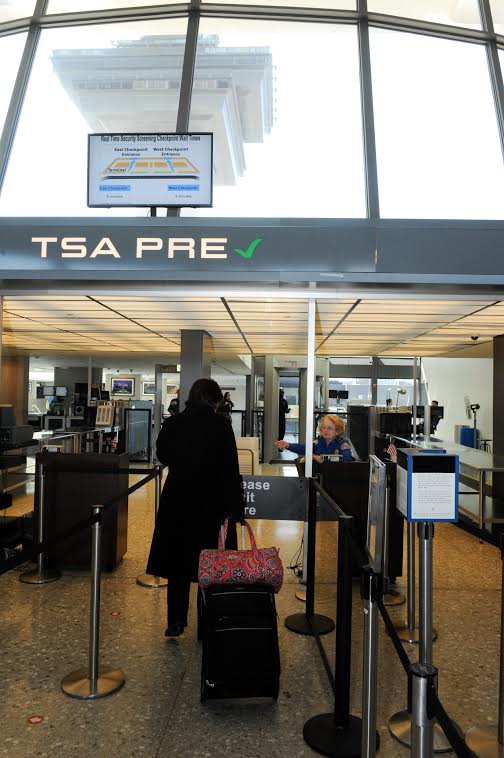
That’s now easier at John F. Kennedy International (JFK), Newark Liberty International (EWR), LaGuardia (LGA), and New York Stewart International (SWF) airports, where the respective websites now show up-to-date TSA wait times, as well as taxi wait times. The wait times are also shown on monitors inside the terminals.
According to the Port Authority of New York and New Jersey, the real-time tracking information is part of the agency’s “aggressive efforts to deliver an enhanced customer experience” for passengers using its airports.
Here are all the airlines currently participating in TSA’s PreCheck program:
TSA’s Year in Review came out today with the (still somewhat unofficial) final stats on the number of guns TSA officers found in carry-on bags at airport checkpoints last year.
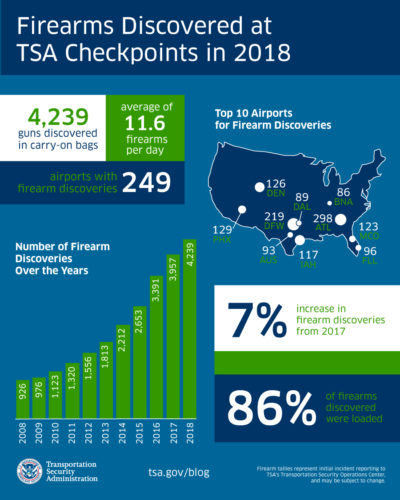
The total for 2018 is a record-setting 4,239 firearms found in carry-on bags at 249 of the more than 400 TSA-controlled airport checkpoints around the country.
That’s up more than 7 percent from the 3,957 firearms TSA officers found in carry-on bags in 2017.
And that averages out to 81.6 firearms a week and 11.6 firearms a day.
The break-down gets more alarming when we look at the stats on the number of guns found to be loaded.
Of the 4,239 firearms found last year, more than 86% (3,656) were loaded (another record) and almost 34% (1,432) of the firearms found had a round chambered.
Why do so many passengers show up at airports with guns?
“I think the biggest reason is that people go buy these things and then completely forget they have them, which is dangerous in its own right,” said aviation security expert Jeff Price, the owner of Leading Edge Strategies, “I imagine when they get the gun, at first they are always aware of it because they feel safer. Then, after a period of time, it works its way to the bottom of the bag and next thing that happens is its discovered at a screening checkpoint.”
Price also suspects that because more people are carrying guns these days and carry those guns in purses and laptops, they are aware they have the guns, “But in the hustle and confusion of preparing for a trip, they forget to take the gun out. “
TSA’s Year in Review also lists the top 10 airports for firearm discoveries in 2018.
Hartsfield-Jackson Atlanta International Airport (ATL) the Top 10 list with 298 firearms found. (253 loaded.) That’s an increase of 53 compared to 2017.
ATL also set the record for the airport with the most firearms discovered in one month: In August 2018, 32 firearms were found at ATL checkpoints.
Here’s the rest of TSA’s Top 10 list of airports for firearms discoveries in 2018:
Dallas/Fort Worth International Airport (DFW): 219 (193 loaded)
Phoenix Sky Harbor International Airport (PHX): 129 (120 loaded)
Denver International Airport (DEN): 126 (95 loaded)
Orlando
International Airport (MCO): 123 (112 loaded)
George
Bush Intercontinental Airport (IAH): 117 (115 loaded). Some good news here: this
is a decrease of 25 compared to 2017.
Fort
Lauderdale-Hollywood International Airport (FLL): 96 (80 loaded)
Austin-Bergstrom
International Airport (AUS): 93 (76 loaded)
Dallas
Love Field Airport (DAL): 89 (83 loaded)
Nashville
International Airport (BNA): 86 (80 loaded)
In a year when TSA also screened a record number of travelers (813.8 million; a 5.5 percent increase over 2017), the agency’s officers also found a wide variety of prohibited items and ‘artfully concealed’ objects other than firearms in carry-on bags, including inert grenades, a bottle of lighter fluid, fireworks and knife combs.
TSA’s week in review also notes the loss in 2018 of Curtis “Blogger Bob” Burns, the charmingly corny TSA employee who chronicled the agency’s odd finds on the TSA blog, on Twitter and on Instagram. Burns is featured in quirky videos highlighting TSA Top 10 Most Unusual Finds in 2016 and in 2017.
TSA’s Year in Review promises that a video highlighting 2018’s most unusual finds will be released soon.
Over the last two days, employees & the public came together to help support our Airline Management Council's donation drive at MCO. These goods are being made available to airport federal employees affected by the partial shutdown. We thank them for their dedication & hard work. pic.twitter.com/DBlh4T88gr
Thank you to the @TSA employees working hard at our security screening checkpoints! @SouthwestAir, @JetBlue, and our Airport Police Department have brought breakfast and lunches to #TSA personnel this week. An anonymous donor also donated coupons for 80 coffees! @TSA_Bilellopic.twitter.com/lNrTdQfMmf
UPDATE: At today's special meeting, the Council unanimously endorsed our proposal to create a short-term loan program for federal employees @FlySJC. @CityofSanJose staff has already started working on logisitics & will return to Council next week. https://t.co/s7dUfiPh67