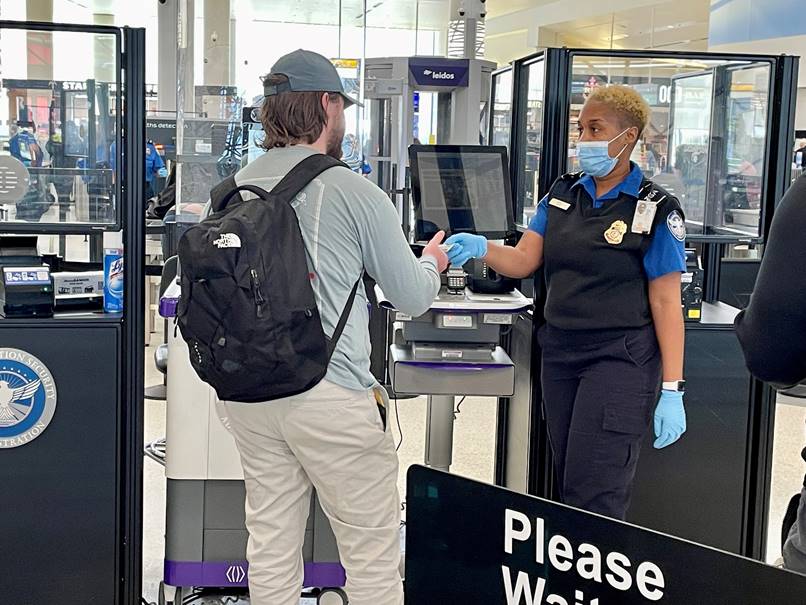
The Transportation Security Administration (TSA) not only stops travelers from bringing dangerous and prohibited items onto airplanes, but it also tallies the finds.
And the agency shares information about some of the more unusual items that show up at the security checkpoints on social media.
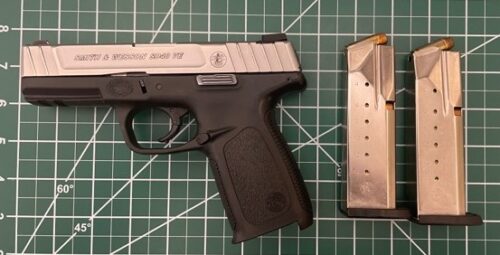
For some reason, many travelers pack guns in their carry-on bags. And the number keeps going up.
In the first quarter of 2023, TSA officers found 1,508 guns at checkpoints. That’s 10.3% more than the same period in 2022.
BREAKING NEWS: The number of guns caught at checkpoints by @TSA officers in the first quarter of 2023 (1,508 guns) represents a 10.3% increase over the same period in 2022 when @TSA stopped 1,367 guns at airport security checkpoints.
— Lisa Farbstein, TSA Spokesperson (@TSA_Northeast) April 20, 2023
Fake guns and ammunition – even replica versions can’t fly either
This is not the fashion statement to make at a @TSA checkpoint. No ammunition (or replica ammo) is permitted through a checkpoint. The traveler was allowed to return the belt to his vehicle at @EWR this morning. Spoiler alert: His pants did not fall down. pic.twitter.com/pH6ACuoTxA
— Lisa Farbstein, TSA Spokesperson (@TSA_Northeast) April 18, 2023
Stop it with all those sharp things
It’s not just guns. Check out these sharp objects travelers tried to bring on airplanes, and TSA’s cutting remarks about them.
A TSA officer detected this sword concealed inside the staff of a cane at a TSA security checkpoint at @EWRairport yesterday. Unfortunately bringing swords to checkpoints just doesn't cut it. Good catch on the sharp eye of the @TSA officer who was clearly on point. pic.twitter.com/jIvOy2KQ1A
— Lisa Farbstein, TSA Spokesperson (@TSA_Northeast) April 26, 2023
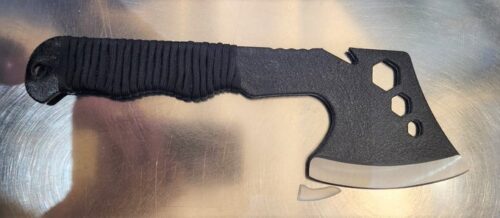
A traveler flying out of @EWRairpot "axidentally" left his axe in his carry-on bag. @TSA officers performed an "axe" of kindness and worked with the man to place the axe in his checked bag, where it could safely be transported to the traveler's destination. pic.twitter.com/afJMnb9aGL
— Lisa Farbstein, TSA Spokesperson (@TSA_Northeast) April 24, 2023
This week (August 16 – 23) is National Coin Week. And it is a good time to remind travelers to keep track of all their loose change at the airport security checkpoints.
Passengers going through airport checkpoints are told to put all their carry-on items on the belt going through the x-ray machine and to empty their pockets as well.
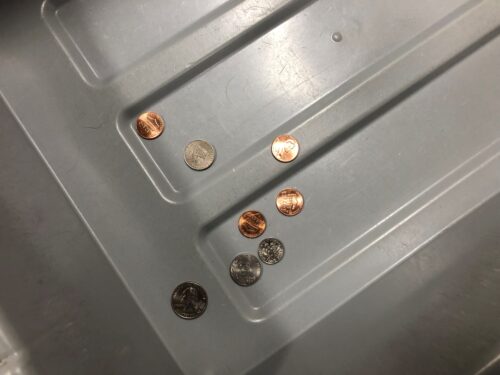
You’ve seen it. And perhaps you do it. But many passengers dump the contents of their pockets directly into a plastic bin. And in the rush to reassemble their belongings and move along, a lot of people leave loose change – and cash – in the bins.
The money left behind adds up.
In a report filed by the Department of Homeland Security for Fiscal Year 2020 (the most recent report we can find), the Transportation Security Administration (TSA) collected $517,978.74 in unclaimed money from airports around the county.
More than $19,000 of the funds was in foreign currency. And more than $37,000 of the funds were collected at airport checkpoints in Las Vegas.
TSA is allowed to keep the unclaimed funds left behind at checkpoints. And the agency can spend it as it wishes “to provide civil aviation security.” In FY 2020, for example, most of the funds TSA had in the kitty were used to purchase “masks, gloves, plexiglass shields, and other protection measures for travelers and TSA’s frontline workers,” according to the report.
Don’t Want TSA To Get Your Loose Change?
We expect a new report to be issued shortly on how much cash and currency travelers have been leaving behind at airport checkpoints. And we won’t be surprised if the numbers tick up because so many travelers are still working on relearning their travel skills.
But it’s pretty easy to avoid adding your cash to the TSA coffers.
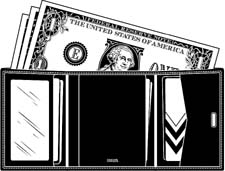
Before you leave home, empty the loose change from your pockets into a small bag, or even an envelope, that you can slip into one of the larger bags you’ll be sending the x-ray machine. Or put that change into a zippered pocket in your coat or carry-on before you get to the checkpoint. Do the same with your wallet, so you decrease the chance of leaving way more than loose change behind, and you won’t tempt someone else to steal it.
It’s been just a few weeks since the Transportation Security Administration (TSA) released its Top Ten Finds of 2022. And we already have news of some items found at airport checkpoints that might appear in the 2023 reel.
Snakes on a Plane. Almost
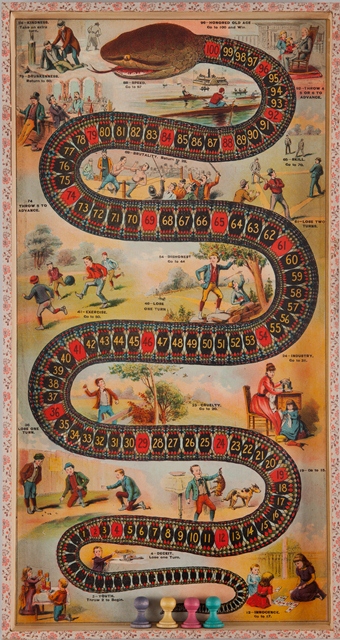
The Game of the Sociable Snake, c. 1890
This didn’t show up in TSA’s Top Ten Catches of 2022. But it should have.
A woman flying out of Tampa International Airport (TPA) had a boa constrictor in her carry-on bag.
The woman claimed that Bartholomew the boa was her emotional support pet, the TSA reports. But that story – and the boa – didn’t fly.
Snake on a plane? This is a @TSA X-ray of Bartholomew, a boa constrictor who was in a traveler's carry-on bag at @FlyTPA last month. Woman claimed the snake was her emotional support pet. TSA notified the airline, which ruled that there was not going to be a snake on their plane! pic.twitter.com/kSg6YeRluU
— Lisa Farbstein, TSA Spokesperson (@TSA_Northeast) January 6, 2023
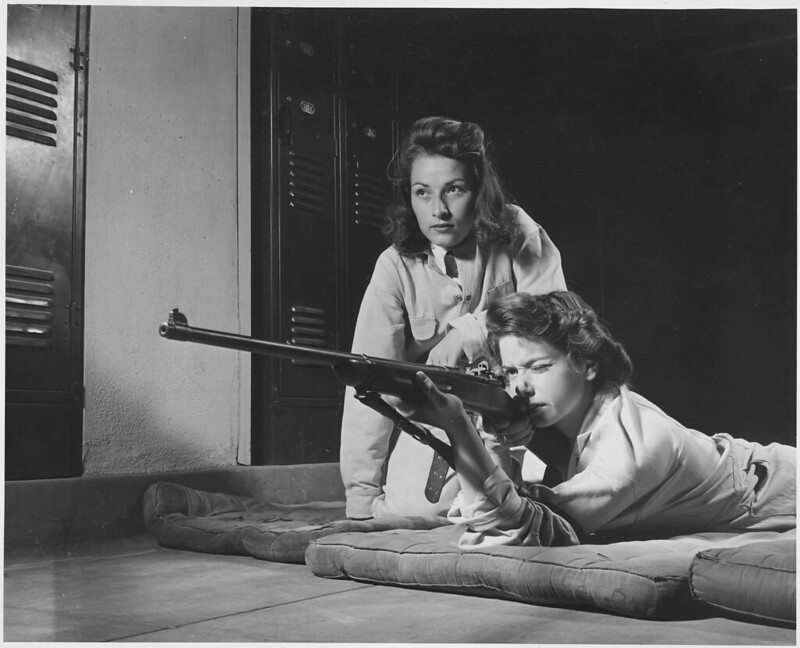
Replica Sniper Rifle Kit
Courtesy Franklin D. Roosevelt Library, Hyde Park, NY
Firearms aren’t allowed in airplane cabins or in carry-on bags. Yet, passengers try to take them onboard all the time. In 2022, TSA found more than 6,000 firearms at airport checkpoints. And most of those firearms were loaded.
Toy guns are also on TSA’s no-fly list. That includes this replica sniper rifle kit discovered in a carry-on bag this week at Manchester-Boston Regional Airport (MHT) in New Hampshire.
In case you missed it, here’s TSA’s Top Ten Catches of 2022
BREAKING: Find out which jaw-dropping discoveries made our "Top 10 Catches of 2022!" Shout out to our TSA officers nationwide for protecting the traveling public.
Officers for the Transportation Security Administration see a lot of stuff in the carry-on bags of passengers. Some of it is just fine for people to take on the plane with them. Other items, such as baseball bats, meat cleavers, and even Magic 8 balls, falls on the prohibited items.
So do knives, guns, and other items that are clearly weapons. Yet people try to sneak that stuff by all the time. In fact, even before the end of December, TSA found a record 6301 firearms in carry-on bags at airports. More than 88% of those firearms were loaded.
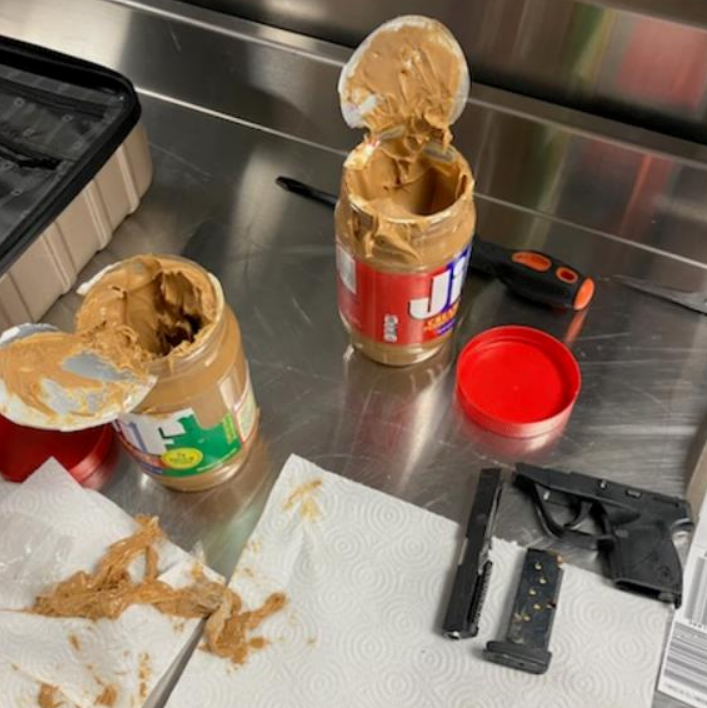
Some travelers forget they have a knife, gun, or some other prohibited item in their bag. Others know exactly what they’ve packed and go to creative lengths to try to get prohibited items past the checkpoint undetected.
The most outrageous items end up on the annual list of TSA’s Top 10 Catches.
Here’s the full 2022 list, in a corny video put together by TSA.
The agency has been doing this year-end round-up for a while. And our favorites are still the early ones hosted by the late Blogger Bob” Burns. We’ve included his 2016 round-up below.
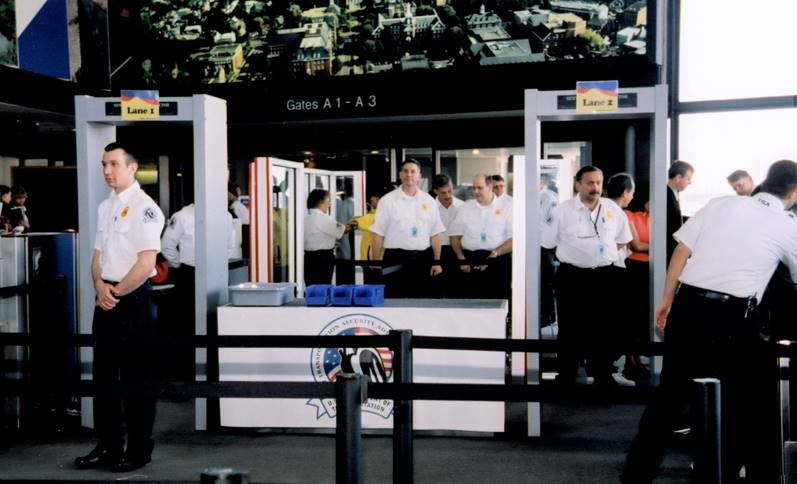
Then: the first TSA Checkpoint was a BWI. Photo courtesy TSA
It feels as if the Transportation Security Administration (TSA) has always been in charge of security at airports.
But TSA was created in November 2001, in the aftermath of the terrorist attacks of September 11, 2001.
And, beginning on April 30, 2002, Baltimore/Washington Thurgood Marshall International Airport (BWI) became the very first airport in the nation to be ‘federalized.’ It became the first airport to have security screening taken over by the newly formed agency.
BWI and TSA officials marked that anniversary on Friday at the airport and shared background on what was happening at the time.
“The ‘TSA Start-Up Team’ at BWI built a ‘War Room’ on the lower level of C Concourse and began testing new screening methods, checkpoint designs, standard operating procedures, and more,” TSA said in a statement. “The team’s main tasks were to establish the new agency and its security mission and write policies and procedures that adhered to the requirements of the law that created TSA. They were to build a fully federalized workforce of security screening officers to replace private contract screeners.”
Many of the early Transportation Security Officers trained at BWI before they were deployed across the country.
Today there are 430 federalized airports and 64,000 TSA employees nationwide.