Posts in the category "Kids travel":

JetBlue’s summer reading program

JetBlue and PBS kids have rolled out a fun literacy program that will not only entertain kids, but help keep the cabin noise level in check.

The program has several elements, but here at StuckatTheAirport.com we’re most pleased to learn that kids on JetBlue flights this summer will receive a free activity kit with reading games, including this fun word find exercise.

Kids and their parents can also download a reading activity kit, create a summer reading list, log reading minutes and do other activities. And for every reader that registers on SoarwithReading.com, JetBlue will make a book donation to a child through First Book, up to 10,000 books.

Soar with Reading will also be giving $10,000 worth of children’s books to one community’s library. Another library will receive $2,500 worth of books and five other libraries will receive $500 worth of books, courtesy of Random House Children’s Books and JetBlue. You can nominate a library and, as a reward, be entered to win a vacation package to the Bahamas.

So it’s win-win-win all around.

Don’t leave your kids at Zurich Airport


Playroom_nursery Zurich Airport

When I walked into this bright playroom at Zurich Airport, it was hard to tell who was happier:

Two-year old Mattia, who was happily playing with the toys and stuffed animals in the room, or his dad, Stefano Schiavon, who was sitting quietly watching his son play.

“We flew in from Washington and have a long layover before our flight to Venice,” said Shiavon, “When I found the airport had this play area, I almost cried.”

Who could blame him?

Lots of airports have small play areas for children. In the United States, these spaces range from a corner with an activity table or two to larger spaces, such as O’Hare’s Kids on the Fly center, with aviation-themed climbing structures.

Zurich Airport not only has special play areas for children, the free facilities have lockers, lots of toys and dolls, books, computer games, painting supplies and building sets.

A separate room is a nursery, with diaper-changing tables, baby care products, cribs and rooms for breastfeeding. There’s also a kitchenette with a hotplate, microwave oven and cutlery so parents can fix a snack for their kids.

The staff on duty is multilingual and there to make sure to make sure everyone is playing safely and to help out with flight information and assist  with minor problems.

“Parents must stay with their children. It’s not a daycare,” my airport guide told me, “People can’t leave their kids here and go off shopping or on a 10-day trip.”

Although you can see how they may be tempted….

Play area at Zurich Airport


Zurich Airport has two Family Service areas:
In the Transit A area, between the entrance to gates 60-69. Hours: daily, 6:30 a.m. to 9:30 p.m;
and on Pier E, level 3, above gate E45. Hours: 7 a.m. to 1 p.m.

Zurich Airport family room

Do you remember your first airplane ride?

Julie McKinney -famiily and friends at Orlando Airport

I had way too much fun gathering stories, drawings and photos for this story about first flights that appeared on msnbc.com today.  I know there are lots more great stories – and first flight souvenirs – out there, so after you read these stories, please send along your own.


Do you remember your first airplane ride?

Julie McKinney does. No doubt other passengers on that flight do too.

It was 1992 and she was “that” kid: the excited 5-year old on her first airplane ride and headed to Disney World. “I was the one singing ‘M-I-C-K-E-Y-M-O-U-S-E’ the entire flight from Pittsburgh to Orlando,” said McKinney.

Now 23, McKinney remembers other passengers singing along. “The singing continued until the end of the flight and I don’t remember anyone getting upset. I think of this now every time I fly and can’t imagine how I’d react to a singing child sitting in front of me.”

Roller coasters, dolphins and cotton balls

Whether it was 50 years ago or just last week, your first airplane ride, like your first kiss, can leave a lasting impression and have an impact on what sort of traveler you become.

Jeff Pecor was also Disney World-bound on his first airplane ride, at age 8, in the early 1980s. Now on staff at Yapta, an airfare and hotel price tracking site, Pecor remembers it being “so cool that they served food and they gave you plastic pilot wings. And everyone was so nice.”

Unforgettable as well: “That first roller-coaster feeling that hits your stomach when the plane sometimes drops suddenly during turbulence. That sensation still gets me today, but it’s altogether different when you’re not expecting the plane to do that.”

Raymond Kollau, who today tracks airline news for airlinetrends.com, first boarded a plane when he was 16, in the summer of 1986. “From the air, the waves in the Mediterranean looked like dolphins,” said Kollau, “And I remember telling my sister she couldn’t walk in the aisle because it would make the plane lean forwards or backwards.”

First Flight

Snow Wonderland

To Boston-based artist Annie Silverman, the world outside the airplane window on her first flight, in 1957, looked like a “snow wonderland.” She even documented the scene in an autobiography she wrote and illustrated in her 4th grade class that year. “It was Christmas vacation and we were all dressed up,” said Silverman, “I remember that the clouds looked like giant cotton balls, the sky was so blue and there was the constant hum of the motor.”
Gum balls, not cotton balls welcomed Thomas Sawyer on his first flight. Sawyer, the bladder cancer survivor recently in the news for his experience with a botched airport pat-down, took his first flight as a young newlywed with his wife, Sherry. At the end of that flight, he realized he’d been sitting on a wad of gum. “The very good looking stewardess attempted to remove it and my wife finally said to her, ‘I think I will take care of that, thank-you.’ She obviously didn’t want this young lady touching my butt. We have laughed about it for 41 years,” said Sawyer.


There was probably no laughing when Orville and Wilbur Wright made those historic first, heavier-than-air powered flights on December 17, 1903. The weather and the wind were bad that day and, according to Peter Jakab, Associate Director of Curatorial Affairs at the National and Space Museum, “Years later Orville said that had they known then what they learned later, they would never have made that test flight under those conditions.”


Still, in preparing for that first flight Orville wrote in his diary, “…Isn’t it astonishing that all these secrets have been preserved for so many years just so we can discover them!!”

Baby’s first flight


Cathy Raines first discovered flying on January 10th, 1955, when she was just nine weeks old. She’s flown to 45 countries since then. And while she doesn’t remember that first flight, she’s proud to have the Sky Cradle Club certificate issued that day by the American Airlines crew. “There’s a drawing of a baby in a diaper astride a jet plane and it’s signed by two stewardesses, the captain and others,” said Raines.


Although Delta Air Lines recently brought back the tradition of handing out plastic wings to kids and polite adults, most airlines did away with tangible souvenirs such as First Flight certificates and wings as a cost-saving step after 9/11.

Mary Winking at John Wayne Airport - 1985

That disappoints American Airlines flight attendant Mary Winking, who has fond memories of her first flight when she was nine years old. “The flight attendants were very attentive and let me help hand out the honey roasted peanuts. I got my first pair of wings that day and still have them with other keepsakes from that first trip to California.”


“I still wish we had the stick-on wings to give out to children and/or a certificate to present to them like we used to,” says Kelly Vrajitoru, also an American Airlines flight attendant. She remembers that on her first flight, at five years old, she held tight to her mother’s hand “feeling my stomach lift as we took off.”


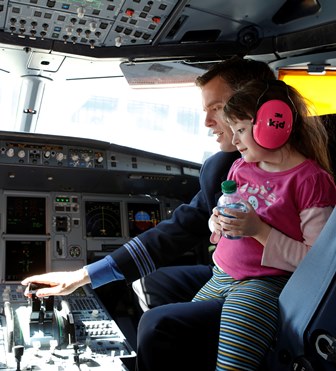
Today, Vrajitoru tries to pay extra attention to first-time flyers, especially kids. “I always offer to have a parent take a picture of their kid with the Captain before take-off or on landing, or to have them sit in the cockpit to take a closer look at all the gears and instruments. I know it makes a special and lasting impression.”


The passenger of the future

Jacob Whitecotton, now four years old, got some of that special attention when he took his first flight from Oklahoma to Orlando at age three. For the flight, Jake dressed up in a white shirt, a tie and the kid-sized American Airlines pilot cap his mom bought for him at an airport gift shop.  “It was a blast. He was going through the airport pulling a little rolling suitcase and he looked just like a tiny pilot,” said Jake’s mom, Andrea Whitecotton.


Once on the plane, Jacob got the royal treatment. A flight attendant produced a set of wings from a secret stash he’d squirreled away. Flight attendants and other travelers took pictures. One passenger gave Jake a disposable camera so he could document his flight.


What does Jake remember?  “I got to go in the cockpit and they let me drive the plane.”


What do you remember about your first flight? Please share your memories below.

[This story first appeared on msnbc.com]


Stuck at the airport – with kids?

Dinosaur_Atlanta_Hartsfield


Adults who are stuck at the airport can spend their time shopping, getting a massage or having a drink at the bar. Kids waiting for flights are usually told to sit still with a book or an electronic game. But the amenities and activities at these family-friendly airports can make a long delay downright desirable.

Orlando_Airport_Snow White

Like the nearby theme parks, Orlando International Airport was designed with kids in mind. The first clue: there’s both adult and pint-sized seating in the main terminal. Then there’s the brand new game arcade, the Kennedy Space Center shop with its video wall showing films of NASA launches and the statues offering photo-ops with celebrities such as Mickey Mouse and Snow White. Even the food court is entertaining: inside the 3,000- gallon saltwater aquarium kids will spot fish made famous by the Disney film Finding Nemo.

SFO FOLK ARt

In addition to an AirTrain people-mover, which offers free train rides circling the airport, San Francisco international Airport has a trio of aquariums (Terminal 1), a weather-themed play area (by Gate 87A) and a series of family-oriented self-guided tours.  Best of all, many of the more than 40 exhibits offered annually by the airport’s accredited museum program are sure to appeal to kids. For example, through the end of March, the Second Chances exhibit in Terminal displays a dress made from Tootsie pop wrappers, a dustpan made from license plates and more than 200 other creative and whimsical works of folk art from tires, soda cans and other recycled scrap.

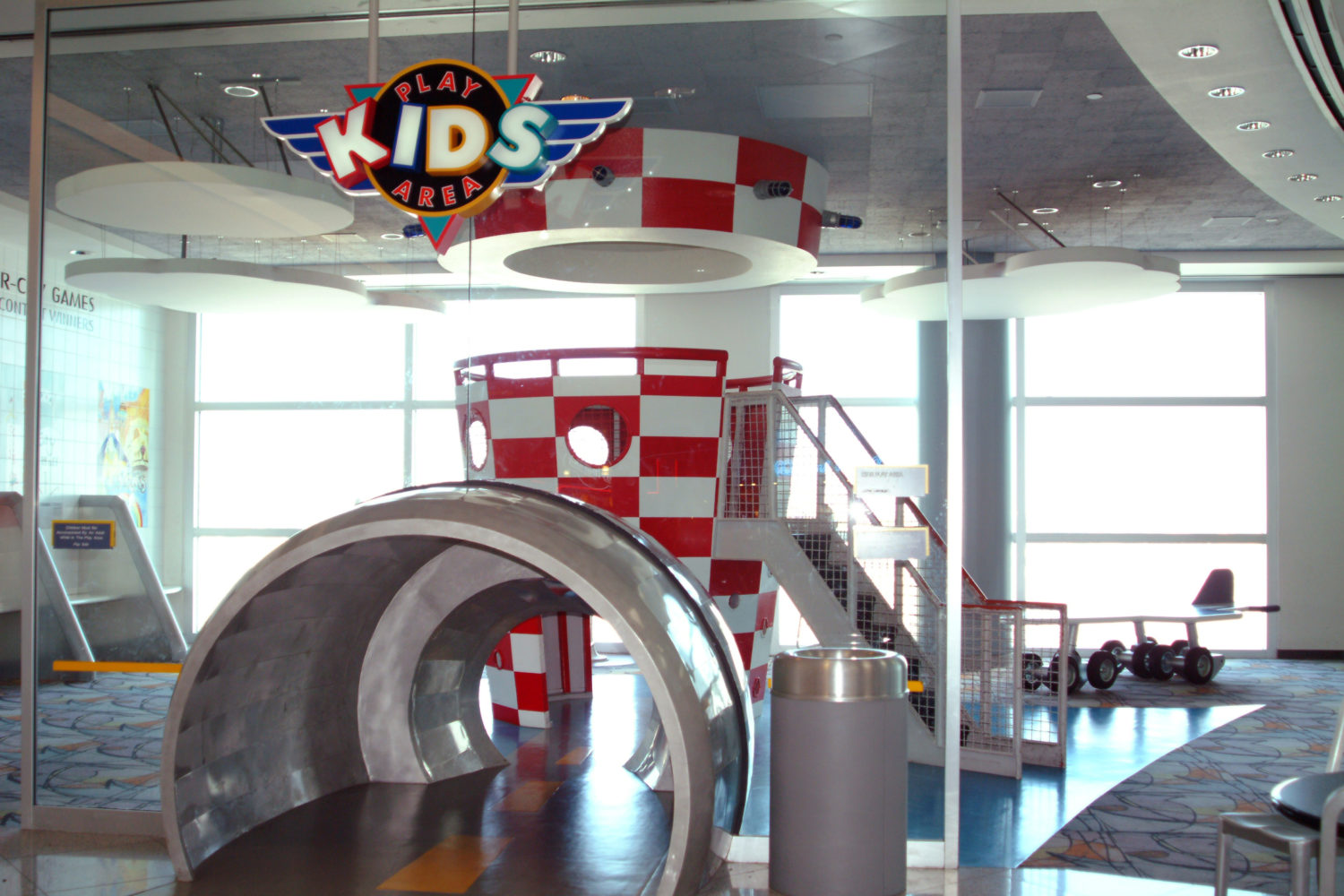
While adults are playing on some of the airport’s 1,300 slot machines, kids at McCarran International Airport in Las Vegas can play in the aviation-themed play area that includes a miniature control tower and a mock jet engine. There’s also a 24-hour museum (on the walkway over the baggage claim, with display cases around the airport) that tells the colorful history of aviation in Southern Nevada.


There are two official play areas at Chicago’s O’Hare International Airport:  the airport-themed “Kids on the Fly” play area (Terminal 2) offers kids the opportunity to tag and weigh baggage, load cargo, fly planes and direct air traffic; the “Play It Safe” area (Terminal 5) offers lessons about fire and home safety. In Terminal 1, it’s hard to miss the four-story model of a Brachiosaurus in front of the Field Museum store or, in Terminal 2, the restored WWII F3F-4 fighter plane that’s just like the one flown by the airport’s namesake, Butch O’Hare. And kids of all ages will find themselves mesmerized by the 744-foot-long light sculpture racing along the ceiling of the tunnel connecting Concourses B and C.

Dallas/Fort Worth International Airport has two Junior Flyer’s Clubs (Terminal B, gate and Terminal C, gate 14) filled with aviation-themed toy structures. Two of the airport’s interactive sculptures in Terminal D are much larger and just as entertaining: Dennis Oppenheim’s Crystal Mountain includes an arched tunnel wide enough for two people and the sounds, glass walls and labyrinth-like floor pattern of Circling, by Christopher Janney, form a walk-in game that needs no instructions.


At Denver International Airport kids will enjoy riding on the automated transit system and looking for the floating steel “paper” airlines, the gargoyles and some of the other light-hearted pieces in the airport’s extensive permanent art collection. Through March 2011, kids are also invited to play with the miniature saloon, the Conestoga wagon and the other Colorado-themed playhouses that are part of a temporary art exhibition in the main terminal.

Mr Rogers at PIT
 

A nearly life-size plaster cast of a tyrannosaurus rex dinosaur greets kids getting on or off the people mover at Pittsburgh International Airport , while on Concourse C there’s a well-padded play area located next to a memorabilia-filled shrine to Fred Rogers and the “Mister Rogers’ Neighborhood” TV show, which was filmed in town. Look for Mister Rogers’ signature sweater, his sneakers, a miniature Neighborhood of Make Believe and clay models of the show’s characters, including King Friday and Henrietta Pussycat.

“Talking” drinking fountains that gurgle loudly, quilts made from strips of recycled soda cans, and a two-part, 80-foot long “contraption” filled with found objects that move and play sounds are among the giggle-inspiring art installations at Seattle-Tacoma International Airport. For young kids with energy to spare, there’s a 1,400-square-foot play area filled with aviation-themed soft foam play equipment, including an airplane, a control tower and a baggage cart.


At Hartsfield-Jackson Atlanta International Airport there’s a 33-foot long cast of a Yangchuanosaurus dinosaur (on loan from Atlanta’s Fernbank Museum of Natural History) in the Main Terminal Atrium. Giant ants – not real; they’re part of an art sculpture – march over the ductwork in the north and south terminal baggage claim areas. Elsewhere in the airport, kids will spot a flying ear of corn (the “Corncorde”) and other entertaining installations that are part of the airport’s permanent and temporary art collection.


There’s an entertaining, educational and (somewhat) hidden treasure for kids at Baltimore/Washington International Thurgood Marshall Airport. Located in the upper level hallway (behind the ticket counters between Concourses B and C), the BWI Observation Gallery lots of comfortable seating, giant windows that look out onto the airfield and aviation exhibits that include several part of a Boeing 737 aircraft, including the nose cone with cockpit and landing gear, the right wing and the vertical stabilizer.

There are plenty of airports outside the United States that are kid-friendly as well. Tops among them: Changi Airport in Singapore , which has a butterfly garden, seven children’s play areas, free movie theaters, an arcade, interactive art stations, a jam studio and loads of other entertaining activities. Since September, 2010, there’s also been a twisty four-story tall slide at Changi, with a milder, one-and-a-half-story tall “preview” slide beside it.

(This originally appeared on msnbc.com)

Flying with baby? How to find and use the right baby seat

A California family booted from a United Airlines flight last week in a dispute over an infant carrier raises the question: How do parents choose the correct airline seat for their baby?

“Parents may be looking for a sticker that says ‘FAA approved,’ but the label on an approved restraint will only say, ‘This restraint is certified for use in motor vehicles and aircraft.’ So it’s easy for parents to get confused,” said family travel expert Anya Clowers of JetwithKids.com.

The Federal Aviation Administration allows children ages two and under to fly unrestrained on an airplane if seated on an adult’s lap. But the agency agrees with the National Transportation Safety Board, the American Academy of Pediatrics and other groups that children are safer when restrained in their own seats.

Melissa Bradley said she purchased a separate seat for her 1-year-old daughter and boarded a United flight on Jan. 26 with an FAA-approved infant carrier. But Bradley discovered that her child’s assigned seat was too narrow to accommodate the carrier. She mentioned the problem to a flight attendant, but ultimately was removed from the plane for being disruptive and rebooked on a later flight.

FAA regulations state that if an approved child-restraint system (CRS) doesn’t fit in an airplane seat, the airline must “accommodate the CRS in another seat in the same class of service.”

“There’s not a lot of ambiguity in that statement,” said NTSB Chairman Deborah Hermann.

Choosing the right seat
But buying the right seat can be tricky. Some child-restraint systems are approved for use in motor vehicles but not for airplanes. The current harness-style Child Aviation Restraint System (CARES) is approved for use on airplanes but not in cars.

To add to the confusion, the FAA doesn’t publish a list of approved makes and models of child-restraint systems. For that, parents must search family travel and company websites that may or may not be inclusive or up-to-date. Then they must make sure the child-restraint system they choose has that FAA certification label.

JetwithKids.com lists and reviews some FAA-approved child seats, but Clowers said she is unaware of any site that has an all-inclusive list.

Once parents have chosen an FAA-approved child-restraint system, they must then learn how to use that seat and seek an airplane seat assignment that matches their needs.

In December, the FAA posted an instructional video on its website showing how to properly install a child-restraint system on a plane. When it comes to getting a seat assignment, though, guidelines and reservation systems can cause confusion. For example, a child-restraint system should be put in a window seat, so that it doesn’t block the emergency exit path for other passengers. Approved child carriers cannot be used in, or in front of, exit row seats. And although bulkhead seats and premium seats offer extra inches, those seats are not always available and sometimes require extra fees.

The type of aircraft also can affect fit, said FAA spokesperson Alison Duquette. “Not all child safety seats fit, but the seats that are approved should fit.”

But Sarah Tilton, child passenger safety advocate at car seat manufacturer Britax, warns that “compatibility issues between car seats (rear or forward facing) and aircraft seats could increase as we see airlines decreasing the leg room to accommodate more passengers in the cabin. This decreasing of leg room will limit the space to install a car seat rear-facing.”

Stay calm
As Bradley and some other parents have discovered, even when parents call ahead to alert an airline that a ticketed passenger will be using a child-restraint system, sometimes seats are too small to allow proper installation.

“Airlines are required to accommodate the CRS in the same class of service,” said Clowers. “Do not give in and check the seat. Risking a child’s safety is not the answer. Speak with a supervisor and remain calm.”

“Remaining calm can be the tough part,” said Dr. Marilyn J. Bull, co-medical director of a program that studies child seat safety at Riley Hospital for Children in Indianapolis, Ind. “It’s hard enough to fly with young children and then add hassles with seats on top of that. Many times parents don’t know the things they should ask or do.”

Airline gate agents and crew members sometimes don’t seem to know what to do either.

Some parents have been told incorrectly that they must check an FAA-approved carrier and travel with their child on their lap. And Bull recently sat a row ahead of a mother who had dutifully strapped her two children into non-FAA-approved booster seats in preparation for a flight. “The flight attendant kept telling the mother that she had to take her children out of those booster seats, but couldn’t explain to the mother why.”

“Perhaps the bigger issue here is that the airlines don’t appear to know the FAA regulations, and the flight attendants don’t appear to be concerned with getting to know them,” said Kate Hanni, founder of FlyersRights.org. “Our babies deserve better.”

But Sara Keagle, a flight attendant who writes the Flying Pinto blog, takes issue with the implication that flight attendants don’t know FAA regulations. “I have never been on a flight where we had to have a car seat removed,” she said. “I believe flight attendants are up to speed on the rules.”

Still, NTSB chairman Hermann said she’d like to see better information conveyed to flight crews about what to do when an FAA-approved child restraint seat doesn’t fit in its assigned airline seat.

“This is an issue that parents should not have to argue with flight attendants about when they’re taking their baby on a trip,” she said. “Parents should not be penalized for doing the right thing.”

Resources for flying with babies

  • Watch the FAA’s video on how to properly install a child-restraint system in an airplane seat.

  • To report problems regarding the use of an FAA-approved child-restraint system on a flight to your airline’s customer service department, the Aviation Consumer Protection Division at the U.S. Department of Transportation at (202) 366-2220 and to the FAA hotline at 866-TELL-FAA.

Traveling with baby? Get the right airplane seat originally appeared on msnbc.com

  • Subscribe to Posts Via Email or RSS

    Subscribe Via Email
    Subscribe Via RSS
  • My USAToday Airport Guides


    • See all airport guides »

  • Posts by Category

  • Browse posts on the site by category:

  • See all categories »