Posts in the category "History":

Souvenir Sunday: What would Alice do?

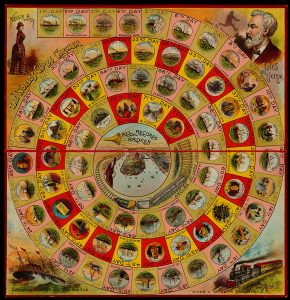
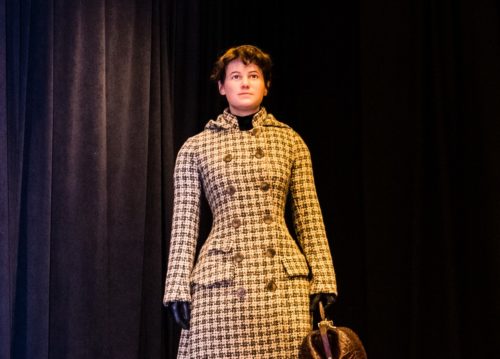
Although she didn’t really mean to, Alice – of Alice on Wonderland fame – ended up going on one of the wildest travel adventures ever “documented.”

Want to see the original notes of her journey?  The British Library happens to have the first edition of Alice’s Adventures in Wonderland, as well Galileo’s letters, Leonardo Da Vinci’s notebooks, manuscript scores from classical composers such as Handel, Purcell, Mozart and Schubert, and lots more.

Can’t just pop over to London to take a look-see? The next best thing might just be the British Library’s new smartphone app (iPad, iPhone, Android) which lets you page through more than 100 of the library’s treasures, including Jane Austen’s teenage writings, maps, scientific papers, an original Magna Carta 1215 and audio clips from historical figures such as Nelson Mandela.

The app isn’t free; it costs $3.99 for iPhone, iTouch and Android ($5.99 for the iPad), but there’s an introductory offer of $1.99 ($3.99 for the iPad) through January 24, 2011.

Not sure it’s worth 2 bucks?  Here’s a really lovely video that includes a sampling of what you’ll get to see on the app.

I’ve downloaded the program, but haven’t had much time to play around with it. When I do, I hope I’ll find photos and more information the world’s smallest atlas and some of the other teeny tiny books in the British Library’s collection.

What I’m watching, reading..instead of working

Don’t tell me this hasn’t happened to you.

You have stuff to do.  Deadlines.  Work someone will pay you for if you just, you know, do it.

So you pour a cup of coffee and sit down at the computer.

But then, dang, the Internet happens.

Here’s a bit of what got me distracted today.

Air New Zealand posted time-lapse video footage of its first new domestic A320 being built and painted with all black livery.

The paint job has something to do with the All Blacks rugby team, so of course I had to visit that site and then the Small Blacks site as well.

As long as I was visiting the Air New Zealand site, I had to check in on what that wild and crazy furry creature, Rico, was up to. I found this reel of bloopers.

A quick check of email and Twitter sent me off in new directions.

Florida’s Dali Museum was opening in its snazzy new building in St. Petersburg, FL. And as someone who first came upon that museum collection, by accident, when it shared space with a factory in Cleveland, Ohio, I of course had to visit.

While there, I came across this clip of Salvador Dali as a guest on the old TV show, What’s My Line?

Then, of course, it was time to check email and Twitter and catch up on my RSS feed.

A blog post by the folks at the  Smithsonian Air and Space Museum - 5 Cool Things at the Udvar-Hazy Center You May Have Missed – caught my eye because the Udvar-Hazy Center is just down the road Dulles International Airport.

And then I really got tangled up in the web. A comment on the museum blog post mentioned Anita, “the spider from Skylab.”  I didn’t know about Anita so had to follow that thread.

It turns out that Anita and a companion spider, Arabella, were part of an experiment flown on Skylab, a space station launched in May 1973.

According the Smithsonian website:

Scientists and students interested in the growth, development, behavior, and adaptation of organisms in weightlessness provided a variety of biology experiments for flight in the orbital research laboratory. A common Cross spider, “Anita” participated in a web formation experiment suggested by a high school student. The experiment was carried out on the Skylab 3 mission, which lasted 59 days from July 28-September 25, 1973. Astronauts Alan Bean, Jack Lousma, and Owen Garriott carried out the scientific research in space, reported the results, and returned this specimen at the end of their mission. NASA then sent Anita, a companion spider “Arabella,” and the experiment equipment to the Museum.

Anita is on display at the Udvar-Hazy Center.

Anita Skylab Space Station spider

Arabella is in storage.

Fresh art at Tampa International Airport

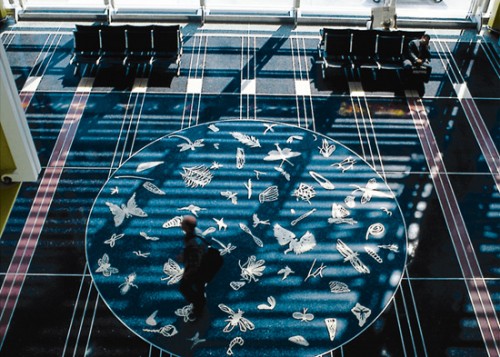
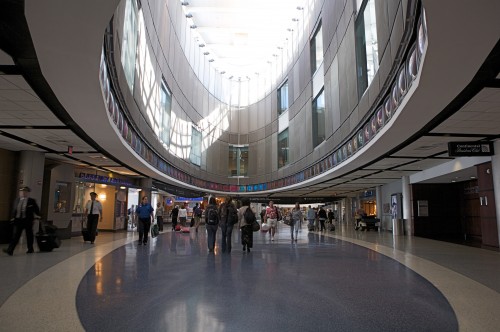
Tampa International Airport is one those airports with an extensive, eclectic and very valuable, collection of permanent public art.

Some of my favorite pieces in the collection include the 22 tapestries in the baggage claim area made by 20 women from Phumalanga, Swaziland in Africa.

Tampa Airport Tapestries

(Photo courtesy Tampa Airport)

And the seven WPA-era murals by George Snow Hill depicting the history of flight.

Tampa airport murals

These murals are especially incredible to see because they were ignored for years and almost destroyed.

From the airport’s website:

In the late 1930′s, local artist George Snow Hill was commissioned to create these murals to adorn the walls of Tampa’s newly built Peter O. Knight Airport. Hill artistically interpreted the history of flight through the contributions made by Icarus and Daedalus, Archimedes, The Montgolfier Brothers, Otto Lilienthal, Tony Jannus, The Wright Brothers, and a triptych, capturing the first scheduled airline flight in history.

The murals were removed from the walls of the Peter O. Knight Airport upon demolition in 1965, and restored by George Snow Hill himself. In 1971, they were relocated to the new terminal building, where only the triptych and the Wright Brothers mural hung in the airport’s executive suite. The others were rolled and placed in storage, untouched for years.

You can read more about the Tampa airport’s art collection here, but be sure to scroll down to the notes about a brand new temporary exhibit featuring blown glass vessels and sculptures by Owen Pach, on display in the airport’s renovated art gallery.

Owen Pach glass art at Tampa

“Fiery Passion – The Beauty of Glass”will be on display through March 2011.

For more information about Owen Pach, see this website.

And for a general guide to Tampa International Airport, see my list of airport guides on USATODAY.com.

Museum Monday: more clocks of the world

Last week, to mark the end of Daylight Saving Time, I put together a list of great places to watch the clock for a story on msnbc.com: How time flies! Where to see the world’s clocks.

Clock forest at American Clock and Watch Museum

The article featured places such the American Clock and Watch Museum in Bristol, Connecticut, which has a ‘clock forest’ (above) filled with dozens of tall cases and wall clocks that strike on the hour.

There wasn’t enough room in the story for all the cool clocks I found, so here are a few more:

St. Peter’s Church (below) in Zurich is the city’s oldest church and has a clock face that’s 28.5 feet; the largest clock face in Europe.

Zurich St. Peter's Church Clocktower

Zurich is also home to Beyer’s Clock and Watch Museum, a collection of more than 500 chronological instruments dating from 1400 B.C. to the present day, everything from sundials, hourglasses and water clocks to a quartz clock accurate to within a thousandth of a second a day and a quartz watch accurate to within a millionth of a second. Here’s a link to a video tour of the Beyer Clock and Watch Museum.

And then there’s Anker Clock, in Vienna, Austria, which was built between 1911 and 1917 and ‘performs’ a twelve-minute animation each day at noon.

Daylight Saving Time: where to watch the clock

Clock turn back time

(Boston: courtesy Marriott’s Custom House)

Daylight Saving Time (DST) ends at 2 a.m. Sunday morning when we “fall back” to standard time by turning our clocks back one hour.

As you rush around resetting the clocks on the microwave, the TV and the bedside alarm, imagine yourself watching time fly in one of the clock-worthy cities I included in the slide-show-style story I put together for msnbc.com this week: How time flies! Where to see the world’s clocks.

Grand Central Terminal clock

(Courtesy Metro-North Railroad)

The story includes the information booth clock at New York City’s Grand Central Station, clock and watch museums in Pennsylvania and Connecticut, what may be the oldest continually running town clock (in Winnsboro, South Carolina), and the Bily Clocks Museum in Spillville, Iowa, which is home to 43 intricately carved clocks, some more than ten feet tall, made by Joseph and Frank Bily over the course of 45 years.

Dvorak clock Bily Brothers

The Bily Brothers’ clocks have themes ranging from art and religion to history and culture. The collection includes an American Pioneer History Clock, an Apostle Clock, a violin-shaped clock honoring Czech composer Antonin Dvorkak (above) and an airplane-shaped clock (below) made to commemorate Charles Lindbergh’s trans-Atlantic flight. (That propeller moves!)

Lindbergh Bily Clocks Museum

(Courtesy: Bily Clocks Museum)

In researching the story, I also came upon this film documenting the incredible video mapping project done to mark the 600th anniversary of Prague’s astronomical clock in Old Town Square.

  • Subscribe to Posts Via Email or RSS

    Subscribe Via Email
    Subscribe Via RSS
  • My USAToday Airport Guides


    • See all airport guides »

  • Posts by Category

  • Browse posts on the site by category:

  • See all categories »